
Specs are compiled from manufacturer listings and verified buyer reviews and can change over time — please confirm the key details on the product page before buying.
Buy for airflow first, noise second, and never trust a fan just because the box says “quiet.” A bathroom fan has one job — pull steam and odor out of the room before they settle into your walls — and it does that job with two numbers working together: CFM (cubic feet per minute, the volume of air it moves) and sones (the sound rating, where lower is quieter). A fan rated 110 CFM clears a full-size bathroom fast. A fan rated 1.0 sones is quiet enough to hold a conversation next to. Get both right, and your mirror stops fogging and your paint stops peeling.
I’m Mohammad Maruf — the founder and writer behind KitchPrep. This guide is built by comparing the manufacturers’ published specifications and the patterns across verified customer reviews, so you get each pick’s real strengths and trade-offs instead of marketing spin.
Below you’ll find nine real models sorted by what they actually do — from retrofit-friendly 50 CFM units to 110 CFM workhorses — so you can match one to your ceiling cutout, your duct size, and your patience for noise. If you want the one most buyers end up happiest with, the Panasonic FV-0511VFL1 WhisperFit sits at 4.7 stars across 900+ ratings, and it earns that spot on airflow you can dial and light you can dim.
Our Picks at a Glance

How To Choose The Best Bathroom Exhaust Fan
Most people replace a bathroom fan exactly once, usually because the old one finally gave out or because the mirror fogging has become unbearable. That means you get one shot at getting it right, and the wrong pick means a second trip into the ceiling within a year. The good news: the decision depends on four things you can measure before you buy anything.
Match CFM to your bathroom’s square footage
CFM stands for cubic feet per minute — it is the raw volume of air the fan pushes out every minute. A fan rated 50 CFM suits a powder room or a small half bath. A fan rated 70 CFM handles a typical small-to-mid bathroom. A fan rated 80 CFM covers a bathroom up to 80 square feet, and a 110 CFM unit covers up to around 110 square feet. Undersize this number and steam lingers no matter how long you run the fan. Oversize it slightly and you simply clear the room faster.
Understand sones before you chase the quietest number
A sone is a unit of perceived loudness, and the scale is not linear — a 4-sone fan sounds more than twice as loud as a 2-sone fan to your ears. A 1.0-sone fan is genuinely quiet; a 2.0-sone fan is a soft background hum; a 4.0-sone fan is the one you hear through a closed door. Here is the trade-off that catches people out: quieter fans often move less air for the same size housing, so a 1.0-sone unit rated at 50 CFM will not clear a large bathroom the way a 2.0-sone unit rated at 110 CFM will.
Check your duct size and ceiling cutout first
This is the step that wrecks weekends. Fans typically connect to either a 3-inch or a 4-inch round duct, and a 4-inch duct is not just physically wider — it allows more airflow over a longer run. The 4-inch connector is the common standard, so a fan with a 3-inch outlet may need a reducer to join your existing ductwork, and a reducer restricts flow. Measure your existing ceiling opening too, and compare it against the fan’s stated cutout dimensions. Some fans are deliberately sized to drop straight into the hole an old unit left behind, which saves you from patching drywall.
Quick Comparison
| Model | Best For | Airflow (CFM) | Noise (Sones) | Duct Size | Amazon |
|---|---|---|---|---|---|
| Panasonic FV-0511VFL1 WhisperFit★ Best Overall | Whole-bath ventilation with dimmable light | 50 / 80 / 110 (selectable) | Not listed | 4″ or 6″ | Amazon |
| Panasonic WhisperRemodelQuietest Per Dollar | Renovations in older 2×6 ceilings | 80 / 110 (selectable) | 0.3 / 0.8 | Not listed | Amazon |
| OREiN 2-in-1 with LightBrightest Room Upgrade | Bright daylight lighting plus ventilation | 110 | 2.0 | 4″ (3″ reducer included) | Amazon |
| Harrier Hardware 70 CFM | Budget swap in a small bathroom | 70 | 2.0 (about 40 dB) | 3″ | Amazon |
| Tech Drive Very Quiet 70 CFM | No-attic roomside replacement | 70 | 2.0 | 3″ | Amazon |
| Homewerks 7140-50 | Quiet half-bath or powder room | 50 | 1.0 | 4″ | Amazon |
| Amico Bathroom Exhaust Fan | Shallow joist installs | 80 | 1.0 | 4″ | Amazon |
| Broan-NuTone 744 | Replacing a recessed can light | 70 | 1.5 | 4″ round | Amazon |
| Broan-NuTone AR110LKVV SurfaceShield | Large baths wanting violet-light mode | 110 | 1.0 | Not listed | Amazon |
In‑Depth Reviews
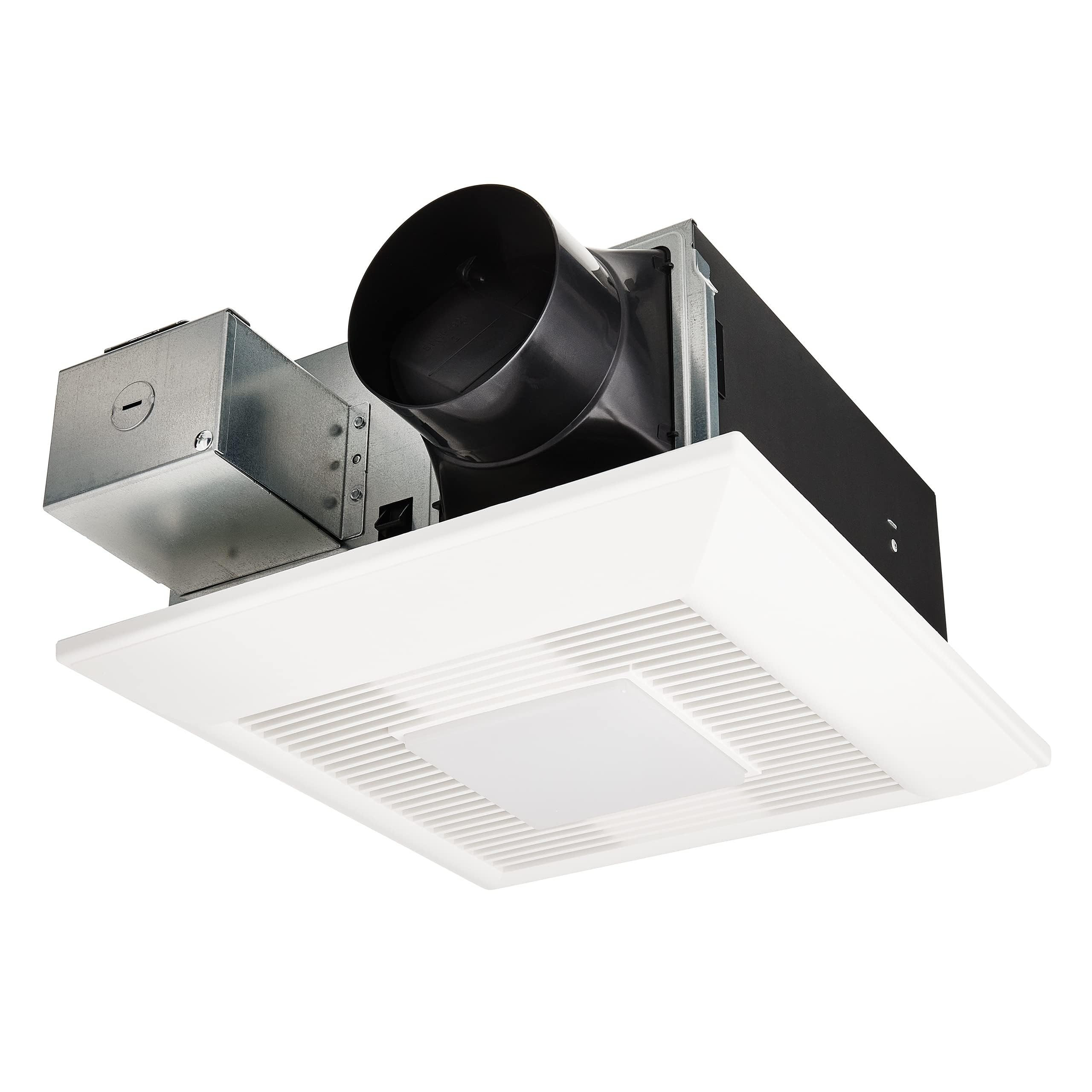
1. Panasonic FV-0511VFL1 WhisperFit Bath Fan + Light, 50-80-110 CFM
Our pick — over 4.5★ from 900+ verified ratings; the strongest balance of quality and price.
One fan that lets you dial the airflow to the room instead of guessing.
If you want to buy once and stop thinking about it, this is the one. Panasonic’s Pick-A-Flow switch lets you set the fan at 50, 80, or 110 CFM (cubic feet per minute — how much air it moves) at the flip of a switch, so the same unit works in a powder room today and a full bath tomorrow. The 10W dimmable LED panel plus a sub-1W night light means you get bathroom lighting thrown in, so you are not buying and wiring a separate fixture.
The install story is where Panasonic earns its reputation. The Flex-Z Fast bracket is a single-hinge design that lets you position the housing from below the ceiling, and the unit takes either 4-inch or 6-inch ducting. Buyers who do this for a living call it the standard — as the review pages sum it up: “Pro installer: Panasonic WhisperFit is gold standard. Exceptionally quiet, retrofit install ~35 min, genius bracket for solo install, 3 speeds, pairs with humidistat for mold control.”
What wins people over is the build quality, and it is the thing the most owners single out by a wide margin. There is a real learning curve on the paperwork side, though — the included instructions are widely described as unhelpful, and the practical advice is to find the install video before you start cutting. A few buyers also flag the speed regulation as the weak link, and the LED color is a fixed cool pale yellow you cannot tune. Size the job honestly: if you have a short duct run and a standard 4-inch connection, this is a straightforward weekend job for a careful DIYer.
What earns the top spot
- Pick-A-Flow gives you 50, 80, or 110 CFM from one unit — no second purchase when needs change
- Flex-Z Fast bracket positions the housing from below, so no attic trip is required
- Accepts 4-inch or 6-inch ducting, which protects airflow on longer runs
- Ships with a 10W dimmable LED and a sub-1W night light built in
Where it asks more of you
- Instructions are the weak spot — plan on finding a video walkthrough first
- LED color is a fixed cool pale yellow with no adjustment
- Speed regulation is the recurring criticism in owner feedback
Buy it if: you want one fan that adapts to the room, moves 110 CFM at full tilt, and throws in dimmable light and a night light.
Think twice if: you refuse to watch a video before cutting drywall — the box instructions will not carry you.
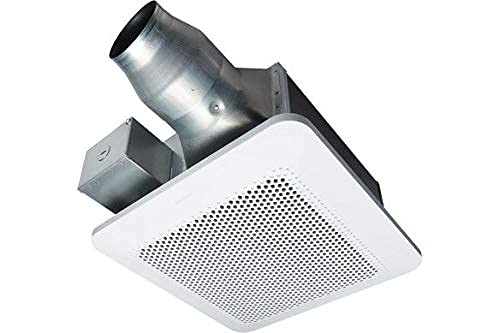
2. Panasonic WhisperRemodel 0.8-Sone 110-CFM White Bathroom Fan ENERGY STAR
The renovation specialist that tucks into shallow old ceilings at 0.3 sones.
Old houses are the reason this fan exists. Its low-profile housing is built to slide into 2×6 construction, which is the shallow framing you find in older homes where a modern bulky unit simply will not fit. The Pick-A-Flow selector lets you run it at 80 or 110 CFM, and the noise ratings are the headline: 0.3 sones at the lower setting and 0.8 sones at the higher one. At 0.3 sones, that is quieter than a refrigerator hum — you will hear the shower, not the fan.
The Flex-Z Fast bracket and adapter let you install from below the ceiling rather than crawling through the attic, and it carries the same ENERGY STAR certification as the top pick. It is a smaller seller than the WhisperFit above — 900+ ratings versus 200+ here — but the quieter rating is genuine and the low-profile shape solves a problem the bigger unit cannot. Buyers report the mirror stays clear through a full hot shower.
The honest caveat is the install, not the fan. This is a renovation-grade replacement, and several owners describe the job as more invasive than a simple swap — old fans sometimes have to come out through cut drywall, which is a contractor job unless you are genuinely handy. One voice on the review pages rated it a four because it was louder than their previous Delta and Broan units, so if you are chasing the absolute silence champion, audition it in person if you can rather than trusting the sone figure alone.
Renovation-first design: the low-profile body and 2×6 compatibility are the whole point — this solves ceiling depth, not just airflow.
The real question: if your existing fan was installed tight to drywall, budget for cutting and patching rather than a clean swap.
Built for: older homes with shallow joists where the ceiling opening must be rebuilt anyway.
Look elsewhere if: you want a straight plug-and-play replacement of a modern fan — the top pick’s bracket is friendlier for that.
3. OREiN 2-in-1 Bathroom Exhaust Fan with Light, 110 CFM, ENERGY STAR
A daylight-bright fan-and-light combo that throws 1000 lumens from the ceiling.
If your bathroom always feels like a cave, the light here is the selling point. The LED panel pushes 1000 lumens at 5000K — that is a crisp daylight-white tone, the kind that makes shaving and makeup easier because it does not cast the yellow tint of a standard bulb. Airflow is 110 CFM, enough for a bathroom up to 110 square feet, and it runs at 2 sones, which is a soft background hum rather than a drone. The 4-inch duct outlet handles the exhaust side, and a 4-inch to 3-inch reducer is included so the fan slots into whichever duct system you already have.
Installation is designed to happen from inside the bathroom, with no attic trip required, and it fits a 7.36″ x 7.68″ ceiling opening. Backed by a 5-year warranty and ENERGY STAR certification, it is built to run for years rather than seasons. Owners praise the 1000-lumen light as much as the fan, calling it a “beautiful fan and lights combo.”
The recurring gripe is the instruction sheet. Several owners describe the frame install as awkward during retrofits, with the supplied screws drawing particular scorn, and a few report that the fan-and-light are best wired on separate switches for real control. On moisture removal, a smaller group notes the airflow does the job in a standard bath but struggles in a cramped or particularly steamy one. A handful find it simply not powerful enough for their taste — worth knowing before you commit if your bathroom is especially small and closed in.
Reasons it stands out
- 1000-lumen LED at 5000K delivers bright daylight-white illumination
- 110 CFM clears bathrooms up to 110 square feet
- Includes a 4-inch to 3-inch reducer for duct flexibility
- ENERGY STAR certified and backed by a 5-year warranty
The honest trade-offs
- Supplied screws and bracket hardware frustrate DIY installers
- Instructions are confusing and retrofit framing can be fussy
- A minority of owners find the airflow short of expectations in tight, steamy rooms
Worth it for: anyone whose main complaint is a dark bathroom — this delivers fan and daylight-grade light in one ceiling cut.
skip it if: your bathroom is tiny and heavily used — the airflow fans in the brightest room may want more power than this provides.
4. Broan-NuTone 744 Recessed Light Ventilation Fan, 70 CFM, 1.5 Sones, White

The cheapest way to turn a dead ceiling light into working ventilation.
Here is the trick this fan pulls: it looks like a recessed can light, because that is exactly the hole it is designed to drop into. The 70 CFM rating handles a typical small-to-mid bathroom, and the 1.5 sones put it in genuinely quiet territory — quieter than a standard bathroom fan, which is the pattern owners mention again and again. The 6.87-inch-high housing fits new construction and also slides into 2×8 ceiling joists, and there is a 4-inch round duct connector on the back.
What makes it useful in practice is the shape, not the specs. Because the trim matches the recessed lights people already have, it disappears into the ceiling, and it can live inside a shower or tub enclosure. It takes a 75-watt R30 or BR30 bulb, so you can run it with a wet-rated PAR30NL over a shower for real light. Multiple units can be used in larger rooms, which is a neat workaround when one fan will not cut it in a sprawling bath.
The two things to know before ordering are both practical. First, the exhaust outlet exits on the wrong side for some joist layouts, so check your ductwork direction before you commit — it occasionally means the ceiling hole has to move. Second, a handful of owners note the light sits slightly off-center, which means minor ceiling patching on some installs. By and large, though, this is the quietest way to replace a light fixture with ventilation, and the steam-clearing performance holds up.
Why it often wins the comparison: it fits a standard recessed-can opening, so no new ceiling hole and no light fixture to buy — ventilation and lighting in a swap you may already have the hole for.
One thing to measure first: the exhaust outlet’s side. A 4-inch round duct has to line up with your existing run or you will be cutting drywall.
Choose it when: you have a recessed can light you want to convert, or the old fan already sat in that position.
Skip it when: you are fitting a fresh install in a completely different opening — the recessed-light shape is the whole advantage.
5. Broan-NuTone AR110LKVV SurfaceShield Vital Vio Powered Exhaust Vent LED White Light & Violet Light, 110 CFM, White

Twin ceiling lights — bright white by day, violet by night, 110 CFM underneath.
A 110 CFM rating is a lot of air for 1 sone of noise, and that is the core of what you buy here. It clears bathrooms up to 105 square feet, it is quiet enough to leave running while you sleep, and the Retrofit install works entirely from the room side with the EzDuct connector — no attic access needed. The white grille is bright and modern, and it is designed to stay cleaner longer than a typical plastic vent cover.
The distinctive feature is the second light. The integrated LED runs bright white, and after about an hour it can switch over to the violet SurfaceShield mode — either automatically or by using the toggle switch, depending on how you set it up. Owners tend to treat that violet setting as a night light as much as anything, and it is the kind of thing that turns an exhaust fan into something you actually notice. The independent lighting controls and the overall build quality are the big draws.
The catch is on the cover. A minority of customers note the plastic grille being brittle — a few describe the spring clips failing or the cover popping loose, and the cover mechanism is the most common install complaint. The fan itself is the well-built part and the cover is the fragile one, so handle the grille gently during installation and cleaning. If the violet-light feature is not something you care about, the standard white-light version of this Broan is the cheaper route — but if you want the extra mode and the quiet 110 CFM, this is the one.
Why it stands apart
- 110 CFM at just 1.0 sone — plenty of air, minimal noise
- SurfaceShield violet light auto-switches after about an hour, or toggles manually
- EzDuct room-side retrofit install means no attic access
- Bright white grille designed to stay clean longer and match ceiling paint
What to handle carefully
- The plastic grille cover is the fragile part — spring clips and clips are a recurring complaint
- Lighting-mode controls take some getting used to
- The violet-light version costs noticeably more than the standard white-light version
Great fit for: anyone who wants bright white light plus a violet night mode and 110 CFM without attic access.
Reconsider if: you would never use the violet setting — the plain white-light Broan saves you the headroom on cost.
6. Amico Bathroom Exhaust Fan, 1.0 Sones, 80 CFM, No Attic Access Needed
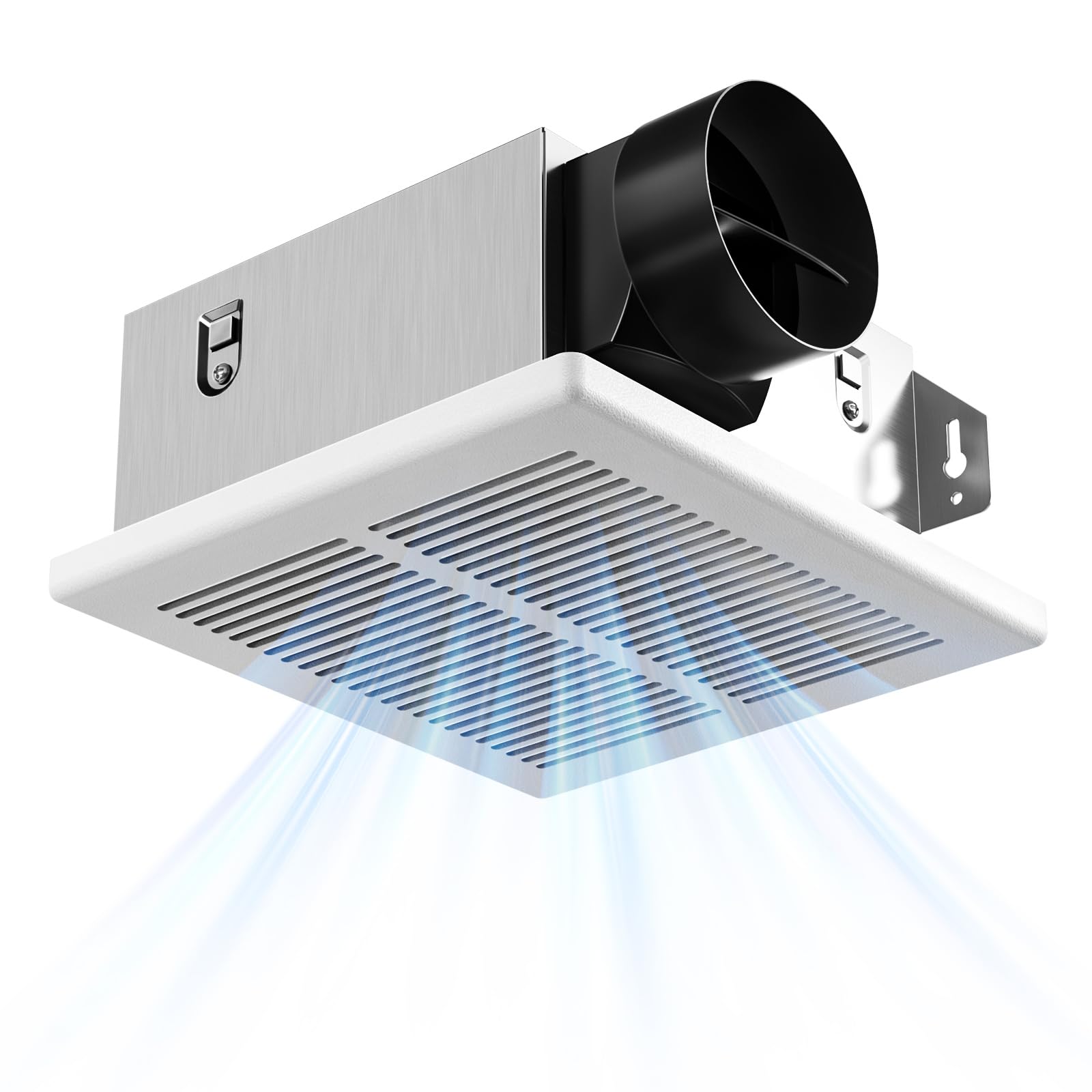
A 4-inch tall housing that fits ceilings where a full-size fan will not.
The number that matters here is the height: 4 inches. That low-profile body is why electricians reach for it in tighter ceilings, and owners confirm it drops into tight 2×6 framing — the 5.5-inch-deep setups where most fans simply crowd the wood. Airflow is 80 CFM, good for bathrooms up to 80 square feet, and the noise rating is 1.0 sone, which is genuinely quiet. A 4-inch round duct connection, small enough to replace most existing fan bodies, and a grille that measures 9.4 x 8.6 inches, round out the picture.
Installation is one of the strong points, and it is worth dwelling on because it is where budget fans usually trip. The included brackets let you mount it between ceiling joists or screw it directly to a joist, and the wiring points accept standard Romex wire without screws or wire nuts. It is UL listed for electrical safety, made from metal and polycarbonate, and weighs 4.3 pounds. For a bathroom fan at this price point, fitting standard framing without modification is the whole reason it exists.
Where opinions diverge is the noise. Most owners call it quiet and are happy, but a small number find it louder than they want, and one terse notes call it “a little loud to keep it on.” That is a minority view against a lot of satisfied buyers, and it is worth weighing against your own tolerance — a powder room you use for a minute at a time will feel different from a master bath you linger in. The other note: some reviewers point out it is not as quiet as the pricier fans in their house, which is exactly the trade-off this price tier makes.
Why it matters for older homes: the 4-inch housing height and 7.6 x 7.3-inch ceiling cutout size make it a direct replacement for a lot of existing openings, so you skip the drywall work.
One honest note: quiet is relative at this tier — a few owners hear more hum than they expected, so size the room to the job before ordering.
Right for: shallow ceilings, tight joist bays, and small bathrooms where the housing simply has to be low-profile.
Wrong for: a large master bath where 80 CFM will thin the steam rather than clear it.
7. Harrier Hardware Bathroom Exhaust Fan 70 CFM Super Quiet 40dB 2 Sone, Corrosion Resistant Bathroom Fan, Shower Tub, Easy Install Bathroom Attic Vent Fan with 3-Inch Duct Outlet

The quiet budget pick that doubles as an old-fan replacement.
Start with the noise number, because that is what most people care about: 2.0 sones, which works out to roughly 40 decibels — a soft hum you will stop noticing within a week. Airflow is 70 CFM, enough for a standard small bathroom, and the 7.5-inch blade pushes air with less turbulence than the smaller 6-inch blade on the Tech Drive unit below. The galvanized steel housing stands up to the moisture in bathroom and attic spaces, and because it is UL listed, it can be used over a tub or shower with GFCI protection.
Owners upgrading from an aging fan say the drop in noise is the biggest change. Same footprint as the old unit, dramatically less noise. In the real world, that is the difference between a fan you run for twenty minutes and one you switch off the second you leave the room. The quick-connect electrical connections and 3-inch duct outlet simplify the job, and the housing comes with joist-mount holes already drilled.
The budget trade-off shows up in two places. First, the 3-inch duct outlet is narrower than the 4-inch standard on many of the fans above, so if your existing ductwork is 4-inch you will need a reducer, and a reducer restricts airflow over a long run. Second, when the motor eventually wears out, replacements are not a clean swap — the motor is mounted in a way that means changing the whole unit rather than a part, unlike some Broan models. For most people that is fine; it is only worth knowing if you are planning on long-term servicing.
What earns its keep
- 2.0 sones (about 40 dB) makes it one of the quietest budget options
- 70 CFM handles a standard small bathroom without straining
- UL listed for use over a tub or shower with GFCI protection
- Galvanized steel housing resists corrosion in damp attic and bath spaces
What budget means here
- 3-inch duct outlet is narrower than the 4-inch standard, so 4-inch ductwork needs a reducer
- Motor replacement requires swapping the whole unit rather than the motor alone
- A few owners note the plastic connectors and wiring could be sturdier
Best for: swapping out a noisy old fan in a small bathroom on a tight budget, where 70 CFM is the right size.
Consider the alternatives if: your ductwork runs 4-inch, because the 3-inch outlet will force you into a reducer.
8. Tech Drive Very Quiet Bathroom Fan,70 CFM, 2.0 Sone,3-Inch Duct

The attic-free installer that swaps out on your existing ceiling hole.
No attic required — that is the whole idea. The Tech Drive is a no-cut housing designed to install entirely from the room side of the ceiling, and it fits most standard openings at 7.6 x 7.3 inches. Its ceiling-cutout size lines up with the Amico above, but the housing depth differs and this one is the easier of the two to retrofit if you are working alone. The motor is rated for at least 25,000 hours of operation, which is a long service life in a fan you will run for twenty minutes at a time.
Noise and airflow are both solid. The 2.0 sones give you a soft, unobtrusive hum, and the 70 CFM rating knocks down the steam from a shower quickly — owners say it removes hot shower-room air fast and keeps mirrors clear. It is Energy Star qualified and UL and HVI certified, and the low-profile white grille cover keeps the ceiling visually clean. It also gives you a low-profile look — the visible grille is small and unobtrusive, which matters in a powder room where a bulky vent cover looks out of place.
The one clear limit is duct distance. This fan will not push air through a long duct run — one owner found it too weak through roughly 15 feet of ducting, which is a common consequence of a compact motor pushing through a 3-inch outlet. So the practical rule: direct venting to an exterior wall or a short attic run, and this fan is excellent. A long, twisting duct run, and it will struggle. Worth knowing before you commit to the location.
Why it works in a powder room: the 3-inch duct and low-profile body fit tight spaces, and the no-cut housing lets you install without a saw or attic trip.
The exact limit: it is fine for direct venting but weak through long duct runs — measure your duct length before you buy.
Pick it when: you are replacing a fan in a small room with a short direct duct path and want to avoid the attic.
Look past it when: your duct run is long — the compact motor will not move air that far.
9. Homewerks 7140-50 Bathroom Fan Ceiling Mount Exhaust Ventilation, 1.0 Sones, 50 CFM, White

Half a century of steam handled by a fan you can barely hear.
Fifty square feet, fifty CFM, one sone. That is the summary: this fan is sized for exactly the small spaces — the powder rooms, the half baths, the guest bathrooms — where a big fan is overkill and a loud one is annoying. At 1.0 sone, it is quiet enough to run during a phone call without being heard. It sits flush and white against the ceiling, blends in, and can be wired to run alongside a shower light. The no-cut design installs from the ceiling with a 7.75 x 7.5 x 6-inch ceiling opening and a 4-inch round duct connector.
It is HVI, ETL, and Energy Star certified, and the galvanized steel construction resists corrosion in a damp bathroom. Owners call it fast and powerful for a powder room, and say the no-cut mount installs in under an hour. At 50 CFM, it clears a powder room or half bath but will not keep up with a large main bathroom.
Two small things to note. The exhaust port sits on one side of the housing, which can complicate retrofits if your ductwork is on the other side — you may need to cut a fresh ceiling hole to align everything. And there is a durability caveat on the grille connection: the clip that holds the cover in place is plastic and has been known to fail on a rare unit. Neither is a reason to avoid an otherwise well-built, well-rated fan; just handle the grille gently and check your duct direction before cutting.
Where it shines
- 1.0 sone runs quietly enough to be almost inaudible
- 50 CFM suits small bathrooms, powder rooms, and half baths
- HVI, ETL, and Energy Star certified with a 3-year limited warranty
- No-cut ceiling mount install fits a 7.75 x 7.5 x 6-inch opening
What to keep in mind
- Exhaust port location can complicate retrofits where ductwork sits on the opposite side
- Plastic grille clip is the known weak point on rare units
- 50 CFM is undersized for a large main bathroom
Great choice for: a powder room or half bath where quiet and compact matter more than raw airflow.
Not the right fit for: a large bathroom — 50 CFM does its job in small rooms only.
Understanding the Specs
CFM — cubic feet per minute
CFM is the volume of air the fan pushes out in a minute, and it is the single most important number on the box. A 50 CFM fan moves about enough air for a 50-square-foot room; a 110 CFM fan handles a bathroom up to 110 square feet. Under-size it and steam hangs in the air no matter how long you leave the fan on. Over-size it slightly and nothing bad happens — the room simply clears faster.
Sones — the perceived loudness scale
A sone measures how loud a fan sounds to a human ear, and the scale is not linear, so a 2.0-sone fan sounds more than twice as loud as a 1.0-sone fan. As a rough anchor, 1.0 sone is quiet enough to forget, 2.0 sones is a soft hum, and 4.0 sones is a fan you can hear through a closed door. Quieter fans often move less air for the same housing size, so you are always balancing airflow against noise.
FAQ
How many CFM does my bathroom actually need?
Is 2 sones too loud for a bathroom fan?
What size duct does a bathroom exhaust fan use?
Can I install a bathroom exhaust fan without attic access?
How long does a bathroom exhaust fan last?
Do I need a fan with a light built in?
Can I put a bathroom fan directly over the shower or tub?
3-inch duct vs 4-inch duct — does it really matter?
What is the difference between 70 CFM and 110 CFM in real use?
Why do some fans cost so much more than others?
Final Thoughts: The Verdict
For most bathrooms, the bathroom exhaust fan winner is the Panasonic FV-0511VFL1 WhisperFit because it lets you set the airflow at 50, 80, or 110 CFM to match the room, takes either 4-inch or 6-inch ducting, and throws in a dimmable LED plus a night light. That flexibility is why it holds the top spot at 4.7 stars — if you want a quieter renovation specialist for shallow old ceilings, grab the Panasonic WhisperRemodel at 0.3/0.8 sones. And for a bright, daylight-white fan-and-light combo that clears 110 CFM from inside the room, the OREiN 2-in-1 is the one to reach for. Whichever you pick, match the CFM to your square footage and check the duct size first — those two numbers decide whether you enjoy the fan or regret it.
How We Picked
We do not accept paid placement. Every pick is matched to a real buyer and a real use-case; we do not hands-on test units.
Sources & Methodology
Specifications: manufacturer listings and product documentation. Review insights: verified customer reviews, as of September 2026. Pricing: not shown on this page (it changes often); check the current price via the retailer link.
As an Amazon Associate, KitchPrep earns from qualifying purchases. This does not affect which products we feature.
Related Guides
