
Specs are compiled from manufacturer listings and verified buyer reviews and can change over time — please confirm the key details on the product page before buying.
You want the steam gone before it soaks into the paint, and you do not want to think about flipping a switch. A bathroom exhaust fan with a humidity sensor watches the air in the room and starts itself when moisture climbs — so your mirror stops fogging, your walls stop sweating, and nobody has to remember anything. That is the whole point of this list, and every pick below is a real unit with a real built-in humidistat, not a fan that just claims to be “smart.”
I’m Mohammad Maruf — the founder and writer behind KitchPrep. This guide is built by comparing the manufacturers’ published specifications and the patterns across verified customer reviews, so you get each pick’s real strengths and trade-offs instead of marketing spin.
The spread runs from whisper-quiet Panasonic engineering to high-airflow value units that push steam out fast. The trade-offs are real: some need a bigger hole in your ceiling than you planned for, and a few get tripped by hallway traffic instead of steam. Pick the one that matches your bathroom’s size and your tolerance for a weekend install — and check the bathroom exhaust fan with humidity sensor specs below before you cut anything.
Our Picks at a Glance

How To Choose The Best Bathroom Exhaust Fan With Humidity Sensor
The old fan you are replacing almost certainly moves less air and makes more noise than anything on this page, so the upgrade itself is rarely the hard part. The hard part is that every one of these fans assumes something about your ceiling — the size of the hole, the diameter of the duct behind it, and how many wires run to the switch. Get those three facts about your own bathroom first, then choose.
Match CFM to the room, not to the listing headline
CFM stands for cubic feet per minute — the volume of steamy air the fan pushes out every minute. A fan rated at 80 CFM is sized for a bathroom up to 80 square feet, while a 160 CFM unit handles bathrooms up to 160 square feet or clears a smaller room much faster. If your bathroom is a long, narrow hall bath, you need to be at the top of the range, not the bottom — the fan has to reach the far corner to be useful. Steam rises, so a ceiling fan above the shower does the heavy lifting, and a fan with more airflow than the room strictly needs will clear a mirror before you have finished toweling off.
Sones decide whether you hear it at 2 a.m.
A sone is a unit of perceived loudness — doubling the sones roughly doubles how loud the fan sounds to a human ear, so a 0.1-sone fan and a 1.5-sone fan are worlds apart in practice. Anything at 1.0 sone or under is quiet enough that you will forget it is running. This matters more with a humidity sensor than with a manual fan, because a sensor-equipped unit runs on its own schedule, often for twenty minutes after you have left the room. If you are looking for white noise to cover bathroom sounds, a louder fan has its own logic — but if you want the fan to disappear, chase the sone rating, not the CFM rating.
The humidity sensor is not one feature — it is three different behaviors
A humidity sensor, also called a humidistat or condensation sensor, measures moisture in the air and either starts the fan or ramps it up when the reading climbs. But the exact behavior varies by model. Some switch the fan fully on as humidity rises. Some only adjust the fan’s speed while a wall switch handles the power, which means the fan still runs all the time at low speed. Others pair the sensor with a motion sensor, a remote control, or an adjustable delay timer that keeps the fan running for a set number of minutes after it stops sensing steam. Read that detail carefully before you buy — it is the single biggest source of “this sensor does not work” disappointment in reviews.
Your ceiling hole and duct diameter are fixed points
The fan housing has to fit through the hole in your ceiling, and it has to connect to whatever duct already exists behind that ceiling. Many modern fans need a 4-inch duct, while some older homes still run 3-inch duct — you will need a reducer to bridge the gap, and a reducer adds a step and a trip to the hardware store. Ceiling openings vary a lot too, from a standard 8-inch-by-8-inch grille to openings more than 13 inches across. Measure both before you order anything, because a fan with the wrong cutout dimension is a very expensive mistake to fix after the box is open.
Quick Comparison
| Model | Best For | Airflow (CFM) | Noise Level (Sones) | Duct Size | Amazon |
|---|---|---|---|---|---|
| Panasonic FV-0511VQC1 WhisperSense★ Best Overall | Best overall, sensor + quiet | 50 / 80 / 110 cfm | < 0.3 sone | 4 in | Amazon |
| VIVOHOME EC Motor Bathroom Exhaust FanBest Value | High airflow on a budget | 50 / 110 / 160 cfm | 0.1 sone (silent mode) | 4 in flex | Amazon |
| breez Delta GreenBuilder GBR80HLEDBest With Light | Small bathrooms with a light upgrade | 80 cfm | 0.8 sone | 4 in | Amazon |
| Tech Drive Bathroom Fan with Humidity Sensor | No-attic-access retrofits | 110 cfm | 1.5 sone | 4 in | Amazon |
| Panasonic FV-0510VSC1 WhisperValue | Thin-ceiling spaces | 50 / 80 / 100 cfm | Very quiet (Panasonic ECM motor) | 4 in | Amazon |
| VIVOHOME Bathroom Exhaust Fan 240 CFM | Large bathrooms and long duct runs | 160 – 240 cfm | 0.1 sone (low speed) | 6 in | Amazon |
| Homewerks 140 CFM Bathroom Exhaust Fan | Rooms up to 140 sq ft | 140 cfm | 1.0 sone | — | Amazon |
| OREiN 3-in-1 Bathroom Exhaust Fan | Fan, light, and night light in one | 160 cfm | 1.0 sone | — | Amazon |
In‑Depth Reviews
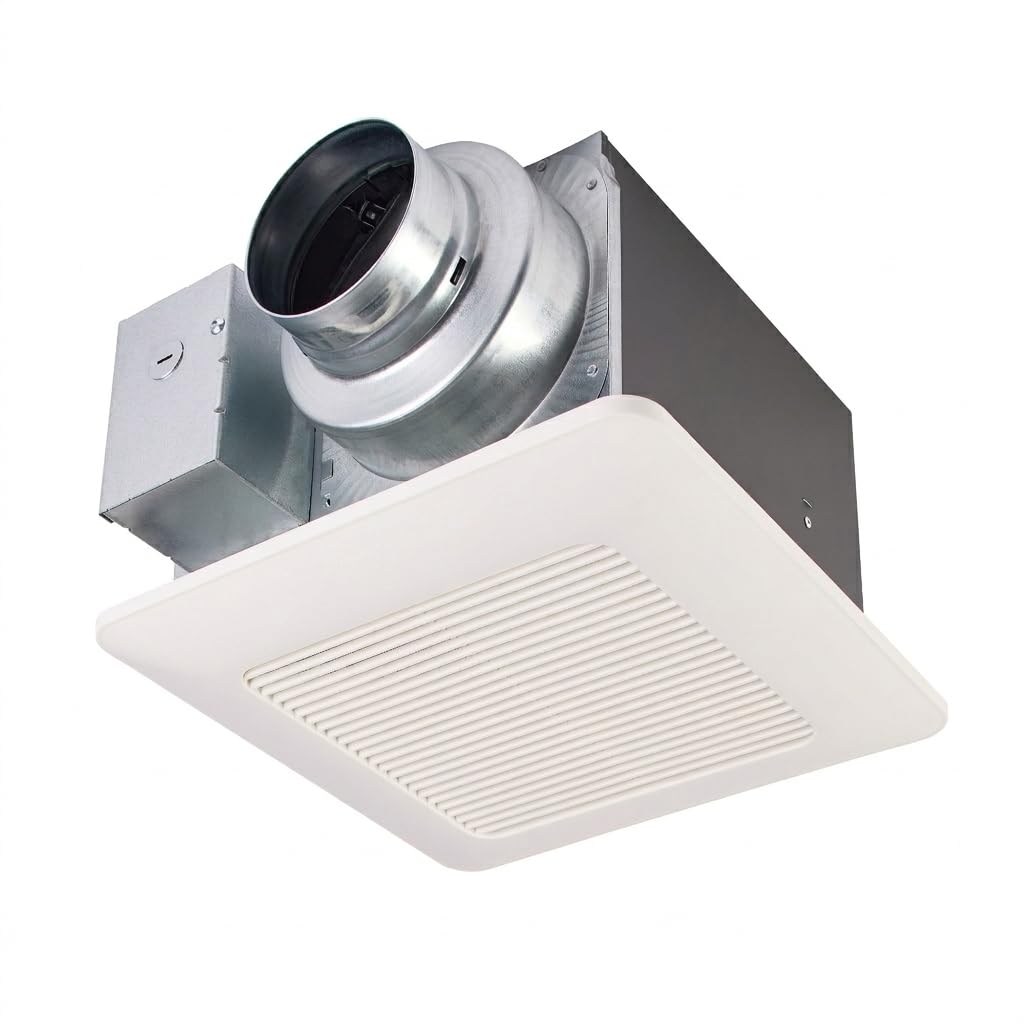
1. Panasonic FV-0511VQC1 WhisperSense Fan, Motion + Humidity Sensor, 50-110 CFM
Our pick — over 4.5★ from 450+ verified ratings; the strongest balance of quality and price.
Two sensors, three airflow settings, and a fan you genuinely will not hear from the next room.
If your bathroom is a small hall bath with a shower that fogs the mirror in ninety seconds, this is the fan built for exactly that job. It pairs a humidity sensor with a motion sensor — one reads moisture in the air, the other notices somebody walked in — so the fan can start on occupancy and finish on steam. The Pick-A-Flow selector on the unit lets you set it to 50, 80, or 110 cfm (cubic feet per minute, the volume of air it pushes out) at install time, which means the same fan can be dialed to your room rather than the room being forced to match the fan. That 110 cfm end is the one most buyers run, and it clears a 5-by-8 hall bath quickly.
What wins people over is the noise level — the ECM (electronically commutated motor, a brushless design that runs cooler and smoother) holds it at under 0.3 sone, which is close to silent. Owners describe running it to cover bathroom sounds and finding its under-0.3-sone motor too quiet for that, then keeping it on for the 110 cfm airflow instead. The motion sensor works alongside a ten-minute delay timer, so after you leave, the fan keeps running for a while and then stops on its own — an inaudible stop, according to the reviews. A Flex-Z Fast bracket handles the mounting and the whole unit is designed to slide into an existing opening, which is why retrofits with attic access go smoothly.
Here is the honest catch. The motion sensor is very sensitive — sensitive enough that hallway traffic has tripped it for some owners, and the fix is a little sheet of tape over part of the sensor lens or angling it away from the door. That is a real quirk worth knowing before install, not a defect, and the review pages sum up the fix as easy to apply once you know the sensor can see past the doorway. The other wrinkle is the exhaust: this fan uses a 4-inch outlet, and if your existing duct is 3 inches you will need a reducer to bridge it. Buyers report the outdoor side of the install takes the most work, not the fan side.
What Quiet Actually Buys You
- Under 0.3 sone on the ECM motor — you stop noticing when it runs
- Pick-A-Flow gives you 50, 80, or 110 cfm from the same housing
- Motion plus humidity sensing means you rarely touch a switch
- Adjustable delay timer keeps the fan running after you leave
Before You Open The Ceiling
- 4-inch outlet needs a reducer if your duct is 3 inches
- The motion sensor can trip on hallway foot traffic until you re-angle it
- Housing is 14.17″D x 16.73″W x 11.85″H — measure your opening first
The verdict in one line: This is the fan for a busy hall bath where the mirror fogs daily and you want steam handled without touching anything.
Where it falls short: The sensor can see past your doorway, so plan on angling it if your bathroom opens onto a corridor.
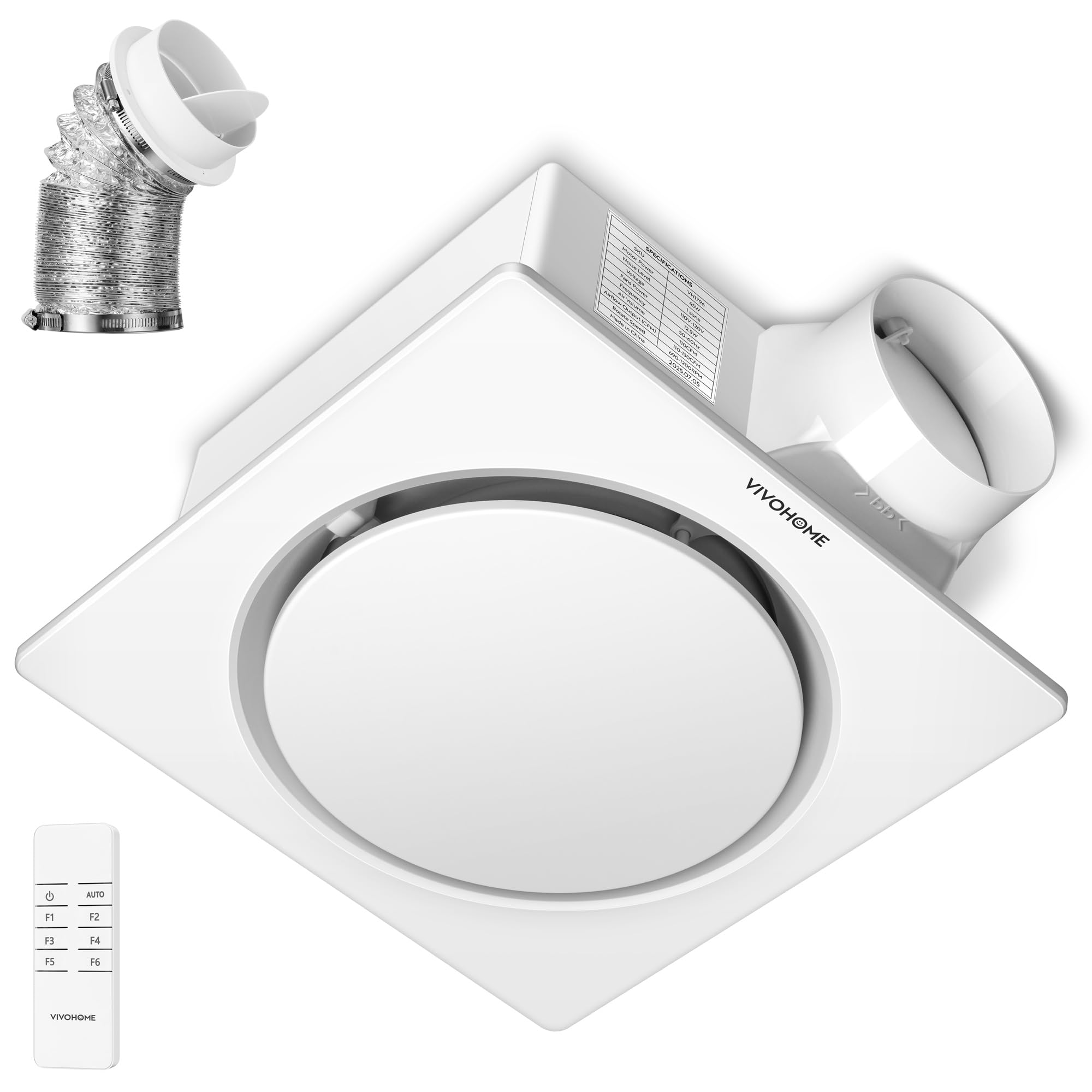
2. VIVOHOME EC Motor Bathroom Exhaust Fan with Humidity Sensor (160-110-50CFM)
160 cfm of ceiling-punching airflow in a mid-range package — provided you can handle the install.
Take airflow as the headline here. This VIVOHOME moves 160 cfm at its top speed, versus the 80 cfm the breez Delta GreenBuilder delivers at its ceiling — that is a 2.0x gap, and it is the difference between a fan that clears a big steamy bathroom fast and one sized for a small powder room. It steps between three speeds — 50, 110, and 160 cfm — switching automatically based on humidity, and it does that without a wall switch doing the thinking. The remote adds manual six-speed control when you want to take over.
The EC (brushless electronically commutated) motor is the other half of the story, and it matters for two reasons. First, it uses 12.5 watts at 110 cfm, positioned for energy savings over a standard AC motor, and the manufacturer rates it for a 30,000-hour service life. Second, it is built to hold constant airflow — as duct bends, dust buildup, or static pressure force a standard fan to slow down, this one adjusts its own speed to keep the same volume of air moving. In silent mode it drops to 0.1 sone, which is about as quiet as a fan gets. The housing is 8.9 x 8.9 x 5.7 inches, sized for a standard 10.2 x 10.2 inch ceiling opening, with an 11.8 x 11.8 inch white panel covering the cutout.
Now the honest catch. Several owners single out install as the weak point: the included cutout template is oversized by more than half an inch, so you need to measure your own opening rather than trusting the paper. There is no attached electrical box — just a pigtail — so you supply your own junction box per code. The mounting bracket lacks backing, and some owners add half-inch wood strips to give it something solid to bite into. It is also heavy, so it wants studs, not drywall anchors, and it uses 4-inch duct where many bathrooms run 3 inches, meaning you will need a reducer. The motor behavior itself, though, gets praised: it starts low, ramps with humidity, and clears moisture fast. The remote control is the one part with mixed feedback — some find it convenient, others report it misbehaving, and support has replaced units overnight for owners who hit that.
Airflow for the money: At 160 cfm this outruns anything else in its tier, and it holds that airflow against real duct resistance rather than losing ground to it.
The install tax: This is not a drop-in replacement. Expect to bring your own junction box, add backing strips, and measure your own cutout — the supplied template is generous by half an inch or more.
Buy it when: You are replacing a fan anyway, want serious airflow in a large bathroom or laundry room, and are comfortable with a non-trivial install.
Look past it when: You need a straight swap into an existing opening with no cutting, no reducer, and no added hardware.
3. breez Delta GreenBuilder GBR80HLED 80 CFM Exhaust Bath Fan/Dimmable LED Light with Humidity Sensor
A quiet fan and a real bathroom light in one fixture — and it is the smallest box on this list.
Two jobs, one fixture. This Delta GreenBuilder pulls 80 cfm, enough to ventilate bathrooms up to 80 square feet, at 0.8 sone — quiet enough that its noise level is the thing buyers mention most. The included LED module outputs a bright 850 lumens at 3000K, and it’s dimmable, so you can drop the light low for a late-night wash-up. The whole housing is 8″D x 8″W x 8″H — genuinely compact compared to the Panasonic WhisperSense’s 14.17″D x 16.73″W x 11.85″H frame. If you have a shallow ceiling cavity or a small powder room with a tight cutout, that size difference is the reason to look here first.
Owners run this fan in a daily-driver pattern that speaks to how it actually behaves: keep the fan switch on all the time, let the humidity sensor handle the on-and-off, and let the fan dry towels and clear the air after showers without anybody touching anything. The DC brushless motor is rated for extended reliability, and the fan impeller stops on its own if something obstructs it — a safety feature you appreciate once and then forget. It is also ENERGY STAR qualified, and the housing is galvanized steel, built to resist corrosion in a wet room.
The catch with this one is the wiring, not the fan. To get the sensor working the way you want, several owners needed a third switch or a timer switch, and at least one ended up with a Lutron timer to bridge the gap — the fan defaults to a 60% humidity, 50 cfm mode rather than tripping on your custom preference. Owners mention fitting the 8-inch cube housing into an existing cutout and cycling the light and fan through two existing switches, which works, but the third wire the unit accommodates often gets capped instead. If your bathroom is a small 6-by-11 space, you are set. In a longer room, remember the airflow on this one is 80 cfm — the top setting moves less air than a much larger fan would, which is the trade-off the smaller housing buys you.
Where it shines: The combination of a real 850-lumen dimmable light, 0.8 sone operation, and an 8-inch cube housing is hard to match in this bracket.
What to plan for: The sensor is more useful when it runs alongside a timer or third switch — without one, the fan sits at its default humidity and airflow rather than yours.
Reach for this if: Your bathroom is small, the ceiling cavity is tight, and you want a bright dimmable light and a quiet fan from a single fixture.
Skip the rush if: You are hoping to skip a third switch entirely — the sensor wiring rewards planning.
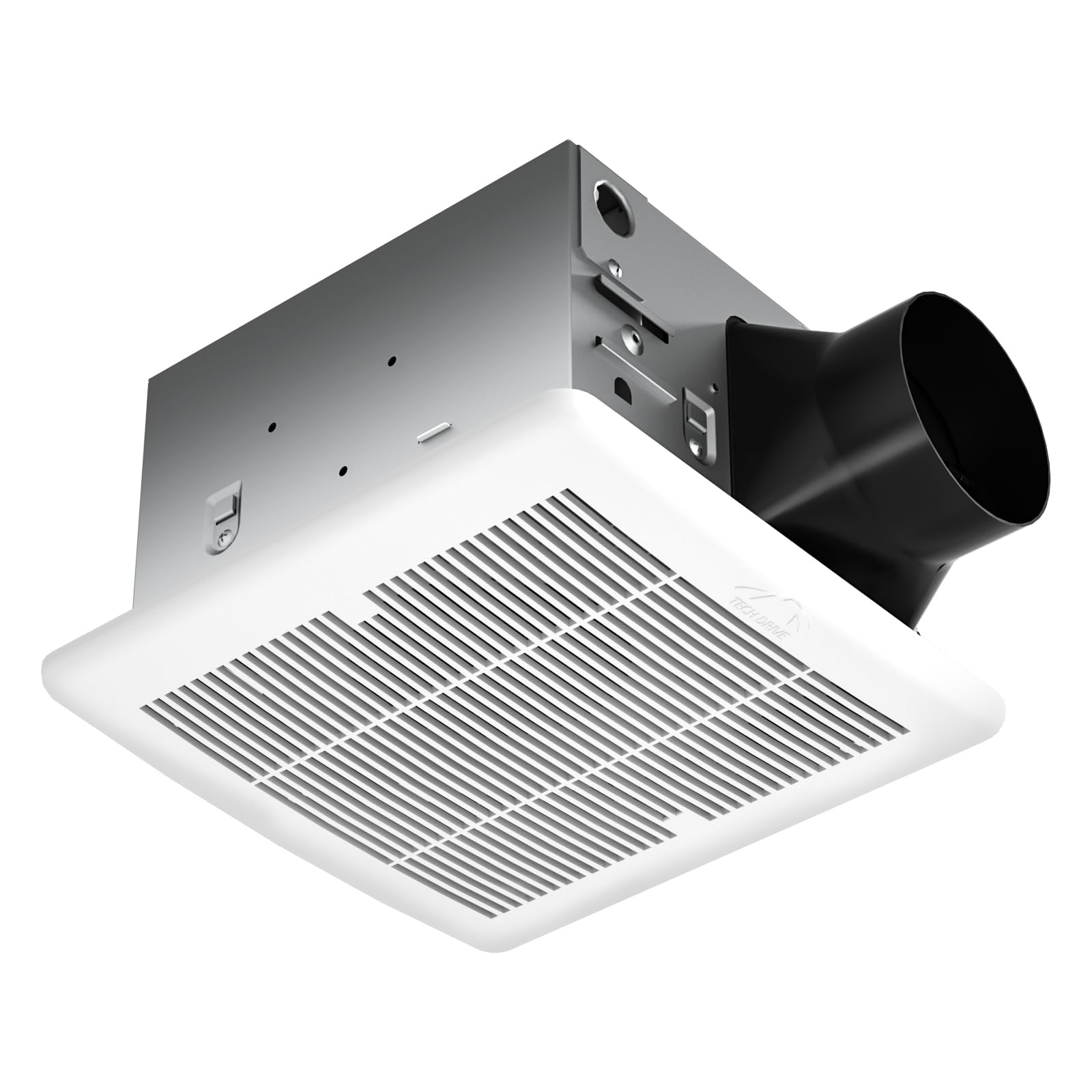
4. Tech Drive Bathroom Fan with Humidity Sensor, 110 CFM, 4 Inch Duct
For the bathroom with no attic above it and no easy way to the back of the ceiling.
Some installs never leave the ceiling. This Tech Drive unit is built so a replacement fan can be swapped in entirely from the room-side — no attic access required — and the housing fits the standard ceiling opening most builders leave behind. Its airflow is 110 cfm for bathrooms up to 110 square feet, and its housing measures 9 x 8.5 x 6 inches with a 4-inch duct, so the cutout has to be carved to 9.25 x 8.9 inches. The humidity sensor trips when the room’s moisture climbs above 60%, and a green LED confirms the fan is in sensing mode. A red LED means you have switched it to manual and the fan just runs until you tell it otherwise.
Owners install this and report the upgrade is immediate — it clears the air and it’s dramatically quieter than the builder-grade fan it replaces. The sensor takes the trickiest part of bathroom ventilation — remembering to run the fan after a shower — and simply does it. Customers note the main thing you notice is the absence of the old fan: no more hearing it from across the house, no more fogged mirrors, no more forgetting to shut it off. The 1.5 sone rating puts this in the quiet bracket without chasing the whisper-quiet territory that some of the premium picks occupy.
Where the honest caveat lands: this fan is quieter than most builder-grade units but not as silent as the marketing language on the box makes it sound, and a few owners note that. The noise level gets mixed feedback in the reviews — you will hear the fan when you are standing under it, just not from the bedroom. It’s also UL and HVI certified and ENERGY STAR qualified, and it’s rated for at least 25,000 hours of operation, which is a long service window for a bathroom fixture. It’s approved for use over a bathtub or shower when it’s wired to a GFCI-protected circuit — that’s the ground-fault circuit interrupter, the outlet that cuts power if water gets where it should not.
Why It Earns The Retrofit Label
- Installs from the room side — no attic access needed
- Humidity sensor auto-starts above 60% with a green LED confirming
- Rated for at least 25,000 hours and ENERGY STAR qualified
- Approved for use over a shower on a GFCI-protected circuit
Set Your Expectations
- 1.5 sone is quiet but not silent — you will hear it in the room
- Cutout needs to be carved 9.25 x 8.9 in to fit the housing
- Noise feedback is genuinely mixed in the reviews, so trust your own tolerance
Best fit for: Anyone replacing a builder-grade fan with a low ceiling and no attic above it — this is the least invasive path to auto-sensing.
Think twice if: You want a dead-silent fan, because 1.5 sone is audible when you are in the room.
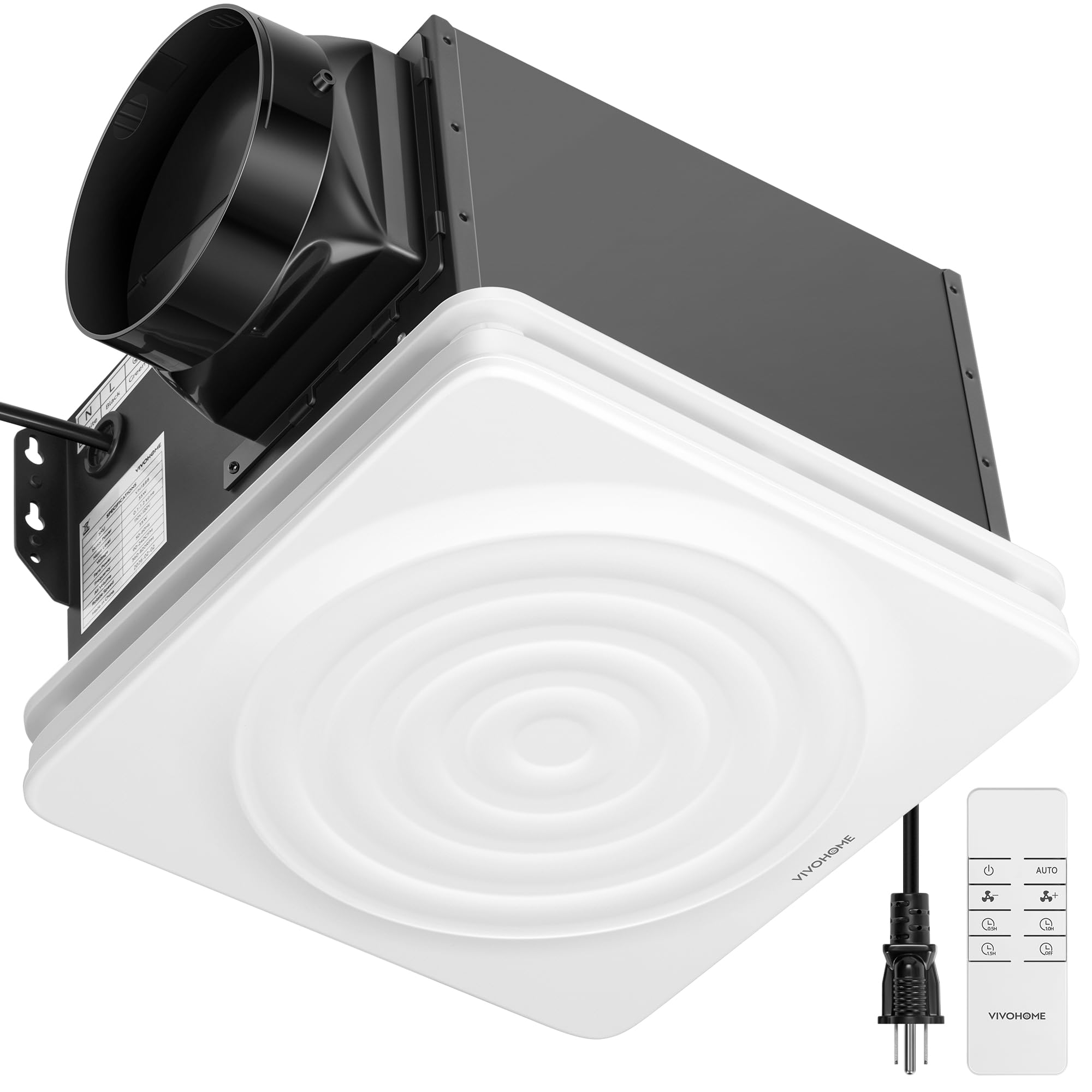
5. VIVOHOME Bathroom Exhaust Fan with Humidity Sensor, 240 CFM 6-Speed
240 cfm for the master bath — serious volume for anyone fighting a long duct run.
Bathrooms and laundry rooms up to 280 square feet are within range here. This VIVOHOME runs a 35-watt brushless DC motor that delivers 240 cfm at full tilt, with humidity-based auto-switching between an off state under 50%, a 160 cfm step above 50%, and full 240 cfm at 80% or higher. A manual six-speed remote adds hands-on control, with a wireless reach up to 45 feet, plus 0.5-hour, 1-hour, and 1.5-hour timer settings you can dial in. A rust-resistant metal shell holds up to the wet environment, and a backdraft damper and aluminum foil duct are included.
Where this fan actually earns its keep is in bathrooms that used to fog up no matter how long the old fan ran. Reviewers point out it pushes air clean through a 25-foot attic duct run — the sort of long, insulated flex duct where a lesser fan would stall — and one owner swapped a 4-inch duct up to 8-inch for that run. The auto mode starts near-silent and ramps from 160 cfm above 50% humidity to 240 cfm at 80%, and at full speed it is still quieter than the old fan it replaced. Shoppers say it can also pull air from an adjacent bedroom, and that its 6-inch duct and 11.37 x 12.12 inch cutout install more easily than its 15.3 x 13.1 x 8.9 inch housing suggests.
The honest part is that this is not a straight-replacement fan, and the reviews are candid about it. The housing is 15.3″D x 13.1″W x 8.9″H, sized for an 11.37 x 12.12 inch ceiling opening, with 6-inch duct compatibility and a 13.1 x 13.1 x 9.2 inch internal housing — that is a much bigger footprint than a standard 4-inch-duct unit, and several owners needed new duct, bigger venting, and attic or roof rework. The instructions are vague on mounting orientation, the remote needs two AAA batteries (not included), there is no wall holder for the remote, and there is no pairing information in the manual. One owner flagged a rattle at low speed, and a few wish the light could be controlled by a separate wall switch rather than the remote only — the wall switch powers the whole unit. At max speed it can whistle. For most owners, none of that outweighs the airflow, and the automatic humidity ramp is the feature that seals the deal.
Where it wins: Large or high-volume bathrooms, long duct runs, and anyone who needs real 240 cfm without paying premium-tier money.
Where it costs you: This is a bigger install than a standard 4-inch-duct fan — expect new ductwork, and plan on the remote doing most of the controlling.
6. Panasonic FV-0510VSC1 WhisperValue Bath Fan + Humidity Sensor, 50-100 CFM
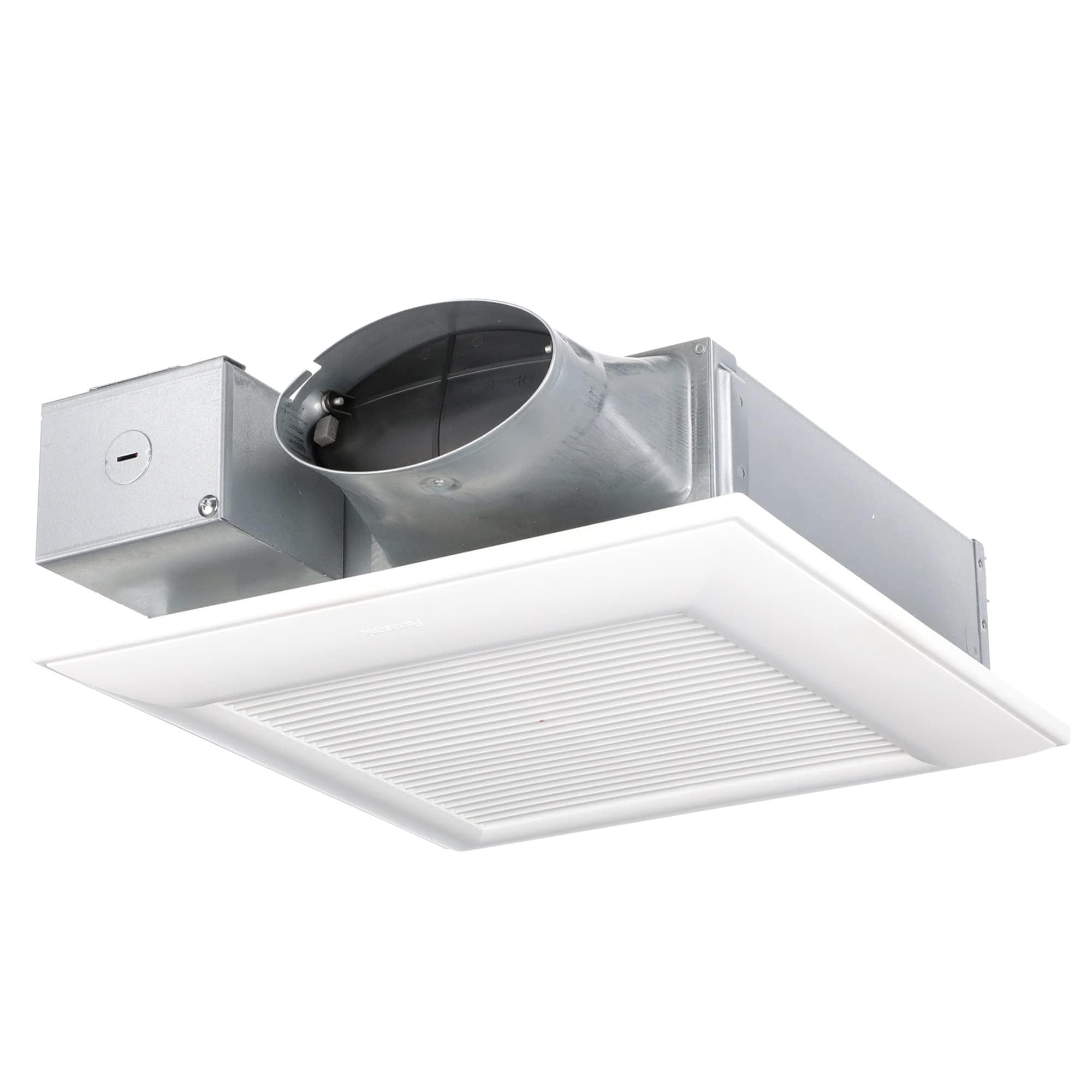
A fan only 3-3/8 inches deep, made for ceilings with almost no room behind them.
Some ceilings are shallow enough that most fans simply will not fit. This is the pick for that specific problem: the housing depth is just 3-3/8 inches, and an L-shaped mounting bracket lets it slip into tighter cavities than a full-size fan. At the same time it keeps the Panasonic signature — an ECM motor that stays nearly silent, and a Pick-A-Flow selector to run 50, 80, or 100 cfm from the same unit. A condensation sensor reacts to moisture in the air, so a rising humidity level triggers ventilation without you touching a switch. It is a clean-looking white fixture, which matters because this one is likely to be visible in a well-finished bathroom.
What owners agree on is that this fan moves a lot of air and stays quiet doing it — the noise level and overall quality are the two things people bring up most, and both are rated positively. On the daily-use side, this fan runs long after you leave the room and it keeps the bathroom dry — mirrors do not fog, and the room feels dry rather than damp hours later. That behavior is exactly why a sensor-equipped fan beats a manual one: it keeps working after you have walked out.
The single important wiring fact about this fan is that its built-in sensor adjusts the fan’s speed — it does not turn the fan fully on and off by itself. Several owners paired it with an external in-wall humidity switch to fire the fan from a standing start, and once wired that way it does the job. That wiring setup is the source of nearly all the frustration in the reviews: five wires instead of the standard three, red wires that must be tested carefully and should not be bundled together, and instructions that assume the fan is being installed in new construction rather than retrofitted into a finished ceiling. One owner noted that instructions were so new-construction-focused that two screws ended up hidden behind drywall. Get the wiring right, though, and this fan delivers quiet, capable, dry-bathroom performance that lasts.
The real reason to choose it: At 3-3/8 inches deep with an L-bracket mount, this is the fan that fits where others will not, and the ECM motor keeps it quiet while it runs.
The wiring reality: Its built-in sensor manages fan speed rather than on/off power, so if you want the fan to start itself you are adding an external humidity switch — and the five-wire setup is where the instructions fall short.
Pick this if: Your ceiling is shallow, you want the WhisperValue quiet, and you are willing to add the switch that makes the sensor fully automatic.
Hold off if: You want a self-contained sensor fan with no extra parts to buy — the wiring here assumes a bit of planning.
7. Homewerks 140 CFM Bathroom Exhaust Fan with Humidity Sensor, ENERGY STAR
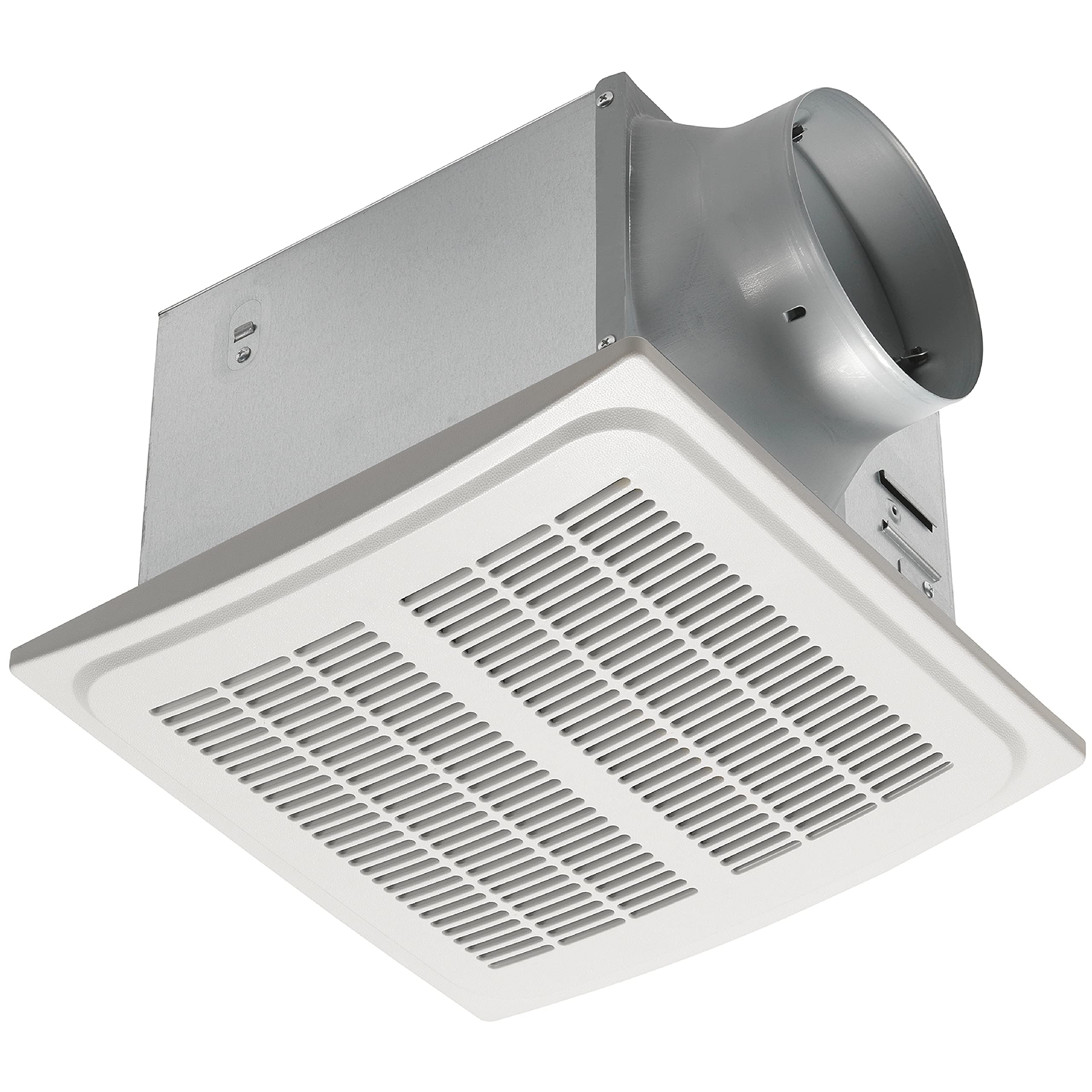
140 cfm of suction at 1.0 sone — the ratio you rarely get at once.
The number that stands out here is 140 cfm at 1.0 sone. That is airflow enough for rooms up to 140 square feet, running at a sone level that reads as whisper-quiet in the room. Once installed, buyers report the drying effect immediately — walls stay dry after showers, the mirror barely fogs, and the fan clears the room while staying quiet enough to talk over. It runs in two modes: automatic, where the humidity sensor starts the fan above a set threshold, or manual, where you switch it on yourself. Red and green indicator lights tell you which mode you are in.
What owners praise most is the moisture handling itself. It runs on the humidity sensor for the everyday shower, and the reported experience is a bathroom that finally dries out — a common refrain in the reviews is that the fan solved what an open window and a dehumidifier used to handle. The unit is ENERGY STAR qualified and built to run quietly enough for regular use rather than being ejected to the backyard whenever possible.
Where it takes real work is the install. The braces the fan ships with are short and only offer three connection points, so fitting it into a standard 24-inch on-center joist bay takes added blocking — you will want to have wood on hand. Some owners found the wiring cover tight and the motor housing at odds with the duct mounting screws. The instructions assume a certain amount of elbow room you may not have if the ceiling above is finished. One other thing to know: the auto-mode at the default humidity threshold runs the fan frequently enough that in winter it can pull heated air out of the room, so a cold shower is a genuine, if uncommon, complaint. It is also rated at 60% humidity by default, which some owners prefer to raise. The 140 cfm motor and 1.0 sone noise spec are the reasons to choose this fan — the install is the part you have to budget for.
Why It Wins On Spec
- 140 cfm of airflow at 1.0 sone — big output, quiet operation
- Red and green LED indicators show humidity and speed modes clearly
- ENERGY STAR qualified and built for rooms up to 140 sq ft
- Owners mention walls staying dry and mirrors barely fogging
Install Realities
- Braces are short with three connection points — expect to add blocking
- Auto mode can pull heated air out in winter at the default humidity threshold
- Not ideal for tight retrofits — some installs benefit from new-construction access
For the buyer who wants raw airflow without the noise: 140 cfm at 1.0 sone is the combination that carries this pick.
For the buyer who wants a weekend drop-in: The mounting brackets make this a bigger job than the spec sheet suggests.
8. OREiN 3-in-1 Bathroom Exhaust Fan with Light & Humidity Sensor, 160 CFM, 1.0 Sone

One fixture that replaces the old fan, the old light, and the old night light.
Three products fold into one here: ventilation, a bright 1500-lumen LED light with selectable 3000K, 4000K, or 5000K color temperature, and a 2200K night light for late-night trips. The fan moves 160 cfm at 1.0 sone, sized for bathrooms up to 160 square feet, and the humidity sensor trips automatically above 60% — a green LED confirms it’s in sensing mode. ENERGY STAR, HVI, ETL, and FCC certified, and backed by a 5-year limited warranty. The housing is 13.1″D x 13.1″W x 8″H and installs flush-mount against the ceiling.
Owners love the effect on the room after showering — the 60% humidity sensor clears the moisture and keeps the mirror clear while the 160 cfm fan runs at 1.0 sone, quiet enough that nobody minds. The 3,000K, 4,000K, and 5,000K light options let you match the room’s existing color temperature rather than fight against it, and the LED output is genuinely bright enough to light a whole bathroom on its own. It’s a fan, a light, and a night light doing separate jobs without a separate fixture for each — and customers note the fit is exactly right for a standard ceiling opening.
There are a couple of honest caveats. The unit is heavy, and the manual insists on anchoring both sides — reviewers point out that improper install tore drywall, so this is a both-hands-on-the-ladder job. Dimmers and timer switches are not compatible, so you cannot put this on a standard dimmer wall plate. Cutout is 11.81 inches by 11.02 inches, and one owner reports the unit’s actual footprint ran slightly smaller than that in the field. Also worth knowing: a couple of owners ran into moisture finding its way into the light electronics over a multi-year window, and in those cases OREiN replaced the unit and added a rubber seal to shield the electronics — the customer service support behind this one is reported to be responsive, though it is note the light does sit directly in the steam path.
One fixture, three jobs: 160 cfm, a 1500-lumen light with three color temperatures, and a 2200K night light — this replaces three separate ceiling cuts with one.
Plan for install weight: Anchor both sides per the manual. Owners who skipped that step dealt with torn drywall, and the unit is heavy enough that the fastening actually matters.
Buy this when: You want the fan, the main light, and the night light handled by a single fixture with auto humidity control and a 5-year limited warranty.
Look elsewhere when: You need dimmer compatibility on the wall switch — this fan explicitly is not made for dimmers or timer switches.
Understanding the Specs
CFM vs. Room Size
CFM measures the volume of air the fan moves per minute, and the rule of thumb is to pick a CFM rating that meets or exceeds your bathroom’s square footage. An 80 cfm fan covers a bathroom up to 80 square feet, and a 160 cfm fan handles up to 160 square feet — but bigger is not always better, because a fan that outruns its duct will simply pull air back through the gap between the housing and the drywall rather than cool the room. This is why a 240 cfm unit like the VIVOHOME six-speed model matters most in large rooms or on long duct runs, and why the compact breez Delta GreenBuilder staying at 80 cfm is the right call for a small 6-by-11 bath.
Sones vs. Decibels
A sone measures perceived loudness, not sound pressure, which is why a 0.3-sone fan and a 1.5-sone fan feel different in a way a decibel reading alone would not capture. Sone levels double when perceived loudness doubles, so every step up in sones is roughly twice as loud in the room. For a fan you plan to run overnight, 1.0 sone is quiet enough to talk over; 0.1 and under 0.3 are inaudible territory for most rooms. On this list, the Panasonic models and the VIVOHOME units sit at the quietest end, while the Tech Drive and Homewerks units sit in the audible-but-not-distracting bracket — a fit decision rather than a flaw.
Humidity Sensors and Threshold Settings
A humidity sensor, sometimes called a humidistat, reads air moisture and decides whether to run the fan. What each fan does with that reading varies. Some switch the fan on when humidity crosses a set threshold and off again when it drops. Others ramp the fan speed up and down while a wall switch handles the power — so the fan still runs continuously at a low level. And some combine the moisture sensor with a motion sensor or an adjustable delay timer that keeps the fan running after the steam clears. The VIVOHOME units switch speed, the Delta breez and OREiN units trigger the on/off, and the Panasonic WhisperValue adjusts speed rather than starting the fan up from zero. Know which behavior you want before you buy.
Duct Size and Cutout Dimensions
Every fan has two physical limits that determine how easy it is to install. First, the duct diameter — 4-inch duct is the most common in residential bathrooms, but many older homes still run 3-inch duct, so a fan with a 4-inch outlet needs a reducer to fit. Second, the ceiling cutout — the opening in the drywall that the housing has to slide into. Cutouts range from a standard 8 x 8 inch opening for a compact fan like the breez Delta GreenBuilder up to 11.81 x 11.02 inches for the OREiN all-in-one. Measure both before you order. A reducer is a small problem; the wrong cutout is not.
Frequently Asked Questions
What does a bathroom exhaust fan with a humidity sensor actually do?
Is a higher CFM always better in a bathroom fan?
What is a sone and how quiet is quiet in a bathroom fan?
Do I need attic access to install a humidity-sensing bathroom fan?
Will a 4-inch duct fan work with my existing 3-inch duct?
How long does a bathroom exhaust fan with a humidity sensor last?
Can I put a bathroom fan with a humidity sensor on a dimmer or timer switch?
What is the difference between a humidity sensor and a motion sensor on a bathroom fan?
Will a humidity-sensing bathroom fan clear steam from a small bathroom faster than a manual fan?
Are ceiling cutouts standard across bathroom exhaust fans?
Do I need a separate light in a bathroom with an exhaust fan that has a light built in?
Final Thoughts: The Verdict
For most people upgrading a bathroom, the strongest pick is the Panasonic FV-0511VQC1 WhisperSense — a fan that pairs motion and humidity sensing with under 0.3 sone operation and a Pick-A-Flow selector that lets one unit cover 50, 80, or 110 cfm, so it fits the room rather than the room fitting it. It holds a 4.6 rating across a deep pool of owner reviews, and at under 0.3 sone with a 50/80/110 cfm selector, it is a fixture you install once and live with for years. If you want to spend less and move more air, the VIVOHOME EC Motor fan delivers 160 cfm on a brushless motor with constant-airflow behavior; just plan on bringing your own junction box and backing for the bracket. And for a bathroom where the fixture has to do more than one job, the OREiN 3-in-1 gives you ventilation, a 1500-lumen LED light, and a night light from one cutout. Whichever you choose, measure the existing ceiling opening and check your duct diameter first — those two facts decide whether the install is an afternoon or a weekend.
How We Picked
We do not accept paid placement. Every pick is matched to a real buyer and a real use-case; we do not hands-on test units.
Sources & Methodology
Specifications: manufacturer listings and product documentation. Review insights: verified customer reviews, as of September 2026. Pricing: not shown on this page (it changes often); check the current price via the retailer link.
As an Amazon Associate, KitchPrep earns from qualifying purchases. This does not affect which products we feature.
Related Guides
