
Specs are compiled from manufacturer listings and verified buyer reviews and can change over time — please confirm the key details on the product page before buying.
A bathroom doorway is where two floors meet, usually with a small step between them. Get the threshold right and the door seals, the draft stops, and a robot vacuum or walker rolls straight through. Get it wrong and you get a gap that lets in cold air, dust, and bathroom smells, or a strip that peels up within a month because the adhesive never held on a wet floor.
I’m Mohammad Maruf — the founder and writer behind KitchPrep. This guide is built by comparing the manufacturers’ published specifications and the patterns across verified customer reviews, so you get each pick’s real strengths and trade-offs instead of marketing spin.
Every pick below is judged on the same three things that actually decide whether a bathroom threshold works: the material, the height it bridges, and how it attaches. By the end you will know which of these bathroom door threshold options fits your doorway, your floor gap, and your patience for install day.
Our Picks at a Glance

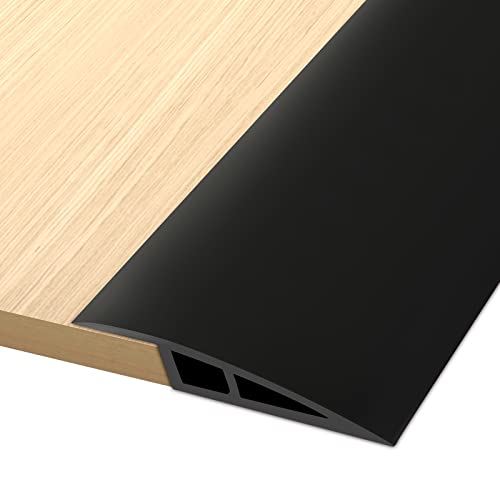
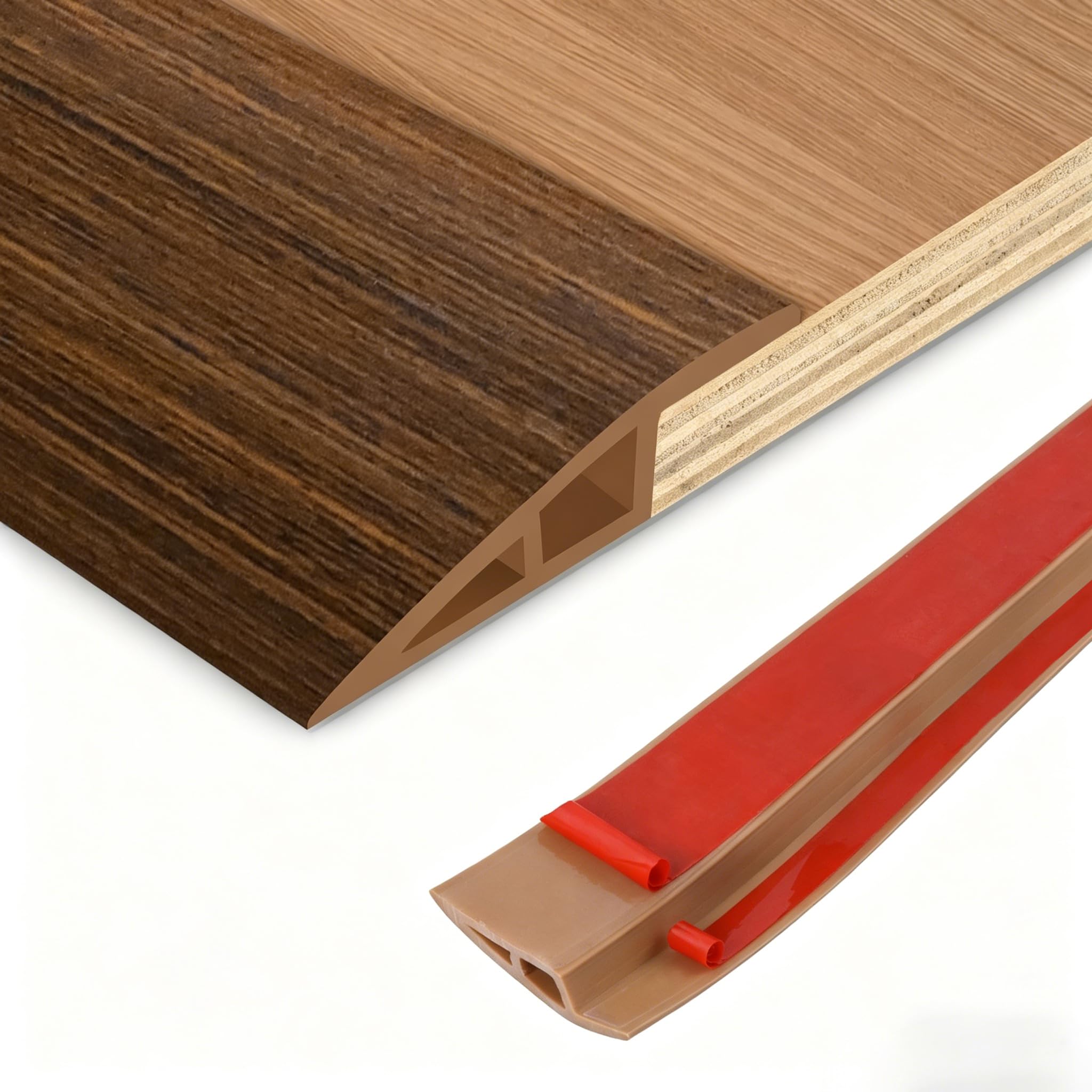
How To Choose The Best Bathroom Door Threshold
A bathroom threshold has one job: cover the seam between two floors and level out the step between them, without becoming a trip hazard or a peeling mess. A bathroom doorway is wetter and more humid than a bedroom doorway, so material and attachment method matter more here than almost anywhere else in the house.
Measure the gap before you buy the strip
Put a ruler on the hallway floor and measure straight up to the top of the bathroom floor. That number is your height difference, and it decides which strip fits. A few of these strips are built to bridge a specific band — one covers gaps from 1/5 inch to 2/5 inch, another handles 3/5 inch to 4/5 inch, and one flat aluminum model is designed for floors with up to a 1 inch height difference. If your gap is bigger than the strip’s stated range, the strip will not sit flush and the door may drag on it.
Wood, PVC, or aluminum
Oak thresholds are solid and easy to stain, but they are stiff, they need cutting to fit, and a wet bathroom floor is harder on wood than a hallway is. PVC (a flexible plastic) thresholds bend to uneven floors and wipe clean, which suits a bathroom well. Aluminum is the most rigid option and holds a straight, flat line even after years of foot traffic, and several aluminum models come with pre-drilled holes and screws rather than adhesive.
Adhesive or screws
Self-adhesive strips install in minutes with no drilling and no damage to the floor underneath, but the bond is only as good as the surface you stick it to — the floor has to be clean, dry, and level. Screw-down aluminum thresholds are more involved but they do not depend on an adhesive holding up against bathroom moisture. One aluminum pick here includes screws for three pre-drilled holes, and another lists expansion screws and tubes in the package.
Check the door clearance
Slide a piece of cardboard under the closed bathroom door to see how much room you have. A thin PVC strip barely changes the floor height, while a higher-profile aluminum threshold sits noticeably taller and may need the door trimmed or a sweep adjusted. Measure the door bottom before you commit to a thick profile.
Quick Comparison
| Model | Best For | Material | Length / Coverage | Height Coverage | Amazon |
|---|---|---|---|---|---|
| Frost King WAT500★ Best Overall | Wood-floor seams you plan to stain | Oak Wood | 36 in. long x 5 in. wide | 1/2 in. thick | Amazon |
| FONUNO Self Adhesive Transition StripBest for Renters | Rented rooms and quick no-drill fixes | PVC | 3.3 Feet | 1/5 in. to 2/5 in. | Amazon |
| DBHXXMB-HH Floor Transition StripMost Reliable Adhesion | Dual-adhesive hold between mismatched floors | PVC | 3.3 Feet | 1/5 in. to 2/5 in. | Amazon |
| Danlaila Floor Transition Strip | Long runs and gap-covering width | PVC | 10 ft. long x 2 in. wide | 0.13 in. thick | Amazon |
| EaseInstall Vinyl Door Threshold | Wheelchair, walker, and vacuum crossings | PVC | 36 in. long | 3/5 in. to 4/5 in. | Amazon |
| M-D Building Mini Threshold | Tight exterior doorways that need a seal | Aluminum | 36 in. long x 1.38 in. wide | 7/16 in. high | Amazon |
| SFNSM Aluminum Threshold | Wheelchair-friendly flat entryways | Aluminum | 36 in. long x 3 in. wide | Flat profile | Amazon |
| Jiekayi Aluminum Threshold | Wide gaps between tile and wood | Aluminum | 36 in. long x 2.4 in. wide | Up to 1 in. difference | Amazon |
| M-D Building High-Profile Threshold | Older doors with oversized gaps | Aluminum | 32 in. long x 3.75 in. wide | 1.13 in. high | Amazon |
In‑Depth Reviews
1. Frost King WAT500 5 x 1/2 x 36″ Wood Threshold, Clear Oak
Our pick — 4.5★ from 550+ verified ratings; the strongest balance of quality and price.
Real oak you can stain to match the floor, at five inches of seam-hiding width.
If your bathroom floor meets a hardwood hallway and you want the seam to disappear rather than announce itself, this is the pick that gets closest. It is a single piece of oak wood measuring 5 inches wide, 1/2 inch thick, and 36 inches long, and that extra width is the point — 5 inches covers more of the seam than a narrow strip, so gaps and color mismatches between two floors stay hidden underneath.
It arrives clear and unstained, which is what makes it adaptable: you can paint it or stain it to match the wood on either side of the doorway. Buyers who stained theirs dark were happy with how the grain took the color, and the light white oak tone straight from the start matches a lot of modern flooring already. The trade-off with wood is real, though. It is a stiff, hard piece, so if your bathroom floor and hallway floor are not perfectly level, you will be cutting or sanding the bottom yourself — one buyer had to grind the last few inches of the underside with an angle grinder to sit flush on an uneven floor.
The recurring complaint is worth knowing before you buy: a handful of these arrive cracked in half, and the paperwork is glued to the top face, which can leave a stubborn glue stain you have to sand out. Neither is common, and both are fixable, but neither is fun on install day.
What it does best
- Extra-wide 5-inch face hides the seam better than a narrow strip
- Paintable and stainable, so you can match either floor
- Hard, solid oak that holds its shape under daily foot traffic
- Low profile at 1/2 inch thick, so door clearance is usually not an issue
What to watch
- Stiff wood will not bend to an uneven floor — expect to cut or sand it
- Arrives unstained, so you supply the finish
- The top-mounted info label can leave a glue stain if you are not careful removing it
Choose oak if: you have a hardwood or carpet seam in a dry hallway side of the doorway and you want the threshold to actually blend in.
Not for you if: your floor is out of level or the doorway sees standing water — wood and puddles do not get along, and bending it to fit is not an option.
2. FONUNO Vinyl Floor Transition Strip Self Adhesive Door Threshold Strip
A no-drill PVC ramp that lets a robot vacuum cross the doorway without a fight.
Renting, or just unwilling to put screw holes in your floor? This is the strip that asks nothing of you but a clean, dry surface and a few minutes. It is a 3.3-foot PVC strip made of a flexible plastic that is scratch-resistant, abrasion-resistant, and dirt-resistant, so it wipes clean and does not stain easily. The self-adhesive backing means no drilling and no damage to whatever floor is underneath — which is exactly the point.
The height coverage runs from 1/5 inch to 2/5 inch, which suits the small step you find between a bathroom floor and a hallway floor in most homes. It is rated for commercial use, so it is built a little tougher than a pure consumer-grade strip, and it works across carpet, tile, and wood transitions. One thing buyers keep mentioning: it arrives rolled up, and you should roll it the opposite way and let it relax before sticking it down, or the curl will fight you.
The honest trade-off is the material’s softness. Because it is relatively soft PVC rather than hard rubber, it does not like being used as a heavy ramp — one reviewer noted it will not hold up to heavy loads the way the hard rubber kind does. Cutting it also needs a strong tool; scissors struggle, and a razor knife or tin snips do the job properly. For light foot traffic and a rolling vacuum, though, it does exactly what it claims.
Where the value sits: this is one of the cheapest, fastest ways to close a small bathroom doorway step with zero tools beyond a knife.
One real limit: soft PVC, so keep heavy equipment off it and cut it with something sharper than kitchen scissors.
Grab this for: a rental, a first apartment, or any doorway where you cannot drill and the height difference is under half an inch.
Look at aluminum instead if: you need this to carry a loaded cart or dolly across, or the gap is bigger than 2/5 inch.
3. Floor Transition Strip Vinyl Door Threshold Ramp Self Adhesive Carpet Edging Strip Doorway Edge Trim, Overlap Edge Reducer for Laminate Carpet, Floor, Tile (Brown Wood Grain)
Two adhesive strips instead of one, for a doorway that keeps trying to peel up.
Same 3.3-foot PVC format and the same 1/5 inch to 2/5 inch height range as the FONUNO above, but the difference here is the backing. This one carries dual self-adhesive strips rather than a single one, which gives it a stronger, more secure hold — the exact fix for a doorway where a cheaper strip has already started lifting at the edges. It is built from PVC that is scratch- and wear-resistant, so it shrugs off daily mopping and wear.
Where it separates itself in use is against moisture. It has held up through mopping and steaming without coming loose, which matters more in a bathroom doorway than in a hallway. The brown wood grain color blends into a range of wood and laminate floors, and the length cuts easily down to your doorway. One buyer ran 15 feet of this along a kitchen-to-dining transition in a 15-minute install without any trouble.
Being honest about the color: the “wood grain” markings are faint, and the oak shade leans light and tan-orange rather than a deep brown if that is what your floor looks like. It is also not for uneven surfaces — both this and the FONUNO above say so plainly, and a bumpy subfloor will break the adhesive seal. Get a flat, dry, clean surface and this holds.
Strengths worth having
- Dual adhesive strips grip harder than a single-strip design
- Survives mopping and steaming in a wet doorway
- Warm wood grain blends with laminate and vinyl floors
- Cuts to length with a standard knife
The fine print
- Not suitable for uneven or bumpy subfloors
- Wood grain pattern is faint up close
- Oak color runs lighter and more orange than a deep brown
A solid match for: a bathroom-to-hallway doorway with a flat subfloor, where a previous adhesive strip gave up and you want something that actually stays put.
Think twice if: your subfloor dips or the wood grain pattern has to be convincing from a foot away.
4. Floor Transition Strip for Doorways, 2” x 10Ft Self-Adhesive Laminate Floor Strip, Carpet Threshold – Gray Wood Grain
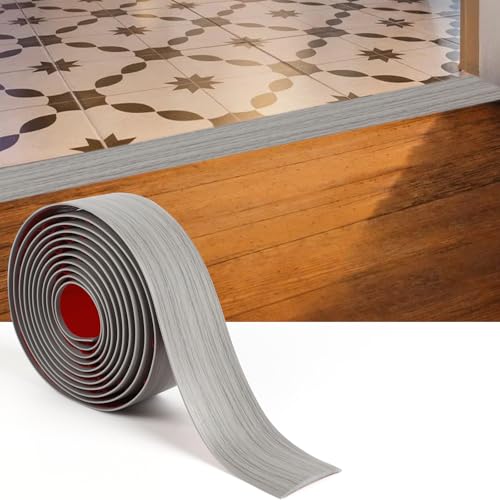
Ten feet of gray PVC strip — enough for the doorway and the whole gap around it.
At 10 feet long and 2 inches wide, this is the longest run in the list by a wide margin, and that changes who it is for. Instead of scraping together a single doorway’s worth, you get enough to bridge a bathroom doorway plus the adjoining tile gaps, thresholds, and trim lines in one continuous roll. The PVC is described as durable and flexible, resistant to wear, scratching, and fading, so heavy foot traffic does not scuff the surface dull.
The self-adhesive backing holds without tools, and it is rated for both commercial and residential use, so a busy household or a light commercial space both get a strip built for the traffic. It works with laminate, vinyl, tile, hardwood, and carpet — a genuinely wide range for a single adhesive strip. Buyers report that one strip held through a cold winter in a three-season cabin, which tells you the adhesive does not give up at the first temperature swing.
Two things to plan around. It is a thin strip — the material is only about an eighth of an inch thick — so it sits nearly flat and covers gaps and tile edges rather than raising a ramp. And because there is so much of it, a small doorway leaves you with a lot of leftover material you paid for and may never use. If you only need three feet, this is more strip than you need; if you have a longer seam, it is the sensible buy.
Best asset: a 10-foot run with a strong grip and color that matches gray and modern floors, so one order covers several transitions.
Honest caveat: thin and flexible, so it covers a gap rather than bridging a real step, and you may be buying more length than your single doorway needs.
Reach for this if: you have more than one doorway or a long seam to cover and want a single roll that handles all of it in gray.
Skip the extra length if: you just need one bathroom doorway — a 3.3-foot strip from the picks above is the leaner call.
5. Vinyl Floor Transition Strip Door Threshold Self Adhesive 36 inch, Thresholds for Doorways, Edge-Reducer Transition-Strips for Door/Floor (Black)

A waterproof 36-inch ramp built to bridge the taller 3/5- to 4/5-inch doorway step.
This is the strip you buy when the step in the doorway is too tall for the thin adhesive jobs above. It is a 36-inch PVC strip with a gentle ramp profile, and it is designed to bridge height differences from 3/5 inch to 4/5 inch — the sort of step you get between a raised bathroom floor and a floor that sits lower on the other side. The PVC is flexible, tough, and fully waterproof and moisture-proof, which suits a wet bathroom doorway better than an untreated wood strip would.
The ramp shape is the real reason people pick this: it lets vacuum cleaners, wheelchairs, and walkers roll over the doorway without catching. In a garage gym, one buyer used it to close the gap between 3/4-inch rubber mats and concrete, cutting a 45-degree end and sticking it down in about ten minutes. The smooth surface wipes clean with minimal fuss, and the adhesive is made to hold in warm conditions.
Two honest limits. The material is soft enough that standing weight can spread it — one wheelchair user found it would support an empty chair but was too soft under an occupied one, so pair this with heavy traffic carefully. And it wants a clean, dry, level floor before it will bond; the same rolled-up packaging curl that affects the other strips applies here too.
Right call for: a doorway with a taller step where a walker, wheelchair, or robot vacuum has to cross, on a level floor that stays dry underneath.
Look elsewhere if: a loaded wheelchair or heavy dolly will roll across — the soft PVC will not hold up under that weight.
6. M-D Building Mini Low-Profile Threshold, Silver, 1-3/8in x 7/16in x 36in

The slimmest, most seal-focused pick — a aluminum-and-vinyl strip for tight exterior doorways.
At just 1-3/8 inches wide and 7/16 inch high, this is the smallest footprint in the lineup, and it is sold as a door seal first and a threshold second. It is made of durable aluminum with a flexible vinyl insert, and the vinyl insert is the working part: it presses against the door to protect against drafts, moisture, dust, and insects. Fits up to a 36-inch doorway.
Where this quietly wins is on awkward, badly-out-of-square openings. Buyers have used it to seal a tall, crooked gap under a patio door and it blocked the desert dust; another used it to cover an uneven floor-to-garage-door gap over tile, with the flexible seal doing the work the rigid frame could not. Because it is low and thin, it does not turn into a step you trip over, which keeps bathroom and shower doorways clean and flush.
The catch is installation hardware. Several versions of this threshold include screws, but at least one buyer had to supply their own — so check what is in the box before you start on a Saturday morning. It is also a very low-profile strip, so it is best at sealing and covering small seams rather than making a big step disappear. Trim the aluminum with a hacksaw and the vinyl insert with scissors.
What it is good at: sealing out drafts, dust, and bugs on tight, low-clearance doorways where a tall threshold would not fit.
What to know going in: low-profile by design, so it seals and covers small gaps rather than bridging a deep one — and confirm the screws are in the box.
Choose this for: a bathroom or shower doorway with low clearance that needs a tight, seal-first fix from a strip just over an inch wide.
Better to size up if: your gap is deep and needs an actual ramp rather than a seal.
7. Aluminum Door Threshold – 36″ L x 3″ W Exterior Floor Transition Strip with Pre Drilled Holes and Expansion Screws
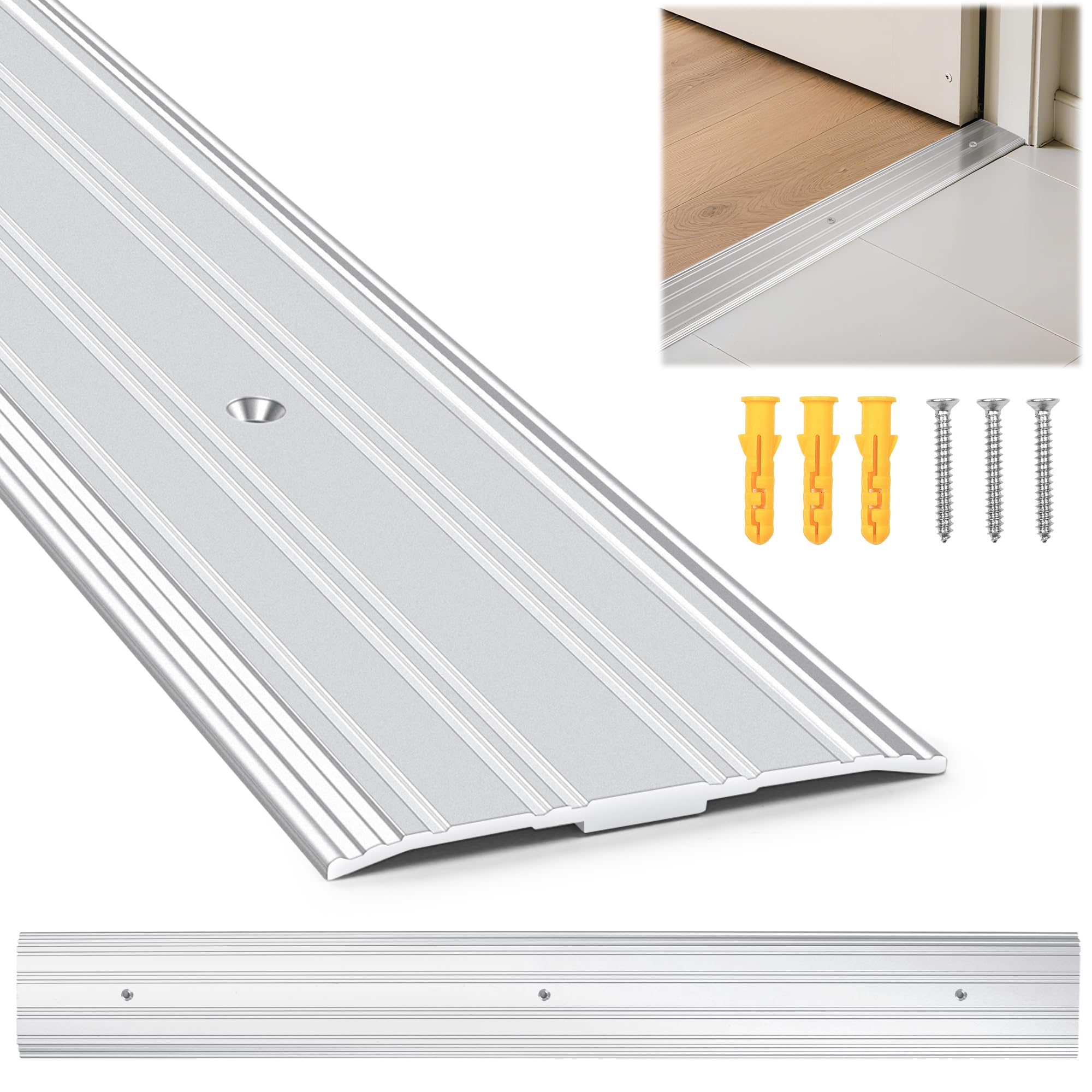
Screw-down aluminum with a flat, fluted top — a threshold a walker can roll straight over.
Where the adhesive strips above suit renters and quick fixes, this is for the doorway you want done permanently. It is a 36-inch by 3-inch aluminum alloy threshold with a flat profile and a fluted (ridged) non-slip top. Aluminum alloy brings corrosion resistance, wear resistance, and rust prevention, so a bathroom doorway’s humidity and splashes are not a concern the way they are with wood. Three pre-drilled holes and expansion screws are included, so it grabs the floor instead of relying on glue.
The flat profile is what makes this the wheelchair-and-walker pick. Because there is no raised lip, wheels roll over the joint instead of catching on it. A buyer who installed one for a parent using a walker said the wheels no longer get caught on a raised portion, and used it to make the entry to the house far easier. It also blocks airflow, moisture, and dust from slipping under a door, and the widened top support is built to take weight without flexing.
The trade-off is installation effort. This is a screw-down strip, not a peel-and-stick one, so it takes longer and the holes need lining up. Buyers also note the provided screws do not always seat right the first time and the holes are not sized for every screwdriver. The aluminum can be cut to length with a hacksaw if 36 inches is longer than your doorway, and a 48-inch option exists for wider openings.
Why it holds up
- Rust-resistant aluminum alloy with a widened, reinforced top
- Flat fluted profile lets wheels and walkers pass without catching
- Three pre-drilled holes and expansion screws included for a fixed install
- Cuttable to length, and a 48-inch size exists for wide doorways
Where it asks more
- Screw-down install takes more time and set-up than an adhesive strip
- Screws can be fussy to seat through the pre-drilled holes
- No adhesive backup — you must anchor it to a solid floor
Best fit for: a doorway that sees a walker or wheelchair, or any bathroom entry where you want a permanent, rust-proof aluminum strip you screw down once and forget.
Not the quick fix if: you cannot drill or want the job done in five minutes with no tools.
8. Aluminum Metal Door Threshold, Floor Transition Strip, 36” L x 2.4” W x 0.1” H, Flat-Profile Threshold, Flooring Gaps Carpet Vinyl Wood (Black)

A flat black aluminum strip rated to cover a full inch of height difference.
This is the pick for a doorway where the floors really do not line up. It is a 36-inch by 2.4-inch aluminum strip in a flat profile, and it is designed for floors with up to a 1 inch height difference — the biggest height range in the adhesive-free group, and a match for a bathroom floor that sits noticeably higher than the room outside it. The aluminum is scratch- and dent-resistant, weatherproof, and rust-resistant, so it tolerates rain, snow, and daily wear without warping.
It comes with pre-drilled holes, screws, and expansion tubes, so installation is measure, cut, then screw down — no adhesive to rely on. The flat-profile design bridges gaps between wood, tile, laminate, vinyl, carpet, and concrete, and it guards the floor edge from chipping while adding an anti-slip safety surface. At 0.1 inch thick it sits almost flush, so it does not add a step for wheels or bare feet to catch on.
Two honest install notes. The top is colored black but the underlying metal is not black throughout, so once you cut it you will see bare aluminum at the fresh edge — measure twice so you cut once. The included screws are thin, so a thicker screw makes a tighter hold (one buyer swapped one out for exactly that reason). Neither is a deal-breaker; both are worth knowing before the drill comes out.
Why it earns a spot: a flat, weatherproof aluminum strip rated for up to 1 inch of height difference, with screws included and a near-flush 0.1-inch profile.
Prep for cuts: the black finish is top-surface only, so any cut exposes bare metal — and swap in a sturdier screw if the included ones feel loose.
Pick this when: the height difference between your two floors is substantial and you want a flat aluminum strip that stays put without adhesive.
Consider the screw-down flat pick above instead if: your doorway is a simpler, near-level seam where the extra height coverage is not needed.
9. M-D Building Products 08003 3-3/4 in. x 1-1/8 in. x 32 in. Silver Aluminum and Vinyl Heavy-Duty High-Profile Threshold
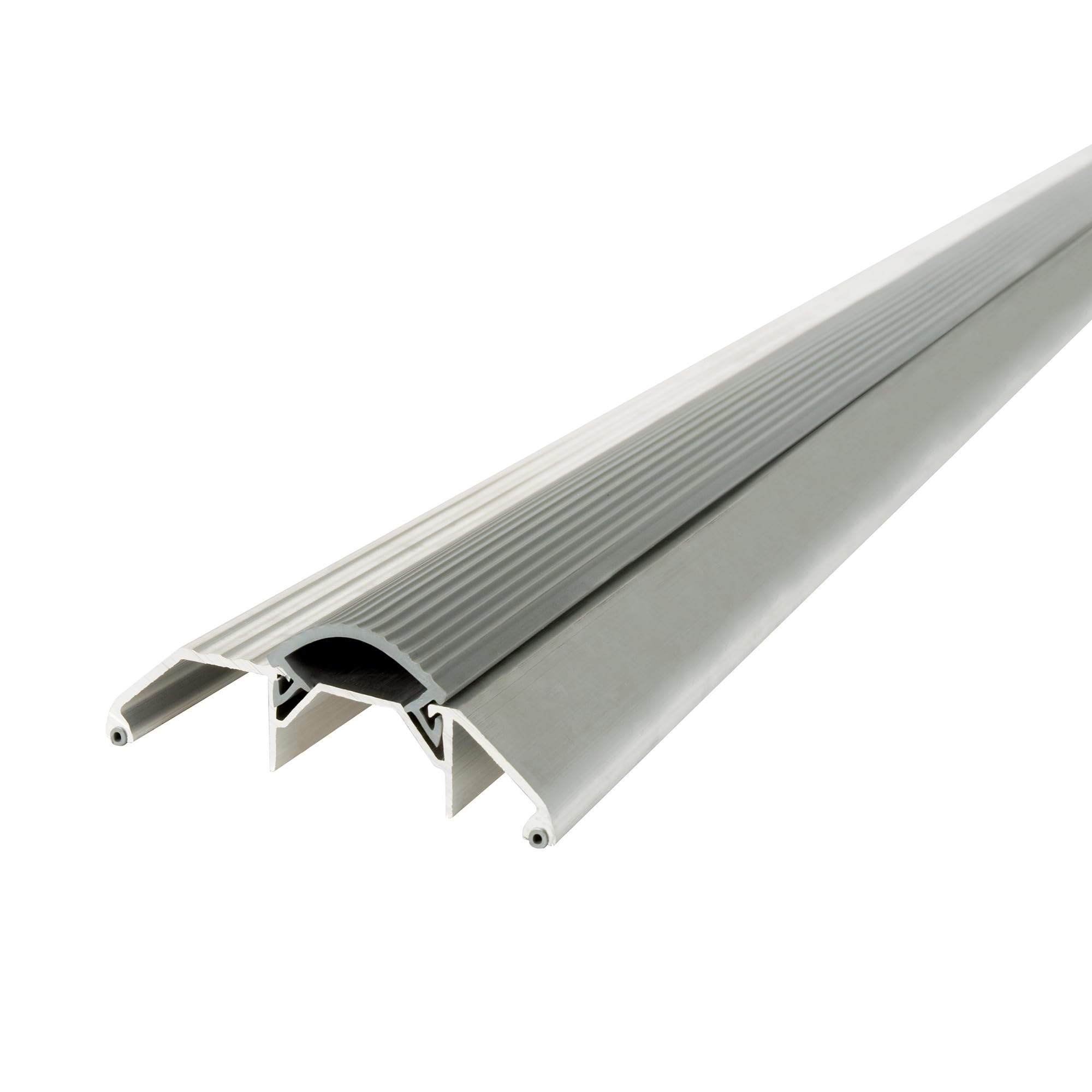
The tallest, widest threshold here — built for an oversized gap under an older door.
At 3-3/4 inches wide and 1-1/8 inches high, this is the heavy-duty profile for the worst-case doorway. It is made of durable aluminum with a flexible vinyl insert, in a 32-inch length, and it is designed to seal out drafts, moisture, dust, and insects. That height and width are exactly what you want when a standard threshold has already failed to cover the gap — this is the strip that actually reaches across it.
Buyers use it precisely for those stubborn openings. It has covered larger-than-average gaps where regular thresholds fell short, and the sturdy aluminum with pre-drilled holes made alignment quick and clean, with installs running about 30 minutes. Underfoot it stays solid with no flex, and the vinyl insert cuts the draft and light without making the door hard to open or close.
There are two things to plan for. Because the profile is tall, it may require a door sweep adjustment or a door trim so the bottom clears it — measure your door clearance first. And the last of the profile range ends at 32 inches, so a wider doorway may need trimming or a second piece. The vinyl seal inserts into a track, and owners mention it is easier to set the track before screwing down, and to lubricate it and ease it in with a flat-head screwdriver afterward. The solid aluminum and tight seal are worth that extra step.
Made for: an older bathroom or garage door with a big, uneven gap that no standard threshold can cover, where you want a heavy-duty aluminum-and-vinyl seal.
Measure first if: your door clearance is tight — the high profile may need a sweep adjusted or the door trimmed to clear it.
Understanding the Specs
Height coverage (how big a step it bridges)
This is the number that decides whether a threshold fits your doorway. A strip rated for 1/5 inch to 2/5 inch handles the small step between most bathroom and hallway floors. A strip rated for 3/5 inch to 4/5 inch handles a taller step, the kind you get when one floor was raised. A flat aluminum model can be rated for up to a 1 inch difference. Match the strip’s stated range to your measured gap: if the strip is rated for less than your step, it will not sit flat, and if it is rated for more, it will leave a ridge under the door.
Material and how it attaches
The material sets how the threshold behaves in a bathroom, and the attachment sets how long it stays. Wood is solid and stainable but stiff and unhappy around water. PVC (a flexible plastic) bends to minor floor unevenness, wipes clean, and comes as peel-and-stick. Aluminum is rigid, rust-resistant, and usually screwed down through pre-drilled holes, which lasts longer but takes more work. Peel-and-stick strips need a clean, dry, level surface — the whole bond depends on it — while screw-down thresholds do not.
FAQ
How do I measure for a bathroom door threshold?
Can I use a bathroom threshold on a wet floor?
Will a self-adhesive strip actually stay stuck in a bathroom doorway?
How do I stop a rolled-up adhesive strip from curling back up?
What tool do I need to cut a vinyl or PVC threshold?
Can a threshold let a wheelchair, walker, or robot vacuum cross more easily?
My last strip peeled up in a couple of months. What went wrong?
How much does a bathroom door threshold actually cost?
Is a taller threshold better than a low-profile one?
What is the difference between a threshold and a transition strip?
Final Thoughts: The Verdict
For most bathrooms, the bathroom door threshold winner is the Frost King WAT500: solid oak, extra-width at 5 inches, paintable and stainable, and built to hide the seam between two floors cleanly. If you have a walker or wheelchair to think about, grab the SFNSM Aluminum Threshold with its flat fluted profile and included screws. And for a deep, awkward gap under an older door, the M-D Building High-Profile Threshold is the one to reach for.
How We Picked
We do not accept paid placement. Every pick is matched to a real buyer and a real use-case; we do not hands-on test units.
Sources & Methodology
Specifications: manufacturer listings and product documentation. Review insights: verified customer reviews, as of September 2026. Pricing: not shown on this page (it changes often); check the current price via the retailer link.
As an Amazon Associate, KitchPrep earns from qualifying purchases. This does not affect which products we feature.
Related Guides
