
Specs are compiled from manufacturer listings and verified buyer reviews and can change over time — please confirm the key details on the product page before buying.
You want the steam gone and the smell gone, without a fan that sounds like a leaf blower in your ceiling. This guide pulls together the nine bathroom air vents worth your time, sorted by what you actually need: airflow that clears the room, a noise level you can live with, and an install that does not turn into a weekend drywall project. The short answer is that a fan rated around 1.0 to 1.5 sones (the standard measure of how loud a vent is, where lower means quieter) at 80 to 110 CFM (cubic feet per minute, the volume of air it moves) handles almost every home bathroom.
I’m Mohammad Maruf — the founder and writer behind KitchPrep. This guide is built by comparing the manufacturers’ published specifications and the patterns across verified customer reviews, so you get each pick’s real strengths and trade-offs instead of marketing spin.
From the ceiling mount retrofit units to the fan-and-light combos with night lights, here is a plain walk through what makes each Bathroom Air Vent worth buying this year.
Our Picks at a Glance


How To Choose The Best Bathroom Air Vent
Picking a vent fan really depends on matching three numbers to your room: how much air it moves, how loud it runs, and whether it fits the hole in your ceiling. Get those three right and the install is straightforward. Get them wrong and you are either cutting new drywall or listening to a jet engine every morning.
Match CFM to your square footage
The CFM rating tells you how many cubic feet of air the fan pulls out every minute. A common rule of thumb is roughly one CFM per square foot of bathroom, so a 50 CFM unit suits a small powder room and a 110 CFM unit handles a large main bath. If your bathroom has a separate shower or you live in a humid climate, step up to the higher end of the range.
Understand Sones before you buy
A sone is a unit of perceived loudness, and the scale is direct: 1.0 sone is close to silent, 2.0 sones is quiet background hum, and anything past 4 sones starts to feel loud. Most of the best picks land between 1.0 and 2.0 sones. Two fans can both list “quiet” in the description, but a 1.0 sone model will sound noticeably calmer than a 2.0 sone model in the same room.
Check the duct size and opening dimensions
The duct outlet size matters because your existing ductwork is often already in the ceiling. A 4-inch duct is the most common size, while some older homes use 3-inch. A mismatch is not a blocker, but you may need a reducer. The ceiling opening is the trickier one: measure the cutout before ordering or you will be buying more drywall.
Room-side versus attic-access installation
If you have attic access over the bathroom, you have the most flexibility. If you do not, look for a “room-side” or “retrofit without attic access” fan. These are built so the housing can be fitted and wired from inside the bathroom, which saves a lot of time and avoids cutting open the ceiling.
Quick Comparison
| Model | Best For | Airflow (CFM) | Noise (Sones) | Duct Size | Amazon |
|---|---|---|---|---|---|
| Panasonic FV-0511VFL1 WhisperFit★ Best Overall | Overall best for quiet power and selectable airflow | 50/80/110 CFM | — | 4″ or 6″ | Amazon |
| Harrier Hardware 70 CFMBest Value | Budget-friendly small bathroom ventilation | 70 CFM | 2.0 sones | 3″ | Amazon |
| JOEAONZ 110 CFM 1.0 SonesTop Performer | Loud-free airflow for larger rooms on a budget | 110 CFM | 1.0 sones | 4″ | Amazon |
| Homewerks 7140-50 | Low-profile fan for small, tight bathrooms | 50 CFM | 1.0 sones | 4″ | Amazon |
| Amico 80 CFM | Quick-retrofit fit for shallow joist framing | 80 CFM | 1.0 sones | 4″ | Amazon |
| Orsong 12″ Panel | Maximum airflow from a large panel grille | 130 CFM | 1.0 sone | 4″ | Amazon |
| VIVOHOME Humidity Sensor | Hands-off humidity-triggered ventilation | 110 CFM | 1 sone | 4″ | Amazon |
| Broan-NuTone Roomside Retrofit | Replacing an old vent with no attic access | 80 CFM | 1.5 sones | 4″ | Amazon |
| OREiN 2-in-1 Fan + Light | Bright LED light and fan in one unit | 110 CFM | 2.0 sones | 4″ | Amazon |
In‑Depth Reviews
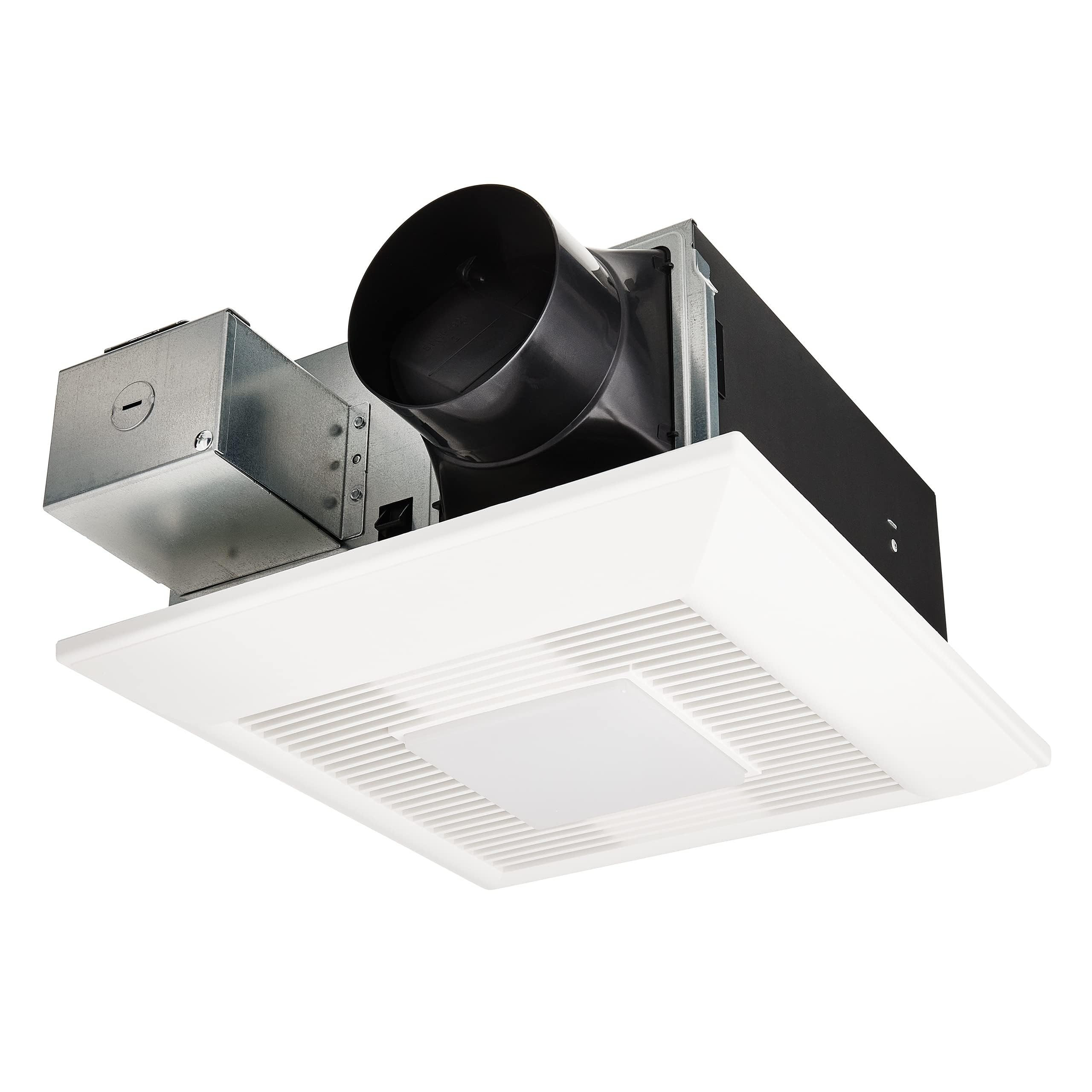
1. Panasonic FV-0511VFL1 WhisperFit Bath Fan + Light, 50-80-110 CFM
Our pick — over 4.5★ from 900+ verified ratings; the strongest balance of quality and price.
Set the airflow once, then forget your vent fan is even up there.
If you want one fan that fits almost any bathroom without a second thought, this is the one to start with. The Pick-A-Flow switch lets you select 50, 80, or 110 CFM with a flip, so the same unit works whether you are moving into a tiny powder room or upgrading a busy main bath. That single feature is why this lands at the top of the list: you buy once, then dial the airflow to match the room, no return trip required.
The other standout is the built-in light. A 10W dimmable LED chip panel with a separate night light under 1W means you get useful brightness without swapping to a separate fixture. Buyers report it lives up to the WhisperFit name, with the DC/ECM motor (a brushless motor design that runs cooler and quieter than traditional AC motors) doing the heavy lifting in near silence. The bracket is a real win for retrofits: a single-hinged Flex-Z Fast bracket slides into place, and the removable duct and wiring junction box makes the wiring connection simple to reach.
Comparing it head-to-head with the JOEAONZ: the Panasonic moves 110 CFM at the top setting, the same airflow as the JOEAONZ, but does it while offering three selectable speeds and integrated lighting. That flexibility is exactly why it earns Best Overall over the cheaper fans. The one honest catch: 4-inch ducting limits airflow on long runs, so if your duct run is long, step up to the 6-inch option this fan supports.
What buyers highlight
- Pick-A-Flow selector lets you run 50, 80, or 110 CFM from one fan
- Dimmable 10W LED with a separate under-1W night light built in
- Flex-Z Fast bracket and removable junction box simplify the install
- ENERGY STAR certified and whisper quiet in daily use
Where it falls short
- Light color reads a touch cool and is not adjustable
- Replacing a smaller old fan may need minor drywall repair
- Long duct runs need the larger 6-inch duct option
Reach for this if: you want one quiet, powerful fan with adjustable airflow and a usable built-in light covering most rooms.
Look elsewhere if: you are on a tight budget or your duct run is short and 110 CFM at one speed is all you need.
2. Harrier Hardware Bathroom Exhaust Fan 70 CFM Super Quiet 40dB 2 Sone
A budget fan for a small bathroom that genuinely sounds quiet at night.
Small bathrooms are the balance for this unit. It moves 70 CFM, which is more than enough for a half bath or a compact full bath, and it lands at 2.0 sones, or roughly 40 decibels (a measurement of sound pressure, close to a quiet library). The noise level is what makes this pick earn its spot: two sones is real-world quiet, and the fan gets there at a price that fits replacement budgets. Buyers consistently describe it as whisper-quiet compared to the old builder-grade fan they removed.
Compared to the Panasonic above, the Harrier is a simpler machine. It runs one speed at 70 CFM, and there is no built-in light or selectable airflow. Where it wins is price-to-value: the JOEAONZ moves 57% more air than the Harrier (110 CFM vs. 70 CFM), but for a small room, 70 CFM is plenty and you keep more money in your pocket. The galvanized steel housing (a zinc-coated steel that resists moisture) is built to stand up to the damp air of bathroom and attic spaces.
One thing to plan for: the unit has a 3-inch duct outlet, so if your existing ductwork is 4-inch, you will need a reducer. Replacing the motor down the road means swapping the whole unit rather than just the motor, so factor that in if you value serviceability. A few owners also flagged mixed feelings about the plastic connectors, so if you are wiring this yourself, take your time on the connections.
The strongest case for it
- 2.0 sones (40 dB) is genuinely quiet for the price tier
- 70 CFM moves plenty of air for a small or half bathroom
- Galvanized steel housing resists moisture and corrosion
- UL listed for safe use over tub and shower areas with GFCI
Worth knowing first
- 3-inch duct outlet may need a reducer to fit existing 4-inch ductwork
- Motor replacement requires swapping the entire unit
- A few owners mention plastic connectors and wiring feel less sturdy
A solid pick if: you have a small bathroom and want quiet operation without spending much.
Not your fit if: you need 110 CFM or a selectable-speed fan for a larger room.
3. JOEAONZ Bathroom Exhaust Fan 110 CFM 1.0 Sones Ultra-Quiet
Big airflow and library-level quiet at a mid-range price point.
This fan hits the combination most people are chasing: 110 CFM of pull at only 1.0 sones. For a larger bathroom or one with heavy steam, that airflow is the number that matters. Buyers describe it clearing the foggy air from a badly ventilated bathroom and ending condensation problems that had dogged them for years. One owner with a basement bathroom reported that after upgrading, tenants stopped complaining about water dripping from the ceiling, which is a tidy way of saying the fan actually removes the humidity.
The install story is friendlier than you might expect. The housing uses standard drywall tabs and quick-connect electrical and duct adapters, so many people fit it as a direct replacement for an older fan using the existing 4-inch pipe. The motor is removable with two screws, which makes future service far simpler than the all-in-one swap you would face on the Harrier. The housing is compact too, so the cutout size is on the smaller side and fits most existing ceiling openings without modification.
Where it loses ground to the Panasonic is control: no selectable airflow setting and no light. The airflow also gets called out honestly in reviews as the trade-off, with a handful of buyers noting it feels less powerful than 110 CFM would suggest, especially in rooms with long duct runs. For most standard bathrooms with a short run, that is not an issue.
What stands out
- 110 CFM at 1.0 sones is a genuinely quiet, powerful combination
- Motor removes with just two screws for easier future service
- Quick-connect electrical and 4-inch duct adapter speed up installation
- Compact footprint suits most existing ceiling openings
Where it leaves room
- No built-in light and no selectable airflow speed
- A few owners feel the air movement is not as strong as expected
- Requires a 4-inch duct, so 3-inch systems need adapting
Good for you if: you need the most airflow you can get without paying a premium, and you can live without a light.
Think twice if: you want color-selectable lighting or adjustable speed in one unit.
4. Homewerks 7140-50 Bathroom Fan Ceiling Mount Exhaust Ventilation, 1.0 Sones, 50 CFM

A tidy low-profile fan built for bathrooms where ceiling space is tight.
If your bathroom is small and you want the vent to disappear into the ceiling, this is worth a look. It runs at 50 CFM and 1.0 sone, which covers bathrooms up to 50 square feet, about the size of a typical hall bath. The low-profile grille is the design signature here: owners mention most fans look bulky on the ceiling while this one blends in with the surface.
The 1.0 sone rating puts it right up there with the quietest picks in this list, and the same quiet near-silence that owners describe comes with a known trade-off: quieter fans move less air. If your bathroom is on the larger side, a 50 CFM unit is at the low end, so step up to something like the JOEAONZ if your space runs past 50 square feet. This one is built for the room it is sized for.
The no-cut design makes the replacement job easier because the housing drops into the ceiling without chopping new drywall. The build is galvanized steel, and it carries HVI, ETL, and Energy Star certifications. One recurring note from owners: the exhaust port sits on one side, so depending on your existing ductwork and joists, you may need to cut a fresh ceiling hole to align the duct. A few owners mention the plastic retaining clip is a weak point, so be gentle with it during install.
The quiet trade-off: 50 CFM keeps things near-silent, but that same low airflow is why it is a match for compact bathrooms and not larger main baths.
Worth it for: a small or mid-size bathroom where you want a nearly invisible, quiet ceiling fan that fits an existing cutout easily.
Skip if: your bathroom is larger than 50 square feet and needs the extra push of a 110 CFM unit.
5. Amico Bathroom Exhaust Fan, 1.0 Sones, 80 CFM, No Attic Access Needed
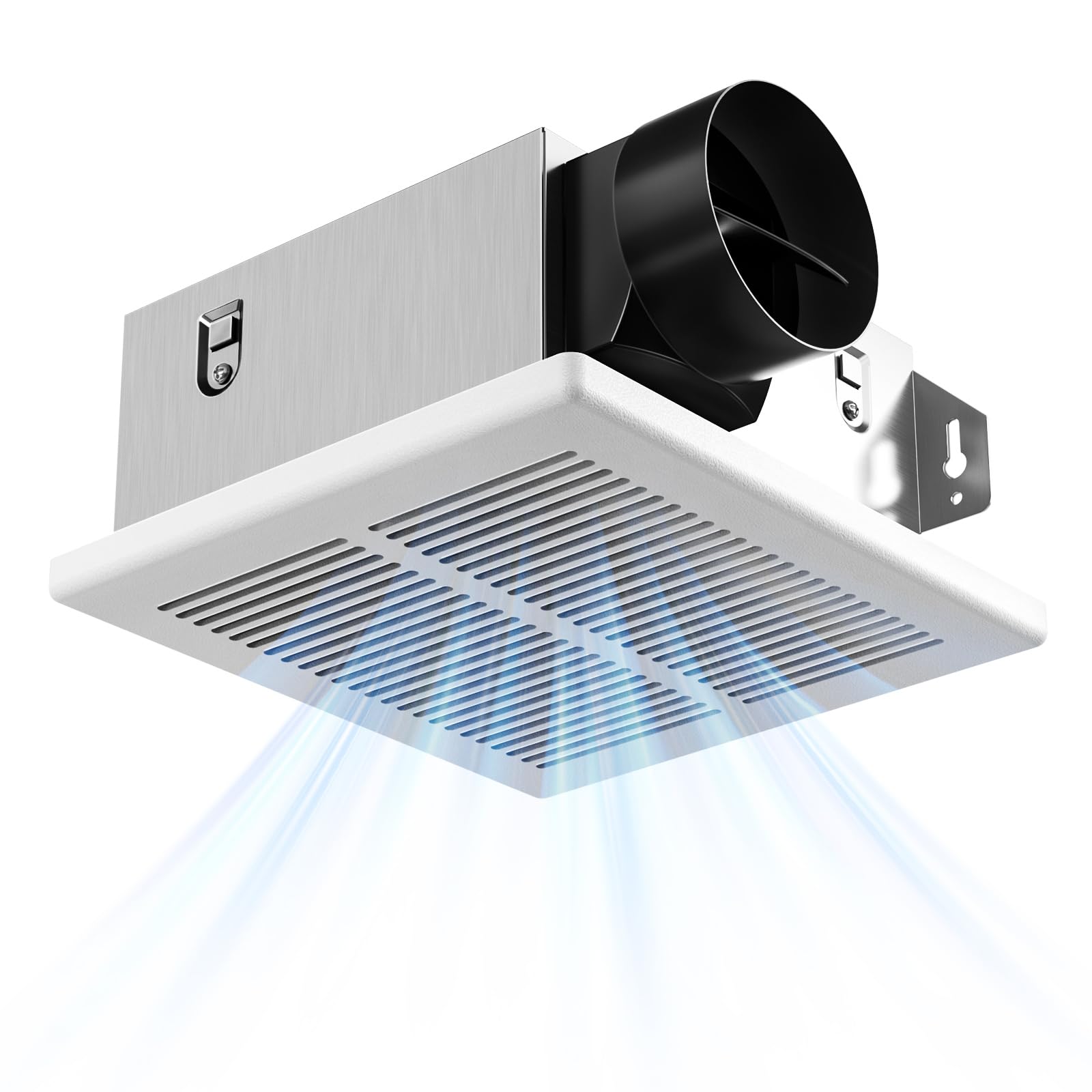
The retrofit-friendly 80 CFM fan that squeezes into shallow joist spaces.
This one earns its spot by solving a very specific problem: fitting where a fan has no business fitting. The housing is compact at 7.5 by 7.2 by 4 inches, which is sized to slip into a tight ceiling void, and it uses simple screw-in brackets to mount between joists or straight to a single joist. Electricians reviewing it note that the 80 CFM unit fits a 2×6 joist frame with no modification, which is a rare thing for a fan this powerful.
Performance-wise, 80 CFM at 1.0 sone is a strong pairing for a small-to-mid bathroom up to 80 square feet. That makes it a step up from the Homewerks on airflow while staying just as quiet, and it keeps the same 1.0 sone rating the Panasonic and JOEAONZ carry. The included dim light is a bonus that owners use as a soft nighttime glow, and one reviewer noted it was perfect for replacing an existing unit precisely because it was small enough to fit. Shipping includes a 4-inch duct outlet, and if your ductwork is 3-inch, Amico offers a free reducer that they send on request.
The one recurring gripe is that it could be even quieter. One owner who paired it with a 4-inch-to-3-inch reducer and a single-sided joist mount felt the airflow restriction may have made it louder than expected, which is a fair thing to check before you buy if you are chasing near silence. For most small bathrooms, this is a comfortable, quiet retrofit.
Why it earns a spot
- 80 CFM at 1.0 sone balances airflow and quiet well
- Compact housing fits shallow 2×6 joist framing with no modification
- Screw-in brackets allow ceiling or joist mounting without attic access
- UL listed with a dim light for soft nighttime glow
Keep in mind
- One owner found it ultimately a touch less quiet than hoped
- 4-inch duct outlet requires a reducer for 3-inch ductwork
- Recommended for spaces up to 80 square feet, so large bathrooms need more airflow
Best for: anyone fighting a tight ceiling void who still needs a real 80 CFM fan without cutting open walls.
Look elsewhere if: you need the very quietest fan on the list or a bigger bathroom calls for 110 CFM.
6. Orsong Bathroom Exhaust Fan 12″ Panel
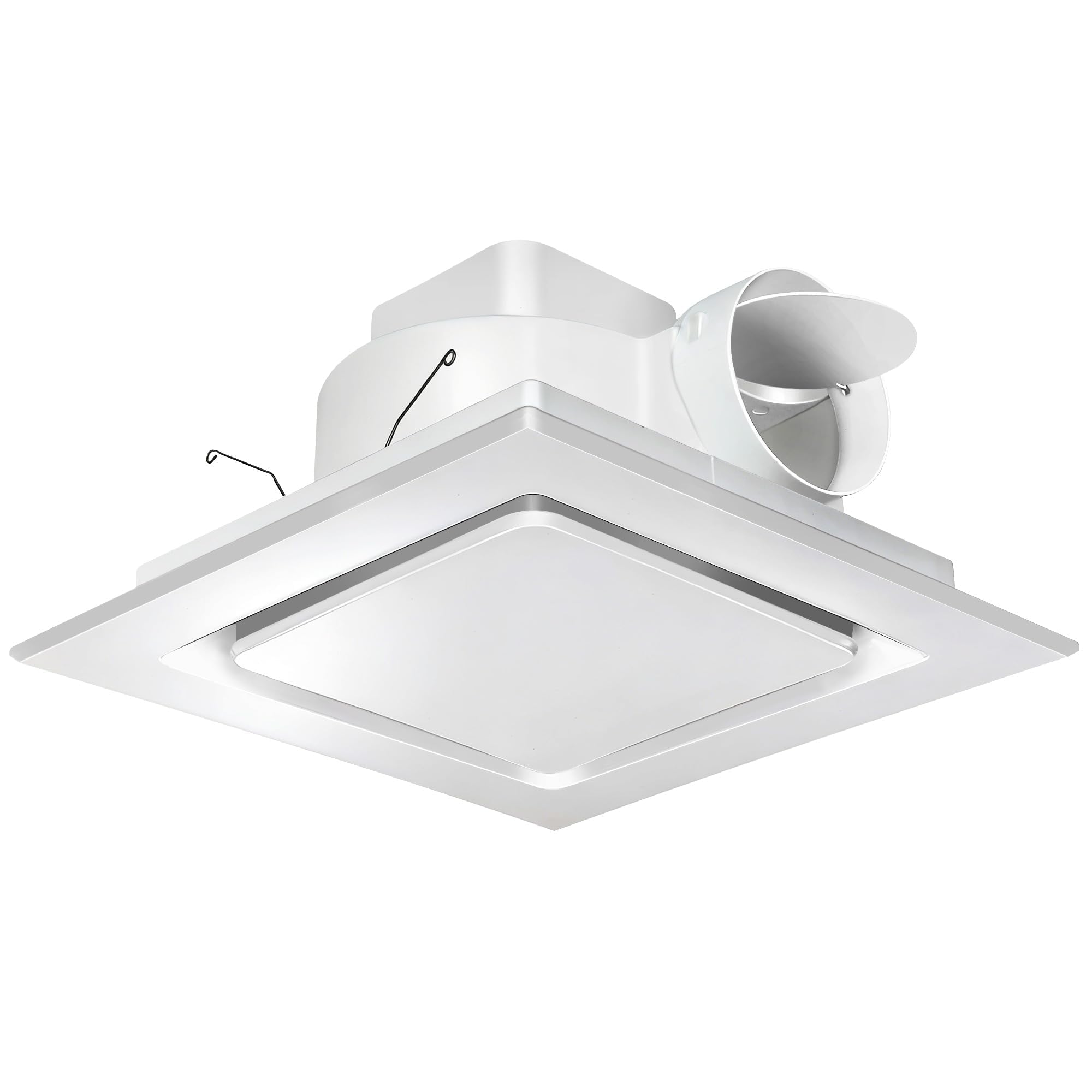
The biggest air mover here, with a wide 12-inch panel that covers a kitchen-sized footprint.
When raw airflow is the goal, this one wins the list. It moves 130 CFM, which is more than any other pick in this guide, and it is rated for rooms up to 150 square feet. That covers a large master bath or a combined bath-and-laundry area where smaller fans would struggle. The wide 12-inch panel grille also makes it a natural replacement for older, larger ceiling fans where a small grille would leave a gap.
Quiet-wise, it runs at 1.0 sone, the same standard the JOEAONZ and Amico carry, so you are not paying a noise penalty for the extra airflow. The unit includes a quick-mount bracket so it can be fitted between joists or straight to one, and it uses the common 4-inch duct. If you are upgrading from an older fan, the 10-by-10-by-7 inch ceiling opening is a standard size that fits many existing cutouts without cutting new cardboard.
Honest trade-off: the airflow is the most-criticized part in reviews, with some owners feeling the fan does not live up to the 130 CFM label, especially if ductwork is under-sized. A few owners reported weak airflow, and one warned against buying it. That said, on the whole, this is a good-looking, quiet, easy-to-install fan where the strong majority of owners are happy with the result, and how much air you get out of it is sensitive to how well your duct run is set up.
Worth noting: 130 CFM on paper is the highest here, but airflow is only as good as the duct run behind it, so check your duct size and length before installing.
Take this one if: you have a large bathroom or a combined space and want maximum listed airflow without raising the noise level.
Reconsider if: your duct run is long or narrow, so you may not feel the full 130 CFM.
7. VIVOHOME Bathroom Exhaust Fan with Humidity Sensor 110 CFM
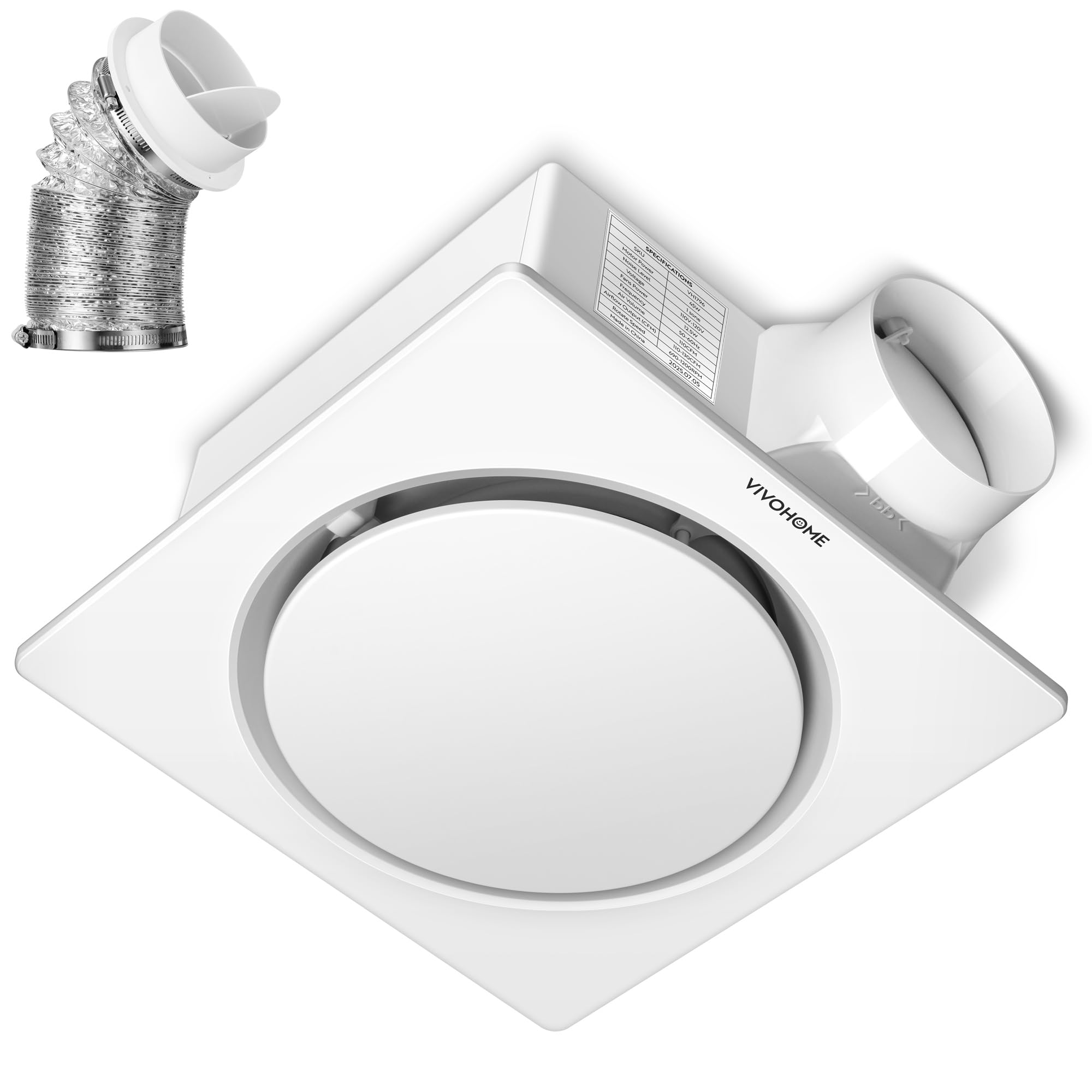
A fan that turns itself on when the room gets steamy and off when it clears.
If your biggest problem is forgetting to run the fan after a shower, this is the pick that solves it. It uses a humidity sensor (a small built-in sensor that detects moisture in the air) to trigger the fan automatically. In Auto Mode, it switches on once the air hits 55% humidity and off when it drops back to 50%, always pushing 110 CFM. There is also a Manual Mode that runs a steady 110 CFM if you prefer to control it yourself.
The motor is the other story worth telling. A brushless EC motor (a motor design that uses electronic controls instead of carbon brushes for smoother, cooler running) drives the airflow at only 12.5W, which is a fraction of the power a traditional AC motor would pull, and it is rated for 30,000 hours of use. Constant Airflow Technology — the fan adjusts its own speed to hold airflow steady as the duct gets dusty or bends — means the airflow stays consistent over years rather than tailing off. Buyers describe the humidity control as accurate and effective even with long showers.
The catch here is two-fold. First, this is a fan-only model, no light built in, so if you want illumination you need a separate fixture. Second, installation is more involved than a basic swap: the housing fits standard 10.2-by-10.2 inch ceiling openings, the included template has been reported as slightly oversized, and there is no electrical box, just a pigtail (an electrical connection consisting of wires rather than a separate box), so you will likely need a junction box and some backing. A confident DIYer can manage it; a first-time installer may prefer help.
The standout features
- Auto humidity mode turns the fan on at 55% humidity and off at 50%
- Brushless EC motor draws only 12.5W and is rated for 30,000 hours
- Constant Airflow Technology holds airflow steady as ducts age
- 1 sone operation is near-silent for a fan this powerful
What gives some buyers pause
- Fan-only unit with no built-in light
- Install needs a junction box and additional backing for the bracket
- Included template has been reported slightly oversized
Choose it if: you want the fan to run itself based on moisture and you value a long-life, low-wattage motor.
Consider something else if: you need a light in the same fixture or want the simplest possible DIY install.
8. Broan-NuTone Bathroom Exhaust Fan Easy Retrofit without Attic Access

Built for the ceiling you cannot reach, so the old vent comes out from below.
This fan’s entire reason for being is the retrofit. If your bathroom has no attic access, replacing an old vent fan usually means cutting drywall to get at the wiring. This model changes that: it is designed to be installed entirely from inside the room, every step done from the ceiling downward. Owners note that they swapped an old loud Broan for this one using the same ceiling opening, and the process was straightforward, one small-framed owner even described self-installing it with the hardest part being the removal of the old unit.
Performance is a solid middle ground: 80 CFM at 1.5 sones, efficient enough for rooms up to 75 square feet, and it is ENERGY STAR certified to use about half the energy of a standard bath fan. That is a notch below the airflow of the JOEAONZ and a hair above the Homewerks, which lands it right in the comfortable middle for most bathrooms. The CleanCover grille sits nearly flat against the ceiling and the SlideClip attachment uses a springless design so the cover snaps on and off for easy cleaning.
Worth knowing before you order: the ceiling cut size is 7.25 by 7.5 inches, so measure your opening first. Another honest note is wiring: the fan uses aluminum wires, which do not connect directly to copper house wiring (a fire hazard to do so). You will need a specialty connector, so plan for that if you are wiring it to a copper circuit.
Best use case: a no-attic-access bathroom where removing the old fan and fitting a new one from the room side is the whole point, saving the drywall work and the messy ceiling access.
Pick this if: you have no attic access, need a straightforward room-side swap, and want a well-engineered quiet 80 CFM fan.
skip it if: you need 110 CFM for a large bath or want to avoid adding connectors for the aluminum wiring.
9. OREiN 2-in-1 Bathroom Exhaust Fan with Light, 110 CFM, 1500LM LED
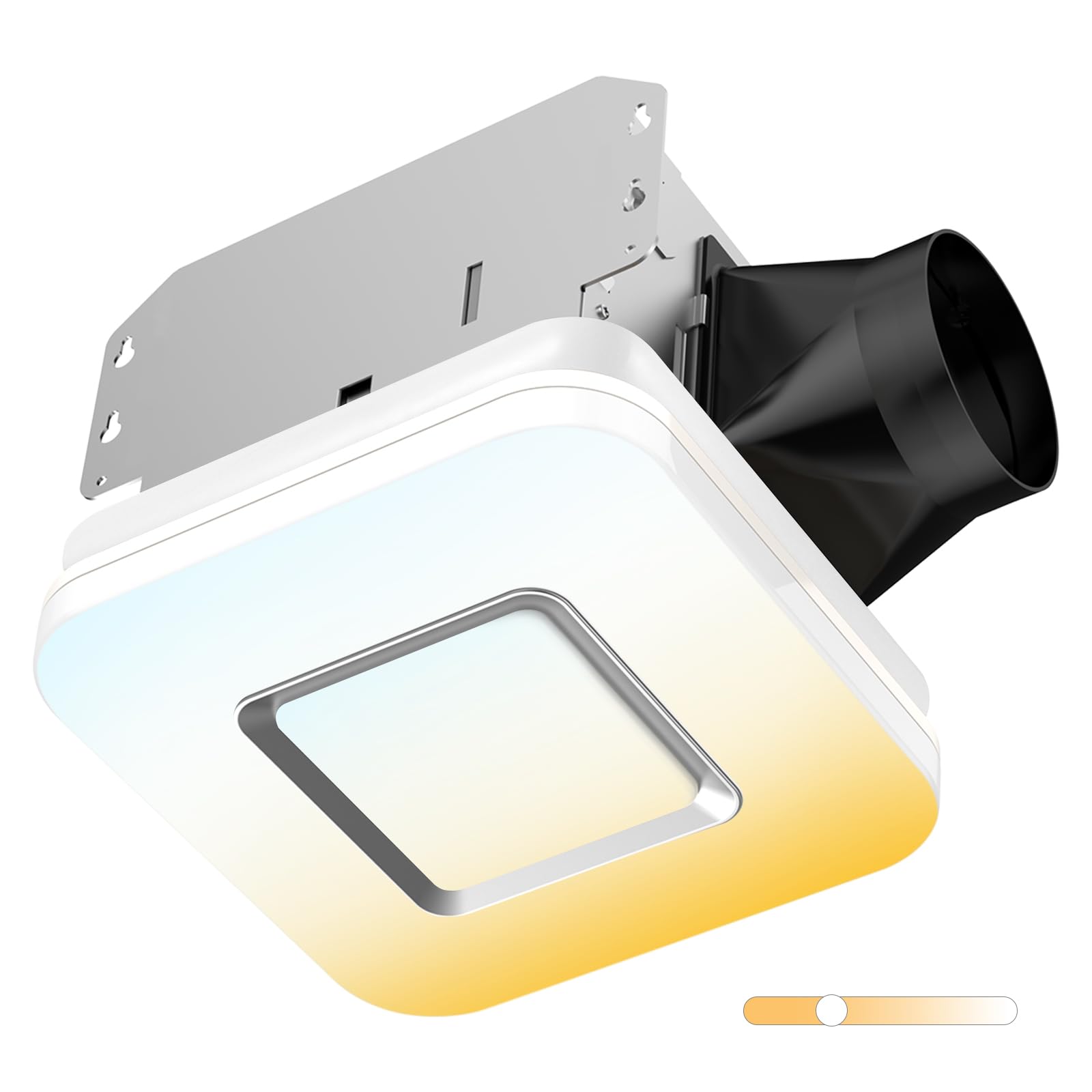
A bright light and a 110 CFM fan in one unit, all installed from inside the room.
If you would rather replace your old fan and your old ceiling light at the same time, this combo handles both. The integrated LED puts out 1500 lumens (a measure of brightness), which is brighter than a lot of standard bathroom fan lights, and you can pick between 3000K warm white, 4000K neutral white, or 5000K daylight to match your other fixtures. A separate 2200K night light adds a soft glow for late-night trips without flipping on the main light.
Ventilation-wise, it moves 110 CFM and covers bathrooms up to 110 square feet, the same airflow as the JOEAONZ and VIVOHOME but doing it as a two-in-one rather than a bare fan. It installs room-side with the included quick-mount bracket, so no attic access is needed. At 2.0 sones, it is a touch louder than the quietest fans here, a small cost for adding a bright light in the same housing. It is ETL and FCC certified for damp bathroom environments and includes a 5-year manufacturer warranty.
Be aware that airflow is the most-disputed point on this model. A meaningful number of owners feel it does not move as much air as the 110 CFM rating implies, and a few go further with sharper criticism. The lighting adjustments are the nicer story: three color temperatures and a night light are settings most fan-light combos leave off entirely. Just check the ceiling opening first, it fits 8.11 by 7.48 inches, so measure before you buy.
The reasons to buy
- 1500-lumen LED with selectable 3000K, 4000K, and 5000K color temperatures
- Separate 2200K night light for soft nighttime illumination
- 110 CFM covers bathrooms up to 110 square feet
- Room-side install with no attic access and a 5-year warranty
The honest trade-offs
- Airflow gets the most criticism from owners of any point on this list
- 2.0 sones is louder than the 1.0-sone quietest picks
- Light color switch can be tricky to reach once installed
Reach for this if: you want the simplicity of replacing a fan and a light with one unit, and a bright, color-tunable light is a priority.
Think twice if: airflow is your main concern or you want the very quietest fan on the list.
Understanding the Specs
CFM (Cubic Feet per Minute)
CFM is the volume of air a fan moves every minute. Bigger bathrooms, more steam, and longer duct runs all call for more CFM. A common starting point is one CFM per square foot of bathroom, so a 50 to 80 CFM unit suits small to mid bathrooms and a 110 to 130 CFM unit suits large ones. A fan rated too low for its room tends to leave mirrors fogged and moisture behind.
Sones (Perceived Loudness)
A sone measures how loud the fan sounds to the human ear. The scale runs low to high, so a 1.0 sone fan is near-silent and a 2.0 sone fan is a quiet hum you mostly forget. Quieter fans often move less air, so the balance for most homes is a fan around 1.0 to 1.5 sones paired with enough CFM for the room size.
Duct Size and Length
The duct is the pipe that carries the air out of the house. Most modern fans use a 4-inch duct, while some older homes have a 3-inch duct. A mismatch is usually fine with a reducer, but a long or narrow duct run can choke airflow and make the fan work harder. Shorter, straighter duct runs let the fan deliver closer to its rated CFM.
Motor Type
The motor is what spins the fan blade. Traditional AC motors are simple and inexpensive, while brushless DC or EC motors run cooler and use less electricity. An EC motor at 12.5W draws a small fraction of what an AC motor pulls, and EC motors are often rated for tens of thousands of hours. The motor type also affects how quietly the fan runs.
FAQ
Will a 110 CFM fan be too strong for a small bathroom?
How quiet is 1.0 sone compared to 2.0 sones?
Can I replace my bathroom fan without going into the attic?
What size duct do bathroom exhaust fans use?
Does a bathroom fan need to be UL listed or ENERGY STAR certified?
How do I know what CFM my bathroom needs?
Will a quieter fan move less air?
Is a humidity sensor fan worth it over a manual switch?
What is the difference between a bathroom exhaust fan and a vent fan?
Do I need a wall or ceiling fan for my bathroom?
Final Thoughts: The Verdict
The crowd favorite is still the Panasonic FV-0511VFL1 because its Pick-A-Flow switch, dimmable LED light, and near-silent DC motor make one fan do the work of three. If a no-attic-access retrofits is your headache, grab the Broan-NuTone Roomside — its 80 CFM at 1.5 sones installs entirely from inside the room. And for the tightest budgets where a small bathroom is all you have, the Harrier Hardware 70 CFM delivers quiet 2.0 sone performance for very little. Whichever you choose, match the CFM to your room size, watch that duct diameter, and you will clear the steam for good.
How We Picked
We do not accept paid placement. Every pick is matched to a real buyer and a real use-case; we do not hands-on test units.
Sources & Methodology
Specifications: manufacturer listings and product documentation. Review insights: verified customer reviews, as of September 2026. Pricing: not shown on this page (it changes often); check the current price via the retailer link.
As an Amazon Associate, KitchPrep earns from qualifying purchases. This does not affect which products we feature.
Related Guides
