
Specs are compiled from manufacturer listings and verified buyer reviews and can change over time — please confirm the key details on the product page before buying.
A chipped tub or a hairline crack in your sink is a small problem that gets expensive fast if you ignore it. Water works its way under the surface, the chip spreads, and suddenly you are looking at a replacement instead of a patch. The good news is that a two-part epoxy repair kit (a resin and a hardener you mix together) can seal most chips, cracks, and small holes in an afternoon. The trick is picking one that actually cures hard, holds up to running water, and blends with your tub’s white instead of leaving a bright patch you will stare at every morning.
I’m Mohammad Maruf — the founder and writer behind KitchPrep. This guide is built by comparing the manufacturers’ published specifications and the patterns across verified customer reviews, so you get each pick’s real strengths and trade-offs instead of marketing spin.
Some kits are paste, some are two-part epoxy, and some come as peel-and-stick patches you just press over the damage — each type suits a different repair. The list below covers all three styles so you can match the kit to your crack, and every pick is a genuinely waterproof option for a best bath patch kit.
Our Picks at a Glance

How To Choose The Best Bath Patch Kit
Before you buy, you need to answer three questions about your damage: what is it made of, how big is it, and how much water hits it every day. A pea-sized chip on a fiberglass tub calls for a different kit than a thumb-sized hole in a ceramic sink or a crack on the floor of a shower pan. Get those three answers straight and the right kit almost picks itself.
Know your surface before you know your kit
Fiberglass, acrylic, porcelain, enamel-coated steel, and ceramic tile all take a two-part epoxy filler well — that is the mix of a resin part and a hardener part you blend in roughly equal amounts. Porcelain sinks and ceramic tile are the hardest and slickest, so the kit needs strong adhesion, which is why the paste-style epoxy kits dominate this category. If your damage sits on a flat vinyl or acrylic panel and you want zero mixing, a cuttable peel-and-stick patch can get the job done in minutes.
Size up the damage first
Small chips and hairlines are the friendliest repair — a thin coat or two smooths out almost invisibly. Deeper cracks and holes need a filler that sets firm enough to sand back flat to the surface. Thick paste formulas stay where you put them, which matters on vertical surfaces like a tub surround where a runny liquid epoxy would sag before it cures.
Color match is the part most people underestimate
On a newer white tub, a pure-white kit blends in and you barely see the repair. On an almond, biscuit, or aged-white surface, that same white kit stands out as an obvious patch. So if your tub is anything other than bright white, pick a kit that includes mixing tints — the little colorant pots you blend into the epoxy (the two-part repair paste) — and mix a small test batch before you commit. Owners consistently report that a tiny speck of dye goes a long way, so start with less than you think you need.
Quick Comparison
| Model | Best For | Repair Type | Item Weight | Material | Amazon |
|---|---|---|---|---|---|
| Tub Repair Kit White, Fiberglass Tub and Porcelain Sink Repair Kit★ Best Overall | Small chips and hairline cracks | Two-part epoxy, 1:1 mix | 5.6 ounces | Fiberglass / Porcelain / Resin | Amazon |
| 10 Pcs Bathtub Hole Patch Siding Wall Repair Kit, WhiteNo-Mix Pick | Flat acrylic and vinyl panels, no mixing | Peel-and-stick PVC patch, pack of 10 | 9.9 ounces | PVC | Amazon |
| LANBOKIT Tile, Granite and Marble Repair Kit (Color Match)Best for Stone | Tile, marble and stone chips | Two-part paste with color tints | 104.9 g | Tile / Marble / Granite / Acrylic | Amazon |
| Tub, Tile and Shower Repair Kit (Color Match), 3.7oz Fiberglass Repair Kit | Owners who want many mixes per kit | Two-part gel epoxy with color tints | 6.87 ounces | Epoxy Resin / Fiberglass | Amazon |
| Fiberglass Tub Repair Kit, Bathtub Repair Kit with Color Match for Cracks | White and aged-white tubs | Two-part paste with color tints | 0.19 kg | Resin | Amazon |
| White Tub & Bathtub Repair Kit – Chip Patch, 5.28oz 3-Pack | Long-term water contact, multi-pack | Push-tube epoxy, 1:1, pack of 3 | 0.29 kg | Plastic | Amazon |
| Fiberglass Repair Kit, Tile Repair Kit for Bathtub, Acrylic, Ceramic | Bigger jobs on mixed surfaces | Two-part paste with 8 color jars | 250 g | Paste | Amazon |
In‑Depth Reviews
1. Tub Repair Kit White, Fiberglass Tub and Porcelain Sink Repair Kit
Our pick — over 4★ from 500+ verified ratings; the strongest balance of quality and price.
The two-tube epoxy that fixes the chip you have been ignoring for months.
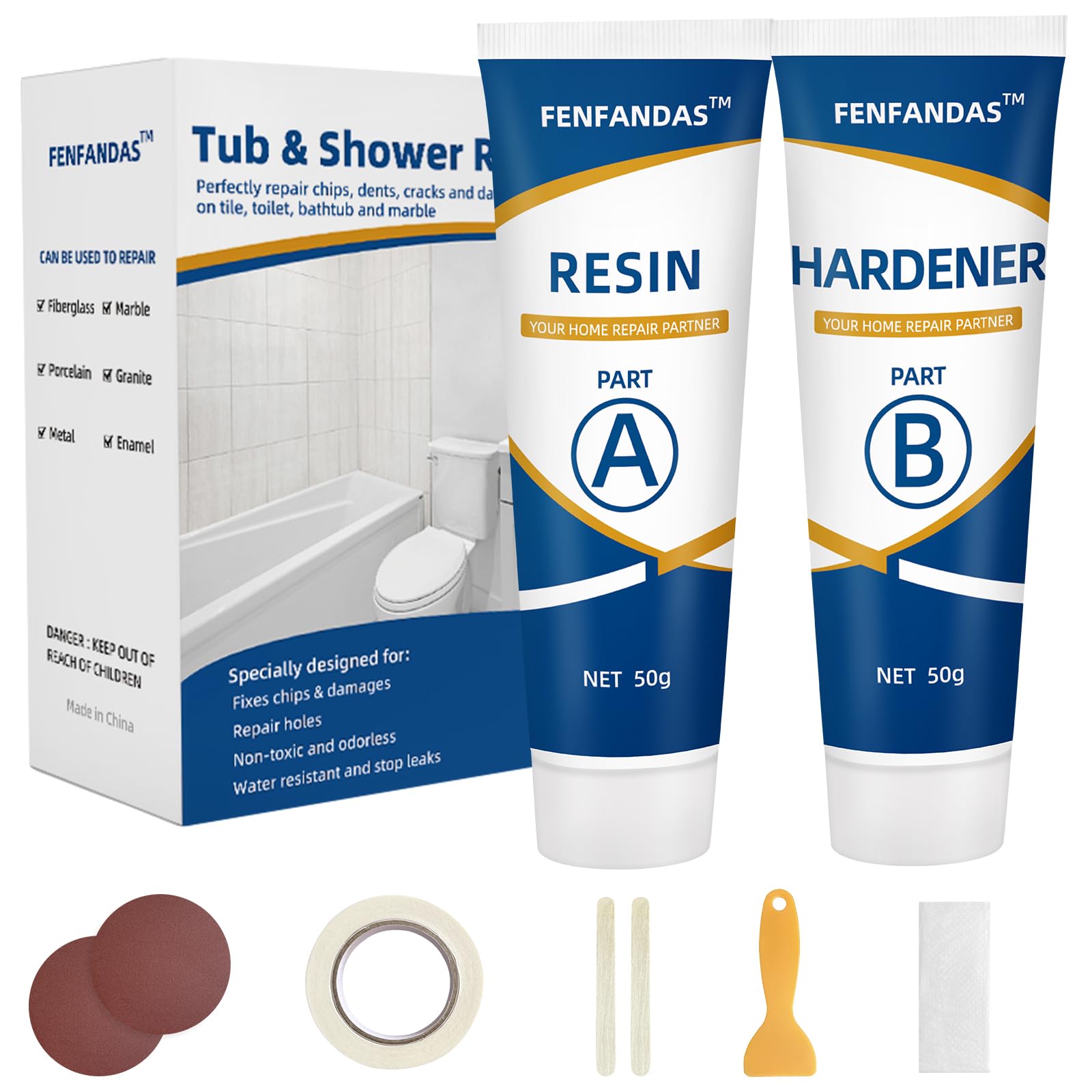
This FENFANDAS kit is the pick for anyone staring at a small chip, scratch, or hairline crack on a fiberglass or acrylic tub, a porcelain sink, or a ceramic tile. You mix part A and part B in a 1:1 ratio — equal amounts of resin and hardener — and the mix turns very hard and firm after 12 hours. It is genuinely simple: the instructions are clear enough that a first-timer can follow them, and everything you need for the job comes in the box. It is rated for fiberglass, acrylic, ceramic, and enamel tubs, plus cast iron, porcelain, ceramic tile, toilet, and cultured marble, so it covers almost any bathroom surface you will meet.
The kit is compact — the whole tube weighs 5.6 ounces and measures 0.95 x 1.5 x 4.5 inches — so it tucks into a drawer and you can store whatever you do not use. That small tube still goes a good distance, which matters because this is the kind of repair you may want to touch up again in a year. What wins people over is the quality of the cured patch: the resin sets firm enough that you can sand it back flush with the surface, so a careful job leaves a smooth finish instead of a lump. Ease of use runs a very close second — the mixing ratio is easy to hold in your head, and there is no complicated tool set to learn.
The real caveat is color. The white here is described by owners as a very bright white — on a bright-white tub it disappears, but on a dark gray chip or an aged, cream-toned tub it will read brighter than the surrounding surface. One buyer put it plainly: “The white is a very bright white. The paint goes on easily, and although it is brighter than the white on the bathtub, it looks a lot better than the dark gray where the tub was slightly chipped.” Durability is the other honest note. Sanded and sealed well, this patch holds; rushed, it can re-crack down the line, and one reviewer noted it cracking after a few months. Applied generously over a properly cleaned, fully dry surface, it works — and it shipped 5-star results for far more buyers than it disappointed.
What it gets right
- Simple 1:1 mix sets very hard and firm after 12 hours
- Sands smooth, so a careful patch blends into the surface
- Works across fiberglass, acrylic, ceramic, enamel, porcelain, and cast iron
- Compact 5.6-ounce tube stores easily for touch-ups
Where you need to think twice
- The white is a very bright white — it shows on aged or cream tubs
- Rushed or under-prepped patches have re-cracked for some
Grab this one: You have a small chip, hairline, or scratch on a white tub or porcelain sink and you want the simplest mix-and-go kit.
Look at a tinted kit instead: Your tub is almond, biscuit, or visibly off-white — the pure bright white will stand out.
2. 10 Pcs Bathtub Hole Patch Siding Wall Repair Kit, White
No mixing, no curing, no sanding — just press a patch over the hole.
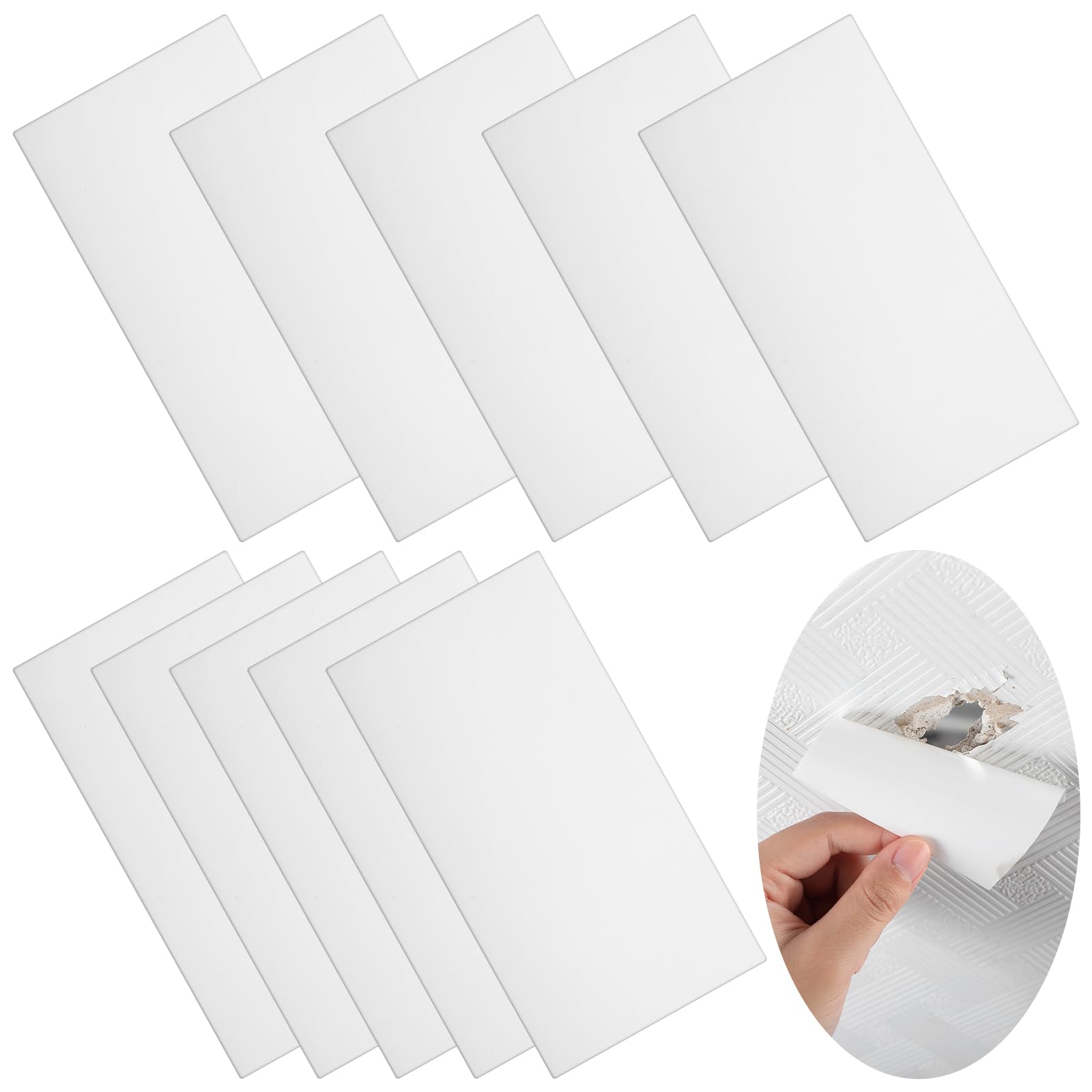
If the very thought of measuring resin and hardener puts you off, this Innconee kit is the alternative. It is a pack of ten white PVC patches that you simply peel and press over the damage, with no other adhesive required and no trays to clean up afterward. That makes it the pick for a flat, low-stress surface — an acrylic shower panel, a vinyl skirting board, a pool liner, or a cracked tub wall where you just want the hole shut. The patch material is waterproof and the backing UV resistant, so it tolerates direct sunlight — which is why the maker lists it for roofs and skylights as well as tubs and sinks.
You get ten patches in the box, and each one measures a generous 11.8 by 5.9 inches, so you can cut it down to the size you need. The full pack weighs 9.9 ounces, and for comparison the epoxy kit at the top of this list weighs 5.6 ounces — that 77% heavier build is simply the bulk of ten large sheets, so it is a lot of patch material rather than a lot of resin. Owners repeatedly note there is far more product than you will ever need for one repair, and that the oversize patch is easy to trim down. On a clean, dry, flat surface the repair holds well; buyers report sealing an acrylic shower crack and it staying put for months with no water getting through.
Here is the honest catch: adhesion depends almost entirely on how clean and flat the surface is. This is a pressure-sensitive tape, not a hardening epoxy, so it cannot bond across a curved tub edge or a textured surround the way a paste kit can. The reviews split on this — some find it strong and effective, while a handful get weak adhesion and peeled edges within hours when the surface was not perfectly prepped. The patch also stays visible on the surface; it seals the hole, it does not disappear into it. It is also rated at 4.0 stars from 74 ratings, the thinnest review base on this list, so treat it as the right tool for flat panels rather than the all-rounder.
The case for it: Ten cuttable 11.8 by 5.9 inch UV-resistant patches with zero mixing — perfect for a flat acrylic or vinyl surface and genuinely quick.
The catch: It is tape, not epoxy, so it needs a clean flat surface and stays visible; on textured or curved surfaces it can lift.
Reach for this if: You want a two-minute fix on a flat acrylic or vinyl panel and have no interest in mixing anything.
Your better route: A curved tub, a textured surround, or a surface you cannot fully dry — pick an epoxy paste kit instead.
3. LANBOKIT Tile, Granite and Marble Repair Kit (Color Match), 3.7 OZ
The paste that hardens so hard you must sand it hours early.
Most bath patch kits sit on a tub shelf. This one is for the stone surfaces — tile, granite, marble, and quartz countertops — where a chipped edge or a drill hole ruins the look. The LANBOKIT kit is a two-part paste, 50 g of component A and 50 g of component B, plus four color pastes, a set of tools, and an instruction manual, all in a compact 1.9 x 1.9 x 1.7 inch box that weighs 104.9 g. It is sold on its color range, with matches listed for white, arctic, beige, cream, light gray, ice gray, cashmere, dark gray, black, almond, biscuit, linen, bone, brown, red, and maroon, and it is compatible with ceramic, fiberglass, marble, porcelain, and stone.
The defining trait here is hardness. This paste cures (sets hard) to a point where sanding becomes near-impossible after about 24 hours — dry and hard enough that if you want a flat finish you have to shape it early, around the 4-hour mark. For a tile chip or a granite surface defect that you will look at every day, that hardness is exactly what you want; a soft patch on a countertop would be a scratch magnet. What the buyers praise most is that it simply works on the small holes in stone tile and marble they bought it for, and the instructions make it approachable even if you have never mixed a repair paste before.
Color is where this kit demands patience. On a natural sand-colored stone the existing variations in the material make a close match easy, but on solid, uniform surfaces the tinting becomes guesswork — buyers describe having to try two or three batches before the shade lands, and one noted that a mustard additive immediately darkened the mix, forcing a bigger batch of adhesive to dilute it back to light beige. There is a second practical warning worth knowing going in: this paste cures hard fast, so keep masking tape away from the hole edge, because the residue sets into an unsandable ridge. Plan an early sanding window, keep the tint tiny, and this kit turns a chipped tile into a non-issue.
Why it earns its place: The cured hardness is the standout — it stands up on tile and countertops where a soft patch would not, and the color-paste range covers the common stone shades.
What to plan for: Sand within a few hours of applying, not the next day, and keep the colorant to a speck at a time to avoid overshooting the shade.
Best for: Chipped tile, marble, or granite where hardness and a close stone-tone match matter more than a five-minute finish.
Skip your purchase if: You want a forgiving kit for a pure white tub — this is built for stone tones and rewards early sanding.
4. Tub and Fiberglass Shower Repair Kit White, Porcelain Tile Repair Kit

Enough epoxy to re-do the job until the color is right.
Ask anyone who has patched a tub and they will tell you the same thing: you often mix two or three batches before the shade is close, and a small kit runs dry before the last try. The HT HOMETINKER kit is the answer to that, with a 3.7-ounce gel epoxy that owners describe as enough for multiple attempts and repeats. It works on fiberglass, acrylic, ceramic, porcelain, gel-coat, enameled steel, and enameled cast iron, and it is sold with a 5-year durability guarantee — the maker’s stated term for how long the patch is meant to hold. The color tint set covers white, arctic, milk white, dune, biscuit, bisque, almond, linen, bone, sandbar, ice gray, cashmere, thunder grey, and black.
It is a gel rather than a runny liquid, which means it holds its shape on a slope, and it cures hard enough that a finished patch needs real abrasion to smooth out. The maker states the formula is non-toxic and odorless, and credits a nanotechnology base for the mix setting hard while staying workable long enough to shape. In practice owners find the working time generous: there is enough open time to spread and shape before it firms, then it cures overnight. For a badly cracked sink or a thirty-year-old resin tub, that patience pays off — a couple of coats 24 hours apart, sanding between, seals the crack watertight.
Two things to know before you mix. First, the instructions themselves conflict on cure time — they state both a 24-hour and a 3-to-4-hour figure, so use the longer window if you want the patch at full strength. Second, sanding cured epoxy is harder than the marketing makes it sound; a fine grit of 1000 or higher works far better than a coarse pad, and owners have resorted to a rotary tool for the stubborn edges. It is also a small gel bottle with only one mixing stick and no polishing compounds, so heavy upgrades like polish and high-grit paper are on you. Get past that and this is the best value in the category for someone with several small chips to fix across the house.
What makes it stand out: A generous gel volume, a firm overnight cure, and a wide tint range that lets you keep mixing until the shade is close — the 5-year durability guarantee backs the finish.
Where it asks work of you: Cure time is stated two different ways in the leaflet, and the cured epoxy is genuinely hard to sand without fine-grit paper or a rotary tool.
Matches you best when: You have several chips and dings to patch and want a kit that does not run out before the color matches.
Not the one for you if: You want a one-shot, set-the-timer kit with no sanding — look for the no-sand peel-and-stick patching above.
5. Fiberglass Tub Repair Kit, Bathtub Repair Kit with Color Match for Cracks
The one that knows your tub is not really white — it is aged white.
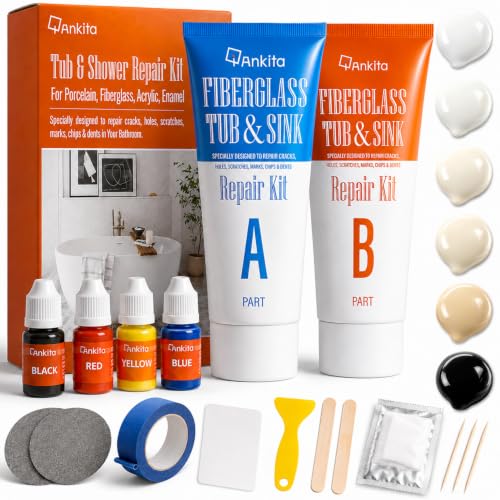
Almost every patch kit says it color-matches, but the Ankita kit is the one that spells out what you are matching against: white, aged white, off-white, almond, beige, bone, biscuit, and ivory. That list is the whole point of the pick — an older fiberglass or acrylic tub is rarely a clean white, and a bright-white patch on it draws your eye every time you step in. Inside the set you get the two-part resin system plus the mixing tints to shift the shade toward a yellowed or cream surface. It is rated for fiberglass, acrylic, porcelain, enameled steel, cast iron, and ceramic tile, so the surrounding bathroom is covered too.
This is a thick, hard-curing paste — the kind that stays where you put it on a wet-area repair. The formula is built to bond and set water-resistant, which makes it a genuine option for a shower floor or pan, not just an ornamental chip. The kit comes in a compact 2.4 x 5.47 x 2.63 inch box and weighs 0.19 kg, so it stores easily between jobs. The pouch of epoxy inside is generous enough to cover several of the small cracks and deep scratches owners buy it for, and the sanding step afterward is straightforward once the patch has firmed up. On a fourteen-year-old tub the aged-white tint is the difference between a repair and a blemish.
The color mixing is the part that tests patience. The tints are highly concentrated, so a speck of yellow goes a long way — and one owner found that even a tiny amount turned the mix banana-yellow instantly, requiring sample batches to walk it back. The color chart makes the correction less useful than it looks, so plan on mixing two or three samples on a scrap of card before you apply. There is also a portion-control risk in cheaper runs — some units ship with diluted or separated color portions, so this is a buy where you want the kit to arrive intact. Work in tiny increments and the reward is a genuine aged-tub match, which is rare in this category.
The buyer it fits: You have an older, off-white, almond, or ivory tub and want a patch that disappears into it rather than sitting on top as a bright white spot.
Ideal for: Older fiberglass and acrylic tubs in aged-white, almond, or ivory tones, plus shower-floor and shower-pan repairs.
Leave it for someone else if: You want a simple to use, no-mix no-guess experience — this kit rewards patience with the colorants.
6. White Tub & Bathtub Repair Kit – Chip Patch, 5.28oz 3-Pack
Three tubes of the formula built to shrug off hot water.
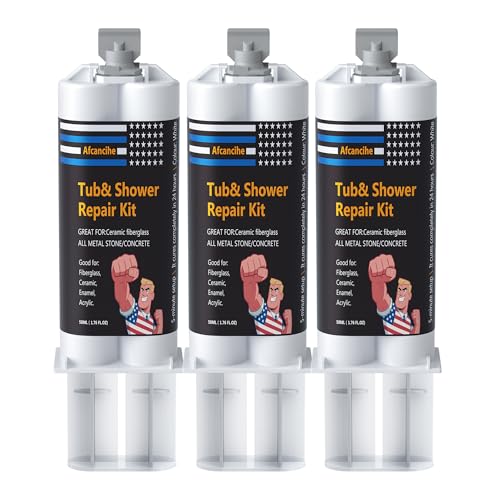
Most kits are one tube. This Afcancihe set is three, and that changes who it suits — it is the pick for someone with more than one chip to fix, or who wants a tube left in the drawer for the next one. The repair material itself is a two-in-one push tube you dispense in a 1:1 ratio, which keeps the mixing simple and precise. The formula is listed as odorless, waterproof, and heat-resistant, with the maker stating it withstands temperatures up to 100°C — well beyond any bath water. The maker also reports it does not shrink, yellow, or mold after curing, and releases no harmful substances once set.
This is engineered for the hardest part of a bath repair: the surface that stays wet. The kit is explicitly built for long-term water contact, which covers bathtubs, toilets, washbasins, and even marine fiberglass. That heat tolerance and non-shrink claim matter because the most common reason a tub patch fails is thermal movement — hot water, cold water, repeat — cracking a rigid repair. Curing is a straightforward 1:1 mix, applied and left to set level for 24 hours. Owners have confirmed the cured film can be sanded to a flat white finish with a 120-grit orbital pad, and that on a vertical crack the sticky paste stays put and holds.
The push-tube format is both the strength and the risk. When it works, you get a cleaner mix with less mess than two separate jars, and the three-pack means three fresh tries. When it does not, one tube can clog on a side, making the 1:1 ratio hard to hold, and since both parts are white it is not easy to tell by eye whether the mix is right. On a horizontal crack the flat, white finish goes on and stays; several owners have used it on pedestal sink cracks and pulled an unnoticeable result. A small handful report the cured patch cracking soon after, so hit the 24-hour set before you use the fixture and apply the mixed paste at the thickness the maker wants. The three tubes easily cover the kitchen-bathroom run of small repairs.
Why the three-pack earns it: Hot-water tolerance up to 100°C and no reported shrinking, yellowing, or molding make these three tubes a good long-term supply for a busy bathroom.
The catch to size: The push-tube can clog on one side, throwing the 1:1 ratio off — inspect both outlets before you dispense.
Built for you if: You have several tub, sink, or toilet chips to fix and want a heat-resistant formula in a triple supply.
Not your pick if: You want a tinted kit for an off-white tub — this one is white only.
7. Fiberglass Repair Kit, Tile Repair Kit for Bathtub, Acrylic, Ceramic

Eight color jars and a big tub of paste for the whole bathroom.
If you would rather buy once and fix everything in the house — the tub chip, the cracked sink, the tile that lost a corner — the Hupeyna kit is the bulk option. It is 250 g of two-part paste in a 7.28 x 3.35 x 1.42 inch kit, and it arrives with more equipment than the rest of this list: mixing sticks, gloves, a spatula, a mixing cup, a palette, and nine sanding disks. The color set goes further than most too — white, black, yellow, light yellow, red, blue, coffee, and green, all in resealable jars you can re-open for the next job. Mix part A and part B 1:1 and the mix cures in 24 hours to a smooth, hard surface that blends into the surrounding material.
The breadth is the real reason to pick it. Compatible surfaces run from fiberglass, enamel, and acrylic to porcelain, granite, quartz, marble, and floor tile — a list that covers essentially every bathroom surface you will hit. What owners keep coming back to is the color range: the eight jars give you the range to match a white repair, a warm-toned repair and a dark repair from one box. The paste is waterproof and heat-resistant, which suits a tub or sink that sees hot water daily, and the cured surface does not need a topcoat. The kit is honest about being for someone doing several pieces rather than one and done — the large paste volume means you are not rationing a tiny tube.
The hiccups are in the small handling details. The dye bottles arrive sealed with a nib top that has to be pierced with a pin; miss the technique and the first bottle’s top can pop off and spill. The resin itself is described by some owners as slightly on the expensive side for the volume, though the 250 g kit and its tool set balance that out, and a small number found their repair failing and the tub cracking again months later — most often, it seems, where the surface was not fully cleaned or the resin was not spread wide enough. The cured mix is very hard, so planning the final look before it sets saves you sanding. Take the prep seriously and this is the highest-capacity kit on the list.
Where it wins: Eight color jars, a 250 g paste volume, and a full tool kit — enough to repair chips, cracks, and holes across an entire bathroom in one purchase.
What to expect: The dye nibs need piercing carefully, and the mixed paste cures hard quickly, so plan your finish before it firms.
For the multi-repair household: You have a tub, sink, and tile to fix and want one large kit with the color range to cover them all.
Overkill for: A single small chip — the smaller paste kits above do that job with less material left over.
Understanding the Specs
Repair Type: Epoxy Paste, Gel, or Peel-and-Stick
A two-part epoxy is a resin and a hardener you mix in a set ratio — usually 1:1 — and the chemical reaction is what makes the patch cure hard. A paste epoxy stays where you press it, which is what you want on a vertical tub wall. A gel is thinner and easier to spread but can run on a slope. A peel-and-stick PVC patch skips the mixing entirely, but it is tape rather than a hardened repair, so it needs a flat, clean, dry surface and it stays visible on top of the damage.
Cure Time and Sanding Window
Cure time is how long the mixed epoxy needs to reach full strength — most kits here cure in about 24 hours, and some fast-setting ones are firm in a few hours. The sanding window is the period when the cured patch is hard enough to smooth but not yet too hard to shape. Many two-part pastes cure so firm that sanding past a certain point becomes a chore, which is why some kits tell you to shape the edge early, around the 4-hour mark, rather than the next day.
FAQ
Can a bath patch kit repair a crack in an acrylic bathtub?
How long does a tub repair patch last?
Do bathtub repair kits come in colors other than white?
How do I color-match the epoxy to my tub?
Can I use a bath patch kit on ceramic tile or a porcelain sink?
How long should I wait before using the tub after repairing it?
Can a peel-and-stick patch work instead of epoxy?
What is the difference between a paste epoxy kit and a liquid repair kit?
Do I have to sand the repair after it cures?
Is it safe to use a bath patch kit around pets and children?
Final Thoughts: The Verdict
If you want one pick to buy without overthinking it, the bath patch kit winner is the Tub Repair Kit White, Fiberglass Tub and Porcelain Sink Repair Kit — it mixes in a simple 1:1 ratio, cures very hard in about 12 hours, sands smooth, and works on fiberglass, acrylic, ceramic, enamel, porcelain, and cast iron. It is the safest all-rounder for a small chip or hairline crack on a white tub or sink.
If your tub is not a clean bright white — almond, biscuit, ivory, or aged — skip the pure-white kits and grab the Fiberglass Tub Repair Kit, Bathtub Repair Kit with Color Match for Cracks, which is the only pick on this list that named-matches aged white and off-white from the start. For a flat acrylic or vinyl panel where you want the repair done in two minutes with no mixing, the 10 Pcs Bathtub Hole Patch Siding Wall Repair Kit is the one to reach for. And if you have a whole bathroom of chips to fix — tub, sink, and tile — the Fiberglass Repair Kit, Tile Repair Kit for Bathtub, Acrylic, Ceramic gives you the most material and the widest color range in a single box. Start with the clean, dry surface and a tiny bit of tint, and any of these will seal the damage before it grows.
How We Picked
We do not accept paid placement. Every pick is matched to a real buyer and a real use-case; we do not hands-on test units.
Sources & Methodology
Specifications: manufacturer listings and product documentation. Review insights: verified customer reviews, as of September 2026. Pricing: not shown on this page (it changes often); check the current price via the retailer link.
As an Amazon Associate, KitchPrep earns from qualifying purchases. This does not affect which products we feature.
Related Guides
