
Specs are compiled from manufacturer listings and verified buyer reviews and can change over time — please confirm the key details on the product page before buying.
If your bathroom mirror fogs up and stays fogged, the fan is rarely the problem — the duct behind it is. A bath fan duct is the tube that carries steam, damp air, and smell from the ceiling vent to the outside of your house. When it is the wrong size, too thin, or crushed into a tight bend, that moisture has nowhere to go but back into the room. This guide covers the eight ducts worth buying, what each one is genuinely good at, and which one fits your ceiling, your fan, and your climate.
I’m Mohammad Maruf — the founder and writer behind KitchPrep. This guide is built by comparing the manufacturers’ published specifications and the patterns across verified customer reviews, so you get each pick’s real strengths and trade-offs instead of marketing spin.
Length, diameter, and layer count decide whether a run stays quiet and dry for years. Here is what separates the bath fan duct options that hold up from the ones that sag, tear, or drip.
Our Picks at a Glance


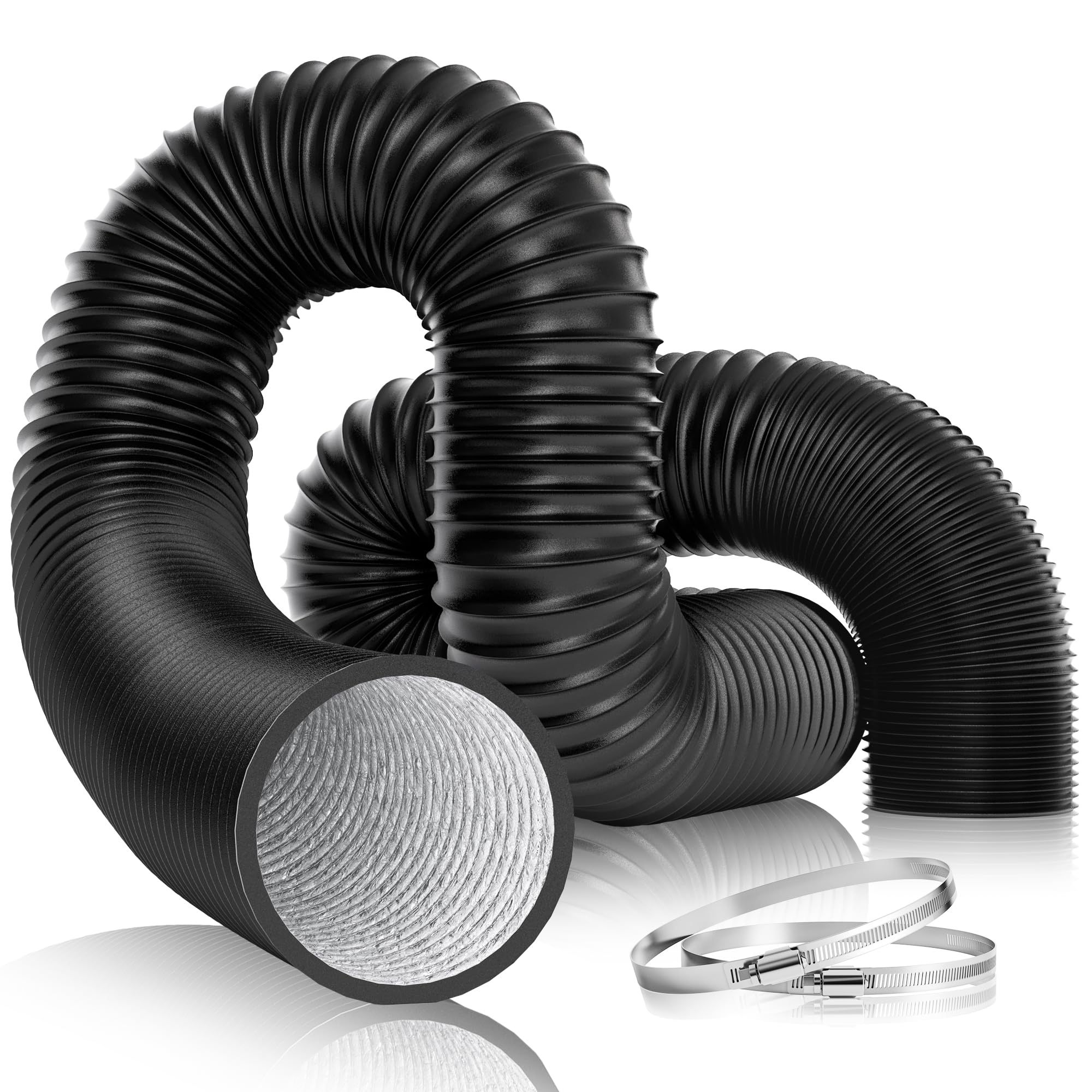
How To Choose The Best Bath Fan Duct
The duct is the least glamorous part of a bathroom fan install, and it is the part that decides whether the job works. Get three things right — diameter, layer count, and insulation — and the rest is just neat routing.
Match the diameter to your fan, not to the box label
Almost every bathroom exhaust fan sold in North America has a 4-inch outlet, so 4-inch duct is the default. The trouble is that “4 inch” on a listing can mean the outer sleeve, not the inner tube. A duct whose inside diameter runs a few millimeters small will fight you at the fan collar and at the wall cap, and it will not seal against a rigid coupler. Measure the fan collar before you order, and if your run has to connect to something rigid, choose a duct whose outside diameter is listed as 4 inches or above rather than below.
Count the layers before you trust the thickness
A single-layer foil duct is the cheapest thing on the shelf and the fastest to tear. Two layers of foil with a steel wire helix is the working minimum. Three and four layers add a PVC or PET film that blocks light, resists cuts, and holds up better in damp air. More layers also make the tube less likely to kink when you push it around a corner — and a kink is where airflow dies and moisture starts pooling.
Decide if you need insulation
If your duct runs through a cold attic, an unheated crawlspace, or any space that drops below freezing, warm damp air inside a bare foil tube will condense on the cold wall of the duct. That water has to go somewhere, and it usually ends up dripping back toward the fan. An insulated duct wraps glass wool around the inner tube so the air stays warm all the way to the outside wall. It also cuts the noise of moving air, which is the other reason people reach for it. If your run is short and entirely inside the heated part of the house, plain foil is fine and costs less.
Quick Comparison
| Model | Best For | Diameter | Length | Construction | Amazon |
|---|---|---|---|---|---|
| AC Infinity Flexible 4-Inch Aluminum Ducting★ Best Overall | Most bathroom fan installs | 4 inches | 25 feet | Four layer with steel wire | Amazon |
| Hon&Guan Dryer Vent Hose 4” 16FTBest All-Rounder | Tight spaces and long stretches | 4.33 inches outside | 16 feet | Three layer PVC with steel helix | Amazon |
| VIVOSUN 4 Inch 25 Feet Flexible Aluminum DuctingBest for Long Runs | Light control and heat resistance | 4 inches | 25 feet | Triple layer with steel wire | Amazon |
| iPower 4 inch 25 feet Aluminum Foil Ducting | Straightforward budget venting | 4 inches | 25 feet | Four layer foil and PVC | Amazon |
| YIJUHOU 4-Inch Dryer Vent Hose 26FT | Long dryer or bath runs | 4 inches | 26 feet | Four layer with black PVC film | Amazon |
| Dundas Jafine FD420ZW Flexible White Vinyl Duct | Bathroom fans and humidifiers | 4 inches | 20 feet | Single wall vinyl | Amazon |
| Hon&Guan 4” Insulated Flexible Duct 8 FT | Quiet, condensation-free runs | 4 inches | 8 feet | Four layer with glass wool core | Amazon |
| Cuchiilo 4 Inch Insulated Flexible Duct 25 Feet | Cold attics and long insulated runs | 4 inches | 25 feet | Insulated, R-4.2 glass wool | Amazon |
In‑Depth Reviews
1. AC Infinity Flexible 4-Inch Aluminum Ducting, 25-Feet Long
Our pick — over 4.5★ from 8,000+ verified ratings; the strongest balance of quality and price.
A four-layer 4-inch duct that stays round through tight ceiling bends.
You get 25 feet of reach from a tube that is 4 inches in diameter, so you can run from most bathroom ceilings to a soffit vent with slack left for a bend or two. What makes this one stand out is the four-layer wall: aluminum foil, a thermoplastic layer (a flexible plastic sheet), and a steel-wire spiral that lets the tube flex without collapsing. That build is why it earns 4.7 stars across 8,000+ ratings, and buyers mention quality more than anything else.
The steel-wire spiral is the part you feel when you install it. You can push the tube through a tight joist bay and it springs back into a round shape instead of folding flat, so the air keeps moving at full width. The two stainless steel clamps are included, and they tighten down without stripping. Buyers also note the protective rubber coating on the outside, which keeps sharp metal edges from puncturing the tube during a rough pull through old framing.
Here is the honest part, and it is a small one. That matters most if you are trying to reach a far soffit vent with a lot of turns. If your run is under 20 feet with a normal amount of bending, the difference will not touch you. The fit is also listed as a mixed area, so check that your fan collar and wall cap are true 4-inch fittings before you order.
What works
- Four layers of aluminum foil and thermoplastic resist leaks, tears, and cuts
- Steel-wire spiral keeps the tube round so airflow does not choke at bends
- Two stainless steel 4-inch clamps come in the box
- 4-inch diameter by 25 feet covers most bathroom runs
What to weigh
- Real usable length falls short of 25 feet on anything but a flat, straight run
- Fit is mixed — confirm your fan collar and wall cap are true 4-inch fittings
Buy this one when: your bathroom run has a couple of bends and you want a duct that will not kink or split on the way through.
Measure first if: you need the full 25 feet — buy a spare length or pick the 26-foot option instead.
2. Hon&Guan Dryer Vent Hose, 4” Flexible Duct 16FT with 2 Duct Clamps
A 16-foot black PVC-sleeved duct built to thread tight joist bays.
This is the duct you buy when the run is short but the path is ugly — around joists, behind a knee wall, through a narrow chase. The honest draw is the outer diameter: it measures 4.33 inches, which is where the extra girth comes from, and that is why this tube stretches around obstructions a thinner foil duct will not. Note the trade-off that comes with that size. The 4.33-inch figure is the outside of the black PVC sleeve (a plastic protective cover), and some owners find the working diameter runs a touch small for rigid couplers (the metal connectors that join duct sections) — one buyer reports it being several millimeters under a 3-inch hose and unable to seal with that brand’s couplers. Match it to a 4-inch fan collar or a proper 4-inch wall cap, and it slides right on.
The value sits in the three-layer construction: two layers of aluminum foil with a PET layer (a strong plastic film) and a steel-wire helix (a coiled wire that holds the shape), wrapped in thick black PVC that keeps light from leaking through. That light-blocking matters in grow rooms, and it does no harm in a bathroom closet either. The tube handles temperatures from -30℃ to 150℃, so it shrugs off the warm damp air a bathroom fan pushes through it. The 16-foot piece can be cut down with a wire cutter and a utility knife if you only need a few feet. Two clamps are in the box.
What this duct does not give you is length, and that is the whole reason to think twice. At 16 feet it comes up short against the 25-foot VIVOSUN and AC Infinity ducts in this list, so a long overhead run to a far gable vent is not its job. If your fan is near an exterior wall and you need maybe six to ten feet with a couple of tight turns, this is the pick. A buyer with a portable AC who wanted to vent heat outside found it more than long enough for the job.
Why it earns a spot: three protective layers plus a lightproof PVC sleeve at a budget-friendly tier, with the flexibility to round tight corners without fighting you.
Worth grabbing for: short, contorted bathroom runs where flexibility and a lightproof sleeve matter more than total length.
Walk past it if: your vent is more than 16 feet away — you will want the 25-foot VIVOSUN or AC Infinity instead.
3. VIVOSUN 4 Inch 25 Feet Flexible Aluminum Ducting with 2 Clamps, Black
A flame-retardant black foil sleeve that blocks light and resists heat.
Black is doing real work here. The outer layer is a flame-retardant aluminum foil, and the dark finish keeps light from bouncing around inside the tube — a small thing until you run a duct past a grow tent or a light fixture and do not want a glow leaking through the sleeve. This is a triple-layer build: foil on the inside and outside with a PET thermoplastic middle (a tough plastic layer) that resists cuts, tears, and leaks, wrapped around a steel-wire helix so you can twist and shape it by hand. It runs 4 inches across and 25 feet long, which lands it right beside the AC Infinity and YIJUHOU options on reach.
Weight is worth mentioning because this is a ceiling job. The whole 25 feet comes in at about 1.06 kg, which is light enough to hold up with one hand while you tighten a clamp with the other. That is the difference between a fifteen-minute install and a forty-minute one when you are balancing on a step stool. Two clamps ship in the box, and the front-loading or top-loading dryer compatibility means this works for a dryer duct and a bathroom fan duct with no compromise.
Where to be careful: this duct is not insulated, and heat escapes through it with the hot air. If it runs through a cold attic, that warm damp bathroom air will cool on the way out and condense. The trick most owners use is to wrap it with external insulation, which adds cost and a step. Buy it for a warm-route bathroom or a dryer that already moves plenty of heat. Two more things to know: durability is a mixed area, so treat the tube gently when you stretch it, and the real usable length runs shorter than the label on anything but a straight pull.
The straightforward case: triple-layer foil, a light-blocking black sleeve, a flame-retardant outer skin, and a 1.06 kg roll that is easy to wrestle overhead.
The trade-off: no insulation at all, so a cold attic run will need a wrap or it will sweat.
Reach for this if: your duct route stays in a warm space and you want a light, tough, light-blocking tube at a mid-range price.
Look elsewhere if: the duct crosses a cold attic — you want an insulated duct for that.
4. iPower 4 inch 25 feet Flexible Air Aluminum Foil Ducting

A four-layer foil-and-PVC duct for short, straight indoor runs.
Four layers of protection at an entry-level price is the pitch. The wall stacks aluminum foil, a PET layer, more foil, and a thick PVC skin, which is the same layering idea the pricier ducts use. It takes heat from -22°F up to 212°F, resists corrosion, and includes a pair of 4-inch stainless steel clamps. Reach is 25 feet at 4 inches across, and the tube bends freely in any direction when you are working it through tight ceiling space.
The install story is the strongest thing here. Owners describe it going on easily, and one who fitted it to a Maytag dryer reported it slipping on without a fight. What the crowd appreciates most is the function — it does the job it is selling, and at this price that is the point.
Two honest caveats. The wall is thinner than a premium four-layer duct, so it flexes more under pressure and you want to support it with a hanger rather than let it stretch across a long unsupported span. The other is diameter. Some owners find it snug or small against a true 4-inch connection — one reported a tight fit that needed patience — so if your fan collar or vent cap runs on the narrow side, expect to work at it. If your run is short, straight, and indoors, this is a fair way to save on a job that does not need the heavy stuff.
Good to know
- Four-layer foil-and-PVC wall at a budget-friendly tier
- Temperature range of -22°F to 212°F handles bathroom and dryer heat
- 25 feet of reach with two 4-inch stainless steel clamps included
- Installs easily with bends in any direction
Keep in mind
- Thinner wall than a premium four-layer duct — hang it, do not stretch it
- Diameter runs snug on some 4-inch connections, so expect a patient fit
This one suits: a short, straight, indoor run where four layers of protection matter more than thick-walled durability.
skip it if: your duct has to ride a long unsupported span or mate with a fussy rigid coupling.
5. YIJUHOU 4-Inch Dryer Vent Hose 26FT

26 feet of four-layer duct when the soffit vent sits just out of reach.
Twenty-six feet at 4 inches across is the longest duct in this group, and when you are stretched across a wide bathroom ceiling that one foot is the difference between finishing the job and ordering a second roll. That length is the headline, but the build is what earns the praise — four layers of protection with a steel-wire core, and a black PVC film on top to blot out light and dampen the sound of moving air. Temperature range runs from -22 to 260°F, which covers anything a bathroom fan or dryer will produce.
The PVC film also makes the tube easy to work with. Owners describe bends going smoothly, no ripping, and a smooth feel as the tube slides over ductwork — and the thumbscrew clamps included in the box get their own specific mention for being genuinely easy to tighten. Some push the tube over the collar and tighten a clamp without a single tool beyond their hands.
The one caveat is worth flagging because it is specific and it is a real thing. The PVC film has a strong off-gassing smell when you open the bag — a buyer who noticed it described it as strong enough that the duct is not suitable for pushing supply air into an occupied space without letting it air out first, while still calling the quality and price excellent for an exhaust run. For a bathroom fan, that trade-off lands on the right side: the duct is exhausting air out of the room, not delivering it in, so a day or two of airing before install is all you need. Nothing here is a dealbreaker for the job this duct is built to do.
The read: the four-layer build, the light-blocking PVC film, the long 26-foot reach, and the easy thumbscrew clamps add up to a lot of duct at a mid-range price.
Best matched to: a long bathroom or dryer run to a distant exterior wall, where the extra length and the smooth install matter.
Let it air first if: the smell-sensitive or the venting-an-occupied-space concern applies to your install.
6. Dundas Jafine FD420ZW Flexible White Vinyl Duct, 4-Inches by 20-Feet

Single-wall white vinyl that coils through corners rigid duct cannot.
If your bathroom duct has to thread behind a knee wall and turn twice in three feet, a thin vinyl tube is the answer. This is a single-wall vinyl duct, 4 inches by 20 feet, and it is the most flexible thing in this list by a wide margin — owners describe it coiling through tight corners far more easily than steel flex-duct. It is explicitly made for general-purpose exhaust including bathroom fans and surface-mounted humidifier units, and it is not for dryer venting. Two clamps are included, and the connections work fine even if the clamps themselves feel light.
The thing to plan around is the smell. Fresh vinyl off-gasses, and the strong chemical odor on first open is the single most common complaint on this duct, so it is worth unrolling it somewhere ventilated and letting it air out for a day or two before you install. It also matters where you vent it: this duct is best used for exhaust out of the room, not for pushing air into a living space. Neither issue is unusual for vinyl, and both go away with time.
Durability is a mixed call here. A few owners find it sturdy and long-lasting — one who replaced a dryer vent hose with it called it far better than the easily torn aluminum it replaced — while others report it tearing if you are rough installing it. The honest read is that this duct wants gentle hands. It is also only rated 4.1 overall across roughly 900 ratings, the lowest score in this group, so if you want the reliability that comes with a four-layer foil duct, this is not that product. It is a good flexible duct for a bathroom fan in a tight spot and nothing more ambitious.
Pick it when: your run has to twist through tight framing and you want the most bendy duct on the shelf.
Think twice if: you want four-layer toughness or a duct that will not need airing out before install.
7. Hon&Guan 4” Insulated Flexible Duct 8 FT, Black Noise Reducer Hose

An 8-foot glass-wool insulated duct that cuts fan noise up to 50%.
Two problems handed to you at once: a noisy fan and a duct that sweats in a cold attic. This one solves both. The construction is four layers with a centrally placed glass wool core, wrapped in aluminum foil and PVC. The glass wool does the work — its fluffy, dense internal structure absorbs sound rather than reflecting it, and the maker claims up to 50% noise reduction, which lines up with what buyers report. It also insulates, with a temperature range from -22°F up to 302°F, so warm damp air stays warm the whole way out.
Owners describe the difference plainly. One replaced a portable AC exhaust hose and found the new tube barely warm to the touch and noticeably quieter, with a dramatic drop in the heat the old hose threw off. Another says it significantly reduced the rumble from a dryer hose. Installation is straightforward, the tube holds its shape when you bend it, and the reinforced foil ends take the clamps cleanly. Two clamps are included.
The honest catch: this duct is only 8 feet long. For a compact bathroom that vents right through a nearby wall, that is plenty and the short length keeps the airflow strong. For a longer run to a far soffit, you will need the 25-foot insulated Cuchiilo instead. The other thing to know is that the inner foil is thin — a buyer who used it on an RV diesel heater said the thin inner foil made the clamp connection a challenge without tearing. Treat the inner layer gently at the connection point, and it holds.
Why buyers keep coming back: the sound dampening is the standout — a rumbling fan hose becomes a mild hum, and the insulated wall stops condensation in an unconditioned space.
Best fit for: a compact bathroom where the fan is loud and the duct crosses a cold attic or crawlspace.
Not the one for: a long run — at 8 feet, this reaches the next room, not the far end of the house.
8. Cuchiilo 4 Inch Insulated Flexible Duct, 25 Feet, R4.2
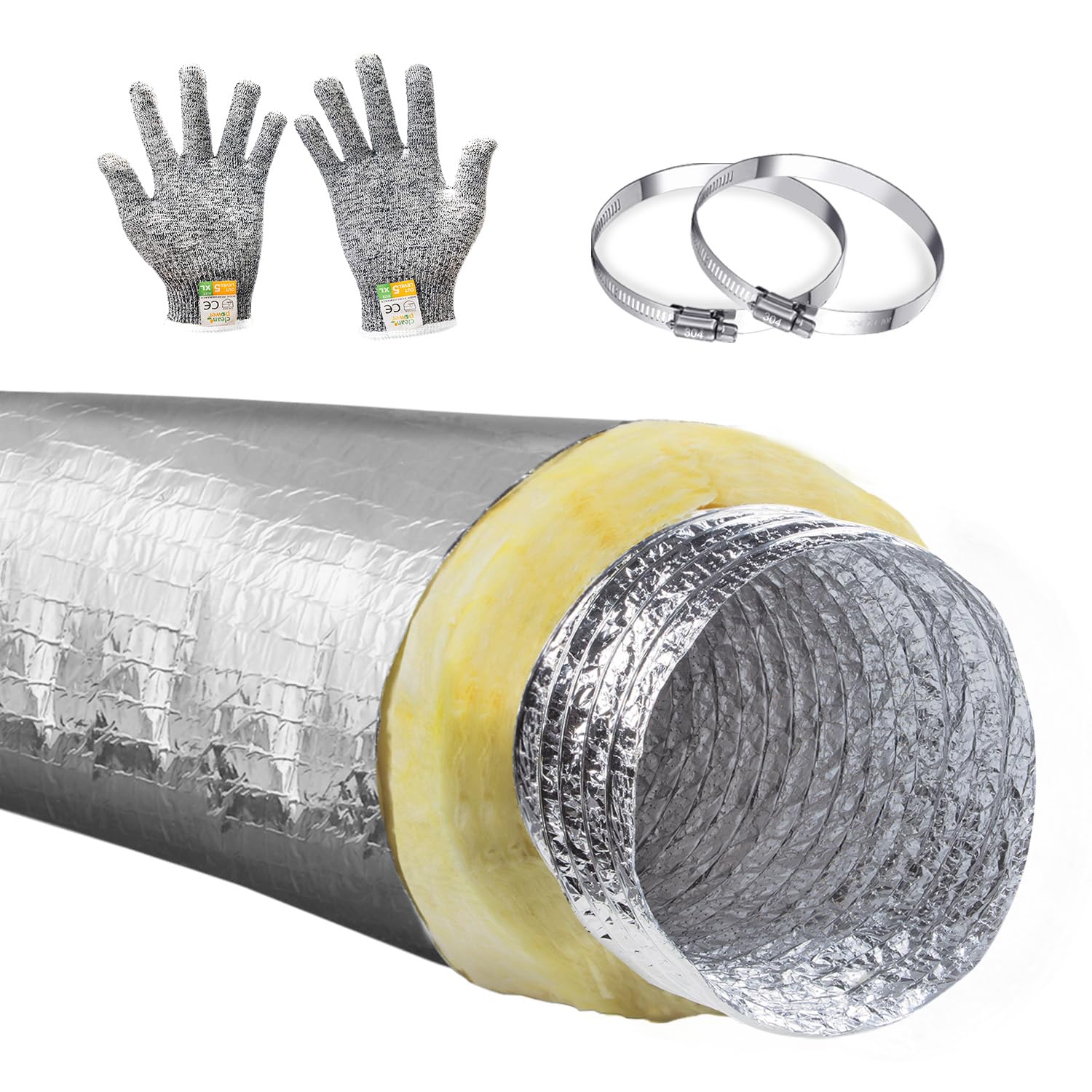
25 feet of R-4.2 insulated duct for cold attic runs that must stay dry.
When the duct has to cross an unconditioned attic — the exact place where warm bathroom air condenses — insulation is not a nice-to-have, it is the whole point. This duct pairs a glass wool insulation layer with a thickened aluminum foil skin and a high-strength elastic spiral steel wire, so it bends without collapsing and holds its shape on a long run. The stated R-value is R-4.2, which is the insulation rating, and the temperature range is wide, from -4℃ up to 454℃. Twenty-five feet of length means a single roll usually covers a full attic traverse.
The details owners care about are the ones that make install day easier. The duct is vacuum-packed and expands out easily once you break the seal, which is a lot less wrestling than a pre-expanded roll. The inner duct is described as durable and not prone to tearing during installation, one buyer fitted it over a 4-inch soffit vent with a snug but doable push, and two hose clamps come with it. The self-supporting foil also means the tube does not sag closed after you hang it, which keeps airflow steady across a long run.
This is the highest-priced duct in this list, so be clear about what you are buying: the insulation, the 25-foot reach, and the cold-weather protection, not the foil itself. If the duct runs entirely inside the warm part of the house, you do not need the four-layer insulated build and can save with a plain foil option. One caution on the build — the insulation performance is the reason to buy it, but a rare owner reports the glass wool insulation coming apart on arrival, so inspect the roll before you install and return it if it looks crushed.
The standout spec: an R-4.2 insulated 25-foot run with a temperature range pushing up to 454℃, for attics and cold crawls where a bare foil duct would sweat and drip.
Worth the premium for: a long attic run where insulation is the only way to stop condensation and keep the fan moving full air.
Save your money if: the whole run stays inside a heated ceiling — a plain foil duct will do the job for less.
Understanding the Specs
Diameter and the real fit problem
The diameter is the width of the tube, and 4 inches is the standard outlet size on nearly every bathroom exhaust fan. A duct that is even a few millimeters undersized will not seal against a rigid coupler or slide cleanly onto the fan collar, which is the source of most install frustration. Match the listed diameter to your fan, and if the duct has to connect to something rigid, favor a duct whose outside diameter reads 4 inches or more.
Layer count and how long the duct survives
Layer count is the number of protective walls in the tube — foil on its own, or foil plus a PET or PVC film plus a steel-wire helix. Fewer layers means lighter, cheaper, and more tear-prone. More layers means a stiffer, more durable duct that resists cuts, holds its shape, and handles the damp warm air a bathroom fan pushes through it. For a long or inaccessible run, more layers pay off because the duct is hard to replace.
Insulation and the condensation question
Insulation is the wrap of glass wool around the inner tube. It slows heat loss, which keeps the damp air inside the duct warm all the way to the outside wall, so it does not cool and condense into water that drips back. It also absorbs the sound of moving air. Any duct that crosses a cold attic, crawlspace, or unheated wall is a candidate for an insulated duct. A short run inside the heated envelope does not need it.
Length, stretch, and the straight-run rule
The advertised length is the maximum, and it only holds on a perfectly flat, straight pull. Bends and turns shorten the usable reach — a duct sold as 25 feet can deliver considerably less once you work it around joists. Before ordering, measure your actual path including every turn, then add slack. If you are close to the limit, size up to a longer roll or a duct whose reviewers report reaching close to full length.
FAQ
Will a 4-inch bath fan duct fit my exhaust fan?
Do I need an insulated duct for a bathroom fan?
How do I stop my bath fan duct from making noise?
Does the advertised duct length include the bends in my run?
Can I use a dryer vent hose for a bathroom fan duct?
How many layers should a bath fan duct have?
Do the clamps that come with the duct actually hold?
Should I use flexible duct or rigid pipe for a bathroom fan?
Why does my new duct smell when I first open the bag?
Can I cut a 25-foot duct down to the size I need?
Final Thoughts: The Verdict
For most bathroom fan installs, the winner is the AC Infinity Flexible 4-Inch Aluminum Ducting because its four-layer build and steel-wire core keep the tube round through every bend, and it earns 4.7 stars across 8,000+ owners — the strongest combination of quality and reach in this group. If your fan is close to the outside wall and you need maximum flexibility through tight framing, grab the Hon&Guan Dryer Vent Hose 16FT or the Hon&Guan 4” Insulated Flexible Duct 8 FT for the noise reduction. And for a long run through a cold attic, the Cuchiilo 4 Inch Insulated Flexible Duct is the one to reach for, with its 25-foot reach and R-4.2 insulation keeping the air warm and dry all the way out.
How We Picked
We do not accept paid placement. Every pick is matched to a real buyer and a real use-case; we do not hands-on test units.
Sources & Methodology
Specifications: manufacturer listings and product documentation. Review insights: verified customer reviews, as of September 2026. Pricing: not shown on this page (it changes often); check the current price via the retailer link.
As an Amazon Associate, KitchPrep earns from qualifying purchases. This does not affect which products we feature.
Related Guides
