
Specs are compiled from manufacturer listings and verified buyer reviews and can change over time — please confirm the key details on the product page before buying.
If your mirror fogs up within seconds of a hot shower and a damp smell lingers long after you towel off, the fix is almost never a bigger fan — it’s a correctly sized one. The number to match is CFM, which stands for cubic feet per minute, or simply how much air the fan pushes out of the room. Sones measure how loud it runs, and lower is better. Get those two right for your square footage and the moisture problem solves itself. This guide covers nine real ceiling-mount exhaust fans spanning the everyday mid-range into the premium tier, with the specs and the installed-in-a-real-bathroom reality laid out plain.
I’m Mohammad Maruf — the founder and writer behind KitchPrep. This guide is built by comparing the manufacturers’ published specifications and the patterns across verified customer reviews, so you get each pick’s real strengths and trade-offs instead of marketing spin.
Some fans handle that moisture easily, others struggle in larger rooms, and the wrong one leaves you with peeling paint. Below you’ll find a complete rundown of the best bath exhaust fan options for your home.
Our Picks at a Glance
How To Choose The Best Bath Exhaust Fan
A bath exhaust fan does one job: pull humid air, odors, and chemical fumes out of the room before they settle into your walls, paint, and grout. Everything else — the light, the heater, the night light — is a bonus on top of that core job. So the buying decision really depends on four numbers: how much air it moves, how loud it is, what size duct it needs, and what ceiling opening it fits.
Start with CFM, not the price tag
CFM is simply the amount of air the fan can move each minute. A common rule of thumb is one CFM per square foot of bathroom floor, with a bump up if you have a tall ceiling or a soaking tub. A 50 CFM fan suits a very small powder room. A 110 CFM fan handles most standard full baths up to roughly 105 to 110 square feet. A 290 CFM fan is for large rooms, kitchens, or a fan serving multiple spaces through shared ductwork. Undersize it and the mirror still fogs; oversize it and you are paying for airflow you never use.
Sones: the number nobody explains
A sone is a unit of perceived loudness — not raw decibels, but how noisy the fan feels to a human ear. A refrigerator hum sits around 1 sone. A typical conversation is closer to 4 sones. Fans rated at 1.0 to 1.5 sones tend to disappear into the background, and fans at 2.0 sones are clearly present but rarely annoying. If the fan shares a wall with a bedroom, sones matter more than almost any other spec.
Match the fan to your ceiling opening and your duct
Most retrofit jobs reuse the old ceiling hole and the old duct pipe, so check both before you buy. Common openings run around 7.5 inches by 7.75 inches. Most fans use a 4-inch round duct, but some push out toward 6 inches for higher airflow. Swapping a 6-inch fan onto an existing 4-inch run restricts it and can add turbulence noise — a genuine performance killer on the higher-CFM models.
Quick Comparison
| Model | Best For | Airflow (CFM) | Noise (Sones) | Duct Size | Amazon |
|---|---|---|---|---|---|
| Panasonic FV-0511VFL1 WhisperFit Bath Fan + Light★ Best Overall | Best overall for standard full baths | 110 (selectable 50/80/110) | Not listed | 4″ or 6″ | Amazon |
| Delta Breez Radiance Fan + Light + HeaterPremium Pick | Cold-climate bathrooms that need heat | 80 | 1.5 | 4″ | Amazon |
| Panasonic FV-30VQ3 WhisperCeilingMost Powerful | Large rooms and kitchen-vent duty | 290 | Not listed | 6″ | Amazon |
| Akicon Bath Fan with Dimmable LED | Modern bathrooms that want adjustable light color | 80 | 2.0 | 4″ | Amazon |
| Broan-NuTone Retrofit Fan with CCT Light | No-attic-access retrofits on a larger budget | 110 | 1.0 | 4″ | Amazon |
| OREiN 2-in-1 Bath Fan with Light | DIY installation without attic access | 110 | 2.0 | 4″ or 3″ (reducer included) | Amazon |
| Broan-NuTone 744 Recessed Light Vent Fan | Laundry rooms and shower enclosures | 70 | 1.5 | 4″ | Amazon |
| Homewerks 7140-50 Ceiling Mount Fan | Small bathrooms on a budget | 50 | 1.0 | 4″ | Amazon |
| JOEAONZ Ultra-Quiet Metal Housing Fan | Budget retrofits that value quiet above all | 110 | 1.0 | 4″ | Amazon |
In‑Depth Reviews
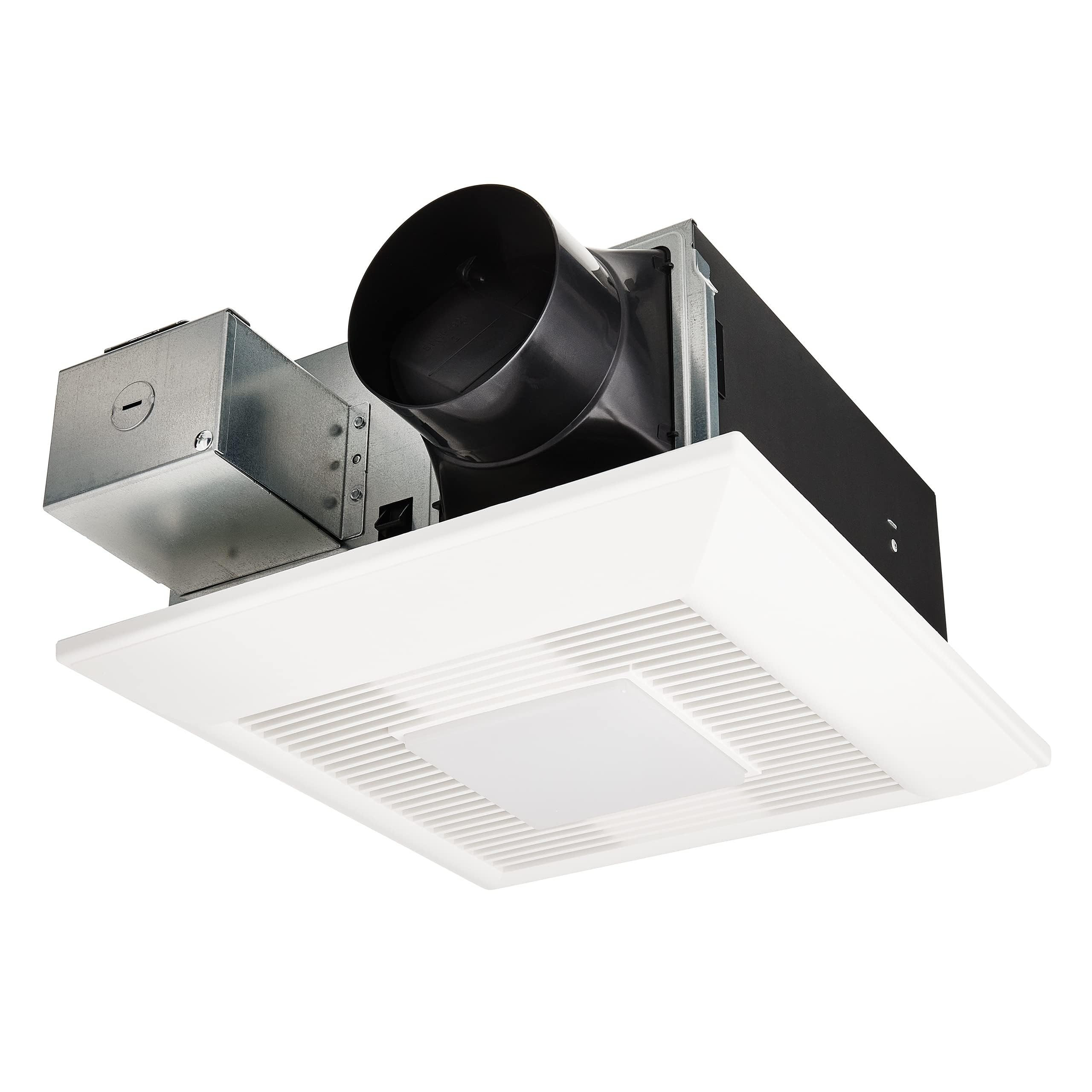
1. Panasonic FV-0511VFL1 WhisperFit Bath Fan + Light, 50-80-110 CFM
Our pick — over 4.5★ from 900+ verified ratings; the strongest balance of quality and price.
Three airflow settings in one fan, so it rightsizes itself to nearly any bathroom.
Set the airflow you want and forget the rest. That is the entire pitch of the Panasonic FV-0511VFL1, and its flip-of-a-switch Pick-A-Flow setup lets you lock in 50, 80, or 110 CFM — cubic feet per minute, or how much air the fan moves — without swapping the unit if you move or redo the room. Built-in dimmable 10W LED and a sub-1W night light round out the package for bathrooms that need illumination alongside the ventilation. Panasonic’s DC/ECM motor is the engine here, and the housing is slim at 5.6 inches tall, so it slips into tight ceilings where a bulky unit would not.
Owners who install for a living call this one the benchmark — the review pages sum it up: “Panasonic WhisperFit is gold standard, beats rivals.” The Flex-Z Fast bracket gets specific credit for enabling a solo retrofit install, since the single-hinge design means you can position and secure the housing from below. A pro installer clocks a typical retrofit at about 35 minutes. The removable duct and wiring junction box also helps — the separate wiring and venting paths mean one person can work both without needing a second set of hands. The intelligent airflow is not the lock-in it looks like: you can move between 50, 80, and 110 CFM at any point, and one buyer walking through this confirmed the 110 CFM setting handles a full bathroom with room to spare.
Here is the honest trade-off: this is a 4-inch or 6-inch duct fan, and long 4-inch runs restrict airflow enough that you will want the 6-inch option for anything past a short duct. A pro installer flagged that limit as a real design constraint and wished Panasonic published richer static-pressure data to plan around it. The instructions are also a weak spot — the assembly copy reads thin enough that even reasonably handy homeowners report needing the install video to get through it. Neither issue changes the outcome for a standard install; both are worth knowing before you start.
What earns it the top shelf
- Selectable 50, 80, or 110 CFM — one fan, three room sizes, no swaps needed.
- Built-in dimmable 10W LED plus a sub-1W night light for a truly combined fan-light fixture.
- Flex-Z Fast single-hinge bracket is designed for solo installation from below the ceiling.
- Slim 5.6-inch housing fits tighter ceiling voids than most combo units.
Where it asks something of you
- Long 4-inch duct runs cut usable airflow — plan a 6-inch duct for anything but a short run.
- Assembly and installation instructions run thin; the install video carries most of the load.
Reach for this if: you want one fan that covers a full standard bathroom with light, airflow choice, and clean install hardware in a single box.
Look elsewhere if: your duct run is long and skinny with no room for a 6-inch swap, or you want install documentation to hold your hand through every step.
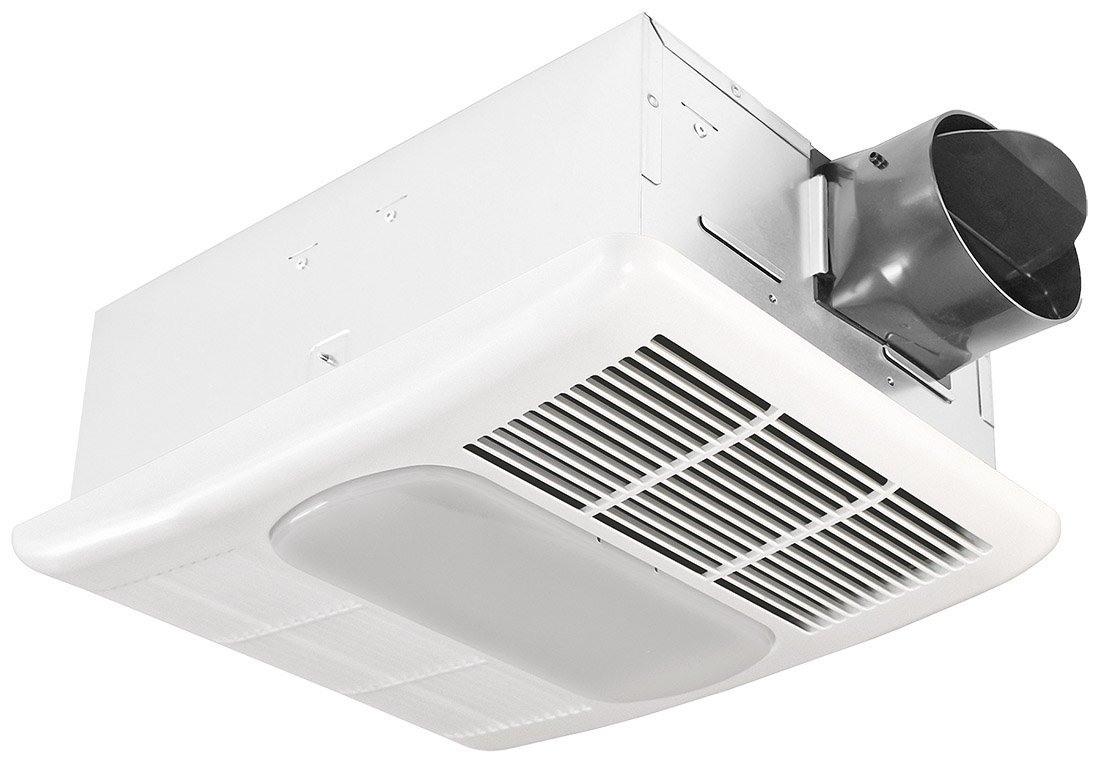
2. Delta Breez Bathroom Exhaust Fan with Light, Heater & Thermostat, Radiance, 80 CFM
A 1300-watt heater element that turns a cold bathroom into a warm one in seconds.
If you live somewhere the tile floor feels punishing in winter, the Delta Breez Radiance solves a colder-room problem the other fans on this list simply do not address. Its built-in 1300-watt heating element is designed for instant warmth on cold mornings, backed by a thermal cutoff fuse and thermostat for safe operation. The vent side handles the shower moisture quietly at 1.5 sones, and the integrated light rounds out the package. A brushless DC motor rated for up to 70,000 hours and 7 CFM per watt — cubic feet per minute of airflow per watt drawn — give it the best longevity numbers in this roundup.
In practice, buyers report this warms the room even when it is wet, and reviews note mirrors no longer fog up after showers. The heat is strong enough that some families report kids asking for it “sometimes too hot” — a good problem when the alternative is a cold bathroom. One detail worth flagging: the unit needs its own dedicated circuit. One buyer’s heater failed at five years, but the cause turned out to be incorrect wiring, not the unit — proper dedicated-circuit wiring likely would have extended its life. That is an install-day decision, not a product flaw, but the electrician-upfront cost is real.
Installation is the honest downside. Because of the heater wiring and the switches needed, most installs require an electrician and possibly new wiring and drywall work — one owner put it plainly as “difficult and costly,” while calling it worth it if you are remodeling and planning to stay long-term. The 80 CFM rating is also sized for small to medium baths, not large primary bathrooms. If you want heat without the electrical project, this fan is not the right fit; if you are already opening up the ceiling, it is the best heat-and-vent combo on this list.
The warmth verdict: a 1300-watt heater plus a 70,000-hour motor is class-leading heat-and-vent capability here, and the 1.5-sone vent side keeps the moisture job quiet. The dedicated-circuit requirement and electrician-cost install are the trade-off you accept in exchange.
Who this beats for: homeowners in cold climates doing a bathroom remodel who want heat, light, and quiet ventilation handled by one fixture and are already budgeting for an electrician.
Skip this one if: you are doing a same-day DIY swap or your bathroom pushes past what 80 CFM can keep dry.
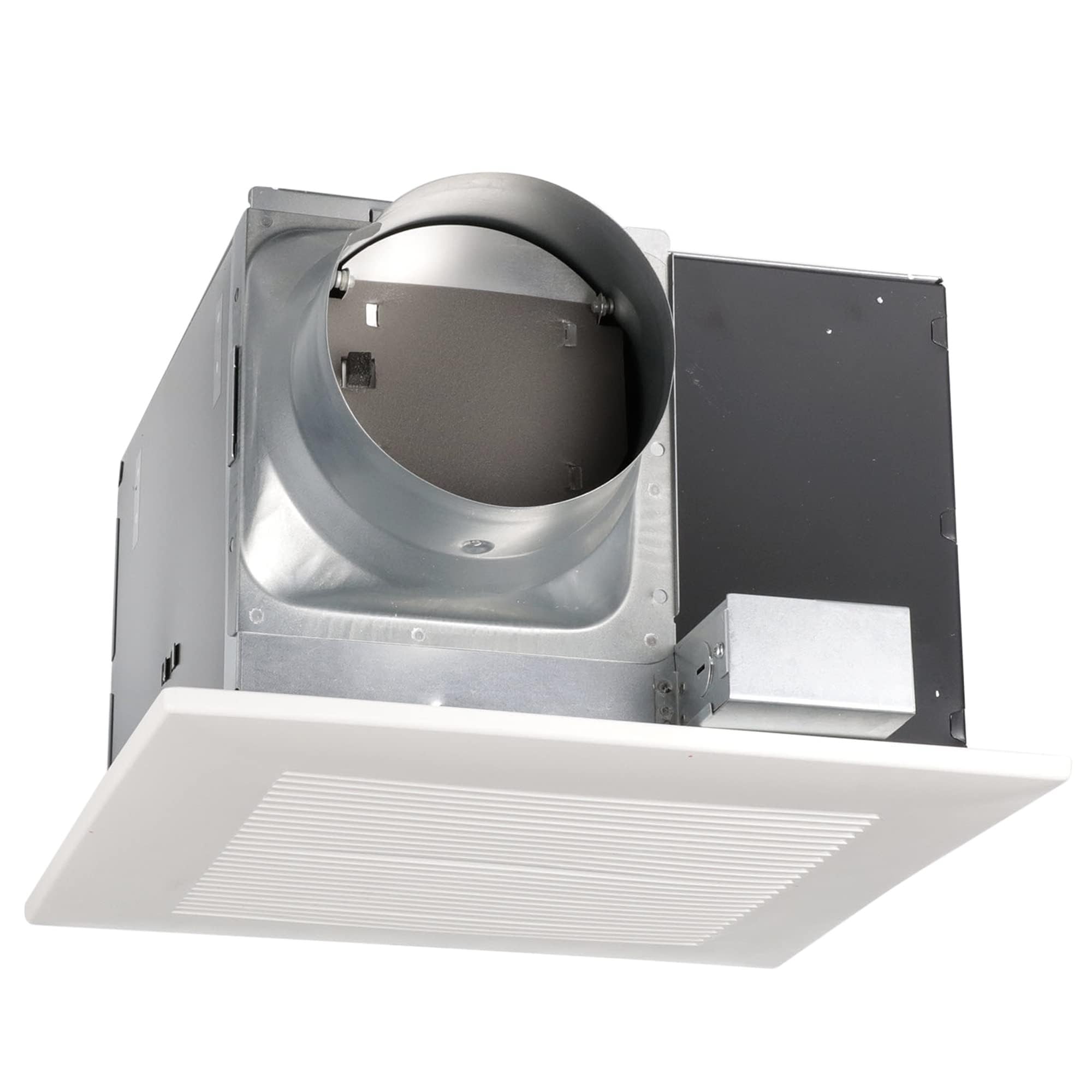
3. Panasonic FV-30VQ3 WhisperCeiling Bath Fan, 290 CFM
A 290 CFM double-tapered blower that clears a bathroom in minutes — and can double as a kitchen vent.
For a primary bath the size of a small bedroom, or for a fan that also vents out cooking aromas, the Panasonic FV-30VQ3 WhisperCeiling is the airflow monster in this group. Its 290 CFM rating is nearly triple the airflow of the JOEAONZ at 110 CFM. A double-tapered blower wheel that wide moves serious air quietly enough that Panasonic’s own copy says it runs so quietly “you might not even know it’s on.” The housing is heavy-gauge zinc galvanized steel with a rust-resistant finish, the motor is permanently lubricated, and a built-in damper stops outdoor air from backdrafting into your room.
Owners install these in kitchens as well as baths. One reviewer running this fan over a 14x12x9 kitchen with a Y-vent into the bathroom reported it empties cooking aromas strong enough to matter across two living rooms, and noted the fan is quiet enough you cannot hear it from the living room. Longevity is the other stand-out: a buyer reports this fan “runs continuously for over 10 years,” which tracks with the permanently lubricated motor and steel housing. Another buyer replacing a 50 CFM basement fan with this 290 CFM unit described it as “powerful and quiet” — a combination that does not always happen at the budget end of this list.
Two things to know before you buy. First, the exhaust outlet is a 6-inch duct connection. If your existing duct is 4-inch, one experienced installer strongly advises running 6-inch duct the whole way to the exterior vent and only reducing to 4-inch right at the outer wall — otherwise you introduce turbulence noise that undercuts the “quiet” reputation. Second, the included mounting bracket is adjustable up to 24 inches, but this is not a room-side retrofit; a buyer noted needing to build a 2×4 frame between joists, and one professional flagged the awkward electrical box placement that forces some drywall work. This is a project fan, not a drop-in replacement.
Where it towers over the rest
- 290 CFM airflow — nearly 3x the JOEAONZ’s 110 CFM — clears large bathrooms and even kitchens fast.
- 6-inch duct adapter with a built-in damper; runs well on 6-inch duct with the right transition.
- Heavy-gauge zinc galvanized steel housing and permanently lubricated motor designed for many years of continuous use.
- Energy Star certified; rust-resistant finish and 24-inch adjustable mounting bracket.
What it demands from your ceiling
- Not a room-side retrofit; needs attic access and often a DIY 2×4 frame between joists.
- Electrical box placement forces extra drywall work on some installs.
- Starved by a 4-inch duct — the higher airflow gets wasted and noise jumps.
Build this into the plan if: you are renovating a large bathroom or want one fan that pulls double duty over a kitchen with real venting demands.
Not the one for: an in-ceiling swap with no attic access or an existing 4-inch duct you cannot change out.
4. Akicon Bathroom Exhaust Fan with Light, 80 CFM 2.0 Sones

A black square fan and light with three selectable light colors and a night light that wins people over.
Some bathrooms care about matching the fixtures as much as moving air, and the Akicon is built for that buyer. Its 80 CFM airflow and 2.0-sone rating cover small to medium bathrooms up to 80 square feet, and the multi-functional light lets you toggle between 2700K, 4000K, and 5500K color temperature — three settings from a soft warm glow to crisp daylight. That is the kind of flexibility that matters if you have a specific fixture color in the room. There is also a 3.5W night light on the side that casts a soft glow for middle-of-the-night trips, and the light remembers your last setting after seven seconds off, so you are not re-picking the color every morning.
What wins people over with this one is the look and the light. Owners describe it as a beautiful design that fits modern bathrooms, with the light bright enough without being harsh. The black square grille — 11 by 11 inches across the light cover — reads as a deliberate design choice rather than the plain white plastic grille most fans ship with. Reviewers who have installed many fans over the years call out the strong airflow relative to its 80 CFM spec, and the night light feature repeatedly surprises buyers who did not expect it to be included.
The catch is installation and room-size fit. The housing is larger than most — 11 by 11 by 7.87 inches — so it will not drop into every existing ceiling opening, and the harder-install reports in the reviews focus on that footprint as much as the wiring. This is also an 80 CFM fan, which paces well for a small to medium bathroom but will not keep up in a large or heavily moisture-loaded space. And it weighs 6.6 pounds, so you want a solid hand on it while you are running the mounting screws.
The design read: the black square 11-by-11-inch light cover, three color temperatures, and included 3.5W night light make this the most styled fan-light combo here. The 80 CFM airflow is genuinely sized for small to medium baths, not a large primary.
Seriously consider it when: your bathroom leans modern and you want a fan that matches the fixtures, with color-tunable light for morning grooming and evening wind-down.
Look elsewhere when: the ceiling opening is fixed and small, or the room runs large enough that 80 CFM will not keep up.
5. Broan-NuTone Retrofit Bath Fan with 4 Selectable CCT Light Settings

A 110 CFM fan that drops into the hole your old one left, no attic trip required.
This Broan-NuTone exists for one specific job: replacing a tired bathroom fan through the ceiling opening itself, without climbing into the attic. The design is set up for “room side” installation — you work from below. The grille measures 12-1/4 by 12-1/4 inches, and the housing is 9-1/4 by 10 by 5-3/4 inches, sized for 2×6 construction. It moves 110 CFM, which sits at the top end of the everyday-residential airflow range and is specced for spaces up to 105 square feet. The 1.0-sone rating matches the quietest fans here.
What makes the light worth talking about is the CCT — correlated color temperature — setup. Instead of a fixed white LED, you get four selectable settings from a warm 3000K all the way to a crisp 5000K, flipped through a switch sequence, and the fan remembers your last setting. Buyers repeatedly call out the difference between this fan and their old one — several report installing it as a replacement for a builder-grade Broan and finding it “2x+ quieter” while still clearing a large bathroom. The CleanCover grille has full-perimeter air intake designed to keep dust from building on the visible face, an underrated detail over the years.
The honest catch is the grille retention clips. Multiple buyers flag the wire clips that hold the cover in place as finicky — one owner describes them as “beyond awful” and reports the cover falling off more than once before it stayed put. In practice, getting the mounting box flush with the ceiling is what solves it, so pay attention at that step. And a handful of owners mention this fan is not as quiet after a 4-inch-to-3-inch duct reduction, since the smaller duct introduces turbulence; keep the duct at 4 inches if you can. Overall a strong pick — just install the cover gently and give the fan clean ductwork.
What it nails for retrofits
- Room-side installation replaces your existing fan through the ceiling opening with no attic access.
- 110 CFM covers standard bathrooms up to 105 square feet.
- 1.0-sone rated quiet — the same class as the quietest fans here.
- Four selectable CCT settings, from warm 3000K to daylight 5000K, that remember your last choice.
Where you will need patience
- Grille retention clips are finicky — mounting box must sit flush or the cover fights back.
- 4-inch-to-3-inch duct reduction undercuts the quiet; keep ductwork at 4 inches where you can.
This is your pick if: the old fan has to come out through the ceiling hole, you cannot reach the attic, and you want a quiet 110 CFM combo with a versatile LED.
Think twice if: you cannot access the cover’s clip system to seat it flush, or your duct run is already restricted to 3 inches.
6. OREiN 2-in-1 Bathroom Exhaust Fan with Light, 110 CFM, ENERGY STAR

A 110 CFM fan-light combo with a five-year warranty, built for a confident weekend DIY swap.
For most bathrooms in the 90 to 110 square foot range, the OREiN hits the balance on airflow — its 110 CFM rating is specced up to 110 square feet. It self-diagnoses as a “no attic needed” install: the ceiling opening is 7.36 by 7.68 inches, and it comes with a 4-to-3-inch duct reducer, so it fits common openings and either duct system. At 2.0 sones, it runs audible but not distracting. The LED is a 1000-lumen 5000K — daylight-bright — so the fixture lights the whole room, not just the vanity.
Two things earn this fan its install confidence: Energy Star certification and a 5-year warranty, the longest published coverage here. Buyers who install these routinely describe the process as straightforward with clear instructions, and mention appending an extra joist bracket for security as an easy upgrade. The 26-watt fan is also efficient enough that running it is not a cost concern, and the separate-switch option — one switch for the fan, one for the light — keeps fan and light independent if you prefer. One owner notes the fan has a short “coast up” period when you first turn it on, meaning it builds to full speed rather than snapping on instantly, and reads that as good engineering rather than a fault.
The honest caveat centers on the install hardware and instructions. Some buyers find the instructions confusing when replacing an older fan, and a few flag the mounting bracket logic as less obvious than it should be for a first-time installer. The frame can also be a snug fit into the hole your old fan left, which is not uncommon for a retrofitted combo unit but is worth knowing going in. Nothing here looks like it undercuts the fan’s day-to-day performance; most problems cluster around install day.
The warranty play: the 5-year coverage here is the longest published in this lineup, and the 110 CFM / 2.0-sone ratings fit a standard bathroom. Paired with the 1000-lumen 5000K LED and the 4-to-3-inch reducer included in the box, it reads as a no-fuss choice.
Buy it if: you want a same-day upgrade with a real warranty cushion and a light bright enough to handle every morning routine.
Skip to a different fan if: you need step-by-step hand-holding through a tricky retrofit of a decades-old frame.
7. Broan-NuTone 744 Recessed Light Ventilation Fan, 70 CFM, 1.5 Sones

A fan that installs as a recessed light — you can drop it right into the shower ceiling.
The Broan-NuTone 744 is the sleeper on this list because it does not look like a bath fan. It installs like a recessed can light — trim matched to major recessed lighting designs — and its 70 CFM airflow at 1.5 sones fits small bathrooms, shower enclosures, and laundry rooms equally well. The 4-inch round duct connector is the standard size, and the housing is 6.87 inches high so it can drop into a 2×8 ceiling joist space without the ceiling surgery a bulkier unit would need. Multiple units can be used in larger rooms if you need more coverage, and optional wall controls are included for simplified use.
The real-world win here is fit. Buyers replace old can lights with this fan just to add ventilation, and the note back is telling — it fits the existing ceiling hole in the shower “perfectly” and installs simply. Another buyer upgrading the laundry room says it eliminates humidity and stuffiness, and even called the unit quieter than bathroom fans, verified with a dB app and described as barely audible with the door closed. The fan clears steam before it reaches the mirror in a lot of setups, so your reflection stays fog-free.
The honest caveats are construction details, not performance. The metal casing has sharp edges on some units and may need deburring for a careful DIY install. The exhaust outlet exits on one side, which some installers report as the “wrong” side for their ceiling layout — not fixable, so measure your duct path first. And because it is a recessed fan, the housing must be paired with a 75-watt bulb (R30 or BR30) and, over a tub or shower, a wet-rated PAR30NL bulb as required. Not for use over a cooking surface, so skip it for kitchen duty.
The stealth install: a 70 CFM, 1.5-sone fan disguised as a recessed light is a genuinely uncommon combination. The 4-inch duct keeps it compatible with existing pipe, and the 6.87-inch housing fits a 2×8 joist bay without tears. The trade-off is that you supply the light bulb.
Perfect for: shower stalls, laundry rooms, and baths where a visible white grille would clash with the ceiling’s recessed lights.
Not for you if: you need the full 100-plus CFM a larger bathroom requires, or you are venting over a stovetop.
8. Homewerks 7140-50 Ceiling Mount Bath Fan, 50 CFM, 1.0 Sones

The quiet little fan for powder rooms and half baths — 50 CFM, 1.0 sone.
Match the number to the room and the Homewerks 7140-50 becomes an easy yes for the smallest spaces. Its 50 CFM airflow is specced for bathrooms up to 50 square feet, meaning powder rooms, half baths, and small en suites. The 1.0-sone rating keeps it in the quiet category — you will forget it is on. Construction is a galvanized steel housing for corrosion resistance, and the grille design stays low-profile against the ceiling. It carries HVI, ETL, and Energy Star certifications and a 3-year limited warranty. The ceiling opening is 7.75 by 7.5 by 6 inches with a 4-inch round duct connector, so it drops into the standard opening most builder fans use.
Buyers describe it as strong and fast for a small bathroom, with quiet operation that is barely noticeable — one review noted wiring it alongside a shower light because it slips invisibly into the white ceiling. It reads as a good value in this lineup. The unit is light enough that assembly and install are simple for a homeowner. If you need a simple, quiet fix for a small bathroom and you are not chasing features, this is the straightforward answer.
One real drawback worth measuring before you buy: the exhaust port exits on one side of the housing, and depending on where your existing ductwork runs, the alignment can complicate the swap. Installing may require cutting a fresh ceiling hole so the fan lines up with your joists and duct — a bit more work than a same-hole replacement. And a small subset of customers note durability issues with the plastic clip that holds the internal spring, plus push-in electrical connectors that are awkward to disconnect once seated. For most small-bath use cases, these are edge details rather than deal-breakers.
The small-bath case
- 1.0-sone quiet at 50 CFM — genuinely forgettable, in the good way.
- Correctly sized for bathrooms up to 50 square feet.
- Galvanized steel housing resists corrosion; HVI, ETL, Energy Star certified.
- 3-year limited warranty; 4-inch duct connector matches typical existing setup.
Small print to check first
- Side-exit exhaust port can force a fresh ceiling cut to align with existing duct and joists.
- Push-in connectors can be stiff to disconnect if you need to move the fan later.
The right fan for: a powder room, half bath, or small en suite where 50 CFM covers the square footage and quiet matters more than raw airflow.
Wrong tool if: you are ventilating a full bathroom or your existing ductwork cannot line up with a side-exit fan.
9. JOEAONZ Bathroom Exhaust Fan 110 CFM 1.0 Sones with Metal Housing

Budget-priced, library-quiet, and sized for a real full bathroom — 110 CFM at 1.0 sone.
The JOEAONZ gets the two most important numbers right for a standard full bathroom: 110 CFM of airflow and 1.0 sones of noise. Its 110 CFM rating is specced for enclosed rooms up to 107 square feet, which covers most standard bathrooms and then some. Duct diameter is 4 inches — the standard residential bath-fan size — and the motor runs quietly enough that the maker compares it to a library. Housing dimensions come in a compact 9.45 by 9.45 by 6.7 inches, which is smaller than the Homewerks at 10.43 by 12.6 by 7.48 inches, so it has an easier time fitting tight ceiling voids on retrofit jobs.
The retrofit story is where owners actually talk about this fan. Buyers replacing a decades-old fan describe the difference as dramatic, and one sums the whole experience up in a remark quoted across the review pages: “Wow I can’t believe how quiet it is.” The screwdriver-tab mounting, quick-connect electrical, and duct adapter mean the swap can literally be done with a screwdriver. The motor is removable via two screws for replacement if it ever needs service, so you are not throwing away the whole fixture. And on condensation specifically, owners with a basement bathroom report it handles humidity that used to leave water dripping from the ceiling.
Two honest caveats. First, on raw air movement, the reviews do read mixed — some reviewers point out it feels powerful and moves much more air than expected, while others find it a bit soft for a large or heavily loaded room. A 110 CFM fan does its job in a standard bathroom; nobody should expect 290 CFM performance out of it. Second, the day-to-day performance is described as average by some, though installation, noise, and value all score well. For a budget-friendly retrofit swap in a normal-size bathroom, the value math here is hard to argue with.
The quiet-budget angle: 110 CFM at 1.0 sone puts the JOEAONZ right in the everyday bathroom-airflow class at an entry-level price point, with a metal housing and a 4-inch duct that drops into existing pipe. The catch is that a small number of buyers find its raw air movement underwhelming in bigger rooms.
Worth picking when: you are replacing an old fan in a standard bathroom and want the 110 CFM and 1.0-sone combo on an entry-level budget.
Better to go up a tier if: your bathroom is large, heavily steam-loaded, or you expect the room to clear almost instantly.
Understanding the Specs
CFM — Airflow Capacity
CFM stands for cubic feet per minute — the metric for how much air the fan moves per minute. Match your CFM to the bathroom’s floor area with at least 1 CFM per square foot, and round up if the ceiling is tall, the room features a soaking tub, or the fan also needs to serve a kitchen. Undersize and the steam sticks around; oversize and you waste energy and money. Higher-CFM fans like the Panasonic FV-30VQ3 at 290 CFM are for large bathrooms or use over a stove.
Sones — Perceived Noise
A sone measures perceived loudness — not raw decibels, but how loud the fan feels in real life. Fans rated between 1.0 and 1.5 sones tend to disappear into the background; 2.0 sones is audible but tolerable; higher than that starts to interfere with talking or sleeping nearby. If the fan sits near a bedroom wall or shares a wall with a hallway, choose the lowest sone rating that still hits the CFM you need. You cannot retrofit quiet — it is decided by the motor and blower at purchase time.
FAQ
What CFM size do I need for my bathroom?
How quiet is 1.0 sone compared to 2.0 sones?
Can I install a bath exhaust fan without attic access?
What size ceiling opening do most bath fans need?
Will a bath fan with 4-inch duct fit my existing ductwork?
Should I wire my bath fan to the light switch or run it separately?
Do I need a humidistat or condensation sensor for my bath fan?
How long does a bath exhaust fan usually last?
Can I use a bath exhaust fan over a shower or above a stove?
Is a bigger CFM fan always better for a small bathroom?
Final Thoughts: The Verdict
For most bathrooms, the bath exhaust fan that handles everything cleanly is the Panasonic FV-0511VFL1 WhisperFit, because its selectable 50, 80, or 110 CFM airflow and dimmable 10W LED let you match the fan to your actual room size, and its Flex-Z Fast bracket makes retrofits a solo job. If you want heat in the mix, reach for the Delta Breez Radiance — a 1300-watt heater and 1.5-sone ventilation in one fixture. And for a small powder room or half bath where budget rules, the Homewerks 7140-50 gives you the 50 CFM and 1.0-sone pair for a straightforward swap.
If you have never bought one of these before, start with airflow and noise and let everything else follow — square footage decides the CFM, and where the fan sits decides how much sones matter. The specs and review patterns across the picks here make the choice narrow down fast: match CFM to your room size, pick the quietest sone rating you can afford, and confirm the duct before you unscrew the old unit.
How We Picked
We do not accept paid placement. Every pick is matched to a real buyer and a real use-case; we do not hands-on test units.
Sources & Methodology
Specifications: manufacturer listings and product documentation. Review insights: verified customer reviews, as of September 2026. Pricing: not shown on this page (it changes often); check the current price via the retailer link.
As an Amazon Associate, KitchPrep earns from qualifying purchases. This does not affect which products we feature.
Related Guides
