
Specs are compiled from manufacturer listings and verified buyer reviews and can change over time — please confirm the key details on the product page before buying.
You want a thermostat that keeps your house comfortable without needing an app or a manual thicker than a paperback. But even simple models now come with hidden surprises — some demand a tricky C-wire (a constant power wire your old system may lack), and others eat batteries every few weeks. The best basic home thermostat solves that: a clear screen, plain buttons, and reliable temperature control that lasts for years.
I’m Mohammad Maruf — the founder and writer behind KitchPrep. This guide is built by comparing the manufacturers’ published specifications and the patterns across verified customer reviews, so you get each pick’s real strengths and trade-offs instead of marketing spin.
Whether you are swapping out a broken unit or upgrading an old dial, the right basic home thermostat will get your HVAC system (heating, ventilation, and air conditioning) working exactly how you want it with zero fuss and a large, easy-to-read screen.
Our Picks at a Glance


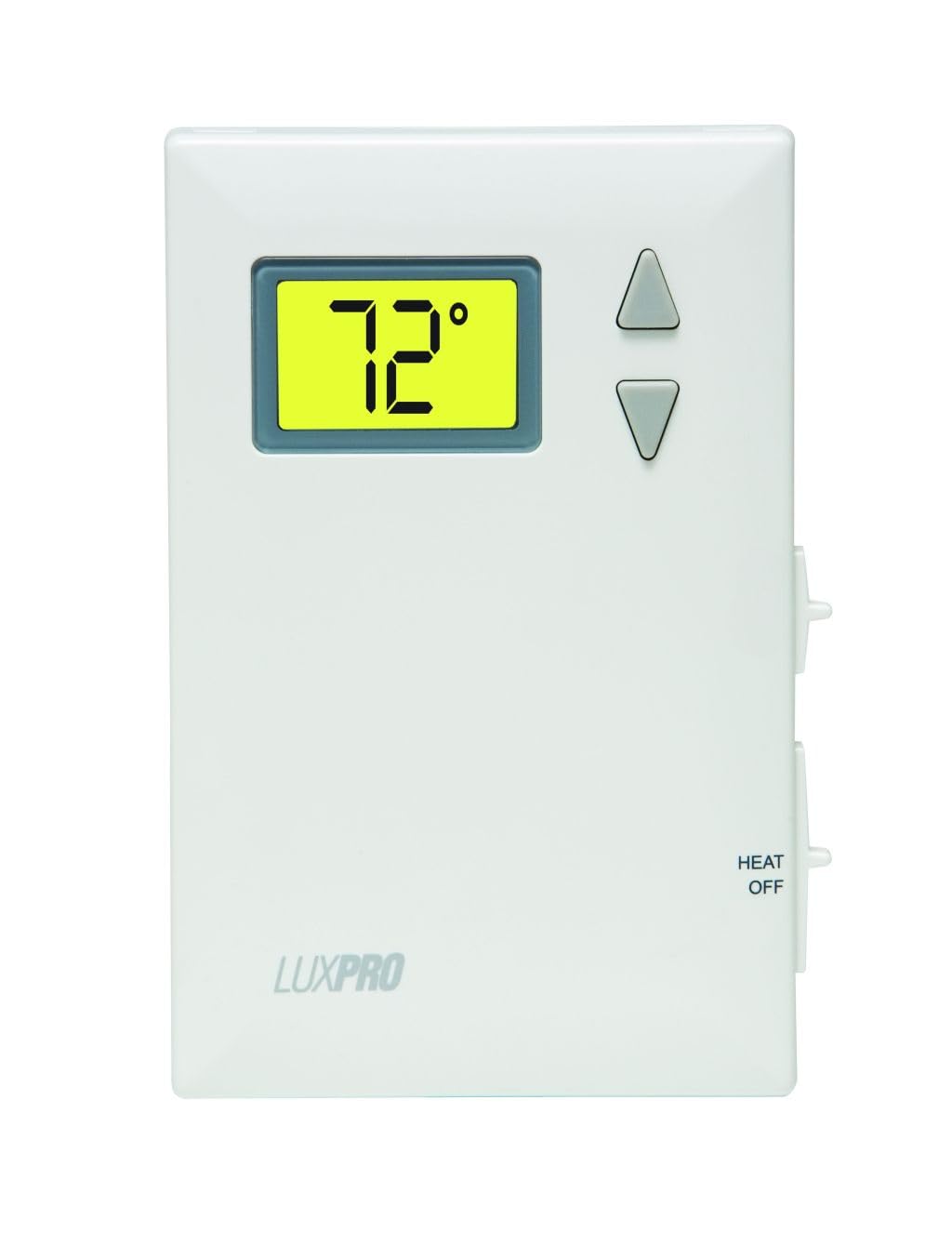
How To Choose The Best Basic Home Thermostat
A basic thermostat purchase depends on just a few simple decisions. You need a model that matches your HVAC system, fits your wiring situation, and is easy enough that anyone in the house can adjust the temperature without help.
System Compatibility: The Non-Negotiable First Check
The single most important thing is whether the thermostat works with your heating and cooling equipment. Most basic models support single-stage systems — that is one heating stage (like a standard gas furnace or boiler) and one cooling stage (a central air conditioner). These are sometimes labeled 1H/1C. If you have a heat pump with auxiliary or emergency heat, a multi-stage system, electric baseboard heat running at 120-240 volts, or a mini-split, you are looking at the wrong category. Double-check the manufacturer’s compatibility list before buying because returning a thermostat once the wires are out is a chore.
Power Source: Battery or C-Wire
Virtually all non-programmable thermostats offer dual power — they can run on two standard AAA or AA batteries or draw power from the 24VAC (24-volt alternating current) system using a common wire (C-wire). If you have an older system without a C-wire, battery operation is the simplest path. Some models also offer front-access battery compartments that let you swap cells without pulling the whole unit off the wall. If you prefer to never think about batteries, look for a model that supports a C-wire connection. The trade-off is that battery-powered units are often simpler to install for a DIYer.
Display Clarity and Backlighting
A basic thermostat that is hard to read defeats the purpose. Look for a large backlit LCD (liquid crystal display) screen with bold numbers you can see from across the room, especially if you or someone in your household has less-than-perfect vision. The backlight can be always-on or triggered by pressing a button. Models with a blue or white backlight are easiest on the eyes in dim hallways or bedrooms. Also, consider the temperature calibration — most high-quality units offer an adjustable swing (the temperature gap between when the system turns on and off) and a calibration offset, so you can dial in exactly how the thermostat “feels” in that specific spot on the wall.
Quick Comparison
| Model | Best For | System Type | Display Size | Power | Amazon |
|---|---|---|---|---|---|
| PRO1 IAQ T701★ Best Overall | Overall Reliability | 1H/1C Single Stage | 4 sq. in blue backlight | Battery or Hardwired | Amazon |
| Honeywell RTH111BTop Performer | Trusted Brand | Heat/Cool/Heat Pump | Digital | Battery | Amazon |
| Lux Pro PSD010BPremium Pick | Heat-Only Systems | 1 Heat (Mechanical) | Illuminated LCD | Battery (Included) | Amazon |
| Riseem STN601 | Adjustable Temperature Swing | 1H/1C Single Stage | Blue backlight LCD | 24VAC or 2 AAA | Amazon |
| Riseem S3001 | First-Time Installers | 1H/1C Single Stage | White backlight LCD | 24VAC or 2 AA | Amazon |
| Aowel 1H/1C | Built-In Humidity Display | 1H/1C Single Stage | 5.0 sq. in backlit LCD | 24VAC or 2 AAA | Amazon |
| Honeywell Pro 1000 | Compact Fit | Conventional / Heat Pump | Backlit Digital | Dual (Battery Included) | Amazon |
| EconoHome EH701 | Elderly Users | 1H/1C Single Stage | Large backlit LCD | 24VAC or 2 AAA | Amazon |
| Mroinge M701 | Weak Vision | 1H/1C Single Stage | Large blue backlight LCD | 24VAC or 2 AAA | Amazon |
In‑Depth Reviews
1. PRO1 IAQ T701 Non-Programmable Electronic Thermostat
Our pick — over 4.5★ from 950+ verified ratings; the strongest balance of quality and price.
Buyers return to this unit year after year — over 90 owners specifically mention its reliability in reviews.
You get a thermostat that owners call their top pick for a reason: it earns a 4.6-star rating from 973 ratings, and the most-praised trait is dependability. It works with single-stage 1 heat/1 cool (1H/1C) systems and runs on batteries or 24VAC hardwired power. The 4-square-inch blue backlit LCD display is easy to read from across a room, a real help for older eyes. The front-access battery compartment lets you swap cells without pulling the whole unit off the wall — no need to redo wiring when the low-battery light comes on.
The main trade-off compared to the Riseem STN601 below is that the T701 lacks an adjustable temperature swing (the gap between when the system turns on and off). That matters less for most homes because the unit locks in and stays steady. A few buyers report that an occasional unit fails after several years, but the vast consensus is that most run fine long past the warranty.
Simple IAQ control
- Rock-solid reliability is the number one thing owners point to
- Large blue backlit display is easy to read from across a room
- Batteries swap from the front — no need to dismount the thermostat
No backlight
- No adjustable temperature differential for fine-tuning cycles
- Display can be tough to read from a low angle if you are short
Budget pick: you want a proven, straightforward thermostat that the largest group of owners swear by for years of trouble-free service.
Needs light: you need granular control over the temperature swing to prevent short-cycling on a sensitive system.
2. Honeywell Home RTH111B Digital Non-Programmable Thermostat
You get precise +/- 0.5°C temperature control from a brand that has made HVAC controls for decades.
The Honeywell RTH111B holds your room noticeably more stable than an old bimetal dial because it keeps temperature within a tight 0.5-degree Celsius (around 0.9°F) range of your set point. The digital display is easy to read, and the soft-touch buttons let you tap the temperature up or down without cycling through menus. It works with standard heating, cooling, and heat pumps without auxiliary heat — but it will not work with electric baseboard heat or multi-stage systems, so check your equipment first.
Compared to the PRO1 T701 above, this Honeywell is more compact and remembers your set point through a power outage. The one clear miss that buyers flag: the display is not backlit, so it is hard to read in a dark hallway. That makes it a step behind the Honeywell Pro 1000 below, which does light up when pressed.
Honeywell reliability
- Precise +/- 0.5°C temperature control keeps the room steady
- Retains your set point through a power outage with no re-programming
- Simple soft-touch buttons make temperature changes fast
Basic display
- Display is not backlit — hard to read in low light
- Incompatible with heat pumps that have backup/auxiliary heat
Trusted brand: anyone who values name-brand reliability and precise temperature accuracy for a standard furnace and AC setup.
No frills: you need a backlit screen or have a heat pump with auxiliary heat stages.
3. Lux Pro PSD010B Mechanical Non-Programmable Thermostat
If you only need to control heat — a fireplace, wall heater, or RV furnace — this is the mechanical pick hundreds of buyers recommend.
The Lux Pro PSD010B is a heat-only mechanical thermostat with no fan switch, designed for simple heating like propane fireplaces, wall heaters, or in-floor radiant systems. It comes with batteries included, so you can install it in minutes. The large illuminated LCD display is easy to read, and the soft-touch buttons feel sturdier than the flimsy membrane buttons on some digital units.
Across hundreds of buyer reviews, its sheer functionality gets more praise than even the well-regarded PRO1 IAQ T701 in raw count. Owners of RVs use it to replace old furnace controls. Homeowners replacing the classic Honeywell T87F dial pick it for simplicity. The catch: this is heat-only — no cooling mode at all — so it will not handle both a furnace and a central AC. For that dual function with a premium feel, the EconoHome or Honeywell Pro 1000 below are better fits.
Rugged choice: heat-only applications like propane heaters, fireplaces, and RV furnaces where simplicity matters more than bells and whistles.
Prefer digital: homes with central air conditioning or any system that needs a fan control switch.
4. Riseem STN601 Non-Programmable Thermostat (Blue Backlight)

You get pro-level cycle control at a low price — an adjustable temperature differential from 0.2°F up to 2°F.
The Riseem STN601 delivers something the PRO1 IAQ T701 does not: you can set the temperature swing (differential) from as tight as 0.2°F to as wide as 2°F. That means you can stop your furnace from short-cycling in a drafty old house by setting a 2°F swing so the system stays off longer, or keep it super tight in a well-insulated modern home. The default heat swing is 0.4°F and the cool swing is 0.5°F, but the fact you can change it gives you real control.
The unit’s profile is just 0.98 inches deep — noticeably slimmer than the PRO1’s bulkier shape — making it easier to mount in tight spots. It runs on 24VAC or two AAA batteries and does not require a C-wire on most systems. The blue backlit LCD is clear, and owners mention setup takes about 10 minutes even for a first-timer. Just flip the internal GAS/ELEC switch (gas or electric heat) before installation if you have an electric heat system.
Visual clarity: you want to fine-tune the temperature swing to match your home’s unique heating characteristics without spending a premium.
Check system: the slim size leaves you wanting a larger, more prominent display on the wall.
5. Riseem S3001 Non-Programmable Thermostat (White Backlight)

First-time installers can swap out a dead thermostat in about 20 minutes using YouTube and the included guide, reviewers report.
The Riseem S3001 targets DIY beginners. Customers note swapping a dead unit in about 20 minutes using YouTube and the included instructions. The white backlit LCD display is bright and clear, making the temperature readable at a glance from across the room. It works with single-stage 1 heat/1 cool systems (gas, oil, electric furnace, boiler, or gas fireplace running at 24 volts) but it will not handle heat pumps, multi-stage systems, or mini-splits.
Like the blue-backlit Riseem STN601 above, this model has separate heating and cooling swing controls so you can adjust the cycle rate. The dual power supply lets it run on 24VAC or two AA batteries without needing a C-wire on most systems. The main limit: the base only accepts 2 to 5 wires. Systems with 6 to 8 connections will not fit, so count your terminals first.
Clean look: a confident DIY swap where you want bright screen visibility and the safety net of a 2-year warranty.
Need humidity: you have a complex system with more than 5 wires or need heat pump compatibility.
6. Aowel Non-Programmable Thermostat with Humidity Display
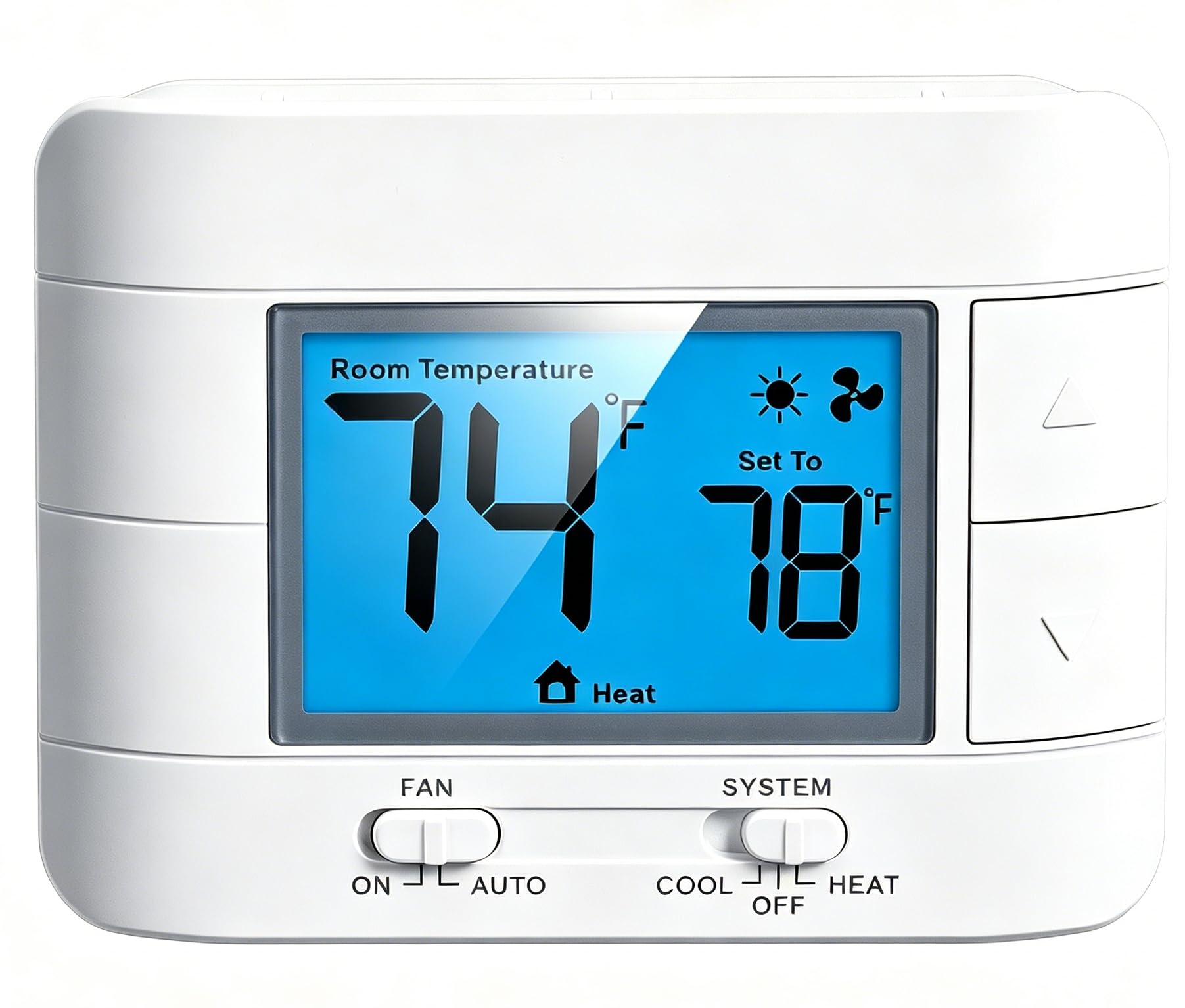
A rare basic thermostat — it shows you the humidity level on the same screen so you know if the air feels sticky or dry.
The Aowel stands out with a built-in humidity monitor that cycles on its 5.0-square-inch backlit LCD screen. That is useful in basements, garages, or any room where moisture matters. Temperature accuracy is +/- 1°F, and you can adjust the swing anywhere from 0.2°F to 2°F and calibrate the reading by up to +/- 4°F if the thermostat’s spot on the wall reads a bit warm or cool.
Installation gets the most praise from owners, who confirm it works without a C-wire on standard systems. The compact size of 4.92 x 3.74 x 0.98 inches fits neatly on the wall. One recurring point: the backlight only lights up when you press a button rather than staying on continuously, and some owners wish the humidity stayed visible permanently. The 2-year after-sales support adds confidence if you run into wiring trouble.
Humidity aware: you want the convenience of a humidity readout without stepping up to a more expensive programmable or smart thermostat.
Sleek style: you need a continuously lit display or have a heat pump system this model does not support.
7. Honeywell TH1110DV1009 Pro 1000 Non-Programmable Thermostat

If the non-backlit Honeywell RTH111B above frustrated you, this model lights up when you press the buttons — saving you from squinting in a dark hallway.
The Honeywell Pro 1000 (model TH1110DV1009) fixes the RTH111B’s biggest flaw: its display lights up whenever you press the up or down buttons, making it usable in a dim basement or hallway. It is dual-powered (batteries included right in the box) and works with both conventional single-stage systems and heat pumps without auxiliary heat. The compact size fits neatly in small spaces, and several owners use it as a quick RV upgrade or a basement fan controller.
The design is dead simple — no tricky programmable menus, just temperature up/down, a heat-off-cool switch, and a fan auto-on toggle. Buyers highlight that battery life is excellent, partly because the backlight only triggers on button press. A slight downside: separating the thermostat from its base for the first time requires pressing three inner clips, which can feel overly tight until you figure out the technique. Once mounted, it runs without drama.
Pro grade: a compact, backlit Honeywell that works for both conventional systems and heat pumps in tight spaces.
Want scheduling: you want a fully continuously lit display or find tight clip-on bases frustrating.
8. EconoHome EH701 Non-Programmable Thermostat

A giant backlit screen that owners consistently praise for setting up in homes of elderly relatives who struggle with tiny numbers.
The EconoHome EH701 puts readability first. The large backlit LCD screen with super bright illumination makes the temperature visible from across a living room, which is why it gets consistently praised by owners setting up thermostats for elderly relatives. It works with conventional single-stage systems — central gas, oil, or electric furnaces, and standard air conditioners — and includes a fan switch with on and auto functions that gives you control over air circulation.
Wiring goes through the standard R, W, Y, G terminals, and the thermostat runs on 2 AAA batteries or 24VAC power. Compared to the two Riseem models above, the EconoHome is less adjustable — it does not offer as granular a temperature swing range — but for someone who just wants to set a temperature and leave it, that extra complexity is unnecessary. A few owners mention the wiring diagram for a 4-wire system takes a moment of focus, but the instructions are adequate to get through it.
Low cost: an elderly family member or anyone with vision challenges who needs a bright, uncluttered screen with simple up/down controls.
Need extras: you need fine-grained cycle rate adjustments or heat pump compatibility.
9. Mroinge M701 Non-Programmable Thermostat

You get a large blue backlit display and a humidity readout at a no-frills price — buyer pages describe it as readable from across the room without glasses.
The Mroinge M701 is the budget twin of the Aowel above. It shows both room temperature and humidity on a large blue backlight LCD that buyer pages describe as readable from across the room without glasses. The display cycles between current temperature and humidity level — a quiet bonus for monitoring basement dampness or winter dryness. It is compatible with about 85% of standard home systems, covering gas, oil, and electric furnaces, but will not work with heat pumps, multi-stage units, or 120/240V electric baseboard systems.
The standout feature is the front battery door that eliminates having to pull the whole thermostat off the wall when the low battery indicator pops up — the same convenience found on much pricier models. Multiple owners mention switching an internal mode from gas to electric to fix heater overshoot issues, so if you have hot water heat, check that setting during installation. The big display has been a hit for elderly users and anyone with weak vision, though one owner noted the terminal shapes were slightly mismatched with the diagram, requiring a small screwdriver to finesse.
Cheapest: you want maximum screen size and a humidity readout at a no-frills price, especially for a user with weak eyesight.
Brand trust: you have a heat pump system or need a thermostat with continuous backlight rather than button-activated.
Understanding the Specs
Temperature Swing (Differential)
This spec controls how far the temperature can drift from your set point before the system kicks back on. A small swing (0.2°F to 0.5°F) means the furnace or AC cycles on and off more often, keeping the room ultra-stable but potentially wearing out equipment faster. A wider swing (1°F to 2°F) lets the temperature drift more, which saves energy and reduces cycling in drafty houses. In the listings above, adjustable swing is a feature that separates the more capable Riseem, Aowel, and Mroinge models from the simpler fixed-swing units like the Honeywell RTH111B and the Lux Pro PSD010B.
Single-Stage / 1H/1C Compatibility
This means the thermostat controls exactly one heating stage (your furnace, boiler, or heat pump’s first stage) and one cooling stage (your air conditioner). It is the most common residential setup. If your system has two-stage heating (a high-fire and low-fire furnace), auxiliary/emergency heat strips, or a heat pump with backup, you need a thermostat with dedicated terminals for those stages — none of the basic models on this list will do. Always match your existing wires to the thermostat’s terminals before buying. The PRO1 IAQ T701, Riseem models, Honeywell units, and most others here are strictly 1H/1C single-stage.
FAQ
Will a non-programmable thermostat work with my heat pump?
What does adjustable temperature swing do for me?
Can I install a basic thermostat without a C-wire?
How do I know if my system is single-stage or multi-stage?
Why does my new thermostat show a different temperature than my old one?
What is the difference between a backlit display and a non-backlit one?
Can I use a basic thermostat for a gas fireplace or a garage heater?
How long do the batteries typically last in a non-programmable thermostat?
Final Thoughts: The Verdict
For the majority of shoppers, the basic home thermostat winner is the PRO1 IAQ T701 because it delivers the best balance of a large, backlit display, easy front-access batteries, and the strongest owner-reported reliability across nearly a thousand ratings. If you want the most control over your system’s cycling, grab the Riseem STN601 with its adjustable temperature swing. And for a heat-only setup like a fireplace or RV furnace, the Lux Pro PSD010B is the straightforward mechanical pick that hundreds of buyers recommend.
How We Picked
We do not accept paid placement. Every pick is matched to a real buyer and a real use-case; we do not hands-on test units.
Sources & Methodology
Specifications: manufacturer listings and product documentation. Review insights: verified customer reviews, as of July 2026. Pricing: not shown on this page (it changes often); check the current price via the retailer link.
As an Amazon Associate, KitchPrep earns from qualifying purchases. This does not affect which products we feature.
Related Guides
