
Specs are compiled from manufacturer listings and verified buyer reviews and can change over time — please confirm the key details on the product page before buying.
If your current thermostat is a confusing mess of menus and blinking lights, the fix is simpler than you think—a basic digital thermostat gives you a big readable number and a couple of buttons, and nothing else to fight with. This guide cuts through the model numbers to find the ones that just work, hold a steady temperature, and won’t leave you squinting at a tiny screen.
I’m Mohammad Maruf — the founder and writer behind KitchPrep. This guide is built by comparing the manufacturers’ published specifications and the patterns across verified customer reviews, so you get each pick’s real strengths and trade-offs instead of marketing spin.
Whether you are replacing a broken unit or upgrading from a dial, the basic digital thermostat that fits your wiring and your eyesight is ranked and reviewed below.
Our Picks at a Glance


How To Choose The Best Basic Digital Thermostat
Before you buy, the single most important question is simple: what system is your furnace or AC? The thermostats below only work with conventional single-stage systems—that is one heat speed and one cool speed. If you have a heat pump with emergency heat, a multi-stage unit, or electric baseboard heat running on 120-240 volts, these will not work.
Check Your Wiring Count First
Most of these thermostats connect with 2 to 5 wires, commonly labeled R, W, Y, G, and C. If your old setup has 6 to 8 wires, you likely have a more complex system that needs a different kind of thermostat. Count the wires at your wall before ordering to save yourself a return trip.
Decide Between Battery and Hardwired Power
Every unit here can run on batteries, and most can also pull power from your system’s C-wire, which is the common wire that supplies continuous power. Battery power is the most forgiving for DIY installs since it works even when no C-wire is present. Hardwiring removes the worry of dead batteries but requires that C-wire to be available.
Quick Comparison
| Model | Best For | Display Size | Power Source | Weight | Amazon |
|---|---|---|---|---|---|
| PRO1 IAQ T701★ Best Overall | Large, bright display | 4 sq. inch | Battery / Hardwired | — | Amazon |
| Honeywell RTH111BBest Value | Trusted brand, easy swap | Digital display | Battery | 0.3 kg | Amazon |
| Heagstat H701WSenior-Friendly Pick | Senior-friendly reading | 4.5 sq inch | 24VAC / 2 AAA | 4.8 oz | Amazon |
| Miuputake 3001 | Energy-saving swing control | LCD backlight | 24VAC / 2 AA | 7.36 oz | Amazon |
| Mroinge M701 | Humidity display | Large LCD | 24VAC / 2 AAA | 5.76 oz | Amazon |
| Braeburn 1020NC | Hardwired dependability | 2 sq. In. | Hardwire / Battery | 8.8 oz | Amazon |
| White-Rodgers 1F78-144 | Tenant-proof simplicity | Digital backlight | 2 AA Batteries | — | Amazon |
| White-Rodgers 1E78-144 | Vertical narrow walls | Digital backlight | 2 AA Batteries | — | Amazon |
| Honeywell Pro 1000 | Compact spaces | Digital display | 2 AAA Batteries | 7.68 oz | Amazon |
In-Depth Reviews
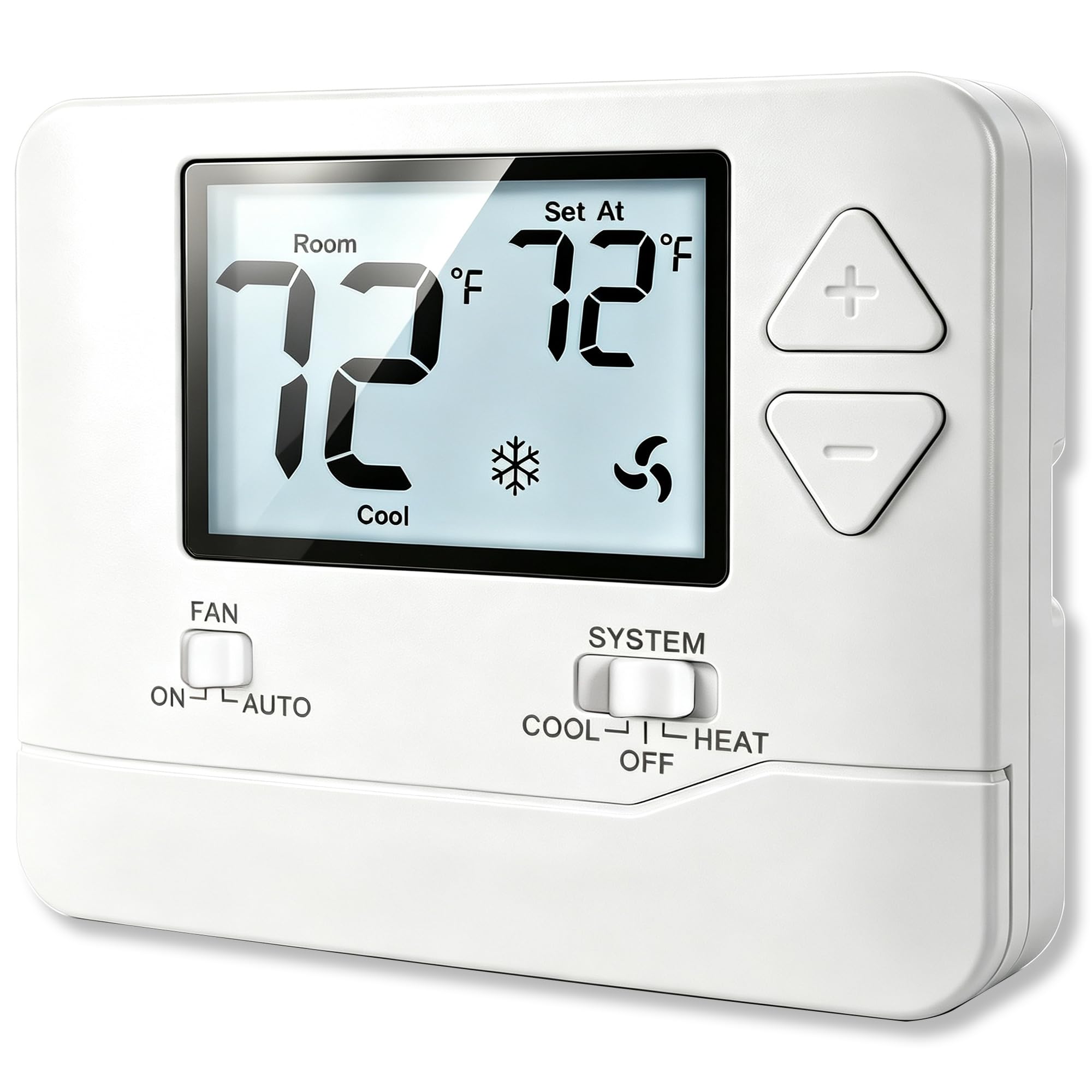
1. PRO1 IAQ T701 Non-Programmable Electronic Thermostat
Our pick — over 4.5★ from 950+ verified ratings; the strongest balance of quality and price.
A wall-mounted upgrade with a glowing 4-square-inch screen that eases eye strain.
Functionality is what wins people over here—well over 80 owners call out how dependably it does the one job asked of it. You get a single heat stage and a single cool stage, no programming to fight, and a blue backlight that makes the large numerals readable from across the room. It runs on batteries or hardwires into your system, and the battery compartment sits on the front so you are not prying the whole unit off the wall when power runs low.
Compared to the Honeywell RTH111B below, this one gives you a physically larger display—4 square inches against a standard digital readout—which is why it suits older eyes or dim hallways so well. Buyers report the buttons are easier to press than the Honeywell’s, and the unit snaps into an existing sub-base for a clean swap. One owner watched a unit fail only after 5 years of service, and its replacement has worked without complaint since, which is a fair life for any thermostat.
The reliability complaints deserve a straight answer: a handful of owners mention units stopping within three months, so it is not flawless from the start. Still, the overwhelming pattern is a simple, accurate, no-nonsense unit that replaced “possessed” programmable thermostats and ended the misery of power-interruption resets. If you want a low-maintenance wall control with the most legible screen in this list, this is the one.
What wins owners over
- Large 4 sq. inch backlit display that is easy on older eyes
- Dual power—batteries or hardwired—with front battery access
- Simple 1 heat / 1 cool layout with no menus to learn
The trade-offs to weigh
- A small group reported early failures within three months
- Short users found the wall-mounted numbers hard to see
Grab this if: you want the biggest, clearest display available and a thermostat that runs on batteries or your system’s power.
Think twice if: you are replacing a system with more than one heating or cooling stage—this handles just 1 heat and 1 cool.
2. Honeywell Home RTH111B Digital Non-Programmable Thermostat
The brand-name swap that lines up with your old screw holes so you skip the drilling.
Installation is the headline story here, and the details back it up. Customers note the screw holes lined up with their previous Honeywell base, meaning a straight swap with no fresh holes in the paint. The soft-touch buttons adjust the set point fast, and the digital display is easy to read at a glance. Everything runs on batteries, so there is no C-wire required and no chance of power-loss amnesia.
Temperature control holds within ±0.5 degrees Celsius, which buyers confirm in practice—one notes the room stays within a single degree of the set point. The set point is retained in memory even if the power blips, so you are not re-entering your preferred temperature after a storm. Against the PRO1 above, this Honeywell is the lower-profile, lighter option at 0.3 kg, and it earns its value badge by delivering the same everyday reliability for a friendlier outlay.
Know its limits before you buy: it works with heating, cooling, and heat pumps without auxiliary heat, but it does not support heat pumps with backup or multi-stage heating and cooling. It also will not run 120-240V electric baseboard heat. For a standard gas furnace with a basic AC, it is a genuinely no-frills unit—owners describe a 4-wire hookup done in minutes with “no frills & just works well.”
Bottom line: A dependable, easy swap for anyone replacing an old Honeywell—the screw-hole match alone saves a headache.
Watch for: Multi-stage or heat-pump-with-backup systems are outside its reach, so check your wiring first.
3. Heagstat NonProgrammable Thermostat 1 Heat/1 Cool
A set-and-forget wall control with a backlit display seniors can read without glasses.
Ease of use is the most-praised trait, and the feedback explains exactly why: press a button and the backlight glows, revealing large numbers that are genuinely easy to see. The 4.5 square inch LCD screen is slightly larger than the PRO1’s 4 square inch panel, and the off-white casing blends into most walls. It runs on 24VAC hardwiring or 2 AAA batteries, with the batteries as a simple fallback when no C-wire exists.
Precision is a real feature here, not marketing fluff. It holds 1°F accuracy, lets you adjust the swing anywhere from 0.2°F to 2°F, and even has a -4°F to +4°F manual calibration if your sensor runs warm or cool. The separate heating and cooling cycle-rate adjustments let you lengthen or shorten how often the system kicks on, which owners tie directly to smoother temperatures and lower annual energy use.
Compatibility is the catch to respect: this is exclusively for 24VAC conventional single-stage 1H/1C forced-air systems. The base accepts a maximum of 2 to 5 wires, so any 6- to 8-wire setup is out. It will not touch heat pumps, mini-splits, or 120-240V electric baseboard loads. Within its lane, though, owners describe it exactly as the reviews sum it up: “as simple as simple can get… No bells and whistles.”
Why it wins praise
- Push-button backlight with large numerals ideal for seniors
- 1°F accuracy with adjustable swing and manual calibration
- Separate heating and cooling cycle rates to cut energy use
Who should pass
- Strictly 2-5 wire single-stage systems—no heat pumps or multi-stage
- Batteries not included, so have 2 AAA on hand
Reach for it if: easy readability and simple Heat/Off/Cool control matter more than any smart feature.
Look elsewhere if: your wiring runs 6 to 8 wires or you have a heat pump system.
4. Miuputake 3001 NonProgrammable Thermostat
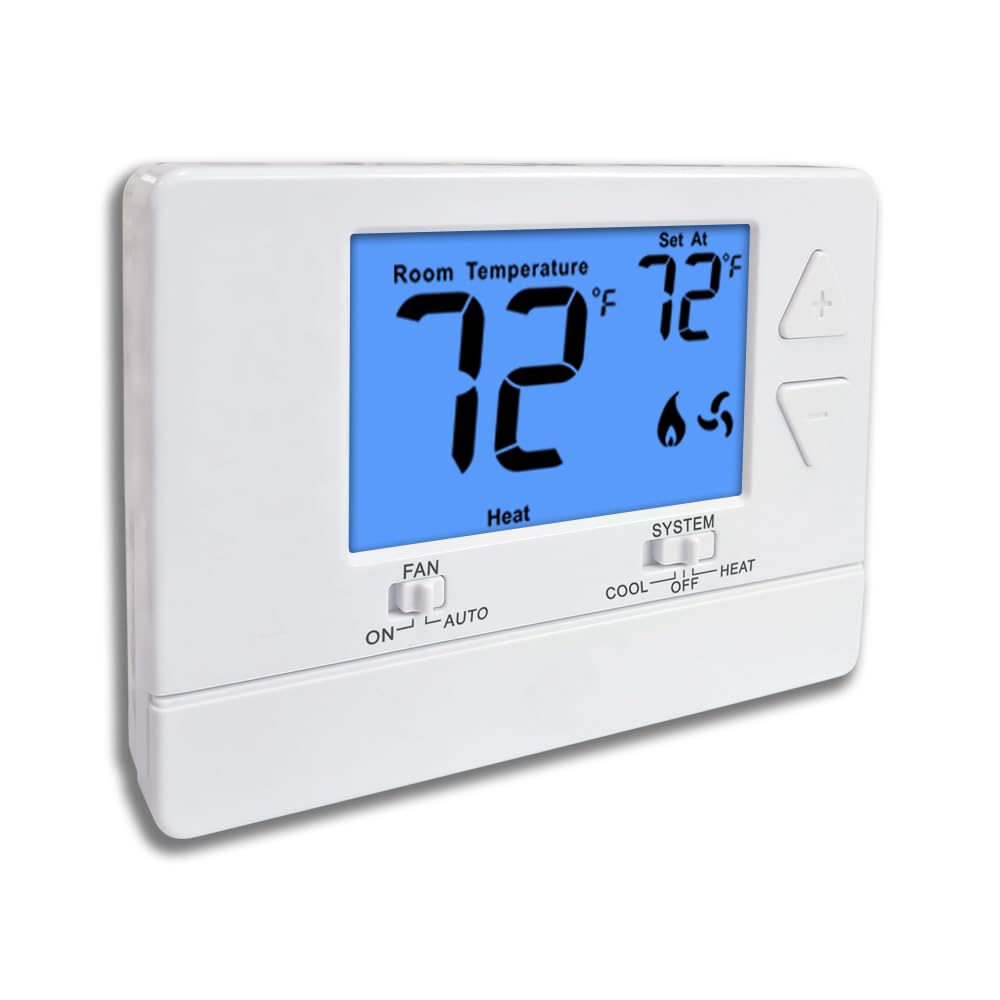
A budget-friendly dial with adjustable swing settings to prevent furnace short-cycling.
Functionality leads the owner conversation by a wide margin—nearly 70 buyers call out how well it performs its single job, with a large blue backlit display and large terminal blocks making the install approachable. The design goal is obvious: separate heating and cooling swing adjustments let you either prolong or shorten how long the system runs, which stops the rapid cycling that wastes energy. One owner set the swing to 1.5°F and watched the short-cycling disappear.
You can power it from your system’s 24VAC (standard household heating/cooling voltage) or just drop in 2 AA batteries, so you are not stuck if one source fails. The maker notes no C-wire (the common wire that supplies constant power) is required on most systems—though heat-only and cool-only setups do need that common wire. You can set the temperature anywhere from 44°F to 90°F, and the display itself shows readings from 41°F to 95°F, so you always know your exact range. The 2-year low-maintenance warranty plus 30-day free returns give DIY installers a safety net if the wiring does not match.
The honest caveat: this unit is strictly for single-stage systems, and the seller posts a blunt warning to examine the wiring images before buying. Multistage heat, heat pumps with or without auxiliary heat, mini-splits, and 120-240V electric baseboard are all incompatible. One owner did note a quirk—the buttons adjust the temperature when you press them to light the backlight—so treat the controls gently when your goal is just illumination.
What owners appreciate
- Adjustable swing stops rapid furnace cycling and saves energy
- Bright blue backlight with large, readable numerals
- 2-year warranty and 30-day returns for confidence
Keep in mind
- Single-stage systems only—check before you buy
- Backlight may need a C-wire or fresh batteries on some setups
The verdict: For a straightforward 1H/1C setup where you want to tame energy bills, the swing control here is a standout that pricier units lack.
5. Mroinge M701 Non Programmable Thermostat with Humidity Display

A wall display showing room humidity and temperature, legible from across the room.
The large backlit screen is the defining feature, and owners confirm they can read it from across the room—one 72-year-old buyer installed it with no trouble and reads it without glasses. The display shows both room temperature and humidity, which is rare at this level and genuinely handy for tracking a dry winter house or a humid summer one. The front battery door is a clever touch: you can swap 2 AAA batteries without pulling the whole unit off the wall.
Setup is forgiving thanks to a small but crucial detail—an internal mode switch that matches your heat type. One owner fixed an overheating problem where the room ran 10° past the set point simply by switching that internal mode from gas to electric, which suited their hot-water heat. The instruction manual is clear, and the broad furnace compatibility covers gas, oil, or electric systems—the maker claims it fits 85% of systems, which is a strong compatibility statement for a non-programmable unit.
The one honest gripe is the humidity reading itself: owners found it noticeably inaccurate and simply turned that readout off. So treat the humidity number as a rough guide, not a hygrometer. Also note this unit will not work with heat pumps, auxiliary or emergency heating, multi-stage systems, RVs, or 120/240V electric baseboard systems. For a standard single-stage gas or oil furnace, though, the bright display and sensible controls make it a crowd-pleaser.
The strong points
- Large blue backlit display includes a room humidity readout
- Front battery door means no wall removal for battery swaps
- Internal gas/electric switch fixes overheating on the right system
The weak points
- Humidity sensor accuracy drew complaints—treat it as a guide
- No heat pump, multi-stage, or line-voltage support
Who it fits: Anyone who wants temperature and humidity at a glance without climbing a ladder to change batteries.
6. Braeburn 1020NC Thermostat, Non-Programmable, 1H/1C

A contractor-grade workhorse that regulates temperature steadily, improving AC performance.
Functionality and ease of use are the twin pillars of owner praise, and the proof is in the details: buyers describe the AC “working even better than before” and regulating temperature very well after the swap. The 2 square inch display with a bright blue backlight is compact but clear, and the permanent memory holds your settings even through power losses. You can run it hardwired or on batteries, with separate O and B terminals for flexibility on heat pump setups without auxiliary heat.
This is a noticeably more compact unit than the PRO1 above—the Braeburn spans 4.72 inches wide against the PRO1’s 4.7 inches, but the bigger difference is the connector block layout that makes DIY wiring straightforward. A 64-year-old owner installed it solo with just a phone call to an HVAC tech for guidance. The compressor short-cycle protection is a genuinely useful safety feature that stops your AC from restarting too quickly after a power blip, which protects the compressor over the long haul.
The trade-off is the physical size—it is on the smaller side, and the instruction card is tiny, though the color-coded wiring makes up for it. One owner replacing a faulty Braeburn noted the color-coded terminals made installation easy and that it corrected inaccurate temperature readings from the old unit. The included English/Spanish packaging broadens its appeal, and for a hardwired install that just sits there and works, this is a dependable choice.
The standout: Compressor short-cycle protection and permanent memory make this a set-and-forget unit that guards your HVAC gear.
The note: The display is compact, so if you need huge numerals from a distance, the PRO1 or Heagstat lead instead.
7. White-Rodgers 70 Series Classic 1F78-144
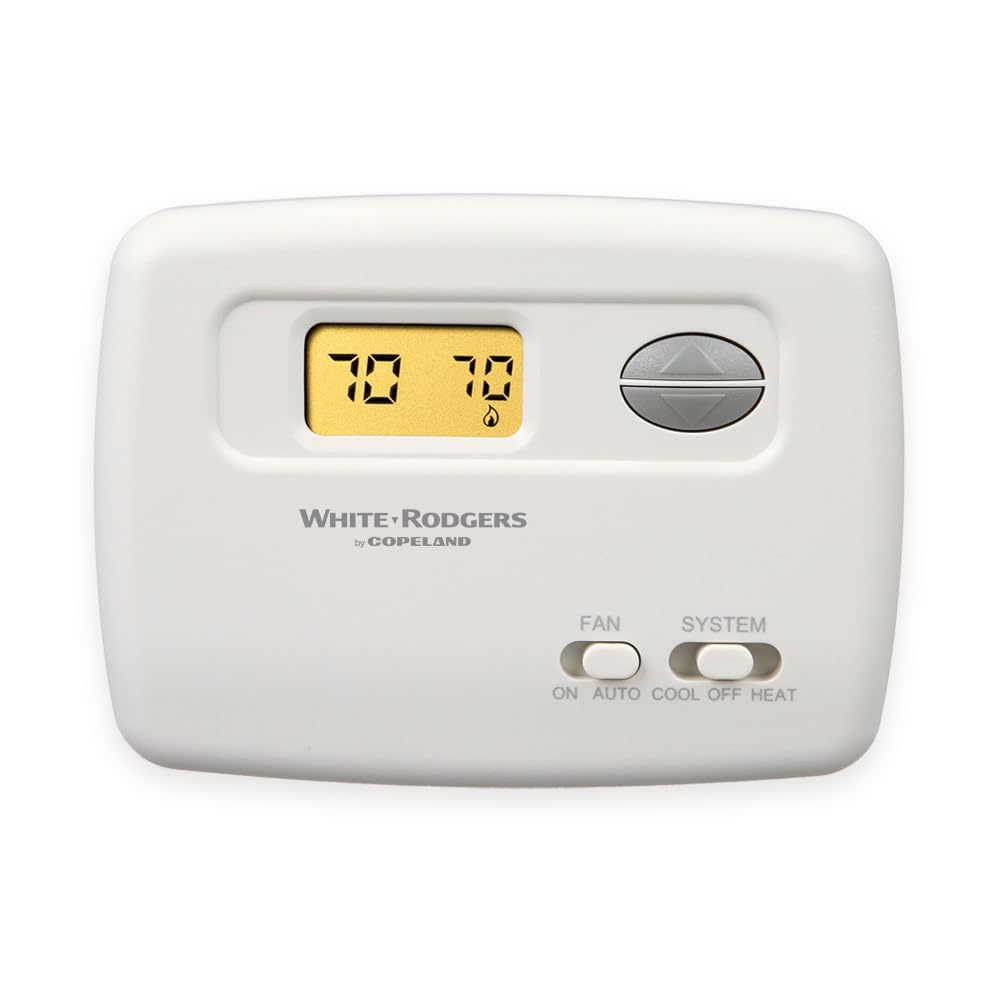
A landlord-approved wall unit tenants can operate in seconds without assistance.
Installation leads the owner story, and the reason is clear: it is simple for tenants to operate, which is exactly what a property owner wants. Buyers describe installing it in less than 10 minutes and note the batteries last a very long time. The backlit digital display is easy to read, and the ±1°F precision control keeps the room steady without fuss. It runs on 2 AA batteries that come included, so it is ready to mount the moment it arrives.
What sets this White-Rodgers apart is millivolt compatibility—a feature not every basic thermostat offers. That means it can work with certain gas fireplace and floor furnace systems that generate their own power, expanding where you can use it. Against the Honeywell RTH111B’s 0.3 kg weight and standard digital readout, this unit pairs similar simplicity with that broader millivolt reach, making it a flexible spare or rental-home choice.
The feedback is consistent: accurate, long-lasting, and refreshingly plain—one owner prefers turning the AC, heater, or blower on and off manually while still having the thermostat report the room temperature even when the system is off. The only real note is that it is a straightforward single-stage unit, so it will not handle multi-stage systems or heat pumps with auxiliary heat. For a simple heating zone in a warehouse or a rental, it is a quiet, dependable performer.
The read: A no-app, no-menus workhorse with millivolt reach that owners trust to sit on the wall for years.
8. White-Rodgers Single Stage 1E78-144

A tall, narrow thermostat designed for tight wall spaces where wide units won’t fit.
Quality and functionality lead the owner conversation here, with buyers calling it the “fool-proof standard of the HVAC industry” and noting a single AAA battery lasts years—often outlasting the HVAC equipment itself. The vertical profile is the defining physical trait: at 1.9 inches wide and 6.3 inches tall, it fits narrow wall gaps between door frames and corners where squat, wide thermostats simply will not mount. The backlit display and ±1°F precision keep it accurate and legible.
This is a White-Rodgers/Emerson unit, which owners treat as an industry benchmark—several note it needs no app, no calibration, and no babysitting, with one buyer preferring it outright over Honeywell. Included are 2 AA batteries and a user manual, and the install is straightforward for single-stage heating, cooling, and heat pumps without auxiliary heat. One owner with a heat-only oil furnace confirmed it works perfectly for that setup.
The honest note is the backlight: it works, but you have to read the instructions to learn how to turn it on, which trips up some buyers initially. And while support is solid—one defective unit was replaced without hassle—the winter delay feature would be a problem for some, so check the manual if you need that function. Against the wider 1F78-144 above, this is the pick when your wall real estate runs tall and narrow.
What stands out
- Narrow vertical design fits tight wall spaces
- AAA battery lasts years, outlasting the HVAC unit
- Simple, accurate, no-app operation owners trust
What to know
- Backlight activation requires reading the manual
- Single-stage only—no multi-stage or aux-heat support
Bottom line: For a slim wall gap and buyers who want an industry-standard name without smart features, this fits the bill.
9. Honeywell TH1110DV1009 Pro 1000 Non-Programmable Thermostat

A compact pro-grade swap that upgrades a camper or apartment in 10 minutes.
Quality leads the owner story here, and the proof shows up in an unexpected place—RVs and campers. Owners describe swapping their archaic camper thermostat for this compact unit as a 10-minute upgrade, since it takes 2 AAA batteries and will not drain the camper’s power. It also controls both AC and a propane-powered heater, which makes it a favorite for tiny homes and vacation trailers. The compact footprint fits in the smallest of wall spaces, and the included batteries mean it works the moment it is mounted.
Dual-powered operation means it runs on batteries or your system’s power, giving flexibility in older homes where a C-wire is missing. It handles heat and cool stages for conventional systems and heat pumps without auxiliary heat. The backlight illuminates when you touch the up or down buttons, which owners appreciate for reading the display in a dark hallway or a camper at night—it even tells you when it is calling for heat.
The mixed feedback centers on temperature accuracy: some owners find the reading correct, while others say it is not very accurate, so expect to use the calibration if your unit runs warm. One owner replaced old mercury-switch thermostats with three of these and appreciated the glow and the heat-call indicator. Made in the United States, it carries the Honeywell name owners trust, and for small spaces or mobile living, the Pro 1000 is a tidy, no-nonsense answer.
The appeal: A compact, dual-powered Honeywell that RV owners and apartment dwellers both reach for.
The catch: Temperature accuracy drew mixed notes—be ready to calibrate if yours reads off.
Understanding the Specs
Single-Stage 1H/1C Compatibility
This is the single most important spec to check. “1H/1C” means your system has one heating stage and one cooling stage—a standard gas furnace with a basic central AC. If you have a heat pump, a two-stage furnace, or electric baseboard heat (120-240V), these thermostats will not control it properly. Count your wires: 2 to 5 wires usually means single-stage, while 6 to 8 wires signals a more complex system needing a different thermostat.
Battery vs. C-Wire Power
Every thermostat here can run on batteries, and most can also pull power from a C-wire (the common wire that supplies continuous 24V power). Battery operation is the most forgiving for DIY—it works even with no C-wire present. Hardwiring via the C-wire means you never worry about dead batteries, but only if that wire actually exists in your wall. If you are unsure, battery power is the safer bet.
FAQ
Will a basic digital thermostat work with my heat pump?
How many wires can these thermostats connect?
Do I need a C-wire for these thermostats?
Will a basic thermostat work with electric baseboard heat?
How long do the batteries last in these thermostats?
What is the swing setting and why does it matter?
Can I install one of these myself without an HVAC tech?
Is a non-programmable thermostat better than a programmable one?
Final Thoughts: The Verdict
For most buyers, the best basic digital thermostat is the PRO1 IAQ T701 because its 4-square-inch backlit display and dual battery-or-hardwire power cover the needs of the widest range of homes. If you want the trusted Honeywell name with a screw-hole match for easy swapping, grab the RTH111B. And for a narrow wall gap or a camper upgrade, the White-Rodgers 1E78-144 or the compact Honeywell Pro 1000 are the space-saving answers.
How We Picked
We do not accept paid placement. Every pick is matched to a real buyer and a real use-case; we do not hands-on test units.
Sources & Methodology
Specifications: manufacturer listings and product documentation. Review insights: verified customer reviews, as of September 2026. Pricing: not shown on this page (it changes often); check the current price via the retailer link.
As an Amazon Associate, KitchPrep earns from qualifying purchases. This does not affect which products we feature.
Related Guides
