
Specs are compiled from manufacturer listings and verified buyer reviews and can change over time — please confirm the key details on the product page before buying.
A basement window AC is a fit problem before it is a cooling problem. Those low, narrow windows — often only a foot of clear height — rule out most standard units, and a damp, sun-starved space below grade needs different air handling than a sun-baked upstairs bedroom. The units below were checked against real window dimensions, real BTU ratings, and what owners actually say after a summer of running them in tight, low-clearance openings.
I’m Mohammad Maruf — the founder and writer behind KitchPrep. This guide is built by comparing the manufacturers’ published specifications and the patterns across verified customer reviews, so you get each pick’s real strengths and trade-offs instead of marketing spin.
Basement windows are often short, old, and single-pane, so a standard AC may not fit. Every pick here is a true through-the-window unit, not a floor-standing portable that needs a hose out a slider. The list runs from a compact mechanical workhorse that clears a shallow frame straight through to a 14,000 BTU smart unit built for a finished basement rec room, and each one is matched to a real window size and room footprint. If you want a shortlist where fit and cooling power are already worked out for a below-grade space, this is the best basement window air conditioner lineup to start with.
Our Picks at a Glance


How To Choose The Best Basement Window Air Conditioner
A basement window is the tightest frame in most homes, and that single constraint narrows the field fast. A below-grade room also tends to be cooler and damper than upstairs, so the right unit here is often smaller in BTU than you would put in a sunny bedroom of the same size.
Measure the clear opening, not the glass
The number that decides everything is the height your window can open to. A unit like the LG LW5023 is built to clear a double-hung frame as short as about 12 inches, while the Della 14,000 BTU unit needs a minimum of 16 inches to seat its larger chassis. Write down both the clear width and the clear height before you shop.
Match BTU to the room, then trim for below grade
A 5,000 BTU unit comfortably handles a room up to 150 square feet, and an 8,000 BTU model reaches 350 square feet. Basements usually run cooler and see less direct sun, so you can often stay at the lower end of that range for the same footprint.
Decide if you want dials or a remote
Mechanical dial units like the GE 5,000 BTU and Senville 5,000 BTU are simple and nothing to lose, while electronic and smart units add a thermostat, a timer, and app or voice control. If you rent, dial control is easier to hand over at move-out.
Check drainage and filter access
In a basement with already-humid air, a common unit needs a clean condensate path and a filter you can pull out easily. Washable slide-out filters make monthly cleaning realistic, which matters more below grade where dust and damp add up.
Quick Comparison
| Model | Best For | Cooling Power | Room Coverage | Energy Use | Amazon |
|---|---|---|---|---|---|
| GE 5,000 BTU Mechanical★ Best Overall | Tight, shallow window openings | 5,050 BTU | 150 sq ft | — | Amazon |
| Midea 5,000 BTU EasyCoolBest Value | Remote control on a budget | 5,000 BTU | 150 sq ft | 580 W | Amazon |
| LG LW5023 5,000 BTUBest for Tight Windows | Shortest window clearance | 5,000 BTU | 150 sq ft | 450 W | Amazon |
| Senville 5,000 BTU | Simple dial control, no remote | 5,000 BTU | 150 sq ft | — | Amazon |
| GE 6,000 BTU Electronic | Digital thermostat and timer | 6,000 BTU | 250 sq ft | — | Amazon |
| Frigidaire 8,000 BTU | Quiet bedroom-grade cooling | 8,000 BTU | 350 sq ft | 550 kWh/yr | Amazon |
| Hisense 8,000 BTU Smart Inverter | Slim profile with app control | 8,000 BTU | 350 sq ft | 400 kWh/yr | Amazon |
| LG 8,000 BTU LW8024RD | Medium rooms, dependable name | 8,000 BTU | 350 sq ft | 660 W | Amazon |
| TCL 8,000 BTU Smart | Voice control and dehumidifying | 8,000 BTU | 350 sq ft | 10.9 kWh | Amazon |
| Midea 8,000 BTU U-Shaped Inverter | Quietest operation, window stays usable | 8,000 BTU | 350 sq ft | 1,700 kWh/yr | Amazon |
| Della 14,000 BTU | Large finished basements | 14,000 BTU | 700 sq ft | — | Amazon |
In‑Depth Reviews
1. GE 5,000 BTU Mechanical Window Air Conditioner for Small Rooms up to 150 sq ft.
Our pick — over 4★ from 750+ verified ratings; the strongest balance of quality and price.
The dial-and-knob workhorse that drops into the shallowest basement frame without a fuss.
If your basement window is the awkward one — short, old, single-pane — this GE is the pick most people end up with. It is rated at 5,050 BTU (a BTU is a unit of cooling power, the higher the number the more heat it pulls out), which pushes it just above the other 5,000 BTU units here and covers a room up to 150 square feet. For a typical basement bedroom or utility corner, that is the right size without overspending on cooling you will never use.
The controls are mechanical — a rotary dial (a simple turn-knob, no digital display and no remote to misplace) that sets cooling and fan speed with a satisfying click. What wins people over is raw cooling performance, the single most-praised trait across its owner feedback: it drops a hot 10×12 room fast even mid-heat-wave, and it holds up in real summer abuse. Buyers report cooling an 87°F room down to 72°F in 2 hours through 90°F-plus outside weather, and pushing cool air into three upstairs bedrooms with the door open and a fan helping. The filter slides out for a rinse, the chassis is fixed, and the included EZ Mount kit bolts into a double-hung window without cutting the frame.
Here is the honest catch: this is not a whisper unit, and the noise and long-term reliability come up mixed in owner feedback. It is quiet enough for most rooms but it will not disappear in a recording studio, and a rare unit developing a rattle late in life is worth knowing about. Compared with the Midea EasyCool below, this GE spends 5,050 BTU against that unit’s 5,000 and stays simpler to operate by hand.
Reasons it earns the top spot
- Tops the budget field at 5,050 BTU, the highest cooling number among the entry-size units here
- Mechanical dial means zero remote, zero digital board to fail, and instant setup
- Pulls a hot small room down quickly — owners mention an 87°F to 72°F drop in about 2 hours
- Slide-out filter and a fixed chassis that installs in a standard double-hung window
Where it asks patience
- No electronic thermostat, so you set it by feel rather than by exact degree
- Noise and long-term reliability swing both ways in owner feedback
- Not a match for a room that needs app or voice control
Reach for this if: your basement window is short, you want dial-simple operation, and the room is roughly 150 square feet or less.
Look elsewhere if: you need a digital thermostat readout, a programmable timer, or app control on the unit itself.
2. Midea 5,000 BTU Window Air Conditioner, Cools up to 150 Sq. Ft. with Easy-to-Use Reusable Filter, Remote, Perfect AC for Bedroom, Living Room, Home Office, Electronic Control
A 5,000 BTU box that cools, dehumidifies, or just moves air — with a remote for lazy afternoons.
What sets this Midea apart at the entry size is that it does three jobs: cool, circulate as a fan, and pull moisture out as a dehumidifier. For a below-grade room, that dry mode earns its keep — basements stay clammy even when the air temperature looks fine, and a dry cycle takes the edge off. At 5,000 BTU it covers up to 150 square feet, and the light background noise floor is a 52 dB low setting (dB is a measure of loudness, and 52 is roughly the level of a quiet conversation).
Installation is the part owners praise: all mounting gear is included, and one reviewer noted a 6-minute solo setup in a window. The remote takes care of temperature and mode from across the room, and the reusable filter rinses under the tap. It draws 580 watts in use, which puts it in line with the small-unit field. On the cooling side feedback is honest but two-sided — the unit cools small bedrooms quickly in minute-by-minute time, yet some units arrive from the reconditioned channel with problems, so buying from a first-party listing matters here.
Living with it, the recurring note is that the fan speeds do not differ much from one another, and the included gap strip is thin. The plastic side-fill panels also want a careful fitting to seal the window opening. Set against the GE 5,000 above, this Midea trades away mechanical simplicity for a remote, a dehumidifier mode, and a digital display.
What you actually get: three modes in one box, a real remote, and a reusable filter for a room up to 150 square feet.
What to think about: the fan-speed dial mostly does nothing, so you will live on low regardless, and it needs a clean first-party listing rather than a reconditioned offer.
Suits: a homeowner who wants one small unit that can both cool and dehumidify a damp corner, with a remote for the couch.
Another route: if you would rather have dials than a remote, the GE or Senville below keeps it simpler.
3. LG 5000 BTU Window Air Conditioners Easy Mechanical Control Ultra-Quiet Compact-size Cools Washable Filter 150 Sq.Ft. for Small Room AC Unit air conditioner Easy Installation White LW5023
The lowest-clearance unit here, built for that stubby basement window the others won’t seat in.
The number that matters on this LG is the window opening it accepts — a double-hung frame as short as 12 inches high, and 21 to 35 inches wide. That is the most forgiving clearance in this entire roundup, and it is exactly the kind of stubby low-opening window you find in older basements. Once it is in, 5,000 BTU covers up to 150 square feet, and it consumes 450 watts — the leanest annual energy figure among the 5,000 BTU machines here.
The vents point upward, which several owners genuinely appreciate because the cold air does not blow straight onto whoever is sitting nearby. It runs as low as 50 dB in low mode (quiet enough to hold a conversation over it), and the mechanical knob has a deliberately old-school, clicky feel that people either love or shrug at. Installation is a 5-minute job after the side flaps are wrestled on, and a washable slide-out filter keeps maintenance simple — the maker suggests cleaning it about every 30 days.
The trade-offs are the point to weigh. There is no remote and no digital display; the controls are retro knobs and switches. And while the cooling performance earns plenty of praise for reaching larger spaces than its rating suggests, it swings both ways in owner feedback — a rare unit simply does not cool like it should. Compared with the Midea EasyCool above, the LG runs leaner on power (450 watts versus 580 watts) but gives up the remote and dehumidifier mode.
The case for narrower windows
- Fits a double-hung window only about 12 inches high — the tightest fit certified in this lineup
- 450 watts of draw, the lowest of the 5,000 BTU group
- Upward-aimed vents keep cold air off seated people nearby
- Washable filter and a genuinely quick 5-minute install once the flaps are on
The reality check
- No remote and no digital temperature display — dials only
- Side flaps are fiddly to screw on, per more than one owner
- Cooling feedback swings, so check your listing before you buy
Best matched to: a tight low-clearance double-hung basement window and a 150-square-foot or smaller room, where a knob is all you want.
Consider a different pick: if you need to control it from bed or want a dehumidifier cycle, step up to a remote unit instead.
4. Senville 5,000 BTU Window Air Conditioner, Cools Up to 150 Sq. Ft., Easy to Use Mechanical Control, Washable Filter
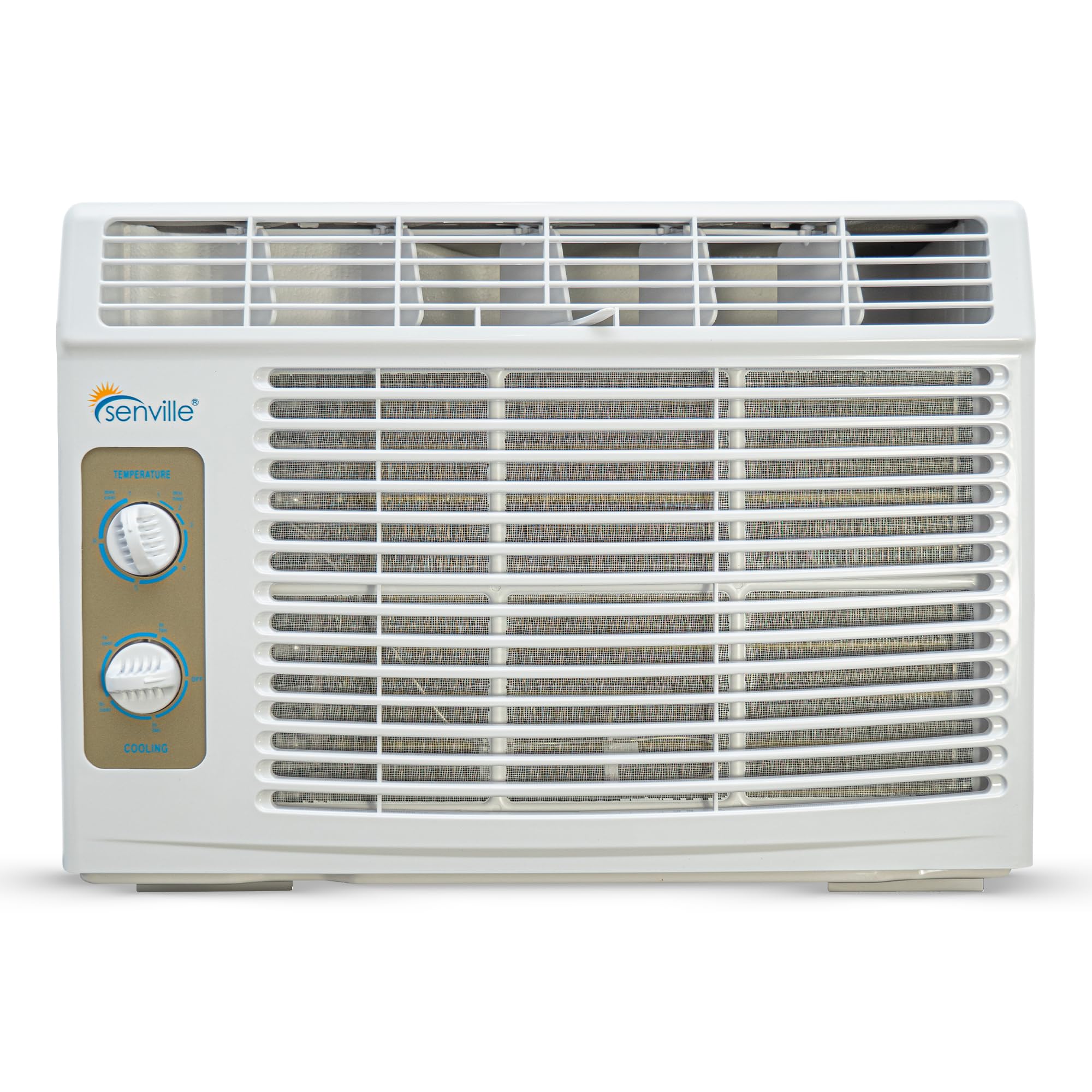
Seven dial settings and a low profile — the no-frills pick for a fixed basement window.
The Senville leans on simplicity: seven temperature settings, two cooling and two fan-only speeds, and 2-way air direction, all on built-in dials with no remote at all. At 5,000 BTU it cools up to 150 square feet, and its CEER of 11.0 (a combined efficiency rating for window units) means it sips power relative to the size. For a basement where you set it once in June and leave it, that dial-only layout is a plus — nothing to lose behind the couch.
The install hardware is complete for a window 23 to 36 inches wide and 13 inches high minimum, with a screwdriver as the only tool you supply. What owners single out is how quietly it runs — feedback repeatedly puts it below comparable brands on noise — plus its light weight, which makes lifting it into the frame a one-person job. The size draws a split verdict: happy buyers call it a clean fit for small windows, and a few complain it is not the advertised width, so measure your opening before ordering.
One honest wrinkle: there is no drain plug, which is note in a humid basement where you may want a deliberate condensate path. And a damaged or used unit arriving from a third-party seller is a real risk with any AC purchase — buy from the manufacturer-backed listing to avoid a returned item sold as new. Against the GE 5,000 above, Senville runs one letter higher on efficiency but adds no remote, no dehumidifier mode, and the drain-plug gap.
Why basement owners like it: dial-only control, a low profile that slips into a short frame, and one of the quieter reputations among small window units.
Choose this if: your window is a fixed double-hung 23 to 36 inches wide and you want the plainest possible operation for one room.
Pass if: you want a drain plug, a remote, or a thermostat to set exact degrees.
5. GE 6,000 BTU Electronic Window Air Conditioner, Cools Rooms up to 250 sq ft, Digital Controls with Remote, Energy Saver Mode, 24Hr Timer, Easy Install Kit Included, White

A digital thermostat and a 24-hour timer on a 6,000 BTU body — set it and leave the basement.
Where the GE 5,000 is all dials, this 6,000 BTU sibling goes full electronic. It cools rooms up to 250 square feet — roughly a 10×25 space — and adds a precise digital thermostat adjustable from 64°F to 86°F, a full-function remote, and a 24-hour programmable timer with auto-restart that remembers your settings after a power blink. For a basement you heat-and-cool around the week, being able to schedule it and let it cycle is the whole reason to step up in BTU and cost.
It runs at 52 dBA on low and 56 dBA on high (dBA is a loudness scale weighted to how the human ear hears), so it stays reasonably under the conversation hum for a work or sleep space. The Eco mode lets the compressor cycle rather than run flat-out, which the maker says Eco mode cuts energy versus a unit that runs continuously, and the efficiency rating comes in at 12.1 CEER. Install uses a fixed chassis in a double-hung window 27.125 to 36 inches wide with a 13.375-inch minimum height, and a washable filter with a reminder light handles maintenance.
The fair warning is that cooling feedback here splits more than on the pricier units — most buyers find it cools a 12×12 room quickly and quietly, but a small number report uneven cooling or an odd smell over time, so a good first-party listing and a real return window matter. It is not Wi-Fi or smart-home compatible. Next to the Frigidaire 8,000 below, this GE covers 100 fewer square feet and gives up six-way airflow, but it keeps the same remote-and-timer convenience.
Where the electronics pay off
- Digital thermostat you can dial to an exact degree, from 64°F to 86°F
- 24-hour timer plus auto-restart so an outage does not reset your schedule
- Eco mode and a 12.1 CEER efficiency number to trim running cost
- 250 square-foot coverage — good for a mid-size basement rec corner
Hold that thought
- Not Wi-Fi or smart-home compatible — remote only, no app
- Cooling feedback is more mixed here than on the top-tier units
- Bigger window opening needed — about 13.4 inches minimum height
For you if: you want a scheduled, thermostat-accurate unit for a basement up to 250 square feet and a remote on the nightstand.
Better elsewhere: if you need app control or a 350-square-foot reach, move up the list.
6. Frigidaire 8,000 BTU Window Air Conditioner with Remote Control, Cools Up to 350 Sq. Ft., Quiet Operation, Eco Mode, 3 Fan Speeds, Auto Restart, White
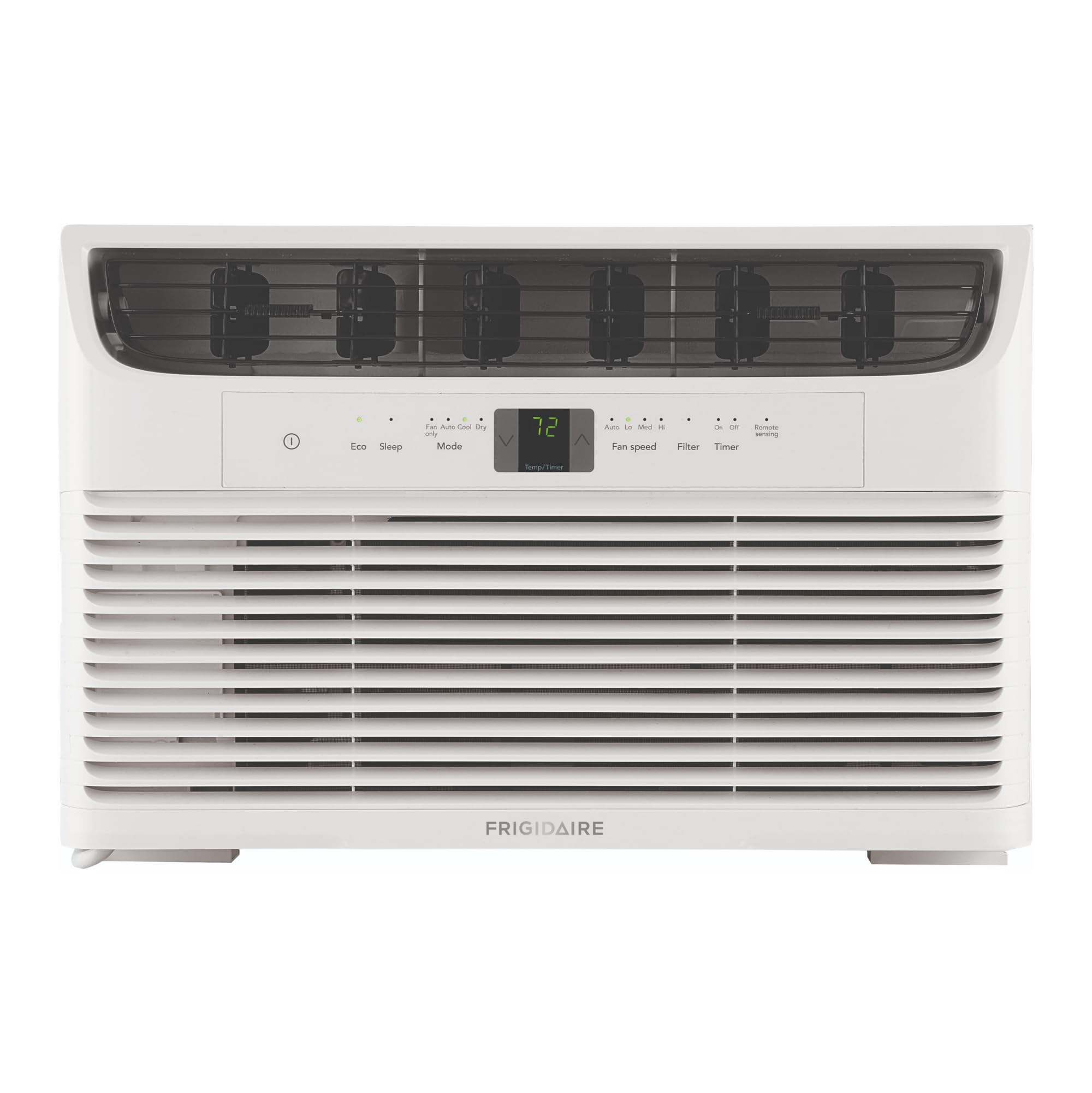
A 54 dBA sleeper that cools a whole finished basement without waking anyone upstairs.
For a basement bedroom or den that runs up to 350 square feet, this Frigidaire brings 8,000 BTU and runs at 54 dBA — low enough that it fades into the background in a room you actually sleep in. Six-way directional airflow (you can aim the louvres up, down, and side to side) is the feature most small units lack, and it matters in a low-ceiling space where you want cold air pushed across the room rather than straight down onto the couch.
The efficiency story is solid: it uses 550 kilowatt hours per year and carries a 10.9 rating, and it offers Eco mode plus a Sleep mode that nudges the temperature up gradually overnight. A 24-hour on/off timer, Dry mode for pulling moisture, and a Clean Filter alert round out the feature set — Dry mode matters more than usual below grade. Owners put it to work in tough heat: it keeps a whole 300-square-foot Arizona tiny home in the 70s through triple-digit summer days with a box fan helping, and it seals cleanly around the window.
Here is what to keep in your head: like most units in this size, noise splits in owner feedback — the majority call it quiet, and a rare review lands it as louder than expected, which is usually a defective unit rather than the norm. The remote is basic. Set against the GE 6,000 above, this Frigidaire reaches 350 square feet to that unit’s 250 and adds the six-way airflow, at a higher running cost per year.
The standout spec: 8,000 BTU into 350 square feet at a 54 dBA noise floor — the combination that makes it a credible basement sleeper.
Suits: a finished basement bedroom or den up to 350 square feet where you care most about noise and want directional airflow.
Think twice if: you need smart-home integration — this one is remote-and-button only.
7. Hisense 8,000 BTU Smart Inverter Window Air Conditioner Easy Install Bracket, Up to 350 Sq Ft, Ultra-Slim Profile, 3 Speed, 700W, 4‑Way Air Direction HLAW0825TW (Renewed)
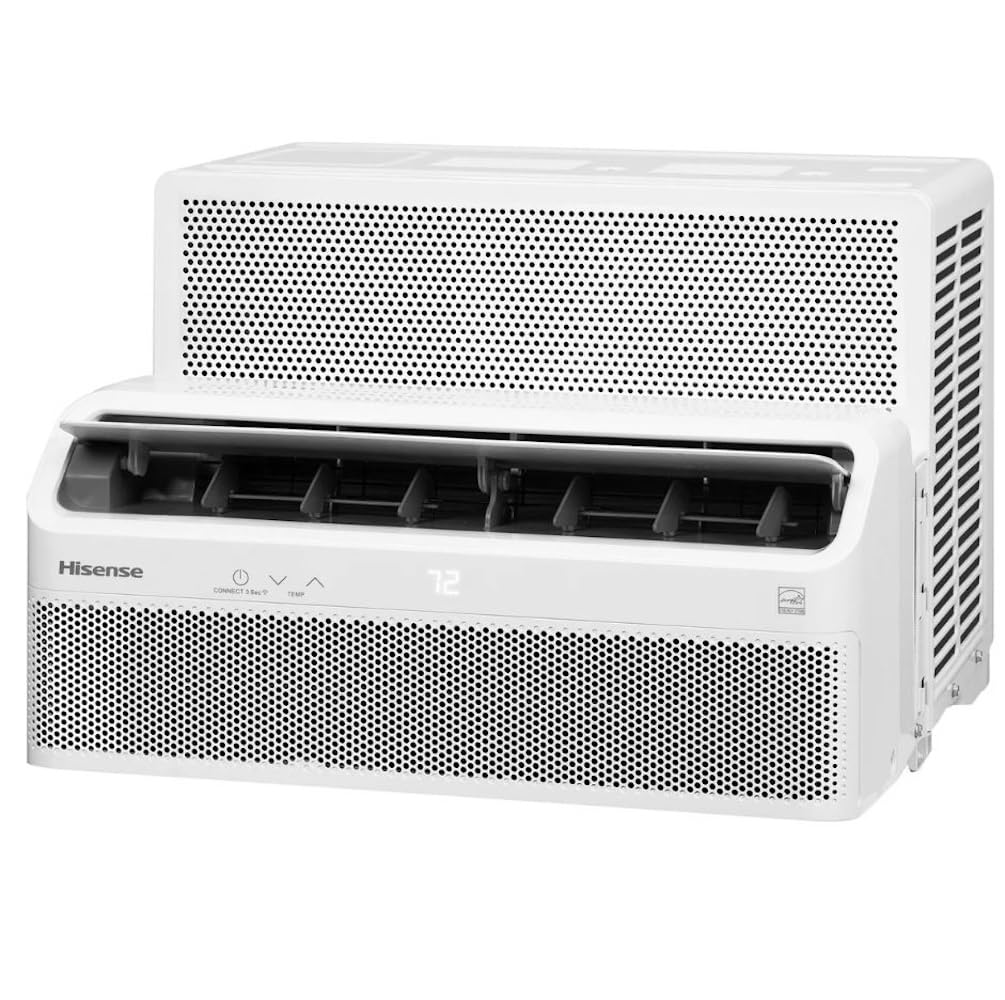
An inverter compressor and a slim frame that lets the window keep opening and closing.
Two things separate this Hisense from the rest. First, it uses an inverter compressor (a variable-speed motor that ramps up and down instead of clicking fully on and off), which keeps temperature steadier and runs more efficiently — the maker rates it at 400 kilowatt hours per year and 700 watts. Second, its ultra-slim profile and included install bracket mean the AC sits in the window without blocking the sash, so your basement window still opens and shuts for ventilation. It covers up to 350 square feet at 8,000 BTU and needs a window 25 to 38.6 inches wide by 15.2 inches high.
What the review pages agree on is quiet operation and real cooling for bedrooms, plus the smart side — it is Wi-Fi enabled and controllable through the ConnectLife app, with cooling, fan, dry, and eco modes plus a sleep setting. The bracket makes installation more sturdy than the typical side-panel setup, and the 235 CFM airflow figure tells you it moves a solid volume of air for its size. Do keep the window-height requirement in mind: at 15.2 inches minimum, this is a taller opening than the 5,000 BTU units demand.
Two honest notes. This is a Renewed listing, so inspect the unit on arrival and confirm the return terms. And the fit feedback is mixed — some windows seat it perfectly while other owners hit installation snags, so measure against that 15.2-inch minimum before you buy. Set against the Midea U-shape below, the Hisense matches it on 8,000 BTU and 350 square feet but does not offer the same 32 dBA noise floor or the U-shape’s ability to leave more of the window pane clear.
What the slim chassis buys you
- Inverter compressor holds temperature steadier and sips power — 400 kWh/year
- Bracket install keeps the window usable, so you can still open it
- Wi-Fi plus ConnectLife app, and four modes including dry and eco
- 235 CFM airflow for a slim body
Points to weigh carefully
- Renewed unit — inspect the packaging and chassis when it lands
- Needs a 15.2-inch-tall window opening — taller than the small units require
- Fit feedback is split, so measure your frame first
Best for: a basement window you still want to open, or a room where app control and steady inverter cooling matter more than price.
Another path: if you want a new-condition unit with the same 8,000 BTU reach, the LG 8,000 below is the safer pick.
8. LG 8,000 Window Air Conditioner, 115V, 350 Sq.Ft. (14′ x 25′ Room Size), Quiet Operation, Electronic Control with Remote, 3 Cooling & Fan Speeds, Auto Restart, 8000 BTU, White
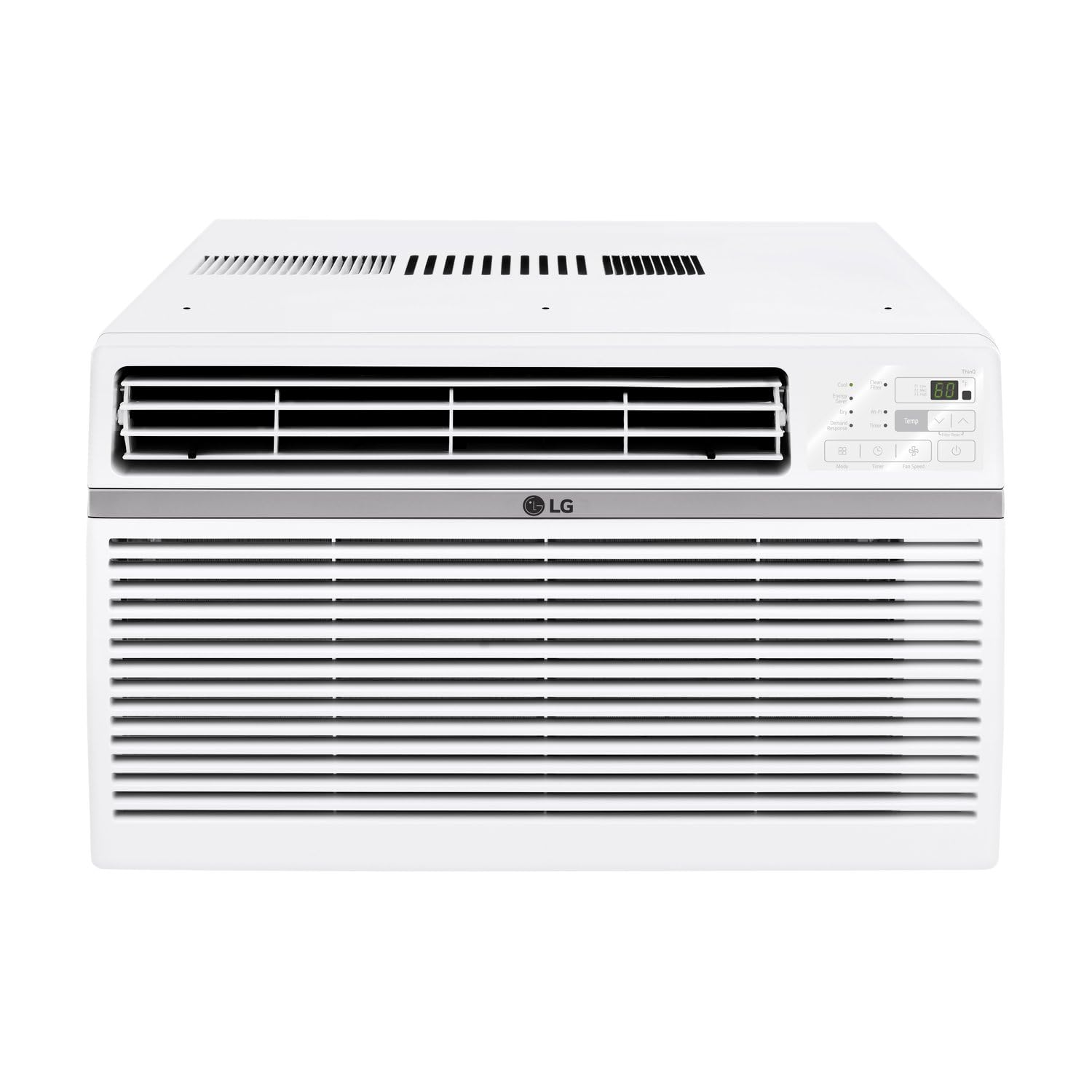
The fleet-buyers’ 8,000 BTU — a unit landlords grab five at a time and stop worrying about.
The telling signal on this LG is how it gets bought: owners running rental properties pick it up in multiples. One buyer installed five of these 8,000 BTU units across Georgia rentals, keeping a 1,000-square-foot mobile home in the mid-70s through 95-to-100°F outside, and another dropped a room from 81°F down to 73°F in one hour. It cools up to 350 square feet — a 14×25 space — at 53 dB on low, with three cooling and fan speeds plus an Auto Cool mode and auto-restart after an outage.
The build is solid and the operation is electronic, with a remote for across-the-room changes and a filter-light reminder when it is time to rinse the filter. It draws 660 watts and carries a rated energy efficiency, and the plate handles a typical 115V basement outlet. For a medium basement room, this is the pick that asks the least of you day to day — set the temperature, let auto-restart worry about power blips.
Two caveats worth stating. Noise splits in owner feedback: plenty of owners call it super quiet, a minority find it noisy, so expectations vary by room and window seal. And the directions are on the thin side, which means a heavier unit like this can be awkward to seat alone — one owner bought a brace bar to help. Compared with the TCL 8,000 below, the LG matches on 8,000 BTU but trades the TCL’s voice control for a plainer, more reliable-feeling remote-and-buttons layout.
Why it stands out: a repeat-purchase track record from rental owners and an Auto Restart that keeps your settings through an outage.
One thing to plan for: it is heavy and the included instructions are brief, so recruit a hand for the lift into the frame.
Reach for this if: your basement room is around 350 square feet and you want a dependable electronic unit with a remote and no app fuss.
Go a different way if: you specifically want voice control or a dehumidifier-heavy cycle — the TCL or Midea U-shape fits better.
9. TCL 8000 BTU Smart Window Air Conditioner with Dehumidifier, Remote Control
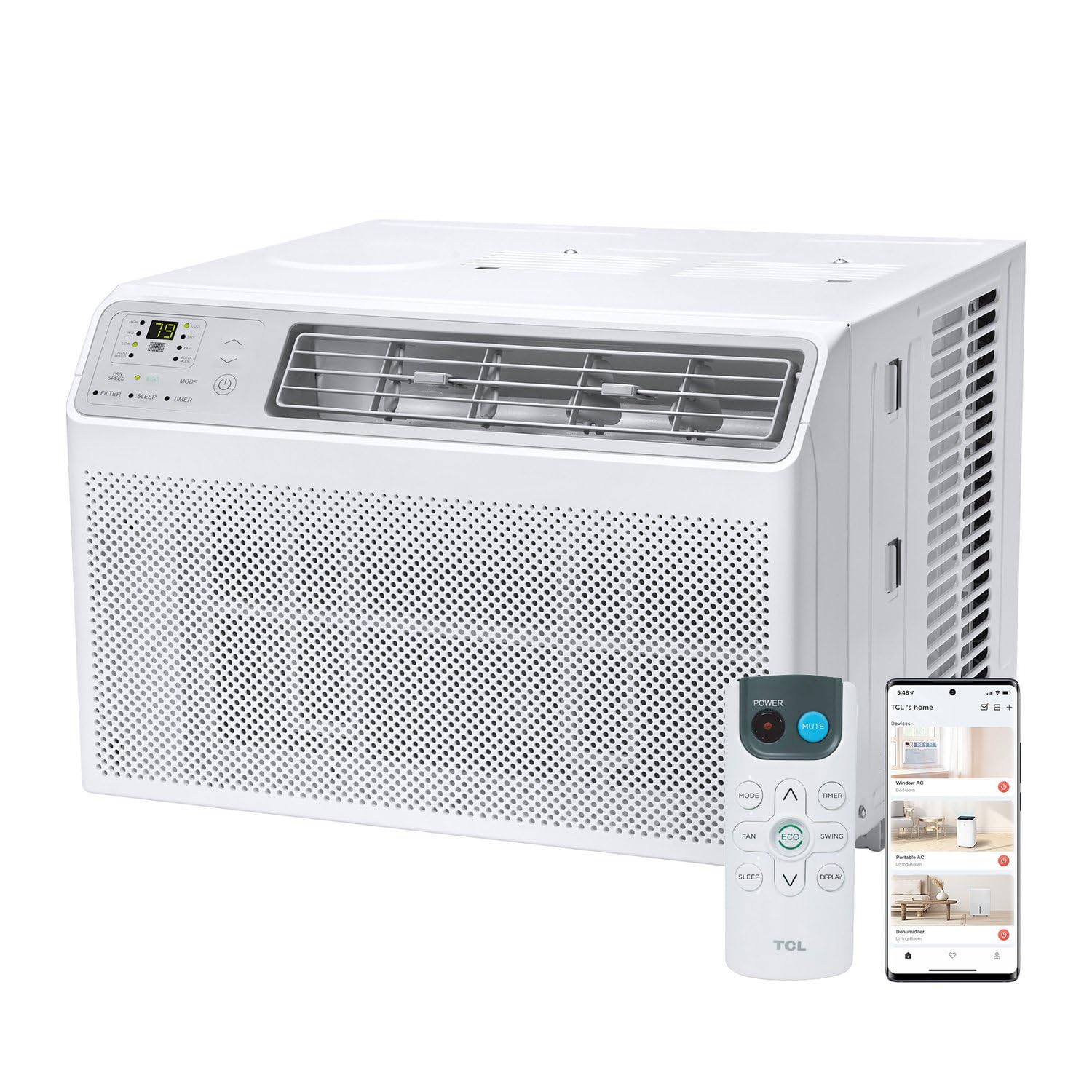
Say the word and it cools — a voice-controlled 8,000 BTU unit that also dries the air.
This TCL lets you run it three ways: the included remote, the TCL Home app, or voice through Alexa, Google Assistant, or Siri-enabled devices. For a basement you rarely walk down to check, being able to trigger cooling by voice or from your phone is the point. It is 8,000 BTU and covers up to 350 square feet, and the 3-in-1 design adds fan and dehumidifier modes — the dry cycle being the one that genuinely helps a damp below-grade room.
It cools a large living space well and pulls humidity out of adjacent rooms too, and the LED display keeps settings visible on the unit. Sleep and Eco modes trim running cost, and the washable filter keeps upkeep easy. Owners rate the cooling performance highly and consider the value fair for what you get. It is the kind of unit you set to a schedule and mostly forget.
The two honest notes: noise is the recurring gripe — this one is louder than the quiet-first units on this list, and when off, it lets a noticeable amount of outside sound through the window. And Wi-Fi setup is fussy via the TCL app, with connectivity a genuine sticking point for some owners. Compared with the LG 8,000 above, the TCL adds voice control and a dedicated dehumidifier, but the LG runs on a simpler, more predictable control set.
What the smart layer adds
- Voice control through Alexa, Google Assistant, or Siri — plus app and remote
- 3-in-1: cool, fan, and dehumidify a room up to 350 square feet
- Sleep and Eco modes for overnight and away-from-home savings
- Washable filter and an on-unit LED display
Where it needs tolerance
- It runs loud — you will notice it when the room is quiet
- Wi-Fi pairing through the TCL app can be tedious
- When powered off it still passes outside noise through the window
Ideal for: a tech-forward owner who wants voice or app control and a real dehumidifier cycle on a 350-foot room.
Better elsewhere: if a low noise floor is your top priority, the Midea U-shape below is the quieter machine.
10. Midea 8,000 BTU U-Shaped Smart Inverter Window AC, Cools 350 Sq Ft, Ultra Quiet, Alexa/Google Compatible
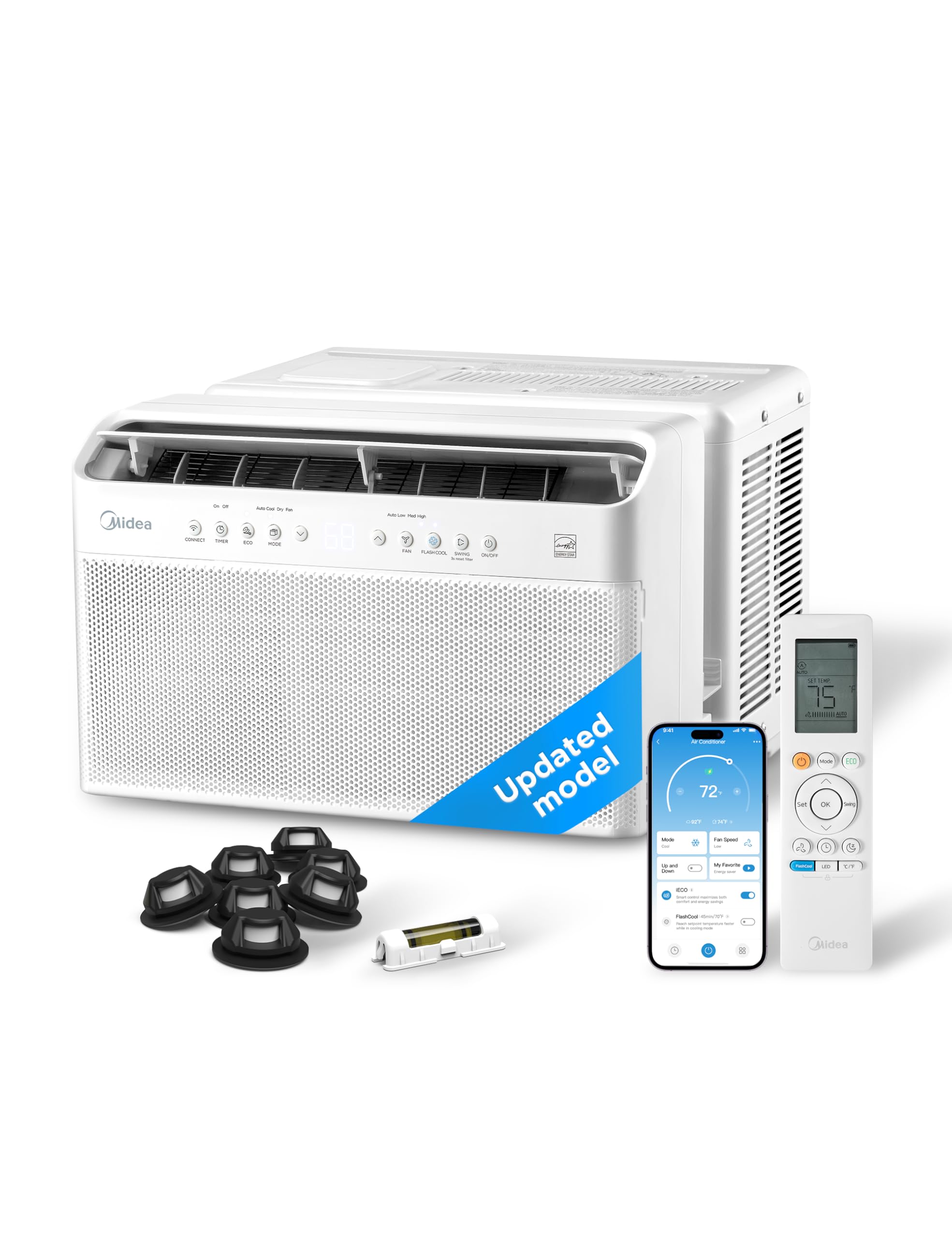
The U-shaped inverter that uses your window as a sound barrier — and shuts the rest of the noise out.
The defining trick on this Midea is its U-shape. Because the noisy compressor end sits outside and the window sash closes down into the U, the glass itself becomes a noise barrier between outside and in. That is what lets it run as low as 32 dBA (about the level of a rustling leaf, near-silent for an AC), and the DC inverter compressor keeps the temperature steady rather than cycling on and off. It covers 350 square feet at 8,000 BTU, draws 710 watts, and uses the R32 refrigerant.
The energy story is the other headline — the maker claims more than 37% energy savings from the inverter drive and calls it the first window AC to earn ENERGY STAR certification. It is Wi-Fi enabled with the SmartHome app and works with Alexa and Google Assistant. Owners who have had one since 2018 report it still running strong, cooling a 13×15 room and beyond, while leaving the window pane usable for light and fresh air.
Two honest issues to plan for. First, drainage: some units shipped with a drain-hole plug and a tall rim that can trap water, and at least one owner reported a mold smell after a month — so check and clear the drain path, and keep the filter and drain clean. Second, installation is logical but may need sill adjustments on stone ledges or an aluminium frame. Compared with the Frigidaire 8,000 above, this Midea runs dramatically quieter (32 dBA versus 54 dBA) and uses more of a window that stays functional, at a higher price.
Why the U-shape wins the quiet race
- Runs as low as 32 dBA — quietest unit on this list by a wide margin
- the U-shaped inverter design keeps the window usable for light and air
- Wi-Fi with SmartHome app, Alexa, and Google Assistant
- Inverter drive claims over 37% energy savings; ENERGY STAR certified
What to watch for
- Condensate drainage needs attention — some units shipped with a plugged drain hole
- Install can need sill adjustments on stone or aluminium frames
- Heavier and it protrudes from the wall — confirm your opening depth
Made for: a basement bedroom or office where near-silence is non-negotiable and you want the window to stay functional.
Look elsewhere: if you want the simplest possible install with no drainage fuss — the LG or GE electronic units are more forgiving.
11. DELLA 14,000 BTU Window Air Conditioner, Work with Alexa, Cools Up to 700 Sq. Ft., GEO Location, Remote/App Control, Dehumidifier, Fan, Reusable Filter, Easy Install Kit
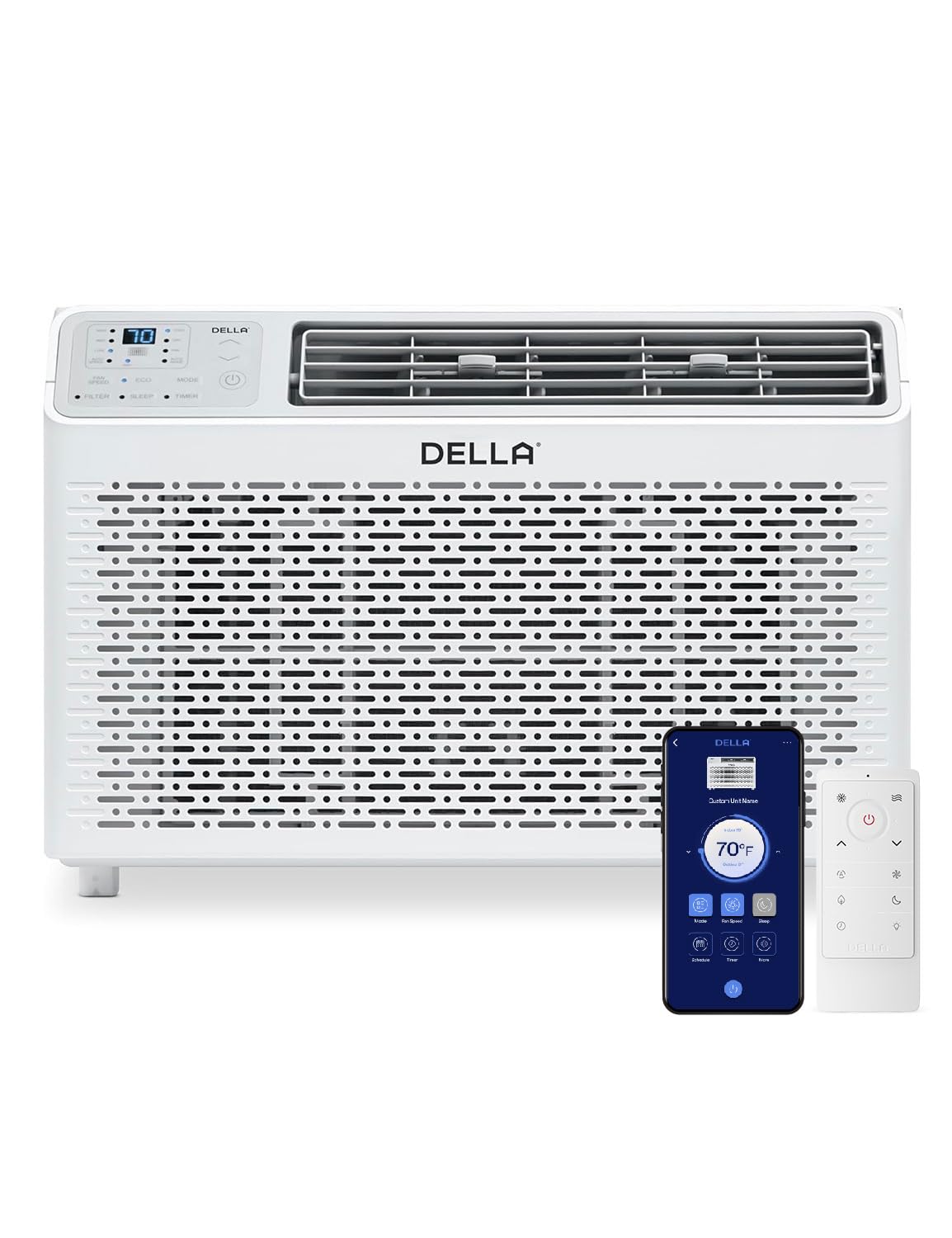
The 14,000 BTU bruiser for a big finished basement — if your window can take it.
When the basement is a full finished rec room, none of the 5,000 or 8,000 BTU units will carry it. This Della brings 14,000 BTU and covers up to 700 square feet —double the reach of every 8,000 BTU pick here — with a CEER of 10.7 (a combined efficiency rating) and UL listing. It runs four modes (Auto, Cool, Fan, Dry) across three fan speeds, with a sleep setting, a 24-hour timer, and a 61°F-to-88°F temperature range, all drivable from the Della+ app, the included remote, or Amazon Alexa.
Owners put it to serious work. Two units cooled an entire roughly 1,000-square-foot home from 100°F down to 70°F overnight in one report, and another owner used it to help a second-floor master bedroom ride out a Texas summer. The app handles setup and scheduling, and the GEO-location feature means the unit can react to you arriving home. It also runs as low as 54 dB, which is credible for a unit this size.
Now the fit reality, because this is where a big unit either works or does not. It needs a window 26 to 36 inches wide and a minimum of 16 inches high — the tallest clearance demand on this list, and a real constraint on a low basement frame. It is also the heaviest pick here at roughly 69 pounds, so plan a second set of hands. Set against the Midea U-shape above, this Della covers 700 square feet to that unit’s 350, and adds Alexa, but it gives up the U-shape’s 32 dBA near-silent floor and the smallest possible footprint.
The core trade: 14,000 BTU across 700 square feet and full smart-home control — the biggest reach and the biggest installation demand in the lineup.
Before you commit: confirm a window at least 16 inches high and 26 to 36 inches wide, and line up help for a unit that runs near 69 pounds.
Right for you if: your finished basement is a large open rec room up to 700 square feet and your window clears a 16-inch height.
Choose smaller if: your frame is tight or the room is under 350 square feet — the 8,000 BTU picks fit more easily and cost less to run.
Understanding the Specs
BTU rating and room size
BTU (British thermal unit) is the measure of how much heat a unit pulls out of the air — higher means more cooling. As a rule for below-grade rooms, a 5,000 BTU unit covers up to about 150 square feet, a 6,000 BTU unit up to 250, and an 8,000 BTU unit up to 350, with the 14,000 BTU Della reaching 700. Basements sit cooler and see less sun than upstairs, so they often run the same size room on less BTU than a sunny bedroom would need.
Decibels and what quiet really means
dB (decibel) measures how loud a unit runs. The lowest mode is the number to compare, since high fan settings are always louder. In this list the scale runs from a near-silent 32 dBA on the Midea U-shape up to a 54 dBA floor on the Frigidaire and Della. Lower is better for a bedroom or office; if you mostly run it empty, a slightly louder unit is fine.
Windows and clearance
The single most common reason a basement AC gets returned is a window that will not accept it. Check the clear opening height first — the LG 5,000 seats in about 12 inches, while the Della 14,000 needs 16. The width range matters too, from about 21 inches up to 38.6 inches depending on the model, and a double-hung frame takes a different mount kit than a slider.
Efficiency ratings — CEER, watts, and kWh
CEER (Combined Energy Efficiency Rate) is a single number for how efficiently a unit cools — higher is more efficient, and here the Senville sits at 11.0 and the Della at 10.7. Annual kilowatt-hour figures and running wattage tell the same story in different units, letting you estimate what a summer of basement cooling will add to the bill.
FAQ
What size window AC do I need for a basement room?
Will a window air conditioner fit a short basement window?
Do window AC units work in a basement with high humidity?
How many BTU do I need to cool a finished basement rec room?
Is a mechanical or digital window AC better for a basement?
How loud is a window air conditioner and which is quietest?
Does a window AC need a dedicated outlet in a basement?
How often should I clean a basement window AC filter?
Is a 5,000 BTU unit enough for a below-grade room?
Can I leave a window AC in place year-round in a basement?
Final Thoughts: The Verdict
For most basements, the basement window air conditioner that belongs at the top is the GE 5,000 BTU Mechanical, because it pairs the highest cooling number in its size class at 5,050 BTU with the simplest possible dial operation and a fit that suits shallow, older windows. If your window opening is the tightest one in the house, reach for the LG LW5023, which seats in a frame as short as about 12 inches. And if the basement is a finished rec room to 700 square feet, the one to grab is the Della 14,000 BTU, provided your window clears its 16-inch minimum height. Whichever slab of a basement you are cooling, measure the opening before you order — that one step decides the whole shortlist.
How We Picked
We do not accept paid placement. Every pick is matched to a real buyer and a real use-case; we do not hands-on test units.
Sources & Methodology
Specifications: manufacturer listings and product documentation. Review insights: verified customer reviews, as of September 2026. Pricing: not shown on this page (it changes often); check the current price via the retailer link.
As an Amazon Associate, KitchPrep earns from qualifying purchases. This does not affect which products we feature.
Related Guides
