
Specs are compiled from manufacturer listings and verified buyer reviews and can change over time — please confirm the key details on the product page before buying.
A wet basement can feel like a crisis, but you don’t always need to hire a contractor and drain your savings. Choose your fix based on the problem: a weeping wall needs a membrane, while a growing structural crack needs reinforcement. Two proven DIY routes target these different problems—here’s how to pick.
I’m Mohammad Maruf — the founder and writer behind KitchPrep. This guide is built by comparing the manufacturers’ published specifications and the patterns across verified customer reviews, so you get each pick’s real strengths and trade-offs instead of marketing spin.
Compare two proven DIY approaches for stopping basement water and foundation cracks, and find the right basement waterproofing system for your home’s specific leak problem.
Quick Picks
- Liquid Rubber Foundation Waterproofing Kit — Best Overall
- KARBXON 50 ft. Carbon Fiber Wall & — Crack Stopper
How To Choose The Best Basement Waterproofing System
The first step is to identify the type of water intrusion you have. A hairline crack that lets in a trickle during heavy rain is a different problem from a wall that sweats or a growing structural crack. Matching the system to the problem is what separates a permanent fix from a temporary patch.
Identify the leak type first
If water seeps through the wall material itself or through joints, you need a waterproof membrane that coats the surface. If you have a single visible crack that is widening or bowing the wall, you need structural reinforcement, not just a coating. Choosing the wrong one leaves you with a damp basement and wasted effort.
Consider the application effort
Both systems require real preparation. A liquid membrane needs a clean, prepped surface and multiple coats. Carbon fiber straps demand surface grinding and epoxy mixing. Think honestly about your DIY skill level and the time you can commit before you buy.
Quick Comparison
In‑Depth Reviews
1. Liquid Rubber Foundation Waterproofing Kit
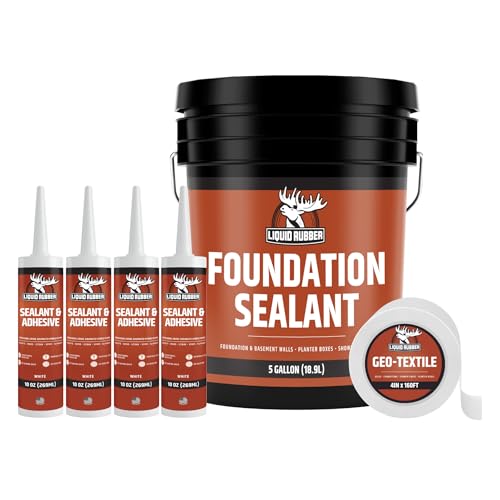
The do-it-yourself wall coating that turns a weeping basement into a dry one, no excavation required.
This system is built around a single 5-gallon pail of rubberized sealant that you roll on like very thick paint. It creates a flexible, waterproof membrane on interior or exterior foundation walls, and it stretches with the concrete instead of cracking. The standout spec is the 900% elongation — the coating can stretch nine times its own length without tearing, so normal foundation movement doesn’t create new leaks. That flexibility is why owners trust it on a 100-year-old foundation that had been leaking for decades.
The kit is genuinely complete: you get the 5-gallon pail, a 4-pack of 10.2-ounce caulk tubes for filling cracks and corners, and a roll of 4-inch by 160-foot geotextile fabric to reinforce joints and transitions. Coverage is clearly spelled out — 50 square feet per gallon for interior surfaces with 2-3 coats, or 20 square feet per gallon for exterior concrete with 3-4 coats. Apply it in temperatures between 50°F and 90°F for best results. The pattern across owner experiences is consistent: careful surface prep is the secret, and most people report needing fewer gallons than they estimated.
The honest trade-off is in the finish and the dry time. The coating dries to a glossy black with a noticeable high sheen, which surprised some owners who wanted a matte look. Drying feedback is genuinely mixed — some find it dries fast, others say the surface stays tacky and needs extra time before you can paint over it or walk on it. It also bonds to a wide range of materials including concrete, masonry, wood, and metal, so it’s not limited to basements alone.
Owner loyalty runs deep here. Multiple buyers report they fixed leaks that had plagued their homes for years—one recounts a full project of excavating 25 feet, patching cracks, and applying four brush coats over roughly 30 hours, which ended with four months of heavy rain and zero leaks. On value, owners consistently call it far cheaper than hiring a professional waterproofing company, and one retired engineer compared it directly against flex-based competitors and found it more effective for less money. Quality is the most-mentioned praise by a wide margin, with ease of application running a close second.
What wins people over
- Creates a flexible waterproof membrane with 900% elongation to resist cracking
- Complete kit includes sealant, crack-filling caulk, and geotextile fabric
- Owner-tested on a 100-year-old foundation with no leaks after months of rain
Read this before you buy
- Dries with a high-gloss sheen, not a flat look
- Drying time gets mixed feedback — plan for a tacky stage before painting
- Needs proper surface prep to reach its full adhesion
Start here if: you have moisture seeping through walls or joints and want one kit to coat the whole problem area.
Think twice if: you have a single widening structural crack — that needs reinforcement, not just a coating.
2. KARBXON 50 ft. Carbon Fiber Wall & Foundation Crack Repair Kit
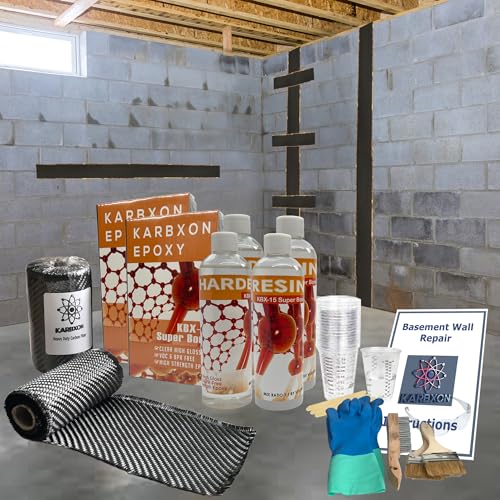
The strap solution that locks a spreading foundation crack in place — the opposite approach to the Liquid Rubber coating above.
While the Liquid Rubber system coats an entire wall to keep moisture out, this kit attacks a different problem: a structural crack that is actively widening or letting the wall bow inward. The fix is a roll of 50 feet of high-strength carbon fiber fabric and a 96-ounce epoxy and hardener set. You saturate the fabric with epoxy and apply it across the crack like a strap, bonding to the concrete to hold the two sides in place and stop further movement.
Owners mention this works exactly as intended on the right crack—a vertical or diagonal structural crack that needs reinforcement, not just sealing. The carbon-fiber fabric forms a permanent, rigid bond that halts further crack growth when paired with proper crack filling. The epoxy cures rock-hard, and one buyer avoided contractor costs by using this kit for what they called “only out.”
The catch, and it’s an important one, is in the prep and the resin quality control. This is not a brush-on job — the surface needs to be ground clean with a diamond grinder so the epoxy can bite into the concrete, and several owners recommend watching installation videos before you start. The epoxy leaves a fluid window that allows you to batch-mix leftovers, but a few buyers mentioned resin bottles arriving already hardened or crystallized, which forced returns. If you buy this, check the resin state right away and consider ordering extra just in case.
On value, owners are emphatic that this undercuts the big commercial carbon fiber brands by a wide margin while performing just as well. Sealing cracks this way also helps block radon gas from entering through the foundation. The kit is thoughtfully bundled with mix cups, stirrers, gloves, a mask, a wire brush, chalk, and straightforward instructions, so you are not hunting for components mid-project.
Why it earns its place
- 50 feet of carbon fiber fabric plus 96 oz of epoxy for a full repair
- Owners call it a permanent fix that stops further cracking
- Far cheaper than commercial carbon fiber brands, per buyer experiences
Know before you start
- Requires diamond grinder prep for the epoxy to bond properly
- A few resin bottles arrived already hardened — check on arrival
- Installation has a learning curve; video guidance helps
Reach for this when: you have a specific structural crack that is growing, especially if it’s bowing the wall.
Look elsewhere if: your issue is broad moisture seepage across the whole wall — that needs a membrane system, not straps.
Understanding the Specs
Elongation percentage
This number, like the 900% elongation on the Liquid Rubber sealer, tells you how far a dried coating can stretch before it tears. Higher elongation means the membrane flexes with your foundation’s natural movement and temperature shifts instead of cracking open. That is the difference between a sealant that lasts and one that fails in a season.
Coverage rate per gallon
Interior surfaces need about 50 square feet per gallon with 2-3 coats, while exterior concrete only covers 20 square feet per gallon with 3-4 coats. Exterior walls absorb more product, which is why the rate drops so sharply. Use the interior number to estimate your project and buy accordingly.
Geotextile fabric
A non-woven fabric layer, like the 4-inch by 160-foot roll in the Liquid Rubber kit, that you press into wet sealant over joints and transitions. It bridges gaps and gives the membrane extra strength where movement is most likely. It is the difference between coating a wall and actually reinforcing the weak points.
Epoxy and carbon fiber
For structural cracks, carbon fiber fabric saturated in epoxy creates a strap that is dramatically stronger than the concrete itself. The 96-ounce epoxy and hardener in the KARBXON kit cures rock-hard to lock the crack in place. This is a reinforcement system, not a waterproof coating, so it solves a different problem entirely.
FAQ
Which is better for my basement, a liquid membrane or carbon fiber straps?
Will the Liquid Rubber kit stop an active leak during rain?
How much area does the 5-gallon Liquid Rubber pail cover?
Can carbon fiber straps be applied over a crack that is still leaking water?
Does the Liquid Rubber sealant need a primer or special prep?
How long does the carbon fiber epoxy take to cure?
Is the Liquid Rubber coating paintable after it dries?
Will carbon fiber straps stop a wall from bowing inward?
Final Thoughts: The Verdict
For most homeowners with a damp, weeping basement wall, the basement waterproofing system winner is the Liquid Rubber Foundation Kit, because it seals broad moisture intrusion with a flexible, stretchable membrane that owners have proven on decades-old foundations. If instead you have one specific structural crack that keeps growing, grab the KARBXON Carbon Fiber Kit to lock it in place with high-strength straps. For many homes, the best fix is both: strap the structural crack first, then coat the wall to seal out moisture. The Liquid Rubber kit, backed by thousands of owners, turns a daunting foundation leak into a manageable weekend project.
How We Picked
We do not accept paid placement. Every pick is matched to a real buyer and a real use-case; we do not hands-on test units.
Sources & Methodology
Specifications: manufacturer listings and product documentation. Review insights: verified customer reviews, as of September 2026. Pricing: not shown on this page (it changes often); check the current price via the retailer link.
As an Amazon Associate, KitchPrep earns from qualifying purchases. This does not affect which products we feature.
Related Guides
