
Specs are compiled from manufacturer listings and verified buyer reviews and can change over time — please confirm the key details on the product page before buying.
Match the sealer to the surface: a flexible rubber coating for damp poured walls, a deep-penetrating sealer for dusty concrete floors and block. Buy the wrong type and you will be re-coating the same wall next spring. This guide breaks down which of the nine picks below actually holds water back.
I’m Mohammad Maruf — the founder and writer behind KitchPrep. This guide is built by comparing the manufacturers’ published specifications and the patterns across verified customer reviews, so you get each pick’s real strengths and trade-offs instead of marketing spin.
Your basement tells you which sealer it needs before you ever open a can. A chalky, damp block wall wants a rubber membrane; a dusty floor wants a penetrant. Below, every pick is matched to the concrete it actually works on, so you can stop guessing and start sealing with the best basement waterproofing sealer for your walls or floor.
Our Picks at a Glance


How To Choose The Best Basement Waterproofing Sealer
Two sealers on the same shelf can do opposite jobs. One paints a rubber skin across the wall; the other soaks in and hardens the concrete from the inside. Knowing which one your basement wants is the whole game.
Match The Sealer To The Surface
A poured concrete wall with a damp film on the inside is the classic case for a rubber membrane that flexes with the wall. Bare, dusty concrete floors and block foundations are the case for a penetrating sealer that reacts inside the pores instead of sitting on top.
Read The Coverage Before You Buy
Coverage tells you how far one container stretches — Rust-Oleum states up to 200 sq. ft. per gallon on a floor, while Lithi-Tek 9500 treats up to 1000 sq. ft. per coat once a single gallon is mixed with four gallons of water. Run your wall area against those numbers so you do not run out mid-project.
Check The Cure Window And The Weather
A rubber coating needs a dry surface and time before rain or water exposure. A penetrant like RadonSeal is applied to a damp surface and cures inside the concrete, so it does not depend on a film drying on top. Pick the one that matches your schedule and your slab’s condition.
Quick Comparison
| Model | Best For | Type | Coverage / Size | Color | Amazon |
|---|---|---|---|---|---|
| Ames Block & Wall Liquid Rubber★ Best Overall | Damp poured basement walls | Liquid rubber membrane | 1 gallon | White | Amazon |
| TUFINEIN Rubber Liquid SealantMost Versatile | Flexible multi-surface repair | Rubber sealant | 53 oz / 1.5 kg | Neutral Gray | Amazon |
| Rust-Oleum 301239 Moisture StopBest For Floors | Basement and garage floors | Penetrating sealer | Up to 200 sq. ft. per gallon | Clear | Amazon |
| YKF Clear Waterproof Sealant | Invisible repairs on walls and joints | Water-based acrylic coating | 68 fl oz | crisp | Amazon |
| LastiSeal Brick & Masonry Sealer | Brick, block and masonry | Deep-penetrating sealer | 1 gallon (128 fl oz) | Clear, natural finish | Amazon |
| Lithi-Tek 9500 Ultra Concentrate | Big concrete floors and slabs | Penetrating waterproofer and densifier | 1 gallon makes 5 gallons | Clear | Amazon |
| Flex Seal Liquid Rubber Coating | Roofs, walls and odd shapes | Liquid rubber coating | 1 gallon | Clear | Amazon |
| Ames Blue Max Waterproofer | Whole-basement coverage | Elastomeric liquid rubber | 5 gallons (640 fl oz) | Blue | Amazon |
| RadonSeal Plus Concrete Sealer | Floors, walls and block foundations | Deep-penetrating sealer | Covers up to ~1000 sq ft per 5 gallons | Natural invisible finish | Amazon |
In‑Depth Reviews
1. Ames Block & Wall Liquid Rubber Waterproofer & Sealant, 1 Gallon
Our pick — over 4.5★ from 300+ verified ratings; the strongest balance of quality and price.
The thick white rubber coat that dries tough enough to shrug off a downpour through a broken gutter.
Start with the number that decides this one: a full gallon of white liquid rubber that rolls on like pudding and dries into a tough skin. It is the classic pick for a poured basement wall that stays damp and chalky. The coating goes on smooth with no odor, and the white color does a second job — it brightens a dark storage room instead of leaving the usual black smear on the wall.
Where it earns its place is flexing with the wall. Buyers report it stopped years of water intrusion on a full pour, sealed both inside and the outside skirt, and stayed bone dry through a downpour with a broken gutter overhead. Two coats inside and one outside is the method that keeps working. Cracks get filled first, and the thick texture covers them well. It sits at 4.6 stars across 340+ owners, one of the strongest records here.
The honest catch is texture and dry time. It goes on thick, so you have to spread it moderately or it will not dry — think frosting, not paint, and use the right rollers. And there is a real limit to what any interior coating can promise. One thorough review puts it plainly: “This is some thick stuff but it goes on very nicely and it seems to be working in our tornado shelter.” That is the right way to frame it — a strong interior seal, not a replacement for fixing water from the outside.
What backs it up
- Goes on thick like frosting, fills cracks, and dries into a tough rubber skin
- Low odor and easy cleanup — safe to use around a 4-month-old baby, per buyers
- Bright white finish replaces the black sealant look with a cleaner, lighter wall
Where it asks for care
- Apply too heavy and it will not dry — spread it moderately and use the right rollers
- An interior coating, not a fix for water that is entering from the outside of the wall
Reach for this if: you have a damp poured basement wall and want a thick rubber coat that flexes and brightens the room.
Look elsewhere if: your water is coming in from the outside — a coating will slow it, not stop it.
2. TUFINEIN Rubber Liquid Waterproof Sealant, 53 oz, Neutral Gray
A self-leveling gray rubber that covers gaps and cracks on basements, gutters, roofs, and everything between.
This is the pick for a job that is not just one wall. The 53 oz (1.5 kg) container holds a flexible rubber sealant that self-levels into cracks and seams, then cures into a rubber membrane. It starts forming a film in 2 to 4 hours, and it holds steady from -40 °C to 80 °C (-40 °F to 176 °F) — the range that matters if your basement swings from freezing winters to muggy summers.
Coverage is spelled out clearly for a change. On vertical concrete foundation surfaces, a 0.6 mm thickness covers 2 m² (21.4 ft²). On flat or low-slope roofs and standing-water surfaces, 1 mm covers 1 m² (10.7 ft²). Polyester fabric at joints and obvious cracks boosts the waterproofing. It brushes, rolls, scrapes, or pours on, and it bonds across brick, concrete, gutter, metal, and roof.
The thing owners praise most is the raw quality of the cure — it goes on like thick paint and sets into a durable membrane. Two honest notes worth knowing before you buy. It is not suitable for walking surfaces because it stays tacky when cured, and the pot life is short: once the container is opened, the curing process begins, and a buyer reports it thickens on top after 24 hours but stays usable over 3 days if kept airtight. Seal it all in one session if you can, and plan on ventilation for the odor.
Buy it for the range: one container handles a foundation crack, a gutter seam, and a low-slope roof patch, which is why it is the most flexible pick here.
Worth grabbing if: you have several small leaks across concrete, metal, and gutters and want one rubber sealer to cover them all.
Steer clear if: you need a smooth walkable surface — it cures tacky, so keep it off floors and decks.
3. Rust-Oleum 301239 Concrete Moisture Stop Fortifying Sealer, Gallon
The no-fumes floor sealer that soaks into concrete and leaves the surface looking untouched.
If your problem is a damp basement floor rather than a weeping wall, this is the pick. The clear sealer penetrates the concrete instead of coating it, so the slab keeps its original look. It goes down at up to 200 sq. ft. per gallon, and the method is simple: apply and let it penetrate for 45 minutes. The manufacturer lists it as preventing damage from water, salt, and radon gas.
The best part for a basement project is the lack of smell. A buyer describes it as “super easy to use, no fumes” and notes they ran two coats in one room and three in another to be safe. It dries quickly, which means you are not blocked out of the space for days. It plays well under a finish, too — it seals a concrete workshop floor nicely prior to painting.
Here is the honest part you should weigh. This is a floor sealer, and the results depend heavily on your actual water source. One detailed note sums up the uncertainty well: a wet spot on a garage floor stopped appearing after a heavy rain, but a new rain gutter went up at the same time, so the writer could not be sure the sealer was the fix. That is fair. Use it to harden and seal a floor and to slow moisture vapor, not as a guaranteed cure for groundwater pushing up.
The floor specialist: unlike the wall coatings above, this one is built for horizontal slabs, so it is the smarter match for a garage or basement floor.
Pick it if: you want a low-odor, penetrating sealer for a basement or garage floor that should keep its natural finish.
skip it if: you are chasing a weeping wall — this is a floor product, not a wall coating.
4. YKF Transparent Waterproof Sealant, Self-Leveling Clear Coating, 68 Fl Oz
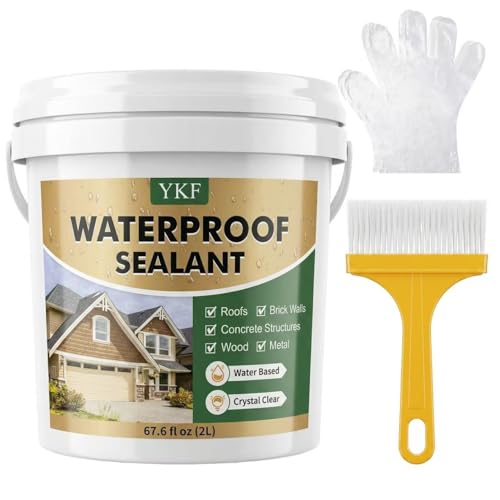
A clear, self-leveling coat that seals seams and cracks without hiding the surface underneath.
Some basements have a spot you do not want covered — a good-looking block wall, a finished edge, a piece of trim. This clear acrylic coating seals those spots invisibly. The water-based formula cures into a transparent membrane, and it flows over uneven surfaces and into cracks and seams, then levels into a smooth film. It works on properly prepared concrete, brick, masonry, wood, metal, ceramic, and tile. The 68 fl oz size suits several repair areas rather than one big wall.
What it is good at is the small, precise fix. Owners mention sealing a cracked fountain so it stopped leaking for months, sealing a tiny fissure in stone window caulk that was letting ants through, and coating an outdoor wooden birdhouse that stayed dry inside through Colorado rain. Two coats, dried fully between, is the routine that shows up over and over. It dries fast — under an hour on a warm day.
Now the caveats, because this one has real limits. It is not for underwater use, continuous submersion, active leaks, or high-traffic floors. And it needs care with the container — the cap does not seal on its own, and it is thick enough that it is hard to get off your hands, so the included gloves earn their keep. One buyer’s birdbath project bubbled and peeled after multiple coats, a reminder that surface prep and a fully cured base decide the outcome on these clear coatings.
The clear-coat payoff
- Dries clear and invisible — repairs seams and cracks without covering the surface
- Self-leveling, so it flows into uneven spots and smooths out on its own
- Big 68 fl oz container for multiple repair areas across rooms and roofs
The limits to plan around
- Not for standing water, active leaks, or high-traffic floors
- The cap does not self-seal and the gel is hard to remove from skin — use the gloves
Made for you if: you want to stop a few small leaks on walls, joints, or trim without changing how any of it looks.
Not the one if: you are fighting a steady stream or a flooded floor — this is a detail sealer, not a flood stopper.
5. LastiSeal Brick & Masonry Sealer, 1 Gallon

The breathable penetrant that waterproofs old brick and mortar while keeping its natural face.
For brick, block, and masonry basements, a film coating can do more harm than good — it traps moisture and flakes off. This sealer takes the opposite approach. It penetrates below the surface and reacts inside the pores, so there is no film to peel, chip, yellow, or fade. The maker rates it for a 15-year service life and a flat, natural finish. It is water-based with ultra-low VOCs, so it is fine for indoor basements and floors. One 128 fl oz gallon covers interior and exterior use.
The application is where it shines. It goes on with a low-pressure sprayer or roller, soaks in, and dries in under 30 minutes at 50°F. One coat is usually enough — a second coat should bead off, which tells you the first has done its job. On old brick it runs about 30 sq. ft. per half gallon. The result on a concrete patio three weeks in: water beads up, it washes clean, and there are no dirty spots.
The honest trade-off is the finish and the cost. Some customers note the surface can look different than expected, and the price-per-gallon is higher than paint-on sealers. The payoff shows up over years, not weeks — one long-running account has sidewalks still looking new years after treatment while untreated neighbors are pitting and cracking. It is a buy-once-and-forget sealer, not a quick cosmetic fix.
The patience play: it does not gloss over a wall, and it does not need to — it hardens brick and block from the inside so you are not re-coating every couple of years.
Choose this when: you have brick, block, or stone and want a breathable, invisible seal that lasts and keeps the natural look.
Skip it when: you want an instant color-sealing coat or you are sealing a poured concrete wall — a rubber coating is the better fit there.
6. Lithi-Tek 9500 Ultra Concentrate, 1 Gallon (Makes 5 Gallons)
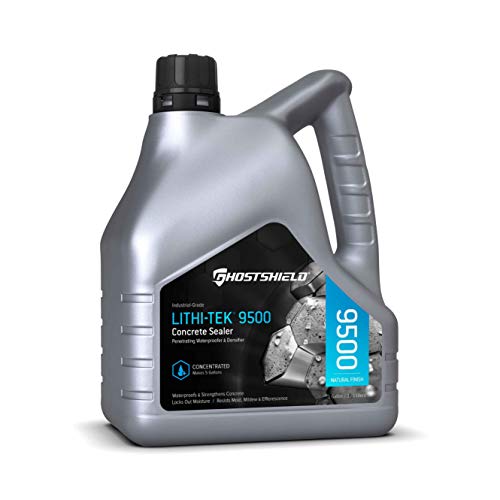
One gallon of concentrate that mixes into five and treats up to a thousand square feet per coat.
If your “basement” is really a big slab, this is the value math to run. One gallon of Lithi-Tek 9500 mixes with four gallons of water to make five gallons of sealer, and that treats up to 1000 sq. ft. of concrete per coat. It is an industrial-grade, water-based sealer that does two jobs at once — it waterproofs and it densifies, strengthening the concrete up to 50% while reducing moisture and vapor intrusion. It also targets efflorescence and hydrostatic pressure.
What owners rave about most is simply how easy it goes down — a garden sprayer, quick work, no color change or blotches. On a 1,500 sq. ft. driveway and paver job the whole thing soaked in fast, and the water beads up like rain on a freshly waxed car. It suits basement floors, poured basement walls, driveways, garages, and patios. It penetrates and strengthens old concrete too, so worn, dusty slabs come out harder on the surface.
Two things decide whether it works. First, measure the dilution precisely — it is a concentrate, and the mix is the product. Second, apply the second coat wet-on-wet or before the first dries, or it will bead instead of soaking in. It runs lighter on color than expected: it dries darker, then lightens back toward the natural finish. The only real watch-out is ventilation in a closed crawlspace, where reviewers point out using a dehumidifier so the absorbed solution does not sit damp for weeks.
The volume winner: no other pick here stretches one container across 1000 sq. ft. per coat once diluted, which makes it the sensible call for a large basement or garage floor.
Buy it for: large concrete floors — a big basement, a garage, or a driveway — where you want one container to go the distance and strengthen the slab.
Think twice for: small jobs or a tight, unventilated crawlspace, where a pre-mixed sealer is less fuss.
7. Flex Seal Liquid Rubber Coating Sealant, Clear, 1 Gallon

Brush, roll, dip, or pour this clear rubber coat on almost any surface in and around the basement.
The appeal here is breadth. This is liquid rubber in a can that you can brush, roll, dip, or pour. It goes on clear, cures flexible, and resists UV, rust, and corrosion. The compatibility list is unusually long — concrete, glass, brick, stucco, masonry, wood, copper, plastic, tile, fabrics, wires, vinyl, fiberglass, metal, aluminum, stone, foam, asphalt, EPDM, PVC, and more. That is the reason it shows up in so many basement and trailer projects: one can covers the odd materials no other sealer wants to touch.
Where it earns its keep is on flexible, moving surfaces. Shoppers say sealing a camper roof with no leaks at all, and one buyer rolled it onto a pergola cover so the fabric turned waterproof like a sail shade. On a sub-grade wall that used to get damp after hard rain, it went down with an airless sprayer and held. The clear finish means it does not change the look of the surface — a real advantage when the material underneath is worth showing.
Be ready for the thickness. It is genuinely thick — one buyer used a full gallon just on a pickup bed floor and found it difficult to brush or roll, ending up pouring and pushing it with a brush. It cannot be thinned for a lighter coat. And the honest limit is the one buyers hit most: it holds up well above ground and on roofs, but under constant water it does not always last, so use it as a surface sealer and a roof and seam coat rather than a submerged liner.
Why it covers so much
- Bonds to a huge range of materials — concrete, metal, wood, fabric, EPDM, and more
- Cures flexible and UV resistant, so it handles camper roofs and outdoor surfaces
- Clear finish keeps the look of whatever you coat
Where it gets fussy
- So thick that brushing and rolling are tough, and you cannot thin it for a lighter coat
- It is a surface coat, not a liner — it can struggle under constant water
The right tool if: you have odd surfaces and mixed materials — a camper roof, a gutter, a metal seam — that need one flexible clear coat.
Not for: a submerged liner or a job where you want a thin, easy-to-brush finish.
8. Ames Blue Max Waterproofer, 5 Gallon, 640 Fl Oz

A five-gallon pail of flexible blue rubber that expands and contracts with the wall it seals.
When you are coating an entire basement rather than patching one corner, the spec that matters is elasticity — and this one leads on it. Blue Max is an elastomeric membrane rated at 1200% elongation, which means it stretches and shrinks with the concrete to resist cracking and peeling. It comes as a full 5-gallon pail (640 fl oz) of liquid rubber, suited for waterproofing above and below-grade basements, foundations, and insulated concrete forms.
It is built to be applied in more than one way. You can brush, roll, or spray it on vertical or horizontal surfaces, and it doubles as a primer on most roofing types, including metal and RV roofs. It bonds to concrete, wood, and metal. The formula is non-toxic and VOC compliant in all 50 states, and Ames is a Veteran Founded company. Buyers report sealing Bilco basement door seams with no leak onto the steps after heavy rain, and coating a sub-grade wall with a sprayer with good results.
Plan for the texturing that comes with a 5-gallon pail. It is thick — “Nice and thick but still two coats,” as one buyer put it, and you will want to scoop it out of the can rather than pour. The honest mixed feedback across the reviews is about durability over many years; the consensus on application and waterproofing strength is clear, but how it holds up long term varies with surface prep. Two coats on a clean, dry wall is the standard that most satisfied users follow.
The whole-basement pick: the 1200% elongation is the headline — this is the coating you reach for when the wall moves and you need the seal to move with it.
Best for: a full basement job where you want one big pail, high flexibility, and a coating that can also prime a roof.
Look elsewhere if: you only have a small spot to seal — a one-gallon product will not leave you with a half-used pail.
9. RadonSeal Plus Concrete Sealer, 5 Gallon
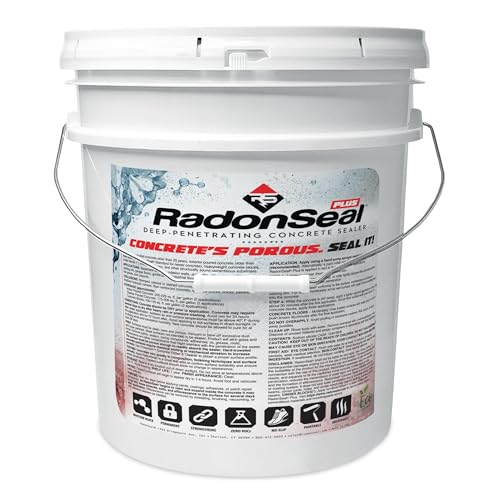
The invisible, internal sealer that soaks into floors and block walls and hardens them from within.
This is the opposite of a coating. RadonSeal Plus penetrates deep into concrete and reacts inside the pore structure to seal the capillaries, which is what actually reduces moisture vapor transmission. It leaves no gloss, no darkening, and no surface film — your concrete looks exactly the same after. The maker rates a 5-gallon pail at up to ~1000 sq. ft. of coverage, and it works on poured concrete and concrete block foundations, floors, slabs, garages, and warehouses.
Because it becomes part of the concrete, it cannot peel, blister, or wear away like a coating would. It also chemically densifies weak, dusty concrete, which is why it is often used as a base before painting or an epoxy topcoat — it prepares the surface by slowing moisture movement through the slab. Being water-based, it goes on with a sprayer, roller, or brush, and it is applied to a damp surface and cured from the inside.
The standout result owners describe is moisture control rather than a visible seal, and it shows up in the numbers they track. Multiple accounts report basement humidity dropping sharply — one rental went from 78% relative humidity on day one to 40% during rain after treatment. A separate note has a dehumidifier finally shutting off on its own humidity setting where it never would before. The honest caveats: it is water-like and easy to apply, but the written coverage estimate runs low for porous slabs, and it is a moisture and vapor sealer, not a fix for a cinder block wall with active water pushing through.
Where it wins
- Reacts inside the concrete, so it will not peel, blister, or wear away like a film
- Invisible — no gloss, no darkening, no surface coating
- Strengthens and hardens porous, dusty concrete while it seals
Where to be realistic
- It handles moisture and vapor, not a block wall with active water pushing through
- Prep can be heavy on a rough, painted, or dirty slab, and it needs two coats
Your pick if: you want to dry out a damp basement floor or block wall and keep the concrete looking untouched.
Not the one if: water is actively streaming through block — that needs a membrane and possibly a footing drain, not a penetrant.
Understanding the Specs
Coating vs Penetrating
A coating forms a flexible skin on the surface. Think Ames Block & Wall or Flex Seal Liquid — you can feel the layer, and it flexes with the wall. A penetrating sealer, like RadonSeal Plus or LastiSeal, soaks in and reacts inside the concrete. The rule of thumb: coatings for damp poured walls that move, penetrants for dusty floors and block that you want to keep looking the same.
Coverage Per Container
Coverage decides how many containers your job takes. Rust-Oleum runs up to 200 sq. ft. per gallon on a floor. Lithi-Tek 9500 treats up to 1000 sq. ft. per coat once one gallon is mixed into five. YKF gives you 68 fl oz. Always measure your wall and floor area first, then match the number to the container — running short mid-coat is the mistake that ruins an even finish.
Elongation & Flexibility
Elongation is how far a coating stretches before it cracks. Ames Blue Max is rated at 1200% elongation, so it moves with a wall that shifts with the seasons. A stiff paint-on sealer cracks under the same movement. If your walls are the problem and your basement temperature swings, flexibility is the spec to check first.
Cure Time & Surface Prep
Cure time is how long the product needs before water hits it or you walk on it. Coatings need a clean, dry surface and time to set — usually two coats with drying between. Penetrants often go on a damp surface and cure inside. Prep is never optional: remove loose material, and on a dusty slab you may need a grinder or a dehumidifier in low-airflow spaces.
FAQ
Should I use a coating or a penetrating sealer on my basement walls?
How much sealer do I need for a full basement?
Can I apply these sealers on a damp basement wall?
Will a basement sealer stop water that is coming up through the floor?
How long does basement waterproofing sealer last?
Is it safe to use these sealers around kids and pets?
Do I need to fill cracks before sealing a basement wall?
Can basement sealer be painted over?
Which sealer is best for a cinder block basement wall?
Does waterproofing sealer smell strong while it dries?
Final Thoughts: The Verdict
For most people sealing a damp poured wall, the basement waterproofing sealer that balances strength and forgiveness best is the Ames Block & Wall Liquid Rubber — thick, low-odor, and rated 4.6 stars by a large and steady group of owners. If your problem is a dusty floor or a block wall you want to keep looking natural, grab the penetrating RadonSeal Plus and treat it as moisture control, not a flood fix. And if you are coating an entire basement once and want it to move with the walls, the five-gallon Ames Blue Max with its 1200% elongation is the one to reach for. Pick by your surface first, and the rest falls into place.
How We Picked
We do not accept paid placement. Every pick is matched to a real buyer and a real use-case; we do not hands-on test units.
Sources & Methodology
Specifications: manufacturer listings and product documentation. Review insights: verified customer reviews, as of September 2026. Pricing: not shown on this page (it changes often); check the current price via the retailer link.
As an Amazon Associate, KitchPrep earns from qualifying purchases. This does not affect which products we feature.
Related Guides
