
Specs are compiled from manufacturer listings and verified buyer reviews and can change over time — please confirm the key details on the product page before buying.
A finished basement is one of the few rooms in the house where bare walls and hard floors fight you. Every footstep bounces, every TV line doubles back as echo, and that cold concrete look never quite goes away. The fix is a slat wall panel system — wood strips mounted on a felt backing that soaks up reflected sound while hiding the block wall behind it. The right panel for your space depends on how much wall you are covering, whether moisture is a factor, and how much of the work you want to do yourself.
I’m Mohammad Maruf — the founder and writer behind KitchPrep. This guide is built by comparing the manufacturers’ published specifications and the patterns across verified customer reviews, so you get each pick’s real strengths and trade-offs instead of marketing spin.
Below you will find nine panels sorted by what they actually do well — coverage per box, thickness, backing density, and how they behave against a basement’s specific problems. Each entry tells you the coverage in square feet, the material, and which room it suits, so you can pick the basement wall coverings that fit before you cut a single strip.
Our Picks at a Glance

How To Choose The Best Basement Wall Coverings
A basement wall is not a bedroom wall. It is usually concrete or block, it sits below grade where humidity creeps in, and it is often wider and taller than any wall upstairs. That combination changes what matters: the material has to tolerate damp, the coverage per box has to be enough to finish the job, and the backing has to actually absorb sound rather than just look like it does.
Coverage per box is the number that decides your order
Every listing states its total coverage in square feet. A 4-panel box might cover around 21 square feet while an 8-panel box can reach roughly 32 square feet. Measure the width and height of the wall you are covering, multiply them, then divide by the listed coverage so you know how many packs to buy. Buy the whole wall in one order if you can, because dye lots can vary between shipments.
Material: WPC composite versus MDF with felt
Wood-plastic composite (WPC — a mix of recycled plastic and wood fiber) is fire-rated, waterproof, and weather-resistant, which makes it the safer call for a below-grade wall where damp is a real risk. MDF with a high-density polyester felt backing is the more common acoustic build — softer to cut, warm in tone, and it soaks up echo effectively in dry finished basements. If your basement has ever smelled musty, lean WPC. If it is dry and climate-controlled, either works.
Thickness and backing decide how much echo dies
Panel thickness runs from about 0.7 inches up to 0.83 inches in this group. The thicker panels typically carry a denser felt layer behind the slats, and it is that felt — not the wood face — that swallows reflected sound. A thin panel still improves the look of a wall, but if cutting echo is your main goal, thickness and backing density matter more than the wood finish.
DIY friendliness: cutting, mounting, and wall condition
Most of these panels mount with screws through the felt backing, construction adhesive, or both. The felt cuts with a utility knife or a saw, while the wood slats cut cleanly with a power saw — though some panels are stiff enough that a band saw beats a hand tool. Wavy concrete walls are the hidden trap: a thick felt backing compresses and forgives a slightly uneven surface better than a rigid panel does.
Quick Comparison
| Model | Best For | Coverage | Material | Panel Size | Amazon |
|---|---|---|---|---|---|
| NeatiEase 4-Piece Teak★ Best Overall | Accent walls and ceilings | About 33 sq.ft. | MDF with polyester fiber | 96″ x 12.6″ | Amazon |
| AKUMAX Black Oak 2-PackCompact Pick | Small accent walls and studios | About 15.5 sq.ft. | E0 MDF with PET felt | 48″ x 24″ | Amazon |
| OUZUGIE WPC 8-Pack OakBest Value | Damp and exposed walls | 32 sq.ft. | Wood-plastic composite | 96″ x 6″ | Amazon |
| Art3d Walnut 4-Pack | Floor-to-ceiling feature walls | About 21 sq.ft. | MDF with polyester fiber | 94.5″ x 7.9″ | Amazon |
| SMARTSTANDARD Deep Gray 2-Pack | Tall walls with fewer joints | 18.5 sq.ft. | Wood veneer with felt | 105.9″ x 12.6″ | Amazon |
| NeatiEase Natural Oak 6-Piece | Cutting around outlets | About 21 sq.ft. | MDF with polyester fiber | 108″ x 4.72″ | Amazon |
| Art3d WPC Gray Oak 8-Pack | Wet or humid basements | 8 panels included | WPC composite | 96″ x 6″ | Amazon |
| Yuzzy Rustic Gray Oak 4-Pack | Large rooms and studios | 31.25 sq.ft. | MDF with polyester felt | 108″ x 11″ | Amazon |
| Avana Rustic Walnut 4-Pack | Warm walnut feature walls | 33.04 sq.ft. | MDF, polyester, veneer | 93.2″ x 11.25″ | Amazon |
In‑Depth Reviews
1. NeatiEase Wood Panels for Wall, 4-Piece 96″ x 12.6″ Soundproof Wood Slat Wall Panel (Teak)
Our pick — over 4.5★ from 550+ verified ratings; the strongest balance of quality and price.
The extra-wide teak panel that covers more wall per box than anything else here.
If you want the fewest boxes and the least cutting, start here. Four panels at 96″ x 12.6″ give you about 33 square feet of coverage, the biggest single-box footprint in this group, and the widest slat face means fewer seams across a long basement wall. That width is why it holds the top spot: you spend more time admiring the wall and less time lining up panel edges.
It is built as MDF with high-density polyester fiber behind the slats, and the specification notes no harmful chemicals and low TVOC levels (TVOC is the total of volatile organic compounds — the stuff that off-gasses and gives new materials that smell). The manufacturer also states the materials come from certified sustainable sources. Appearance is what wins people over most — the warm red-orange teak reads like cherry in person, and the panels go up horizontally, vertically, or cut to any shape, so you can frame a mirror, wrap a column, or run them straight across a ceiling.
The install is screw-through or superglue, both simple enough for a first-timer. One honest catch sits in the review pages: a faint odor lingers on some panels, dissipating over weeks rather than days, so if you are sensitive to new-material smell, plan to air the room. A few buyers also mentioned cutting around wavy walls takes patience — the thick felt backing helps, but a level is not optional.
What earns its keep
- About 33 sq.ft. from four panels — the most coverage per box in this lineup
- Realistic wood veneer over a thick, sturdy felt backing that holds its shape
- Cuts clean with no chipping, and mounts horizontally, vertically, or on ceilings
- Low TVOC levels and environmentally friendly materials
Where it asks patience
- A strong new-panel odor on some units, fading over roughly a month
- 19.96 kg per box — two people make the wall-mounting step easier
- No listed warranty on the product page
Reach for this if: you are covering a broad accent wall or ceiling and want the fewest boxes and the fewest seams.
Look elsewhere if: you need a waterproof panel for a wall that has ever taken on moisture.
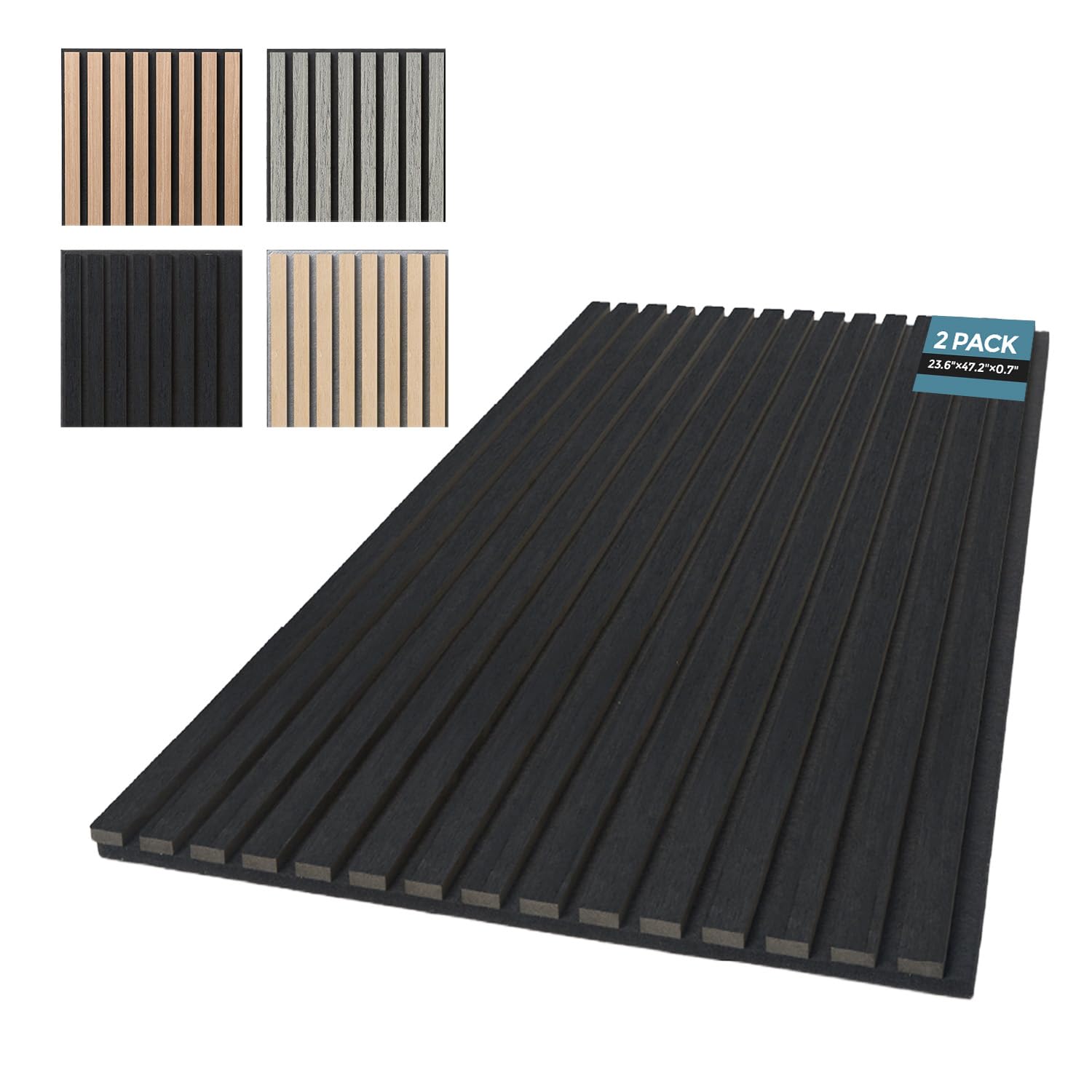
2. AKUMAX 0.7 in Thick Wood Slat Acoustic Wall Panels, 2-Pack, Black Oak
A two-panel starter kit for a corner, a closet nook, or a first test wall.
Two panels at 48″ x 24″ give you roughly 15.5 square feet — a small footprint, and the honest reason to pick it is that you are not committing to a whole basement yet. If you want to see how black oak reads against your lighting before ordering the rest of the room, this is the lowest-risk way to find out. It is also the only panel here that publishes an NRC rating: NRC 0.80, where NRC (Noise Reduction Coefficient) measures how much sound a surface absorbs, with higher being more absorbing.
The build is a real wood veneer face over 9 mm E0-grade MDF slats and a 9 mm high-density PET acoustic felt back. E0-grade MDF is a low-emission board, so it off-gasses less than standard MDF. Coverage per panel is smaller than the AKUMAX’s larger rivals — compare the OUZUGIE 8-pack at 32 square feet and you see the trade: this kit is lighter and easier to handle, but you will buy more packs to finish a full wall. The two panels in this block versus the eight in the OUZUGIE pack is a four-to-one difference in panel count, so plan your quantity before you start.
Mounting notes from the review pages are worth following. Buyers report hanging these with long black finishing screws rather than liquid nails so panels can be swapped later, and one buyer adds that dropping 1″ Styrofoam panels behind the felt improves results further. The warning that matters: order enough at once, because color lots vary and a later shipment can arrive slightly darker. The panels are heavier than they look, so factor that into your mounting plan.
Where it wins: a published NRC 0.80 rating and a real wood veneer face in a lightweight two-panel pack.
The trade: small coverage means multiple orders for a full wall, which risks a shade mismatch between batches if you do not buy everything at once.
The right call for: a small accent corner, a bedroom upgrade, or a sample wall before a larger purchase.
Think twice if: you are finishing a wide basement wall in one go and cannot source all panels from a single order.
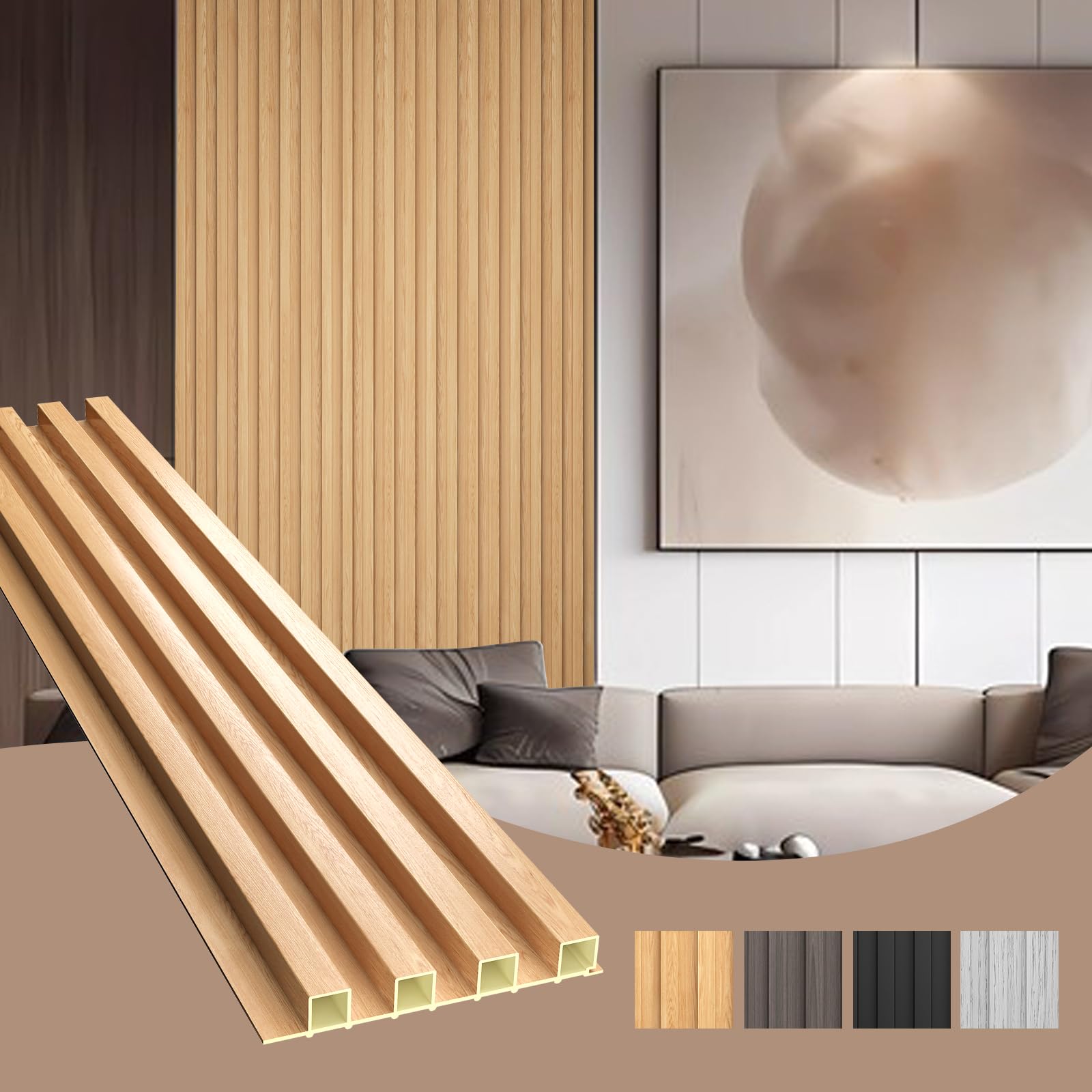
3. OUZUGIE WPC Acoustic Slat Wall Paneling, 8-Pack 96 x 6 Inches
Eight waterproof composite slats for the basement wall you are worried about.
The material is the point here. These panels are wood-plastic composite (WPC), a blend of recyclable plastic and wood fiber, and the listing states they are fire-rated, waterproof, weather-resistant, formaldehyde-free, and soundproof. In a below-grade room where damp is the enemy, that combination is the reason to shortlist this pack before any MDF alternative. Eight panels at 96″ x 6″ cover 32 square feet.
Installation is the friendliest of the bunch. The panels buckle together, screw in with the included accessories, and cut to size with any power saw, so a first-timer can finish a wall without specialized gear. The narrow 6″ slat face also means more lines of texture than a wide panel, which reads deliberate rather than plain. Buyers describe the color as spot-on and the look as more expensive than the wall it replaced, and the finish holds up in rooms where temperature swings.
The trade-offs are real and worth naming. Durability is the recurring gripe — the panels can break under hard handling, so treat cuts and corner pieces gently. Color consistency is mixed too, and a single damaged panel means buying a whole new set rather than a replacement piece. Weigh that against the 32 square feet and the waterproof rating, and this remains the best pick for any basement with a moisture history.
Why it earns the value label
- Fire-rated, waterproof, and weather-resistant WPC — the safest material for damp basements
- 32 sq.ft. from eight panels at 96″ x 6″
- Buckles and screws together with included hardware — no special tools
- Formaldehyde-free and made from recyclable plastic and wood fiber
What to plan around
- Panels can break under rough handling — durability is the loudest concern in the reviews
- Color varies between panels, so order everything at once
- No single-panel replacements — one damaged piece means a fresh set
Best match for: a basement that has ever felt damp, or any wall exposed to temperature swings.
Not for you if: you need to replace one broken panel without buying eight more.
4. Art3d 4-Pack Soundproof Wood Slat Wall Panels, 94.5 x 7.9 Inch, Walnut

The thickest slat panel here, and the one that handles a real noise problem.
At 0.83 inches thick, this panel carries more backing material than the thinner AKUMAX kit at 0.7 inches, and that extra felt is what absorbs the reflected sound that makes a basement feel like a cave. The four 94.5″ x 7.9″ panels cover about 21 square feet. Buyers put walnut on a shared bedroom wall to block a neighbour’s television and stopped hearing it — the same job a basement wall needs done when the room above is busy.
Quality and appearance dominate the review pages for good reason. The wood grain finish photographs well in both walnut and oak, and the long 94.5″ panels run floor-to-ceiling without a mid-line seam. Buyers who are not experienced with tools still managed the install with a nail gun and caulk after their contractor pre-cut the lengths, and the foam felt backing at the back of each panel cuts with scissors or a skill saw.
Here is the catch: cut edges are sharp, so sand them before you call the wall done, and the coverage at roughly 21 square feet per four-pack means a wide wall takes several boxes. Value for money is the one split opinion in the reviews — some find the finish worth it, others find the coverage per box expensive. It also earns a spot near the top on strength of the volume of positive feedback behind it, not just the spec sheet.
The thickness argument: 0.83″ of slat over a dense polyester backing out-absorbs thinner competitors, and the 94.5″ length removes visible seams on tall walls.
Handle with care at the saw: cut edges arrive sharp enough to need sanding, and the coverage per box means more cartons on the order.
Pick this when: you want the best echo reduction per panel and can sand the cut edges.
skip it if: you need maximum coverage from a single box and refuse to spring for extra packs.
5. SMARTSTANDARD 2 Pack 105.9″ x 12.6″ Wood Slat Wall Panels, Deep Gray
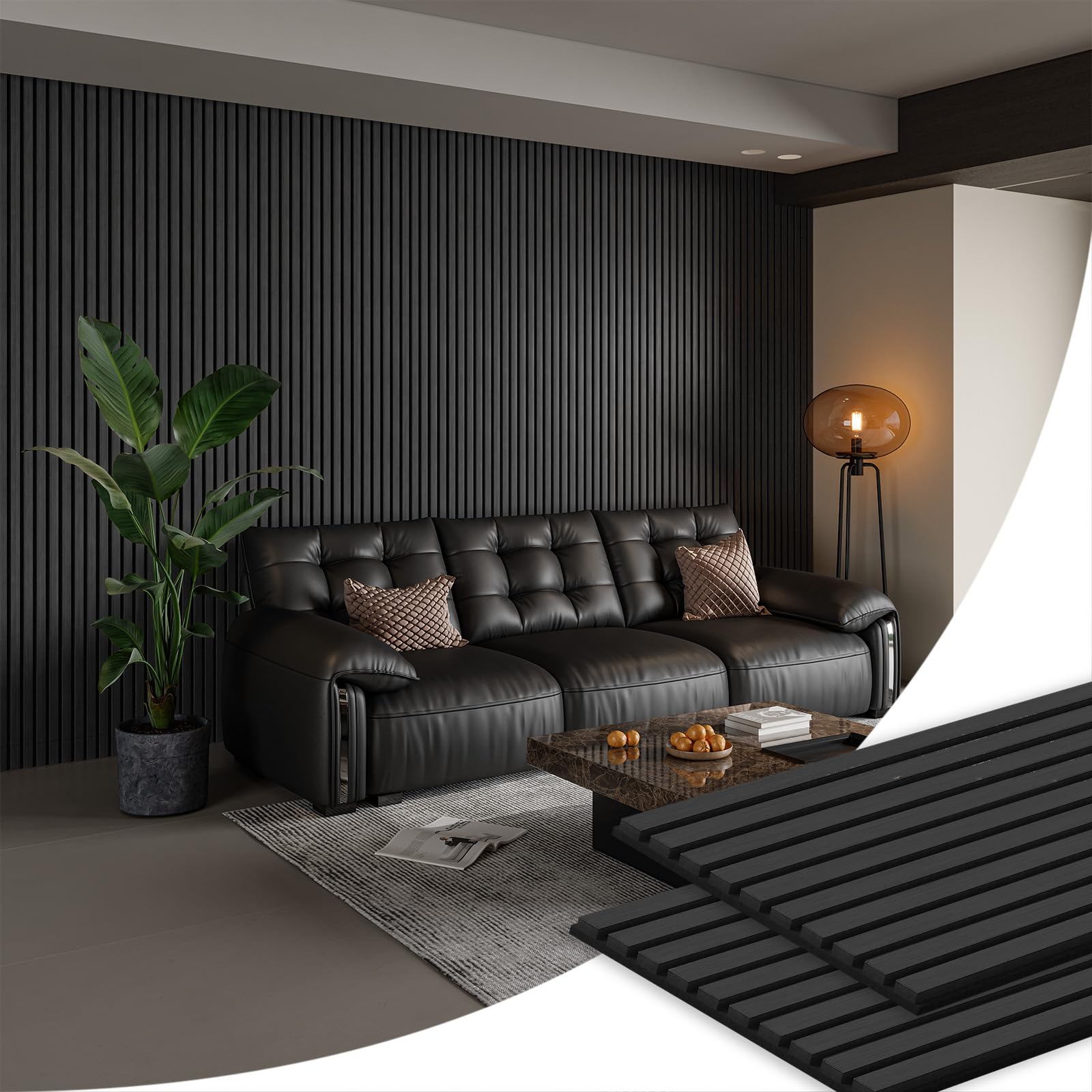
At nearly nine feet long, this one reaches the ceiling in a single run.
The 105.9-inch length is the reason to consider it: floor-to-ceiling in one panel, no mid-wall joint, no seam to line up. Two panels at 12.6 inches wide cover 18.5 square feet, so this is a precision pick rather than a coverage champion. If your basement wall is tall and you want clean vertical lines running top to bottom, the extra length pays for itself in less cutting and fewer joints to hide.
Under the wood veneer face sits a thick felt backing that conceals screws and hides the seam between panels, which is what makes a two-panel setup look like one continuous wall. The material comes from certified sustainable sources with low TVOC levels, and panels can be glued or screwed to most surfaces — walls or ceilings. The deep gray finish suits a darker, modern basement better than a warm oak.
The cutting performance is the split opinion here, and it is worth taking seriously. Some find the felt-backed panels easy to trim; others find them stiff enough that a band saw does a far better job than a hand tool or the suggested alternatives. A few buyers received cracked panels that were still usable. Weigh that against the 105.9-inch single-run convenience and the hidden-screw finish, and it remains a strong pick for tall walls where seams would be obvious.
Strengths worth paying for
- 105.9″ panels span floor to ceiling without a middle seam
- Thick felt backing hides screws and panel joints
- Materials sourced from certified sustainable suppliers with low TVOC levels
- Deep gray finish suits dark, modern rooms
Honest friction points
- Cutting is genuinely hard — a band saw may be the only tool that works well
- Only 18.5 sq.ft. per order, so a wide wall needs more packs
- A few panels arrive cracked, usually still usable
The smart buy for: tall basement walls where a single unbroken run of texture matters.
Look past it if: you are cutting lots of small pieces around outlets and ductwork.
6. NeatiEase Wood Wall Panels, 9 Feet Acoustic Slat Wall Panels, Natural Oak, 6-Piece

Six narrower slats that make short work of cutting around outlets and trim.
Six panels at 108″ x 4.72″ cover about 21 square feet, and the 4.72-inch width is the quiet advantage here: narrow strips are far easier to notch around an outlet box, a light switch, or a low soffit than a wide panel. If your basement wall is busy with obstacles, this is the pack that turns a fiddly cut into a quick one. The 108-inch length still runs a full nine feet, so floor-to-ceiling coverage stays clean.
This is the commercial-grade option from NeatiEase, built from MDF with high-density polyester fiber and low TVOC levels. The pieces are light for their length, which matters when you are holding one against a wall and driving screws at the same time. Buyers shaped these into a feature headboard and framed out a picture wall — the narrow profile makes decorative work easier than a single wide panel would.
Two things stand out from the reviews. First, the panels cut clean with minimal splintering, which is exactly what you want when trimming around obstacles. Second, the listed warranty runs 12 months with a 30-day free return and replacement window — the most complete protection in this group, even though scratches can show on the finish if you are rough during handling. For a first-time basement installer who wants the least fiddly cuts, this is the pack to grab.
The narrow-panel advantage: 4.72″ wide strips notch cleanly around outlets and switches and cut with minimal splintering.
What to know upfront: the finish can scratch during install, so use a straightedge and tape when trimming.
Well suited to: basement walls crowded with outlets and fixtures where clean cuts matter most.
Rewind if: you want the widest possible slat face and the fewest vertical lines.
7. Art3d 96 x 6 Inch WPC 3D Wood Textured Slat Wall Panels, 8-Pack, Gray Oak

Composite slats with polished gray oak face — built for rooms that see moisture.
Art3d’s WPC version carries the same waterproof, fire-rated, weather-resistant, formaldehyde-free construction as the OUZUGIE pack, but in a polished gray oak finish across eight 96″ x 6″ panels. The gray reads cooler and more contemporary than a warm oak, so if your basement leans modern, this is the color match. Composite also tolerates the damp drafts that would slowly damage a felt-backed MDF panel.
Installation is the same buckle-and-screw system used across WPC slat panels — the panels clip together, the included accessories hold them, and any power saw makes the cuts. In the review pages, buyers used them in a bathroom and on a brick wall closing off a screen porch, and both reported the fit and finish holding up. The lightweight build is a real plus overhead, since a ceiling run on composite slats is far less strain than lifting MDF.
Durability is the honest split here — some buyers find the composite panels tough, others report they damage under impact, so keep them away from moving furniture and heavy foot traffic. The weatherproofing still makes this the safe pick for a wall that gets damp air or a below-grade room that sees temperature swings. Just buy the full quantity at once, since the panels are sold as eight-piece packs and color can shift between shipments.
What justifies the premium price point
- Waterproof, weather-resistant, fire-rated, and formaldehyde-free WPC build
- Polished gray oak face with a cool modern tone
- Lightweight enough to mount overhead on a ceiling run
- Buckle-and-screw install with included hardware
Where it needs care
- Impact durability is split — some owners mention damage under rough handling
- Gray oak may clash with warm existing trim
- Sold only as eight-piece packs, so partial-wall projects leave spares
Choose this for: a contemporary dark-tone basement wall exposed to moisture or temperature swings.
Think again if: your room is finished in warm oak and needs a matching tone.
8. Yuzzy Wood Panels for Wall and Ceiling, 108 x 11 Inch, 4 PCS, Rustic Gray Oak
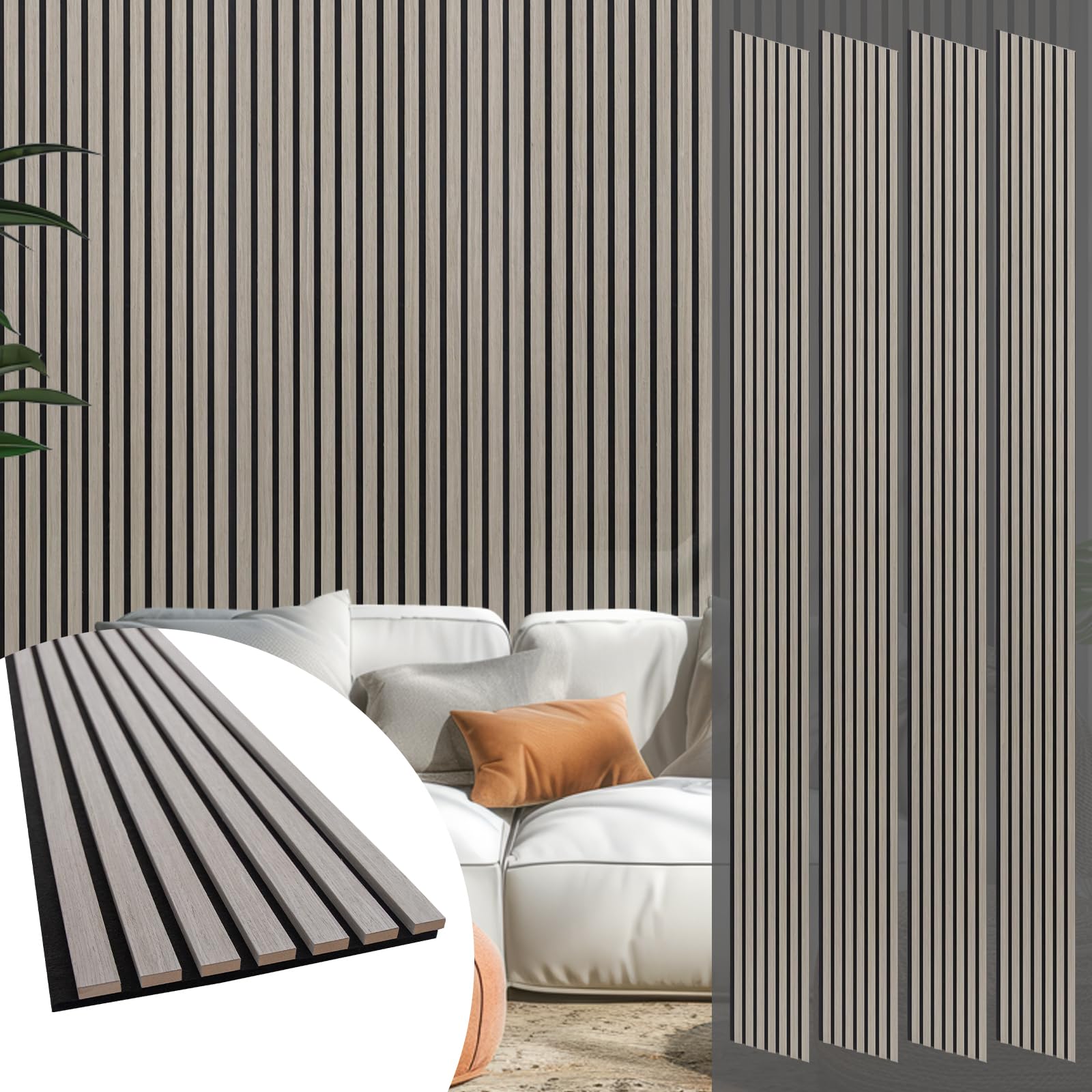
Four long panels packing 31.25 square feet — the biggest coverage in a four-pack.
Four panels at 108″ x 11″ deliver 31.25 square feet, which is the highest coverage of any four-pack in this lineup and it beats the Art3d walnut four-pack at about 21 square feet. Nine-foot panels plus the widest four-pack coverage means you cover more wall with fewer boxes, and the long run avoids horizontal joints when you install vertically. For a large basement wall or a full home-studio wall, this pack does the most with the least.
Construction is MDF plus high-density polyester fiber, materials the listing says come from certified sustainable sources, with low TVOC levels and no harmful chemical emissions. The vertical wood slats over the felt backing cut reverberation and add an organic look, and the review pages describe buyers mounting them with drywall screws through the felt after adhesive strips proved insufficient — which tells you the felt accepts a screw cleanly. Sound improvements reported include cleaner high frequencies and more precise stereo directionality after the panels went in.
The cut lines are the one place customers note friction. Cutting to length works with a miter or circular saw, but short trimmed cuts need at least two staples per slat or the slats shift out of alignment, and rip cuts only work between the slats. The slat gap on a side-by-side join is slightly wider than the spacing inside a panel, so plan your layout with that in mind. If you do modify the panels heavily, the inner fiberboard can show through the veneer, so this is the pack for a wall you can leave clean and unmodified.
Why it leads on coverage: 31.25 sq.ft. from only four panels, with 108″ runs that span a full wall height without horizontal seams.
The trade-off: trimmed cuts and joints need extra staples to keep slats aligned, and heavy modifications expose the fiberboard under the veneer.
A strong fit for: a large open wall or home studio where you want maximum coverage with minimal boxes.
Look elsewhere if: your wall is full of outlets and angles requiring lots of custom cutting.
9. Avana Acoustic Wood Wall Panels, 93.2 x 11.25 Inch, Fits 94 x 12 Layout, Rustic Walnut, 4 PCs
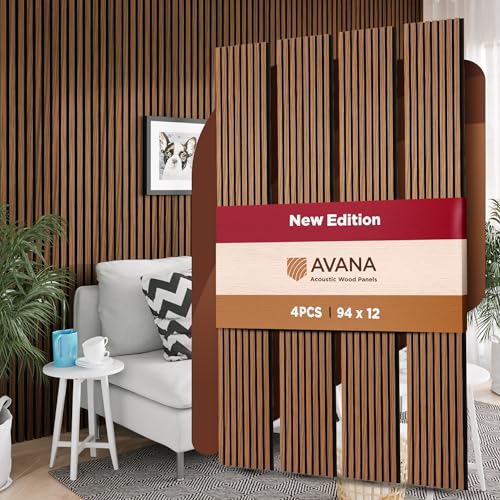
A commercial-grade walnut panel with the densest felt backing in the set.
Avana builds to commercial grade, and the coverage shows it: four 93.2″ x 11.25″ panels deliver 33.04 square feet, the largest four-panel coverage in this article and a touch ahead of the NeatiEase teak at about 33 square feet. The layers are MDF, high-density polyester fiber, and a technical wood veneer, and the description states the panels run low on chemical emissions. This is the pick when the wall is the focal point of a room you care about.
The review pages tell the story of a panel that reduces noise in a real basement. One buyer ran eight packs and reported cutting basement noise by roughly 65%, installing with an air-powered crown stapler and black spray-painted staples so nothing showed on the felt. The same buyer noted the panels cut well with a jigsaw and laminate blade, and that the backing is thick, dense, and firmly attached to the slats. They also described the piece as looking more expensive than the price point suggests.
Two honest catches to plan around. Reviewers point out some packs arrive damaged in transit — replacements are typically sent and arrive clean, so keep the packaging and test each panel before installing. Color is also inconsistent between batches, so order everything in one shipment. For a premium basement accent wall, the rustic walnut finish and the 33.04 square feet of coverage earn the price point.
What the top tier buys you
- 33.04 sq.ft. per four-pack — the most coverage of any 4-panel option here
- Commercial-grade MDF, polyester fiber, and technical wood veneer
- Thick, dense, firmly attached backing that cuts with a jigsaw and laminate blade
- Rustic walnut finish that reads more expensive than its price tier
Plan around these
- Some packs arrive damaged in transit — inspect before installing
- Color varies between batches, so buy all at once
- Rustic walnut tone is a statement and may not suit a cool-toned room
Go with this if: you are finishing a feature wall and want the best coverage and finish per pack.
Choose differently if: you want a cheaper composite for a damp-exposed wall where waterproofing matters more than looks.
Understanding the Specs
Coverage per box (square feet)
The square footage number listed on the box is your planning tool. A box might cover about 21 square feet, or 32 square feet, or 33.04 square feet depending on how many panels are packed inside. Measure your basement wall — width times height — then divide by the box coverage to find the number of packs to buy. Order the full quantity in one go so the panels share a dye lot, because color can shift between shipments.
NRC rating
NRC stands for Noise Reduction Coefficient, a number between 0 and 1 that rates how much sound a surface absorbs. A panel with an NRC rating of 0.80 absorbs roughly four-fifths of the sound that hits it — a meaningful result for a basement with hard floors and bare walls. Not every panel publishes this number, so it is worth checking each product page if acoustic performance is your main goal.
Material: MDF versus WPC
MDF (medium-density fiberboard) is a wood-fiber board that accepts veneer beautifully and cuts cleanly, but it is not waterproof. WPC (wood-plastic composite) blends recycled plastic and wood fiber into a panel that is waterproof, weather-resistant, and fire-rated. In a dry finished basement, MDF with felt backing performs well acoustically. In a room that has ever taken on moisture, WPC composite is the safer structural choice.
Thickness and felt backing
Panel thickness in this group spans about 0.7 inches to 0.83 inches. The number to watch is the felt layer at the back, because that felt — not the wood slat face — is what actually absorbs reflected sound. A thicker panel with a denser felt backing generally absorbs more echo than a thin one. If acoustic improvement is the goal rather than appearance alone, thickness and backing density should drive your choice.
FAQ
Will these wood slat panels hold up on a concrete basement wall?
How many packs do I need for my basement wall?
Do I need to add insulation behind the panels for better quiet?
What is the difference between WPC and MDF slat panels?
Should I glue the panels or screw them to the wall?
Can I install these on a basement ceiling?
How do I cut slat panels around outlets and light switches?
Will the panels reduce echo in an open basement room?
Do I need a special saw to cut these panels?
What should I do if only one or two panels arrive damaged?
Final Thoughts: The Verdict
The basement wall coverings winner is the NeatiEase 4-Piece Teak panel because it packs about 33 square feet into one box and covers a broad wall with the fewest seams. If your basement has ever taken on moisture, the OUZUGIE WPC 8-Pack is the wall-safechoice with its waterproof, fire-rated build. And for a tall wall where a floor-to-ceiling run matters most, the SMARTSTANDARD Deep Gray 2-Pack reaches nearly nine feet per panel. If you want the warmest finish and the most coverage from a premium four-pack, the Avana Rustic Walnut at 33.04 square feet delivers the densest backing in this group — a strong pick for a feature wall that anchors the room.
How We Picked
We do not accept paid placement. Every pick is matched to a real buyer and a real use-case; we do not hands-on test units.
Sources & Methodology
Specifications: manufacturer listings and product documentation. Review insights: verified customer reviews, as of September 2026. Pricing: not shown on this page (it changes often); check the current price via the retailer link.
As an Amazon Associate, KitchPrep earns from qualifying purchases. This does not affect which products we feature.
Related Guides
