
Specs are compiled from manufacturer listings and verified buyer reviews and can change over time — please confirm the key details on the product page before buying.
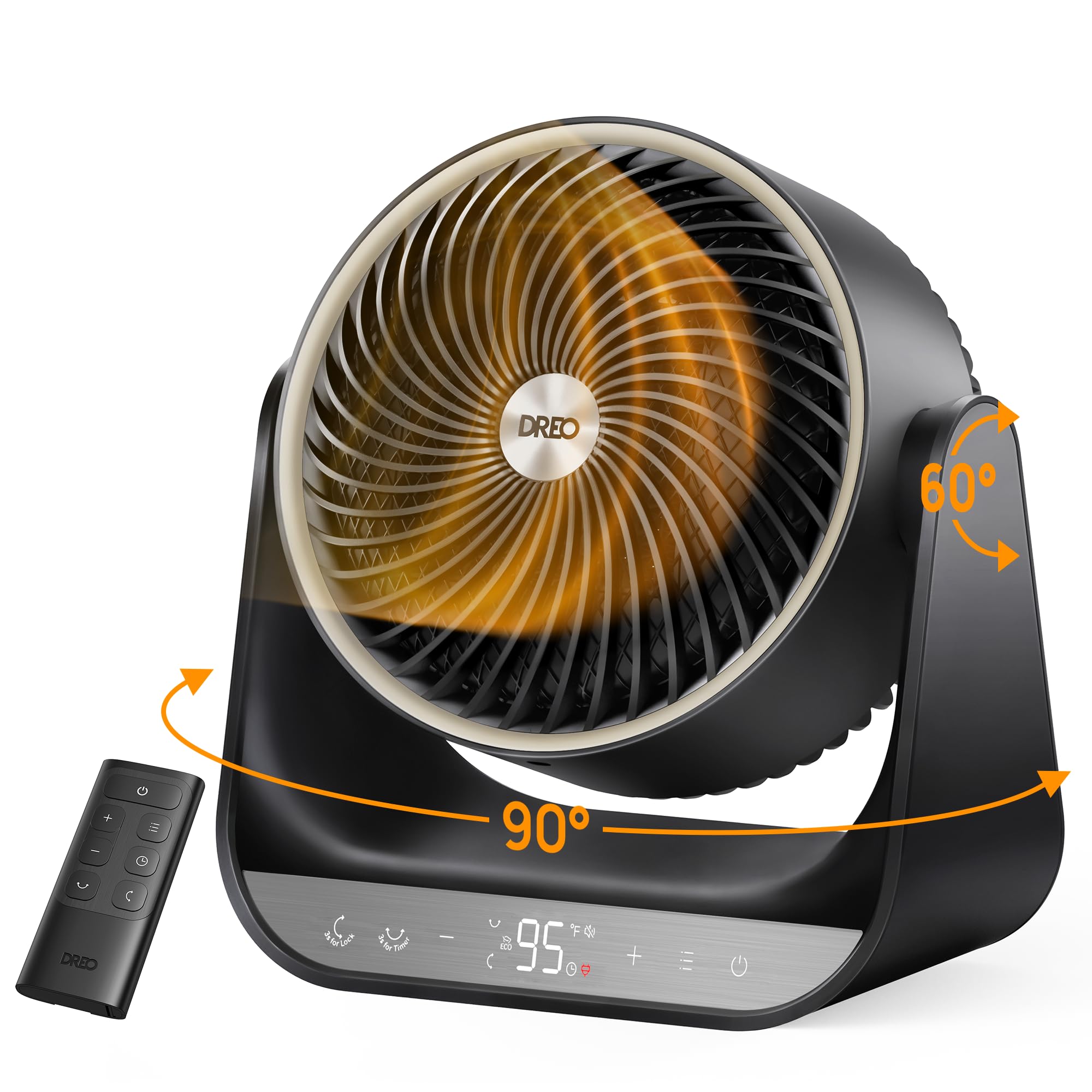
Cold air sinks, so your basement stays the coldest room in the house no matter what the thermostat upstairs says. A heater that only glows warms the air six inches in front of it — you need one that pushes heat across a low-ceilinged, concrete-floored space. Every pick below is a 1500W electric heater (1500 watts, the standard full-size plug-in output) built for that job. Start with the DREO Whole Room Heater: its 3D oscillation sweeps 60° vertically and 90° horizontally to push heat into corners, not just straight ahead.
I’m Mohammad Maruf — the founder and writer behind KitchPrep. This guide is built by comparing the manufacturers’ published specifications and the patterns across verified customer reviews, so you get each pick’s real strengths and trade-offs instead of marketing spin.
Basements throw two extra problems at you: damp air feels colder than dry air, and a heater tucked against a wall can starve itself of airflow. This guide sorts nine electric heaters by how they handle coverage, safety shutoffs, and timer control, so you can pick the right one for your space without guessing.
Our Picks at a Glance


How To Choose The Best Basement Space Heater
Two things set a basement apart from any upstairs room. First, the floor is usually bare concrete, and concrete pulls heat straight out of the air. Second, the ceiling is often lower, which traps warm air near the top unless something moves it around. Solve those two problems and the rest is simple. Here is what actually matters when you shop.
Match the heater to your square footage, not to wattage hype
Almost every heater in this group runs on 1500 watts, because that is the most a standard 120-volt household outlet will safely carry. So wattage is a tie, not a selling point. What separates them is stated coverage: some are rated for 200 square feet while others stretch to 250 or even 269. Measure your basement first. A heater rated for 200 sq ft in a 300 sq ft room will run nonstop and still leave corners cold.
Decide how the heat moves before you buy
A forced-air PTC ceramic heater uses a fan to blow warmed air across the room — that is the fastest way to break the chill in an open basement. Radiant and infrared models warm objects and people directly rather than the air, which feels instant when you stand nearby but spreads more slowly. Oil-filled radiators heat up quietly and hold warmth after they switch off, which suits a finished basement you use all evening.
Put safety features ahead of style
A basement is a room you often leave unattended, and it sometimes doubles as storage. Look for tip-over shutoff, which cuts power if the unit gets knocked, and overheat protection, which trips the heater before the housing gets dangerously hot. A child lock helps if kids or pets have access. A timer — 12H or 24H — lets you run the heater on a schedule instead of remembering to switch it off.
Plan for damp air and tight floor space
Damp basement air feels colder than the thermometer suggests, so airflow matters more here than in a dry bedroom. If floor space is tight, a wall-mounted unit clears the ground entirely and keeps cords out of walkways. If you want to carry heat between rooms, go portable and check the weight — some units are noticeably heavier than others to haul up and down stairs. A heavier build only pays off if you plan to leave it in place most of the season.
Quick Comparison
| Model | Best For | Coverage | Timer | Form Factor | Amazon |
|---|---|---|---|---|---|
| DREO Whole Room Heater★ Best Overall | Fast, even heat in an open basement | 161-269 ft² | 12H | Pedestal | Amazon |
| BREEZOME 1500W PTC Ceramic HeaterBest Value | Compact power for a mid-size room | 250 sq.ft | 24H | Tower | Amazon |
| AUBKN X-Large 1500W HeaterCompact Pick | Quiet overnight warmth in a small basement room | 200 sq.ft | 12H | Tower | Amazon |
| PELONIS Oscillating Ceramic Tower | Large, high-ceiling spaces that stay cold | 220 ft² | 12H | Tower | Amazon |
| JNDRO Wall-Mounted Heater | Clearing floor space in a tight basement | 200 sq.ft | 24H | Wall Mount | Amazon |
| GiveBest Electric Wall Mounted Heater | Smart control and voice commands | 200 sq.ft | 12H | Wall-mounted | Amazon |
| GiveBest Smart Wall Heater | Wall or floor use with wide 120° sweep | — | — | Wall-mounted and Portable | Amazon |
| DREO Oil Filled Radiator | Silent warmth in a finished basement | 250 sq.ft | 24H | Pedestal | Amazon |
| Heat Storm Infrared Quartz Cabinet | Supplementing a weak whole-house furnace | 300 sq ft (Primary) 1000 sq ft (Secondary) | 12H | Cabinet | Amazon |
In‑Depth Reviews
1. DREO Whole Room Heater, 3D Oscillating Heating Space Heaters for Indoor Use
Our pick — over 4.5★ from 800+ verified ratings; the strongest balance of quality and price.
The pedestal heater that warms a basement corner-to-corner instead of one spot at a time.
Most cheap heaters blow heat in a single straight line, which is why a basement stays warm near the unit and cold twenty feet away. This DREO solves that with 3D oscillation — the unit sweeps 60° up and down and 90° side to side while pushing air at 12 ft/s. That combination of vertical and horizontal movement is the DREO Whole Room Heater’s defining strength, and it is exactly what a wide, open basement needs. Its stated coverage runs 161-269 sq ft, the widest range in this group, helped by fan ratings of 120CFM airflow, 92% boost, and a 2s heat-up claim.
Inside is a 1500W PTC ceramic element, backed by overheat shutoff, tip-over protection, and a flame-retardant housing, all ETL-listed. The 12H timer is shorter than the BREEZOME’s 24H, but the DREO’s ECO mode holds a target from 41-95°F in 1°F steps, which is the finer control you want in a room that loses heat unevenly. It runs at 34dB — genuinely conversation-quiet — thanks to a brushless DC motor. Buyers report freezing basement setups crawling with this thing: as owners put it, they describe an efficient small heater warming a large bedroom with outside air intake and 16°F weather outside.
whole room coverage
- 3D oscillation sweeps 60° vertically and 90° horizontally, so heat reaches the corners, not just the center.
- 34dB operation sits well below the 55dB of the PELONIS tower above.
- 161-269 sq ft coverage is the widest here, topping the BREEZOME’s 250 sq ft.
- ECO mode lets you set any temperature from 41-95°F in 1°F increments.
needs floor space
- At 6.5 pounds it outweighs the 5.2-pound BREEZOME — fine parked in place, less fun to carry down stairs.
- Its 12H timer is half the BREEZOME’s 24H ceiling.
- Built-in controls are small and dim; the included remote is the easier way to change settings.
pick for large rooms: your basement is an open, uneven room and you want heat that physically travels across it.
skip if cramped: you need the longest possible timer or the lightest unit to haul between floors.
2. BREEZOME Space Heater for Indoor Use, 1500W PTC Ceramic Electric Heaters
Twenty-four hours of run time in a tower slim enough to tuck beside a furnace.
If you want a basement heater you can literally leave ticking all day, the BREEZOME’s 24H timer is the headline — double the DREO’s 12H cutoff. It runs the same 1500W PTC ceramic core and warms the room in 2 seconds, with a cross-flow fan and 90° oscillation that distributes heat evenly. Stated coverage is 250 sq ft, which edges out the AUBKN’s 200 sq ft. Three modes (Power Heat, ECO, Fan) and three heat levels give you enough range to dial in without fuss.
ECO mode maintains anywhere from 59-95°F by reading the room and adjusting power on its own — helpful when a basement swings in temperature through the day. The unit is ETL-certified with V0 flame-retardant materials, tip-over protection, overheat protection, and a 24-hour auto-shutdown. Noise stays under 35dB, so it will not fight a TV or a conversation. It comes with a remote and an LED display, and a built-in handle makes it easy to move between rooms.
The trade-off is honesty about size: some owners mention it does not heat an entire large open room, only a defined area. For a smaller or well-divided basement it is more than enough. Its 250 sq ft coverage and lightweight 5.2-pound body — 1.3 pounds lighter than the DREO — make it the one to grab when you want budget-friendly performance without the heavier cabinet build.
The recurring gripe is reach, not reliability: it does its best work in rooms where it has actual walls to bounce heat off. In a long, open basement plan on pairing it with the room’s natural layout rather than expecting it to carry the whole floor.
fast ceramic heat: a 24-hour timer, sub-35dB operation, and three heat levels cover the everyday basement-comfort box at a genuinely budget-friendly tier.
choose for desks: your basement is moderate in size and you value a long unattended run time.
avoid for big rooms: the room is large and open — reach is where it gives ground.
3. AUBKN X-Large 1500W Electric Space Heaters for Indoor Use, 24 inches
A tall, slim tower that disappears into a corner and quietly holds a basement office warm.
This AUBKN tower slips into gaps where a wider unit would not fit: it measures just 5.51 inches deep and 5.51 inches wide, and stands 23.09 inches tall. That is noticeably more compact than the 11.02″D x 7.09″W footprint of the DREO pedestal. It pushes the same 1500W PTC ceramic heat (a self-regulating element that warms up fast) and reaches full output in 3 seconds. Coverage is rated at 200 sq ft, well under the DREO’s 269 sq ft ceiling, but plenty for a defined basement room or work area.
Where it wins is quiet operation. Buyers describe it as extremely quiet, and the auto-off display drops to tiny red indicator lights so a sleeping basement bedroom stays dark. A 1-12 hour programmable timer, a 70° oscillation arc, adjustable fan speed, and a remote let you steer everything from the couch. Safety runs standard: tip-over protection, overheat shut-off, flame-retardant materials, an ETL listing, and a 6-foot flat cord.
extra large size: the machine-side buttons take real pressure — the remote is the smooth path, so keep it on a hook. One owner also questioned whether it keeps up in genuinely brutal cold, calling its performance in southern winter solid but untested against a harsher northern January.
great for garages: you want a slim, near-silent tower for a small or medium basement room and rarely touch the panel.
not for small spaces: you need to heat a wide open space or want controls you can easily press by hand.
4. PELONIS Oscillating Ceramic Tower Indoor Space Heater, PHF15RSAPH23

Brings a cavernous, concrete-floored space up to temperature in seconds.
The PELONIS leans on ceramic heating to hit 70°F in about 3 seconds, and its 26% more hot-air vents push that warmth out fast. Where it pulls ahead is the arc: a 75° oscillation sweeps wider than the DREO’s 90° horizontal-only sweep when you factor in the vertical reach, and it carries a 220 ft² coverage rating to match. Four settings — High, Low, ECO, and Fan — plus 1°F adjustments let you fine-tune, and it runs quieter than many bigger units.
Pelonis’ board of reviewers includes long-term owners. One owner reports it warmed a living, dining, and kitchen space in a two-bedroom apartment with the bedroom doors closed, running virtually silent through a full winter. Another ran it in a north-facing entryway with 25-foot ceilings at -5°F outside to reduce central heating load. Those are the real-world numbers people want when they ask whether a tower can handle a hard room.
The honest catch is durability. Its fans report that it tends to develop a mechanical crackle or creak in oscillation mode over time, and the aspects list flags durability as the weak point. Also, an internal mechanism that pivots this often takes more wear than a stationary unit. For most buyers with a moderate basement, that is a fair trade against the performance; if you expect to run it dozens of seasons without a hiccup, a fixed radiant or oil-filled unit is the safer call.
The remote is the easier way to change settings — 221 reviewers call it the simplest way to control temperature and mode. If you want simplicity over gadgetry, this is the one to shortlist.
ideal for living rooms: large basements with high ceilings where you need heat delivered fast and far.
skip if need quiet: you want the quietest, most durable build for year-round, heavy-duty use.
5. JNDRO Wall-Mounted Space Heater with Thermostat and Remote Control

Mounted on the wall, it clears the floor entirely and keeps cords out of walkways.
If your basement is short on floor space, the JNDRO solves the problem by leaving the floor alone. It attaches directly to the wall and takes up nothing below, and its 16.54″D x 10.24″W x 4.65″H footprint means it hugs the surface rather than protruding. Three oscillation angles — 60°, 90°, and 120° — let you spread heat across an uneven room, and it runs a full 24H timer, double the DREO’s 12H.
The control story stands out: remote and LED display on the unit, ECO mode that reads the room and self-adjusts, and a child lock for households with kids. Temperature is adjustable from 41°F to 95°F, and the brand backs it with a 30-day return and 12-month replacement policy. Buyers describe installation as a non-issue, and the near-silent operation keeps it out of the way. One owner reports it handled a 20×40 ft room in a century-old drafty home and cut their electric bill.
The honest limit is output ceiling. It is rated for 200 sq ft, same as several others here, so a very large or poorly insulated basement will leave it working hard. Owners in deep-cold climates report it maintaining rather than blasting past a target — for a small, contained basement office or den, that is exactly right.
pick for workshops: floor space is precious and you want a 24H timer with three oscillation widths.
avoid for renters: your basement is large — this is a coverage-under-200-sq-ft heater, not a whole-floor one.
6. GiveBest Electric Wall Mounted Heater, 1500W Space Heaters for Indoor Use

Turn the basement warm from upstairs with a voice command before you head down.
For anyone who hates descending into a cold basement, the GiveBest gives you four ways to switch it on: touch, a WiFi app, the remote, or Alexa voice commands. The app lets you preheat the room on your way home, and once the temperature is set it maintains itself. That kind of pre-start control is a real comfort upgrade over a heater you have to walk down and switch on.
Heat comes from a 1500W PTC element with five modes — ECO, P3(1500W), P2(1000W), P1(600W), and Fan Only — and it reaches temperature quickly. Coverage is 200-300 sq ft, which places it alongside the taller towers here rather than the smallest units. The thermostat is precise to 1°F, adjustable from 41 to 95°F, and it includes a 12H timer. For sleep, the LED display can be turned off and the sound muted entirely.
Safety leans on an ETL listing, tip-over protection, overheat shutoff at 122°F, V-0 flame-retardant materials, and a child lock for homes with pets or kids. Buyers like that it clears the floor, and it handles low-ceilinged garages and basements without occupying a square inch of walking space. The recurring note is that setup and the controls take some patience: the manual is thin and the app needs a smart-home account, though the remote works on its own.
choose for bathrooms: smart-home convenience — app preheating and Alexa voice control — matters as much as the heat itself.
not for open areas: you want zero setup fiddling and pure plug-and-play simplicity.
7. GiveBest Smart Wall Space Heater for Indoor Use with Remote Control and APP

Mount it on the wall or stand it on the floor — a heater that bends to the room.
This second GiveBest is the flexible one. Where the wall-only model locks to a bracket, this version can be wall-mounted for zero floor footprint or stood on its base as a portable unit, so it fits a basement office as easily as a raw utility space. The defining number is its 120° oscillation (a motorized side-to-side sweep) — the widest here — which spreads warm air gently around the room rather than blasting one corridor. It delivers heat in 2 seconds.
Smart control is comprehensive: WiFi app, remote, touchscreen panel, and Alexa voice commands all work, and you can switch among three heating modes, adjust temperature, and set timers from any of them. ECO mode auto-adjusts power to the room, and the brand claims up to 40% lower energy cost. It is ETL certified with overheat protection, flame-retardant construction, and a child lock.
Owners put it to work in genuinely hard conditions. One owner used it outside for two hours to melt snow off a balcony, and inside behind a dishwasher to thaw a frozen pipe. Reviewers find it performs best in smaller rooms, with a compact build and simple app setup as the standout. A washable filter helps keep dust from collecting on the element in a dusty basement — a small detail that pays off over a heating season.
The recurring caveat is calibration: a few owners note the onboard temperature gauge reads a little off from a separate thermometer, so you may want to nudge your set point to match reality. It is a minor adjustment, not a fault, and one buyer simply dialed in a setting about five degrees higher than the number they wanted.
great for tech users: your space changes — a wall spot this season, a floor corner next.
skip if no wifi: you want a temperature readout you can trust straight from the start without fiddling.
8. DREO Radiator Heater, 1500W Oil Filled Radiator Heater for Indoor Use

No fan, no hum — just a low, steady warmth that stays in the room after you switch it off.
Oil-filled radiators work on a different principle from every other heater here: there is no fan at all, so it makes essentially no noise. The DREO runs 1500W full-power heating through eight M-shaped fins that, per the maker, give a 59.5% higher dissipation area for wide, even warmth. Coverage is listed at 250 sq ft — the same as the BREEZOME — and the surface stays safely warm rather than scalding. It runs quiet enough to sit beside a desk or a bed, and after the power cuts, the oil continues radiating stored heat for a while.
Control comes through four modes — 600W, 900W, 1500W, and ECO — with the thermostat adjustable from 41 to 95°F in 1°F steps. DREO quotes a sensing error as low as ±4%, and an ambient temperature indicator shows the room’s reading at a glance. Tip-over protection, V0 flame-retardant material, triple overheat protection, and a safety plug round out the ETL-certified package.
The trade-off is warm-up time. Oil has to heat through before it radiates, so it is a slow starter compared with the 2-second PTC units above. But it also cools down slowly, which is why owners like it for a finished basement den or a bedroom rather than a room you only use in bursts. Owners also note the oil itself carries an initial smell that fades over a few hours of first use.
ideal for bedrooms: a basement room you use for hours — quiet, even, and warm long after it powers down.
avoid for quick heat: you want heat in seconds or the room is used in short bursts.
9. Heat Storm Portable Electric Space Heater, 1500-Watt Cabinet Infrared Quartz Heater

The sole cabinet here rated for a whole heated zone, not just a single room.
Heat Storm’s cabinet is the odd one in a good way. It uses an infrared quartz element (a tube that heats objects and people directly instead of the air) rated at 5200 BTU (British thermal units, a measure of heat output). The maker advertises it for up to 300 sq ft as a primary heat source and up to 1000 sq ft as a supplement — the largest stated reach of any heater here, bigger than the DREO’s 269 sq ft primary ceiling. If your basement runs cold because the whole-house furnace does not reach it, this is the supplemental unit designed for exactly that gap. An energy-efficient mode drops output from 1500W to 750W.
Its patented heat exchanger with HMS technology works with humidity in the room, and the manufacturer states it provides soft heat without reducing oxygen or humidity — note in a damp basement where dry heat can feel harsh. A built-in thermostat with LED display shows the ambient temperature, and it holds your target within roughly 1°F once dialed in. There is a 12-hour timer, a remote, and a washable filter that keeps dust off the element. Optional casters make it mobile.
Customers note this one holds up well as the room’s main source: it keeps small spaces effectively warm, and one owner uses it to maintain 800 sq ft at 72 degrees. It runs quietly and looks tidy enough to leave out. The honest caveat is that infrared quartz heats objects and people rather than the air itself, so it feels instant when you are in the room but spreads more slowly through a large, open, uninsulated basement.
pick for offices: the basement is genuinely cold all season and you need a supplemental heater with real whole-zone reach.
not for tight spots: you want fast air warming across a big open floor — radiant heat is felt, not blown.
Understanding the Specs
Heating element type
PTC ceramic is a self-regulating element that warms up fast — several heaters here claim warmth in 2 to 3 seconds — and it runs a fan to push that heat across the room, which is why forced-air models suit an open basement. Infrared quartz heats objects and people directly rather than the air, so it feels warm the moment you are in front of it but spreads more slowly through a large space. Oil-filled radiators have no fan at all, so they run silently and hold their warmth after switching off, but they take longer to reach full output.
Coverage and airflow
Coverage tells you the square footage a heater is rated to warm, and it is the number to check first. In this group the ratings range from 161-269 sq ft up to a stated 300 sq ft primary and 1000 sq ft supplemental. Airflow matters just as much: a unit that pushes air at 12 ft/s with a 120CFM fan moves warmth further than a stationary panel. Oscillation — the side-to-side or up-and-down sweep, measured here from 70° to 120° — is what spreads that heat into corners instead of leaving it in one strip.
FAQ
Will a 1500W space heater keep a basement warm?
Can I run a basement space heater without tripping a breaker?
What is 3D oscillation and does it help in a basement?
Should I choose a wall-mounted or portable basement heater?
Are space heaters safe to leave running unattended in a basement?
How long does an oil-filled radiator take to heat a room compared with ceramic?
Does ECO mode actually save energy in a basement?
Will a space heater work in a damp basement?
How many square feet will 5200 BTU cover?
Do space heaters with a remote need batteries?
Final Thoughts: The Verdict
For most basements, the best basement space heater is the DREO Whole Room Heater, because its 3D oscillation sweeps both sideways and vertically to reach the corners a single-direction heater misses, and its 161-269 sq ft coverage is the widest starting range here. If a long unattended run time is your priority, the BREEZOME doubles the timer to 24H in a lighter body. And if the basement runs cold because your whole-house furnace simply does not reach it, the Heat Storm cabinet is the one to reach for — its stated 300 sq ft primary and 1000 sq ft supplemental coverage make it the largest-reach pick in the group.
How We Picked
We do not accept paid placement. Every pick is matched to a real buyer and a real use-case; we do not hands-on test units.
Sources & Methodology
Specifications: manufacturer listings and product documentation. Review insights: verified customer reviews, as of September 2026. Pricing: not shown on this page (it changes often); check the current price via the retailer link.
As an Amazon Associate, KitchPrep earns from qualifying purchases. This does not affect which products we feature.
Related Guides
