
Specs are compiled from manufacturer listings and verified buyer reviews and can change over time — please confirm the key details on the product page before buying.
A flooded basement is every homeowner’s nightmare, and the machine standing between you and that disaster is the sewage ejector pump. You need a pump that moves waste up to your sewer line reliably, and the ten models here are ranked on the specs that decide that: horsepower (HP), flow rate in gallons per minute (GPM), lift height in feet, and whether the float switch (the part that turns the pump on and off) will leave you stranded. You’ll see which pump chews up solid waste, which fits a deep basin, and which gives you the most confidence for your money.
I’m Mohammad Maruf — the founder and writer behind KitchPrep. This guide is built by comparing the manufacturers’ published specifications and the patterns across verified customer reviews, so you get each pick’s real strengths and trade-offs instead of marketing spin.
We’ve matched real owner experiences to the raw specs to find the basement sewage ejector pump that keeps your home dry and your family safe from raw sewage backups.
Our Picks at a Glance

How To Choose The Best Basement Sewage Ejector Pump
Choosing an ejector pump is about matching the machine to your specific pit depth, pipe run, and the amount of waste you generate. A pump that’s too weak will struggle to lift water to the sewer line, while an oversized one will cycle on and off too often, wearing itself out quickly.
Horsepower and Motor Type
The motor’s horsepower (HP) directly dictates how much water it can move and how high it can push it. Most residential basements need a 1/2 HP or 3/4 HP motor; a 1 HP unit is for homes with long horizontal pipe runs or high lift requirements. Look for motors with thermal overload protection—a sensor that shuts the pump off before it overheats and burns out during a dry run.
Flow Rate and Maximum Lift Height
These two numbers work together. Flow rate, measured in gallons per minute (GPM) or gallons per hour (GPH), tells you how fast the pump clears the basin. Maximum lift height tells you the highest vertical distance it can push water. A pump with a high flow rate but a low lift height won’t work if your sewer line is 20 feet above the pit floor.
Switch Type and Solids Handling
A tethered float switch is the most common automatic trigger; it swings on a pivot as the water rises. You need enough room in the basin for the float to move freely. Equally important is the pump’s solids-handling rating—most handle up to 2-inch solids, which is enough for a basement bathroom but not for a main sewer line.
Construction Material
Cast iron housings are heavier and dissipate heat better, which extends the motor’s life in continuous use. Thermoplastic models are lighter and corrosion-resistant but can be noisier. For a unit that sits in water 24/7, the weight of cast iron usually signals a longer service life.
Quick Comparison
| Model | Best For | Horsepower | Flow Rate | Max Lift | Amazon |
|---|---|---|---|---|---|
| Superior Pump 93501★ Best Overall | Value & track record | 1/2 HP | 80 GPM | 25 ft | Amazon |
| Zoeller Waste-Mate 267Also Great | Premium reliability | 1/2 HP | 125 GPM | 21.5 ft | Amazon |
| Acquaer 1/2 HPHigh Flow | High flow per dollar | 1/2 HP | 100 GPM | 27 ft | Amazon |
| VEVOR 3/4 HP | Resale-shop power | 3/4 HP | 98 GPM | 37 ft | Amazon |
| LANCHEZ 1HP | Raw lifting power | 1 HP | 94 GPM | 27 ft | Amazon |
| WAYNE RPP50 | Quick basement floods | 1/2 HP | 103 GPM | 10 ft | Amazon |
| WASSERMANN 3/4 HP | Clog-resistant design | 3/4 HP | 120 GPM | 32 ft | Amazon |
| Red Lion RL-WC50TA | Clean sump baskets | 1/2 HP | 93 GPM | 22 ft | Amazon |
| Little Giant 9SC-CIA-RF | Long cord reach | 4/10 HP | 100 GPM | 20 ft | Amazon |
| Wayne SEL50 | Versatile discharge | 1/2 HP | N/A | 15.5 ft | Amazon |
In-Depth Reviews
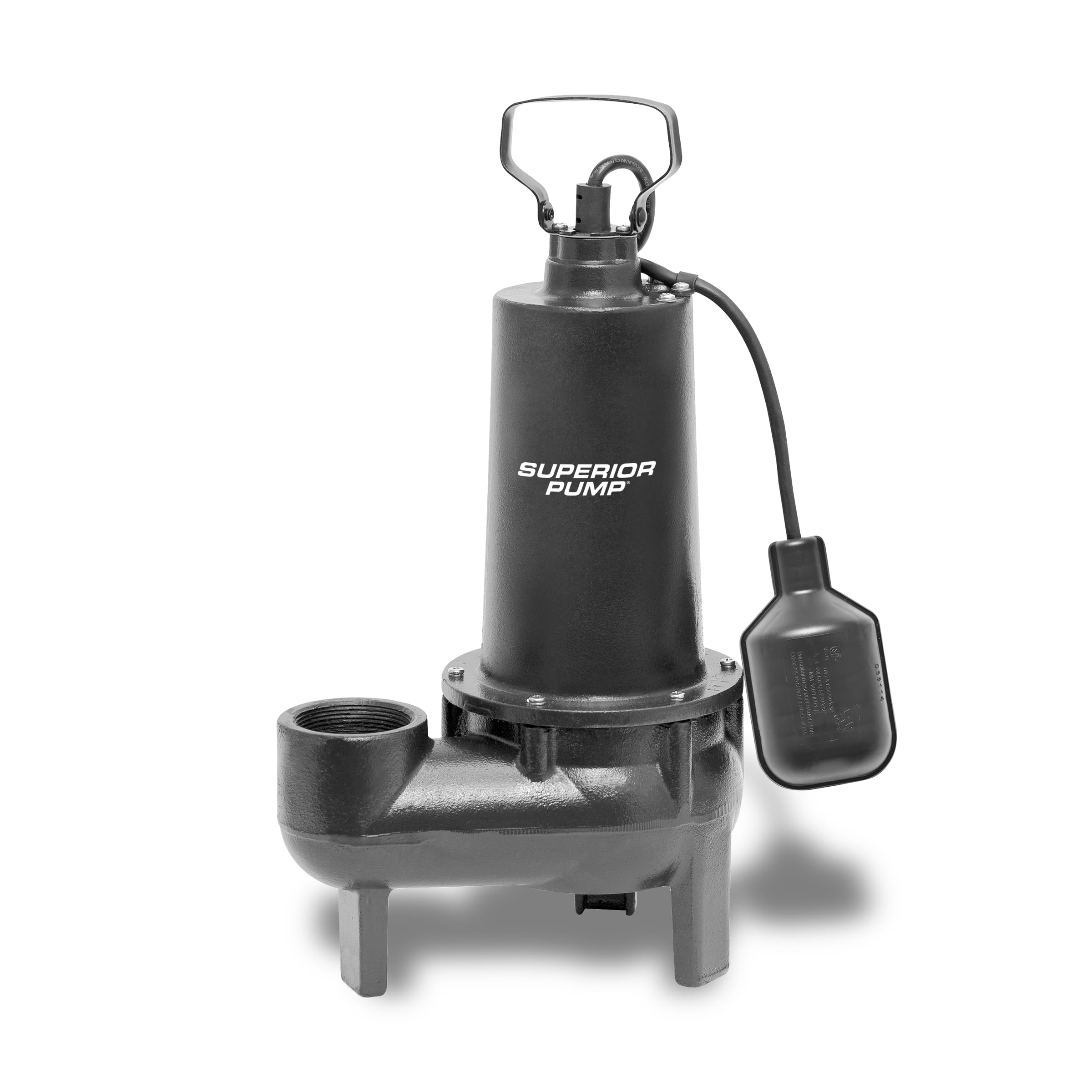
1. Superior Pump 93501
Our pick — over 4.5★ from 400+ verified ratings; the strongest balance of quality and price.
The Superior Pump 93501 is a 1/2 HP cast iron workhorse with an 80 GPM flow and a proven record of lasting over eight years in sewage pits.
The Superior Pump 93501 delivers a proven formula: a 1/2 HP cast iron workhorse that moves 80 GPM and lifts water up to 25 feet of vertical height. Its 2-inch NPT discharge and non-clogging vortex impeller handle solids up to 2 inches, making it a direct fit for most residential sewage ejector setups. The tethered float switch automates the on/off cycle without needing a separate control box.
This is the pump that owners replace with another unit of the same model. The review pages are full of stories like the installer who put one in a septic tank eight years ago and it is “still going strong,” pumping into a mound drainage system. Another owner swapped out a pump that had run for 25 years, confident this one would match the interval. It’s also notably easy to install, and owners consistently praise the quiet operation and the simple adjustability of the float cord.
It’s lighter than a 3/4 HP replacement yet delivers similar capacity, which makes the swap manageable for a solo DIYer. The biggest caveat is not the pump itself but the shipping—a few units arrived with the box showing wear, so inspect the packaging before you commit to the install. For a mid-range price, this is the safest bet for a first-time buyer.
The long-haul strengths
- Proven longevity—owners mention 8+ years of service
- Quiet operation and easy float adjustment
- Lighter than comparable 3/4 HP models
- 100% factory tested before shipping
What to watch
- Occasional reports of motors burning out within a year
- Some deliveries lack an inner box, risking damage in transit
Reach for this if: You want the best balance of price, proven performance, and an easy install for a standard basement pit.
Look elsewhere if: You need maximum horsepower for a long horizontal run—the 80 GPM flow is adequate but not extreme.
2. Zoeller Waste-Mate 267-0001
The Zoeller Waste-Mate 267 delivers a 125 GPM flow rate and a cast iron housing that plumbers trust for decades of service.
The Zoeller Waste-Mate isn’t just a pump; it’s an institution in the plumbing world. Its 1/2 HP motor moves an impressive 125 GPM, and it’s built on an ASTM Class 25 cast iron housing that shrugs off the corrosive environment of a sewage pit. The non-clogging vortex impeller design means it can pass a full 2-inch spherical solid without jamming—a critical feature when a stray toy or wipe heads down the drain.
What truly sets this pump apart is the owner loyalty it inspires. Buyers report units running trouble-free for years, with one even calling its performance “military grade.” The automatic discharge with an integral float switch is completely submersible, watertight, and dust-tight, so you can install it and forget it. It empties a standard basin in about three seconds, which is a noticeable step up in speed from lesser pumps.
The trade-off is the entry price; this is the premium tier of this list, and you pay for that reputation. It also weighs 35.8 pounds, so installation is a two-hand job. But for a permanent fixture that protects your home’s foundation, the longevity here is the real value.
Why owners swear by it
- Passes 2″ spherical solids without jamming
- Rapid 125 GPM flow empties basins in seconds
- Quiet operation praised across many reviews
- ASTM Class 25 cast iron switch case and housing
The honest trade-offs
- Premium price point reflects the brand’s top-tier status
- Heavy cast iron build (35.8 lbs) makes handling awkward
- Some owners recommend drilling a weep hole to prevent air lock
Best for: Homeowners who want a set-and-forget pump for a basement bathroom and are willing to pay for the most respected name in the category.
Consider if: Your budget is tight—this is the priciest pick here, and more affordable options handle standard jobs fine.
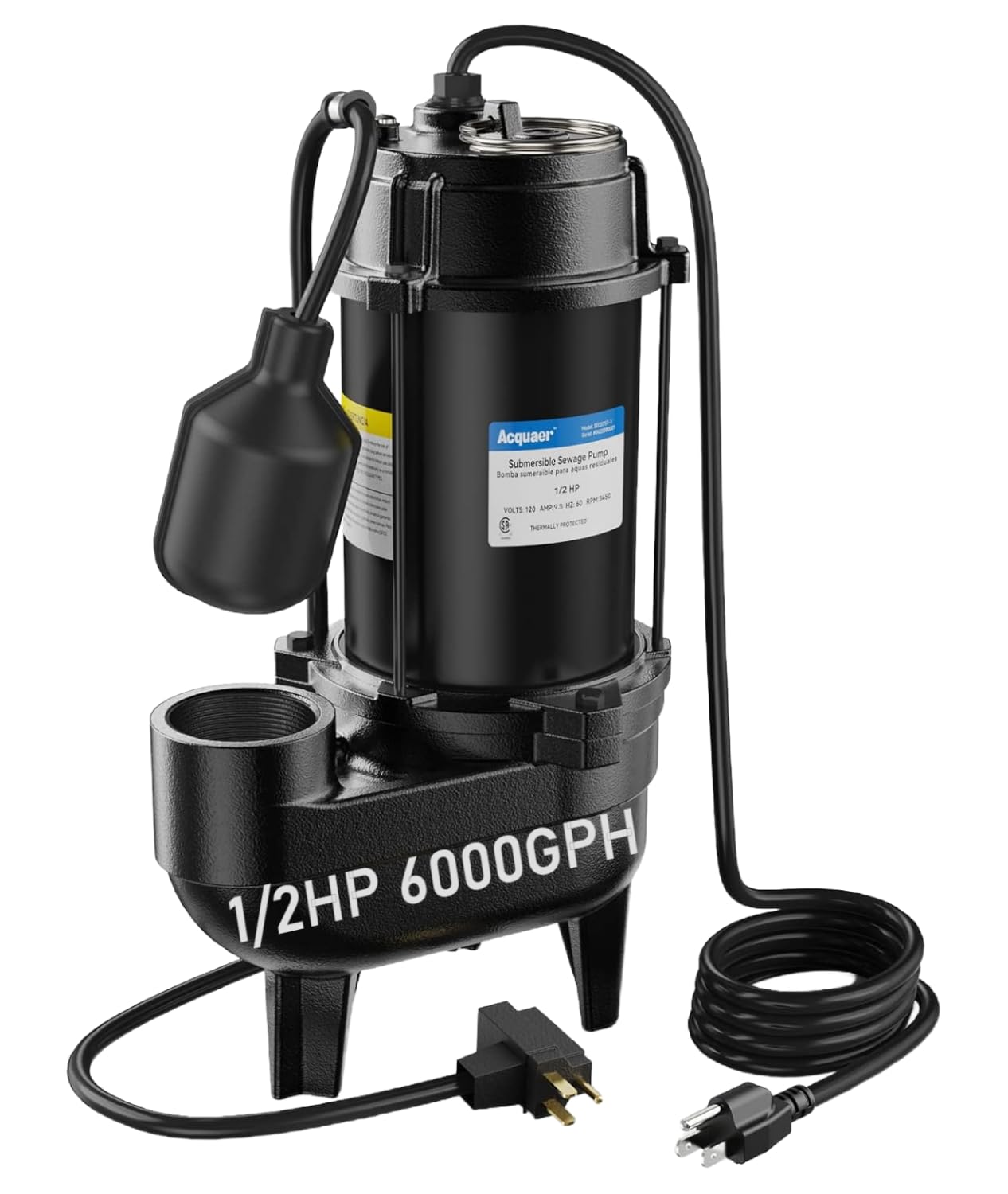
3. Acquaer 1/2 HP Submersible Sewage Pump
A 1/2 HP motor that punches like a 3/4 HP unit, moving 100 GPM up a 27-foot rise.
The Acquaer delivers a surprising amount of power for a 1/2 HP pump. It pushes 100 GPM and can lift water to 27 feet vertically, which beats the Superior Pump’s lift height by 2 feet. The oil-filled split capacitor motor runs cool and quiet, and the cast iron casing with a reinforced non-clogging vortex impeller handles 2-inch solids without a fuss. It’s explicitly rated for basements and below-grade installations, though the manufacturer notes it is prohibited for use in septic tanks.
This is a popular pick for laundry room ejector setups. One owner runs it as an ejection pump with piping routed through the attic to the sewer line—a demanding application that requires solid lift, and the Acquaer handles it. The installation is straightforward, and the 10-foot power cord with piggy-back plug gives you the choice of automatic float operation or manual override.
The catch is reliability is a split decision in the review data. Many units run flawlessly, but a few customers note the motor burning out within the first year. The good news is the seller’s customer service gets high marks for replacing units outside the normal return window. For the price, you get more flow and lift than the competition, but consider the two-year warranty your safety net.
The power play
- 100 GPM flow and 27 ft lift for a 1/2 HP motor
- Auto/Manual operation with piggy-back plug
- Thermal overload protection prevents burnout
- Strong seller support for warranty claims
The risk factor
- Some units fail within months of installation
- Not rated for septic tank use
- Lift by the handle, never the power cord
Who it beats: The Superior Pump on raw flow and lift—100 GPM vs 80 GPM, and 27 ft vs 25 ft—at a similar price.
Who it doesn’t: Anyone who needs a pump they can trust for a decade; the reliability track record is less certain here.
4. VEVOR 3/4 HP Cast Iron Submersible Sewage Pump

The vertical champion, lifting water to a towering 37 feet—nearly double the standard.
If your basement sewer line sits high, or you have a long horizontal run to the street, the VEVOR’s 3/4 HP motor is the answer. It lifts water to 37 feet and moves up to 98 GPM, so it out-pushes the Superior Pump’s 80 GPM by a solid margin. The cast iron body carries an IPX8 waterproof rating, meaning it’s built to sit fully submerged for long periods without the housing degrading.
Owners who upgraded from weaker pumps saw an immediate difference. One buyer replaced an identical-horsepower unit that could only manage a 20 ft head height; the VEVOR, rated at almost double that, handled a 200-foot run at a 15-foot lift with ease. In a 60-gallon sump basin, it pumps the pit dry within minutes. The piggy-back plug lets you run it fully automatic or switch to manual control by unplugging the float.
The ergonomic handle makes this 3/4 HP unit easier to move than you’d expect. The one weak spot reported is the tethered float switch, which failed shortly after installation for a few buyers—a critical component, since a dead switch means a dead pump. Check the float carefully during your first dry test, and you’ll have a powerful ally against basement flooding.
The height advantage
- 37 ft max lift is class-leading for the price
- 98 GPM flow handles heavy rain and snow melt
- IPX8 waterproof rating for submerged use
- Passes solids up to 3/4″ diameter
The weak spot
- Tethered float switch has an occasional failure rate
- Needs ample vertical float space to avoid short-cycling
The standout spec: At 37 feet, this pump’s lift height leaves the LANCHEZ’s 27 feet in the dust—it’s the pick for deep pits and high sewer lines.
The single caveat: Treat the float switch as the first thing you test, since a dry-tested unit can still ship with a dead switch.
5. LANCHEZ 1HP 6600 GPH Submersible Sewage Pump
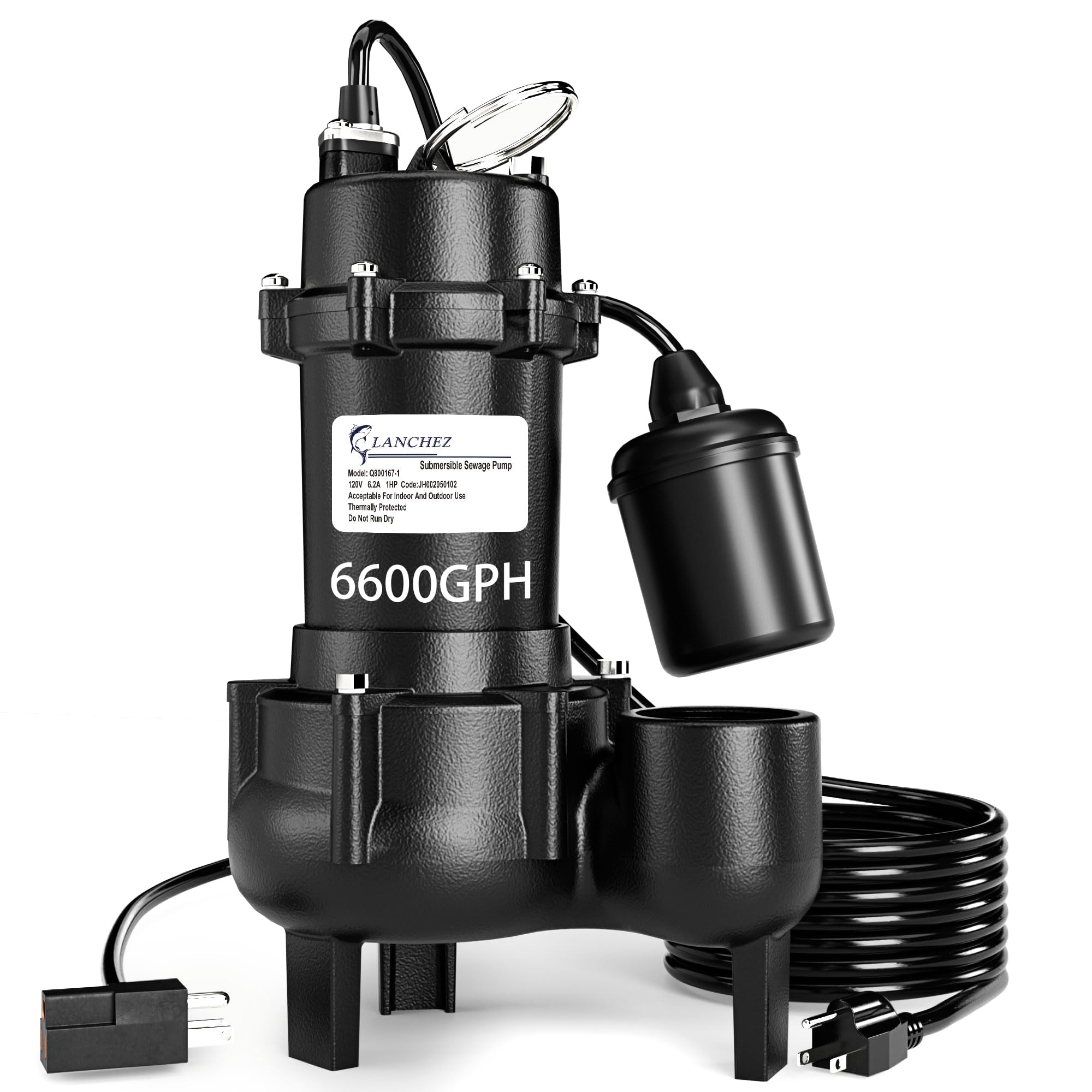
The LANCHEZ 1HP pump delivers 6,600 GPH of raw force, making it the top choice for the most demanding lift applications.
The LANCHEZ brings a full 1 horsepower to the fight, pumping 6,600 gallons per hour at ground level and still moving 5,644 gallons at a 5-foot rise. It lifts water to 27 feet, matching the Acquaer’s ceiling but with more grunt behind it. The permanent split capacitor (PSC) copper motor is designed for efficiency and quiet running, and the cast iron casing offers better cooling for sustained use.
Buyers who rely on it in emergencies are emphatic about its power. The review that stands out describes a pump that “saved my house” and ran for a year with zero complaints, removing water at an incredible rate. It’s heavy—so heavy it stays put in the basin without drifting—and the durable metal frame takes knocks in a ditch or a wide sump container.
The honesty here is that performance reviews are mixed: some units stop working within a year, despite the heavy-duty construction being praised. The 3-year manufacturer after-service is the backstop, and the 24-hour customer support is a real lifeline if you get a dud. This is the pump to pick when you absolutely need maximum horsepower and are willing to gamble slightly on long-term QC.
The brute force
- 1 HP motor with 6,600 GPH peak flow
- 27 ft vertical lift for high sewer lines
- Thermal overload protection on dry runs
- 3-year warranty with 24-hour support
The temperament
- Mixed reliability reports—some fail within a year
- Heavy and awkward handle digs into hands
- Float must be vertical to auto-start
Go with this if: Your installation demands the highest flow rate and you want the security of a 3-year manufacturer warranty.
Think twice if: You need a compact pump for a narrow basin—this unit is bulky and tends to tip in open water.
6. WAYNE RPP50 1/2 HP Cast Iron Sewage Pump

The WAYNE RPP50 moves 103 GPM to quickly clear flooded basements, though its 10-foot max lift limits high sewer lines.
The WAYNE RPP50 is built for one heroic job: clearing water out of a flooded basement in a hurry. That makes it a poor fit for a house where the sewer line is high, but a perfect match for a standard pit where the discharge is only a few feet above the pump.
Reviewers point out it handles an 8-foot rise with 45-degree bends without breaking a sweat, and it’s remarkably quiet while doing it. The piggy-back tether float switch allows automatic operation, and the cast iron housing is solid enough that buyers expect a decade of service. It’s designed for 18-inch diameter or larger basins, so check your pit size before ordering. The install is a direct swap for most existing pumps with no plumbing changes needed.
The honest warning is that a small number of units arrive with electrical faults—failures that trip GFCIs or spark when submerged. These are safety-critical defects, though they appear to be the exception rather than the rule. If you get a good unit, it’s a fast, quiet, powerful pump; if you get a bad one, the 1-year warranty is your recourse.
Speed and silence
- 103.33 GPM high-volume water removal
- Quiet operation praised by owners
- Direct replacement for most existing pumps
- Handles 2″ solids through a 2″ NPT discharge
Know the limits
- 10 ft max lift is the lowest on this list
- Rare but serious electrical failure reports
- Needs a minimum 18″ diameter basin
Pick this for: Ground-level discharge setups where speed matters more than lift—it drains a flooded floor faster than any other pick here.
skip it if: Your sewer line is more than 10 feet above the pump; you’ll need the VEVOR or LANCHEZ instead.
7. WASSERMANN 3/4 HP Sewage Pump
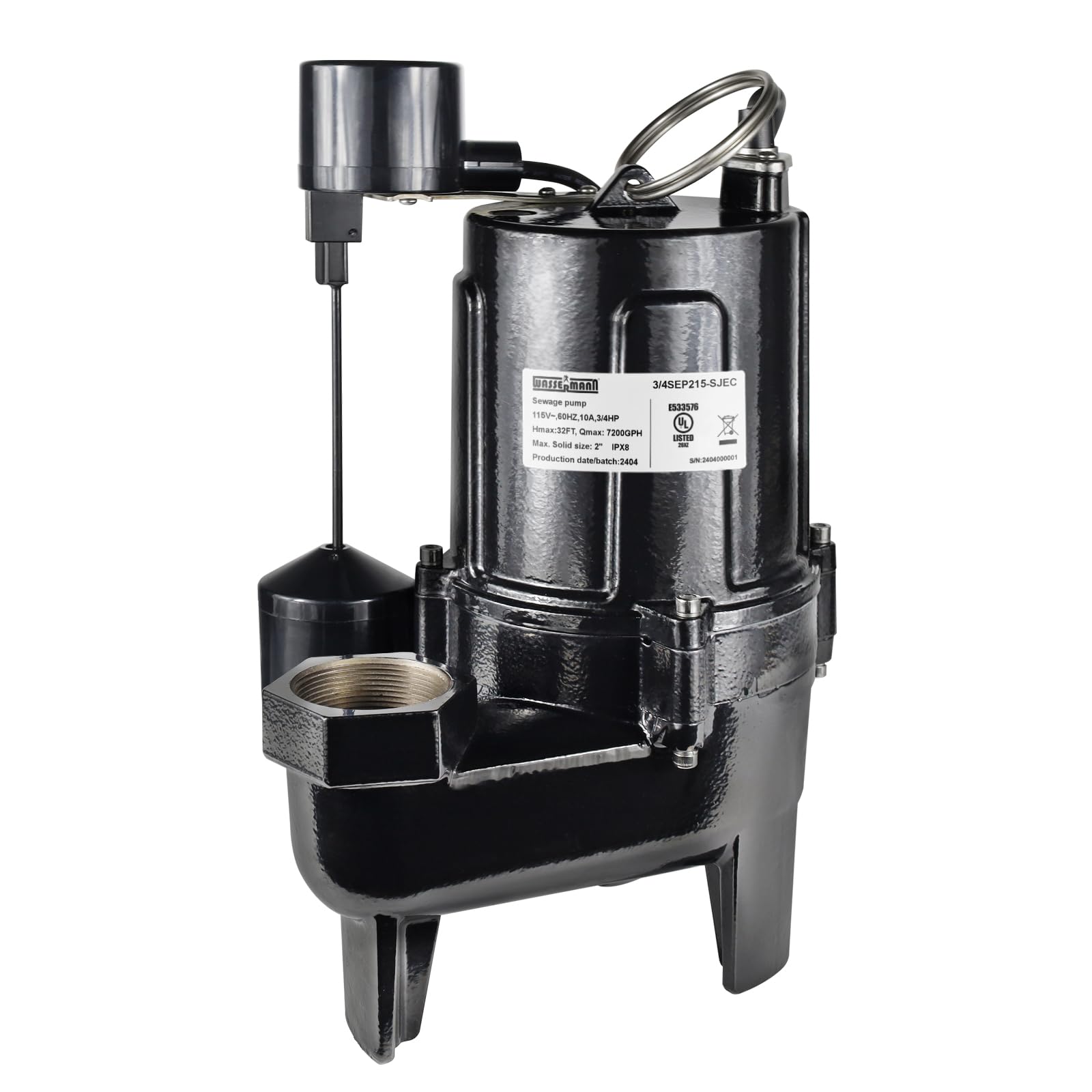
The WASSERMANN 3/4 HP pump leads its class with a 120 GPM flow rate and a 32-foot maximum lift height.
It lifts water to 32 feet, splitting the difference between the VEVOR’s 37 and the LANCHEZ’s 27. The oil-filled split capacitor motor is built for high-efficiency performance, and the cast iron casing with a non-clogging vortex impeller passes 2-inch solids without jamming.
Owners who’ve run it for six months report strong performance grinding solids and pushing waste up and out—exactly the job description for a basement ejector. The installation is notably easy, with everything you need included in the box. The unit is heavy, which buyers take as a good sign for reliability, and the confidence is the frequent payoff mentioned in reviews.
The main flaw is quality control at the factory. A couple of buyers found the rubber around the power cord torn where it enters the motor, leading to water shooting out the side during a test. This is a serious defect when it happens, but it’s rare in the review data. With 56 total ratings and a 4.4 average, the WASSERMANN is a strong mid-range bet if you want maximum flow without stepping up to a 1 HP motor.
The flow monster
- 120 GPM is the top flow rate on this list
- 32 ft lift handles high sewer lines
- Comes with all necessary installation parts
- Auto and manual control via separate plugs
The QC gamble
- Occasional cord-seal defects let water escape
- Heavy unit complicates solo installation
- Small review base—long-term data is thin
Grab this if: You want the fastest basin drain possible from a 3/4 HP motor—120 GPM clears a standard pit in under a minute.
Be cautious if: You’re buying from a distance and can’t inspect the cord seal on arrival; that’s the one part that’s failed for owners.
8. Red Lion RL-WC50TA Automatic Sewage Pump
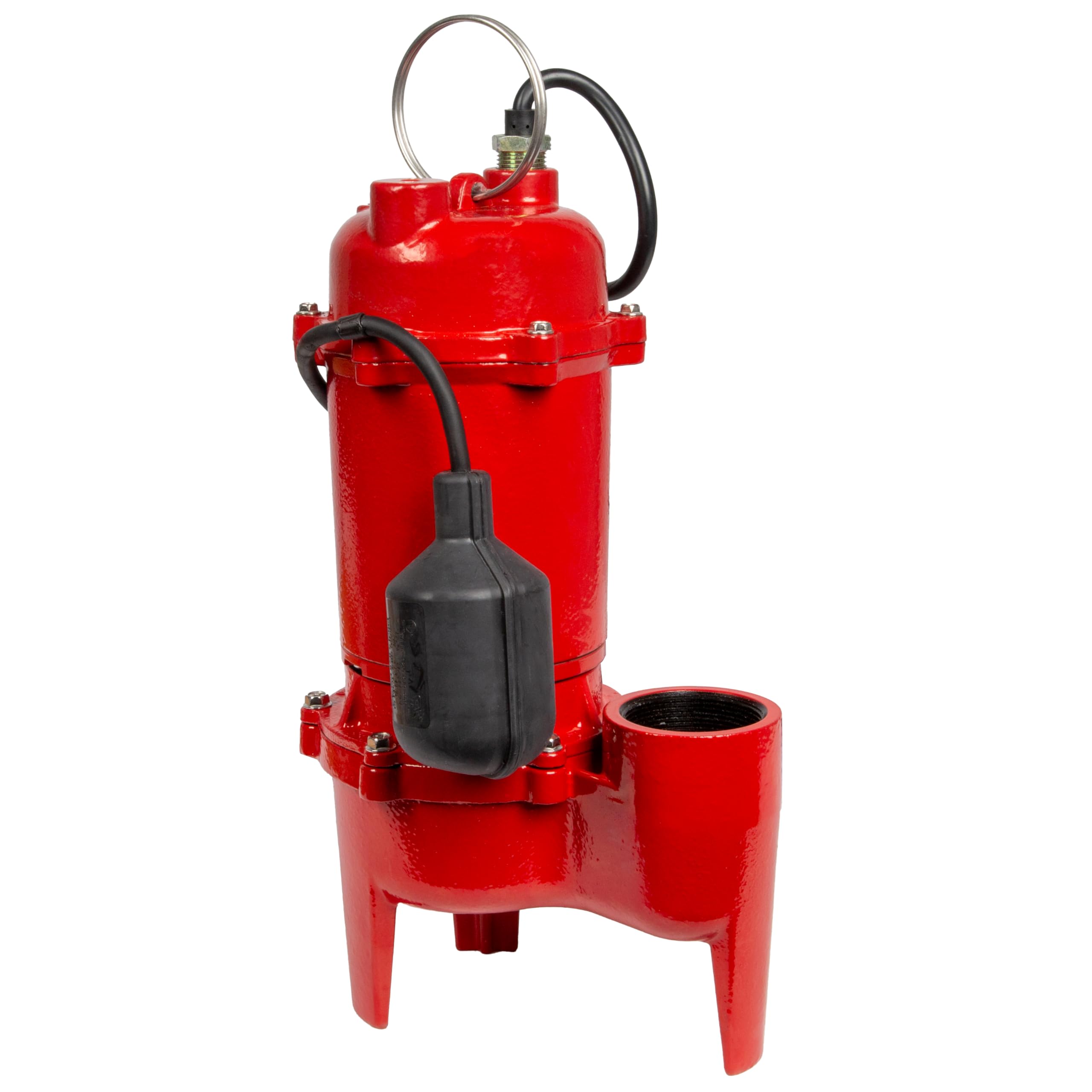
The Red Lion RL-WC50TA uses a cast iron vortex impeller to keep sump baskets cleaner than standard pumps.
The Red Lion RL-WC50TA is a 1/2 HP, 115-volt automatic sewage pump that moves 5,600 GPH at zero lift and shuts off at 22 feet. It’s built with a cast iron housing and a cast iron vortex-style impeller, plus dual ball bearings and a stainless steel rotor shaft for durability. The piggyback tethered float switch activates at 17.5 inches of water and shuts down at 7.5 inches, giving you a predictable cycle in a standard basin.
Owners note a specific advantage: a cleaner sump. One buyer who cleans his pit every three months observed the basket isn’t as “crapped up” with this pump as with previous models, suggesting the vortex design does a better job of keeping solids moving. It’s a well-built unit from a brand with a reputation for quality, and the build quality is exactly what you’d expect from Red Lion. The 2-inch FNPT discharge handles up to 2-inch semi-solids, and the 10-foot power cord reaches most outlets.
This pump is explicitly not recommended for pond use, and it needs an 18-inch minimum basin diameter. The float switch’s high activation point (17.5 inches) means you need a deep enough pit for the water to rise that far before the pump kicks on. It’s a solid, reliable choice for basement bathrooms, but the higher-than-average price for a 1/2 HP unit means you’re paying for the Red Lion name.
The clean-machine edge
- Cast iron vortex impeller keeps the basin cleaner
- 22 ft shutoff handles most residential lifts
- CSA listed in USA and Canada
- Dual ball bearings for long motor life
The fit notes
- Float activates at 17.5″—needs a deep basin
- Not for pond or fountain use
- Price runs higher than comparable 1/2 HP models
A reliable pick for: Homeowners who want a clean, low-maintenance basin and trust the Red Lion brand for longevity.
Not ideal for: Shallow pits where the water can’t reach the 17.5-inch float activation point.
9. Little Giant 9SC-CIA-RF Submersible Sewage Pump

The Little Giant 9SC-CIA-RF features a 20-foot power cord and moves 6,000 GPH, ideal for distant outlets.
The Little Giant 9SC-CIA-RF solves a problem most pumps ignore: getting power to the pit. Its 20-foot power cord is double the length of most competitors, so you can place it far from an outlet without an extension cord. The 4/10 HP motor is more modest than the others on this list, but it still moves 6,000 GPH at a 5-foot lift and reaches a 20-foot shutoff. The epoxy-coated cast iron housing is designed for continuous duty, resisting the corrosion that eats lesser pumps.
The piggyback float switch activates between 16 and 19 inches of liquid and shuts off between 9 and 11 inches, and you can switch to manual mode for maintenance. It’s rated for liquid temperatures up to 140°F, which matters if you’re pumping hot water from a laundry room. Weighing 38.5 pounds, it’s the second-heaviest pump here, a sign of its dense cast iron construction.
The trade-off is the lower horsepower. At 4/10 HP, it won’t match the LANCHEZ or VEVOR on raw lifting power, and the 8-amp draw is on the lower end. But for a standard basement bathroom with a modest lift, this pump is quiet, fast, and built to run continuously. The nylon vortex impeller handles 2-inch solids, and the 3-year manufacturer warranty is among the longest on this list.
Reach and durability
- 20-ft power cord reaches distant outlets
- Epoxy-coated cast iron for continuous duty
- Rated for 140°F liquid temperatures
- 3-year manufacturer warranty
The power ceiling
- 4/10 HP is the weakest motor on this list
- 38.5 lb weight makes handling tough
- Nylon impeller is less durable than cast iron
Choose this for: Installations where the outlet is far from the basin—the 20-foot cord eliminates the need for an extension.
Pass on it if: You need serious vertical lift; the 4/10 HP motor tops out at 20 feet.
10. Wayne SEL50 Thermoplastic Sewage Pump

The Wayne SEL50 offers a combo 2-inch or 3-inch NPT discharge, adapting to both old and new plumbing setups.
The Wayne SEL50 stands out for its plumbing flexibility. It offers a combination 2-inch or 3-inch NPT discharge, so it adapts to older 3-inch pits or modern 2-inch lines without an adapter. The 1/2 HP thermoplastic motor pumps up to 7,800 GPH at zero lift and 6,420 GPH at a 10-foot discharge lift, with lower ball bearings for quiet operation and an easy-access handle for portability.
This is the pump that owners pick as a direct replacement for the same model—two buyers mention prior Wayne units lasting 11 and 16 years, respectively, which is why they didn’t hesitate to buy again. It’s a favorite for smaller tanks and greywater systems, with many adjustment holes on the float to tailor the on/off levels to your pit depth. The cast iron seal plate adds durability where it matters most.
The honest caveat is the plastic impeller. One owner reported the “cheap plastic impeller fell off after two years,” a failure mode that’s rare but not unheard of in thermoplastic pumps. The float height can also sit too high for a shallow 55-gallon tank, though a simple bracket lowers it. For a lighter, corrosion-resistant option that’s easy to carry, this is a solid choice—just know the impeller is the weak link.
Flexibility first
- Combo 2″/3″ NPT discharge fits old and new pipes
- 7,800 GPH flow at zero lift is strong
- Proven 11-16 year track record for the model
- Lightweight for easy carrying
The plastic catch
- Plastic impeller can fail—one owner had it fall off
- Float may sit too high for shallow tanks
- Only the 3″ discharge on newer versions
Best for: Homes with unusual discharge sizes or anyone who wants a lighter pump that’s easy to maneuver.
pass on it if: You’re pumping raw sewage with heavy solids and want the bulletproof feel of full cast iron construction.
Understanding the Specs
Horsepower and Flow Rate
Horsepower (HP) is the engine’s muscle, but flow rate tells you the actual work done. Flow is measured in gallons per minute (GPM) or gallons per hour (GPH). A 1/2 HP pump typically moves 80-100 GPM, while a 3/4 HP unit pushes closer to 120 GPM. Match the flow rate to how fast your basin fills—a bathroom ejector needs less flow than a whole-house system draining a flooded floor.
Maximum Lift Height
This is the vertical distance a pump can push water, measured in feet. A pump rated for 25 feet can push water up a 25-foot vertical pipe, but every 90-degree elbow adds resistance that effectively shortens that distance. If your sewer line is 15 feet above the pit floor, you need a pump rated for at least 20 feet to account for pipe friction and fittings.
Tethered Float Switch
A tethered float is a ball on a cord that pivots as water rises, triggering the pump on and off. It’s the most common automatic switch on residential pumps. The critical requirement is basin clearance: the float needs enough vertical room to swing freely without catching the pit wall or the pump body. A float that catches will cycle the pump rapidly, burning out the motor.
Solids Handling and Impeller
Solids handling is measured in the maximum diameter of solid waste a pump can pass—usually 2 inches for ejector pumps. The impeller design matters: a vortex impeller creates a whirlpool that pulls waste through without the blades touching it, which prevents clogs. A non-clogging vortex is the gold standard for sewage, as it rarely jams on wipes or debris.
FAQ
What is the difference between a sump pump and a sewage ejector pump?
How do I know what horsepower pump I need?
Will these pumps handle a full 2-inch solid waste item?
How long does a sewage ejector pump typically last?
Can I install a sewage ejector pump myself?
Why is my pump cycling on and off too frequently?
What is a check valve and do I need one?
How often should I test or maintain my ejector pump?
Can a sewage ejector pump handle a washing machine and bathtub?
What is the difference between automatic and manual operation?
Final Thoughts: The Verdict
For most homeowners, the best basement sewage ejector pump is the Zoeller Waste-Mate 267 because it pairs a massive 125 GPM flow with the most trusted name in the industry—the crowd favorite with a 4.4-star rating across nearly a thousand owners who swear by its durability and speed. If you want the best value and a proven track record without the premium price, the Superior Pump 93501 is the one to reach for, with owners reporting eight or more years of trouble-free service. And if your sewer line sits high and you need maximum lifting power, the VEVOR 3/4 HP with its 37-foot lift height is the pump that will save your basement when the water rises fast.
The real takeaway is that a sewage ejector pump is a long-term investment in your home’s safety, not a disposable gadget. The brands that win here—Zoeller, Superior, Wayne, Red Lion—are the ones that have earned their reputation through decades of reliable service, not through flashy marketing. Look for cast iron construction, a non-clogging vortex impeller (a spinning blade that pushes waste through without jamming), and a float switch with enough clearance for your basin, and you’ll buy this pump once and forget it exists. That confidence is worth more than any spec sheet.
How We Picked
We do not accept paid placement. Every pick is matched to a real buyer and a real use-case; we do not hands-on test units.
Sources & Methodology
Specifications: manufacturer listings and product documentation. Review insights: verified customer reviews, as of August 2026. Pricing: not shown on this page (it changes often); check the current price via the retailer link.
As an Amazon Associate, KitchPrep earns from qualifying purchases. This does not affect which products we feature.
Related Guides
