
Specs are compiled from manufacturer listings and verified buyer reviews and can change over time — please confirm the key details on the product page before buying.
A basement fridge has one job that matters more than any glossy feature list: keep drinks and snacks reliably cold in the coolest, dampest, least-visited room in the house. The traps are specific to that room. A model that runs loud gets annoying fast in a finished basement where you watch TV. A model that frosts up solid demands manual defrosting in a space you rarely think about. And a model with a freezer-on-top split wastes half its capacity when all you actually store downstairs is cans, bottles, and the odd lunch. This guide cuts straight through that, matching eleven real basement-ready mini fridges to the exact job you need them to do.
I’m Mohammad Maruf — the founder and writer behind KitchPrep. This guide is built by comparing the manufacturers’ published specifications and the patterns across verified customer reviews, so you get each pick’s real strengths and trade-offs instead of marketing spin.
Basement use really has two lanes: beverage centers with glass doors that show off your cans, and all-refrigerator or dual-zone units that keep food, dairy, and freezer items cold without a wasted compartment. This guide sorts through both lanes so you can choose the right basement mini fridge.
Our Picks at a Glance
How To Choose A Basement Mini Fridge
The basement changes the rules. Down there, a mini fridge is usually the farthest appliance from the kitchen — which means you want a unit that holds what you actually drink and snack on without forcing a trip back up the stairs. A few specs decide whether a model earns its floor space.
Capacity: Match The Room, Not The Label
Capacity is measured in cubic feet, and the spread across basement-ready units runs from around 1.7 up past 4.5. Smaller units slip under a low basement window or tuck beside a sectional; larger ones justify their footprint by replacing the snack runs entirely. Cans-per-unit claims on the box are optimistic — most beverage centers note that a full load can block airflow, so a realistic count runs lower. If you plan to store milk, eggs, produce, or lunch containers, prioritise an all-refrigerator layout over a can-count ceiling.
Defrost Type: Manual vs Automatic vs Frost-Free
Defrost type is a maintenance question. Manual defrost means you periodically shut the unit down and chip ice off the back wall. Automatic defrost cycles moisture away without your help. Frost-free goes a step further and prevents ice buildup entirely. In a basement you visit twice a week, frost-free or automatic saves you the annoyance of finding a block of ice where a shelf used to be.
Noise Level & Basement Placement
A decibel (dB) is a measure of sound — 37dB is roughly the hum of a quiet room, while 45dB sits closer to soft conversation. If your basement holds a TV, a game table, or a home office, chase the lower number. Beverage centers that operate below 36dB are rare enough to call out.
Door Swing & Reachability
Reversible door hinges let you open the unit from the left or right, which matters in tight basement corners where you can only approach from one side. Smooth-back designs without exposed rear piping let you slide the unit closer to a wall without losing usable space behind it.
Quick Comparison
| Model | Best For | Capacity | Annual Energy | Cooling Type | Amazon |
|---|---|---|---|---|---|
| Danby DBC117A1BSSDB-6 117 Can Beverage Center★ Best Overall | Basement bar & can storage | 3.1 cubic feet | 258 kWh/year | Fan-forced | Amazon |
| Frestec 1.7 Cu.Ft Mini Fridge with FreezerBest Compact Value | Under-desk & small-space basement | 1.7 cubic feet | 200 kWh/year | Compressor | Amazon |
| Midea 3.3 Cu.ft Mini FridgeBest All-Fridge Layout | Coffee bar & tall bottles | 3.3 cubic feet | 260 kWh/year | Compressor | Amazon |
| Upstreman 3.2 Cu.Ft All-Refrigerator | Colour-match decor & all-fridge space | 3.2 cubic feet | 258 kWh/year | Compressor | Amazon |
| Feelfunn 2.5 Cu.Ft Mini Fridge with Freezer | Two-zone basement storage | 2.5 cubic feet | 350 kWh/year | Compressor | Amazon |
| Tehanld 3.2 Cuft 130 Can Beverage Fridge | Glass-front can display | 3.2 cubic feet | 181 kWh/year | Compressor | Amazon |
| Antarctic Star 3.2 Cu.Ft Double-Door Refrigerator | Man-cave freezer zone | 3.2 cubic feet | 300 kWh/year | Compressor | Amazon |
| Frigidaire EFR451 Top-Freezer Refrigerator | High-capacity basement food storage | 4.5 cubic feet | 250 kWh/year | Compressor | Amazon |
| Manastin 4.5 Cu.Ft Mini Fridge Freezer | Wet-bar & dorm-style freezer | 4.5 cubic feet | 181 kWh/year | Compressor | Amazon |
| Electactic 4.5 Cu.Ft Mini Fridge with Freezer | Basement bedroom food storage | 4.5 cubic feet | 356 kWh/year | Compressor | Amazon |
| Feelfunn 4.5 Cu.Ft Beverage Refrigerator | Large glass-door bar setup | 4.5 cubic feet | 240 kWh/year | Compressor | Amazon |
In‑Depth Reviews
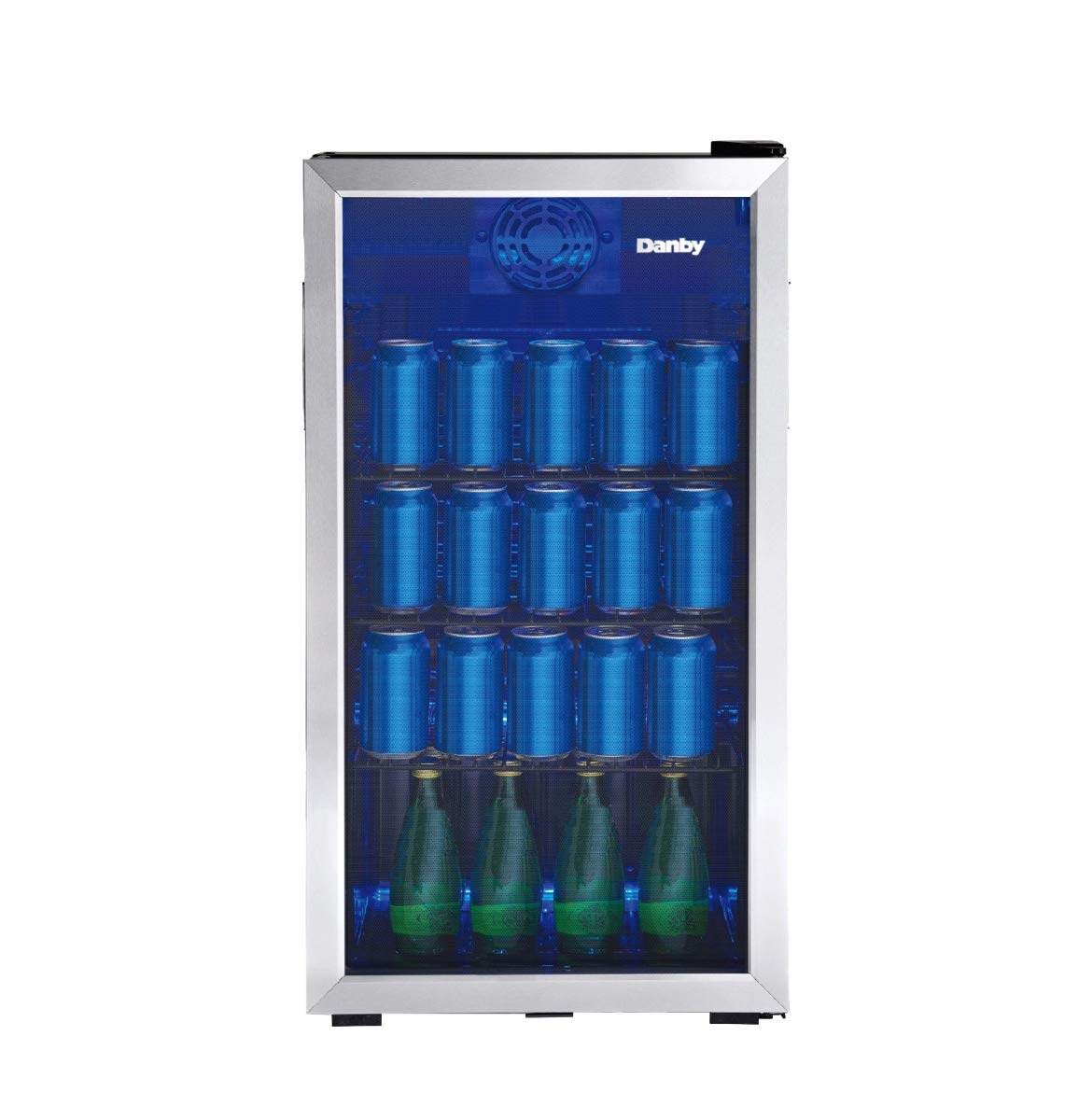
1. Danby DBC117A1BSSDB-6 117 Can Beverage Center, 3.1 Cu.Ft. Freestanding Drinks Refrigerator
Our pick — 4.5★ from 650+ verified ratings; the strongest balance of quality and price.
The glass-front beverage center that turns a basement corner into a real bar.
If your basement is a bar, a man cave, or a rec room where cans of beer, pop, and sparkling water live, the Danby DBC117A1BSSDB-6 is built for exactly that — 3.1 cubic feet of room that holds up to 117 twelve-ounce cans behind a tempered glass door with stainless steel trim. The fan-forced cooling system keeps a consistent, even temperature throughout the cabinet rather than letting the back get colder than the front. That matters downstairs, because the whole point of a beverage center is that the can you grab from row three is as cold as the one at the front. The mechanical thermostat lets you dial anywhere between 35.6°F and 50°F, so you can run it colder for beer or gentler for wine-adjacent items. Blue LED interior lighting showcases the contents, and the door lock adds a small layer of use control if the basement is also a guest space or a workshop with kids around.
What wins people over here is the size-to-footprint ratio and the temperature hold — a smooth-back design with no bulky exposed rear components means you can push it into a tight corner and still grab cans without a renovation. Buyers report it holding 35°F to 40°F, chilling cans in about half the time of a full-size kitchen fridge, and running quietly enough to forget it is plugged in. One owner after two months: “Holds many beverages/snacks, quiet, very cold—chills drinks in half the time of a full-size fridge.” Three adjustable shelves and a reversible door hinge let you fine-tune the layout for cans, bottles, or a mix. Auto defrost means you are not scraping ice off the back wall every few months.
Set expectations on two things. First, loading it to its full 117-can claim restricts airflow — most owners settle around 80 cans in normal rotation so the fan can move cold air freely. Second, the occasional unit arrives with cosmetic bruises from shipping; the compressor and seal are what matter, and the 669-strong review base runs strongly positive, so a scratch on the door is the outlier, not the pattern. The tempered glass and stainless trim also collect fingerprints on a light finish, so keep a soft cloth on the shelf nearby.
What earns the top spot
- 3.1 cubic feet holding up to 117 cans keeps a basement bar stocked for weeks
- Fan-forced cooling holds an even temperature, so every can pours equally cold
- Adjustable thermostat from 35.6°F to 50°F covers beer through white wine
- Blue LED interior lighting with a switch-off option and a built-in door lock
- Reversible door hinge fits tight corners with a single flip
Worth knowing before you buy
- Packing all 117 cans restricts airflow — most owners keep it nearer 80 in rotation
- Some shipments arrive with minor cosmetic dents, though cooling is unaffected
- Fingerprints show up quickly on the stainless trim
Best if: your basement is set up as a bar, man cave, or entertaining space and you want a glass-front can center that looks the part and holds temperature.
Think twice if: you need a freezer compartment or a floor-saver for a bedroom-sized corner — the fan-forced beverage layout is built for cans, not frozen dinners.
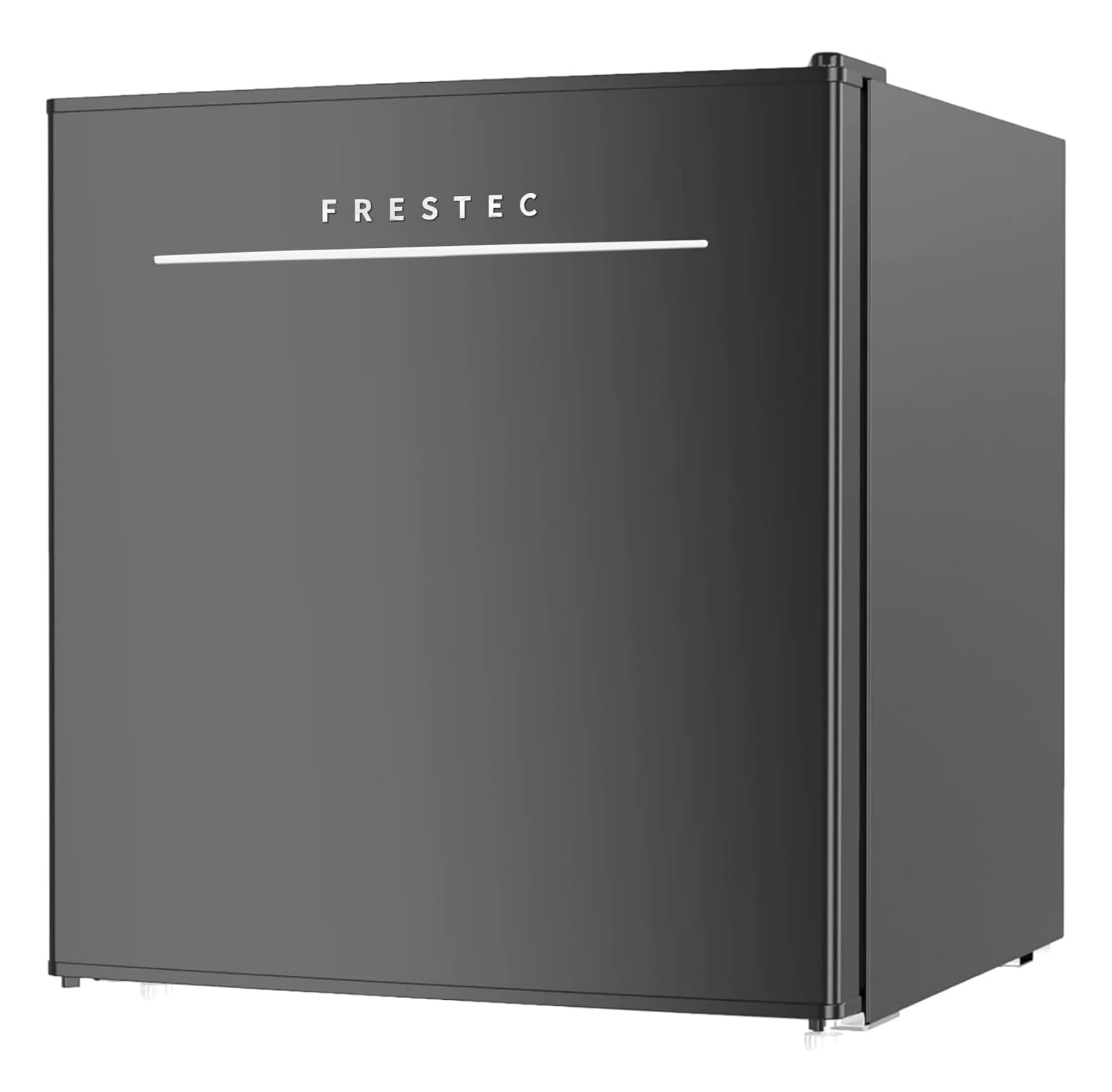
2. Frestec 1.7 Cu.Ft Mini Fridge with Freezer (Black)
The tiny under-desk fridge that runs quieter than a whispered conversation.
Where a beverage center holds cans, this Frestec goes the other way — it is a full refrigerator with a small freezer built into a 1.7-cubic-foot body. That makes it the pick for a basement home office or study nook where you want milk, a lunch container, and a couple of ice cubes reachable without climbing stairs. The unit runs at just 37dB, a hair louder than a soft whisper, which means it fades into the background during a call or a show. That is not a small thing in a basement, because the room usually has no door between the fridge and your desk. The 200-kilowatt-hour annual energy figure is the lowest in this lineup, so leaving it plugged in year-round costs less than leaving a comparable beverage center running. Supported by an energy-saving certificate, the unit pulls around 0.55 kilowatt-hours per day.
The 6-mode thermostat runs from 28.4°F to 50°F, and one of those modes includes a light-degree freezing storage spot for ice cubes — worth knowing if you want a tray of ice on hand without a full-size freezer. Detachable door seals make cleaning the gasket simple. What owners consistently praise is performance: cooling is fast, food stays cold, and the unit quietly disappears into the room. “This is perfect for the office,” one reviewer wrote. “Keeps my lunch and drinks cold and takes up very little space.” The compact 17.83-by-18.05-by-19.8-inch footprint means it fits under a standard desk without cramping legroom, and the reversible door swings either way depending on where you sit.
The honest caveat: noise is mixed at the review level. Some owners mention a genuinely quiet unit, while others describe a rattle that appears louder in a silent room. The glass shelf can also sit loose and buzz if it is not seated exactly in its groove — a repositioning fixes it. Set against that, the 4.4-star track over 474 ratings says most units land on the quiet side, and the upset reviewers tend to be the ones running the fridge in a bedroom rather than a workroom where ambient noise masks it.
Where it earns its place: a 1.7-cubic-foot footprint that slips under a desk or into a tight basement corner, a 37dB rating that keeps it out of your ear, and the lowest annual energy figure in this list at 200 kilowatt hours per year.
Reach for this if: you want a basement office or study fridge for lunch, milk, and drinks without giving up floor space.
Look elsewhere if: you need real storage volume for a family’s worth of snacks — 1.7 cubic feet fills up fast once a case of drinks goes in.
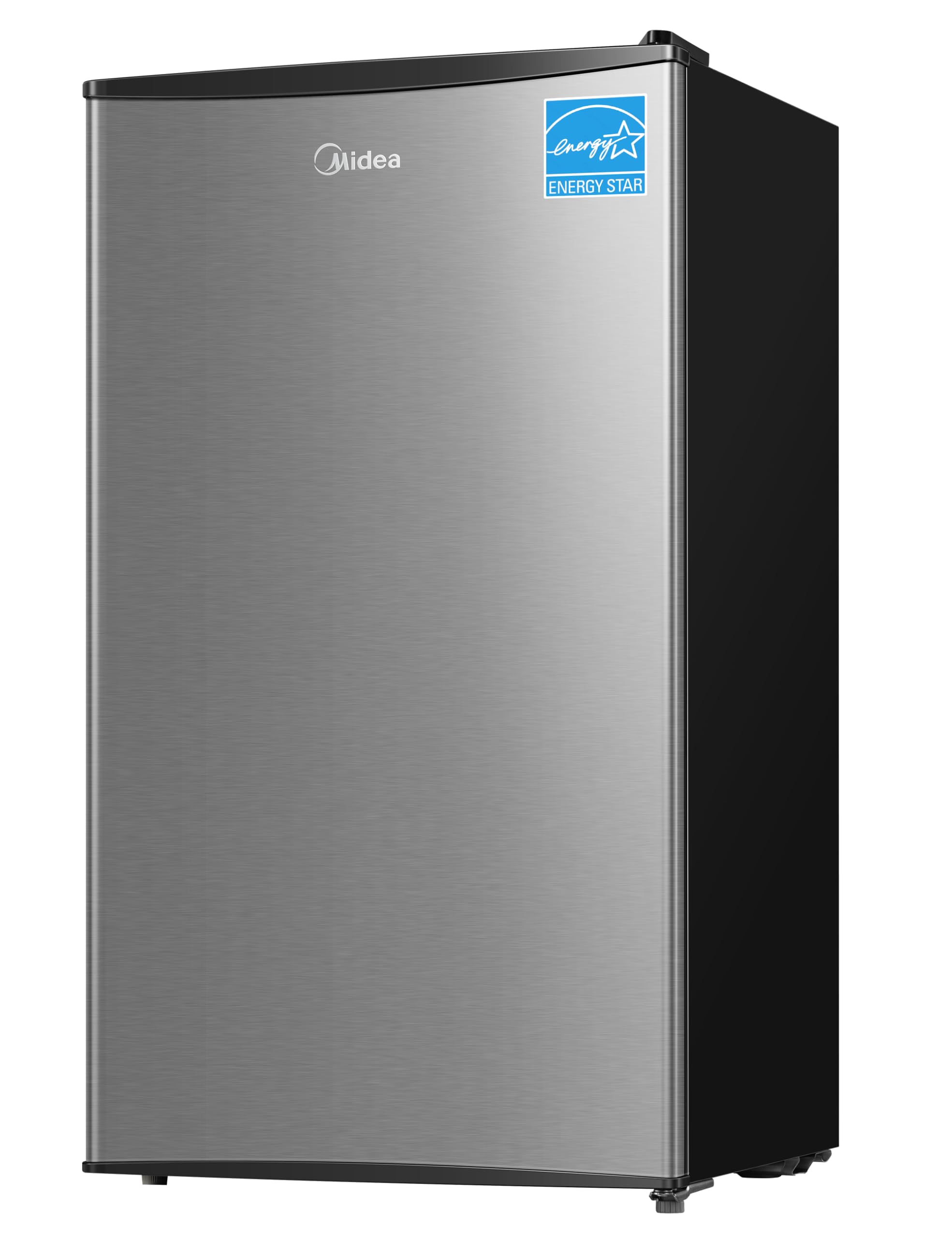
3. Midea 3.3 Cu.ft Mini Fridge, Energy Star Certified, Low Noise for Office
All fridge, no freezer — 3.3 cubic feet of nothing but usable cold space.
Here is the entire pitch in one line: this Midea runs 3.3 cubic feet with zero freezer stealing room from the fridge cavity. That is 1.9 times the capacity of the 1.7-cubic-foot Frestec above — a huge jump for anyone who has felt the frustration of a mini fridge where half the interior is taken up by an ice-box hump. The all-refrigerator layout frees every shelf for actual food and drinks, which is why owners who keep a coffee bar or a basement snack station tend to prize it. A dedicated 2L bottle rack holds daily milk and drink bottles upright, and an easy-access can rack puts soda within reach without reshuffling the whole shelf.
Two features carry the day here. First, a reversible door that opens left or right, which answers the tight-corner problem in most basements. Second, the multi-air-flow system that pushes cooler air evenly through the cabinet, so the rear shelf is no colder than the front. The mechanical thermostat dials anywhere from 33.8°F to 50°F and holds it. LED interior lighting means you can see into the back without a flashlight. Energy Star certification and a 260-kilowatt-hour annual draw put it right next to the Danby in running cost, even though it carries more cubic feet — a fair efficiency win for the extra space. The R600A high-efficiency compressor is the same refrigerant family other good units here use.
The trade-off to be aware of is defrost style: this one is manual defrost, unlike the frost-free Danby above. That means one or two defrost days a year depending on basement humidity, plus a towel on the floor. A handful of customers note delivery damage — a single 1-star note about a dented arrival stands out against the mostly 5-star run, which is honest but not the pattern. Set against 337 ratings and a 4.3-star average, the odds of a clean arrival are strongly in your favour.
Why it wins the fridge-only lane
- 3.3 cubic feet with no freezer eating the cavity — every shelf is usable
- Multi-air-flow system keeps temperature even from back to front
- 2L bottle rack plus can rack keep drinks organized without shuffling
- Reversible door hinge and adjustable legs handle awkward basement floors
The trade-off to plan for
- Manual defrost means you will scrape ice off the back a couple of times a year
- A few arrive with a cosmetic dent from shipping — check the box before you unpack
Fits: buyers who want maximum usable fridge space per cubic foot and will happily trade a defrost day for it.
Skip the trade if: you need a freezer compartment — this unit is deliberately all-fridge.
4. Upstreman 3.2 Cu.Ft All-Refrigerator Mini Fridge, Silver-CR32
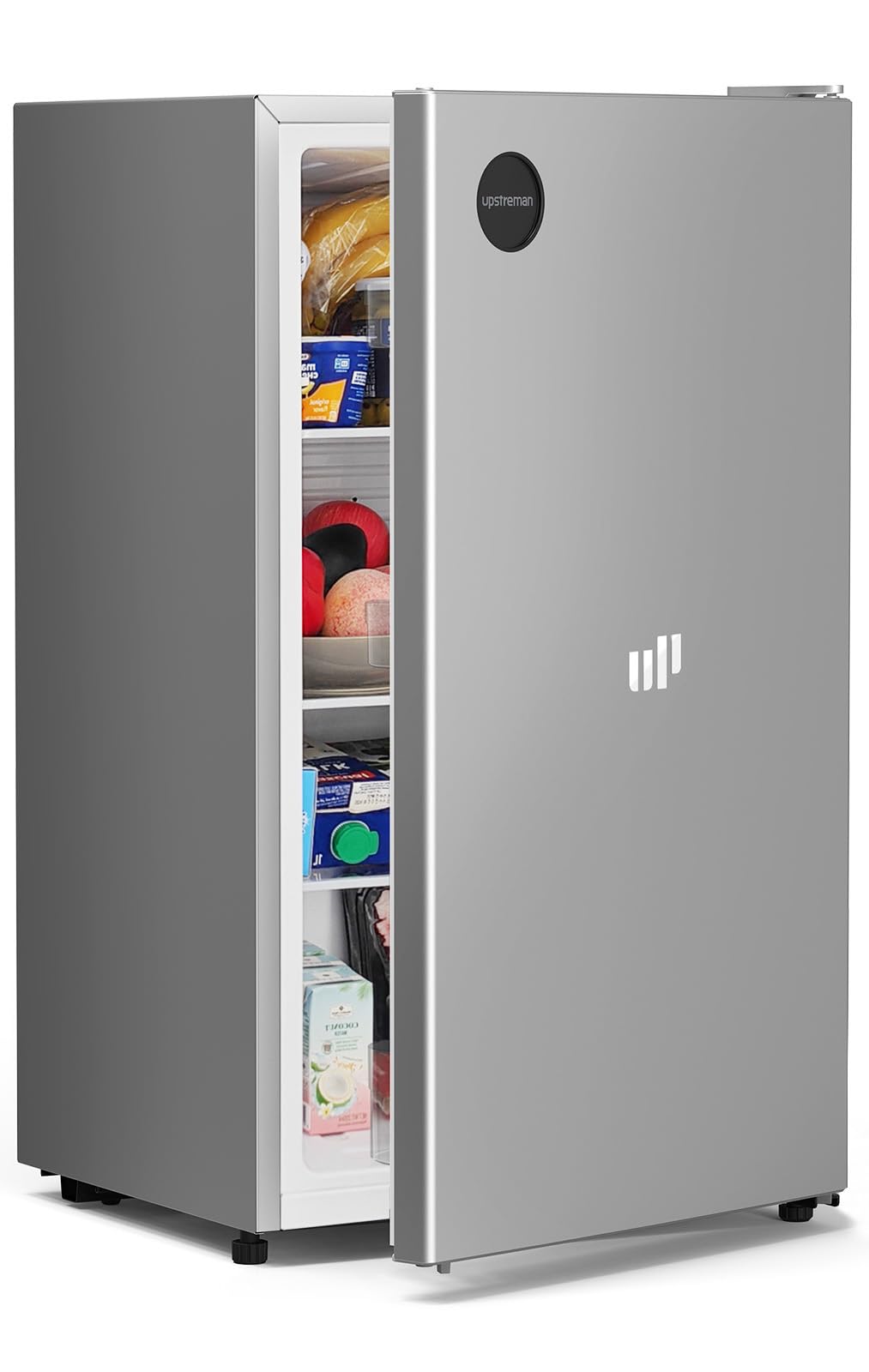
An all-silver finish that looks like part of the furniture, not an appliance.
Most cheap mini fridges ruin an otherwise tidy basement with black plastic sides. The Upstreman goes a different route — a smooth all-silver exterior with an integrated hidden handle and clean lines, so it reads as a piece of furniture rather than a dorm appliance. That design choice is the reason to consider this over the Midea above if the fridge will sit in a finished space. The 3.2-cubic-foot capacity runs just shy of the Midea’s 3.3, and the same 258-kilowatt-hour annual draw matches the Danby’s energy figure despite more interior volume. Under-the-counter placement needs a 1-to-2-inch clearance on all sides, worth checking against your basement cabinetry before you commit.
Internally, the useful details stack up well: 3 adjustable glass shelves, 3 clear door bins, an LED light that switches on automatically when you open the door, and a reversible hinge. The thermostat runs a 7-setting sweep from 32°F to 50°F, which gives finer control than the 3-setting units in this roundup. R600a refrigerant keeps the cooling efficient. Two adjustable leveling feet compensate for the uneven slope you will likely find in a basement floor — a genuinely useful feature if you have ever tried to shim a fridge with a matchbook.
The honest note: noise is split. Some owners describe it as super quiet while others hear it working, and a 3-star review flags that the unit does make noise and to expect that in a quiet room. On the size question, one 3-star reviewer notes it was smaller than expected and did not fit their intended spot — a fair reminder to measure your corner and not guess. Against 128 ratings and a 4.2-star average, the noise split is the main thing to weigh if the fridge lives beside a bed or desk. For a basement family room or kitchen-adjacent nook, it fades into the background where any fridge would.
What makes it stand apart: a fully silver exterior without the black plastic flanks, a 7-setting thermostat with a wider 32°F to 50°F range, and three glass shelves plus three door bins for real organizing.
Worth measuring first: the under-counter clearance is 1-2 inches on all sides, and a handful of owners find it smaller than the cubic-foot figure suggests, so check the spot before you buy.
Suits: anyone who wants the fridge to disappear visually into a finished basement and does not need a freezer.
Not the pick if: you are sensitive to compressor hum in a silence-first room — this unit’s noise floor is more present than the Frestec’s 37dB.
5. Feelfunn 2.5 Cu.Ft Mini Fridge with Freezer, 2 Door Dorm Fridge, Silver
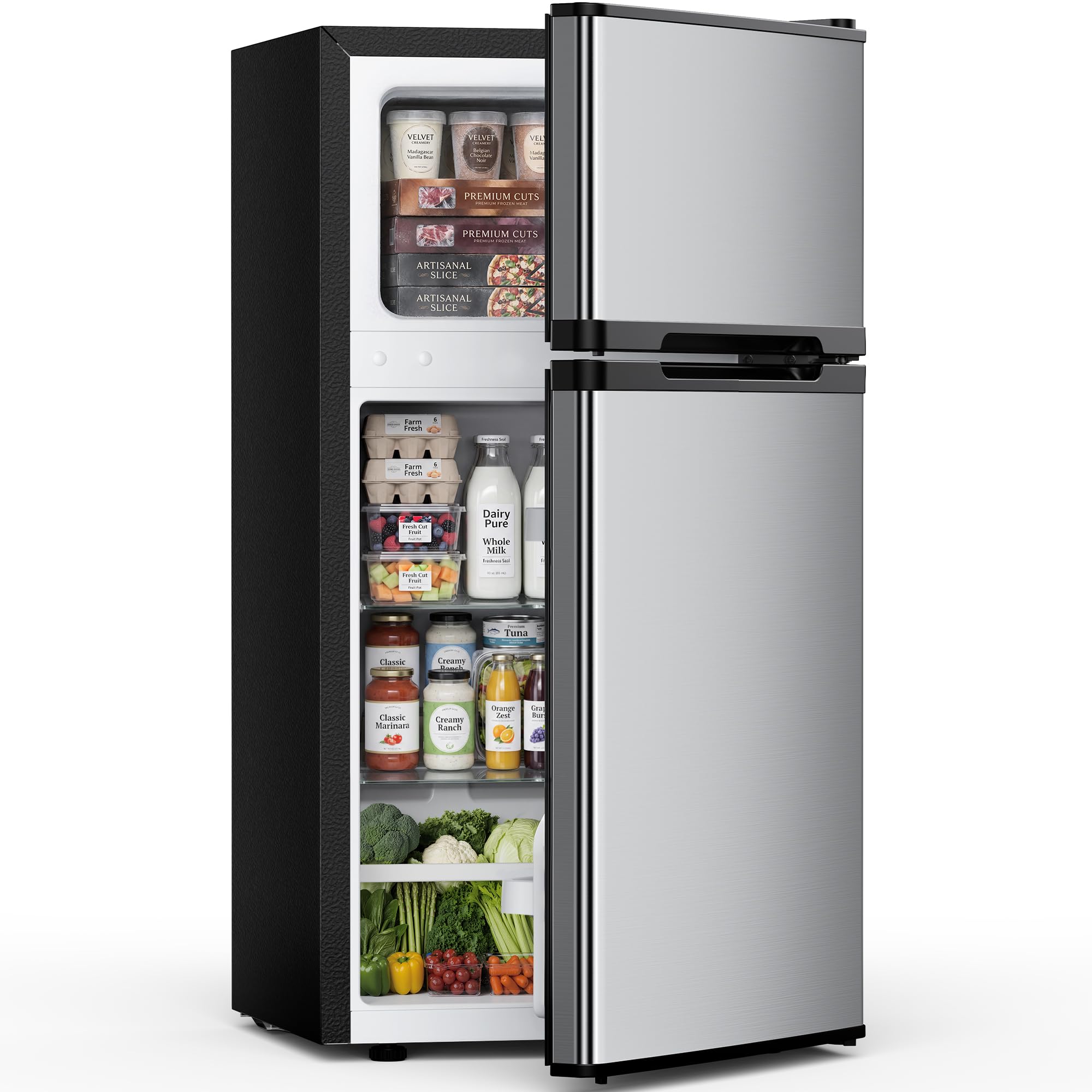
A true dual-zone fridge with a real freezer door — no ice-box compromise.
The key thing this Feelfunn does that the single-door units here cannot is genuinely separate the cold zones. It splits 2.5 cubic feet into 1.85 cubic feet of fridge for beverages, fruits, and veggies, plus a 0.65-cubic-foot freezer for ice cream and frozen meat. That separation matters because the freezer temperature drops below -4°F while the fridge holds 32°F to 41°F — you are not compromising between two temperature goals in one cavity. The 1.95-square-foot footprint means you can plant it in a basement corner, RV, dorm, or garage without giving up meaningful floor space. An ice tray and ice shovel come in the box, so you can make ice without a separate appliance.
What makes this a strong basement pick is the honesty about temperature. The 3-setting thermostat controls both zones independently, so a mid-setting keeps the fridge cold without dropping the freezer off the deep freeze. R600a compressor cooling plus a low noise ceiling of ≤38dB keeps it quiet enough for a bedroom-adjacent spot. The reversible hinge handles left- or right-side opening, and a built-in LED light shows what is inside. Note the manufacturer’s setup step: keep it upright for 6 to 12 hours before plugging in, so the compressor oil settles back after shipping. Backed by a 1-year warranty.
The fair warning is cooling consistency. Some reviewers point out that the fridge would get cold and then warm up, which is a temperature fluctuation concern in a small number of units. Others run it for weeks with no issue and specifically note the freezer “keeps ice cream solid.” For the sensible middle path, owners recommend running the thermostat on setting 2 rather than 3 — the top setting is described as too powerful. A couple also note it is used for storing medications that need a stable cool temperature, but if that is your use case, confirm with the manufacturer on the tolerance range rather than assuming.
The case for it: a genuine two-door, two-temperature setup in only 2.5 cubic feet, with a real freezer that holds ice cream hard and a fridge side sized for milk, soda, and produce.
The buyer to skip it: if you need rock-steady temperature swings every minute in a medical or precision setting, choose a unit with fewer reports of cold-warm cycles.
Worth it for: a basement snack station that needs a frozen pizza option as well as cold drinks.
Wrong pick if: you want only casual beverage cooling — the freezer split adds complexity most drink-only setups never use.
6. Tehanld 3.2 Cuft Beverage Fridge, 130 Can Mini Fridge With Glass Door, Black
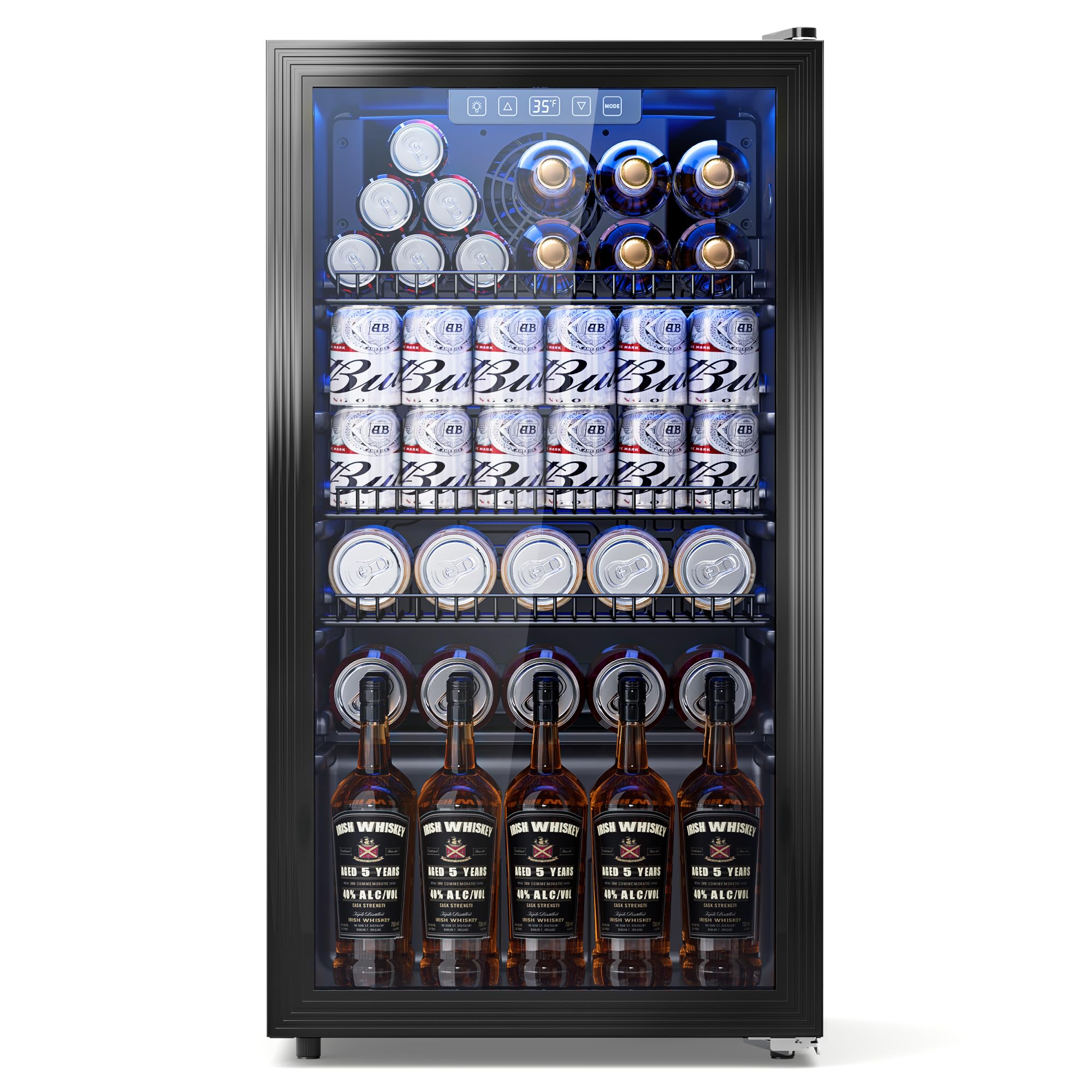
A 130-can display fridge that runs quieter than the room you sleep in.
Two specs lift this Tehanld above the generic glass-door crowd. First, the operating noise sits below 36dB — that lands inside the 15-to-45-decibel range the brand calls the ideal sleep noise band, so it will not wake anyone in a basement guest room. Second, defrost style is frost-free, which means you never scrape ice off the back wall. That is a real convenience in a basement you visit twice a week. The 3.2-cubic-foot capacity holds up to 128 cans of beer or 26 standard bottles of wine, and you can pack it with either or a mixed load. Energy consumption runs at 181 kilowatt hours per year — one of the lower figures in this roundup — and the high-performance compressor sips power per day compared to a traditional beverage cooler.
Control is where the value sits. A touch panel shifts between a 35°F to 65°F range, which runs far colder than a typical fridge for beer and warm enough for red wine storage. A MODE button flips the display between Fahrenheit and Celsius. The glass door uses a low-e coating with a dense seal to block warm air entering and cold air escaping, and a 360-degree full-angle air duct circulates cold air evenly through the cabinet. An LED light toggles on at the touch of a button, and there are three removable shelves plus five optional slot positions for tall cans, wine bottles, or a mix. The blue LED strip gives the glass door a soft glow.
The honest gripes are worth flagging. Some owners say the unit needed around 24 hours before it actually held its set 40-degree target — one review notes, “Took about 24 hours to actually maintain its 40 degrees, but it’s holding now.” Temperature retention as a category runs mixed at the review level, with a minority reporting the fridge will not hold its set temperature. There is also a durability note: a small number of units arrive with cosmetic scuffs and the door is a fingerprint magnet on the black trim. Set against 536 ratings and a 4.3-star average, the strong signals from the panel are performance and value, with temperature retention sitting on the mixed side. If beer and wine storage with a clean glass-front look is your basement goal, the value is hard to argue with.
The winning combination
- Frost-free defrost — no scraping ice in a room you rarely visit
- Under 36dB operation keeps it out of the sleep-noise range
- 35°F to 65°F touch control covers beer, soda, water, and wine
- Holds up to 128 cans or 26 wine bottles in 3.2 cubic feet
- 181 kWh per year — among the lowest annual draws in this lineup
Which buyers should weigh this
- Takes roughly a day to settle into its set temperature after first plug-in
- Some shoppers say it will not hold a target temperature consistently
- Black glass finish shows fingerprints and smudges
The right buy for: a basement wet bar or dining corner where you want cans visible through glass, no ice-scraping chore, and one of the quietest compressors here.
Choose differently if: you need to store food alongside drinks — a beverage center like this one is laid out for cans and bottles, not groceries.
7. Antarctic Star Mini Compact Refrigerator, 3.2 Cu.Ft. Separate Freezer Double 2-Door

A freezer-on-top setup that keeps frozen pizzas ready without leaving the basement.
What sets this Antarctic Star apart is the separate freezer door. Instead of a tiny built-in ice box, it gives you 0.96 cubic feet of dedicated freezer above the 3.2-cubic-foot fridge body — enough for ice cube trays and a few pints of ice cream according to owners. That is a layout that suits a basement man cave, garage, or dorm room where you want both a cold beer and a frozen snack reachable without running a full-size kitchen. A removable slide-out glass shelf separates the fresh zone and locks in a bit of organization for cans on the door and veggies in the drawer. A thermostat with three numbered positions runs from 32°F to 50°F in the fridge and 3°F to -1°F in the freezer, so the two compartments run independently of each other.
What owners consistently call out is fit and quietness. This unit is built to slip into tight spots — a compact 18.9-by-18.11-by-33.46-inch body — and runs quietly enough that you barely notice it is on. That silence is what owners highlight most: the size lands them a spot under an office counter, next to a workbench, or in a college dorm room, and the low noise lets the fridge vanish into the background. The freezer actually freezes — beer stays cold, frozen pizzas are ready, and the separate door means the two zones are not fighting each other for temperature.
The honest limit here is defrost style: manual defrost, not frost-free. In a humid basement, you will scrape ice off the freezer walls a few times a year. A one-year review base running positive across the size, temperature retention, room fit, and reliability dimensions keeps the overwhelming signal as well-sorted. If you want a real frozen-food option in a compact body, this is a fair call.
Standout spec: 0.96 cubic feet of dedicated freezer above 3.2 cubic feet of fridge — a rare combo in a compact body this size.
One caveat: manual defrost on both compartments, so expect a bit of ice-scraping maintenance at least yearly in a damp basement.
Fits: basement man caves, garages, and dorms that want a real freezer zone alongside the cold drinks.
Pass on this if: you never use a freezer and would rather have every cubic foot working as fridge space.
8. Frigidaire EFR451 Refrigerator with Top Freezer — 4.6 Cu Ft, Platinum Series, Stainless Steel
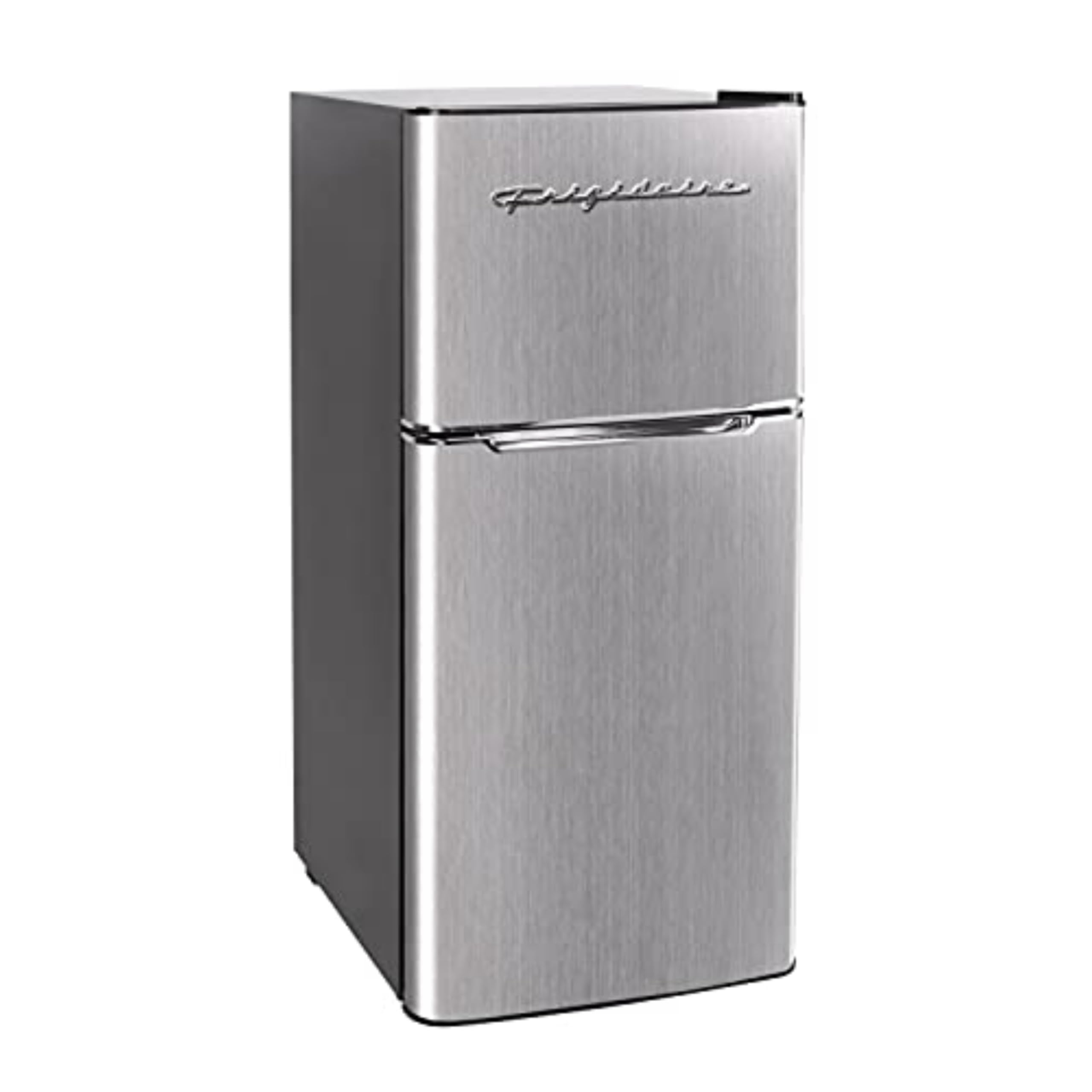
A full-size-feeling fridge that keeps frozen dinners ready in any basement corner.
When you need a real fridge in the basement rather than a beverage cooler, this Frigidaire steps up the capacity. The unit splits into 4.3 cubic feet of fresh food and a separate 0.8-cubic-foot freezer, topped off with its own ice cube tray. The dual-door layout keeps frozen air sealed away from the fresh compartment, so opening the fridge does not blast your milk with freezer cold every time. Adjustable and removable shelves let you reconfigure for tall bottles or a stack of frozen dinners, and the thermostat control is placed where you can reach it without emptying the interior. Stainless steel with a glossy finish gives it a look you would not mind in a finished basement kitchenette.
What owners consistently praise is the design — the appearance lands as the most-discussed positive in the review base, and buyers report a roomy interior that surprises them for the footprint. One owner describes going from a prior fridge set on 6 or 7 to running this one at setting 3, with no ice buildup. Another uses it as an office fridge with three adjustable glass shelves and a freezer door that fits frozen dinners. Owners on both sides note the stainless is easy to clean. The 4.5-cubic-foot capacity — 4.3 of it fresh — puts it in a different category from the compact units above; you can genuinely treat this as a snack-and-meal basement fridge.
Two trade-offs to plan for. First, the review base flags durability and frozen performance as the mixed area — a few owners mention the unit arriving with shipping damage such as a cracked vegetable bin handle or bent rear piping, and a small minority describe the plastic components as cheap feeling. Second, temperature control draws a mixed signal: some owners say the thermostat holds beautifully and others describe cooling that is uneven. Set against 735 ratings and a 4.2-star average, the reviewing crowd is largely happy, and the strongest consensus is that the fridge looks great and holds more than you would expect for its footprint.
The strong points
- 4.3 cubic feet of fresh space plus a 0.8-cubic-foot freezer with ice tray
- Dual-door layout keeps freezer cold out of the fresh food zone
- Adjustable and removable shelves handle tall bottles and frozen dinners
- Stainless steel glossy finish that suits a finished basement
What to accept
- A few units arrive with shipping damage to the plastic bin or rear piping
- Temperature control gets a mixed read — some customers note uneven cooling
- Manual defrost, so expect periodic ice removal in a damp basement
Best for: anyone who needs a real fridge-and-freezer combo in the basement without the footprint of a kitchen unit.
Reconsider if: you want frost-free convenience — this unit is manual defrost, and the mixed durability signal means careful unboxing pays off.
9. Manastin 4.5 Cu.Ft Mini Fridge Freezer for Dorm/Office, 2-Door, Quiet
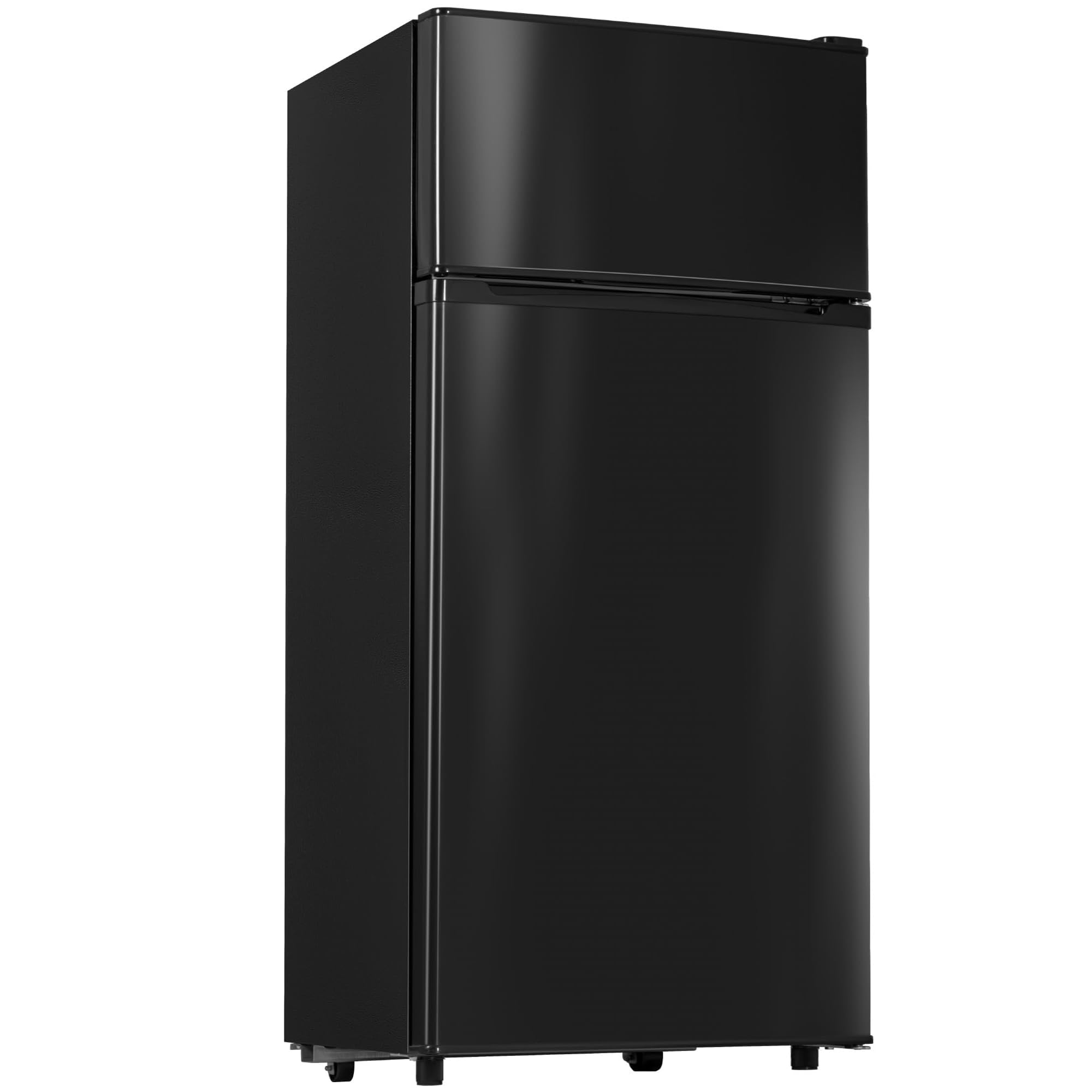
A quiet 4.5-cubic-foot dual-door that keeps the freezer a full door away from the fridge.
Full-size capacity with a dedicated freezer door — that is what this Manastin delivers. The 4.5-cubic-foot body splits into 3.5 cubic feet of fresh food and a full 1-cubic-foot freezer, kept fully separate from the fridge zone so odours do not travel between compartments. That separation matters in a basement fridge storing both frozen meat and fresh produce: you do not want last week’s fish giving tomorrow’s milk a smell. A 7-level thermostat dial gives you the widest temperature control range among the dual-door units in this roundup. Below 38dB compressor operation means you can set it near a desk, a study nook, or a bedroom door without a distracting hum in the background.
The storage layout is where the value sits. Three adjustable glass shelves can be repositioned for tall bottles or containers, and a clear crisper drawer holds produce. Structured door bins keep condiments and cans from rolling loose. Adjustable leveling feet keep it steady on a sloped basement floor. Owners consistently praise the freezer — one reviewer notes it “freezes meat and ice cream solid” and arrived a day early and well-packed. Another says it has been reliable in a hot, humid North Carolina basement setting, used for seed storage at steady cool temperatures. The manual defrost is a small cost in exchange for the straightforward design, and a manual scraper is included in the box.
The honest risks. Temperature control is mixed at the review level — one owner reports a dial that swings between 33°F and 40°F, which makes holding a precise dairy temperature hard; aside from that it runs cold and quiet. A small number of units arrive damaged in shipping, with one 1-star review describing a door arriving with damage and a difficult return process. Against 719 ratings and a 4.2-star average, the review pattern leans strongly positive, with quiet operation and freezer performance landing as the two features owners call out most. If you want capacity and a real freezer in a compact frame, this one is a solid call.
Where it delivers
- 4.5 cubic feet total, with 1 cubic foot reserved for the freezer
- Dual independent doors stop odours crossing between zones
- 7-level thermostat — widest temperature control in this dual-door lane
- Three glass shelves, a crisper drawer, and structured door bins
- Under 38dB keeps it quiet enough for study or sleep-adjacent rooms
Points to think through
- One owner reports a dial that swings 33°F to 40°F, which makes precise dairy temps hard
- A small number arrive damaged in transit
- Manual defrost — the included scraper gives you the hint
Worth considering for: a basement or home-office setup that needs full-size capacity plus a genuinely separate freezer door.
Pick something else if: you need micron-precise temperature hold for dairy or medications — dial swings have been reported on some units.
10. Electactic 4.5 Cu.Ft Mini Fridge with Freezer, 2 Door Compact Refrigerator, Satin Black
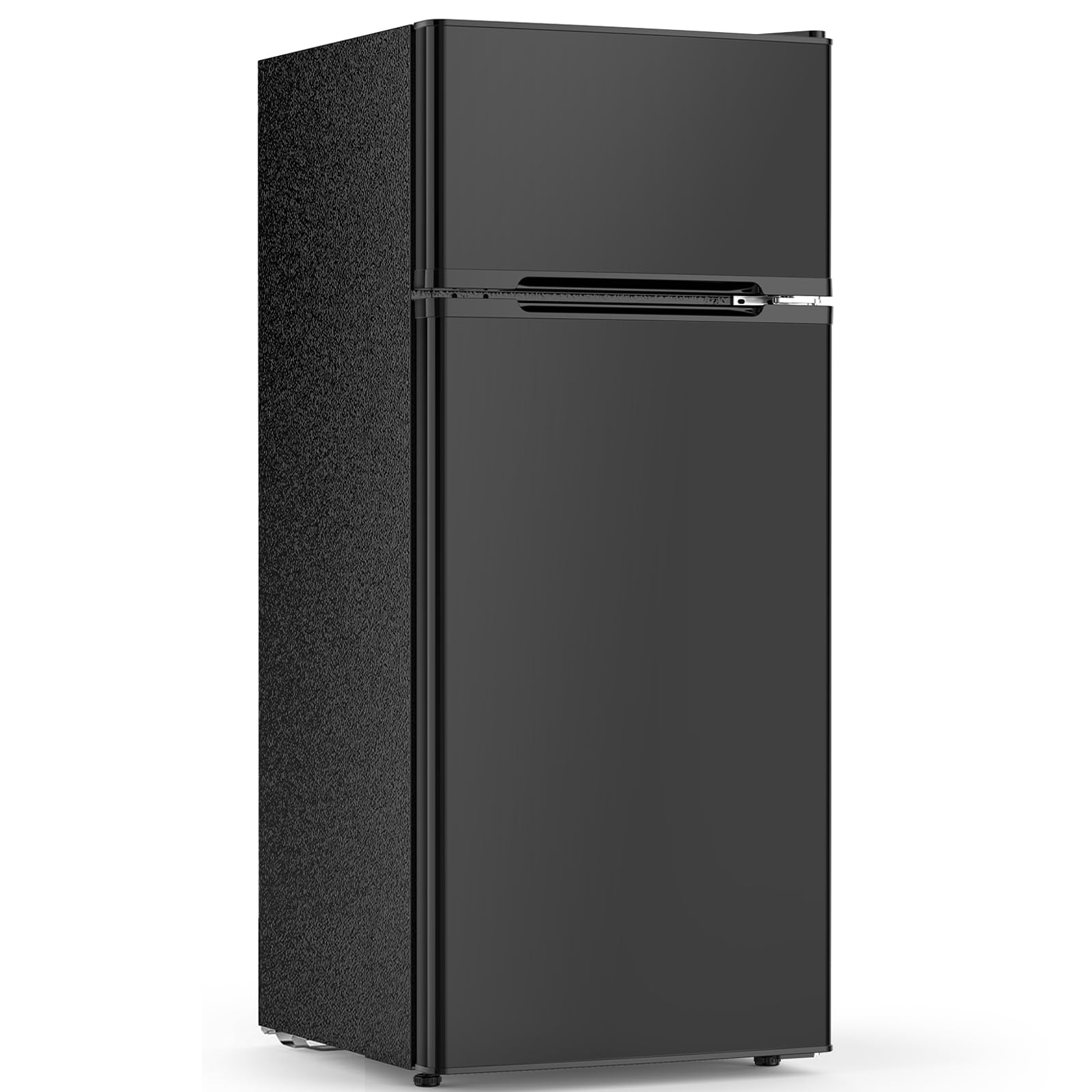
A satin-black dual-door that quietly acts like a full-size fridge in a compact frame.
Owners describe the Electactic as behaving like a full-size fridge, and the layout backs that up. A 3.64-cubic-foot fridge compartment holds fresh groceries while a 0.85-cubic-foot freezer sits top of the cabinet, kept separate by the dual-door design. That separation stops odours crossing, and the layout organizes food instead of forcing you to shuffle it. Temperature control runs on a 3-setting dial, from 32°F to 50°F in the fridge compartment and below -1°F in the freezer — the freezer half is a genuine deep-freeze zone rather than a barely-cold ice box. Energy consumption lands at 356 kilowatt hours per year, working out to roughly 1 kilowatt hour per day according to the brand, which is one of the higher daily draws in this roundup but still modest for a fridge you leave plugged in year-round. An LED interior light shows you what is inside, and the reversible hinge lets the door open from whichever side suits your basement corner.
What makes this a strong basement-bedroom pick is the packaging and build. Owners describe it arriving without scratches or dents, and the brand routes the fridge with protective wrapping. One owner reports tightening two rear screws to kill a startup rattle, after which it runs virtually silent. Another uses it in a mother-in-law’s bedroom for snacks and describes it keeping everything cold or frozen without making noise. A wheelchair user notes it saves trips to the kitchen for cold items. The 3.64-cubic-foot fridge zone holds three half-gallon milk containers on the top shelf alone, which is generous for the compact class.
Two honest limits. First, the freezer is shallow front-to-back — owners note the included ice tray does not fit the freezer in its lengthwise orientation. Second, noise splits at the review level: some find it quiet, a couple note it gets louder over time, and a handful report ice forming on the back wall of the center shelf. Run it in a basement storage room and it goes unnoticed; run it beside a bed and the track record is mixed. On balance the panel lands strongly positive on quality, size, temperature, and value, with the noise and freezing-performance lines carrying the honest caveats.
What lands: a 3.64-cubic-foot fridge plus a 0.85-cubic-foot freezer, working like a full-size unit — owners fit three half-gallon milks on one shelf and report the freezer freezing solid.
The nit to know: the freezer floor is shallow front-to-back, so the included ice tray sits sideways, and a handful of units develop ice on the center-shelf back wall.
Pick it for: a basement bedroom or pantry where you want milk, produce, and frozen items in a compact body with a satin-black finish.
Better not to: run this as the fridge beside your headboard if you are a light sleeper — noise feedback at the review level is genuinely mixed.
11. Feelfunn 4.5 Cu.Ft Beverage Refrigerator, 145 Can Mini Fridge, Silver

A 145-can glass-door bar fridge that outperforms the cans-per-cubic-foot average.
If your basement has a full wet bar, this is the beverage center that matches it in scale. The Feelfunn gives you 4.5 cubic feet of capacity holding up to 145 cans or 33 wine bottles — a clear step up from both the 117-can Danby above and the 128-can Tehanld. It reaches that capacity with four adjustable shelves that slot into the tall body, so you can configure it for standard cans, tall cans, and wine bottles in the same cabinet. The 360-degree full-angle circulating duct system moves cold air through the compartments evenly, and the double-layer glass door with sealing strip blocks both cold leakage and warm-air intrusion. Energy consumption comes in at 240 kilowatt hours per year, a reasonable number for the volume.
Control is where the value sits. The touch panel spans 32°F to 61°F — the widest range in this roundup — so the same unit can run cold enough for beer and warm enough for red wine. A blue LED light inside adds a display glow, and the reversible glass door lets you orient the fridge whichever way the space works best. Under 42dB operation keeps the compressor’s hum inside the 15-to-45-decibel band the brand cites as the sleep-noise range, though it runs a touch louder than the sub-36dB Tehanld. Frost-free defrost means no ice-scraping maintenance. Owners note the glass door makes it easy to see exactly what is loaded before you open it.
Where the honest caveats sit. Temperature retention reads mixed at the review level, with a minority reporting the unit stops short of the coldest setting — one owner says it will not get cooler than 45 degrees. Noise is also mixed: some call it relatively quiet, others describe it as noisy for a beverage fridge. On the shelf, a couple of reviewers point out the wire grates bow under the weight of fully loaded rows, and one owner notes standing next to the fridge makes the digital display hard to read. Against 740 ratings and a 4.4-star average, the strongest consensus is around quality and value. If your basement aim is a beautiful, high-capacity glass-door bar fridge with flexible temperature control, this one deserves top of the shortlist.
What makes it stand apart
- 4.5 cubic feet holding up to 145 cans or 33 wine bottles
- Widest temperature span in this roundup: 32°F to 61°F
- 360-degree full-angle circulating air keeps cooling even
- Frost-free defrost and reversible glass door
- 240 kWh per year — efficient for the capacity
Weigh these before buying
- Some shoppers say it stops short of the coldest settings
- Noise level reads mixed — not as silent as the sub-36dB Tehanld
- A few owners note the shelf grates bow under fully loaded weight
Own it if: your basement houses a wet bar or entertaining setup and you want maximum beverage capacity behind a glass door with the widest temperature range here.
Look past it if: you need to store food — the beverage-center layout is built for cans and wine bottles, not groceries.
Understanding the Specs
Capacity & Freezer Split
Capacity tells you how much storage the fridge provides, measured in cubic feet. A unit rated 1.7 cubic feet fits under a desk; a 4.5-cubic-foot unit stands close to a full-size bar fridge and can replace multiple trips up the stairs. Where the capacity splits between fridge and freezer matters for basement use: an all-refrigerator design uses every shelf for drinks, milk, and produce, while a dual-door freezer-on-top design spends some of that capacity on frozen storage. The best fit depends on if you need a frozen-pizza zone or you want every cubic foot working as fridge space.
Defrost Type & Annual Energy
Annual energy consumption is measured in kilowatt hours — roughly the amount of electricity the fridge uses over a year of standard operation. The units on this list run from 181 to 356 kilowatt hours per year, so picking an efficient model can matter if the fridge runs year-round. Defrost type pairs with that decision. Manual defrost means the unit periodically builds ice on the interior walls and you clear it off by hand. Automatic defrost cycles that moisture away. Frost-free goes further and prevents buildup entirely. In a humid basement, frost-free or automatic saves real maintenance over the unit’s life.
FAQ
How cold does a basement mini fridge actually get?
What size mini fridge fits in a basement corner?
What is a frost-free mini fridge and do I need one in a basement?
Are basement mini fridges loud enough to hear upstairs?
Will a mini fridge with a glass door keep drinks colder than a solid door?
How long do I have to let a basement mini fridge sit before plugging it in?
Is a beverage center or a standard mini fridge better for a basement bar?
Do mini fridges need a dedicated electrical circuit in a basement?
Can I reverse the door on these basement mini fridges?
Final Thoughts: The Verdict
For most basement setups, the basement mini fridge that gets it right first time is the Danby DBC117A1BSSDB-6 — a glass-front 3.1-cubic-foot beverage center with 117-can capacity, fan-forced even cooling, and a sized footprint that fits most basement corners. If you need a real freezer and a full-size feel, the Electactic 4.5 Cu.Ft nails the dual-door layout with 3.64 cubic feet of fridge plus 0.85 cubic feet of freezer. For a small under-desk basement office spot, the Frestec 1.7 Cu.Ft runs at 37 decibels with the lowest annual energy draw in the list. If your aim is a large glass-front bar, grab the Feelfunn 4.5 Cu.Ft Beverage Refrigerator — 145 cans, 32°F to 61°F control, and a blue LED glow. Whichever lane fits, the fridges here put cold drinks and cold snacks exactly where you actually need them — downstairs.
How We Picked
We do not accept paid placement. Every pick is matched to a real buyer and a real use-case; we do not hands-on test units.
Sources & Methodology
Specifications: manufacturer listings and product documentation. Review insights: verified customer reviews, as of September 2026. Pricing: not shown on this page (it changes often); check the current price via the retailer link.
As an Amazon Associate, KitchPrep earns from qualifying purchases. This does not affect which products we feature.
Related Guides
