
Specs are compiled from manufacturer listings and verified buyer reviews and can change over time — please confirm the key details on the product page before buying.
Raw concrete in a basement does two things: it sheds gray dust on everything you store, and it soaks up any dampness like a sponge. A good coating seals that surface so you get a floor that wipes clean, resists stains, and actually brightens the room. This guide separates proven performers from box-appeal duds., focusing on coverage, curing time, and how much prep you can genuinely handle.
I’m Mohammad Maruf — the founder and writer behind KitchPrep. This guide is built by comparing the manufacturers’ published specifications and the patterns across verified customer reviews, so you get each pick’s real strengths and trade-offs instead of marketing spin.
Before you pick a coating, know this: some options below are sized for garages, but any coating that works on a concrete garage slab does the same job on a basement floor. The nearest same-type size serves the same purpose. So read on to find the best basement floor coating for your DIY skill level, drying-time patience, and square footage.
Our Picks at a Glance

How To Choose The Best Basement Floor Coating
Buying the wrong basement floor coating usually ends with a floor that looks worse than the bare concrete you started with. Before you pick a color, you need to answer three questions: what is the floor made of, how wet does it get, and how much time can you spend on prep and drying.
Know your moisture situation first
Basements sit below grade, which means groundwater pressure can push moisture up through the slab. A coating is a surface treatment — it is not a waterproofing membrane. If your floor shows efflorescence (white chalky powder) or feels damp after rain, no paint or epoxy will fix that. You must resolve the moisture source first, or any coating you apply will bubble and lift from underneath. Coatings labeled waterproof resist spills and pooling water on top, but they cannot stop rising damp from below.
Decide between acrylic paint and two-part epoxy
Acrylic floor paints are water-based, low-odor, and the easiest for a beginner to roll on with a brush and soap-and-water cleanup. They dry fast, often within hours, but they sit on the surface like a thick paint — scratches and hot tire pickup are a real risk. Two-part epoxies mix a resin with a hardener to form a plastic-like film that bonds hard to the concrete. They are tougher and more chemical-resistant, but they demand precise mixing, careful timing, and much longer cure times before you can walk or park on them.
Read the coverage claim with skepticism
Every manufacturer prints an optimistic coverage number based on a perfectly smooth, sealed surface. Real concrete is porous and absorbs the first coat like a sponge. The recurring theme across owner experiences is that coatings cover far less than advertised — a kit that claims 500 square feet might barely finish a 2-car garage. Buy at least one extra kit beyond your calculated need, and always test a small patch first to see how thirsty your slab really is.
Quick Comparison
| Model | Best For | Type | Coverage | Dry Time | Amazon |
|---|---|---|---|---|---|
| Magic Resin Clear Epoxy★ Best Overall | High-gloss, scratch-proof finish | 2-part epoxy | ~450–600 sq. ft. | — | Amazon |
| SENVEN Acrylic PaintBest Value | Budget-friendly, easy rolling | Acrylic paint | 120 sq. ft./gal | Dries in 5 min | Amazon |
| Rust-Oleum EpoxyShield ClearTop Performer | Clear topcoat over painted floors | 100% solids epoxy | 500 sq. ft. painted | Walk 24 hr / vehicle 72 hr | Amazon |
| Rust-Oleum RockSolid Metallic | Showroom metallic looks | Polycuramine | 125 sq. ft. | Walk 8–10 hr / vehicle 24 hr | Amazon |
| ANE Self-Leveling Epoxy | smooth, mirror-smooth pours | Self-leveling epoxy | — | — | Amazon |
| Everflow MPC-100 Epoxy | Large industrial-style areas | 100% solids epoxy | 240 sq. ft. (3-gal) | Full cure 48 hr | Amazon |
| ShangTianFeng 5-Gallon Paint | Big-area value projects | Acrylic paint | 800–1000 sq. ft. | Dried within 24 hr | Amazon |
| Epoxy-Coat PerformanceDIY | Single-coat 9.7-mil protection | 100% solids epoxy | 500 sq. ft. | Full cure 12 hr | Amazon |
| ArmorPoxy Designer Gray Kit | Complete 17-piece DIY kit | 100% solids epoxy | 300 sq. ft. | Cure 24 hr / vehicle 72 hr | Amazon |
In-Depth Reviews
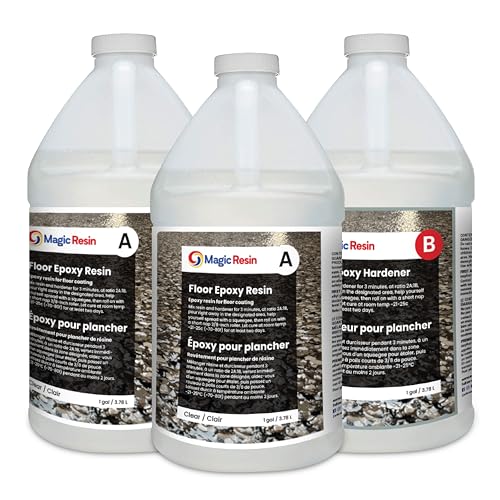
1. Magic Resin Clear Floor Epoxy Kit
Our pick — over 4★ from 300+ verified ratings; the strongest balance of quality and price.
The clear, glossy armor that turns a tired basement slab into a bright, wipe-clean showpiece.
This 3-gallon kit (11.4 L) is the pick for anyone who wants that deep, wet-look gloss that makes a basement feel finished rather than merely painted. The manufacturer rates it for roughly 450–600 sq. ft. depending on whether you flood-coat or roll it on, and owners confirm a 1.5-gallon pour covered an entire garage floor with a durable, scratch-resistant, high-gloss finish.
Because it is a true two-part epoxy resin, it bonds to concrete, metal, and wood, and resists scratches, spills, and stains once cured. The non-porous surface means dirt has nowhere to hide, so maintenance is just soap and water. It is also self-leveling, which helps it settle into a smooth, even film if you pour and spread it correctly.
The catch: this epoxy punishes rushed prep and sloppy mixing., and the crowd favorite warning is consistent — prep work and careful mixing are essential, and you should spread it with a squeegee rather than a roller to avoid bubbles. Buyers report that a batch mixed too long can harden right in the bucket, and coverage can fall short of the claim if you lay it thick. The praise outweighs the risk for many, but this is not a grab-and-go weekend paint.
Why it wins the top spot
- High-gloss, non-porous finish that resists stains, scratches, and chemicals.
- Self-leveling formula spreads into a smooth, smooth film.
- Coverage estimate of 450–600 sq. ft. fits most average basements.
Where you must be careful
- Bubbles appear if you roll instead of squeegee it on.
- Mixed epoxy can harden in the bucket if you work too slowly.
- Coverage drops sharply if you pour it thicker than the recommendation.
Reach for this if: you want a durable, glossy, professional-grade finish and will follow the prep and mixing steps precisely.
Think twice if: you want a forgiving, low-stakes paint — this epoxy punishes rushed work with bubbles and missed coverage.
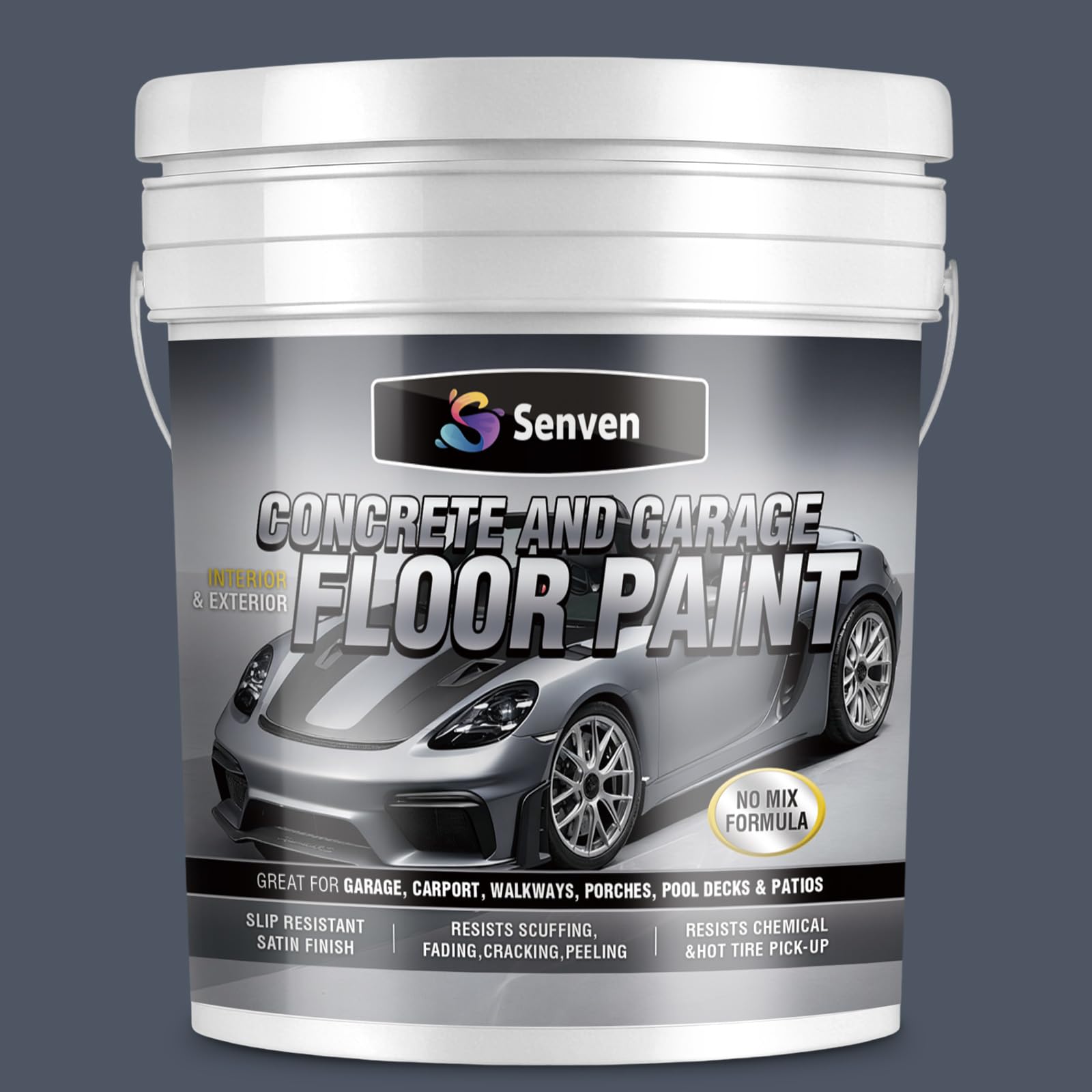
2. SENVEN Acrylic Concrete & Garage Floor Paint
The beginner-friendly, low-odor acrylic that rolls on easy and dries fast, all on a budget.
If the idea of mixing two-part epoxy makes you nervous, this water-based acrylic paint is the gentlest on-ramp to a finished basement floor. It is a single-part formula, so you stir it, roll it on with a standard roller or brush, and clean up your tools with plain soap and water — no solvents, no hazard gear. The semi-gloss slate gray finish gives concrete a clean, uniform look that reads as intentional rather than leftover.
The math here is noteworthy: this 1-gallon can holds 640 fluid ounces — a full 7.1 times the volume of the Rust-Oleum EpoxyShield kit’s 90 fluid ounces — and covers up to 120 square feet per gallon. That makes it a genuinely economical choice for touching up a small basement room or laundry area without buying a massive kit you will not finish.
Owners consistently praise the quality, coverage, and the fact that it dries within 5 minutes to the touch, with a full overnight cure for normal foot traffic. There is a consistent minority warning, though: because it is a paint rather than a plastic film, standing water can soften it, and at least one owner watched paint come off on a towel after a spill just a week in. That makes it a fit for dry, low-traffic basements rather than flood-prone ones.
The smart-money take: at this price per gallon, you can afford two coats and still come in far under the cost of an epoxy kit, making it the best entry-level value in this list.
The durability warning: treat it as a tough paint, not a waterproof membrane — standing water is its weak spot.
3. Rust-Oleum EpoxyShield High Gloss Clear Kit
The clear, high-gloss shield that gives painted basement floors a showroom-grade finish and real durability.
This Rust-Oleum kit is the go-to when you already have a painted or stained basement floor and want to lock in that look with a tough, transparent topcoat. It is a two-part, 100% solids epoxy — meaning no solvents evaporate away — which is what gives it excellent adhesion, chemical resistance, and protection against hot tire pickup. The low-odor, low-VOC formula makes it tolerable for indoor basement work where ventilation is limited.
Coverage depends on your starting surface: each kit handles up to 500 sq. ft. on painted floors, but only 250 sq. ft. on bare concrete, which soaks up more of the product. The 90 fluid ounces come in a two-part burst pouch that reduces waste, and the coating is walk-ready in 24 hours with full vehicle readiness at 72 hours. Owners pairing it with a colored stain additive on a basement living room floor report a beautiful, professional result when the concrete is properly cleaned and repaired first.
Budget for extra material if your floor is larger than a single-car space.
The honest read: this is a proven, quality clearcoat from a trusted name, but the coverage math demands you buy more than one kit for anything but a small room.
Who it suits: DIYers with a painted floor who want a glossy, durable seal without switching brands.
4. Rust-Oleum RockSolid Metallic Gunmetal

The one-coat metallic stunner that makes a basement floor look like a designer showroom.
This is the pick for anyone who wants their basement floor to be a talking point rather than an afterthought. The RockSolid formula is a polycuramine coating — a polycuramine chemistry Rust-Oleum rates 20X stronger than standard epoxy — in a shimmery gunmetal metallic finish with an extreme high-gloss look. It comes as a two-part kit in a patented burst pouch, ready to pour and spread in a single coat.
The practical win is speed: the coating is walk-on ready in 8–10 hours and vehicle-ready within 24 hours, which beats most epoxy cure times by days. Each kit covers up to 125 sq. ft. depending on how porous your concrete is. Owners who took prep seriously — scraping, sanding, degreasing, acid etching, and drying for two days — report gorgeous results on garage craft rooms and cottage kitchen concrete that has held up without chips or peeling for years.
Here is the trade-off you need to weigh: the aggregate feedback flags that this product scratches more easily than you would hope and covers less area than advertised, with some owners finding a single kit barely touched a quarter of a 2-car garage. The metallic color also divides opinions — some love the depth, others find it differs from the swatch. It is a looks-first coating that demands a second kit for most real-world floors.
The show-stopping strengths
- Extreme high-gloss metallic finish in a single coat.
- Fastest dry times here: walk-ready in 8–10 hours, vehicle-ready in 24.
- Resists cracking, peeling, chemical spills, and hot tire pickup.
The honest limitations
- Coverage is stingy at 125 sq. ft. per kit — buy two for most rooms.
- Some owners find the surface scratches more readily than expected.
- The metallic tint can look different from the advertised shade.
Pick it for: a small-to-mid basement room where the wow-factor metallic finish and fast cure justify the extra cost per square foot.
Look elsewhere if: you need to cover a large area on a tight budget — the coverage shortfall will bite you.
5. ANE Self-Leveling Epoxy Resin Kit
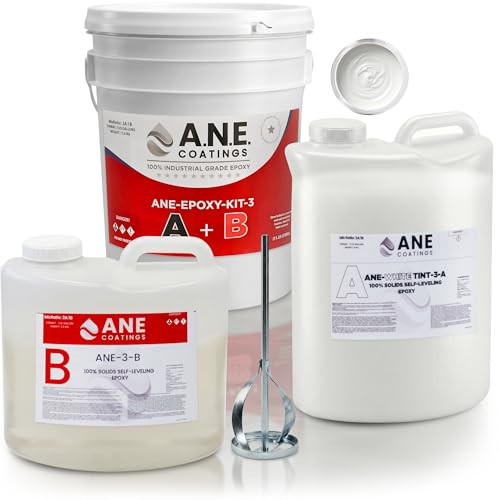
This water-thin epoxy pours out and spreads across the whole floor in seconds, giving you a mirror-smooth, smooth finish without brush marks.
If your basement floor has cracks, seams, or an uneven surface you want to hide, this self-leveling epoxy is the answer. Unlike paints that sit on top and show every imperfection, this kit is designed to flow out into a uniform, glass-like coating that leaves no ripples or seams even with multiple coats. The white tint gives a clean, bright base that makes a low-light basement feel more open.
The application experience is the standout feature here — owners describe a water-like consistency that spreads instantly and smooths over an entire floor in seconds without running. The formula includes an anti-slip additive, so you get that glossy mirror sheen without turning the floor into an ice rink, which matters in a basement where moisture is common. Once fully cured, it shrugs off moisture, oils, and harsh chemicals, and any spill wipes away with soap and water.
The catch mirrors the coverage complaints across this category: the manufacturer’s coverage claim runs optimistic, with one owner reporting a kit advertised for 300 sq. ft. only managing about half that on a porous flagstone floor. The working window also requires you to move fast once mixed, and some owners note drying takes longer than the label suggests. It is a superb finish if you buy enough material for your real floor size.
The defining trait: no other paint here self-levels the way this does — it is the pick for a flawlessly smooth, seam-free white floor.
Plan ahead: order extra kits; the real-world coverage on porous concrete runs about half the claim.
6. Everflow by MPC Epoxy Resin Floor Coating Kit
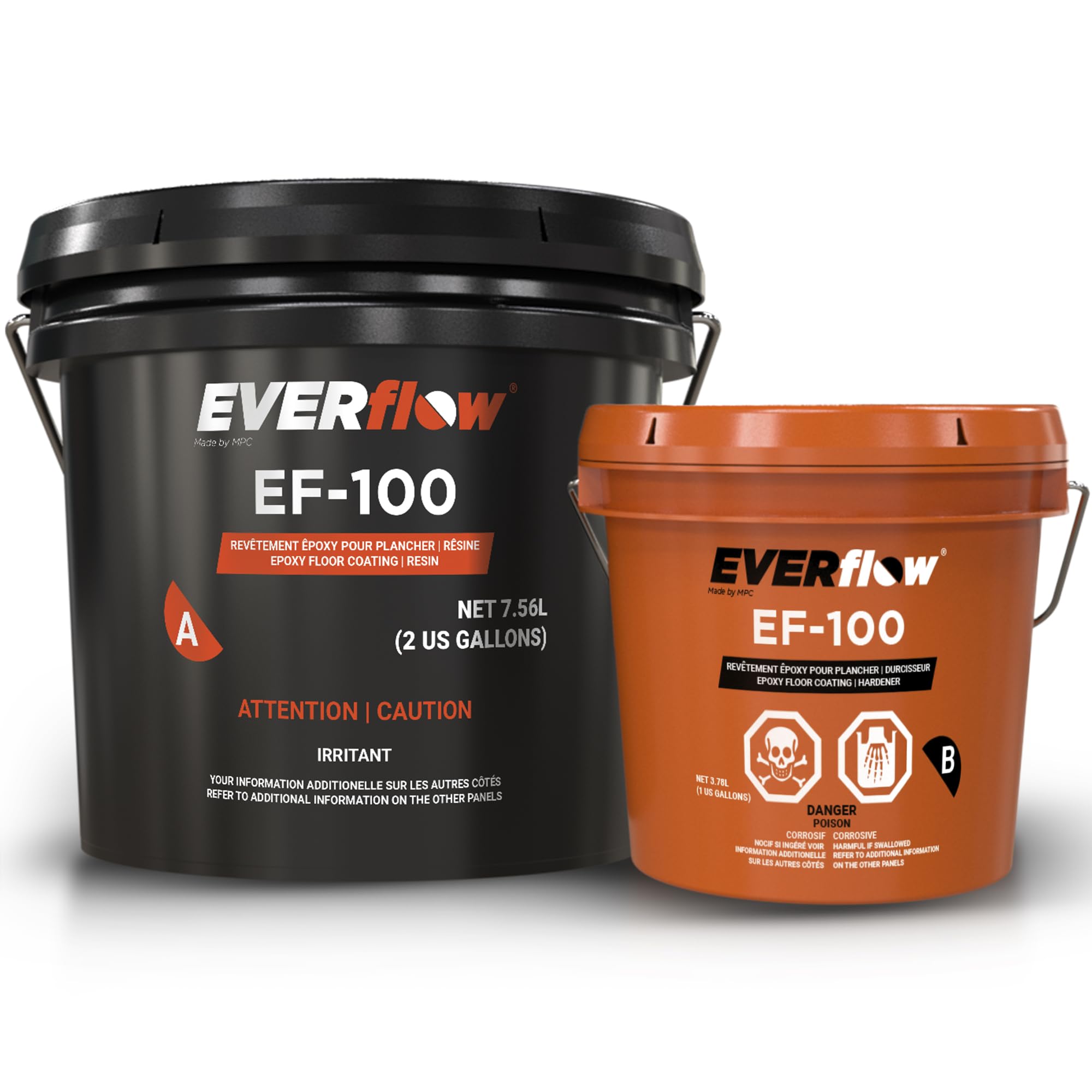
The 100%-solids workhorse that lays down a thick, glass-like layer capable of covering a whole cabin or pole barn.
Everflow’s MPC-100 is built for the bigger jobs — the kind where you are coating a full basement, a workshop, or even a pole barn floor rather than a single room. It is a 100% solid, two-component self-leveling epoxy with no solvent, which means what you pour is what stays on the floor, giving you a thick protective film that owners compare to a layer of glass. The light grey color keeps the space bright while hiding dirt far better than a clear or white coat.
This kit earns its premium position with real-world proof: one owner coated a 900 sq. ft. pole barn with two coats and reported it still looked new 19 months later, while another confirmed a 3-gallon kit covers exactly 240 sq. ft. in a single coat on a cabin floor. The cycloaliphatic formulation is specifically designed to reduce water spotting and amine blushing — the cloudy film that ruins many epoxy jobs in damp basements — and it delivers excellent adhesion, abrasion, impact, and chemical resistance.
The price-per-gallon math is the main consideration, and the reviews carry one caution: epoxy this reactive demands speed, since mixed material can heat up and solidify within 5 minutes if you dawdle. The full cure takes 48 hours before you should put heavy loads on it. For a large, high-traffic basement that needs serious protection, the coverage efficiency makes it a sound investment.
Built for the big pour
- 100% solids formula lays down maximum film thickness per gallon.
- Proven on large floors — 900 sq. ft. pole barns and full cabins.
- Reduces water spotting and amine blushing common in damp basements.
What to watch
- Premium price per gallon compared to acrylic paints.
- Fast-working epoxy can harden in the bucket if mixed too long.
- Wait the full 48 hours before rolling heavy loads across it.
Choose it for: large basement areas or workshops where a thick, glass-like, long-wearing coating is worth the premium.
Skip it for: small rooms or one-time touch-ups where a single acrylic gallon is the smarter economy.
7. ShangTianFeng 5-Gallon Professional Floor Paint
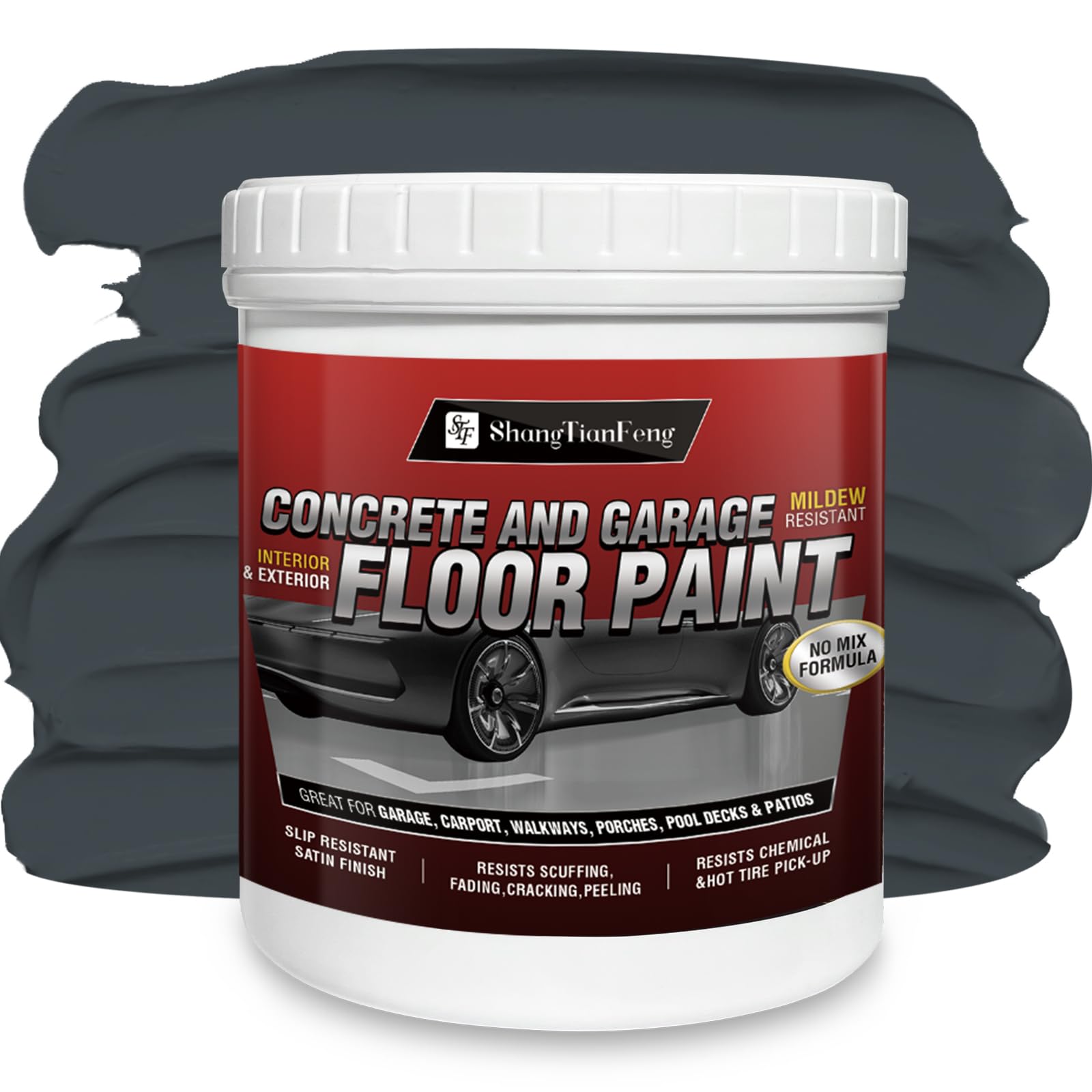
A full 5 gallons of ready-to-roll acrylic that covers an entire basement for less than most single epoxy kits.
When your basement floor is big and your patience for mixing chemicals is small, this 5-gallon bucket of professional floor paint is the practical answer. It is a single-component, water-based acrylic — you stir it for two minutes and roll it straight out of the can with no hardener to measure and no pot-life clock ticking against you. The slate gray satin finish resists water, scuffing, fading, cracking, and peeling, plus it defends against chemicals, mildew, and hot tire marks.
The scale is the selling point: at 640 fluid ounces, this one bucket covers a stated 800–1000 sq. ft., which handles a full basement overhaul in a single purchase. Owners confirm it applies easily with a standard roller and dries within 24 hours to a clean, attractive finish. It is also among the most health-conscious options here, with a VOC content of just 2 g/L during application and emissions dropping to zero after the 5-day full cure.
The budget trade-off shows up in edge toughness: one owner reported the paint peeled in spots where painters tape was removed, which tells you the film is not as bulletproof as a two-part epoxy. The manufacturer also notes you must clean the floor, fill cracks, and possibly prime dusty concrete first. For a dry, low-abuse basement, the cost per square foot is tough to top.
The value verdict: nothing else here stretches a dollar across 1,000 square feet while keeping fumes this low.
The honest limit: it is a sturdy paint, not a plastic armor — avoid dragging heavy metal across it or letting water pool for days.
8. Epoxy-Coat PerformanceDIY Clear Epoxy Kit

The complete all-in-one kit that lays down a single coat nearly 10 mils thick for serious, long-haul protection.
This kit from Epoxy-Coat (formerly Epoxy-Coat, manufactured in Mt. Clemens, Michigan since 1982) is for the basement owner who wants to do the job once and forget about it. It includes 2 gallons of Part A color resin and 1 gallon of Part B hardener, plus a non-slip aluminum oxide additive and acid cleaning granules — everything needed for a professional-grade installation. Applied in a single coat, it delivers a stated 9.7 mils of thickness, which is dramatically more protection than a rolled-on paint.
What sets this apart is the low-odor, zero-VOC formula that makes indoor application manageable, and a 2-year warranty backs the kit with a residential lifespan estimated at up to 20 years. Owners who installed it on 2-car garage floors report no peeling or staining even after 2.5 years, with oil and chemical spills wiping straight off. One contractor praised its self-leveling properties and shine even without a separate topcoat.
This is a two-person job — the epoxy reaction is fast, so speed is critical once the parts are mixed, and the included squeegee is small enough that owners recommend upgrading to a 24-inch model. The premium price reflects the professional-grade results, but the coverage is honest at 500 sq. ft. per kit rather than the inflated claims seen elsewhere on this list.
The pro-grade edge
- Single coat delivers a beefy 9.7-mil protective film.
- Zero VOCs and odor-free — comfortable for indoor basement work.
- Backed by a 2-year warranty and up-to-20-year residential estimate.
Before you commit
- Fast exothermic reaction means you need a second person working quickly.
- Premium price lands it in the top tier of this list.
- Upgrade the included squeegee to a wider one for even spreading.
Best for the serious DIYer: someone coating a large basement or garage who wants maximum film thickness and is ready to follow a precise, fast-paced mixing routine.
Not for the casual painter: if you want a relaxed weekend roll-on, the fast epoxy reaction will stress you out.
9. ArmorPoxy 100% Solids Garage Epoxy Kit
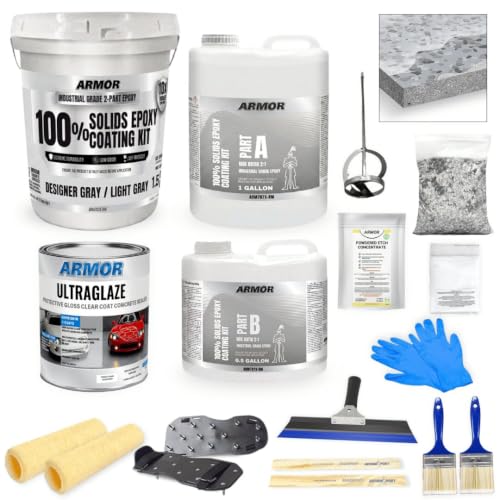
The bargain-bulk 17-piece kit that brings contractor-grade toughness and a custom flake finish to a home basement.
ArmorPoxy markets this as a military-grade, 100% solids epoxy that bonds permanently to concrete with zero shrinkage, and it swells the kit count to justify a true all-in-one DIY experience. The 17 pieces include etching solution, decorative flake mix, non-slip additive, a roller, and a squeegee — so you are not making separate trips for the little things. The designer gray base with optional flake broadcast gives you a custom, textured finish that hides dirt well in a high-traffic basement.
The maker’s 10x-stronger-than-steel claim is marketing hype, but the 100% solids chemistry is genuinely tough., but the chemistry is genuinely serious: 100% solids epoxy resists cracks, peeling, oil, solvents, and hot tire pickup. The cure schedule is practical for a homeowner — 24 hours to harden and 72 hours before you drive on it. Owners who followed the prep steps on new and 40-year-old concrete alike report flawless results, with one noting no cracking or flaking after a full year in a heated garage.
The honest friction points: measuring the two-part ratio without clear tub markings caused slight color differences between batches for one owner, and the included squeegee was flimsy enough to rip. A minority report that a single coat leaves blotchy areas on very porous floors, and humidity can keep the topcoat tacky for days. The instructional video is widely praised for guiding first-timers through the process.
The kit advantage: with 17 pieces and clear video guidance, this is the most complete out-of-the-box package for a first-time epoxy user.
The preparation reality: like every epoxy here, the outcome hinges on sweeping, degreasing, and acid-etching — skip that and even the best kit will let you down.
Understanding the Specs
Acrylic Paint vs. Two-Part Epoxy
The single biggest decision is which chemistry you want on your floor. Acrylic floor paints are water-based, low-odor, and clean up with soap and water, making them ideal for a first-time DIYer who wants an easy weekend project. They dry fast but form a thinner film that can scratch or soften under standing water. Two-part epoxies mix a resin with a hardener to create a thick, plastic-like bond that resists chemicals, scratches, and moisture far better — but they demand precise mixing, faster work, and a longer cure before you can use the room normally.
Coverage Claims and Real-World Math
Every manufacturer prints an optimistic coverage figure based on a perfectly smooth, sealed surface. Real basement concrete is porous and thirsty, so the first coat soaks in and you always use more material than the box suggests. The pattern across owner experiences is consistent: coatings cover less than advertised, sometimes by half. Measure your floor, multiply by 1.5 to account for the first-coat absorption, and buy at least one extra kit. A small test patch in a corner will tell you exactly how hungry your slab is before you commit to the full pour.
100% Solids, Cure Times, and VOCs
Epoxy labeled “100% solids” means no solvents evaporate during curing, so the full volume you apply stays on the floor as film thickness — that is why it outperforms thinner solvent-based formulas. Cure time matters for planning: some coatings are walk-ready in 8-10 hours, while others need 48-72 hours before you can place heavy items or vehicles. VOCs (volatile organic compounds) are the fumes you smell during application; low-VOC and zero-VOC formulas are markedly more comfortable for indoor basement work where windows are scarce.
Self-Leveling vs. Roll-On Application
Self-leveling epoxies are poured and spread with a squeegee, and their water-thin consistency flows out to hide cracks, trowel marks, and uneven patches on its own. The result is a smooth, mirror-smooth floor that looks professionally installed. Roll-on coatings are thicker and easier to control for a beginner, but they follow the contours of your concrete, so every imperfection shows through. If your basement floor is rough or cracked, a self-leveling product saves you from the tedious work of patching every defect by hand.
FAQ
Will a basement floor coating stop water from seeping up through my concrete?
Acrylic floor paint or two-part epoxy — which should I choose for my basement?
How much coating do I actually need for my basement floor?
How long do I need to wait before walking on or using my coated basement floor?
What is the difference between 100% solids epoxy and a solvent-based coating?
Is low-VOC or zero-VOC really important for a basement project?
Why do so many reviews say the coverage was less than advertised?
Can I apply a clear epoxy topcoat over a painted or stained basement floor?
What is the single most important step to make my basement floor coating last?
I have a rough, cracked basement floor. Should I use a self-leveling epoxy?
Final Thoughts: The Verdict
If you want one dependable pick, the answer to the search for the best basement floor coating is the Magic Resin Clear Epoxy Kit, because it delivers the glossy, scratch-resistant, wipe-clean finish most basement owners actually want, and the 3-gallon size covers a typical room in one purchase. If you want a budget-friendly, beginner-easy weekend project that needs no chemical mixing, the SENVEN Acrylic Paint — a full 7.1 times the volume of a small epoxy kit per dollar — is the smart entry point. And for a large basement or workshop floor that needs serious, thick protection, the Everflow MPC-100 is the one to reach for. Whichever you choose, remember the crowd wisdom: measure your floor generously, buy an extra kit, and never skip the prep.
How We Picked
We do not accept paid placement. Every pick is matched to a real buyer and a real use-case; we do not hands-on test units.
Sources & Methodology
Specifications: manufacturer listings and product documentation. Review insights: verified customer reviews, as of September 2026. Pricing: not shown on this page (it changes often); check the current price via the retailer link.
As an Amazon Associate, KitchPrep earns from qualifying purchases. This does not affect which products we feature.
Related Guides
