
Specs are compiled from manufacturer listings and verified buyer reviews and can change over time — please confirm the key details on the product page before buying.
Basement renovations live and die by one question most homeowners skip: can you actually get out in a fire? That’s the entire point of an egress window — a window big enough to climb through, installed in a well deep enough to stand in. This guide cuts through the contractor jargon to show you which of the top options genuinely meets code, which installation quirks will bite you, and which complete kits save you from piecing things together.
I’m Mohammad Maruf — the founder and writer behind KitchPrep. This guide is built by comparing the manufacturers’ published specifications and the patterns across verified customer reviews, so you get each pick’s real strengths and trade-offs instead of marketing spin.
Safety, sizing, and energy efficiency define the right basement egress windows for a finished below-grade living space that feels secure and passes inspection.
Our Picks at a Glance

How To Choose The Best Basement Egress Windows
The single biggest mistake buyers make is ordering a window based on the rough opening size without checking the net clear opening. Code inspectors don’t measure the frame — they measure the actual hole you crawl through. If that’s too small, no amount of craftsmanship saves you from a redo.
Understand the Code Minimums First
For a bedroom or habitable space, the International Residential Code typically demands a clear opening of at least 5.7 square feet, with a minimum width of 20 inches and a minimum height of 24 inches. The sill height must sit low enough for a person to climb out — usually within 44 inches of the finished floor. Check your local amendments, because some jurisdictions enforce tougher numbers.
Window Style: In-Swing vs. Single-Hung vs. Casement
In-swing casement windows open fully into the room, giving you the maximum possible escape opening because the entire sash swings clear. Single-hung units only lift the bottom sash, which can limit the net opening compared to the full frame size. If you have a shallow window well, an in-swing design is often the safest way to hit code without buying a deeper well.
Don’t Forget the Well and the Ladder
A window on its own only solves half the problem. The well outside must be wide and deep enough to fully open the window and provide standing room, and it needs a permanently affixed ladder if it’s deeper than a certain point. Full kits bundle the window, the steel well, and the ladder together so every component is designed to work as one system.
Quick Comparison
| Model | Best For | Opening Style | Glass / Insulation | Egress Depth | Amazon |
|---|---|---|---|---|---|
| Redi-Exit Single Hung (35.5″ x 36″)★ Best Overall | Contractor-approved single window installs | Single-Hung In-Swing | Low-E, Argon-filled | — | Amazon |
| Window Well Supply In-Swing Casement (31″ x 40″) | Maximum energy efficiency | In-Swing Casement | Low-E, Argon, U-Factor 0.27 | — | Amazon |
| Redi-Exit Premium Casement (31″ x 41″) | Tighter exit areas needing a taller sash | Single-Hung In-Swing | Low-E, Argon-filled | — | Amazon |
| Tuffwell Egress Well Kit (42″L x 36″W x 48″D) | Whole-system new construction | In-Swing Casement | 8-inch thick window | 48 inches | Amazon |
In‑Depth Reviews
1. Redi-Exit Single Hung Egress Window (35.5″ W x 36″ H)
The contractor favorite whose dual-function sash converts from ventilation to a fire escape in one motion
This window leads the list because of its dual nature. It operates as a normal single-hung unit for daily airflow, then a corner latch releases the lower sash to hinge fully inward — turning the whole opening into an emergency exit. Buyers report exactly that scene: “this is the greatest little window for window Wells I can open it as a double hung window to let air in or open it in such a way to crawl out if there’s an emergency.”
The glass package explains the premium positioning. It’s double-paned with a Low-E coating (a microscopically thin metallic layer that reflects heat) and an Argon gas fill between the panes to slow heat transfer. The frame itself is 3.25 inches deep, and the unit comes in left- or right-hinged versions so you can match your room layout and exit path.
Confidence comes from the backing: glass seal covered by a 10-year limited warranty and a lifetime warranty on the vinyl. Local building inspectors have been genuinely impressed, per the reviews — always a reassuring sign when your town’s code official is the one nodding approval on site.
Why owners smile
- Dual-mode sash works for fresh air and rapid escape
- Low-E and Argon fill keep energy costs down year-round
- Inspectors and contractors both praise the build quality
- Lifetime vinyl warranty plus 10-year glass seal coverage
Who should look elsewhere
- Frame depth of 3.25 inches suits standard walls, not thick masonry
- Single-hung style may not boost the net opening for very tight wells
The pick if: you want a single, ready-to-install window that handles both daily ventilation and code-compliant escape without a full well kit.
Reach for it unless: your foundation wall is unusually thick or your window well is too shallow for the in-swing sash to clear.
2. Window Well Supply In-Swing Casement (31″ W x 40″ H)

A casement that swings wide for a full escape opening while posting some of the tightest energy numbers here
Energy efficiency is this unit’s defining trait — the reviews even call it a “great price and product.” It pairs 3/4-inch insulated Low-E glass with an Argon gas fill and achieves a low U-Factor of 0.27, meaning very little heat escapes through the glass in winter or intrudes in summer. For a basement that stays chilly, that translates into a more comfortable, cheaper-to-heat room.
Made in the USA with a zero-maintenance vinyl frame, it needs no painting and won’t rust. The casement swings inward from either the left or right side, which gives you installation flexibility most fixed-hinge windows can’t match. The welded sash and powder-coated handles point to a unit built for years of smooth operation.
There is one honest caution the review pages surface: the frame is substantial, but it has no provision for mechanical attachment to the rough opening — it relies on foam sealant to hold it in place. That’s a fair warning if you expect screws into the framing, so plan your anchoring approach before you start.
What stands out
- U-Factor of 0.27 makes it a top-tier insulator
- Reversible left or right swing adapts to any layout
- Zero-maintenance vinyl requires no painting
- In-swing casement opens the full sash for maximum egress
The honest caveat
- No mechanical fastening points — foam sealant alone is expected
- Thick 8-inch wall profile needs a matching rough opening
Choose this when: reducing heat loss in a below-grade room matters as much as the safety exit, and you can handle a sealant-based install.
Think twice if: your region floods often or you insist on mechanically screwing the frame into the wall structure.
3. Redi-Exit Premium Casement Egress Window (31″ W x 41″ H)

The taller sibling for rooms where every extra inch of climb height makes the difference in an escape
At 41 inches tall, this version stands 5 inches higher than the 36-inch model above — a meaningful edge when you’re hauling yourself up from a low basement sill. The 14% height advantage matters most for taller adults who need that extra clearance to get their shoulders through, making this the smarter choice for tighter exit areas where width is limited.
Everything else carries over from the Redi-Exit family: the same dual-function single-hung operation, Low-E coated double-paned glass with an Argon gas fill, and the 10-year limited warranty on the glass seal backed by a lifetime warranty on the vinyl frame. Contractors who installed these praised the packing and shipping, noting the high-quality materials impressed everyone on site.
A note on orientation: this specific unit is right-hinged, so visualize which direction the sash will swing into the room before you commit. The reviews confirm the quality story holds, though buyers with a left-hand preference will want the mirrored version instead.
The tall-sash payoff
- 41-inch height beats the standard 36-inch model for clearance
- Dual-mode sash switches from vent to escape in seconds
- Low-E and Argon glass cut heat transfer
- Well-packed shipping protects the unit in transit
Before you order
- Right-hinged only — left-hand layouts need the mirror unit
- Single-hung design limits the net opening vs. full casement
Go for it if: your window well allows a taller opening and you want extra vertical clearance for climbing out comfortably.
skip it if: your hinge direction is left or your rough opening can’t accommodate the extra 5 inches of height.
4. Tuffwell Egress Window Well Kit (42″L x 36″W x 48″D)
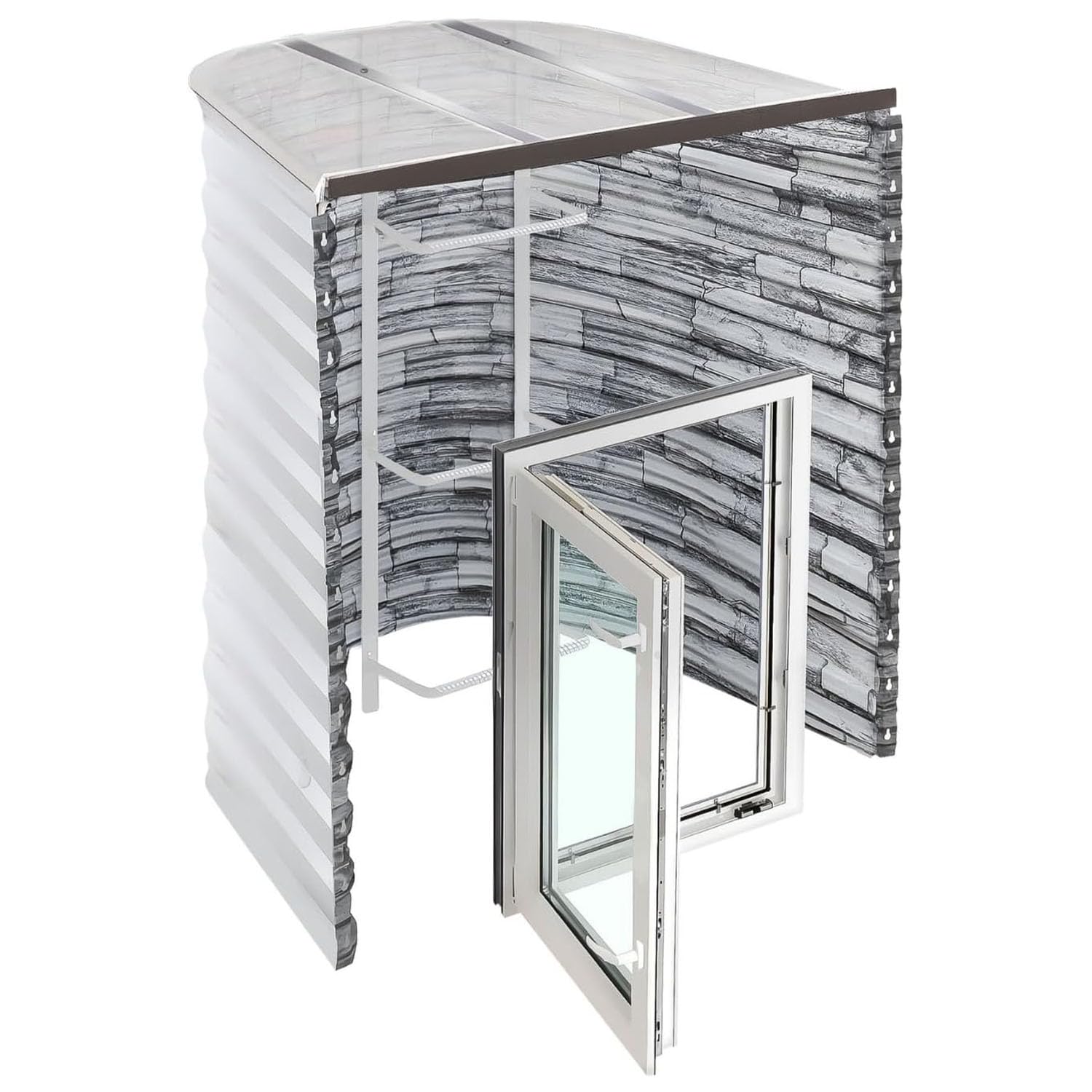
The do-it-all kit that bundles the steel well, ladder, cover, and window into one code-ready package
This is the whole-system answer for new construction or a major cut-in project. The kit pairs a 48-inch-deep steel well with an 8-inch-thick in-swing casement window, plus a ladder that hooks over the top of the well and a polycarbonate cover. Instead of matching components from different brands, you get one integrated assembly designed to work together from day one.
The construction is the headline. The Tuffwell well is made from 19-gauge steel with a corrugated design, built to hold up against heavy soil pressure and aggressive backfilling. The cover is.177-inch thick polycarbonate reinforced with aluminum bracing, and it supports up to 500 lbs — enough to walk on safely while staying UV-resistant so it won’t yellow over time.
Buyers who cut two openings at once called the kits “outstanding in quality” and noted the window is wide enough for a 10-inch wall opening and easy to open and crawl out of in an emergency. One review points to the cover’s fit around the sides as a potential water entry point — an occasional issue worth checking during installation.
Everything included
- 48-inch deep steel well meets depth requirements
- Cover handles up to 500 lbs with UV-resistant polycarbonate
- Ladder hooks on securely for quick exits
- Pre-punched flanges and snap-on parts speed installation
Install notes
- Cover-to-well fit around the sides can allow water in some cases
- Full kit is a premium investment best for major projects
Worth it for: homeowners cutting a fresh egress opening who want every piece — well, ladder, cover, and window — spec-matched and code-ready in one order.
Verify first: that your soil drainage plan and cover sealing meet local standards, since the cover fit is the one area owners flag.
Understanding the Specs
Net Clear Opening vs. Rough Opening
The rough opening is the hole cut in your foundation wall. The net clear opening is the actual space you crawl through once the window is fully open — and it’s what code enforcement measures. A single-hung window’s net opening is only as tall as the bottom sash lifts, while an in-swing casement can expose the full frame. Always compare net clear openings between models, never the frame dimensions.
Low-E Glass, Argon, and U-Factor
Low-E glass has an invisible metallic coating that reflects heat back into the room in winter and keeps solar heat out in summer. Argon is a dense, inert gas injected between the panes to slow heat transfer through the air gap. The U-Factor is the number describing how well the whole window insulates — lower is better, and a figure around 0.27 is genuinely efficient for a basement window.
Window Well Depth and Ladders
The well is the excavated pit outside the window that lets it open fully and gives you room to stand while climbing out. Building codes typically require a certain minimum depth — often around 36 inches — before a permanently affixed ladder becomes mandatory. A 48-inch deep well, like the Tuffwell kit uses, clearly exceeds that threshold and always needs a ladder for safe exit.
Vinyl vs. Steel vs. Polycarbonate
Vinyl frames resist moisture, never need painting, and won’t rust — ideal for below-grade conditions. The steel in a well, measured in gauge (19-gauge is thick and strong), resists the weight of the soil pressing against it from outside. Polycarbonate covers are impact-resistant and clear, letting light into the well while keeping debris and rain out.
FAQ
What is the minimum size for a legal basement egress window?
Is an in-swing casement better than a single-hung egress window?
What does a window well do and why does it need to be deep?
How does Argon gas improve a basement window?
What is a good U-Factor for an egress window?
Do I need a window well cover with my egress window?
How much weight can a polycarbonate window well cover hold?
Can I install an egress window myself or do I need a contractor?
Are Redi-Exit and Window Well Supply windows made in the USA?
Final Thoughts: The Verdict
Across the board, the basement egress windows winner is the Redi-Exit 35.5″ x 36″ Single Hung because its dual-function sash delivers daily ventilation and emergency escape in one dependable unit backed by a lifetime vinyl warranty. If cutting your energy bills is the priority, the Window Well Supply In-Swing Casement posts the tightest U-Factor of the group at 0.27. And for a brand-new opening or full renovation, the Tuffwell 42″L x 36″W x 48″D Kit bundles the steel well, ladder, cover, and an 8-inch-thick window into one code-ready package.
How We Picked
We do not accept paid placement. Every pick is matched to a real buyer and a real use-case; we do not hands-on test units.
Sources & Methodology
Specifications: manufacturer listings and product documentation. Review insights: verified customer reviews, as of September 2026. Pricing: not shown on this page (it changes often); check the current price via the retailer link.
As an Amazon Associate, KitchPrep earns from qualifying purchases. This does not affect which products we feature.
Related Guides
