
Specs are compiled from manufacturer listings and verified buyer reviews and can change over time — please confirm the key details on the product page before buying.
A damp, musty basement usually traces back to one thing: a crack in the foundation letting water in. This guide ranks the best Basement Crack Sealer options by water flow level and crack location on the wall.
I’m Mohammad Maruf — the founder and writer behind KitchPrep. This guide is built by comparing the manufacturers’ published specifications and the patterns across verified customer reviews, so you get each pick’s real strengths and trade-offs instead of marketing spin.
You will learn which formulas work on dry hairline cracks versus actively leaking fissures, so you can pick the basement crack sealer that matches your foundation repair job.
Our Picks at a Glance
How To Choose The Best Basement Crack Sealer
Assess your crack’s water flow—dry, damp, or gushing—before choosing a sealer. The flow level determines whether a simple coating or a serious injection system is required.
Match the Product to the Water Flow
For dry, hairline cracks, a brush-on elastomeric coating forms a flexible membrane that bridges the gap. For actively leaking cracks, a polyurethane injection kit fills the void from inside and expands to block water flow.
Understand Coverage and Thickness
Surface coatings specify coverage in square feet per gallon. Injection kits list how many linear feet of crack they can repair. Always check the crack depth too—epoxy fillers handle shallow divots, while rigid polyurethane is meant for deeper structural movement.
Quick Comparison
| Model | Best For | Type | Coverage | Cure Time | Amazon |
|---|---|---|---|---|---|
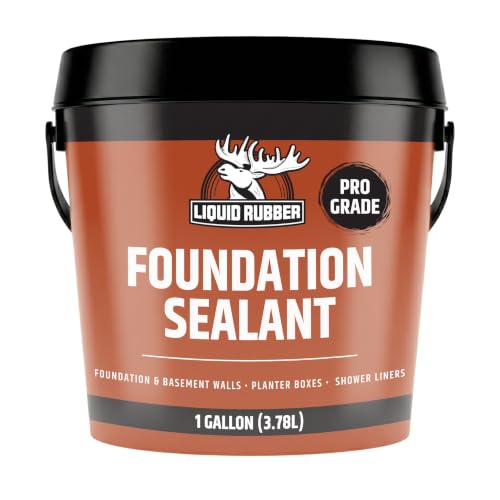
| Liquid Rubber Foundation Sealant★ Best Overall | Overall waterproofing | Elastomeric Coating | 50 sq ft/gal | — | Amazon |
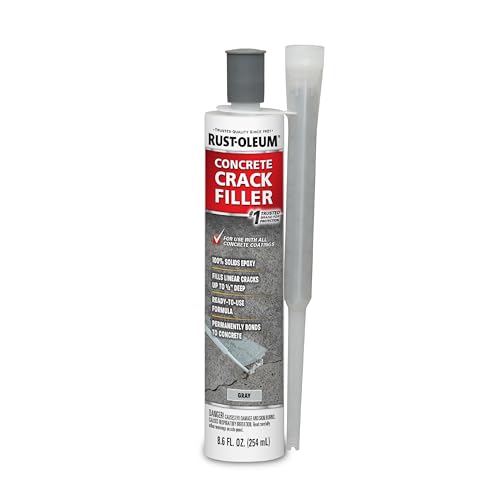
| Rust-Oleum Gray Epoxy FillerQuick Fix | Shallow garage cracks | Epoxy Paste | — | 3 hours | Amazon |
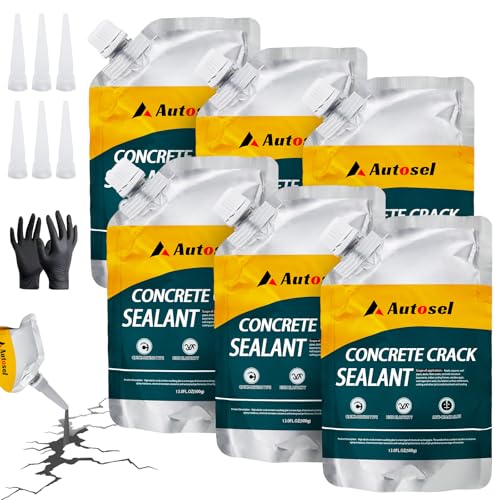
| Autosel Self-Leveling 6-PackDIY Multi-Pack | Driveway & floor gaps | Silane Gel | 6 x 1.1 lb | Hours | Amazon |
| Hupeyna Rubber Sealant | Vertical wall leaks | Liquid Rubber | 21.4 sq ft | 24-48 hrs | Amazon |
| Daich ElastoLock Coating | Foundation & block walls | Rubber Membrane | 128 fl oz | — | Amazon |
| Simpson Crack-Pac Flex-H2O | Mildly leaking cracks | Polyurethane Injection | 2 x 9 oz | Varies | Amazon |
| Hydra Stop 300 Kit (10ft) | DIY crack injection | Polyurethane Foam | 10 linear ft | Varies | Amazon |
| Acta-Leak 10′ Injection Kit | Actively leaking cracks | Polyurethane Foam | 10 linear ft | Varies | Amazon |
| Applied Tech 40ft Kit | Large-scale wall repair | Polyurethane System | 40 linear ft | Varies | Amazon |
In‑Depth Reviews
1. Liquid Rubber Foundation Sealant
Our pick — 4.5★ from 3,000+ verified ratings; the strongest balance of quality and price.
A brush-on waterproof membrane that flexes with the wall instead of cracking like old cement patches.
This is the pick for covering broad sections of wall and sealing multiple small cracks at once. The key spec is the 900% elongation — the ability to stretch without tearing, which means it moves with your foundation through temperature swings instead of splitting open again. One gallon covers 50 square feet on interior surfaces, so a single order handles a sizable repair area.
Buyers report using it on a 100-year-old house, patching cracks and laying down 4 brush coats to stop leaks for good. It brushes on like thick paint, dries to a glossy black, and is safe for indoor use since the water-based formula contains zero VOCs (the chemicals that cause paint fumes). The trade-off is that it stays tacky to the touch, so it is not meant for floors you walk on.
It does not self-level the way a liquid epoxy would, so you have to work it into the crack with a brush. Prep matters — owners stress cleaning the surface and filling deep voids before coating. A recurring note is that a single purchase often covers more wall than expected, making it a strong value for the money.
What wins people over
- Flexible 900% elongation prevents future cracking
- Zero VOCs make indoor application safe and odor-free
- Covers 50 sq ft per gallon on interior walls
Reality check
- Stays tacky when cured, so avoid walking surfaces
- Requires 2-3 coats for full protection
Best for: Homeowners sealing large wall areas and multiple hairline cracks with one flexible coating.
Skip if: You have a single deep crack pushing active water — that needs an injection kit instead.
2. Rust-Oleum Gray Concrete Crack Filler
A two-part epoxy that dries rock-hard in three hours, perfect for garage floors you need to walk on fast.
If your crack is a shallow divot in a concrete floor rather than a weeping wall fissure, this cartridge is a fast, tough option. It is a 100% solids epoxy formula (meaning no watery solvents that shrink as they dry), built to repair holes up to 1/2 inch deep. The non-sag paste stays where you put it instead of running down a vertical surface.
Owners mention repairing 1/2″ deep garage cracks with an easy mixing applicator that bonds fast. The standout feature for practical use is the quick turnaround — you get a tack-free cure in 3 hours at room temperature, with only 8 minutes of working time before it starts setting. It handles damp surfaces and even full water immersion, so a moist garage floor does not ruin the bond.
The catch is the short working window; you have to move quickly once the two parts mix. A few note the dried color can be slightly off from the surrounding concrete. This is a repair tool rather than a waterproofing membrane — it fills the gap but does not stretch like a rubber coating.
Why it stands out
- 3-hour cure means quick project turnaround
- Non-sag formula holds on vertical surfaces
- Works on damp concrete and in full immersion
Keep in mind
- 8-minute working time forces fast application
- Dried color may not match older concrete
Reach for this if: You need a durable, hard patch for shallow floor cracks or steps.
Look elsewhere if: The crack is actively leaking — epoxy paste cannot stop flowing water.
3. Autosel Self-Leveling Crack Filler 6-Pack
A self-leveling gel that flows into horizontal gaps and dries flexible, sold as a six-tube bundle for big jobs.
This one earns its place for driveway and sidewalk cracks that run flat and wide, where a self-leveling (flowing into the gap on its own) formula saves real effort. The high-elasticity mix adapts to ground movement and settlement, which helps stop the same crack from reopening. Each of the six tubes weighs 1.1 lbs, and the set includes brushes, glue nozzles, and a glove.
The thing everyone raves about is how easily it applies — squeeze it from a standard caulking nozzle, let it find its own level, and it forms a smooth finish. Customers note it drying within hours and surviving rain. The catch is that it runs on sloped surfaces, so you need to add sand on an incline, and the grey color can stand out against weathered old concrete.
On crack filling, feedback splits: some find it fills well, while others say it does not prevent new cracks from forming nearby. Kneading the packets thoroughly before use breaks up lumps, and sprinkling sand after about 20 minutes helps it blend. It is a maintenance filler for horizontal gaps, not a structural repair for moving foundation joints.
Where it shines
- Self-leveling action creates a smooth, flush finish
- Dries flexible to resist re-cracking
- Six tubes in one box cover multiple repair spots
The honest limits
- Runs on slopes and needs sand to hold
- Grey color may not match old concrete
- Some find it does not stop new cracks forming
Who it fits: DIYers patching multiple horizontal cracks on driveways, patios, and basement floors.
Who it misses: Anyone sealing a structural wall crack under hydrostatic pressure.
4. Hupeyna Rubber Liquid Waterproof Sealant
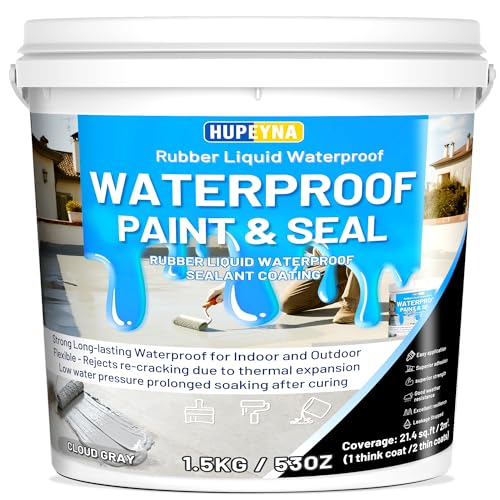
A spreadable rubber coating that stops leaks on anything from basement walls to a backyard waterfall basin.
This Cloud Gray sealant is the versatile option that proves a flexible rubber membrane can handle all sorts of surfaces. Applied by brush, scraper, or poured straight on, it forms a dense elastic coating that blocks water, gases, and humidity in both indoor and outdoor settings. Its compatibility list stretches from concrete and wood to metal, tiles, and fiberglass.
Measuring coverage, a vertical concrete foundation coat at 0.6 mm thick covers 2 m² (about 21.4 square feet), while a thicker 1 mm coat on flat roofs covers half that. Full cure lands in 24-48 hours, though curing time shifts with temperature and humidity. The included kit brings a polyester fabric and scraper for reinforcing tricky spots.
The winning real-world story is stopping a basement leak after a prior crack repair made things worse — a few coats, painted over and invisible, held through severe flooding. But results split sharply: some find it never fully dries and stays sticky enough to peel, while others note it cannot be rolled or brushed and only works with the provided plastic trowel. This is the pick for patient DIYers who follow the cure-time advice closely.
The strengths
- Bonds to many surfaces beyond concrete
- Full cure in 24-48 hours in normal conditions
- Resists re-cracking from thermal expansion
The variability
- Drying behavior varies — some report it stays sticky
- Application can require the included trowel rather than a roller
Grab it for: A multi-material sealing job where you need one product for walls, pipes, and planter boxes.
Take care if: You expect paint-like application; this one can demand a trowel and patience.
5. Daich ElastoLock Waterproof Rubber Coating
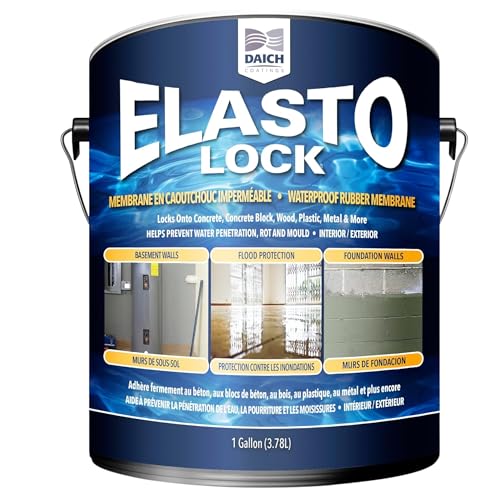
A roll-on rubber membrane that spans cracks and seams while keeping moisture out, sized for serious foundation work.
This gallon jug is built for walls where movement happens — the high-elasticity formula expands and contracts with the surface to bridge cracks and seams as the weather changes. It sticks to concrete, block, wood, metal, plastic, drywall, and fiberglass, making it as useful on a cinder block wall as on a plywood seam. The water-based coating applies with brush, roller, or spray and cleans up with soap and water.
Reviewers point out it holding against basement leaks on both inside and outside foundation cracks, with water staying out where it entered before. It also blocks vapor transmission (moisture moving through the wall as gas), which helps with dampness even when there is no standing water. The full 128 fluid ounces gives you a real working supply for a whole wall section.
The known frustration is curing time — it needs ample drying between coats, which slows down a one-day project. Some also flag the lid design, with one unit arriving with the lid off and causing a messy spill. Adhesion on plywood and cinder block held with no issues after two weeks in one report, but long-term durability is still unproven. It is a promising membrane for prevention and mild seepage.
What impresses
- Flexible membrane spans cracks during movement
- Blocks both water and vapor transmission
- Cleans up easily with soap and water
Before you buy
- Curing is slow and needs ample drying time
- Lid design drew complaints over messy spills
Best for: Homeowners applying a preventive moisture barrier across foundation walls and block joints.
Think twice if: You need a fast same-day fix — this coating demands drying patience.
6. Simpson Strong-Tie Crack-Pac Flex-H2O
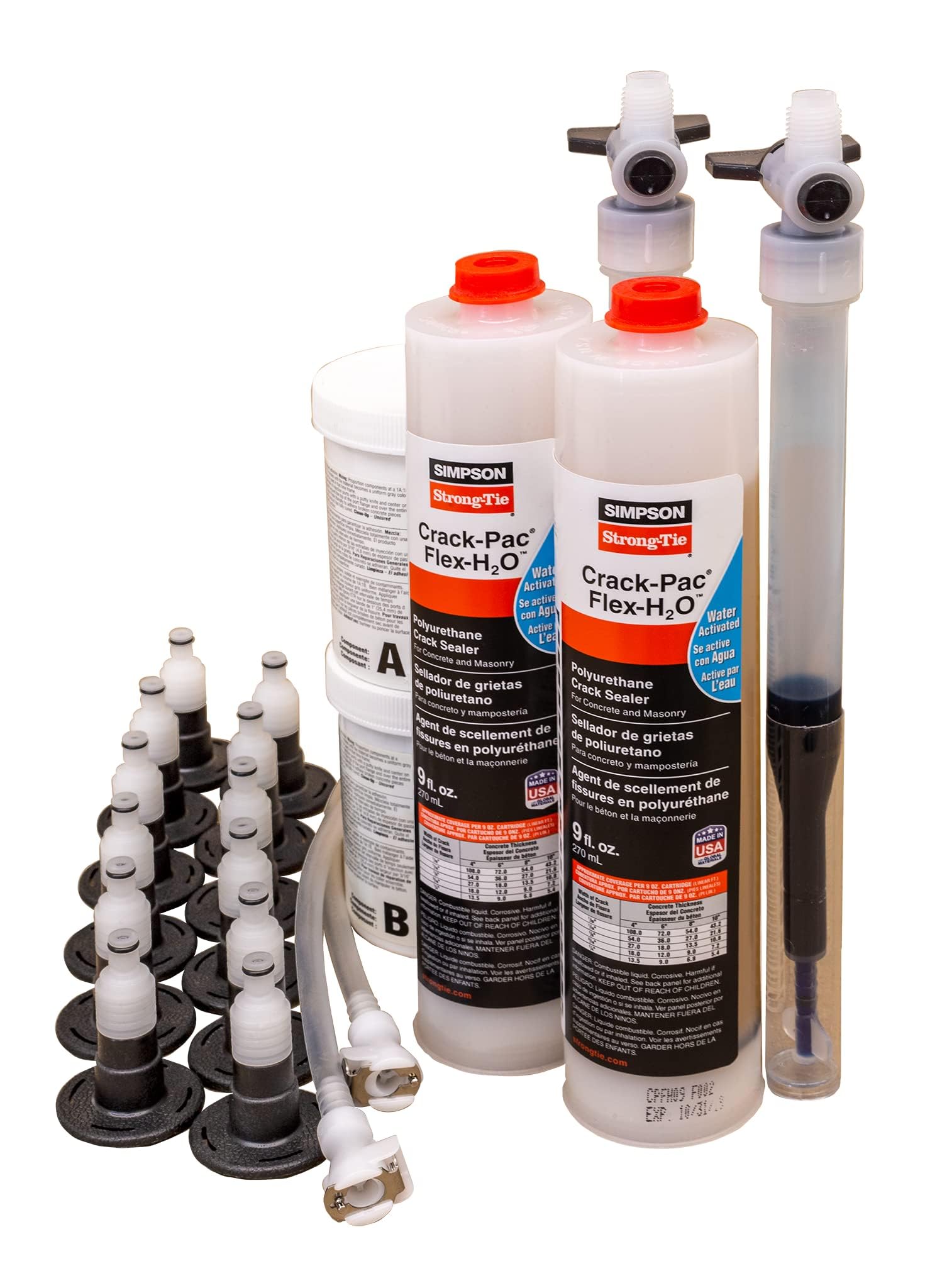
A two-cartridge injection system that forces expanding foam deep into a crack to stop seepage from inside.
This is the professional-grade answer when you have a seeping or mildly leaking crack that a surface coating cannot fix. The polyurethane reacts with water, expands to fill the void, and seals the affected area from the inside out. It dispenses with a standard caulking tool, so you do not need fancy equipment. The clever bit is you can even use it on dry cracks by introducing water to the area first, which triggers the foam to expand.
The review pages sum it up: this is the kit that saved people thousands of dollars in contractor quotes. One homeowner repaired a sister’s floor-to-ceiling crack in under an hour, and the product penetrated an 8-inch wall, rising above the ground despite the modest 9 oz cartridges. Ownesr report the crack staying dry through rain and snow a full year later.
Do not expect a tidy job. It is extremely messy to work with, sets very quickly, and the included patch-over may not cover all tubes. The foam expands a lot — so mixing small epoxy batches and sealing port bases are the workarounds that make it succeed. For a structural-quality water seal on a single crack, this delivers performance that justifies the premium tier.
Why it justifies the price
- Foam expands to fill voids and seal from inside
- Works on both seeping and dry cracks
- Uses a standard caulking tool
Prepare for
- Messy application that requires careful prep
- Fast set time demands working in small batches
Choose this for: A single, deep, seeping crack where you want a lasting seal without hiring a pro.
Skip it for: Many small cracks across a large area — a brush-on coating is faster there.
7. Hydra Stop 300 Fast Set Crack Injection Kit
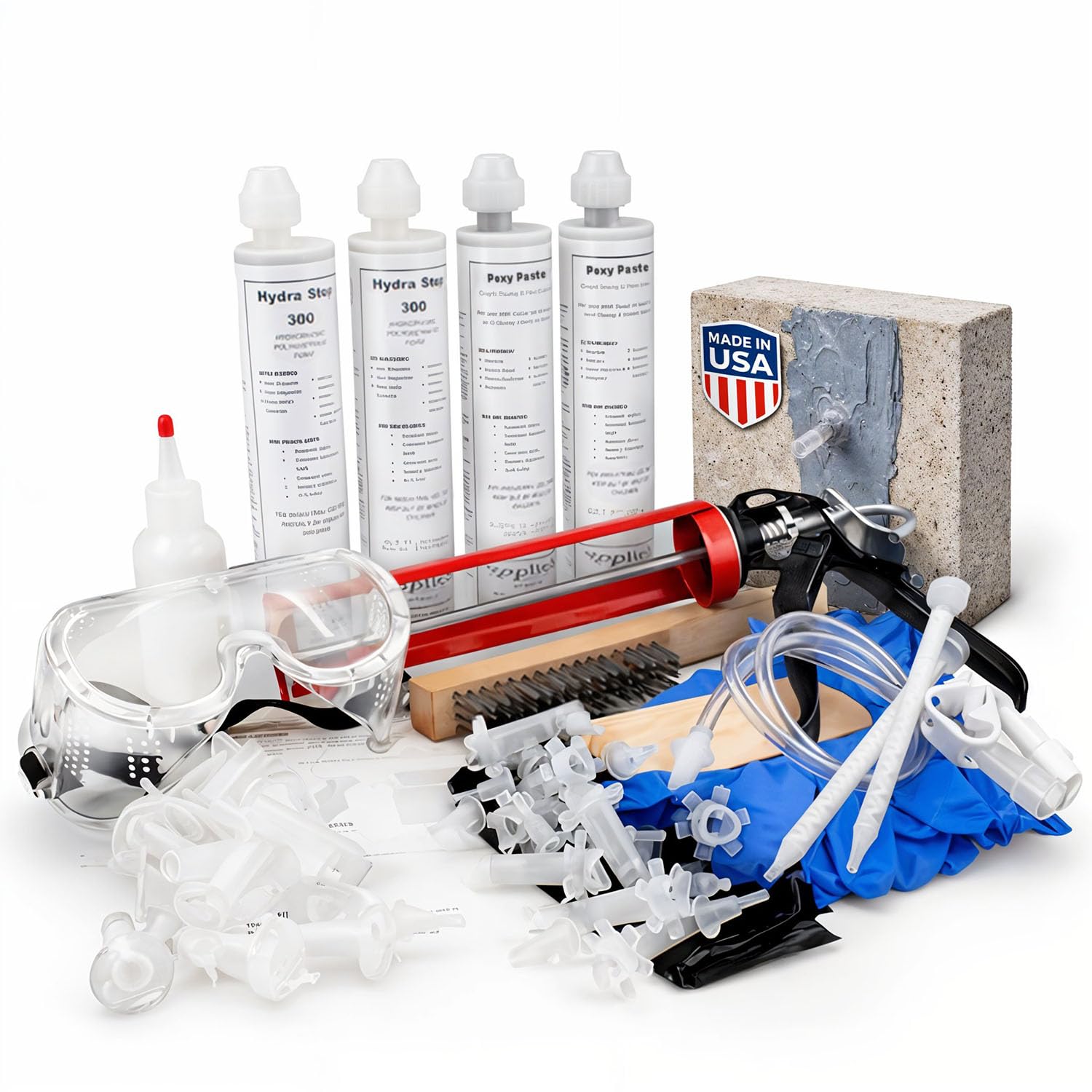
A full toolbox of foam, ports, and tools that lets a DIYer inject a waterproof barrier into wall cracks.
This kit suits the hands-on homeowner fixing foundation cracks without digging outside. You get 2 tubes of Hydra Stop 300 polyurethane foam, 2 tubes of Poxy Paste surface sealant, 15 surface ports, a caulk gun, nitrile gloves, safety glasses, a drop cloth, 10 wooden sticks, 10 corner ports, a wire brush, and a flexible injection hose assembly. Everything arrives in one box, and it handles cracks up to 10 linear feet.
Shoppers say it sealing foundation cracks and holding for years — one owner fixed a crack 14 years ago with no leaks since. The expanding foam pushes through the crack from the inside, working for hairline gaps up to 3/16″ wide. The written and video instructions get consistent praise for making the process clear.
There is a durability caveat: some owners find the included caulk gun breaks easily under pressure and swap in their own, and the epoxy tubes can firm up during storage. The quantity also draws a note, with tubes arriving only half-filled. It is a capable system that rewards careful prep and following the directions — and it still costs a fraction of a contractor visit.
Everything included
- Complete kit with foam, ports, gun, and PPE
- Clear written and video instructions
- Foam works on hairline to 3/16″ cracks
Be aware
- Caulk gun quality drew some complaints
- Tube fill levels are a recurring concern
Ideal for: First-time DIYers who want every tool and clear guidance in the box.
Consider another if: You plan to inject multiple corner cracks — the corner ports are the weak point.
8. Acta-Leak 10′ Foundation Crack Injection Kit
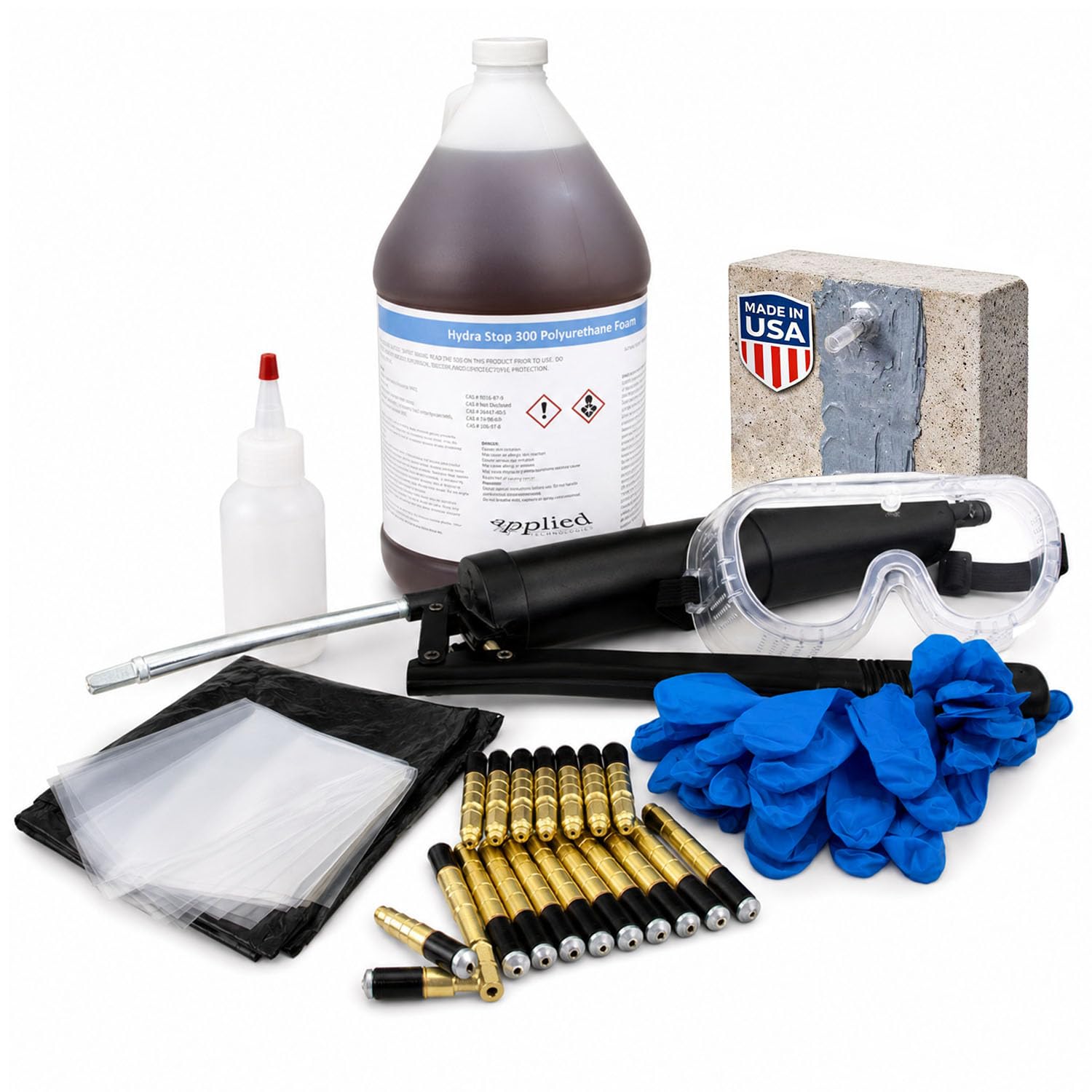
A single-component foam kit built for wet cracks, sealing active leaks where hydraulic cement failed.
When water is actively flowing, this kit is engineered for exactly that condition. The Hydra Stop 300 foam reacts with moisture and expands to form a dense, closed-cell barrier that blocks water at the source. It seals cracks as narrow as under 0.02″ wide, so even fine fissures are covered. The included grease gun delivers over 1000 PSI of injection force, driving material deep into hidden fracture paths without exterior excavation.
The success stories are dramatic: one owner stopped a leak and saved roughly versus a professional quote, and another filled three 42″ actively leaking cracks with no leaks since. A notable win is that it worked where hydraulic cement had failed, sealing a leak that a rigid patch could not handle. All the work happens from inside the basement.
The honest weakness is the hardware. The gun leaks resin during injection in many reports, the plastic liners can tear, and the gun is essentially one-time use. Owners advise spreading a tarp and wearing protective clothing. The foam earns strong marks for sealing, but the included grease gun leaks resin and is essentially one-time use.
Performance highlights
- Seals actively leaking and hairline cracks
- Over 1000 PSI injection reaches deep voids
- No exterior digging required
Gear to manage
- Grease gun leaks resin and is one-time use
- Plastic liners can tear during handling
Reach for this if: You have a wet, actively leaking crack that surface fillers cannot stop.
Prepare yourself if: You dislike messy work — the gun leaks and demands a tarp underneath.
9. Applied Technologies 40ft Foundation Crack Repair Kit
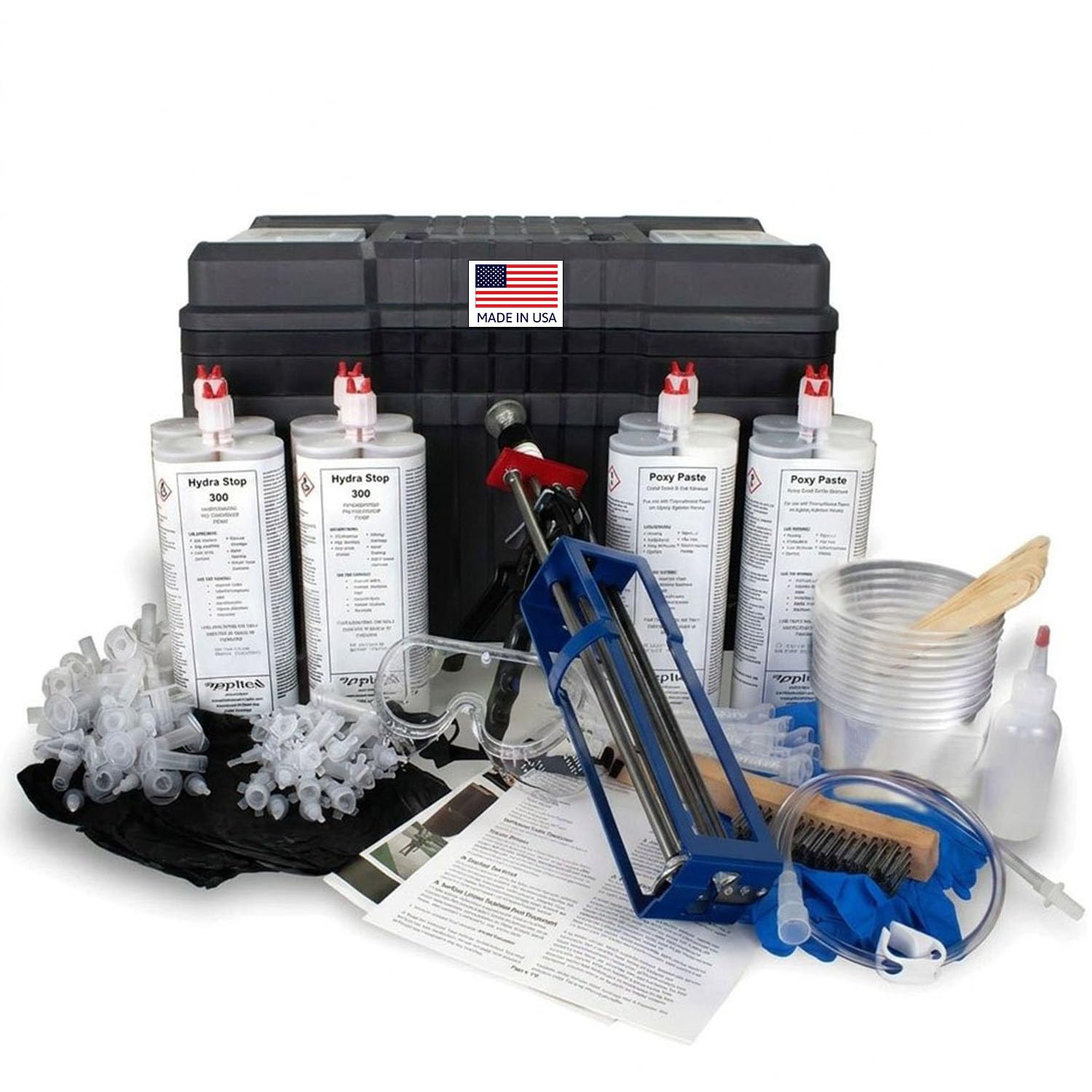
The heavyweight system for sealing up to 40 feet of cracked foundation wall in one professional-grade pass.
This complete system from Applied Technologies covers up to 40 linear feet of crack, making it the maximum-coverage option for extensive basement cracking. It includes a dual-cartridge gun, injection ports, polyurethane foam, and step-by-step instructions packed in a Plano organizer case. The Poxy Paste surface sealer locks injection ports firmly to the wall and prevents blowouts during injection, even on brick-patterned or poured concrete surfaces.
Owners describe it as professional grade and report it sealing long stretches of wall — one project covered 20 feet of cracks in an 85-year-old basement, and another praised it closing deep cavities inside walls. The water-like viscosity penetrates deep into the structure, stopping active leaks where surface fillers reach. One reviewer noted the repairs held bone dry through a winter rain cyclone.
The main objection is simply the investment — it is the most expensive kit here, and some note the cost is steep even if cheaper than hiring a contractor. The locking caulking gun also drew a complaint, with advice to bring a non-locking type. For a home with widespread wall cracking, this one-shot, all-inclusive system saves the headache of buying multiple smaller kits.
Why it earns its spot
- Covers up to 40 linear feet of crack
- Complete kit includes gun, ports, case, and instructions
- Works on brick-patterned and poured concrete walls
The trade-off
- Premium investment, though less than contractor quotes
- Locking caulk gun can be problematic
Who it serves: Owners with extensive foundation wall cracking who want one complete, pro-level solution.
Who it does not suit: Anyone with a single small crack — that is overkill when a smaller kit handles it.
Understanding the Specs
Elongation Percentage
This number tells you how far a cured rubber coating can stretch before it tears. A coating with 900% elongation can stretch nine times its original length, which lets it move with the foundation through temperature shifts and ground settlement. Look for a high elongation number on brush-on sealers meant for basement walls.
Coverage Rate and Linear Feet
Coatings measure coverage in square feet per gallon, telling you how much wall area one container will seal. Injection kits measure in linear feet, stating how many feet of a single crack the included foam will fill. Match the number to your specific crack size so you don’t run out mid-project.
FAQ
Can I paint over a rubber crack sealer?
What is the difference between a coating and an injection kit?
Will a crack sealer stop an actively leaking crack?
How much crack can one injection kit repair?
Do I need to excavate outside to fix a basement crack?
What does “self-leveling” mean for a crack filler?
Is there a sealer that works on damp concrete?
How long does a crack sealer take to cure?
Final Thoughts: The Verdict
If you want one dependable pick, the best Basement Crack Sealer is the Liquid Rubber Foundation Sealant because its flexible 900% elongation coating and wide 50 sq ft per gallon coverage handle most basement wall problems in one easy brush-on application. If you have a single deep crack pushing active water, the Simpson Crack-Pac Flex-H2O is the pro-grade injection answer that stops the leak from inside. And for widespread foundation cracking, the Applied Technologies 40ft Kit delivers everything needed for the big jobs in one complete box.
How We Picked
We do not accept paid placement. Every pick is matched to a real buyer and a real use-case; we do not hands-on test units.
Sources & Methodology
Specifications: manufacturer listings and product documentation. Review insights: verified customer reviews, as of August 2026. Pricing: not shown on this page (it changes often); check the current price via the retailer link.
As an Amazon Associate, KitchPrep earns from qualifying purchases. This does not affect which products we feature.
Related Guides
