
Specs are compiled from manufacturer listings and verified buyer reviews and can change over time — please confirm the key details on the product page before buying.
A basement bathroom is the hardest room in the house to ventilate. Cold walls pull moisture out of the air, so steam condenses fast, and the duct run to the outside is usually long and awkward.
I’m Mohammad Maruf — the founder and writer behind KitchPrep. This guide is built by comparing the manufacturers’ published specifications and the patterns across verified customer reviews, so you get each pick’s real strengths and trade-offs instead of marketing spin.
Below you will find nine bathroom exhaust fans ranked by how well they handle a below-grade room, from duct-friendly models to low-profile retrofit picks and decorative light combos. Use this guide to the best basement bathroom exhaust fan to match a fan to your duct length, your joist depth, and how much noise you can live with.
Our Picks at a Glance

How To Choose The Best Basement Bathroom Exhaust Fan
A basement bathroom traps moisture differently than a main-floor one. The surrounding ground stays cool year-round, so warm shower steam condenses on the first cold surface it touches, and any duct that runs sideways through a joist bay adds resistance the fan has to push through. Getting the airflow and the ducting right matters more than any single number on the box.
Match airflow to the room, not to the box
Airflow is measured in CFM, or cubic feet per minute — the volume of air the fan pulls out every minute. A fan rated at 80 CFM is matched to a bathroom up to 80 square feet, and a 141 CFM unit is rated for spaces up to 141 square feet. Underground rooms often sit below that size, but a longer duct run eats into the airflow you actually get at the grille.
Understand what sones tell you about noise
A sone is a unit of perceived loudness — the lower the number, the softer the fan sounds while running. A 1.0-sone fan is close to a refrigerator hum, while something in the 2.0 to 2.5-sone range is more like a steady kitchen exhaust. Quiet ratings matter more in a basement bathroom, because a low-ceiling room bounces sound right back at you.
Size the duct before you buy the fan
Duct diameter sets how easily air can leave the house. A 4-inch duct is the common size, though some fans ship with a 3-inch connector and others accept 4- or 6-inch runs. A short, straight run to an outside wall lets even a modest fan work well; a long, bending run needs the widest duct the fan supports.
Quick Comparison
| Model | Best For | Airflow (CFM) | Noise (Sones) | Duct | Amazon |
|---|---|---|---|---|---|
| Panasonic FV-0511VFL1 WhisperFit★ Best Overall | Best all-round basement pick | 50 / 80 / 110 | — | 4″ or 6″ | Amazon |
| Panasonic FV-0510VSL1 WhisperValuePremium Pick | Tight-ceiling retrofit | 50 / 80 / 100 | — | 4″ oval | Amazon |
| Good Housekeeping Yorkshire 90053Décor Pick | Décor-forward bathrooms | 80 | 2.5 | 4″ | Amazon |
| Broan-NuTone 744 Recessed Light Fan | Replacing a ceiling can light | 70 | 1.5 | 4″ round | Amazon |
| Broan-NuTone BEL8 Fan with LED | Roomside retrofit with light | 80 | 1.5 | — | Amazon |
| Homewerks 7140-50 | Small basement half-bath | 50 | 1.0 | 4″ round | Amazon |
| POWERENG 141 CFM Ceiling Fan | Large, steam-heavy bathrooms | 141 | 0.7 | 4″ | Amazon |
| Amico Bathroom Exhaust Fan | Shallow 2×6 joist bays | 80 | 1.0 | 4″ | Amazon |
| Tech Drive 70 CFM Bathroom Fan | Direct-vent budget installs | 70 | 2.0 | 3″ | Amazon |
In‑Depth Reviews
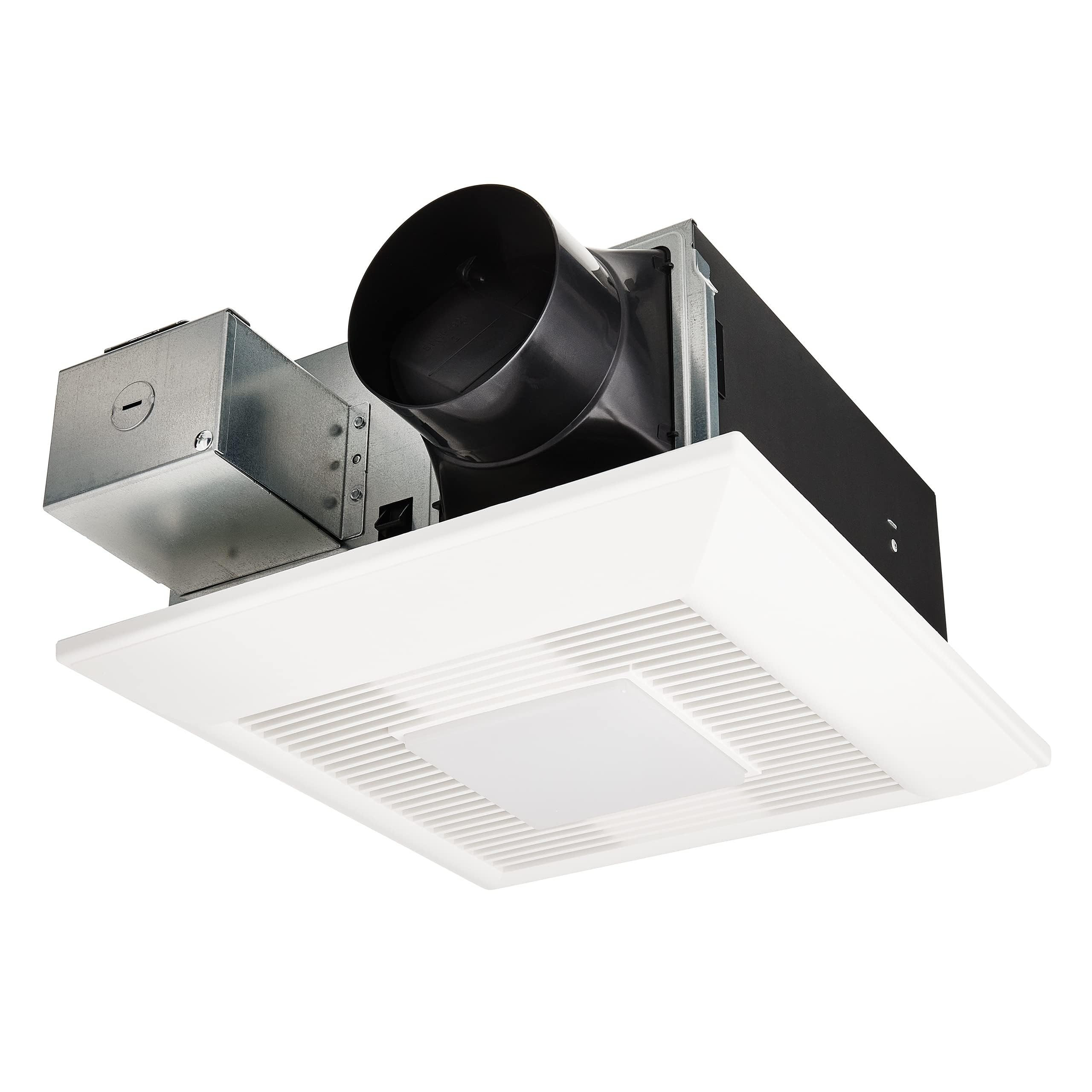
1. Panasonic FV-0511VFL1 WhisperFit Bath Fan + Light, 50-80-110 CFM
Our pick — over 4.5★ from 900+ verified ratings; the strongest balance of quality and price.
The one that lets you dial airflow up or down after it is already in the ceiling.
You get to pick your airflow instead of guessing it: Pick-A-Flow lets you choose 50, 80, or 110 CFM (cubic feet per minute, the measure of how much air the fan moves) with a switch, and the fan runs on a DC/ECM motor (a brushless motor that sips power and runs smoothly) with Panasonic’s SmartFlow technology. One housing covers a small half-bath and a full basement bath, so you are not guessing at the right size before you cut the ceiling. The 110 CFM setting pushes 110 cfm of air, while the Tech Drive budget pick below moves 70 cfm — you get noticeably more headroom for a longer duct run here.
The installation story is what keeps this at the top. A single-hinged Flex-Z Fast bracket holds the housing in place while you wire it, and you can finish the job from below without climbing into an attic. It accepts either 4-inch or 6-inch ducting, which matters in a basement where the run to an exterior wall is rarely a straight shot. There is also a removable duct and wiring junction box, a detail owners single out as the thing that makes the wiring stage simple.
The 10W dimmable LED is genuinely bright — bright enough that replacing a dim basement light fixture is part of the appeal — and the under-1-watt night light is a nice touch for a middle-of-the-night trip downstairs. An optional humidistat can be paired for moisture-triggered running, which suits a below-grade room that stays damp after the shower is over. The trade-off is the instructions. They are disorganized and skip steps, and since the fan is otherwise very quiet, that mismatch between a well-built product and a poorly written manual is the recurring gripe. Watch a video before you start and the rest falls into place.
What makes it the top pick
- Three selectable airflow settings — 50, 80, or 110 CFM — cover both a small powder room and a full basement bath with one housing.
- Flex-Z Fast bracket and a removable duct and wiring junction box let you complete the install from below, with no attic access needed.
- Accepts 4-inch or 6-inch ducting, giving you room to work with a long basement run.
- Airflow tops out at 110 cfm, well above the 70 cfm of the Tech Drive budget pick.
Where it asks for patience
- The written instructions are disorganized and confusing; plan on a tutorial video and extra time.
- Speed settings do not show an obvious difference on the switch itself, so setting it correctly takes some trial and error.
Made for this job: anyone finishing or upgrading a below-grade bathroom who wants to set airflow to the room and never think about it again.
Prepare for this: the manual is the weak link — budget an hour of video-watching before you touch the ceiling.
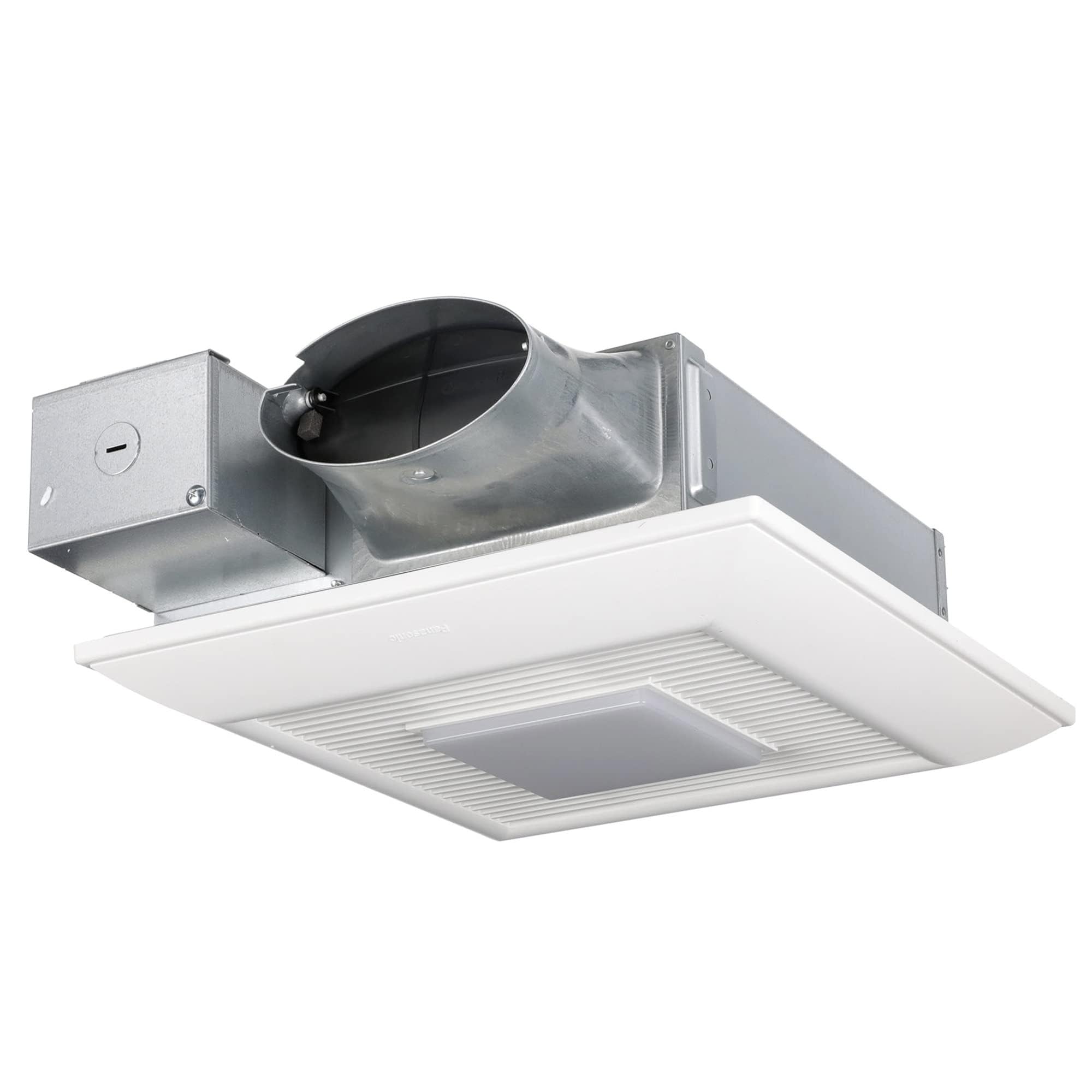
2. Panasonic FV-0510VSL1 WhisperValue Bath Fan + Light, 50-100 CFM
Built for basements where the ceiling cavity is only a few inches deep.
A 3-3/8-inch housing depth is the whole reason to look at this fan. Finished basement ceilings often sit close to the joists or drop to accommodate ductwork, and this unit slides into that tight gap where a deeper housing will not fit. An L-shaped bracket supports it during installation, and the fan carries the same 50, 80, or 100 CFM Pick-A-Flow switch as its bigger sibling, so you can tune it once the room is done.
Airflow and moisture removal hold up well. Even at the lowest 50 CFM setting, buyers report it pulling steam and odor out of the room, and the 3000K dimmable LED with a low-power nightlight is bright without feeling harsh. The fan is UL listed for ceiling, wall, and tub or shower enclosure mounting when GFCI protected, which gives you placement options a ceiling-only unit does not offer.
Plan around one honest catch: this is not a drop-in replacement. It mounts to the bottom of a joist (the horizontal beam above your ceiling), so swapping out an older fan usually means cutting and patching drywall, and the 4-inch oval duct outlet may need a custom adapter to match the round duct already in your ceiling. Factor that extra work in before you order. For a new basement build or a room where you are already opening up the ceiling, that effort disappears.
Why it earns its spot: the 3-3/8-inch depth solves a real problem in low basements, and the selectable 50/80/100 CFM range means one fan covers most room sizes.
Plan around it: the joist-bottom mount and oval duct outlet turn a simple swap into a drywall job, so treat this as a project fan rather than a quick replacement.
Right call if: your basement ceiling is shallow, your duct run is short, and you are building fresh rather than swapping an existing fan.
Reconsider if: you want to replace an old fan in an afternoon without opening up the ceiling.
3. Good Housekeeping Yorkshire (90053) Decorative 80 CFM 2.5 Sones Bathroom Ventilation Exhaust Fan
A fan-and-light that looks like a light fixture, not a vent.
If your basement bathroom is finished and styled, a plain white grille can look out of place. This Yorkshire unit wears a brushed nickel finish with a decorative glass shade, and it reads as a light fixture first. Appearance is exactly what wins people over here — it draws more praise than any other single trait. The 80 CFM airflow clears humidity in a standard-size room, and the fan runs at 2.5 sones, which is a soft white-noise hum rather than a rattle.
The enclosure is screwless by design, so re-lamping and cleaning happen without hunting for a screwdriver. You can wire the light and fan together on one switch or split them across two, and it is ETL listed for use over shower enclosures and bathtubs when installed on a GFCI circuit. It also carries HVI certification and backs onto a full 80 CFM of air movement through a 4-inch duct. One owner got 17 years of heavy daily use out of a 2008-vintage version of this same fan before replacing it.
The install has a couple of gotchas worth knowing. The side exhaust assumes a standard half-inch ceiling, so on a thicker plaster ceiling the unit sits recessed and the pre-installed light mounting bolts come up short — a pair of longer bolts fixes it. Instructions are also sparse and unillustrated, and the 4-inch outlet sits low on the housing. None of that is a defect; it is just the kind of thing that turns a two-hour job into a three-hour one.
Where it shines: the finish and glass shade make a finished basement bathroom look intentional, and the tool-free re-lamp design keeps maintenance simple.
Know before you install: on ceilings thicker than the standard half inch, plan on longer mounting bolts and a slower, read-the-manual install.
Best match for: a done-up basement bath where the vent should disappear into the décor instead of announcing itself.
Skip the fuss if: you want a plain white grille and the fastest possible install — a simpler housing will do that faster.
4. Broan-NuTone 744 Recessed Light Ventilation Fan, 70 CFM, 1.5 Sones

Slips into an existing recessed-light opening, so no new hole and no new patch.
If your basement bathroom already has a recessed can light in the ceiling, this fan slides right into that hole. The 744 occupies the same opening, trimming out to match the recessed lights around it, and one owner reports it dropping into the existing can-light hole in a shower ceiling with a simple install — no drywall work at all. It moves 70 CFM through a 4-inch round duct connector and rates 1.5 sones (a sone is a sound rating, so lower is quieter), which puts it among the gentler options in this group.
Noise is the trait that carries this fan. It idles at a low hum that owners describe as noticeably quieter than the older fan it replaced, and it clears steam before the mirror has a chance to fog. The housing is 6.87 inches high, which fits 2″ x 8″ ceiling joists and new construction alike, and it takes a 75-watt R30 or BR30 bulb. The light and fan can run on independent switches or share one.
Two things to know. First, it is not convertible — the exhaust outlet exits one specific side, so if your duct run comes in from the other direction, plan your layout around it. Second, if a fan like this runs noisier than expected, the fix is in the installation: the hangers need to be crimped to the housing to stop the metal panels from vibrating. That is a documented step in the manual, and skipping it is the usual source of the rattle. If you skip it, this fan will sound louder than its rating suggests.
Why it fits a basement bath
- Drops into an existing recessed-light opening, avoiding a new ceiling cut.
- Runs at 1.5 sones and 70 CFM, which suits a standard-size room.
- The 6.87-inch housing fits 2″ x 8″ joists and new construction.
- Clears steam before it fogs the mirror, per owner reports.
Two things to plan for
- The exhaust outlet exits on one fixed side and is not convertible, so duct routing has to match.
- Skip the step of crimping the hangers to the housing and the metal panels vibrate audibly.
Go this route if: there is already a recessed light in the ceiling you can swap for a fan-and-light combo.
Look past it if: your ductwork enters from the wrong side — the fixed outlet leaves no flexibility.
5. Broan-NuTone Bathroom Exhaust Fan with LED Light, 80 CFM, 1.5 Sones

A roomside swap that skips the drywall cutting entirely.
Roomside installation is the feature that earns this one its place. You can retrofit this fan into an existing ceiling opening without cutting drywall and without attic access, which is exactly the situation in a finished basement where the ceiling above is somebody’s living room. It moves 80 CFM, rates 1.5 sones, and clears rooms up to 75 square feet, so it handles a normal basement bath without strain.
The LED light is a real upgrade rather than an afterthought. The integrated LED is rated for 50,000 hours at 3500K, and the CleanCover grille sits flush with the ceiling. A springless Slideclip holds the cover, which makes pulling it off for cleaning quick. The fan also carries ENERGY STAR certification and a 3-year manufacturer warranty.
Where buyers split is on size. Some find the housing a good match for the opening they already have; others find it smaller than the fan it replaced, which is normal when swapping an older, bulkier model. If you are upgrading from an old Broan fan, that means matching the ceiling cutout before you buy, since the housings rarely match exactly. The upgrade cost is also worth weighing against a basic fan if the room is small and the old unit was already working.
Standout strength: the no-cut roomside install makes it one of the easiest basement upgrades you can do without touching drywall.
Check one measurement first: confirm your existing ceiling opening matches the housing size, because older fans are often larger.
Perfect for: a finished basement bath where the ceiling above is off-limits and you want light and ventilation in one housing.
Think twice if: your current fan has a bigger cutout — you may end up patching and recutting the ceiling anyway.
6. Homewerks 7140-50 Bathroom Fan Ceiling Mount Exhaust Ventilation, 50 CFM, 1.0 Sones

A low-profile fan that suits a small, quiet half-bath under the stairs.
At 1.0 sones and 50 CFM, this Homewerks unit is built for a compact space — it handles rooms up to 50 square feet and stays nearly silent doing it. That quiet is its strongest trait, and it matters in a basement half-bath tucked near a rec room, where fan noise carries. The housing sits low against the ceiling, so it barely reads as a fixture once installed.
Installation is where this fan earns its keep. The no-cut design plus a 4-inch round duct connector makes it a flexible fit for both new work and retrofits, and the galvanized steel housing resists corrosion — a nice detail in a damp basement where cheap metal tends to rust. It carries HVI, ETL, and Energy Star certifications (independent safety and efficiency checks), and the 3-year limited warranty is longer than many fans in this group offer.
Two notes on the parts. The push-in wiring connectors are convenient going in, but disconnecting them means cutting the wires, so get the wiring right the first time. And the exhaust port sits on one side, which can force a new ceiling hole to line up with existing ductwork depending on how your joists run. Both are manageable if you look at your setup before ordering.
What you get: a nearly inaudible 1.0-sone fan with a corrosion-resistant housing, sized right for a small basement bath.
One wiring caveat: the push-in connectors cannot be undone, so plan your connections carefully before you push the wires in.
Made for: powder rooms and small basement baths where a quiet 50 CFM fan is all the room needs.
Not the one if: your bathroom is large or your duct run is long — 50 CFM will feel thin in either case.
7. POWERENG Bathroom Fan Ceiling Mount Exhaust Ventilation, 141 CFM, 0.7 Sones

The highest airflow here, paired with a light bright enough to replace a fixture.
Two numbers set this fan apart from everything else in the group. It moves 141 CFM, which covers rooms up to 141 square feet, and it does it at a claimed 0.7 sones — a combination that is quiet on paper given how much air is moving. If you have a big, steam-heavy basement bathroom, or a long duct run that eats into airflow, this is the one with the capacity to spare.
The built-in light is a genuine selling point rather than a filler. It is a 12-watt LED at 6000K, a crisp daylight white, and owners describe it as bright enough to make the fan-and-light combo worth it on its own. The square 11.8 x 11.8-inch grille trims out cleanly and matches white ceilings. A heat-protection device shuts the motor down automatically if it hits a certain temperature, which is a sensible safeguard for a fan running hard in an enclosed room.
The honest caution is durability. The body is mostly plastic, and the metal mounting arms you might expect are not there — it screws up into the studs from below instead. That is a shortcut, and it is the reason some installers raise an eyebrow. For a basement bath where the fan is running several times a day, that reliance on a plastic housing is worth considering before you commit. If you want a beefier metal build for daily heavy use, the Amico below is sturdier in the hand.
The case for the big one
- 141 CFM airflow for rooms up to 141 square feet — the most airflow on this list.
- Runs quietly for its power at a claimed 0.7 sones.
- A 12-watt 6000K LED light bright enough to light the room on its own.
- Heat-protection device shuts the motor down if it gets too hot.
The trade-off to weigh
- Mostly plastic housing with no metal mounting arms — it screws into studs from below.
- Long-term sturdiness of the plastic construction is the open question for daily heavy use.
Choose it when: you need maximum airflow for a large, steam-heavy basement bathroom and want the light built in.
Pass on it if: you want a heavy metal build that will take a beating for years without a second thought.
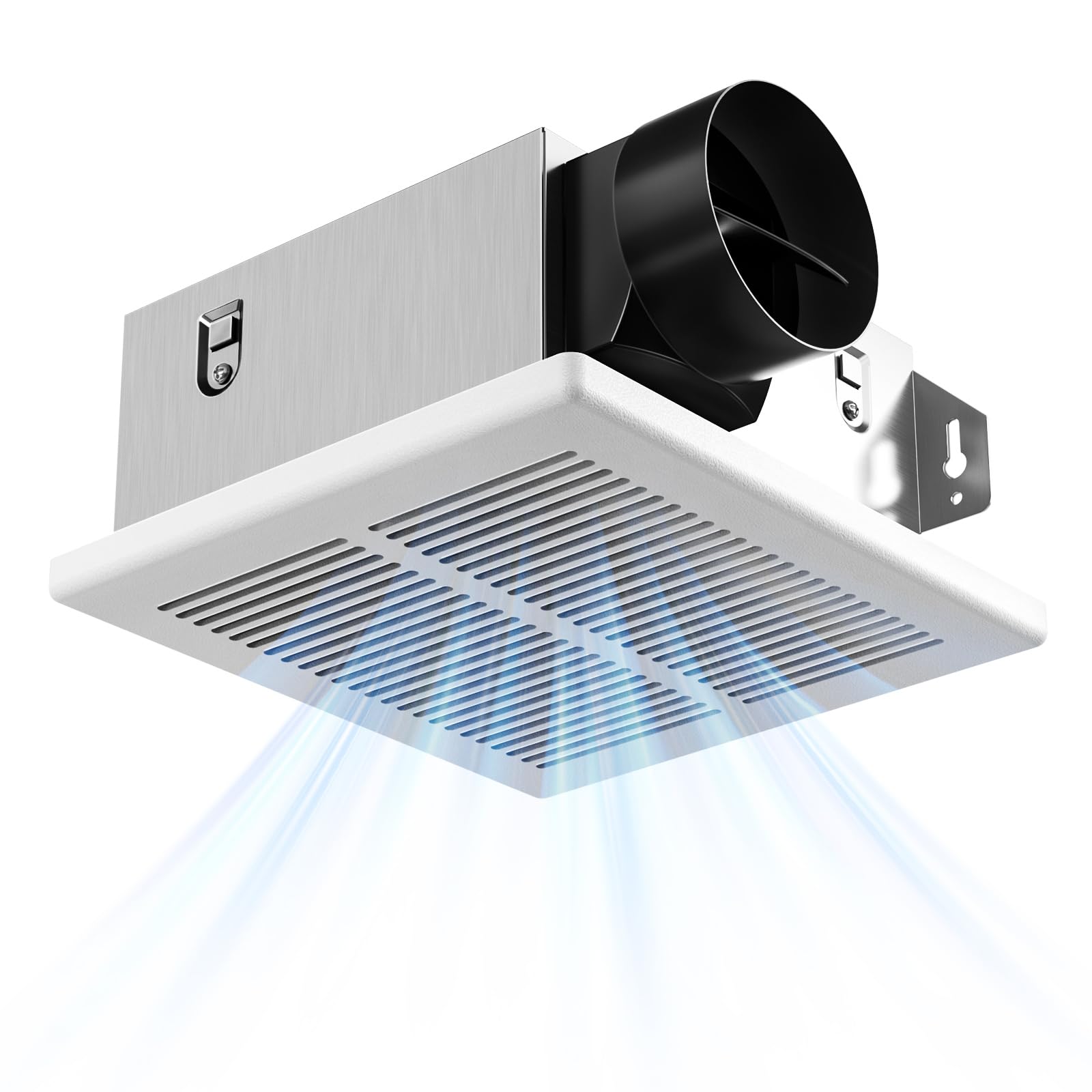
8. Amico Bathroom Exhaust Fan, 1.0 Sones, 80 CFM, No Attic Access Needed
The shallow one that fits between 2×6 joists without a single modification.
A 4-inch-deep housing at 7.5 x 7.2 inches is what lets this fan drop between shallow 2×6 joists — a profile a professional installer described as fitting 5.5-inch framing without modification, ideal for shallow joists. If your basement ceiling is built on 2×6 framing rather than the deeper stuff, this is one of the few in the group that goes in cleanly. It moves 80 CFM for rooms up to 80 square feet at 1.0 sones, so it is quiet and capable at the same time.
The build quality is the quiet strength here. The housing is solid metal rather than plastic, which owners note gives it a substantial feel, and it is UL listed for electrical safety. Installation is as simple as it gets: mount between the joists with the included brackets, or screw the housing directly to a joist. The wiring points accept solid Romex wire without needing screws or wire nuts, a detail that makes the electrical side faster for a DIYer.
The one thing to size correctly is the room. At 80 CFM this suits a standard bath, but if you are trying to ventilate a large basement bathroom with a long duct run, you will be asking a lot of it. For a smaller or mid-size below-grade bath where the joist depth is the limiting factor, it fits and it works. The compact footprint also means it can replace most existing fans without a fuss.
Fits where others do not: the 4-inch housing and shallow 2×6 framing compatibility solve a common basement-ceiling problem.
Know the limit: 80 CFM is right for a standard room, so size up if your basement bath is large or your duct run is long.
Reach for this if: your ceiling is framed with shallow 2×6 joists and you need a fan that drops straight in.
Look elsewhere if: you are ventilating a big room — this fan is sized for a standard bath, not a large one.
9. Tech Drive Very Quiet Bathroom Fan, 70 CFM, 2.0 Sone, 3-Inch Duct

The straightforward, low-cost fan that swaps a steamy basement bath in half an hour.
For a simple below-grade bathroom where the duct run is short and the budget is tight, this fan does the job with almost no ceremony. It moves 70 CFM at 2.0 sones, enough for rooms up to 75 square feet, and the no-cut housing installs entirely from the ceiling side, no attic access required. The quiet side depends on a simple fact owners keep returning to: dropping from an old 4-sone fan to this 2-sone unit is a large, immediate difference you notice the first time you flip the switch.
Retrofitting is where it gets interesting. The housing matches a common 7.5 x 7.25-inch opening, so it drops into many existing fan cutouts, but it is taller than the old units — check your ceiling depth before assuming a direct swap. If you are working without attic access, you may need to improvise support brackets, and drilling fresh holes in the metal frame to reach the ceiling beams is part of the process. With attic access above, the install is far simpler.
The real limitation sits in the ducting. This fan ships with a 3-inch duct, and pushing air through a long run at that diameter is asking a lot — it works well venting directly through a short path but struggles when the run stretches out. If your basement route to the outside is long or full of bends, look at a wider-duct option like the Panasonic up top instead. For a direct, short vent, this fan is hard to argue with at its price.
Where the value is: a 70 CFM fan at 2.0 sones with a no-attic roomside install, cheap enough to keep spares on the shelf.
The catch to plan around: the 3-inch duct limits it to short, direct vent runs; a long duct run will choke the airflow.
Great for: a small basement bath with a short, direct vent run where keeping the cost down matters most.
Steer clear if: your duct to the outside is long or winding — the 3-inch connector is the weak point there.
Understanding the Specs
CFM: how much air leaves the room
CFM stands for cubic feet per minute — the volume of air the fan pulls out every minute. In a basement bathroom, a fan rated at 80 CFM suits a room up to 80 square feet, and a 141 CFM unit suits up to 141 square feet. The longer and narrower the duct run, the more airflow gets lost before the air reaches the outside, so a bigger CFM number can help on a long basement run.
Sones: what the fan actually sounds like
A sone measures perceived loudness — the lower the number, the softer the fan. A 1.0-sone fan is close to a fridge hum, while 2.0 to 2.5 sones is nearer a steady kitchen exhaust. In a low-ceiling basement bathroom, the room bounces sound back, so a quieter rating pays off every time you shower. Just remember: a fan can only be as quiet as its installation allows.
Duct diameter: how air escapes
Duct diameter sets how easily air can leave the house. A 4-inch duct is the common size, while some fans accept 4- or 6-inch runs and others ship with a 3-inch connector. A short, straight shot to an outside wall lets even a modest fan work well. A long, bending basement run needs the widest duct the fan supports.
Housing depth and joist fit
Housing depth decides whether a fan fits your ceiling at all. Shallow basements often have tight ceiling cavities, and a fan with a housing that sits too deep will not slide in without modification. Checking your joist depth and existing cutout size before you buy saves a return and a second trip to the hardware store.
FAQ
What CFM do I need for a basement bathroom exhaust fan?
Is a 0.7-sone fan actually quieter than a 1.5-sone fan?
Can I install a basement bathroom fan without attic access?
Does duct diameter matter as much as CFM in a basement?
How long should a basement bathroom fan last?
Should I wire the light and fan to the same switch or separate switches?
Are bathroom exhaust fans safe to install over a shower or tub?
What is the difference between a 50 CFM and an 80 CFM fan for a small bath?
Do I need a fan with a built-in light for a basement bathroom?
Why does my new quiet bathroom fan sound loud after installation?
Final Thoughts: The Verdict
For most basements, the basement bathroom exhaust fan to beat is the Panasonic FV-0511VFL1 WhisperFit, because its 50/80/110 CFM range and 4- or 6-inch ducting let you tune it to both the room and the run. If your ceiling is tight and you are building fresh, grab the Panasonic FV-0510VSL1 WhisperValue. And for a large, steam-heavy bathroom where airflow is king, the POWERENG 141 CFM is the one to reach for. Whichever you pick, match the CFM to the room, the duct to the run, and the housing depth to the joists —
How We Picked
We do not accept paid placement. Every pick is matched to a real buyer and a real use-case; we do not hands-on test units.
Sources & Methodology
Specifications: manufacturer listings and product documentation. Review insights: verified customer reviews, as of September 2026. Pricing: not shown on this page (it changes often); check the current price via the retailer link.
As an Amazon Associate, KitchPrep earns from qualifying purchases. This does not affect which products we feature.
Related Guides
