
Specs are compiled from manufacturer listings and verified buyer reviews and can change over time — please confirm the key details on the product page before buying.
Choosing baseboard heating starts with one honest question: how big is the room you need to warm? The 750-watt unit that transforms a small bathroom will barely take the edge off a drafty living room, and a 1500-watt giant is overkill for a powder room. The right pick is a match between the heater’s wattage and the square footage it covers.
I’m Mohammad Maruf — the founder and writer behind KitchPrep. This guide is built by comparing the manufacturers’ published specifications and the patterns across verified customer reviews, so you get each pick’s real strengths and trade-offs instead of marketing spin.
Match your room size to the right wattage, and you’ll find a baseboard heating unit that runs quietly, heats evenly, and slots neatly along your wall without taking up floor space.
Our Picks at a Glance


How To Choose The Best Baseboard Heating
Every baseboard heater works on the same principle: cool air sinks to the floor, gets drawn in at the bottom, warms against the heating element, and rises out the top to circulate through the room. But the details of that element — and the wattage behind it — change how fast a room warms, how the heater sounds, and what it costs to run.
Match Wattage to Square Footage
The single most important decision is picking the wattage that fits the room. A general rule of thumb is about 10 watts per square foot, so a 500-watt heater suits a snug 50–100 square foot space like a bathroom, and a 1500-watt unit reaches a larger 250 square foot room. Matching the wattage to the room size is what makes the heat actually useful.
Check Your Voltage and Amperage
Baseboard heaters run on either 120-volt or 240-volt circuits, and that choice affects the amperage draw. A higher-voltage heater pulls fewer amps for the same wattage, which can matter on older or shared wiring. The amperage is usually listed on the spec sheet, and a qualified electrician can confirm which circuit is safe to use.
Know Your Element Type
The heating element separates a quick warm-up from an even, steady warmth. Convection heaters with metal fins push heat out fast, while hydronic heaters with sealed liquid inside warm up more slowly but hold heat longer after the thermostat clicks off. Hydronic models also avoid the popping and pinging sounds that older metal-fin heaters make as they cool.
Quick Comparison
| Model | Best For | Heat Output | Amperage | Heating Coverage | Amazon |
|---|---|---|---|---|---|
| Cadet F Series 36 in.★ Best Overall | Small rooms | 750 watts | 6.25 A | 187.5 sq ft | Amazon |
| Stelpro B0502WCompact Pick | Tight bathrooms | 500 watts | 2.08 A | 50 sq ft | Amazon |
| Cadet 09956 72 in.Top Performer | Large single rooms | 1500 watts | 6.25 A | 250 sq ft | Amazon |
| KING 2K1205-BW | Small basement baths | 500 watts | 4.2 A | 100–150 sq ft | Amazon |
| DIMPLEX LC2005W31 | Compact wall spaces | 500 watts | — | 300 sq ft | Amazon |
| ROVSUN 32 in. | Plug-in flexibility | 1500 watts | 12.5 A | 400 sq ft | Amazon |
| KING 4K1210-BW 4 ft | Basement bedrooms | 1000 watts | 8.3 A | 1000 sq ft | Amazon |
| Fahrenheat PLF504 | Allergen-free warmth | 500 watts | 4.2 A | 300 sq ft | Amazon |
In-Depth Reviews
1. Cadet F Series 36 in. Electric Baseboard Heater
Our pick — over 4★ from 550+ verified ratings; the strongest balance of quality and price.
The reliable workhorse that warms a small room on a standard 120-volt circuit with zero fan noise.
If your central heating skips the bedroom or bathroom, this 36-inch Cadet warms spaces up to 187.5 square feet. It delivers 750 watts and 2560 BTU of convection heat (a method that draws cool air in low and pushes warm air out the top), so you get even warmth without the dust or noise of a fan-forced unit.
Owners consistently call out the installation as the easy part, with buyers reporting the unit draws just two amps in practice. The all-steel cabinet measures 36 inches wide and about 6.75 inches high, a slim footprint that tucks along walls and under windows where cold air pools. A full-length automatic overheat cut-out switches the heater off if it ever gets too hot, and the durable steel construction is built to run season after season.
The honest trade-offs surface in the details. The thermostat is sold separately, so you’ll need to budget for a wall-mounted or built-in end thermostat to control it. While 41 owners praise its reliability, a handful of buyers report the heating element failing at the same point on the strip, so watch it during the first winter.
What Owners Praise
- Easy hookup on a standard 120-volt circuit
- Quiet convection heat with no fan to rattle
- Safety cut-out that stops the heater if it overheats
What to Know
- Thermostat not included — plan to buy one separately
- A few owners mention the heating element burning through at the same spot
- Professional hardwired installation recommended
Reach for it: if you need dependable 750-watt warmth in a bedroom, office, or bathroom up to 187 square feet and want no fan noise.
Think twice: if you want a ready-to-run heater — this one needs a separate thermostat and a hardwired circuit before it works.
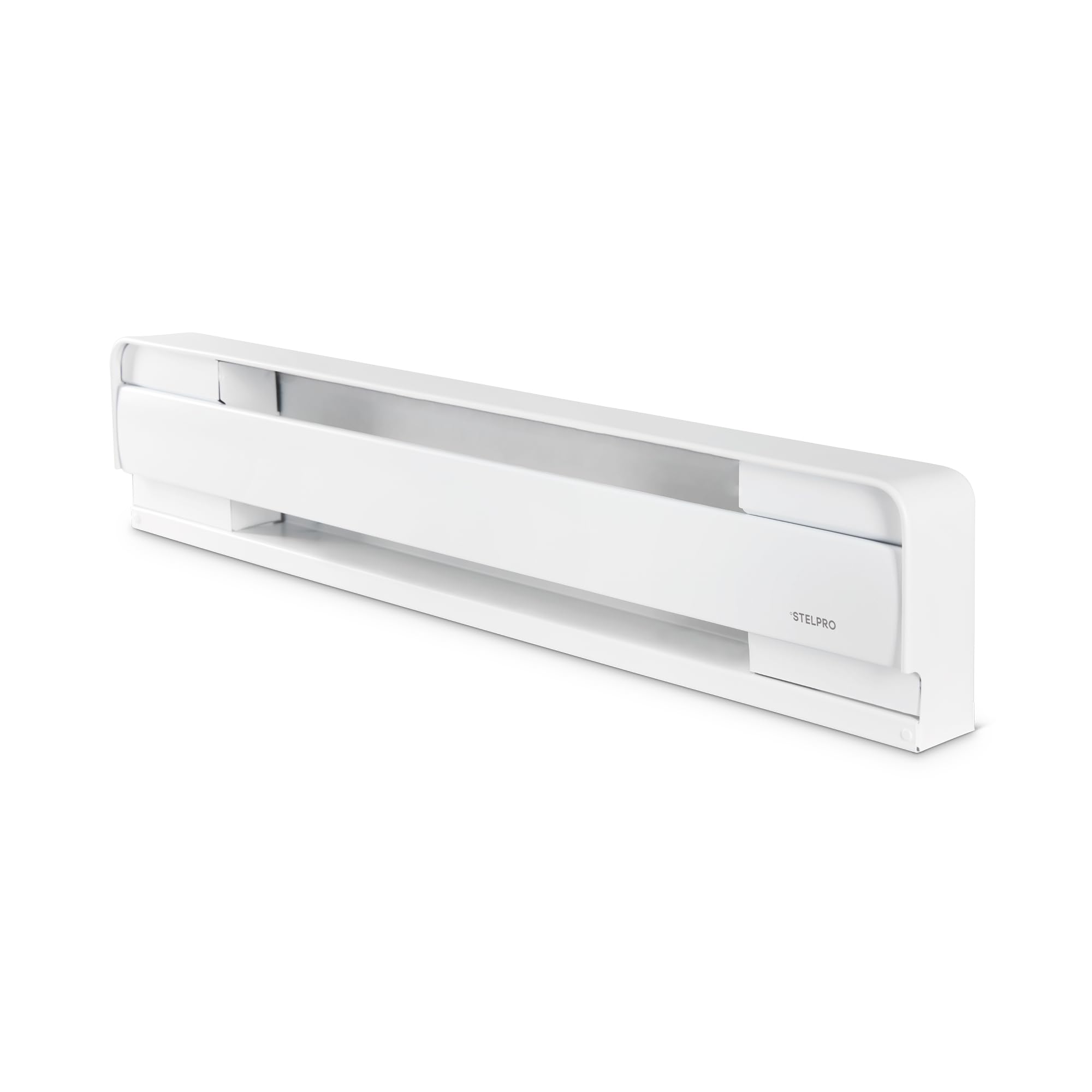
2. Stelpro B0502W B Series Baseboard Heater
A short 27-inch heater that’s perfect for a bathroom where every inch of floor space counts.
For a tight powder room or half-bath, this Stelpro fits where larger heaters won’t—it measures just 2.56 inches deep by 27.87 inches wide. At 500 watts, it’s sized for a compact 50 square foot area, and customers note it “works great in bathroom and doesn’t take a lot of floor space.”
The build quality stands out in ways you can feel. The 22-ga steel casing is strong enough to support 165 lb at its center, and the full-length wireway makes connecting the wires a cleaner job. A diffuser sits above the heating element to spread the warm air better, and full-length thermal protection with automatic reset means the heater shuts down if it overheats, then comes back on once it cools.
The catch is the modest reach. This unit’s 50 square foot coverage is the smallest in the lineup, and its 3.0x lower amperage — 2.08 A versus the Cadet 09956’s 6.25 A on 240 volts — trades raw power for a gentler draw. Buyers call it exactly as promised with no issues reported, but it’s a zone heater for a small room, not a whole-house solution. The maximum temperature setting tops out at 30 °C, which suits a bathroom that just needs to take the chill off.
Where it shines: a trim 500-watt heater for tight spaces with a rugged casing that can hold 165 lb, plus full-length thermal protection that resets itself automatically.
The honest limit: don’t expect this to warm anything beyond a 50 square foot area — it’s built for compact rooms where space is the priority.
Pick this if: you have a small bathroom or half-bath and want a neat, compact heater that disappears against the wall.
Look elsewhere: if you’re heating a full bedroom or living space — you’ll want a higher-wattage unit with more coverage.
3. Cadet Manufacturing 09956 240-Volt Baseboard Heater
This 72-inch heavy hitter pushes 1500 watts to warm a 250 square foot room with better heat spread than older units.
At 72 inches long, this Cadet is built to handle the biggest single room in the house. It delivers 1500 watts on a 240-volt circuit, covering 250 square feet — a 5.0x gap over the Stelpro B0502W’s 50 square foot reach. Reviewers point out a 6-foot unit fits an 11×10 room comfortably, and the longer surface area means the heat dissipates more evenly than the older 1970s units they replaced.
What wins people over is the build quality—44 owners praise the all-metal, powder-coated construction. The 25-gauge steel body and 20-gauge junction box with ground give it a solid, UL-listed feel, and 26 mentions praise the installation; buyers pair it with a Honeywell digital thermostat and report it runs “flawless over winter” with a low heating bill. The convection method means quiet, even warmth with no fan.
The durability picture is mixed, so it’s worth a careful look on arrival. Several shoppers say the spot-welded brackets breaking off, which can leave internal parts feeling loose. The amperage draw of 6.25 A is the same as the smaller Cadet F Series, but this unit needs the full 240-volt circuit to run. One owner sums up the trade-off: cheaper materials than a 1970s unit, but better heat dissipation and an easy install with the right thermostat.
The Strong Points
- 1500 watts covers a 250 square foot room
- All-metal, powder-coated cabinet is UL-listed
- Owners pair it easily with a Honeywell thermostat
The Weak Points
- Spot-welded brackets have broken on some units
- Requires a 240-volt circuit and a separate thermostat
- Mounting screws can be fiddly to line up
Grab it: for a large single room up to 250 square feet where you want strong, even heat on a 240-volt line.
Skip it: if you only have a 120-volt circuit available or you want a heater that arrives ready to run without extra parts.
4. KING 2K1205-BW K Series Baseboard Heater

The made-in-USA pick with a crushproof element and dent-resistant cover, sized for a small basement bath.
This 27-inch KING runs on a standard 120-volt circuit — no special wiring needed beyond a dedicated line — and pulls just 4.2 A. It’s rated for 100–150 square feet, and one electrician owner calls it the right size for a 7×7 basement bathroom, noting it “removes morning chill” when paired with an inline thermostat. The 500 watts make it a focused zone heater rather than a room-wide solution.
Its rugged construction separates it. The aluminum ribbon fin element and crushproof design protect the heating mechanism from clothes or debris on the floor, and the dent-resistant die-form cover keeps the cabinet looking clean. Buyers report the side wiring and 27-inch length make installation straightforward, and owners say they’d buy it again.
The honest caveat is the rating—it’s the lowest in the lineup at 3.9 stars, and owners mention the surface gets hot and a few say it “barely puts out heat.” The reality is it’s a 500-watt unit, so it’s not designed for big rooms. One owner offers a practical tip: if you buy a built-in thermostat of the wrong size, you can drill new holes in the existing plate to mount it. An occasional unit arrives with instructions that don’t mention extra required parts, so plan to have a thermostat and conduit ready.
What wins people over: a sturdy, dent-resistant 500-watt heater for a small basement bath that’s easy to wire up on a 120-volt line.
What to expect: modest 500-watt output for a 100–150 square foot room — buy it for a bath or hallway, not a main living space.
Perfect for: a homeowner with a small bathroom looking for a solidly built, USA-made heater on a standard circuit.
Not for: anyone expecting to heat a full room — this is a compact 500-watt zone heater with a few mixed reviews on output.
5. DIMPLEX North America LC2005W31 Base Heater

The 20-inch stubby that fits awkward wall gaps and responds to temperature changes 40% faster.
For tricky spots where a full-length baseboard won’t fit, this Dimplex is the shortest unit in the lineup at 20 inches. The manufacturer claims it’s 42% shorter than a traditional baseboard while pushing 40% faster heat flow, and owners confirm—it “fit perfectly in a small area in my bathroom” and puts out a surprising amount of heat for its size.
At 3 pounds and just 2.38 inches deep, it’s the lightest, slimmest option here, making it a favorite for tight bathroom real estate. The 500 watts run on a 240-volt circuit and the rating lists 300 square feet of coverage, though owners note it’s really a small-room heater that “doesn’t put out much heat” in a bigger space—one buyer keeps theirs on all the time to keep a small room comfortable. The convection heat is fanless, so it runs very quiet.
The look is a big part of the appeal, with buyers calling it “very stylish” and praising how it “compliments the look of my bathroom.” The trade-off is that a flat 20-inch surface generates less total heat than a longer unit, and the manufacturer’s 300 square foot claim may overstate real-world reach. It’s also manufactured in China and weighs only 3 pounds, so it feels lighter-duty than the all-steel Cadet options. One owner notes it cut their electric bill in half in a small space.
The Good
- Fits small wall spaces a full baseboard can’t
- Quiet convection heat with no fan
- Stylish look praised by owners
The Trade-offs
- Modest 500 watts for a small room only
- Very light at 3 pounds — feels less sturdy than steel rivals
- Advertised 300 square foot reach may be optimistic
Choose it: for a tiny bathroom or hallway with tight wall space where you want a slim, quiet, good-looking heater.
Reconsider: if you’re heating a full room — the short length caps the heat output regardless of the coverage claim.
6. ROVSUN 32” Electric Baseboard Heater with Remote
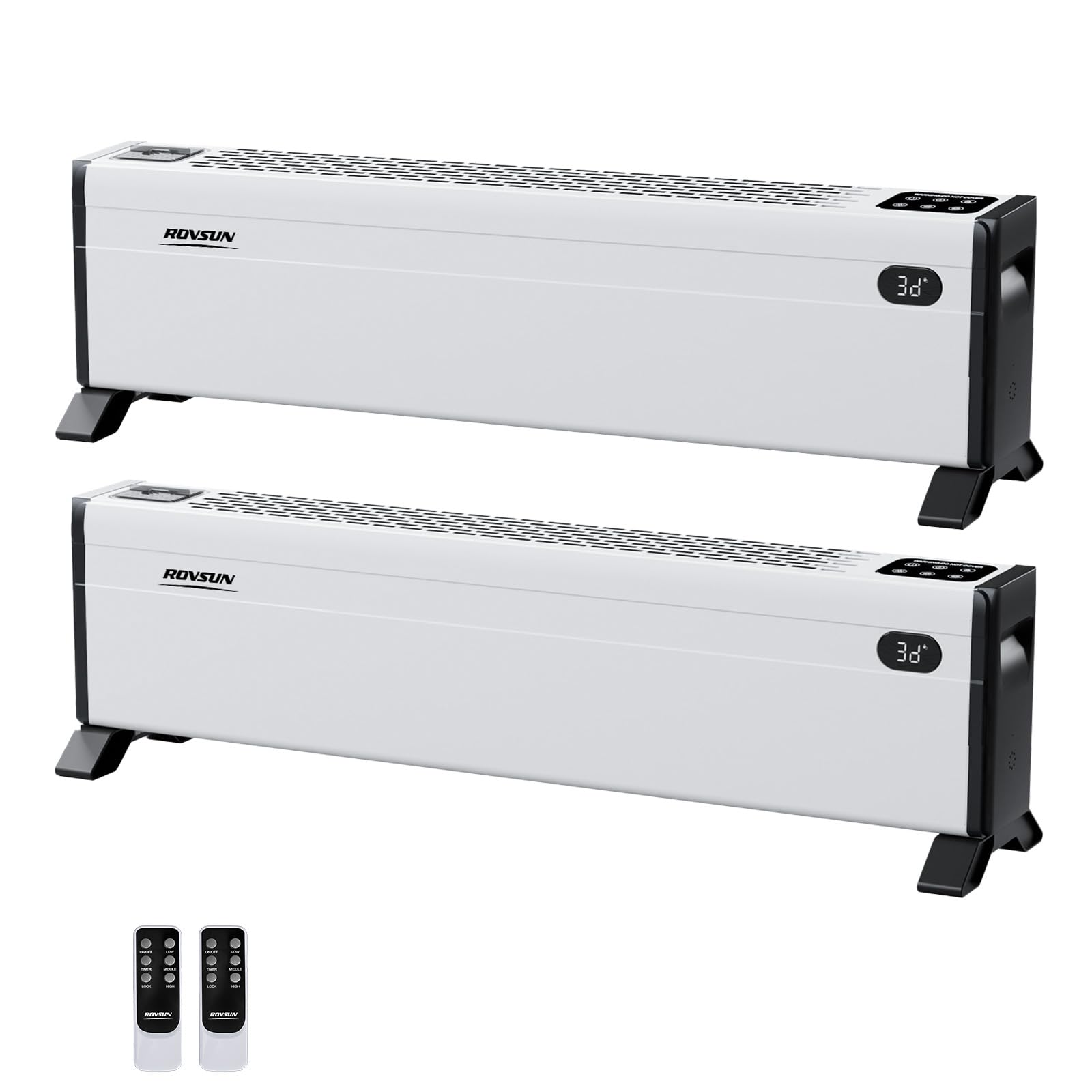
The plug-in heater with a remote, a built-in humidifier, and a 12-hour timer that heats up to 400 square feet.
This is the only unit in the lineup that breaks the hardwired mold — it’s a plug-in floor-mounted heater, so you skip the electrician and the dedicated circuit. It pushes 1500 watts of convection heat over a 400 square foot area with three adjustable heat settings, and a remote control lets you change the temperature from your seat. Customers note it warms an 11×13 room comfortably and “heat the room faster than any fan heater” they’ve owned.
It’s packed with features the hardwired options don’t have. A built-in humidifier adds moisture to the air as it heats, which can help prevent the dryness that comes with forced heat. The LED touch panel and full-featured remote control manage power, temperature, timer, and on/off. A tip-over protection shuts the unit off if it’s knocked over, and a child lock prevents unintended adjustments — both useful if you have kids or pets. The fanless convection heat runs at low noise, and the 12-hour timer lets you schedule warmth around your routine.
The feedback is genuinely mixed, so this is a fit note rather than a universal win. The quality gets split reviews — some owners find it better than other baseboard heaters, others express disappointment. The heat output is similarly divided: some praise the “very uniform heat” while others say it doesn’t warm as described. The 12.5 A draw is the highest in the lineup, so make sure your outlet and breaker can handle it. There’s also no clear “on” indicator, which one owner found frustrating — the front screen turns off after a few minutes. A slight smell from the heat fins is normal until the newness wears off.
What It Offers
- Plug-in install — no hardwiring required
- Remote control plus LED touch panel
- Built-in humidifier and 12-hour timer
What to Watch
- Mixed reviews on heat output — some find it underwhelming
- High 12.5 A draw needs a capable circuit
- No visible “on” indicator; screen goes dark
Ideal for: renters or DIYers who want powerful 1500-watt heat with remote control and no hardwired installation.
Not ideal for: buyers who want a set-and-forget heater — the mixed heat output reviews mean results vary by room.
7. KING 4K1210-BW K Series Baseboard Heater
The 4-foot heater that owners credit with keeping a 10×14 basement bedroom properly warm.
This 48-inch KING delivers 1000 watts on a 120-volt circuit and earns its strongest reviews for heating performance — 17 owners single it out for effectively heating a 10×14 basement bedroom. The design protects the heating mechanism from clothes and debris on the floor, which is a real advantage in a kid’s room or basement where things pile up.
Functionality gets its own round of praise at 15 mentions, with owners noting it works quietly and pairs well with a Honeywell thermostat. The aluminum ribbon fin element and crushproof design mirror the smaller KING 2K1205-BW, and the dent-resistant cover keeps the 4-foot cabinet clean. It runs natural convection, so there’s no fan noise to disrupt a light sleeper.
The durability reviews are mixed, and there’s a genuine safety note in the data. One owner reported a unit overheated and made a cracking noise before they shut it off at the thermostat. Another got six years of service with four months of use per year before it died. The 8.3 A draw is higher than the 500-watt models, so a dedicated 120-volt circuit is the right approach. Owners describe the look as “sleek and clean” and it does the job, but the mixed durability record means it’s worth inspecting on arrival.
Why it’s a favorite: a solid 1000-watt heater with proven performance in 10×14 basement bedrooms and quiet, fanless operation.
The fair warning: durability is a mixed bag — some units run for years, one overheated, so test it on first power-up.
Best for: a basement bedroom or workshop where you need 1000 watts of reliable, quiet heat on a standard circuit.
Think twice if: you’re wary of the mixed durability record or you need more than 1000 watts for a larger space.
8. Fahrenheat PLF504 Hydronic Baseboard Heater

The hydronic option that holds heat longer and skips the popping and pinging of metal-fin units.
This Fahrenheat uses hydronic technology — a sealed liquid inside the element that warms up and holds heat longer than bare metal fins. That means it starts and stops without the popping or pinging sounds traditional baseboards make, and because there’s no fan, it won’t blow dust and allergens around the room. For anyone sensitive to air circulation, that’s a real comfort difference.
At 28 inches long and 500 watts on a 240-volt circuit, it’s a compact zone heater, but the rating lists 300 square feet of coverage. Owners who replaced nine resistance heaters with these units reported winter bills dropping by roughly 30% — the hydronic design’s heat retention is the reason. The unit pulls just 4.2 A and connects from either side with a large wiring compartment, dual knockouts, and a built-in cable clamp, so you can even chain multiple units together.
The feedback splits on heat output — some owners say it heats well, others report very little heat. One buyer with three units on a three-season porch says they keep a 240 square foot room at 68°F easily. The recurring practical tip from owners: check the grounding contacts before install, since paint on the interior can affect the ground. The field-installed thermostat means you’ll need a separate wall or unit thermostat, and a few owners note the installation directions could be clearer.
The Upside
- Hydronic element holds heat and runs very quiet
- Fanless design doesn’t circulate dust or allergens
- Shoppers say lower winter bills after switching
The Downside
- Heat output is mixed — some find it underwhelming
- Needs a separate field-installed thermostat
- Check the grounding contacts for paint issues on arrival
Best for: someone replacing old resistance heaters who wants quiet, fanless warmth and doesn’t mind a separate thermostat.
Not for: buyers who want fast, aggressive heat — the hydronic element warms more slowly by design.
Understanding the Specs
Wattage and Square-Foot Coverage
Wattage is the heater’s power output, and it directly controls how much room the unit can warm. A common rule is about 10 watts per square foot, so a 500-watt unit covers roughly 50–100 square feet and a 1500-watt unit reaches 150–250 square feet. Match the wattage to the room, or you’ll either freeze or waste electricity on heat you don’t need.
Voltage and Amperage
Voltage is the electrical pressure the heater runs on — most homes have either 120-volt or 240-volt circuits. A 240-volt heater draws half the amps of a 120-volt unit at the same wattage, which can matter if your wiring is older or shared with other loads. Amperage, listed in amps, tells you the electrical current draw, and your circuit breaker must be sized to handle it.
Convection vs. Hydronic Elements
Convection heating uses metal fins that heat up fast and push air out quickly — great for quick warm-ups, but the fins can pop and ping as they cool. Hydronic elements use a sealed liquid that warms slower and holds heat longer, so the room stays comfortable after the thermostat clicks off, and they run much quieter.
Thermostat Compatibility
Most hardwired baseboard heaters don’t include a thermostat — you buy a separate wall-mounted or built-in line-voltage thermostat to control them. The thermostat you choose must match the heater’s voltage (120V or 240V) and amperage rating. Some plug-in models like the ROVSUN have a digital panel and remote built in, so no extra thermostat is needed.
FAQ
How do I size a baseboard heater for my room?
What’s the difference between 120-volt and 240-volt baseboard heaters?
Will a baseboard heater dry out the air in my room?
Can I install a baseboard heater myself, or do I need an electrician?
Do I need a separate thermostat for my baseboard heater?
Why does my new baseboard heater smell when I first turn it on?
How loud is a baseboard heater compared to a space heater?
Can I control a baseboard heater with a smart thermostat?
Is hydronic baseboard heating better than electric convection?
How many square feet will a 1500-watt baseboard heater cover?
Final Thoughts: The Verdict
For most buyers, the best baseboard heating choice is the Cadet F Series 36-inch because it delivers dependable 750-watt warmth across a standard 120-volt circuit with quiet convection heat and a safety shutoff. If you want a ready-to-run plug-in option with a remote and a humidifier, grab the ROVSUN 32-inch. And for a room up to 250 square feet needing real output, the Cadet 09956 72-inch brings 1500 watts on a 240-volt line. The crowd favorite across the lineup is the Cadet F Series — with the highest rating and more than 500 owners weighing in, it’s the safe, proven first pick for a small room. Whatever you choose, match the wattage to your square footage and confirm your circuit voltage before you buy.
How We Picked
We do not accept paid placement. Every pick is matched to a real buyer and a real use-case; we do not hands-on test units.
Sources & Methodology
Specifications: manufacturer listings and product documentation. Review insights: verified customer reviews, as of September 2026. Pricing: not shown on this page (it changes often); check the current price via the retailer link.
As an Amazon Associate, KitchPrep earns from qualifying purchases. This does not affect which products we feature.
Related Guides
