
Specs are compiled from manufacturer listings and verified buyer reviews and can change over time — please confirm the key details on the product page before buying.
You want the corners of your baseboard to look like a pro did them, without wrestling a miter saw and hoping the angle closes up. That is exactly what these eight products do. A corner block is a short piece of trim that caps the spot where two baseboard runs meet, so you cut both boards straight and let the block hide the joint. Real wood blocks get painted or stained to match, while peel-and-stick versions handle quick fixes in closets, trailers, and bathrooms.
I’m Mohammad Maruf — the founder and writer behind KitchPrep. This guide is built by comparing the manufacturers’ published specifications and the patterns across verified customer reviews, so you get each pick’s real strengths and trade-offs instead of marketing spin.
The picks below split into two camps: solid wood blocks for rounded bullnose and tight inside angles, and peel-and-stick sets for straight walls and fast gap coverage. Rounded bullnose corners and tight inside angles call for solid wood blocks you can sand and paint. If your walls are already straight and you just need to cover a gap fast, a self-adhesive corner set saves an afternoon. The rest of this guide walks through baseboard corner molding block by block so you can pick yours in one pass.
Our Picks at a Glance


How To Choose The Best Baseboard Corner Molding
Buying a corner block before checking two numbers — your baseboard height and your baseboard thickness — is the most common mistake here. A block that is shorter than the baseboard sticks out awkwardly. A block thicker than the trim leaves a lip you have to sand flush.
Match the block to your corner shape first
Rounded drywall corners, also called bullnose, are the most common corner type in newer homes. A rounded bullnose block curves with the wall instead of meeting it at a hard 90 degrees. If your wall corner is a standard sharp angle, you want a square outside corner block instead. Inside corners are their own thing — that is the angle where two walls fold inward, and inside corner blocks sit in that pocket.
Mismatched corner shape is the top return reason for these blocks. Solid wood blocks can be sanded down a little, but you cannot reshape a bullnose curve into a square corner.
Then match height and thickness
Wood blocks here fit baseboards up to 5.5 inches tall in most cases, and several can be cut down to match shorter runs. Thickness matters just as much: a 3/4 inch block pairs with 3/4 inch trim, while a 5/8 inch block suits thinner baseboards. Self-adhesive corner sets are built around a specific trim width instead — mostly 4 inch or 2.1 inch — so measure your molding before ordering.
Decide between paint-grade wood and peel-and-stick
Solid poplar and pine blocks are paint grade, which means the maker has already sanded them smooth enough to take primer and paint without the grain telegraphing through. They cost more per block, but they can be stained, painted, or clear finished and they will outlast a vinyl strip. Peel-and-stick corner sets are plastic or PVC and go on in seconds with no tools. They handle gaps and quick cosmetic fixes, but their adhesive is the part buyers talk about most, in both directions.
Quick Comparison
| Model | Best For | Corner Shape | Material | Pack Size | Amazon |
|---|---|---|---|---|---|
| Poplar Outside Corner Base Block, Bullnose, 3/4″ x 6″★ Best Overall | Rounded bullnose corners | Outside bullnose | Poplar hardwood | 10 blocks | Amazon |
| Baseboard Corner Protector, Self Adhesive 2.1inchBest for Tight Spots | Tight spaces and quick gap fixes | 3 inside + 3 outside | PVC | 6 pieces | Amazon |
| Self Adhesive 4 Inch Baseboard Corner Blocks, WhiteBest Value | 4 inch vinyl baseboard runs | 3 inside + 3 outside | Plastic | 6 pieces | Amazon |
| COUKIU Self Adhesive 4 Inch Baseboard Corner Blocks | Garage and utility wall base | 3 inside + 3 outside | Plastic | 6 pieces | Amazon |
| 5.5″ x 3/4″ Rounded Outside Bullnose Corner Baseboard Block, Pine | Standard bullnose corners | Outside bullnose | Pine | 10 blocks | Amazon |
| Poplar 1 3/4″ x 1 3/4″ x 6″ Square Outside Corner Base Block | Square outside corners | Square outside | Poplar Wood | 6 blocks | Amazon |
In‑Depth Reviews
1. Poplar Outside Corner Base Block, Bullnose, Trim Molding, 3/4″ x 6″ (10)
Our pick — over 4.5★ from 100+ verified ratings; the strongest balance of quality and price.
Ten solid poplar blocks that turn a fiddly rounded corner into one straight cut.
If your home has rounded drywall corners, this is the block that fits them. It is made to slide over a standard 3/4 inch radius bullnose corner — the curved wall edge most houses built in the last few decades have. Each block measures 3/4 inch by 2 1/4 inches by 6 inches, so it covers a baseboard up to 5/8 inch thick and 5 3/4 inches tall. You get ten in the pack.
The material is paint-grade poplar, a hardwood that sands smooth and holds paint without the grain showing through. What wins people over here is the wood itself — quality is the trait owners bring up more than anything else, with the finished look close behind. As buyers report: “High-quality wood blocks for rounded corners; 1 of 60 had a chip/splinter (irrelevant since cut 6″ to 5″).” That one chip out of a sixty-block order is the rare exception, not the pattern.
The real payoff is skipping the miter saw. Instead of measuring a 45 degree angle on a wall that is probably not perfectly square, you cut both baseboard ends straight and drop the block in. One owner put it plainly: “Saves time vs. miter cuts; looks better as wall corners aren’t true.” Painters like that it takes primer cleanly, and several mention the blocks look even better after a coat.
Turns awkward angles into straight cuts
- Fits the standard 3/4 inch radius bullnose corner found in most newer homes
- Paint-grade poplar takes primer, paint, or stain without raising the grain
- Ten blocks per pack covers a whole room’s worth of outside corners
- Blocks can be stained, painted, or clear finished to match any trim
Before you commit
- Only fits rounded bullnose corners — square outside corners need a different block
- Caps out at 5 3/4 inch tall baseboard, so very tall trim will need a taller block
- An occasional block arrives with a small chip, usually hidden once you cut it to height
If your walls curve: this is the pick to start with, especially if you are trimming more than one room.
Look elsewhere if: your corners are sharp 90 degree angles — the square outside block further down fits those.
2. Baseboard Corner Protector, Self Adhesive 2.1inch(Width) 3 Inside + 3 Outside Corners
Six sticky PVC corners for the spots nobody wants to cut trim for.
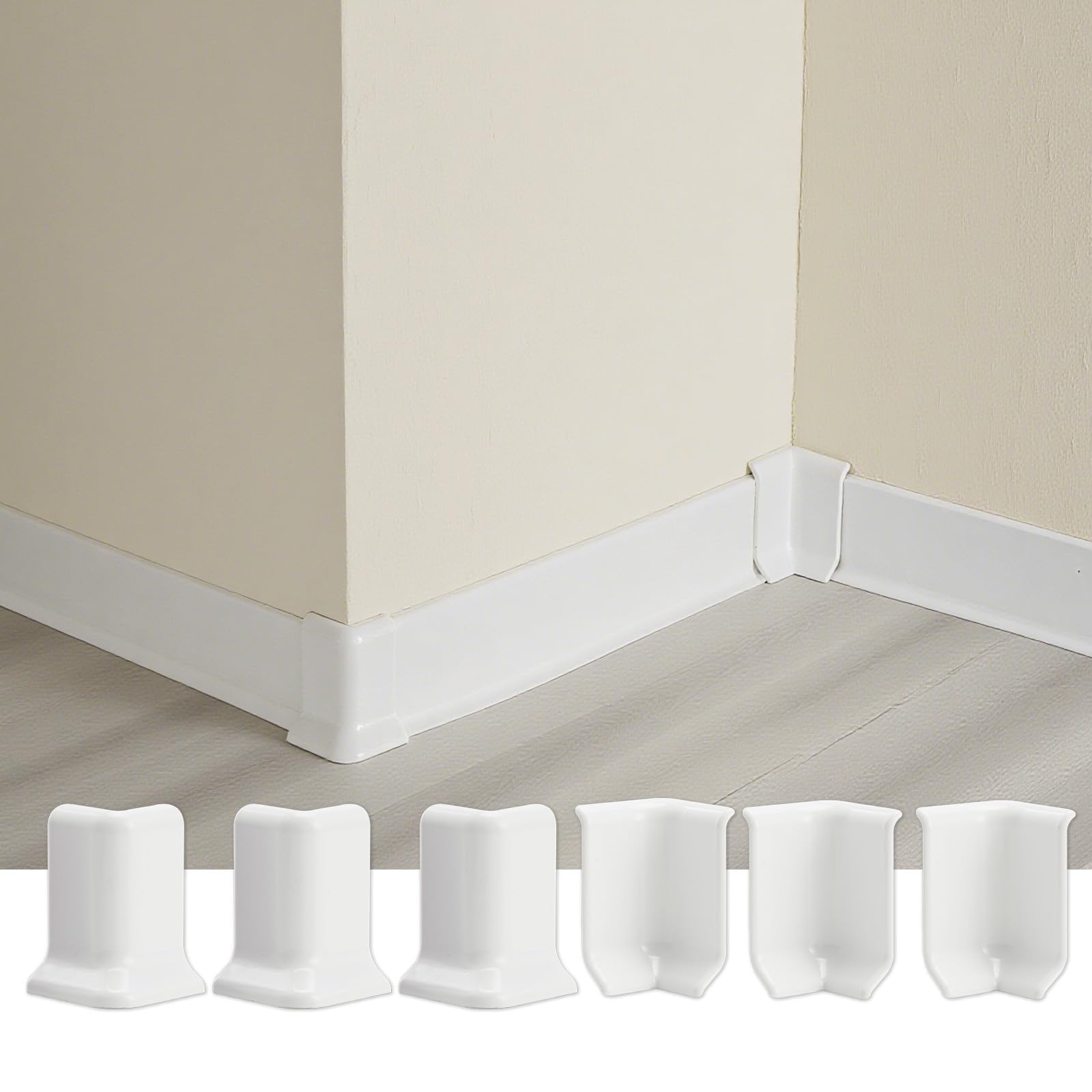
Closets, laundry rooms, the gap where a bathtub apron meets the floor, the inside of a converted trailer — that is where this set earns its place. You get three inside corners and three outside corners, all molded from white PVC that is calibrated to match a 2.1 inch wall base with no color mismatch. The whole kit weighs 1.9 ounces, so it ships as a flat, flexible strip rather than a box of wood.
You skip the screws, the drill, and the miter saw — just peel, stick, and you are done. The adhesive is what makes or breaks a peel-and-stick corner, and in this set it generally holds. One buyer ran it along a metal tub and noted the difference: “Most importantly stuck to the metal tub. With other bases, the adhesive would fail and I would have to use other adhesives to make them adhere.” Another sealed up a horse trailer conversion and got over a year of service from it, cutting the strips with a utility knife.
Where it asks for care is the same place all self-adhesive trim does. Adhesion can be inconsistent on dusty or freshly painted walls — that is the recurring trade-off across this whole peel-and-stick category, not a flaw unique to this kit. Prime and clean the wall first and the bond is far more dependable. Coverage is also tied to that 2.1 inch width, so measure your existing baseboard before ordering.
Where it shines: fast cosmetic finish in rooms where a wood block would be overkill, with a bright white surface that wipes clean.
The honest catch: the strips are sized for 2.1 inch wall base, so a 4 inch trim run will not line up.
Reach for this if: you want corners handled in minutes with nothing but a scissors and a clean wall.
skip it if: your baseboard is wider than 2.1 inches — the adjacent 4 inch set is the right size.
3. Self Adhesive 4 Inch Baseboard Corner Blocks, White, 6-Piece Set
The corner cap that skips mitering entirely, for standard 4 inch vinyl baseboard.
This is the set for anyone running 4 inch flexible baseboard molding and dreading the corners. Each block is 4 inches by 1 inch by 1 inch, and the six-piece pack splits evenly into three inner corners and three outer corners. The blocks are molded plastic in white, built specifically to cap the exposed ends of the maker’s own 4 inch trim line.
The draw is the finished look. Owners call out appearance more than any other single trait, with how well the blocks function right behind it. The result reads as a factory finish rather than a DIY patch, and the peel-off film makes the actual install a two-minute job. The whole set weighs just 2.39 ounces, which tells you how little material you are handling — this is a topping-off piece, not structural trim.
Two things to weigh before you buy. The blocks are tailored to one brand’s 4 inch trim, and the maker states plainly that they cannot guarantee a perfect match with other manufacturers’ wall base. If your baseboard is from a different line, measure the profile first. The other is adhesive strength — some owners find it solid out of the pack, while others supplement it. As owners mention: “Used these for inside and outside corners with 4″ vinyl floor boards…used commercial glue to supplement the glue they come with.” A dot of construction adhesive turns that into a non-issue.
Caps corners in one peel
- Three inner and three outer corners in a single six-piece pack
- Clean white finish that owners consistently describe as polished
- Self-adhesive backing means no drills, screws, or miter cuts
- Wipes clean and holds up in kitchens, closets, and utility rooms
Worth knowing before you stick
- Designed around one brand’s 4 inch trim, so other profiles may gap
- Some owners add their own glue to reinforce the factory adhesive
- Only sold in white — no stainable or color-matched options
A strong fit for: 4 inch vinyl baseboard runs in kitchens, garages, and rentals where speed beats craftsmanship.
Think twice if: your trim came from a different brand — the fit depends on matching profiles.
4. COUKIU Self Adhesive 4 Inch Baseboard Corner Blocks, White, 6-Piece Set

Six 4 inch plastic corners that finish vinyl wall base fast, if your fit is right.
COUKIU’s kit mirrors the set above in shape but carries its own sizing quirks. The pack holds three inner and three outer corners, each 4 inches by 1 inch by 1 inch, molded in white plastic and calibrated to the maker’s S100 trim line.
What works is the finished appearance — owners describe the result as professional-looking, and installation takes minutes. One buyer used them to dress up a garage with striking results. Another capped chewed-up bathroom toe kicks in a 50-plus year old building and got a clean finish by pairing the blocks with a mastic filler to rebuild the damaged trim first.
This is also the most-discussed pick in the lineup, and the conversation is mixed in a useful way. Quality, adhesion, and fit all draw both praise and complaint. The recurring theme is sizing — a few buyers found the blocks wider than their baseboard, and the maker notes these are tailored to 4 inch wall base with toes rather than universal. The adhesive is the other honest caveat: it holds for many and needs backup for some. If your trim profile matches and you keep a tube of adhesive handy, it does its job.
The real strength: a white finish that reads as professional on vinyl wall base, at a budget-friendly entry point for a six-piece set.
The trade-off to plan for: sizing is trim-specific and adhesion is inconsistent, so measure and have glue on standby.
Best for: garage, utility, and rental walls where a fast cosmetic finish matters more than a perfect seam.
Not the one if: you need a guaranteed match on an off-brand baseboard profile.
5. Poplar Outside Radius Corner Base Block Bullnose, 5/8″ x 6″ (4)

Ten pine bullnose blocks that finish a new build without a single miter cut.
Pine instead of poplar, ten to a pack, and sized at 3/4 inch thick by 2 inches long by 5.5 inches high. That height is the headline: it matches the taller baseboard used in many newer homes, and it can be trimmed down to meet shorter runs. It is built for the standard 3/4 inch radius rounded bullnose corner, and it arrives ready for primer and paint.
Buyers talk most about how little wrestling the blocks take to go on, which is the whole point of a corner block. One described the effect on a full house trim-out: “Perfect for finishing out a new house, works great with the trim and made it all match great.” Owners who checked whether the blocks were actually 90 degrees (a true square corner) were split; a couple noted the angle ran slightly off square, but filler closed the gap with little effort.
There is a thickness note worth flagging. A few owners found these a touch thicker than their standard boards and sanded the face down to bring it level. That is a quick job with a sanding block, but it is extra work the poplar blocks rarely require. Weight comes in at 1.15 pounds for the set, so the ten blocks are light enough to hold with one hand while you position the baseboard with the other.
Built for the tall trim
- 5.5 inch height matches the taller baseboard in many newer homes
- Can be cut down to match shorter runs instead of buying a second size
- Ten blocks per pack, ready to prime and paint straight from the start
- Pine face takes paint smoothly and matches surrounding trim after finish
Small things to expect
- Some blocks run slightly thicker than standard baseboard and need sanding flush
- A share of buyers found the corner angle not quite a true 90 degrees
- Pine is softer than poplar, so it dents more easily before paint
Suits: full-house trim-outs on rounded corners where you want one block type to cover every outside angle.
Less ideal if: you need a precise dead-square angle straight out of the pack — budget a little filler time.
6. Poplar 1 3/4″ x 1 3/4″ x 6″ Square Outside Corner Base Block, Trim (6)
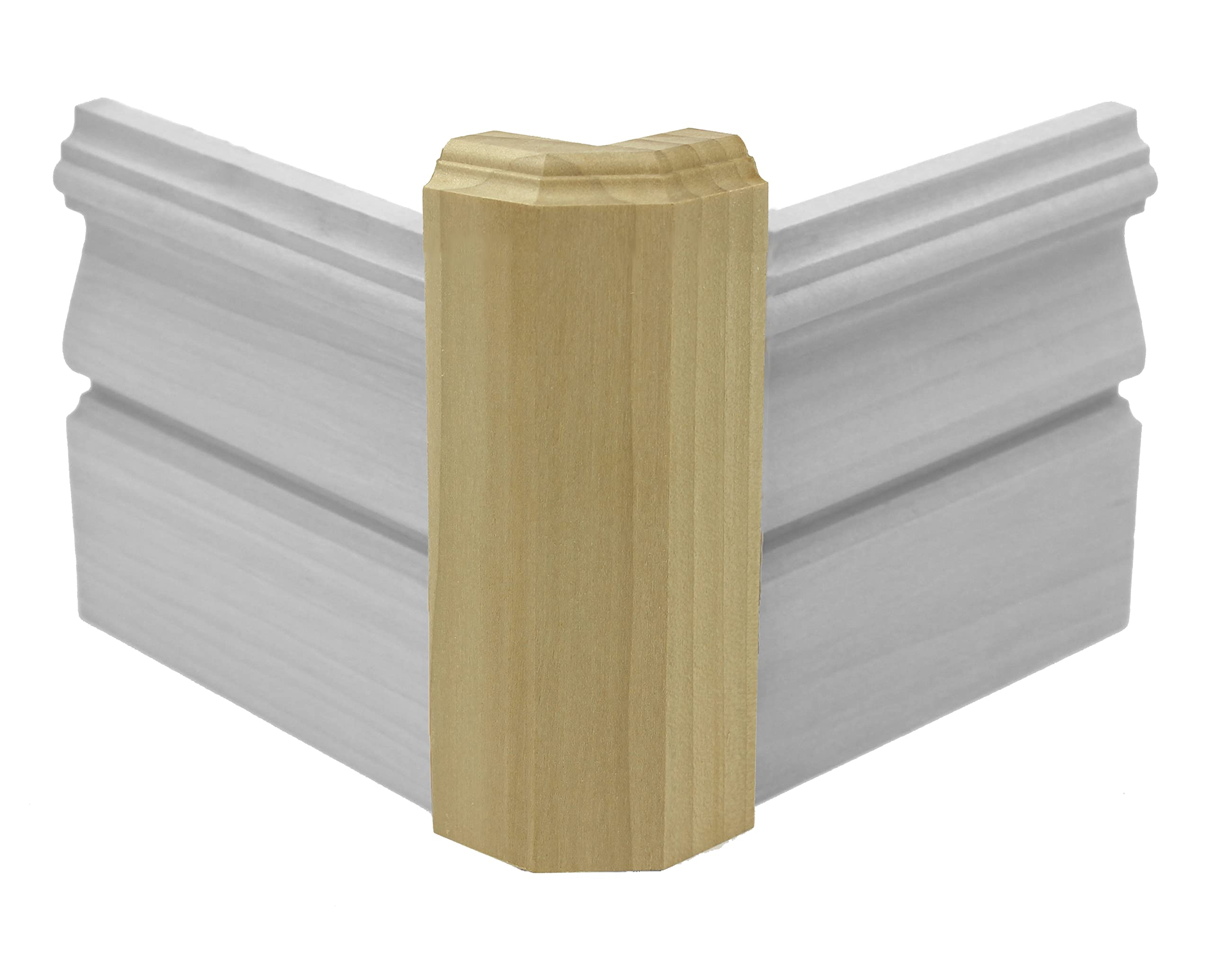
A square poplar block that makes hard outside corners look like a plan, not a patch.
Square outside corners — the sharp projecting ones — need a blunt block, not a curved bullnose. This one has a 1 3/4 inch square face and stands 6 inches tall, fitting baseboards up to 3/4 inch thick and 5 1/2 inches tall. Six blocks come in the pack, all cut from paint-grade poplar.
Owners lean on the same two qualities every time: the seam it creates and the wood it is made from. One put the install method simply: “No more miter cuts. Great for fitting straight cut base boards. Easy to install I used a wood glue and a few finishing nails.” Others skipped paint altogether and clear coated the blocks to show the natural grain, which works because the poplar (a smooth, paint-grade hardwood) is smooth enough to finish either way. One re-trimmed an entire house and cut each block to height to match the existing baseboard.
The honest limit is that it only fits square outside corners. This block has one job — square outside corners — and it will not help at a rounded bullnose wall or an inside angle. It also arrives bare, so plan for primer and paint or a clear topcoat. What you get in return is a block light enough to hold with one hand and firm enough to take a finishing nail without splitting.
What it gets right: a solid poplar square face that turns a hard outside corner into two straight cuts and a clean seam.
Set your expectations: it only fits square outside corners, and the wood arrives unfinished.
A clean fit for: square corner runs in living rooms and hallways where a visible block is better than a wobbly miter.
Not the one if: your wall corners are rounded — a bullnose block is what those need.
Understanding the Specs
Corner shape: bullnose, square, or inside
Corner shape is the first spec to lock down, and the one buyers most often get wrong. A bullnose block curves to follow a rounded drywall corner, which is the standard corner type in most newer homes. A square outside block sits on a sharp projecting angle. An inside block fills the pocket where two walls fold inward. Match the block shape to your wall before you look at any other number, because none of them are interchangeable.
Block height and baseboard thickness
Block height needs to be at least as tall as your baseboard, or it will look short in the run. Wood blocks here top out around 5.5 to 6 inches and most can be cut down to meet a shorter board. Thickness is the second match: a 3/4 inch block suits 3/4 inch trim, while 5/8 inch blocks fit thinner baseboards. Self-adhesive sets are sized by trim width instead, mostly 4 inch or 2.1 inch, so measure your molding profile too.
Paint grade versus peel-and-stick
Paint-grade poplar and pine are hardwood or softwood blocks with fine grain that takes primer and paint without telegraphing. They can also be stained or clear finished, and they last as long as the baseboard they sit on. Peel-and-stick corner sets are plastic or PVC pieces with an adhesive back. They go on in seconds with no tools, which makes them ideal for closets, trailers, and utility rooms, but their adhesive performance and profile match are what most buyers end up discussing.
Cutting and finishing
Blocks are meant to save you from angled cuts, not add work. Cut each baseboard end straight, then set the block over the joint. From there you have options: nail and glue for a permanent install, or a straight peel-and-stick where the wall is clean and the trim profile matches. For wood blocks, always prime the raw faces and any cut edges before the final coat so the paint seals evenly and the block reads as one solid piece.
FAQ
How do I know if my corners are bullnose or square?
What height corner block do I need for my baseboard?
Do self adhesive corner blocks stay stuck over time?
Can I paint or stain a poplar corner block?
Will a 3/4 inch corner block fit my 3/4 inch baseboard?
What is the difference between an inside corner and an outside corner block?
Can I use a corner block on vinyl or flexible baseboard?
Do I still need to cut baseboard at an angle with a corner block?
How many corner blocks do I need for a full room?
Final Thoughts: The Verdict
For most people tackling baseboard corner molding, the winner is the Poplar Outside Corner Base Block, Bullnose, 3/4″ x 6″ because it fits the standard 3/4 inch bullnose corner (a rounded corner edge) found in most homes today, arrives as paint-grade hardwood that takes finish cleanly, and comes ten to a pack so a whole room’s worth of corners is handled in one order. If you want a rounded block sized for thinner 5/8 inch trim, grab the Poplar Outside Radius Corner Base Block Bullnose, 5/8″ x 6″. And for tight spots where a wood block is more than you need, the Baseboard Corner Protector, Self Adhesive 2.1inch is the one to reach for — clean the wall, peel, stick, and the gap disappears in minutes.
How We Picked
We do not accept paid placement. Every pick is matched to a real buyer and a real use-case; we do not hands-on test units.
Sources & Methodology
Specifications: manufacturer listings and product documentation. Review insights: verified customer reviews, as of September 2026. Pricing: not shown on this page (it changes often); check the current price via the retailer link.
As an Amazon Associate, KitchPrep earns from qualifying purchases. This does not affect which products we feature.
Related Guides
