
Specs are compiled from manufacturer listings and verified buyer reviews and can change over time — please confirm the key details on the product page before buying.
If your cantilever umbrella has ever tipped, walked, or slammed over in a gust, the umbrella itself is rarely the problem — the base is. A cantilever umbrella hangs its whole canopy off one arm, so the base has to fight a long lever arm every windy afternoon. The fix is weight and a wide footprint, not a prettier stand. That is the whole job of a base for a cantilever umbrella, and the seven picks below split cleanly into two camps: fillable plastic plates you load with water or sand, and one steel anchor you bury in concrete.
I’m Mohammad Maruf — the founder and writer behind KitchPrep. This guide is built by comparing the manufacturers’ published specifications and the patterns across verified customer reviews, so you get each pick’s real strengths and trade-offs instead of marketing spin.
Before you buy, the two things that actually decide whether your umbrella stays put are how many pounds you can load into the base and how wide that base spreads on your deck. This guide ranks each option by fill weight, footprint, and real owner experience so you can pick the right base for a cantilever umbrella without a second trip to the store.
Our Picks at a Glance

How To Choose The Best Base For A Cantilever Umbrella
A cantilever umbrella holds its canopy out on an arm, so the base carries leverage the umbrella never lets go of. That single fact drives every choice here: you want mass low and spread wide. Two bases can both claim “heavy duty” and behave nothing alike once the wind picks up.
Fill weight is the number that matters most
Every fillable base here lists a maximum loaded weight, and that figure is your real anchor. Water is easy to pour, sand is heavier per scoop, and a sand-and-water mix usually tops out highest. If your base lives outside year-round in a freezing climate, dry sand avoids the ice problem water brings.
Footprint, not just pounds
A base spreads its weight across its contact area, so a wider plate resists tipping better than a small dense one. A four-plate set spreads over a large rectangle, while a one-piece square base stays compact. Measure your deck or patio corner before you commit — some of these bases are genuinely big.
Wheels versus a fixed base
Wheels let you roll a loaded base into place, which is a real convenience once it is full of sand or water. The trade-off is that a wheeled base is harder to reposition after loading, and the wheels themselves can be a weak point over time. A fixed base stays where you set it and asks nothing more.
Quick Comparison
| Model | Best For | Fill Capacity | Material | Footprint | Amazon |
|---|---|---|---|---|---|
| In-ground Offset Umbrella Base★ Best Overall | Permanent wind-proof mount | Concrete set in ground | Stainless steel panels | 11.3 x 11.3 in plate | Amazon |
| Giantex 208 lbs BaseBudget Champion | Budget stability for 10 ft umbrellas | 208 lbs mix | HDPE | 46 x 43 in | Amazon |
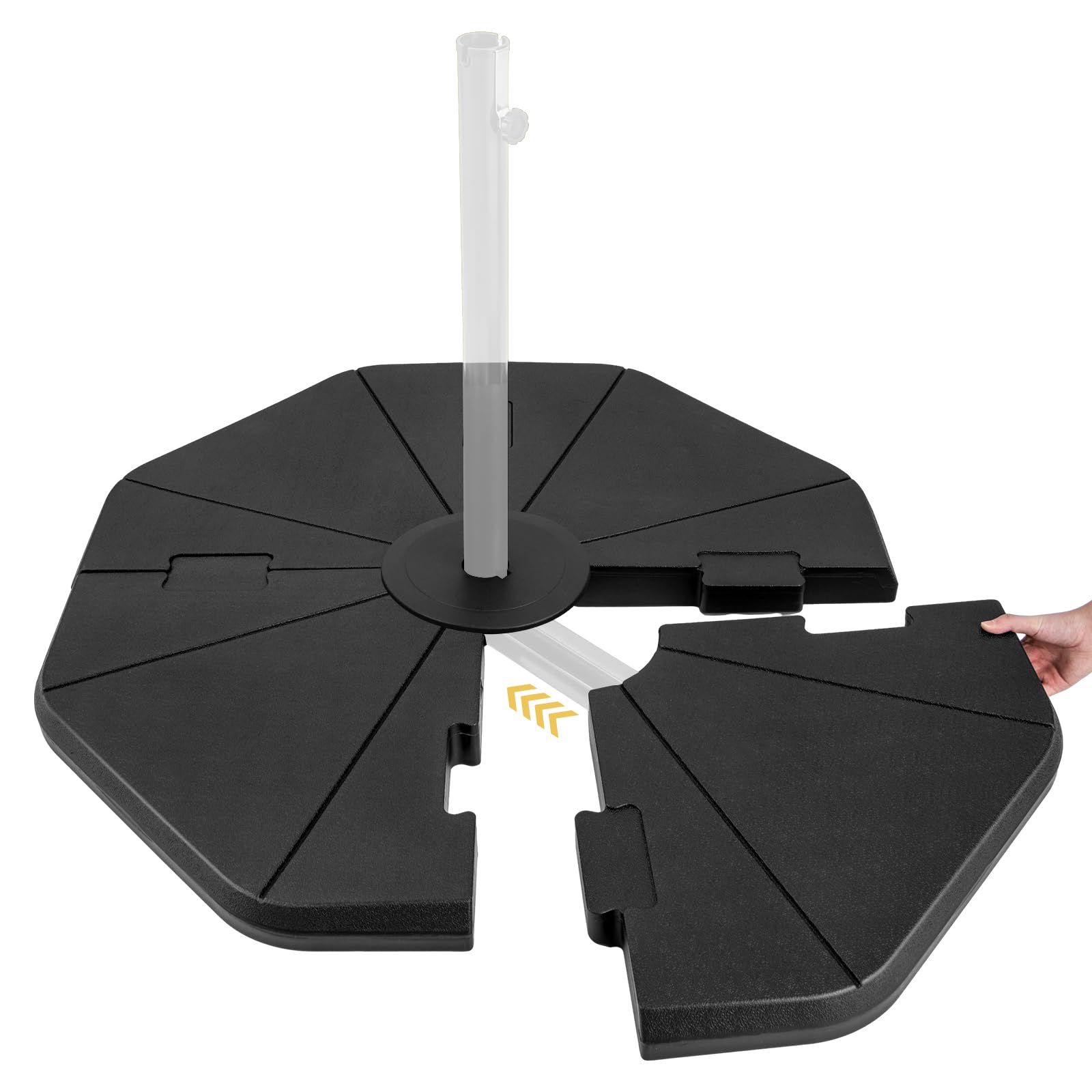
| FRUITEAM 4Pcs Base | Easy water fill on a deck | 190 lbs wet sand | High-density polyethylene | 4-piece set | Amazon |
| C-Hopetree 229lb Base | Tool-free setup | 229 lbs | Recycled plastic | 4-piece set | Amazon |
| Best Choice Products 330lb Base | Rolling a heavy umbrella around | 330 lbs | HDPE | 33.5 x 33.5 in | Amazon |
| MONDAWE 308 lbs Base | One-piece stability with wheels | 308 lbs sand | HDPE | 33.07 x 33.07 in | Amazon |
| 34″ x 34″ Weighted Base | Large rectangle umbrellas | 300 lbs capacity | HDPE with steel cross | 34 x 34 in | Amazon |
In‑Depth Reviews
1. In-ground Umbrella Base for Offset Cantilever Umbrellas
Our pick — over 4.5★ from 350+ verified ratings; the strongest balance of quality and price.
The base that wins by refusing to be a base at all — it sinks into the ground instead.
If you have a spot on your patio where the umbrella truly lives, this is the strongest answer on the list. You dig a pit 20 inches wide and 18.9 inches deep, drop this steel bracket in, and pour roughly 700 lbs of cement, sand, and concrete around it. Once it sets, no gust is moving it, because the anchor is now the ground itself rather than a plastic tub sitting on top of it. Owners of 10×13 cantilevered umbrellas report installing two of these at either end of a patio and finding them sturdy against wind coming off the water.
The build quality is what buyers rave about most — the panels are stainless steel, so they stay waterproof and rustproof outdoors, and the hardware even ships with the right masonry drill bit. One reviewer summed up the whole appeal: “If you never intend to move the umbrella around I would highly recommend this.” The catch is that it is permanent, and the hole has to be big enough — as one buyer put it, “only works well if you dig a big enough hole and use enough concrete.”
This pick also solves a problem none of the fillable bases can: it leaves nothing on your deck to trip over or rearrange. If you have ever bumped a heavy plastic plate while carrying a tray of drinks, you know the appeal. Weighing 20.4 lbs as shipped, it is manageable to place before the concrete goes in, and once set it is simply part of the yard.
What makes it the top pick
- The sturdiest option here — a 700 lb concrete pour in a pit 20 inches wide and 18.9 inches deep beats every fillable base against wind
- Stainless steel panels are waterproof and rustproof, so it survives seasons outdoors without flaking
- Leaves your deck completely clear — no obstacle to walk around or trip over
- Ships with the matching masonry drill bit and mounting hardware
What to weigh before you dig
- Permanent by design — you cannot move the umbrella once the concrete sets
- Getting it right means digging a wide, deep hole, so plan the location first
- A thicker umbrella pole may sit loose without an adapter
Lock it in if: your umbrella lives in one spot and you want the wind argument settled permanently, especially on a patio you own.
Look elsewhere if: you rent, or you like rearranging furniture by season — a fillable base keeps that flexibility.
2. Giantex 208 lbs Offset Patio Umbrella Base
Four plates that hold 208 lbs for the least money — if you can live with the fill hole.
This is the value play in the group, and it earns that spot honestly. You get four HDPE plates that spread across 46 by 43 inches and weigh only 4.5 lbs each when empty, so carrying them from the start is easy. Load them with water and you get 128 lbs of hold, sand brings it to 168 lbs, and a sand-and-water mix reaches the full 208 lbs. That is enough to plant a 10-foot overhang umbrella firmly, which is exactly the use case buyers describe most.
Assembly is genuinely simple, and the four grooved handles make the plates easy to lug around before you fill them. What owners appreciate is how well water alone works: “just water in it it’s very sturdy and looks good,” one notes, and another says it withstood an all-night of rain and wind without the umbrella shifting. The plates stack flat when you empty them, so off-season storage is painless.
Here is the trade-off you need to plan around. Filling with dry sand takes real patience — owners describe it as a nightmare that stretches past an hour, because the side fill hole is small and sand keeps jamming. Funnel-and-water is the smarter route. The other thing to measure is floor space: at 46 by 43 inches, this base claims a big patch of your deck, and once loaded it is heavy to reposition.
The fill-port catch: if you intend to use sand rather than water, budget the time and bring a funnel, because the small side opening is the one recurring frustration.
Reach for this if: you want solid wind-holding on a tight budget and your deck has room to spare.
Think twice if: your patio is small, or you dislike pouring anything other than water into a base.
3. FRUITEAM 4Pcs Patio Umbrella Base

Four boards with big screw-cap ports, built to be filled and emptied without a fight.
This is the base for someone who has wrestled a tiny fill hole before and never wants to again. FRUITEAM puts four large water fill ports with screw caps — one per board — so pouring water goes fast, and emptying before you move or store it is just as quick. Each board holds 45.9 lbs of wet sand, and all four together hold 190 lbs of wet sand, enough to keep a 9-to-10-foot cantilever umbrella standing in wind. No tools are needed to seat the boards around your umbrella base legs.
What owners praise most is stability — the base simply does not wander, and buyers in genuinely windy spots report it working exactly as promised. Water is the popular choice here because it is clean and quick, and the units still feel steady even before you top them off with sand. The screw caps seal well enough that filled boards do not weep, which is the classic failure point on cheaper fillable sets.
Before you buy, check one measurement: the spacing of your umbrella base legs. Buyers point out that the boards need to fit around those legs, and on some frames the fit is snug. Filling with dry sand is slower than water — buyers report roughly 30 to 45 minutes per board — so water-only is the practical route if you want it done in one sitting.
Where it stands out
- Four large screw-cap ports make water filling and draining far quicker than small-hole rivals
- 190 lbs of wet sand across four boards holds a 9-10 ft cantilever umbrella level in wind
- No tools needed — the boards seat around your existing cross base
- Each filled board stays manageable in size for moving before the final position
Where it asks for planning
- Dry sand is slow going — owners clock 30 to 45 minutes per board
- Check your umbrella leg spacing, since the boards must fit around them
- Wet sand rather than water is what gets you to the full 190 lbs
Pick this one if: you plan to top up with a hose and want the least fuss between empty and anchored.
Pass if: you insist on dry-sand filling or your umbrella base legs sit unusually wide.
4. C-Hopetree 229lb Heavy Duty Base Weights Stand

The set-up-and-forget four-piece that drops onto your cross base without a single clip.
C-Hopetree keeps it simple: a metal cross fits directly into the base slot with no clips required, and the four plastic plates sit on top. Fill it with water and sand together and you get 229 pounds of hold, which is plenty for most freestanding parasols on a deck, lawn, or poolside. The recycled plastic handles sun and weather without complaint, and the specially designed spout makes topping it up straightforward.
Owners are clear on one thing — this 229 lb base is meant for a mid-to-large cantilever umbrella, not a lightweight one. The plates are heavy-duty, the fill holes are ample, and the metal bars hold the squares in place so nothing shifts. Use sand and water together rather than sand alone; buyers who did report the base supports well past its rated figure and keeps the pole planted even when the canopy sways in a breeze. The whole thing weighs only 14.1 lbs empty, so carrying it out is easy — just bring a helper once it is full.
The honest caveat is that the four sections are not joined to one another. That means the set is slightly less rigid than a pinned alternative, and the inner corner indents in each plate are a magnet for leaves and dirt. Neither stops it from doing its job, but if you want the most rock-solid connection, a one-piece base is the more rigid route.
What owners keep coming back to: the tool-free, clip-free setup — you set the cross, drop the plates, and you are done in minutes.
The one thing to know: the four plates are not bolted to each other, so clean the corner indents now and then and accept a touch less rigidity than a pinned set.
Best fit: a mid-to-large cantilever umbrella on a patio where you want anchoring done in minutes, not hours.
skip it if: you are shopping for a featherweight umbrella — this base is meant to pin down real weight.
5. Best Choice Products 330lb Mobile Cantilever Umbrella Base

Roll a fully loaded umbrella into place instead of dragging it across the patio.
Built-in caster wheels are the whole point here — this base lets you move even a heavy cantilever umbrella by rolling it, and two locking wheels hold the spot once you stop. It folds two easy-fill spouts into a rugged HDPE body that takes up to 330 lbs of sand or water, so you get real anchoring weight without giving up the ability to reposition. The mounting-hole pattern is designed to suit both U.S. and European umbrella styles across the 6ft to 15ft range, and it supports 360° rotation whether your umbrella has a foot pedal or not.
Owners who fill it with water report the umbrella staying put through several storms, and the locking caster wheels let them roll the loaded base into place instead of dragging it. The 33.5 by 33.5 inch footprint is large enough to spread the load, which is what makes the wheeled design stable rather than tippy.
The trade-off here is durability over the long haul. Some owners find the base gets hard to move or deforms after extended outdoor use, so if yours will sit in punishing sun, treat it kindly. Filling with water keeps it lighter and easier to roll than sand, which is the practical choice for a mobile base.
Why it earns its spot
- Caster wheels with two locking brakes let you roll a heavy umbrella into place and pin it there
- Holds up to 330 lbs of sand or water for serious anchoring weight
- Mounting-hole pattern fits both U.S. and European umbrella styles from 6ft to 15ft
- Supports 360° rotation whether or not your umbrella has a foot pedal
Where it needs care
- Long-term outdoor durability is the recurring concern — some units deform after prolonged sun exposure
- Once loaded, rolling it still takes effort and the wheels become the stress point
- Best kept with water rather than sand if easy moving matters to you
Choose this if: your patio setup changes often and you want a heavy umbrella that still rolls.
Don’t choose it if: it will bake in relentless sun for years and never move — a fixed base suits that better.
6. MONDAWE 308 lbs Cantilever Umbrella Base with Wheels

One solid piece with a built-in cross brace, so there is nothing to shift or line up.
MONDAWE sidesteps the four-plate problem entirely: this is a single HDPE base engineered with a built-in cross brace, which the maker says gives it more stability under strong wind than multi-piece designs. Fill it with water and it holds 220 lbs, fill it with sand and it reaches 308 lbs, or blend the two for 275 lbs. Four built-in wheels and grooved handles mean you can still roll it around, and two large fill ports plus a side drain make loading and emptying simple.
The one-piece construction is the real draw — buyers who filled theirs with sand and left it in genuinely windy conditions report the base staying upright where looser sets might flex. Others paired it with a 9×12 or 10×13 umbrella and found it kept the canopy stable, and using water alone worked well as a lighter alternative. The HDPE body is recyclable, handles impacts without cracking, and the side drain makes winterizing far less of a chore.
The honest note here is fit. This is a big, heavy base once loaded, so you want to place it and fill it rather than fill it and then try to move it — owners stress this. A few report the umbrella not staying put in extreme wind, which usually traces back to under-filling or a mismatched pole, so pack the cavities fully and check your umbrella’s compatibility first.
Why it holds up: the built-in cross brace keeps the load rigid in a way four separate plates cannot match, and the 308 lb sand fill is a serious anchor.
Worth it if: you want one sturdy piece with a braced core that rolls when empty and refuses to budge when full.
Not for you if: you want a featherweight setup or plan to move the base after it is loaded with sand.
7. 34” X 34” Cantilever Umbrella Weighted Base

A wide 34-inch square built for the biggest rectangle umbrellas on the market.
At 34 by 34 inches, this base is sized for large offset umbrellas — the maker names 9×12 and 10×13 rectangle cantilever umbrellas as its target, and it suits any heavy-duty cantilever model that needs a big counterweight. Fill it with water and it provides roughly 275 to 380 lbs of weight, or use wet sand to go heavier. There is no assembly required, and a steel cross base is built into the bottom, so you do not need the original umbrella’s cross base anymore.
Owners mention it holding a 10×13 or 12×12 canopy steady in breezy conditions. One filled theirs with sand and water and found it immovable under a 10×13 umbrella; another reports it holding a 12×12 pool umbrella even in breezy conditions. The four built-in wheels make moving it easier before you fill it, and two fill holes speed up the water pour. The steel cross at the base adds rigidity that plastic-only stands lack, which matters most when your umbrella is large and catches a lot of wind.
Two things to plan for. Fill both sides — the instructions do not spell this out, and a half-filled base is the usual reason an umbrella feels loose. And measure your patio: this is a large base, and some owners find it nearly too big for their space. An occasional unit has leaked and needed a top-up, so check the seals when it arrives.
Big-canopy proof: sized at 34 by 34 inches with a steel cross base, it is aimed squarely at the 9×12 and 10×13 rectangle umbrellas that smaller bases struggle to counterweight.
Measure first: it is a genuinely large footprint, and you need to fill both sides to get the stability buyers describe.
Ideal for: owners of large rectangle cantilever umbrellas who want a wide, braced counterweight with wheels for empty repositioning.
Look on if: your patio is tight or you want a compact, unobtrusive base.
Understanding the Specs
Fill capacity and fill material
The maximum loaded weight is the single number that decides how well a base holds a cantilever umbrella, because the umbrella’s arm constantly pulls the base sideways. Water is the easy choice and gets you less weight per cavity; sand is heavier per scoop; and a sand-and-water mix usually reaches the highest figure. In cold climates, dry sand avoids the freezing problem water brings. Pick the fill material that gets you closest to your umbrella’s needs without making the base impossible to move.
Footprint, wheels, and cross base
A wider footprint spreads the anchor load and resists tipping better than a small dense block, so a 34-inch square out-holds a compact plate of similar weight. Wheels trade a little long-term rigidity for the ability to roll a loaded base into place — handy on a patio, less so on soft ground. A steel cross base or a built-in cross brace adds rigidity at the point where the umbrella pole meets the stand, which is exactly where big canopies flex the hardest.
FAQ
Will these bases fit my cantilever umbrella pole?
Is water or sand better for filling a cantilever umbrella base?
How much fill weight do I need for a 10-foot cantilever umbrella?
Can I move a cantilever umbrella base once it is filled?
Do I need the umbrella’s original cross base with these stands?
Should I choose an in-ground base or a movable fillable base?
How do I stop water freezing inside my umbrella base in winter?
How long does a fillable HDPE cantilever base last outdoors?
Can I fill a cantilever umbrella base with concrete instead of water or sand?
Final Thoughts: The Verdict
If your umbrella lives in one spot and you are done arguing with the wind, the In-ground Umbrella Base is the clear winner — it sets into concrete and removes the tipping question for good. If you want serious weight but need to keep the umbrella movable, the MONDAWE 308 lbs base gives you a braced one-piece core that rolls when empty, and for the value shopper on a budget, the Giantex 208 lbs base holds a 10-foot umbrella firmly for the least outlay. Whichever you choose, measure your footprint, confirm your pole or leg fit, and fill the cavities fully — that is what actually keeps a cantilever umbrella standing.
How We Picked
We do not accept paid placement. Every pick is matched to a real buyer and a real use-case; we do not hands-on test units.
Sources & Methodology
Specifications: manufacturer listings and product documentation. Review insights: verified customer reviews, as of September 2026. Pricing: not shown on this page (it changes often); check the current price via the retailer link.
As an Amazon Associate, KitchPrep earns from qualifying purchases. This does not affect which products we feature.
Related Guides
