
Specs are compiled from manufacturer listings and verified buyer reviews and can change over time — please confirm the key details on the product page before buying.
You are hunting for a barrister bookcase because you are tired of dusting every single book spine, or you want that classic lawyer-office look where each shelf hides behind its own glass door. The real question is not whether to buy one — it is which solid-wood construction actually earns the price tag and which one you can assemble without losing your mind. Both picks here are genuine solid-wood units with tempered glass fronts (glass that is heat-treated to resist shattering), and both cost roughly the same, so the decision depends on height, door style, and how much moving weight you can handle.
I’m Mohammad Maruf — the founder and writer behind KitchPrep. This guide is built by comparing the manufacturers’ published specifications and the patterns across verified customer reviews, so you get each pick’s real strengths and trade-offs instead of marketing spin.
Find out which barrister bookcase suits your office, study, or living room based on real wood quality, weight, and how straightforward the assembly truly is.
Quick Picks
- AnywaysWood 4-Tier Solid Wood Bookcase — Best Overall
- AnywaysWood Walnut Glass-Front Bookcase — Premium Pick
How To Choose The Best Barrister Bookcase
A barrister bookcase is defined by one signature feature: each shelf tier has its own glass front that either lifts up and slides back or swings open on hinges. That design came from lawyers who needed to grab law books without exposing every page to dust, and it still does that job beautifully today. Before you commit, you want to weigh the wood, the glass, and the physical reality of getting a heavy cabinet into your room.
Solid wood vs. fiberboard construction
Both brands on this list make an explicit promise: no fiberboard, no density particle board, no compressed board — only solid wood. That matters because solid wood resists the sagging and edge-cracking that cheap composite shelves develop under a full load of heavy books. Expect real weight here; a solid-wood frame with glass doors is a two-person job to move, and buyers report exactly that.
Door style: flip-up or flat panel
Traditional barrister doors lift upward and tuck into the top of the cabinet, which means you never have a door swinging into your walking path. Some modern builds use flat-panel doors that open differently. Think about how you actually grab books: if you want the classic no-swing experience, the flip-up mechanism matters more than you might expect.
Height, depth, and what you store
Standard barrister shelves sit around 60 to 71 inches tall, and that height difference changes what fits. A deeper unit around 15 inches gives you room for big coffee-table books, while a shallower 14-inch depth suits regular paperbacks and binders. Check your shelf spacing too — bottom shelves often fit taller binders while upper shelves run shorter for standard books.
Quick Comparison
In‑Depth Reviews
1. AnywaysWood 4-Tier Solid Wood Bookcase with Flip-Up Doors
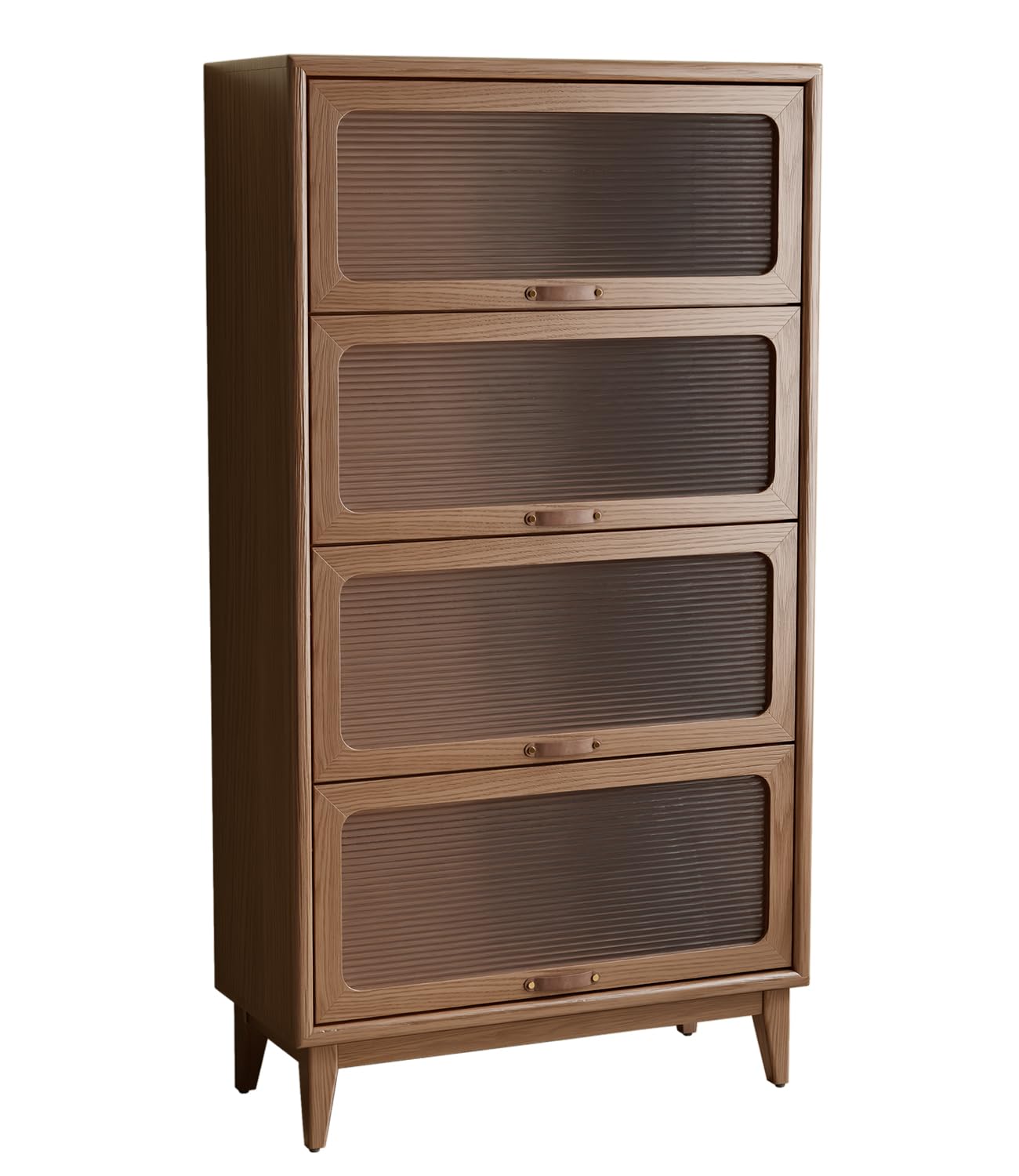
The classic barrister that seals every shelf behind glass while keeping assembly genuinely manageable.
This 61-inch-tall, 14-inch-deep unit is the one owners describe as one of their best purchases — and the reason is the real wood construction you can see and feel in every panel. The brand explicitly states there is no fiberboard, density particle board, or compressed board anywhere in the build, which directly answers the worry about shelves cracking or splitting under a full row of heavy law books.
What wins people over is the assembly experience. With 11 owners calling the build straightforward, the long side pieces make the job easier than most flat-pack furniture, and extra hardware arrives in the box so you are not stuck if a peg goes missing. Tool-free door installation means you position the heavy frame first, then attach the glass doors once it is exactly where you want it. Owners mention the furniture glides built into the base make sliding the finished shelf into place against a wall surprisingly easy — the hard part is the sheer weight before the glides do their job.
Owners describe the look as gorgeous and note the glass keeps dust and pet hair off the books, which is the entire point of a barrister design. There is an important sizing note: the bottom shelf fits standard binders, while the upper shelves run shorter and suit regular books — so stack your tall items low. In reviews, the exact phrase that keeps appearing is that the case is “very heavy,” and the recurring guidance is to plan for two people during setup. That weight is the trade-off for solid wood, and most owners agree it is worth it, with several saying they are already planning a second unit to sit beside the first.
What Owners Love
- Genuine solid wood throughout, with no fiberboard or particle board in the build
- Furniture glides on the base make final placement simple once assembled
- Bottom shelf depth fits binders while glass shields books from dust and pet hair
Before You Buy
- Extremely heavy — plan for two people when moving or assembling
- Upper shelves run shorter, so oversized books belong on the bottom tier
- Deep dowel holes can push through if you insert them in the wrong order
Who It Fits: Anyone wanting a true classic barrister look with dust-sealed flip-up doors and a build that feels like real furniture, not a disposable cabinet.
The Honest Caveat: Its 61-inch height and 14-inch depth sit slightly shorter and shallower than the walnut model, so measure your tallest books before committing.
2. AnywaysWood Walnut Glass-Front Bookcase
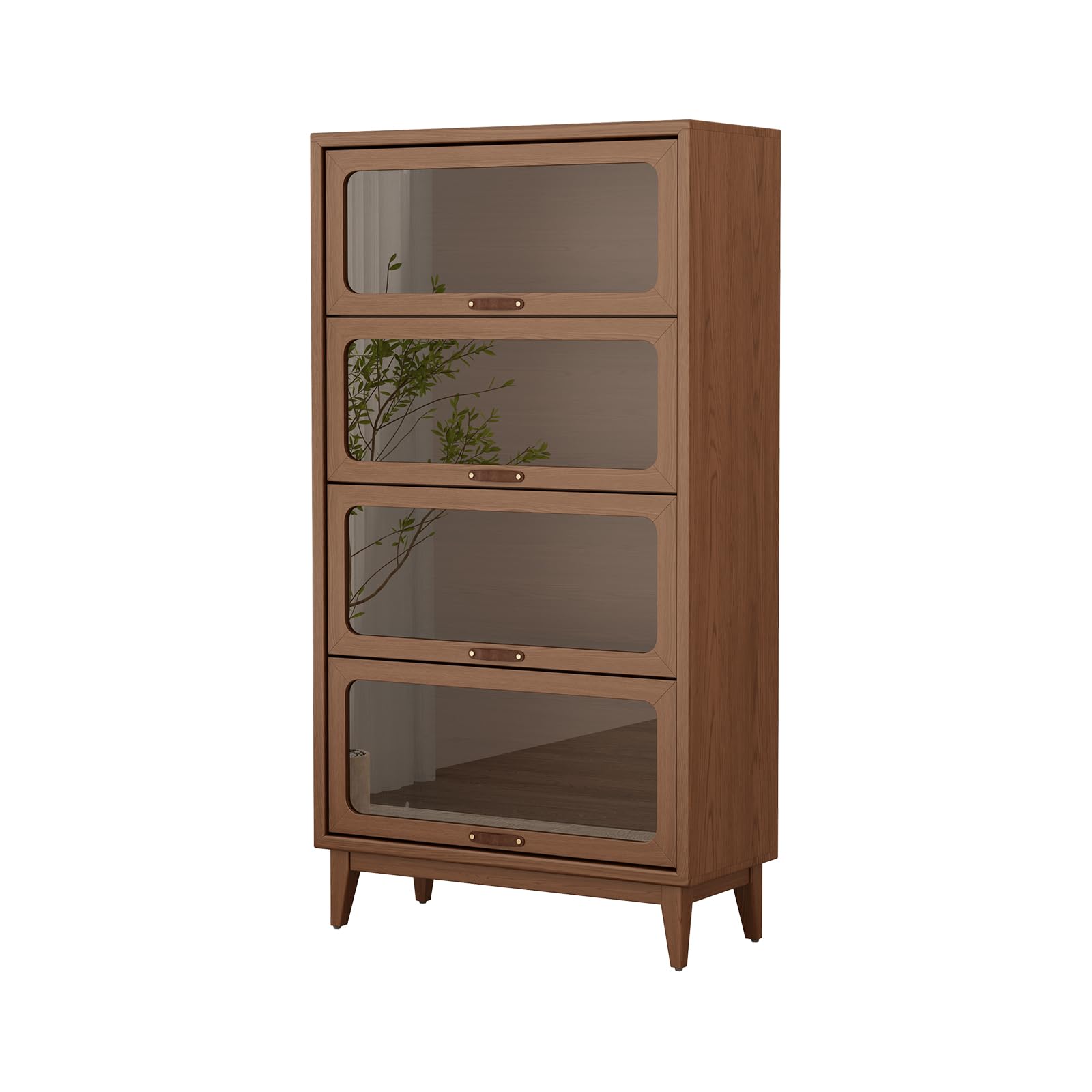
The taller, deeper walnut build that adds anti-tip protection for homes with kids or pets.
This is the pick for buyers who want more headroom — it stands a full 71 inches tall and 15 inches deep, compared to the 61-inch, 14-inch profile of the flip-up model above. That extra inch of depth and 10 inches of height translate directly into more storage rows and room for heftier coffee-table books that would not fit on the shorter unit’s upper shelves.
Quality is the thing everyone raves about here, with 9 owners praising the build and another 6 calling out the appearance. The walnut finish and finger-jointed wood planks with embossed grain give it a midcentury character that fits a study or living room rather than reading as generic office furniture. It also carries one safety feature the other pick lacks: an anti-tip mechanism designed to keep the tall cabinet stable in homes where children or pets might pull on a door.
The honest split in the feedback is assembly. Some owners find it easy and praise clear instructions, while others describe the manual as frustrating — “terrible instructions” and “very small print” are the words that recur, with one experienced builder noting shelf hole placement that did not match and back panels lacking matching holes. The praise is just as strong, though: customers note the case is sturdy, looks sharp in an office, and one owner loved it so much they planned to buy a second to sit right next to the first. The glass-front doors keep dust and small insects out of the cabinet, which is precisely the clean-storage promise that defines this category.
What Wins People Over
- Anti-tip mechanism adds real stability for families with children or pets
- Walnut finish with embossed grain gives a midcentury, furniture-grade look
- Taller 71-inch frame with 15-inch depth fits more oversized books
The Assembly Reality
- Instruction manual is hard to read, with tiny print and some mismatched holes reported
- Opinions on value split — some call it a bargain while others find it pricey
- Glass doors can tumble shelves if opened too far, so open them flat
Reach For This If: You want the tallest possible barrister presence plus anti-tip confidence (a feature that anchors the unit to the wall so it cannot topple forward), and you are comfortable with a build that may demand patience with the manual.
Look Elsewhere If: low-maintenance assembly is your top priority — the flip-up model above earns consistently stronger praise for its build process, so you would be better served by that pick.
Understanding the Specs
Solid Wood vs. Fiberboard
The term “solid wood” means the panels are cut from real timber rather than made by gluing wood scraps and sawdust into boards. Both AnywaysWood models explicitly exclude fiberboard, density particle board, and compressed board from their construction. Real wood resists the sagging that composite shelves develop under heavy book loads, but it also adds serious weight — expect a two-person job when moving either of these cabinets into place.
Tempered Glass and Door Styles
Tempered glass is safety glass that shatters into small blunt pieces rather than sharp shards if it breaks. The flip-up model uses flat-panel doors that you attach tool-free after positioning the frame, while the walnut model’s glass doors guard against dust and small insects. Both styles protect books from dust, but they open differently — flip-up doors tuck overhead while hinged glass doors swing outward, so leave clearance in front of the walnut unit.
FAQ
What makes a bookcase a “barrister” style?
Which is taller, the flip-up model or the walnut model?
Will standard office binders fit on these shelves?
How heavy are these solid wood bookcases?
Is the glass on these doors tempered for safety?
How do the flip-up doors actually work?
Which model has better assembly instructions?
Do these bookcases protect books from dust?
What safety features do these bookcases have for homes with kids?
Final Thoughts: The Verdict
For the majority of shoppers, the best barrister bookcase winner is the AnywaysWood 4-Tier Flip-Up because it pairs genuine solid wood with the most consistently praised assembly experience and dust-sealed glass doors. If you want extra headroom and anti-tip protection for a busy household, grab the AnywaysWood Walnut Glass-Front. Both are pre-computed winners in the crowd’s eyes — the flip-up model holds a slight edge in owner enthusiasm because the build process is the part that actually frustrates people, and it is the one that goes smoothly.
How We Picked
We do not accept paid placement. Every pick is matched to a real buyer and a real use-case; we do not hands-on test units.
Sources & Methodology
Specifications: manufacturer listings and product documentation. Review insights: verified customer reviews, as of September 2026. Pricing: not shown on this page (it changes often); check the current price via the retailer link.
As an Amazon Associate, KitchPrep earns from qualifying purchases. This does not affect which products we feature.
Related Guides
