
Specs are compiled from manufacturer listings and verified buyer reviews and can change over time — please confirm the key details on the product page before buying.
You want café-grade espresso at home, and the machine you pick decides whether that happens in three weeks or never. The difference between a great shot and a sour, watery one depends on a handful of things: steady brew temperature, real pressure at the puck, and a steam wand that can actually texture milk. This guide covers eleven semi-automatic machines that all use a steam wand and a real portafilter, so you can pull a genuine barista-style shot rather than press a pod button.
I’m Mohammad Maruf — the founder and writer behind KitchPrep. This guide is built by comparing the manufacturers’ published specifications and the patterns across verified customer reviews, so you get each pick’s real strengths and trade-offs instead of marketing spin.
The Gaggia Classic Evo Pro leads the list for one plain reason: it is the machine most home baristas eventually wish they had bought first. Below you will find every spec that matters explained in plain words, plus who each machine genuinely suits, so your best barista espresso machine choice feels obvious rather than overwhelming.
Our Picks at a Glance


How To Choose The Best Barista Espresso Machine
Buying a machine that pulls real espresso is a bigger decision than buying a kettle, because the machine sets a hard ceiling on how good your coffee can get. A pod machine tops out quickly. A semi-automatic with a steam wand and a proper portafilter keeps improving as your skills do. Start by deciding how much of the process you actually want to control yourself.
Pressure and brewing system
Look at the pump pressure first. Nine bar is the standard commercial extraction pressure, and machines often quote a higher pump figure during pre-infusion (the low-pressure wetting stage before the real pull). A machine rated at 15, 19 or 20 bar usually means the pump is capable of that, while the brew is regulated down to roughly 9 bar at the group head. Pair that with the boiler type: a single aluminum or stainless boiler keeps the price down but needs a cooldown between steaming and pulling another shot.
The portafilter and basket size
The portafilter is the handle-and-basket assembly you fill with grounds. A 58mm commercial-size portafilter is the enthusiast standard because third-party baskets, tampers and bottomless versions are widely available for it. Smaller 54mm portafilters work perfectly well but have a narrower upgrade path. Pressurized baskets forgive a coarse pre-ground coffee; unpressurized baskets demand freshly ground beans and a proper tamp, and that is where genuinely barista-level flavor lives.
Grinder, temperature control and steam
If you want consistent shots, fresh grinding matters as much as the machine. Built-in conical burr grinders on these machines save counter space and keep the dose repeatable. Temperature control is the other half: a PID (a small digital thermostat that holds a set temperature) keeps water steady, and infusion-temperature settings let you match different roast levels. Finally, judge the steam wand. A wand that runs out of steam mid-pitcher leaves you with flat, bubbly milk instead of the tight microfoam you need for latte art.
Quick Comparison
| Model | Best For | Pump Pressure | Water Capacity | Built-In Grinder | Amazon |
|---|---|---|---|---|---|
| Gaggia RI9380/49 Classic Evo Pro★ Best Overall | First real upgrade | 9 bar | 2.1 liters | No | Amazon |
| KitchenAid KES6503Easiest Start | Beginner-friendly daily shots | — | 1.4 liters | No | Amazon |
| Gemilai Owl G3006Best for Dialing In | Budget PID control | 15 bar | 57 oz | No | Amazon |
| CASABREWS 5700Pro | All-in-one value | 20 bar | 91 fl oz | Yes | Amazon |
| De’Longhi La Specialista Arte Evo | Guided café drinks | 15 bar | — | Yes | Amazon |
| Ninja Luxe Café Pro ES701 | Multi-brew households | — | 68 fl oz | Yes | Amazon |
| De’Longhi La Specialista Opera | Hands-on tamping | 19 bar | 67.6 fl oz | Yes | Amazon |
| Breville Barista Touch BES880 | Touchscreen café menus | — | 67 oz | Yes | Amazon |
| Smeg EGF03 | Retro kitchen styling | — | 2.5 quarts | Yes | Amazon |
| Breville Barista Touch Impress BES881 | Assisted tamping | — | 67.6 fl oz | Yes | Amazon |
In‑Depth Reviews
1. Gaggia RI9380/49 Classic Evo Pro Espresso Machine, Thunder Black
Our pick — over 4★ from 3,000+ verified ratings; the strongest balance of quality and price.
A solid steel Italian classic that teaches you to pull real shots and never holds you back.
If you have been putting off buying a proper machine because the choice feels endless, the Classic Evo Pro is the answer most espresso veterans give. It brews at 9 bar — the same pressure a commercial café machine uses — so what you taste at home matches what you taste on a good bar’s bar. The stainless steel body is genuinely steel, not painted plastic, and the whole thing weighs 20 pounds, which is why it stays planted while you lock in the handle.
What wins people over here is raw performance — it is the single most-praised quality of this machine by a wide margin, with espresso quality a close second. The 58mm commercial portafilter is the enthusiast standard, and the commercial three-way solenoid valve (a release valve that dumps leftover pressure after each shot so the puck doesn’t sit soggy) means your used grounds knock out clean in one tap. The uncoated aluminum boiler is the old-school Gaggia design, and it is the reason this machine is so famously easy to modify and repair down the line.
The honest catch is durability. This machine’s longevity draws mixed feedback — plenty of owners expect it to run for years, and others report it breaking down after 1.5 years, so treat regular descaling and bottled water as part of the ownership, not an optional extra. Capability-wise it stands apart from the smaller KitchenAid below: the Gaggia holds 2.1 liters against the KitchenAid’s 1.4 liters, its footprint measures 8″D x 9.5″W x 14.2″H against the KitchenAid’s 6.38″D x 13.15″W x 11.26″H, and it weighs 20 pounds to the KitchenAid’s 17. One more thing to expect: the portafilter can feel stiff to lock in when the seal is new, and it loosens up over the first few pulls.
Where this machine earns its keep
- Brews at a true 9 bar through a 58mm commercial portafilter, the basket size the upgrade market is built around
- Full stainless steel housing and a 20-pound body that sits dead still on the counter
- Three-way solenoid valve empties the puck so cleanup is a single knock
- Uncoated aluminum boiler makes this among the most modifiable machines in its class
What to plan around
- Durability is the recurring question — some units give years, others quit around the 1.5-year mark
- Stiff new portafilter seal takes a few sessions to break in
- No built-in grinder, so budget for a burr grinder to go with it
Buy this if: you want the machine that rewards learning, takes third-party parts, and pours with commercial pressure from day one.
Think twice if: you want grinder-and-machine in one box, or you would rather not think about descaling on a schedule.
2. KitchenAid Metal Semi-Automatic Espresso Machine – KES6503
The forgiving first machine that still uses a real 58mm portafilter and a metal body.
For a household where the espresso maker is used before anyone is properly awake, this KitchenAid is the one that asks the least of you. It runs dual smart temperature sensors that talk to each other through the brew, holding heat steady so a simple double shot tastes sweet rather than sour. The dosage selector lets you program a single or double to your preferred size and then repeat it at the press of a button.
The 58mm commercial-grade portafilter here has a detail the Gaggia above does not: two recessed spouts that give it a flat base. That flat base makes stable tamping noticeably easier than a traditional curved residential portafilter. It is also the smaller machine of the two, at 1.4 liters of water capacity versus the Gaggia’s 2.1 liters, and lighter too at 17 pounds against 20 — worth knowing if you slide the machine out for refills. Ease of use and espresso quality are what owners talk about most, and the cup warmer on top means your demitasse is already warm when the shot lands.
Reliability is the honest mixed note. Most owners settle into a happy daily routine with it, but there are reports of a unit arriving with a fault from the start — a bad steam wand or an internal leak — and one owner saw the single and double shot run only a third of its usual time at the one-year mark, which a guided reset resolved. Treat a faulty first unit as a shipping-swap problem, not a machine-wide verdict. The steam wand is also fixed rather than fully articulated, so it frees up less room for creative pitcher angles.
What owners settle into: a sturdy brushed-steel machine that pairs with a KitchenAid grinder, pours a solid crema on a daily double, and cleans up without drama — beginners tend to love it precisely because nothing about the routine is fussy.
The trade-off to accept: it does not grind and steam at the same time the way the higher-end dual-boiler machines do, so a round of lattes for guests takes a little longer.
Worth it for: someone buying their first real espresso machine who wants a metal body, a flat stable tamp, and a programmed shot size.
Look elsewhere if: you plan to steam large pitchers back to back and need a wand with more reach and swing.
3. Gemilai Owl Espresso Machine G3006
A retro-look machine that lets you tune pre-infusion, brew time and temperature like a lab bench.
The G3006 is for the tinkerer who wants numbers on screen instead of a guess. A dual display tracks brewing pressure, temperature and time in real time, and a long press on the touchscreen opens up the brewing program. You can set brewing temperature anywhere from 176-215°F, pre-infusion from 0-30 seconds, and brewing time from 10-120 seconds — that is genuine control at this price.
Under the hood sits a PTC heating element (a self-regulating heater built into the group head) working with a PID system to keep water temperature steady through the pull. The pump is a 15 bar Italian ULKA with 1500W of power and a 58mm commercial brewing system, so you get real steam pressure and repeatable extraction. A side-mounted steam lever and a dual-hole steam nozzle make frothing approachable even if you have never held a pitcher. The 57oz tank lifts out for filling, and the drip tray detaches for cleaning.
The aspect that carries this machine is performance, with its looks running a close second — the retro aluminum body genuinely looks the part on a counter. The one thing to watch is heat. Some owners find the group head only feels warm to the touch and that shots fall short of the target temperature, so preheating properly — waiting for the indicator light to go solid before you grind — is not optional here. It is also the taller, wider footprint of the budget trio, and the included 58mm tamper runs a touch small for a 58.5mm basket.
Where the value sits: adjustable pre-infusion, a built-in shot timer and a temperature range that stretches to 215°F put control features here that usually cost far more. Owners find it a clear step up from starter machines like a Stilosa or Bambino.
The habit to build: give it a full preheat and expect a cooldown gap between steaming and pulling your next shot — the drip tray is shallow, so pour carefully.
Pick this for: the brewer who wants to punch in temperatures and pre-infusion times rather than accept factory presets.
skip it if: you will not preheat the machine fully — rushed shots are where this one disappoints.
4. CASABREWS 5700Pro Espresso Machine with Grinder and Milk Frother Steam Wand
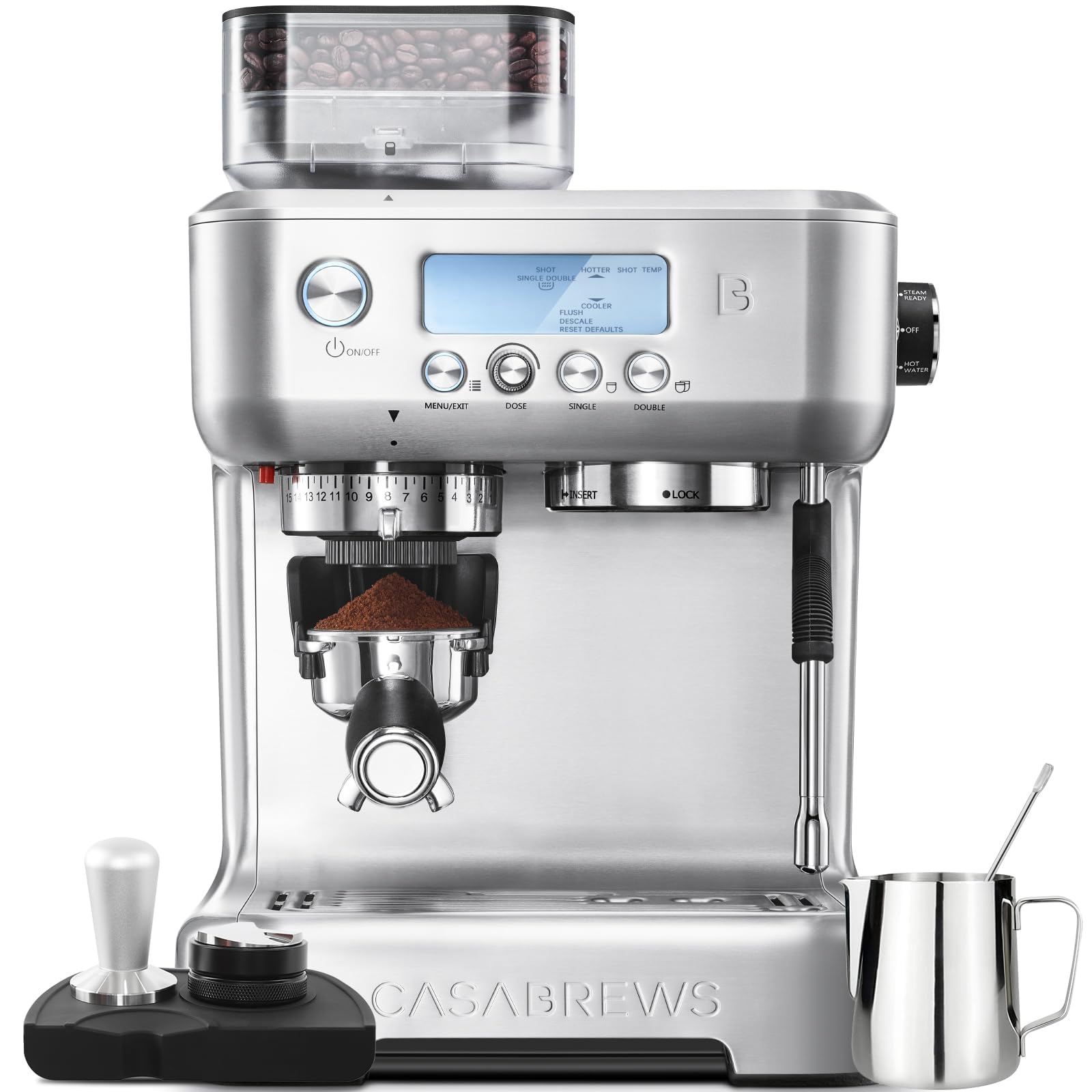
Beans to latte art in one box, with 15 grind settings and a 20-bar Italian pump.
This is the pick for someone who wants everything in one footprint: grinder, brew head and steam wand. A conical burr grinder sits on top and drops fresh grounds straight into the portafilter, with 15 adjustable settings so you can move from a fine espresso grind to something coarser. The pump is a 20-bar Italian unit paired with a 1500W power system, and the LCD screen shows you which pressure zone you landed in so you can adjust the next brew.
Buyers praise the espresso most, with value for money a close second. The D.10 mm steam wand is built for microfoam, and the 91oz detachable tank means far fewer refill trips than the KitchenAid’s 1.4 liters. A dial handles steam, hot water and pre-programmed single or double shots, so you are not hunting through menus mid-brew. It ships with a full kit too — extra replacement grinder, coffee distributor, tamper, tamper mat, milk pitcher and art pen.
Two things to know before you commit. First, this machine has a real learning curve — you will spend the first week dialing in grind and dose, and owners describe it as practice, not plug-and-play. Second, the grinder needs cleaning every 18-25 days to keep performing, and a grinder that bogs down is the fault most likely to appear. When a grinder jammed, CASABREWS shipped a replacement and stayed responsive. The compact brushed body also tucks under cabinets, which matters in a small kitchen.
Reach for this if: counter space is tight and you would rather buy one machine than match a separate grinder to it.
Be ready for: a genuine dial-in period plus a grinder cleaning every 18-25 days to keep the shots consistent.
5. De’Longhi La Specialista Arte Evo Espresso Machine with Coffee Grinder
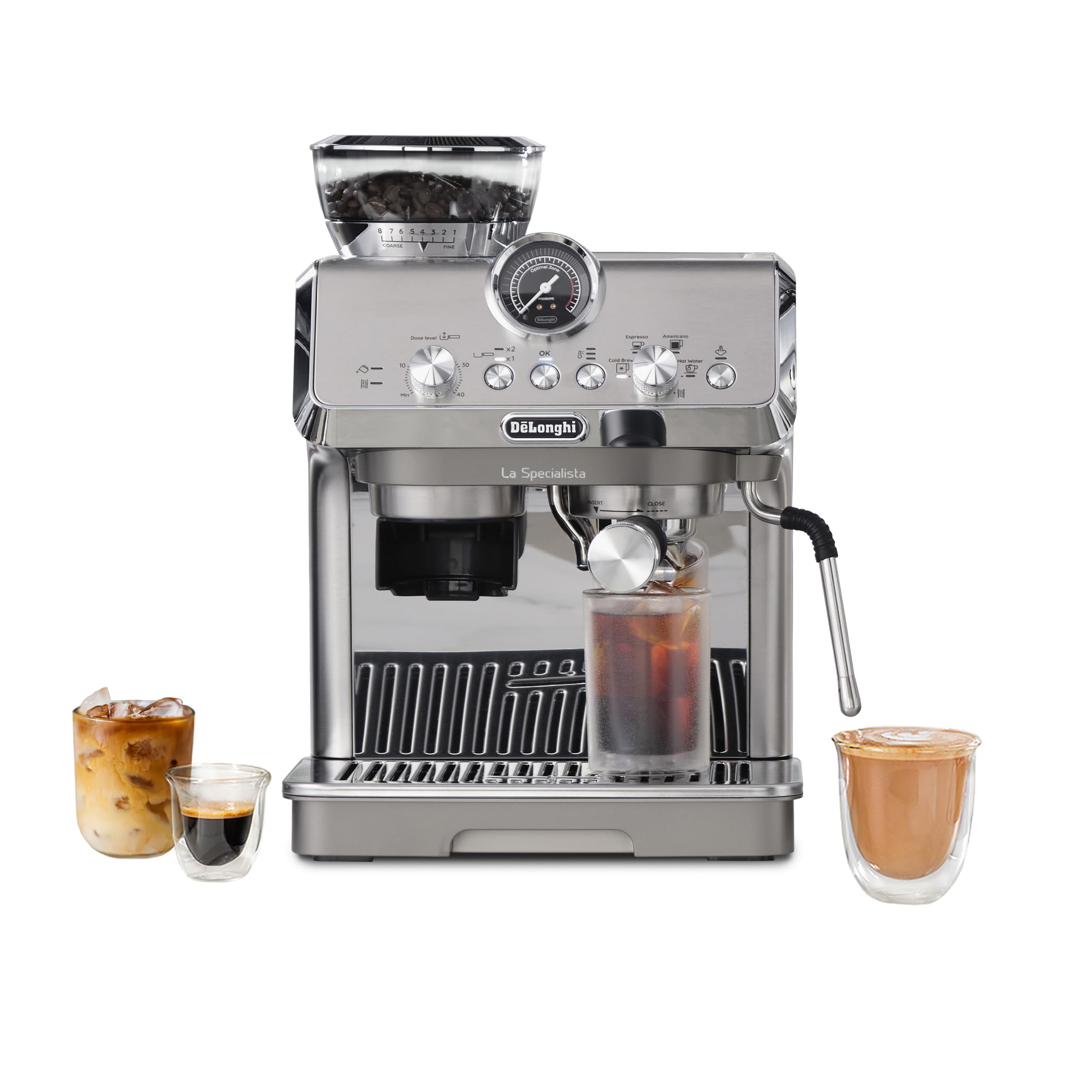
A built-in grinder, a dosing funnel and a tamping mat that turn a beginner into a repeatable brewer.
Beginners who want café drinks without the guesswork tend to land here. The conical burr grinder drops a precise dose for a single or double, and 8 grind settings cover the bean varieties you are likely to try. What makes this machine friendlier than most is the barista kit it ships with — a dosing and tamping guide plus a tamping mat, so you get the pressure consistent instead of eyeballing it. There are 4 presets to start from: Espresso, Americano, Cold Brew and Hot Water.
The 15 bar Italian pump handles the full arc of the brew, dropping to low pressure for pre-infusion and holding the optimal 9 bar during extraction. Active Temperature Control offers 3 infusion temperatures so you can match a lighter roast with a warmer setting and a dark roast with a cooler one. Cold Extraction Technology, developed with the Specialty Coffee Association, brews a single cold brew in under five minutes without the overnight wait. Performance and coffee quality are what owners praise most, with the built-in grinder and the machine’s café-shop looks close behind.
The recurring gripe is the grinder itself. Grinder reliability comes up as a mixed point across reviews — oily dark roasts can clog the burrs over time, and one owner found that after roughly two years the grinder stopped and needed disassembly to clear the packed oils. It is a maintenance task rather than a dead machine, and cleaning it on a routine keeps it brewing. If you drink a lot of very oily beans, plan for that upkeep.
Best matched to: someone who wants a compact all-in-one that guides the dose and tamp so every shot tastes the same.
The upkeep to expect: a built-in grinder that rewards regular cleaning, especially if your beans run dark and oily.
6. Ninja Luxe Café Pro Series ES701

One machine that pours espresso, drip coffee, cold brew and hot water without changing your routine.
Households where one person wants a quad-shot ristretto and another just wants a mug of drip coffee are exactly who this Ninja was built for. It covers 5 espresso styles — single, double, quad, ristretto and lungo — plus 3 drip styles, 2 cold brew styles and an independent hot water system for americanos and tea, all in one body. Drip and cold brew come in seven sizes from 6 up to 18oz, so there is a setting for a travel mug.
The technology doing the heavy lifting is Barista Assist, which watches each brew and recommends a grind size based on how the last one went — it takes the trial-and-error out of dialing in. A conical burr grinder offers 25 grind settings, and a built-in scale enables weight-based dosing rather than grinding for a set time and hoping. The integrated tamper presses your grounds flat with a lever, and the Dual Froth System Pro steams and whisks at once across 5 preset froth functions, including cold foam. Owners praise the performance most, with ease of use a clear second.
The trade to know about is froth consistency — froth performance shows up as a mixed point, so expect a little variance between dairy and plant milk runs. Durability is also a mixed note, though the long-term reports read well, including a machine that ran eight months on a single descaling. At 27.1 pounds it is the heaviest of the value picks here, so find its permanent spot before you fill the 68 fl oz tank.
Why it earns its place: the built-in scale and adaptive grind recommendations mean the machine adjusts to your beans instead of you chasing settings — and the XL milk jug froths for two drinks at once.
The honest read: froth results vary a little with plant milks, and this is a big, heavy machine to park on a counter.
Good fit for: a multi-drinker kitchen that wants espresso, drip and cold brew from one footprint with near-zero guesswork.
Not the pick if: you only ever drink espresso and would rather put the space toward a dedicated machine.
7. De’Longhi La Specialista Opera Espresso Machine with Coffee Grinder

A lever-tamp machine that removes the guesswork but keeps you in charge of every shot.
For the brewer who wants café consistency without a scale and a tamper ritual, this is the elegant answer. Smart Tamping Technology means you pull a lever and the machine tamps the puck evenly — no pressing, no mess, and the same result every time. A built-in grinder with 15 precise settings handles the dose and grind size for a single or a double. The 19 bar Italian pump drops to low pressure for pre-infusion and settles at the optimal 9 bar for extraction.
Three infusion temperatures under Active Temperature Control let you match the water to the beans at the press of a button. A commercial-style steam wand heats fast and delivers steady pressure for smooth microfoam. The 67.6 fl oz capacity is generous, and the machine ships with a full filter set — pressurized single and double, plus unpressurized single and double — so you can move from pre-ground training wheels to real barista baskets. Taste and ease of use are what owners highlight, alongside a build that looks the part on a counter.
The grinder is the honest sticking point. It can jam after a couple of weeks, and clearing it is not a quick fix — the bean bin is not removable, so you may have to tip the whole 28.1-pound machine to empty it. Regular clearing and a coarser setting on oily beans keeps it running. If you would rather never touch a grinder, the guided all-in-ones below sidestep that entirely.
What you gain
- Lever tamping gives you an even puck without a technique to learn
- 19 bar Italian pump with pre-infusion down to 9 bar at extraction
- Ships with both pressurized and unpressurized baskets, so it grows with you
- 3 infusion temperatures and a fast commercial-style steam wand
What you accept
- The grinder can jam after roughly two weeks, and clearing it means tipping a 28.1-pound machine
- Non-removable bean bin makes grinder maintenance more of a chore than it needs to be
- Large footprint takes real counter commitment
The right call when: you want café-level consistency and a proper tamp without learning pressure by feel.
Consider another route if: low-maintenance grinding matters more to you than lever tamping — the all-in-one grinders here behave better with oily beans.
8. Breville BES880BTR Barista Touch Espresso Machine, Black Truffle

A three-step touchscreen that gets you from beans to espresso in under a minute.
The Barista Touch is aimed at someone who wants a café drink without memorizing a brew routine: the screen breaks everything into Grind, Brew and Milk. It packs an integrated precision conical burr grinder, a 54mm full stainless steel portafilter and automatic microfoam texturing that lets you dial in milk temperature and texture. There are 5 pre-programmed café favorites and room to save up to 8 personalized drinks.
The ThermoJet heating system is the headline spec — it reaches precise extraction temperature in 3 seconds, so you are not standing around waiting for a boiler. Water pressure starts low for pre-infusion and rises gradually to draw flavors out evenly, while digital PID regulation holds the brew temperature steady. A 67 oz water tank and 1/2 lb bean hopper keep refills infrequent. Performance is the quality owners talk about most, with value for money a strong second — buyers report it pays for itself against daily café spending.
Reliability is the honest caveat: it is a mixed point in the review record, and there are reports of a machine failing within seven months and of slow warranty service. More commonly, owners mention years of happy daily use, including one who has run it twice a day for three years with no complaints. The steam wand texture is also inconsistent enough that some users take a few tries to nail a stable microfoam, and there is no bottomless portafilter in the box.
Choose this for: a counter with WiFi-router-level confidence about tech — a tap-through touchscreen, saved drinks, and 3-second heat-up.
The trade-off: an automatic steam wand that rewards practice, and a warranty process you may need patience with if something fails.
9. Smeg EGF03 Semi-Automatic Espresso Machine with Built-In Grinder

Fifties curves wrapped around a real 58mm portafilter and a dual thermoblock system.
Some kitchens call for a machine that looks as good as the coffee it makes, and the Smeg answers that with retro 1950s styling in a cream finish. Under the shell it is no decoration: an integrated conical burr grinder adjustable from coarse to super fine, a professional 58mm portafilter with a built-in pressure gauge, and a stainless steel steam wand for microfoam. The dual thermoblock system heats fast and holds stable brew temperatures.
The package is genuinely complete — a cleaning kit, water hardness test strip, stainless steel milk jug and tamper, plus four filters, split into two non-pressurized for grinding and dosing and two pressurized for pre-ground coffee. That means you can start on forgiving pressurized baskets and graduate to real ones. A pull of a single or double shot is a simple button press, and an auto shut-off powers the machine down after inactivity. An app with how-to videos and manuals supports the learning side. Built-in appearance and quality are the two qualities owners appreciate most.
Two things to weigh honestly. Reliability is mixed — some owners have years of smooth service, and others describe the machine stopping or struggling to reach proper brew temperature. One owner reported weak extraction and coffee that never got truly hot, though that is not the common experience. The other note is origin: several buyers expect this to be built in Europe and find it built in China, which is worth deciding on before you order. At 28 pounds, it is also heavy enough to claim a permanent spot.
What it gets right: a retro body that reads like furniture, paired with a real 58mm portafilter, a pressure gauge and a grinder with coarse-to-super-fine control.
What to check: reliability varies and it does not suit someone who wants a machine that heats coffee piping hot on every bean and grind combination.
Made for: the buyer who wants the machine to be the visual centerpiece and does not mind learning its quirks.
Think again if: you are chasing the hottest cup and the most predictable reliability — the guided De’Longhi machines are the safer routine.
10. Breville BES881BSS Barista Touch Impress
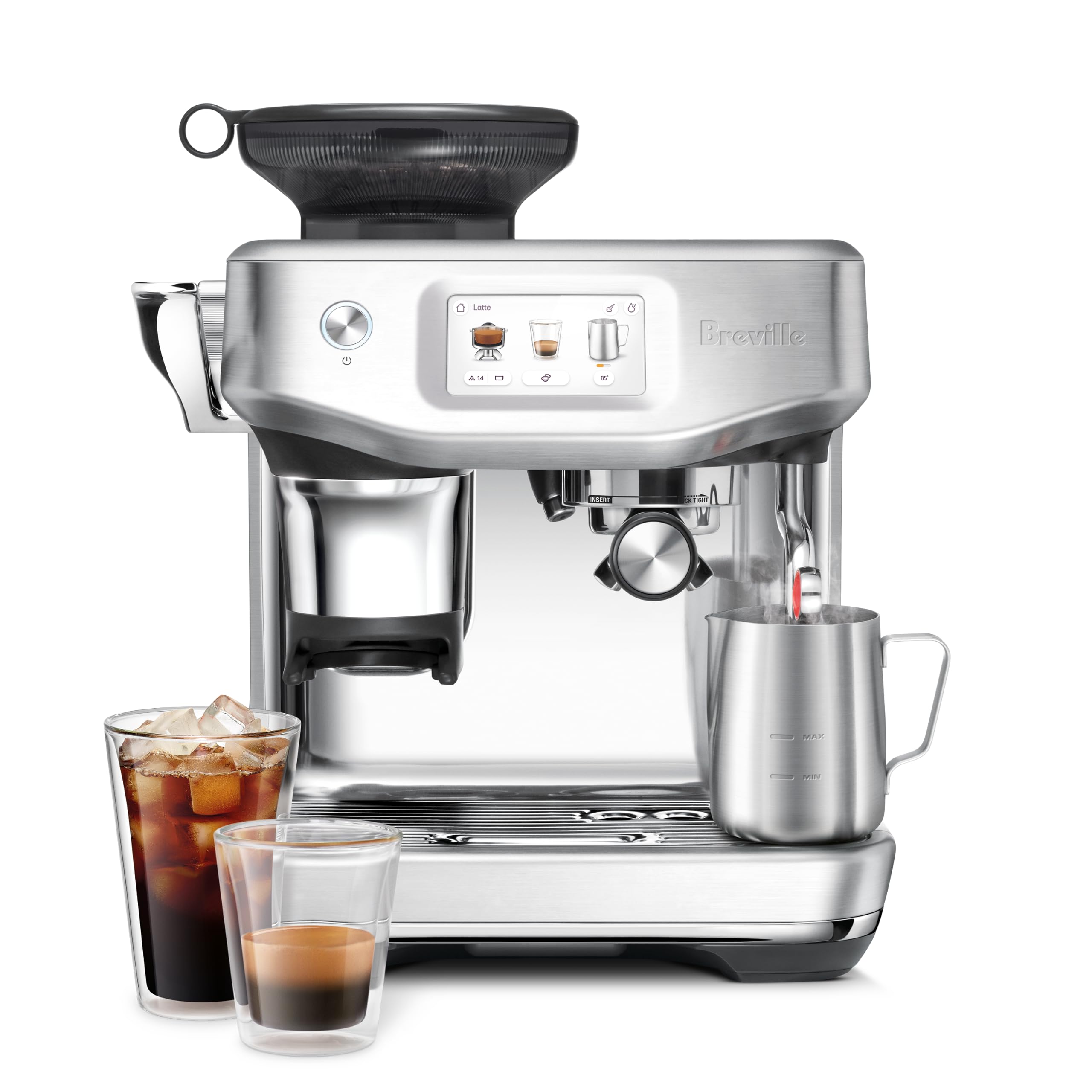
The machine that tamps for you at 22lb and corrects the next dose on its own.
The Impress is for someone who wants café output but hates the tamping step. Its Impress Puck System does intelligent dosing and assisted 22lb tamping, then auto-corrects the next dose based on how the last puck turned out, finishing with a 7º barista twist. The grinder is a Baratza European precision burr unit with 30 grind settings and dose regulation, and the ThermoJet system reaches extraction temperature in 3 seconds.
Auto MilQ lets you adjust milk temperature and texture, and adds three alternative milk settings that calibrate air injection time and temperature for the specific type of milk — so an oat milk latte behaves differently from a dairy one. A Cold Brew function expands the drink range beyond espresso. The touchscreen walks you through 13 café favorite presets with room to customize up to 6 drinks, and step-by-step guidance gives real-time feedback from the puck system. This unit also includes a bottomless portafilter and both single and dual wall filter baskets.
Here is the honest picture. Beginners lean on the step-by-step touchscreen prompts and report lattes that beat the local coffee shop. But the machine asks a lot of your beans and your settings: reliability is a mixed point, durability and grinding performance both draw negative notes, and one experienced user returned it because the grind and dose needed re-calibrating every time the machine powered on, wasting expensive beans. The extra they get is that the dose auto-corrects, which mostly keeps quality on track once you are dialed in.
Why buy it anyway: assisted tamping at 22lb plus a Baratza burr grinder with 30 settings and dose correction makes the puck physics hands-free — you mostly set the drink and let it work.
What long-term owners see: it brews beautifully when dialed in, but recurring re-calibration and warranty headaches frustrate part of the owner base.
Reach for this when: you want the newest automation — assisted tamping, alternative milk calibration and a bottomless portafilter in the box.
Look at the Barista Touch instead if: you would rather hand-tamp on a simpler platform than deal with recalibration every power-on.
Understanding the Specs
What is a portafilter
The portafilter is the handle that holds a metal basket you fill with coffee grounds and lock into the machine. A 58mm commercial portafilter is the enthusiast favorite because the whole upgrade market — precision baskets, tampers, bottomless versions — is built for it. In this guide, the Gaggia Classic Evo Pro, the KitchenAid KES6503, the Gemilai G3006, the Smeg EGF03 and both Breville units use a 58mm basket, while the Barista Touch BES880 uses a 54mm full stainless portafilter and the Impress uses a 54mm stainless portafilter. The commercial single and double baskets inside a 58mm unit are what let a home barista pull café-style shots.
Pumps, pressure and pre-infusion
Pressure does the work of pushing water through your coffee puck. Nine bar at the puck is the commercial brewing standard, and lower pressure at the start draws flavor out evenly before the main extraction — that low-pressure stage is called pre-infusion. Machines here quote their maximum pump figure: the Gaggia quotes 9 bar espresso extractions, the Gemilai and La Specialista Arte Evo run 15 bar Italian pumps, the La Specialista Opera runs a 19 bar Italian pump, and the CASABREWS 5700Pro runs a 20 bar Italian pump. A higher pump number usually sits above the actual brew pressure, which is regulated down to around 9 bar during the pull — treat the pump figure as headroom, not the pressure in your cup.
FAQ
Do I need a built-in grinder or a separate one?
Is 9 bar better than 15 or 20 bar for espresso?
What is the difference between a pressurized and an unpressurized basket?
How long does a home espresso machine usually last?
Can I use pre-ground coffee instead of whole beans?
How often should I clean a built-in grinder?
Does a steam wand really matter for lattes?
Can I brew cold brew with these machines?
Do I need to preheat the machine before pulling a shot?
Should I use filtered or bottled water in my espresso machine?
Final Thoughts: The Verdict
For most home baristas, the best barista espresso machine winner is the Gaggia RI9380/49 Classic Evo Pro because it brews at a true 9 bar through a 58mm commercial portafilter, ships in full stainless steel, and stays modifiable for years. Its 58mm portafilter and uncoated aluminum boiler keep it modifiable for years. If guided brewing is what you want and you would rather the machine teach you, the De’Longhi La Specialista Arte Evo pairs a built-in grinder with a dosing and tamping guide and brews cold brew in under five minutes. And for a multi-drinker kitchen pouring espresso, drip and cold brew from one footprint, the Ninja Luxe Café Pro ES701 is the one to reach for — its built-in scale and Barista Assist grind recommendations keep the guesswork out. All three brew at 9 bar through a real portafilter, so the cup in your kitchen matches a good café’s.
How We Picked
We do not accept paid placement. Every pick is matched to a real buyer and a real use-case; we do not hands-on test units.
Sources & Methodology
Specifications: manufacturer listings and product documentation. Review insights: verified customer reviews, as of September 2026. Pricing: not shown on this page (it changes often); check the current price via the retailer link.
As an Amazon Associate, KitchPrep earns from qualifying purchases. This does not affect which products we feature.
Related Guides
