
Specs are compiled from manufacturer listings and verified buyer reviews and can change over time — please confirm the key details on the product page before buying.
Before you buy a barbecue grill smoker, answer one question: what do you want to cook? Wood pellets give you push-button temperature control and near-hands-off cooking. Charcoal and propane give you old-school smoke and the ability to run for fourteen hours on one load. Get the fuel right and the rest — cooking space, build weight, app connectivity — follows. Get it wrong and every cook becomes fire management instead of cooking.
I’m Mohammad Maruf — the founder and writer behind KitchPrep. This guide is built by comparing the manufacturers’ published specifications and the patterns across verified customer reviews, so you get each pick’s real strengths and trade-offs instead of marketing spin.
Below are eleven cookers, from compact charcoal drum smokers to a Wi-Fi pellet rig that fits six chickens. Each one earns its place on a different job, and each has a real catch worth knowing before you commit. A pellet grill does not magically make you a pitmaster — it changes the job from tending coals to planning cooks, and this guide shows you exactly where barbecue grill smoker fire management still matters most.
Our Picks at a Glance


How To Choose The Best Barbecue Grill Smoker
Choose fuel before size. A pellet hopper that holds 225°F overnight is a different machine from a charcoal offset you feed splits every 45 minutes. Decide which of those two cooks you want, then shop the specs that support it.
Pellet, Charcoal, Or Propane
Pellet grills burn compressed hardwood sawdust fed by an auger (a screw that pushes pellets from the hopper into the fire pot). Set a temperature on the controller and the grill feeds itself — that is what buys you a hands-off brisket. Charcoal and wood splits give you the sharpest smoke flavor and the most control over draft and airflow, but you load and tend the fire yourself. Propane is the odd one out: a burner supplies heat while wood chips sit in a pan above it, so you get smoke flavor with gas-level convenience and no ash to shovel.
Cooking Space And Layout
Total square inches almost never tell the whole story. A barrel-shaped unit might list a big combined number, split across primary grates, a warming rack, and a separate offset firebox. A well-used warming rack holds ribs at holding temperature, not a full brisket. A tall vertical chamber stacks several removable racks so you can cook for a crowd without spreading out sideways — useful when your patio is small but your guest list is not.
Build Weight And Heat Retention
The 226-pound Longhorn holds temperature steadier than the 66.5-pound Masterbuilt, which needs more vent adjustments in wind and cold. Thicker steel wall soaks up heat and releases it slowly, which shortens how often you adjust vents or refill a hopper. Thicker steel wall soaks up heat and releases it slowly, which shortens how often you adjust vents or refill a hopper. The trade-off is moving day — a 226-pound offset smoker is not something you roll onto a trailer alone. Match the weight to how often you actually plan to relocate the thing.
Quick Comparison
| Model | Best For | Fuel | Cooking Area | Weight | Amazon |
|---|---|---|---|---|---|
| Traeger Ironwood 650★ Best Overall | Family cooks, remote monitoring | Wood Pellet | 650 sq in | 147 pounds | Amazon |
| Royal Gourmet 30-Inch Charcoal GrillBudget Champion | Budget offset smoking | Charcoal | 811 sq in | — | Amazon |
| Masterbuilt MPS 230SCompact Pick | Compact propane smoking | Liquefied Petroleum Gas | Four racks | 66.5 pounds | Amazon |
| Char-Griller E5030 Dual-Function | Gas-and-charcoal flexibility | Gas and Charcoal | 870 sq in | — | Amazon |
| Oklahoma Joe’s Bronco 18 in. | Small-footprint charcoal smoking | Charcoal | 284 sq in | 136.5 pounds | Amazon |
| Z GRILLS ZPG-7002B | Large-capacity budget pellets | Wood Pellet | 700 sq in | 135 pounds | Amazon |
| Captiva Designs XL Smoker Grill | Backyard gatherings | Charcoal | 941 sq in | 123 pounds | Amazon |
| Oklahoma Joe’s Longhorn Reverse Flow | Serious offset smoker cooks | Charcoal | 1060 sq in | 226 pounds | Amazon |
| Pit Boss 850 Navigator | App-connected pellet cooks | Wood Pellet | 932 sq in | 175 pounds | Amazon |
| Traeger Woodridge | Mid-size pellet cooking | Wood Pellet | 860 sq in | — | Amazon |
| recteq Patio Legend 600 | Small-patio high-heat pellet searing | Pellet | 600 sq in | — | Amazon |
In-Depth Reviews
1. Traeger Ironwood 650 Wood Pellet Grill & Smoker, 650 Sq In, WiFi
Our pick — over 4.5★ from 550+ verified ratings; the strongest balance of quality and price.
The 147-pound pellet grill that holds temperature while you get on with your evening.
If you want to cook a rack of ribs at 225°F without standing over the fire, the Ironwood 650 is the pick to beat. It runs on wood pellets instead of gas or charcoal, so you fill a hopper and let the controller feed the fire for you. Six cooking modes — grill, smoke, bake, roast, braise, and barbecue — come off the same set of porcelain grates, which wipe down easily after a sticky cook. The 500°F ceiling is hot enough for a real sear at the end of a smoke, and the built-in meat probe (a wired thermometer you leave in the meat) reads internal temperature right on the app.
What wins owners over is the performance itself — steady heat and reliable results cook after cook, with assembly commonly knocked out in twenty minutes. Buyers report “Assembled in 20 min. Seasoned 30min@300 then 20min@500,” which tells you how quickly a first cook gets underway. The 650 square inches fit eight chickens, five rib racks, or six pork butts, so a full family cook does not need a second grill. Super Smoke mode adds extra wood flavor but only engages at or below 225°F, so it is a low-and-slow tool rather than an all-purpose switch.
Here is the trade-off. The WiFIRE connection links to home Wi-Fi and the Traeger app, and the grill wants a 2.4GHz band — if your router splits its bands, you may have to separate them before the app finds the grill. Durability is the second thing to know: the bulk of owner experience points to solid build quality, but a handful of units have failed early, which is worth keeping the warranty in mind for. Compared to the Masterbuilt MPS 230S, this Traeger weighs 147 pounds against 66.5 pounds — a 2.2x gap — so it is a set-it-and-leave-it cooker rather than a lift-and-go one.
Where It Wins
- Hands-off 225°F smoking with app temperature tracking and probe alerts
- 650 sq in of porcelain grates — eight chickens or five rib racks at once
- 20-minute assembly and a quick season cycle before the first cook
Where It Asks Something Back
- Wi-Fi setup wants a 2.4GHz band, which can mean splitting your network
- 147 pounds means a permanent spot on the patio rather than a portable cooker
- Super Smoke only works at or below 225°F, so high-heat cooks skip it
Reach for this if: you want family-sized capacity and cooker-grade temperature control without feeding a fire all afternoon.
Look elsewhere if: you plan to move the grill between the deck and the tailgate, or you want deep offset-smoker smoke rather than clean pellet flavor.
2. Royal Gourmet 30-Inch Charcoal Grill with Offset Smoker, Wood-Painted Table
Real offset smoke on a family budget, with 811 square inches spread across three cooking zones.
This is the entry point into proper charcoal smoking. The 30-inch barrel gives you 443 sq in of porcelain-enameled cooking grates, a 184 sq in chrome-plated warming rack above them, and a 184 sq in offset firebox on the side — add those up and you get 811 square inches of working space. Heat output is 18,000 BTU (British thermal units, a measure of heat energy). The side fire box is where the smoke happens: burn charcoal there and the smoke travels over the food in the main chamber, which is exactly the low-and-slow setup that produces a real smoke ring. The 2-level height-adjustable charcoal pan holds up to 4.4 lbs of coal and lets you raise or drop the coal bed for finer heat control, and the lid-mounted thermometer tracks what is happening inside without lifting the lid.
What buyers like most about this one is the value — that is far and away the reason it keeps selling, followed closely by how straightforward it is to put together. Prep space is generous, with a wood-painted front table and a side table plus three “S” hooks for tools. A mesh bottom shelf holds up to 20 lbs of accessories distributed evenly, so charcoal bags and utensils stay off the ground. As one owner put it: “Perfect Father’s Day gift for our small family of 5 … put it together myself in less than 2 hours!”
The honest catch is sturdiness. The steel here is lighter than a premium offset, and sealing the barrel-to-firebox joint with gasket tape is a common upgrade owners make for better heat retention. If you want the flavor of offset smoking without the price tag, this delivers; if you want a cooker that shrugs off a cold snap, look further up this list.
Value read: 811 sq in, an 18,000 BTU fire, and a real offset firebox at entry-tier money is a lot of smoker for the outlay.
Set expectations: expect to seal the seams with gasket tape and treat it as a fair-weather smoker.
Worth grabbing when: you are new to charcoal and want to learn offset smoking without overspending.
Think twice when: you need the smoker to hold heat through a windy winter — a heavier build earns its keep there.
3. Masterbuilt MPS 230S Propane Smoker, 30″, Black
Propane convenience in a 66.5-pound footprint small enough for a narrow patio.
If you smoke on a balcony or a small patio, size decides your shortlist before anything else. This Masterbuilt runs on liquefied petroleum gas (standard propane) through a 15,400 BTU (British thermal units, a measure of heat energy) stainless-steel burner, and its 66.5-pound frame measures 20.47″D x 20.87″W x 43.5″H — pygmy numbers next to the Traeger Ironwood 650’s 27″D x 46″W x 48″H at 147 pounds. For scale, that Traeger occupies 32% more depth-by-width footprint. Four chrome-coated smoking racks stack vertically, so you smoke several batches at once without spreading out sideways. A push-button ignition lights the burner without a match, and a patented porcelain-coated flame disk bowl lets flame reach the wood chips while shielding the burner from grease drips.
Owners praise the build quality above all, and propane smoking removes the ash-shoveling that charcoal demands. The flavor is milder than charcoal, but you get smoke with gas-level ease — a 7-pound pork shoulder comes out tender in about 7 hours at around 250°F. The built-in temperature gauge sits on the door, and one satisfied buyer described firing it up at 10:30 in the morning and pulling “mouth watering ribs” 5.5 hours later with the temperature holding steady all day.
Now the caveats, and they are worth reading carefully. Temperature control earns mixed marks — plenty of cooks get a steady reading, but some report it running hotter than the dial suggests, so adding a cheap digital thermometer to double-check is sensible. Flame control is the other split opinion: the vast majority of units behave, but a few arrive with a faulty regulator that leaks, which is a safety issue, not a cooking one. Check the regulator connection on arrival, and this is a genuinely handy patio smoker. It simply rewards a little attention on the first burn.
Best fit: small-space cooks who want a vertical rack stack and propane simplicity rather than charcoal work.
The safety note: inspect the regulator on delivery and add a digital thermometer to cross-check temps.
Buy it when: space is tight, propane is your fuel, and you want four racks without a big footprint.
Pass if: you want the deepest charcoal smoke or already have room for a full-size offset.
4. Char-Griller Dual-Function 2-Burner 24,000 BTU Propane Gas and Charcoal Combination Grill and Smoker
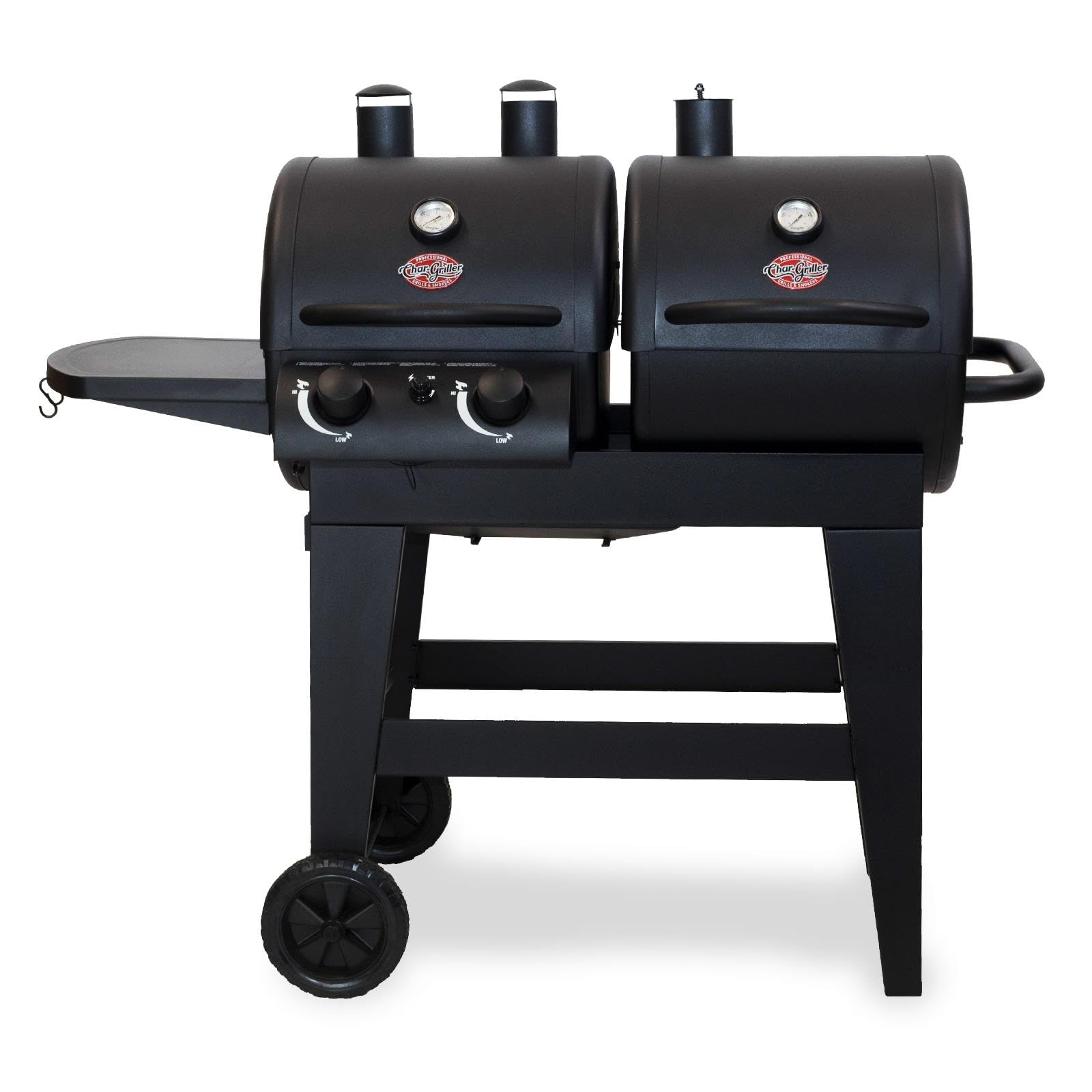
One cart, two fuel sources: gas on the left chamber, charcoal on the right.
For anyone who cannot decide between gas and charcoal, the Char-Griller E5030 skips the decision. One chamber runs on propane, the other on charcoal, and both sides light off an electronic ignition at the press of a button. The propane side holds two stainless steel main burners with a combined 24,000 BTU output, which is what lets you sear a steak over high heat on one side while the charcoal side runs lower for ribs. Total cooking space is 870 square inches, enough for a serious cookout, and porcelain-coated cast iron grates hold heat well and clean up without scraping. An EasyDump Ash Pan lets you clear the charcoal side without dismantling anything, and dual temperature gauges let you watch both chambers separately.
What owners value most is the quality of the build for the tier — that is the standout theme — followed by the sheer flexibility of dual fuel. In charcoal mode it holds smoke well; in gas mode you can reheat or cook vegetables without waiting on coals. The substantial weight and high-gauge sheet metal signal a unit meant to last, and most report it going together easily even though the assembly manual would have you believe otherwise.
The one thing to plan for is temperature management. The gas side puts out a lot of heat even at its lowest setting — running both burners low lands around 350-375°F, and both high hits 500°F — while the charcoal side can be tricky to keep below 400°F. That is a feature in the hands of someone who wants searing power, and a wrinkle for anyone chasing a long 225°F smoke on the charcoal side. Buy a cheap digital thermometer to cross-check the dial and you will get plenty from this combo.
Loves the flexibility: 870 sq in and two fuel choices on one cart suits a household that grills weeknights and smokes weekends.
Watch the heat: low-and-slow on the gas side takes practice because the burners run warm even at their lowest.
Go for it when: you want both fuels in one purchase and value a sturdy frame over a single-purpose cooker.
Skip it when: gas temperature control is your top priority — the burners run hotter than a dedicated smoker at the low end.
5. Oklahoma Joe’s Bronco 18 in. Heavy Duty Charcoal Drum Smoker and Grill
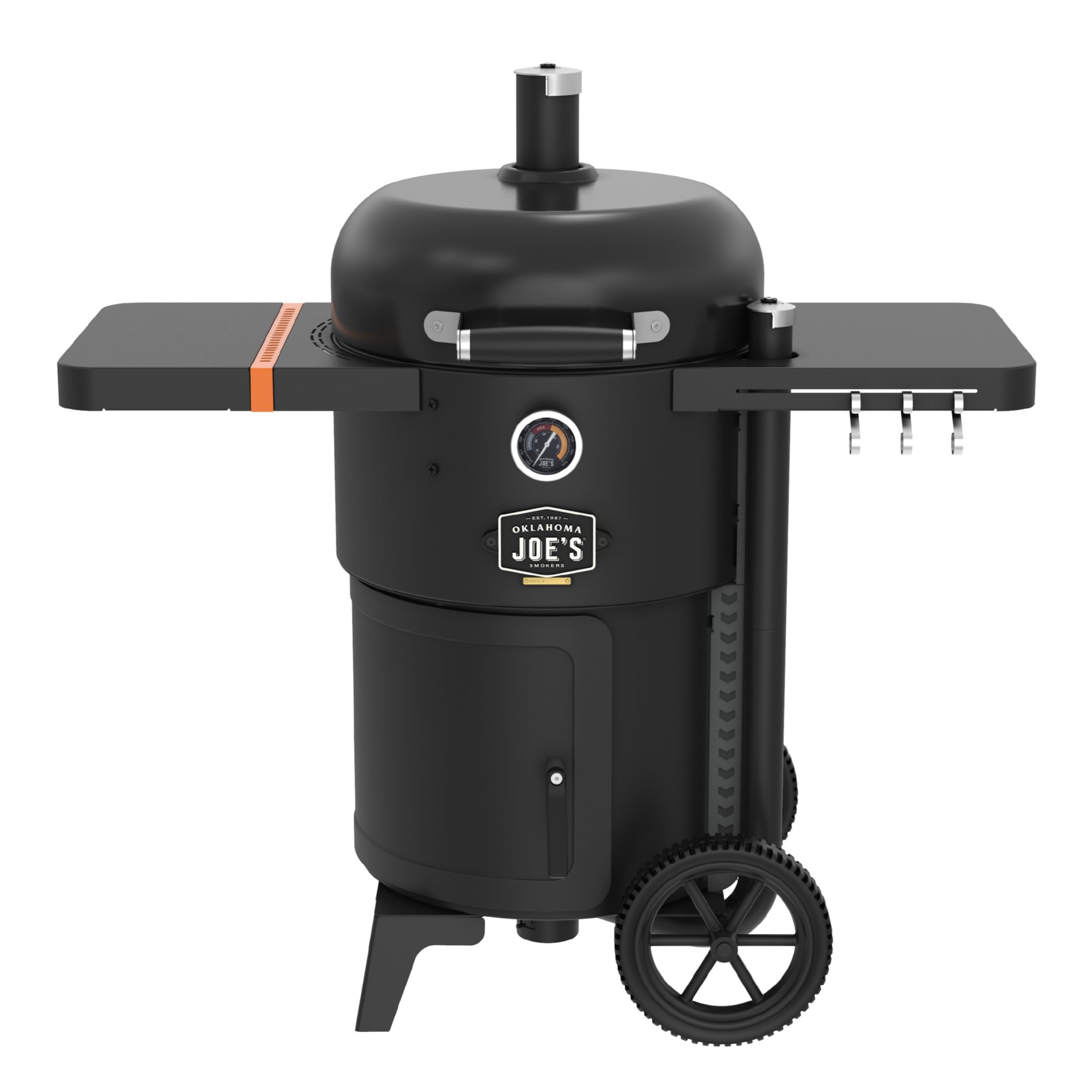
Award-recognized drum smoker that burns for 14+ hours on one charcoal load.
Recognized as the 2025 Men’s Journal Grilling Awards Best Overall Smoker, the Bronco 18 does one thing better than most cookers here: it holds fire for a very long time. The drum holds up to 8 lb of charcoal and wood, which supports 14+ hours of uninterrupted smoking — enough to sleep through an overnight brisket. Its 284 sq in of cooking space carries a rib hanger kit with 9 meat hooks and 3 hangers, so you can hang ribs vertically and cook more cuts in the same footprint. It weighs 136.5 pounds and stands on dual side shelves with steel-core rubber-tread wheels, so it rolls around a patio without much effort.
The thing everyone raves about is the performance — clean, steady smoke and no electronics to babysit. Temperature control is the runner-up strength: a purpose-built airflow system with an industry-leading fuel door lets you add charcoal or wood without removing food or grates, which keeps heat and smoke going through a long cook. The barrel is fully gasketed to seal in heat. Most find it easy to set up, though a first-time builder might lean on a video for the air intake shield; sealing the seams with RTV gasket material is a popular refinement that tightens up any smoke leaks.
The honest limit here is grill space. At 284 sq in, this is a compact cooker, and while the rib hanger adds vertical capacity, anyone feeding a big crowd will wish for more room. Some also find the grate handles eat into the usable surface. As a smoker-first, grill-second cooker for a small household or a tailgater, though, it punches well above its footprint — several owners rate it ahead of their pellet grills for flavor.
The 14-hour case: load 8 lb of charcoal once and a long cook runs on its own through the night.
The size trade: 284 sq in is compact; hang ribs on the kit to make the most of it.
Pick this when: you want serious flavor and overnight cooks in a smoker that takes up about half the space of a traditional offset.
Don’t pick this when: you regularly feed a crowd and need large horizontal cooking area.
6. Z GRILLS ZPG-7002B Pellet Smoker Grill with PID Control, Rain Cover, 700 sq. in Cooking Area

700 square inches of pellet cooking and a rain cover included, at a value-tier outlay.
If capacity per dollar is your scoreboard, the ZPG-7002B plays hard. You get 700 sq in of cooking surface — enough for 30 burgers, 6 rib racks, or 5 chickens — plus a rain cover and a grease bucket in the box. It runs on wood pellets through a PID controller (a proportional controller that constantly nudges the auger speed to hold your target temperature), which is the same control technology the pricier pellet rigs use. The 8-in-1 cooking modes cover smoking, baking, roasting, searing, braising, barbecuing, and char-grilling, so it doubles as an outdoor oven. Z GRILLS backs it with a 3-year quality assurance and a phone-and-online support team.
Owners find plenty to love about the quality of the build and the even cooking — those two themes lead everything else in the feedback — and the smoke flavor it produces earns consistent praise. It is a light, easy-to-move unit at 135 pounds, and the outdoor powder-coated steel keeps it looking sharp through the seasons.
The recurring gripe is the electronics. Temperature control gets split reviews — plenty of cooks report tight, stable heat, while others run into instability. This is a controller that sometimes needs a firmware-grade fix; Z GRILLS support has a track record of sending upgraded control boards, and that sorts most of the complaints, though the process can take a few weeks. The build is also on the lighter side, so it does not seal as well as heavier steel in cold weather. Buy it for the cooking space and the flavor; budget a little patience for the electronics.
Space vs. price: 700 sq in and 8-in-1 versatility is a lot of grill for the tier, and the rain cover keeps it usable year-round.
The honest wrinkle: controllers on some units need a support-replaced board, so factor in a call if temps drift.
Choose this when: you want big-capacity pellet cooking and are comfortable contacting support if the controller acts up.
Look past it when: you want a set-and-forget controller that never needs a replacement board.
7. Captiva Designs Smoker Grill Extra Large Outdoor Charcoal Barbecue Grill

941 square inches and a three-zone layout built to feed a full backyard party.
Total cooking area is the headline here: 941 sq in across three distinct zones. There is a 551 sq in primary smoking area for big cuts, a 198 sq in removable warm grate above it, and a 192 sq in offset firebox with its own direct-smoking area — so you can smoke a brisket, hold food warm, and grill sides without shuffling anything. The steel is genuinely heavy: body steel reaches 1.2mm thick with lids at 3mm, and the whole unit weighs 123 pounds. That mass is not wasted — it holds heat steadier and stands more stable in wind. An integrated smoking chamber with a grooved lid keeps smoke inside longer than a segmented body, and enamel-coated cooking grates clean up without scrubbing.
What performs consistently for owners is the heat retention and temperature stability, and the cooking space earns strong marks on top of that. The offset firebox is the piece buyers appreciate most — it improves temperature control and cuts down flare-ups by keeping the fire away from the food. It also converts to a straight charcoal grill with the included grates, so it works as a smoker and a griller in one frame. Enamel grates and the stainless warm rack both shrug off high heat, and the built-in lid thermometer helps you track fluctuations without lifting the lid.
Assembly on a unit this size is the task to plan for — expect to set aside real time and possibly a helper, since the steel is heavy. Once it is together, though, it is one of the sturdiest charcoal smokers at this size for the money, and families cooking for a crowd find the three-zone layout genuinely useful. It is a big footprint, so measure your patio first.
Space to spare: 941 sq in across three zones lets you smoke, warm, and grill all at once.
Bring a friend: 123 pounds of steel is great for heat retention and a two-person job to assemble.
Matches best with: hosts who cook for groups and want smoking plus grilling in one heavy-duty frame.
Not for: anyone short on patio space or shopping for a smoker that assembles solo in under an hour.
8. Oklahoma Joe’s Longhorn Reverse Flow Offset Charcoal Smoker and Grill, 1060 sq. in.

A 226-pound reverse-flow offset for cooks who want to run a real stick burner.
This is the serious one. The Longhorn is a reverse-flow offset smoker: smoke from the firebox runs under a baffle plate and back across the meat before venting, which smooths out the hot spots a traditional offset can leave right above the fire. Four baffles locked beneath the grates distribute heat and smoke evenly across the chamber. On capacity, you get 751 sq in of primary cooking space plus 309 sq in of secondary space — 1060 sq in total — so multiple large cuts go on at once. A professional temperature gauge tracks the cook, and an oversized charcoal basket supports a steady burn for longer cooks with less tending. Cool-touch handles protect your hands during long sessions, and wagon-style wheels let you roll the whole thing around.
The quality of the build is where it shines — heavy-gauge steel, consistent left-to-right temperatures thanks to the reverse-flow design, and a cook chamber that handles briskets and whole hogs in any weather. Smokers report temperature swings under 10°F from one side of the chamber to the other when it is dialed in, which is what reverse flow buys you. It arrives mostly pre-assembled, which takes an edge off the setup for a cooker this size.
Two things to know before you commit. The first is paint: the firebox runs hot enough that bubbling or peeling is a common touch-up task, and high-temp paint is a routine maintenance item. The second is size and weight — at 226 pounds, it is a stationary cooker that wants a permanent patio spot. Owners also commonly seal the firebox and lid with silicone and gasket tape to tighten the fit, part of running a stick burner well. If you want true offset flavor, this earns it.
What it delivers: reverse-flow evenness and 1060 sq in of capacity for competition-style cooks.
The stick-burner tax: expect to touch up the firebox paint and seal the seams as routine upkeep.
Suits: dedicated pitmasters who tend hardwood splits and want even heat across a big cook chamber.
Mismatch if: you want no-touch cooking or a smoker you can move without a second person.
9. Pit Boss 850 Navigator Series WiFi & Bluetooth Wood Pellet Grill & Smoker
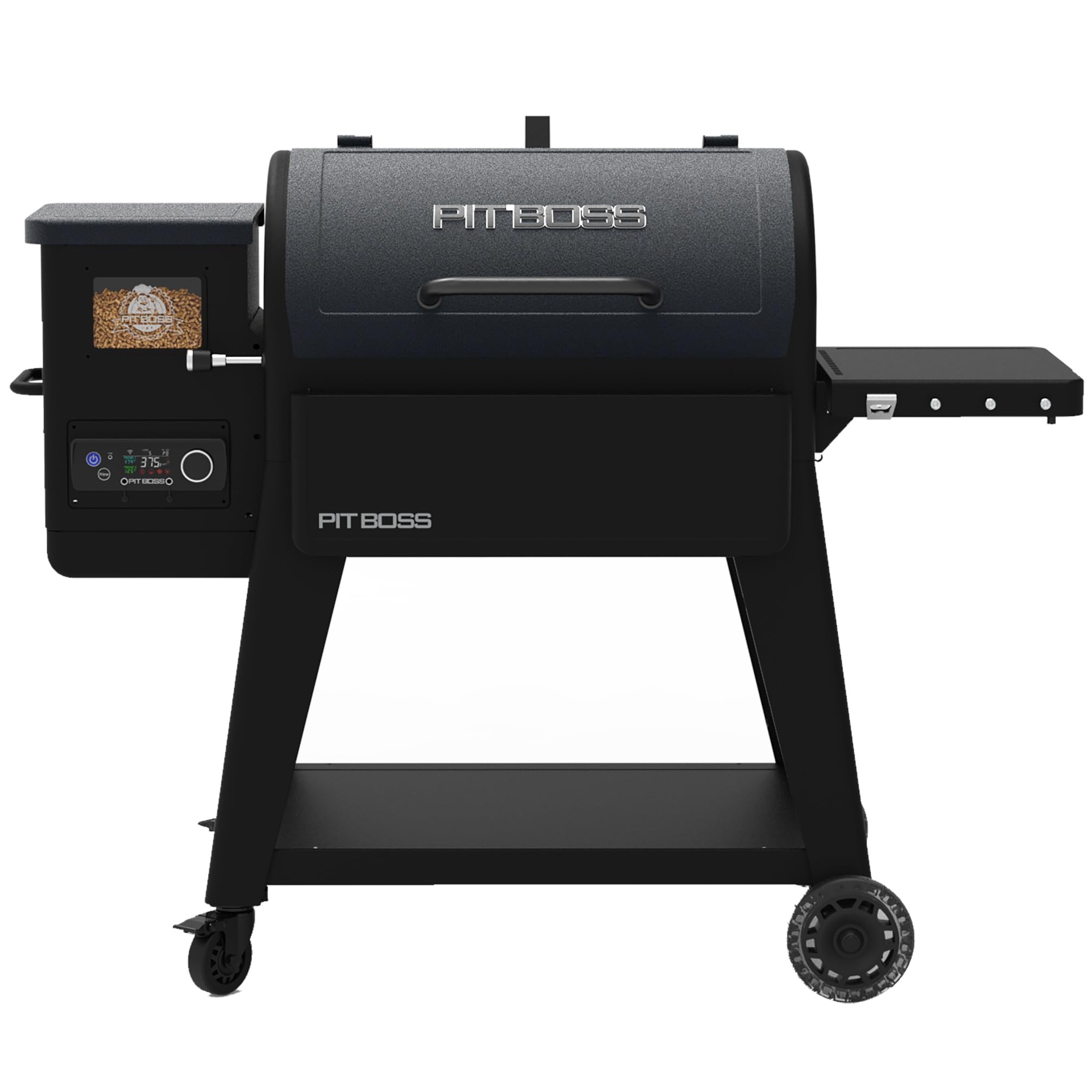
A 30 lb hopper with a viewing window, so you can see when the pellets run low.
Big cooks need big fuel. The Navigator 850 carries a 30 lb hopper with a built-in window, which means fewer refills when you are running a long brisket on 932 square inches of cooking surface. It runs from 180°F to 500°F on 100% hardwood pellets, uses fan-forced convection (a fan that moves hot air evenly around the chamber) to keep indirect heat consistent, and includes two meat probes so you can track two pieces of meat at once. Wi-Fi and Bluetooth both connect, which is what gives you app reads and quick temperature adjustments from inside the house. There is a folding front and side shelf for prep, tool hooks, and a bottom shelf for pellets and accessories. Pit Boss backs it with a 5 year warranty.
Owners describe it as sturdy and simple to run, and the app plus the shutdown cool-down mode earn strong marks on convenience. The heavy lid seals tightly with a good gasket, which helps hold heat. A note on assembly: it is a two-person job at a couple of points, and the instructions leave room for improvisation — building the base and legs separately before bolting them to the unit reportedly saves around an hour of frustration.
The honest knock is weight. At 175 pounds this is not a portable grill, and if you want to move it around the yard or load it for tailgating, it will not make that easy. It is also a heavier investment than the value-tier pellet rigs on this list, so the question is whether the 30 lb hopper, dual probes, and 932 sq in justify the step up. For heavy pellet users who cook for crowds, it earns its keep.
Built for volume: a 30 lb hopper, 932 sq in, and dual probes handle several large cuts in one cook.
The weight reality: at 175 pounds it wants a fixed spot on the patio — plan the assembly location before you start.
Right for: pellet cooks who value app connectivity, long hopper runs, and a 5 year warranty.
Wrong for: anyone who wants to move the grill between locations, or wants a value-tier pellet setup.
10. Traeger Woodridge Wood Pellet Grill & Smoker, 860 Sq In, WiFi
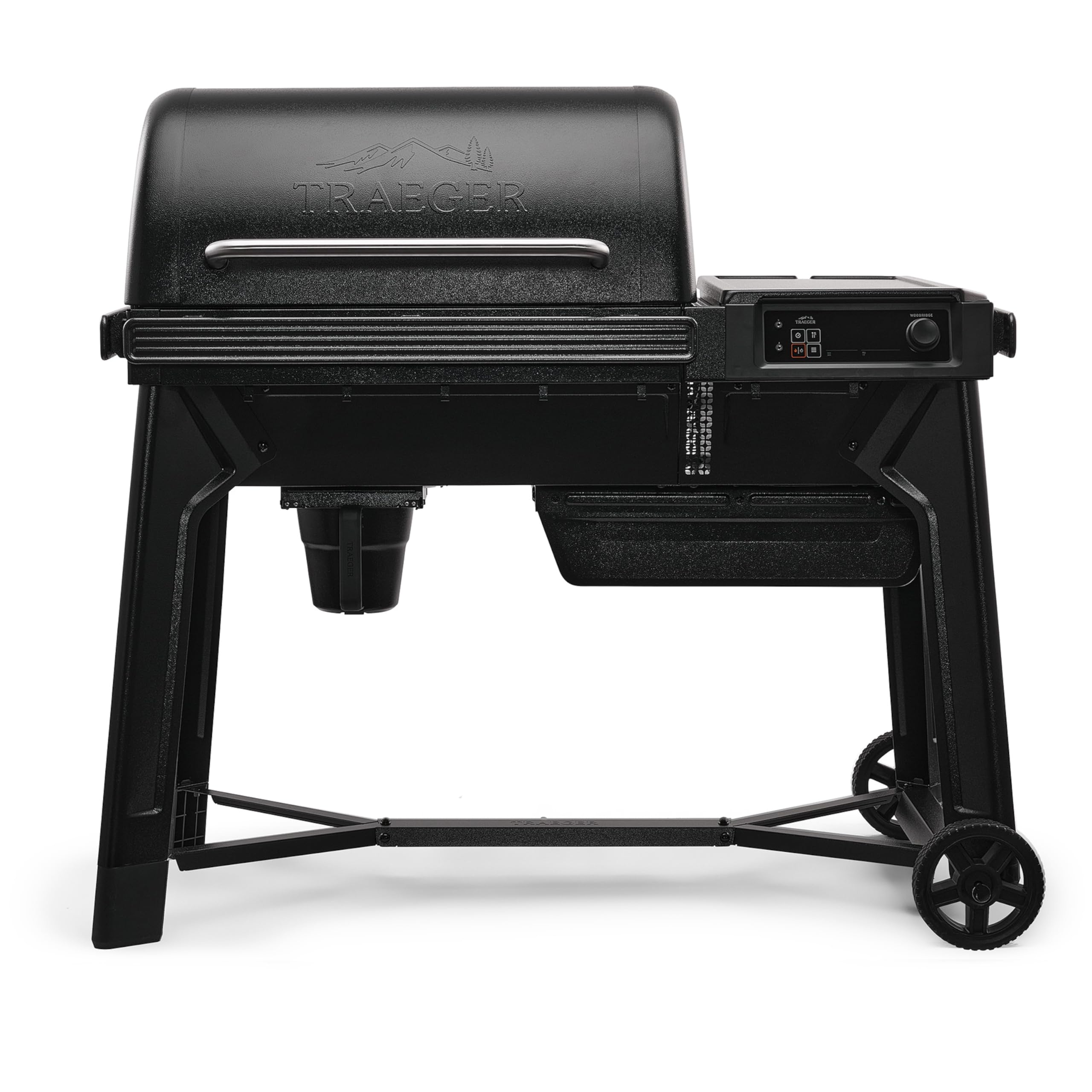
An 860 square inch pellet grill that collects ash and grease in one place for fast disposal.
Cleanup is the Woodridge’s calling card. An EZ-Clean Grease & Ash Keg gathers drippings and ash together so you empty one container instead of scraping two surfaces, and it keeps the cooker ready for the next session with minimal fuss. Cooking capacity is 860 square inches — room for 6 chickens, 8 rib racks, or 6 pork butts — and the temperature range runs 180°F to 500°F, controlled and monitored remotely through the Traeger app. Six cooking modes (grill, smoke, bake, roast, braise, and BBQ) cover everything from weeknight dinners to holiday roasts, and P.A.L. Pop-And-Lock compatibility lets you snap on Traeger accessories like shelves and hooks without drilling.
What performs well for owners is the grill’s overall cooking quality, and the temperature control holds steady across cooks. The app earns praise for convenience — pulling up a recipe, tracking a probe, and adjusting temperatures from the phone is the routine. On durability, the Woodridge holds up on an outdoor patio as long as you keep a cover on it, and it uses a meat probe right from the start.
Two caveats worth knowing. First, the controls take a bit of getting used to, so budget the first cook for a learning curve. Second, this is the more modest of the two Traeger models on this list — it does not include Super Smoke and heats up more slowly than the Ironwood 650, though it does step up in cooking area to 860 sq in. Buy it if cleanup and app control matter most; look at the Ironwood if you want the faster heat-up and Super Smoke mode.
The easy-clean win: the EZ-Clean Grease & Ash Keg does the one-chore pellet cooking usually leaves you with.
The step-down: no Super Smoke and a slower heat-up than the Ironwood 650 — trade-off for the bigger 860 sq in area.
Made for: cooks who want a bigger pellet grill and hate scraping ash and grease separately.
Not for: buyers who want the fastest heat-up and the Super Smoke mode — the Ironwood has both.
11. recteq Patio Legend 600 Pellet Smoker with WiFi & App Connectivity, 180° to 700°+
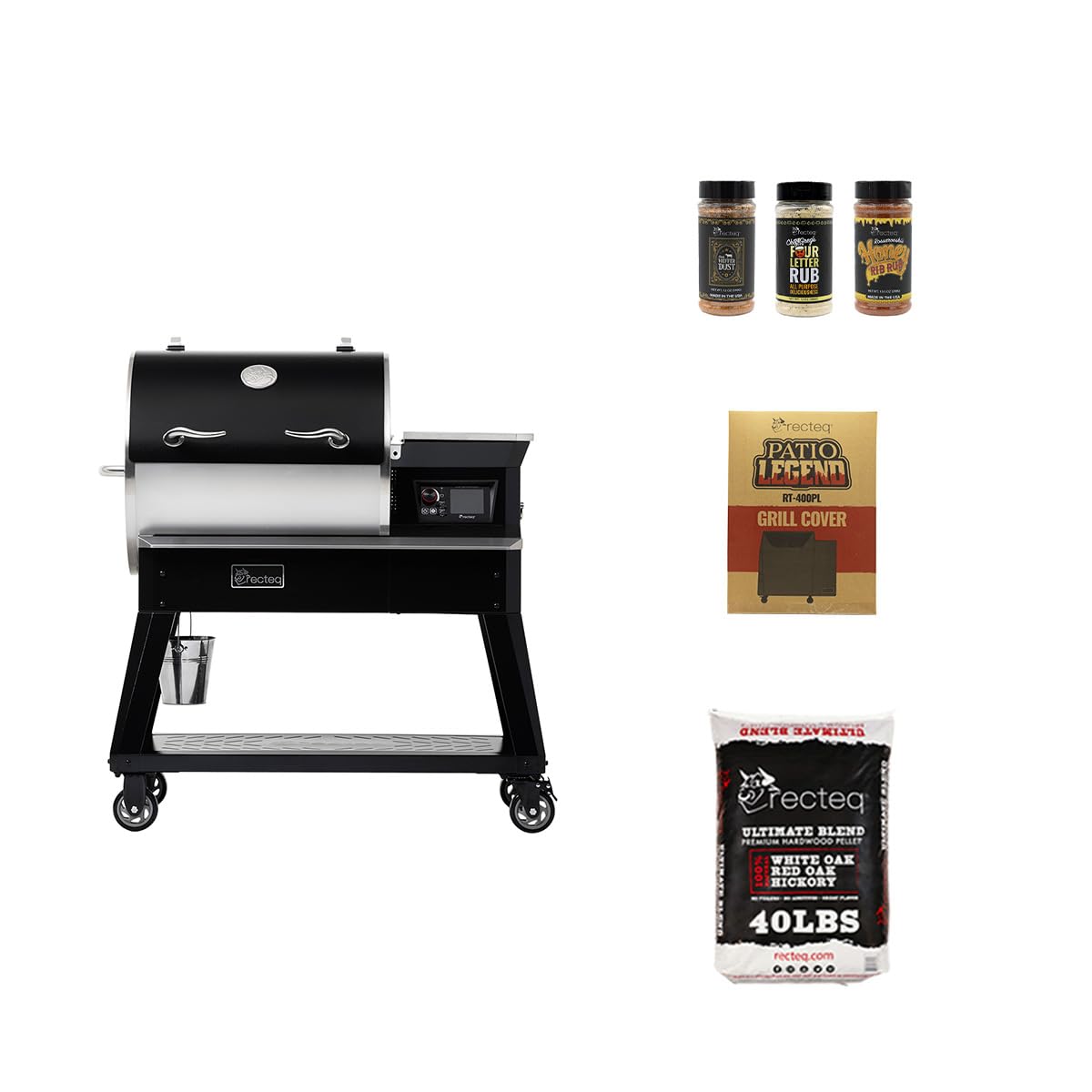
A small-patio pellet smoker that reaches 700°F — hot enough to sear, not just smoke.
Most pellet grills top out around 500°F, which is plenty for smoking but short on searing power. The Patio Legend 600 runs from 180°F all the way to 700°F, and its burner is rated for over 100,000 lightning cycles (the number of times the igniter can spark a fresh fire). That range means you can smoke a rack low and slow, then crank the heat for a real crust. It has 600 square inches of cook space, and recteq builds it with more stainless steel components than comparable grills — stainless resists rust, which matters on a patio that sees rain. Two probes come in the bundle, and the app pairs guided cooks with over 500+ recipes and leaderboards for iOS and Android.
Owners find it starts reliably and holds its set temperature, and the app hits the mark with temperature and done alerts. It produces a lot of smoke for its size — more than one owner compared it favorably to a bigger Traeger. It also burns efficiently: expect to go through up to about 1 lb of pellets per hour depending on the weather, which is modest for a pellet grill. A PID controller keeps the temperature steady whatever the conditions. On a small patio, the compact size is exactly the point.
The catch to know is the app connection: it wants a 5GHz-capable setup in some cases, and a few buyers run into pairing trouble with certain networks. Also note, the stainless steel lid patinas over time — that is normal aging, not a defect. One unit arrived with a misaligned leg hole and the company sent a replacement leg, which is a good sign for support. It is not a heavy-duty offset competitor; it is a nimble smoker for one to four people that also sears.
Searing plus smoking: the 700°F ceiling and PID control cover both jobs on 600 sq in of stainless.
The app watch-out: pairing can be touchy on certain Wi-Fi setups; the stainless lid will patina normally.
Pic it when: your patio is small, you want searing heat, and you cook for one to four.
Pass if: you need the wide horizontal space of a big offset or you prefer a simpler charcoal setup.
Understanding the Specs
Cooking Space, Measured Honestly
Square inches are only meaningful once you know how they are split. A pellet grill might list 700 sq in at 135 pounds on one big flat grate, while a charcoal offset could list a similar figure across a main chamber, a warming rack, and a separate firebox. A warming rack holds food at temperature rather than cooking a brisket from raw. A tall vertical chamber with removable racks stacks capacity upward, which is what lets a compact smoker like the Bronco fit more cuts into less patio space. Read the breakdown — primary grates, secondary racks, offset area — before you decide a number is big enough.
Temperature Control And Why PID Matters
On a pellet grill, a PID controller (proportional-integral-derivative) constantly adjusts how fast the auger feeds pellets to hold your set temperature, even as outdoor conditions change. That is what buys hands-off cooking. Charcoal and propane models rely on you — vents and baffles on a charcoal unit, burner output and a flame disk on a propane one. A propane smoker at180°F to 500°F range gives you fine control once the regulator behaves, and a charcoal offset’s four baffles even out heat across the chamber. Whichever fuel you pick, a cheap digital thermometer is the cheapest upgrade you can make — it lets you cross-check the dial without guessing.
FAQ
Should I buy a pellet, charcoal, or propane smoker?
How do I know how much cooking space I really need?
What does reverse flow mean on an offset smoker?
Do pellet grills really run hands-off overnight?
Why does my pellet grill want a 2.4GHz Wi-Fi network?
How heavy is too heavy for a movable smoker?
Do I need to season a new smoker before cooking?
Is propane smoking as good as charcoal or pellet?
Can I sear on a pellet grill or is that only for charcoal?
What maintenance does a charcoal or offset smoker need?
Final Thoughts: The Verdict
For most buyers, the barbecue grill smoker that balances capability and control is the Traeger Ironwood 650 — 650 sq in, a 500°F ceiling, WiFIRE app control, and a 4.6-star reputation across a large field of owners. If you want the deepest charcoal smoke and 14+ hours on a single load, reach for the Oklahoma Joe’s Bronco 18. And for a small patio that wants smoke and real searing heat in one nimble unit, the recteq Patio Legend 600 is the one to check first. Whichever fuel wins your vote, buy the smoker whose routine you will actually keep.
How We Picked
We do not accept paid placement. Every pick is matched to a real buyer and a real use-case; we do not hands-on test units.
Sources & Methodology
Specifications: manufacturer listings and product documentation. Review insights: verified customer reviews, as of September 2026. Pricing: not shown on this page (it changes often); check the current price via the retailer link.
As an Amazon Associate, KitchPrep earns from qualifying purchases. This does not affect which products we feature.
Related Guides
