
Specs are compiled from manufacturer listings and verified buyer reviews and can change over time — please confirm the key details on the product page before buying.
You need a stair rail that stays solid when you lean on it, mounts into real wood instead of hollow drywall, and feels comfortable every time you use it. The picks below are ranked by what they hold, how they mount, and how they grip — not by how they look in a photo. Almost every complaint about these rails depends on one thing: the anchors. The rail itself is rarely the problem. The screws and wall plugs in the box usually are.
I’m Mohammad Maruf — the founder and writer behind KitchPrep. This guide is built by comparing the manufacturers’ published specifications and the patterns across verified customer reviews, so you get each pick’s real strengths and trade-offs instead of marketing spin.
Before you drill, there are three numbers worth writing down on a scrap of paper: total length, load rating, and rail diameter. That trio decides whether a rail covers your staircase and whether your hand actually closes around it. A longer, higher-rated rail is not automatically the right buy — the wall behind it matters just as much. This shortlist is designed to help you pick the right banisters and handrails on the first order.
Our Picks at a Glance


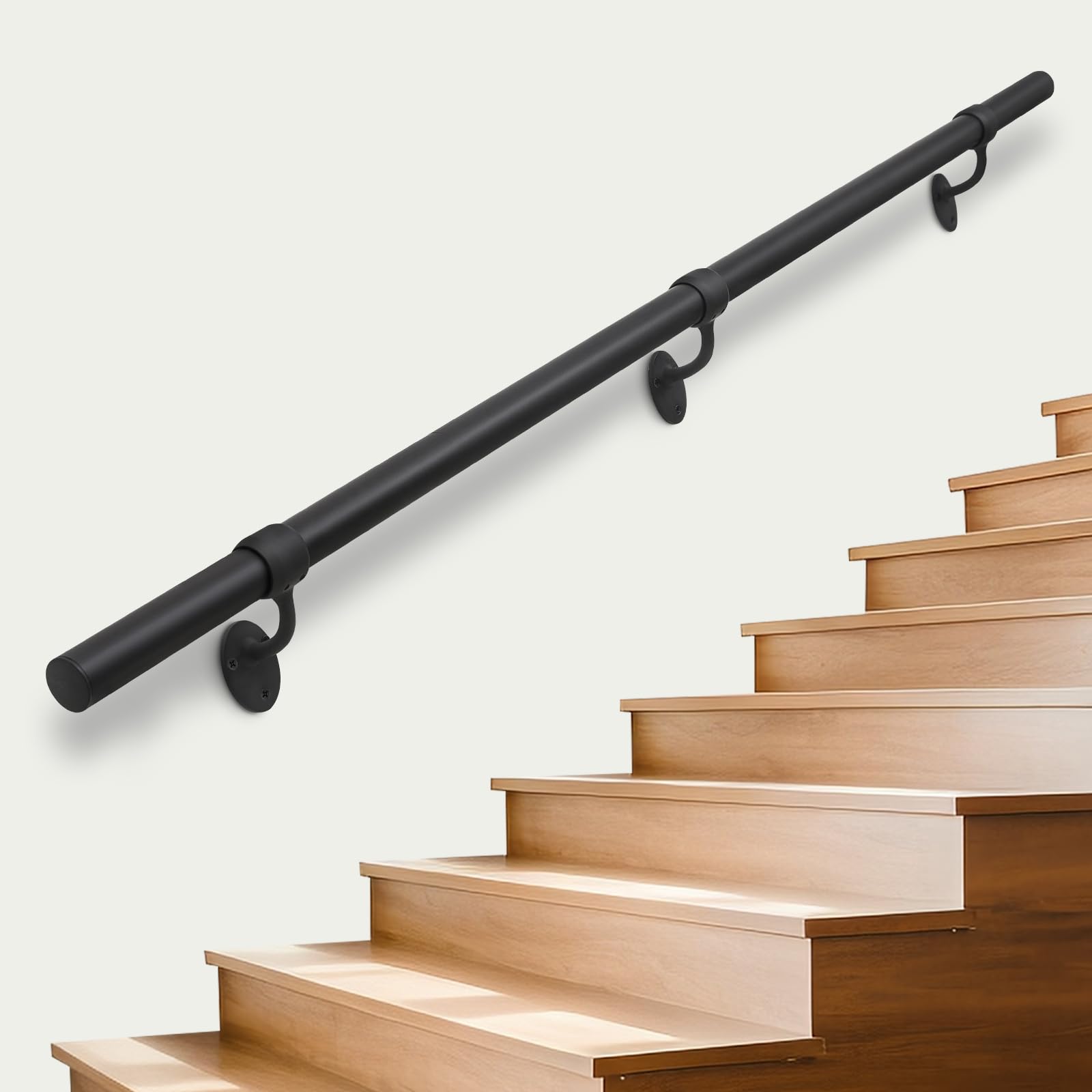
How To Choose The Best Banisters and Handrails
The hardest part of this purchase is not picking a rail. It is figuring out whether your wall will actually hold one. Every rail on this list screws into a vertical surface, so the wall surface and the studs behind it decide how solid the finished job feels under your hand. Get the wall right and the rail outlasts the staircase.
Match the rail length to the steps you actually have
A 10-foot rail covers a long straight run of steps. An 8-foot rail suits most basement stairwells. A 5-foot kit with an adjustable angle is built for short porch or garden steps that do not attach to a wall at all. Measure your staircase from the bottom riser to the top landing, then subtract a hand-width at each end so nobody bangs their knuckles on the trim.
The VEVOR kit is different from the rest — it is a freestanding rail that bolts to the floor and steps instead of the wall, which is exactly what you need on a porch or garage entrance with nothing beside it. Every other rail in this guide mounts flat to the wall.
Load capacity tells you how much lean the rail takes
A 500-pound rating means the rail and its brackets are built to hold that much weight pushing or pulling on the bar, which is far more than a person steadying themselves ever applies. A 250-pound rated rail still covers typical indoor hallway use. Buy the higher number if you want the rail to feel dead solid when you lean on it hard, or if the rail doubles as something you grab during a stumble.
Grip diameter matters more than finish
Rails in this group run from a 1.18-inch pipe up to a 2.36-inch square tube. A narrower round pipe closes easily in most hands, while a wider square profile gives a flatter surface for a full palm. If the person using the stairs has small hands or a weak grip, a round 1.5-inch pipe is the safer bet. Square tube reads more industrial and can feel sharper on a fast grab.
Budget for better anchors before you start
Owner feedback in this category repeats one lesson: the supplied wall plugs fail. The rail arrives solid, the finish looks right, and then the supplied wall plugs fail. Buy a pack of proper anchors or lag bolts sized to your wall before installation day. A few dollars of anchors removes the most common reason these rails wobble later.
Quick Comparison
| Model | Best For | Length | Load Rating | Rail Width | Amazon |
|---|---|---|---|---|---|
| Wall Handrail 10FT Black Industrial Pipe (PNBO)★ Best Overall | Main staircases | 120 in | 500 lbs | 1.18 in | Amazon |
| 10FT Black Iron Railings, 3 Sections (CAVAOSEY)Widest Grip | Loft and deck runs | 120 in | 500 lbs | 2.36 in | Amazon |
| SDNBHT 1.5″ Pipe Aluminum Handrail, 8ftLightest Install | Replacing an old oak rail | 8 ft | 440 lbs | 1.5 in | Amazon |
| VEVOR Outdoor Stair Railing Kit, 5 FT | Free-standing porch steps | 60 in | 155 lbs | 1.96 in | Amazon |
| 11FT Heavy-Duty Wall Mounted Handrail (Byijpzi) | Long stair runs | 132 in | 500 lbs | 2.76 in | Amazon |
| 7 FT Wooden Stairs Handrails (Purife) | Warm wood interiors | 84 in | 400 lbs | 3 in | Amazon |
| 8ft Black Wrought Iron Stair Railing (YuayiJubil) | Basement and hallway steps | 8 ft | 250 lbs | — | Amazon |
| Senmit 16 FT Wall Mount Iron Pipe Handrail | Extra-long continuous runs | 16 ft | — | — | Amazon |
In-Depth Reviews
1. Wall Handrail 10FT Black Industrial Pipe Staircase Railing (PNBO)
Our pick — over 4.5★ from 650+ verified ratings; the strongest balance of quality and price.
The narrow-pipe rail that disappears into your hand and then holds 500 pounds without complaint.
This is the rail to buy if your stairs are the main event — the route you take ten times a day with an armful of laundry. It runs a full 120 inches, which is long enough to cover a serious straight staircase in one continuous piece rather than stitched-together sections. The bar measures 1.18 inches across, and that narrow round pipe is the detail owners keep coming back to. It closes in your hand the way a broom handle does, which is exactly what you want when you are carrying something in the other arm.
The frame is iron with a black powder coating that the maker says resists corrosion and fading, and the base plate uses four screw fixing points instead of the two you see on lighter rails. That four-point base is what keeps the rail from pivoting under load. Rated capacity is 500 pounds. Buyers report the finish arrives uniform and that the whole thing assembles with threaded poles and ends — no welding torch, no fabrication. The kit ships with a drill bit, screws and wall anchors, and the rail suits wood, brick, stucco and concrete walls.
The honest catch is the anchors. One buyer put it plainly: the included wall plugs were poor enough that they had to source better hardware, and the finished rail was still good. Swap in good anchors or go into studs and this becomes a permanent fixture. If you want a thinner, warmer-looking bar instead, the SDNBHT aluminum rail below has a rounder 1.5-inch profile at a shorter length.
What owners keep praising
- A full 120-inch run in one piece, so no mid-stair joint to flex
- 1.18-inch round pipe sits naturally in the hand — a buyer’s wife preferred it to the wider wood rail it replaced
- 500-pound rating with a four-screw base plate for steadier anchoring
- Threaded assembly and an included drill bit make the install a one-person job
Where it asks a little more
- Supplied wall anchors are the weak point — several owners bought better ones
- Powder coating durability in wet, outdoor weather is still unproven over years
- The narrow pipe gives less surface area for a full-palm flat grip
Right in the balance: a long, sturdy, comfortable rail for the staircase you use every day, and the one to pick if grip feel matters as much as strength.
Only look elsewhere if: you need a freestanding kit with no wall behind it, or you want a wooden bar to match existing trim.
2. 10FT Black Iron Railings for Indoor Stairs, 3 Sections (CAVAOSEY)
A broad flat bar for a full-palm grip, shipped in three bolt-together sections.
If your hands are large, or you want a rail that feels like something rather than nothing, the 2.36-inch square tube here is the widest bar in this group. That is exactly double the 1.18-inch width of the PNBO above — the difference between a rail you wrap your fingers around and one that fills your whole hand. It weighs 3.72 kg, the heaviest rail in the roundup, and that number shows up as the assembled stiffness owners notice when they lean on it.
It arrives as three sections that bolt together into a 120-inch run, and the maker lists a 500-pound-plus capacity on premium metal frames. The coating is a high-temperature electrostatic paint finish, which is a baked-on process rather than a simple spray. Owners describe the black as uniform and the surface as smooth to the touch. It also gets used sideways — as a bar foot rail under a desk, as a bathroom grab bar, as a rack for hanging plants.
Here is the compromise that shows up again and again in feedback: alignment. The screw holes on the mounting brackets can land directly behind the bar, which makes a screwdriver awkward to drive straight. One buyer’s advice was to line those holes up deliberately before you tighten anything down. A few also found the brackets too small to reach a stud without adding a mounting board. Plan your stud positions first and this is a very solid rail for the length.
The sturdiness story: what wins people over here is sheer rigidity — the square tube does not roll or flex, and the extra width gives you something substantial to grab during a stumble.
The alignment caveat: expect to think about screw placement before you drill, and budget for a small backing board if your studs fall awkwardly under the brackets.
Reach for this if: you want the most holdable bar in the group and your wall has usable studs behind the run.
Think twice if: you are fitting a narrow stairwell where a 2.36-inch profile will feel chunky against the wall.
3. Stair Railing Indoor Metal Hand Rails, 1.5″ Pipe Aluminum, 8ft (SDNBHT)
An aluminum rail that drops 1.27 kg off the iron alternative and hides every fixing behind the plate.
Aluminum is the practical choice when the person hanging the rail is doing it alone. This one weighs 2.45 kg — the CAVAOSEY iron rail above comes in at 3.72 kg, so you are handling noticeably less while balancing on a step ladder. The pipe measures 1.5 inches in diameter, a round profile that sits between the narrow 1.18-inch PNBO and the broad 2.36-inch square tube. Anodized treatment is the finish here, which is an electrochemical coating that hardens the surface rather than sitting on top of it, so it resists cracking and peeling.
The fixings are concealed behind the handrail plate, meaning you do not see mounting bolts marching along the bar once it is up. It installs horizontally, diagonally or vertically, and the length is adjustable. Rated capacity is 440 pounds, and the kit includes the tubes, wall brackets, connecting screws, plastic expansion screws and a hex wrench, with a one-year after-sales term on the rail. Owners have mounted it as a modern replacement for an old oak banister and on the exterior of a duplex, where the tenants were happy with it.
Two things to watch. The set screw holes on some brackets come oversized, so the tiny screws can drop straight through — a bracket with the right hole size fixes it. And several installers found the trio of holes would not all line up with a stud at the required angle, which pushes you toward two stout screws per mount plus a heavy-duty anchor. Two people make the 45-to-50-degree alignment much easier.
Best for: a solo DIY replacement where a heavy bar would be a struggle and the concealed fixings matter to the finished look.
Skip if: you need a bar you can hang your full weight from on every step — the iron rails here carry more.
4. VEVOR Outdoor Stair Railing Kit, 5 FT, 0-5 Steps (VEVOR)

The only rail here that bolts to the ground, so a porch with no wall finally gets a handhold.
Every other rail in this guide needs a wall. This one does not. It bolts down to the steps or floor through a 5.3-inch square base with four pre-drilled holes, so it works on a porch, a garden path, a garage entrance, or any staircase standing free of a structure. The angle adjusts from 0 to 60 degrees, so it can follow 1 to 5 steps or sit flat on a level surface. Total dimensions are 60 inches long by 35.8 inches high, with a maximum step height of 37.4 inches.
The tube is aluminum with a powder-coated black finish, and it measures 1.96 inches across — a round profile that owners single out as comfortable. What people like most about it is the build quality, followed closely by how it looks sitting against a house. Two users mounting it on wood steps swapped the supplied fasteners for lag bolts, and both said the result was rock solid. It pairs naturally with the wooden Purife rail further down if you are mixing indoor and outdoor entries and want a consistent look.
The rated capacity is 155 pounds, which is the lowest number in this group and worth taking seriously. This is a balance rail, not a rail you catch a fall on at full weight. It is also where the fit complaints land — mounting hardware that does not suit every surface, and a square cover plate over the screws that has nothing holding it in place. On concrete or stone the included fasteners are fine; on wood, plan on lag bolts.
Where it earns its place: there is no other way to add a handhold to a set of steps that has no wall beside it, and the adjustable angle covers a wide range of step counts.
Know before you buy: at a 155-pound rating it is built for steadying, not for catching weight, so it is the wrong pick for a steep indoor flight.
Made for: outdoor porch and garden steps with open sides, especially where a household member needs something to hold on a wet ramp.
Not the one if: you need a wall-mounted rail inside the house — the load rating and mounting style both point the other way.
5. 11FT Heavy-Duty Wall Mounted Handrail, 500LB (Byijpzi)
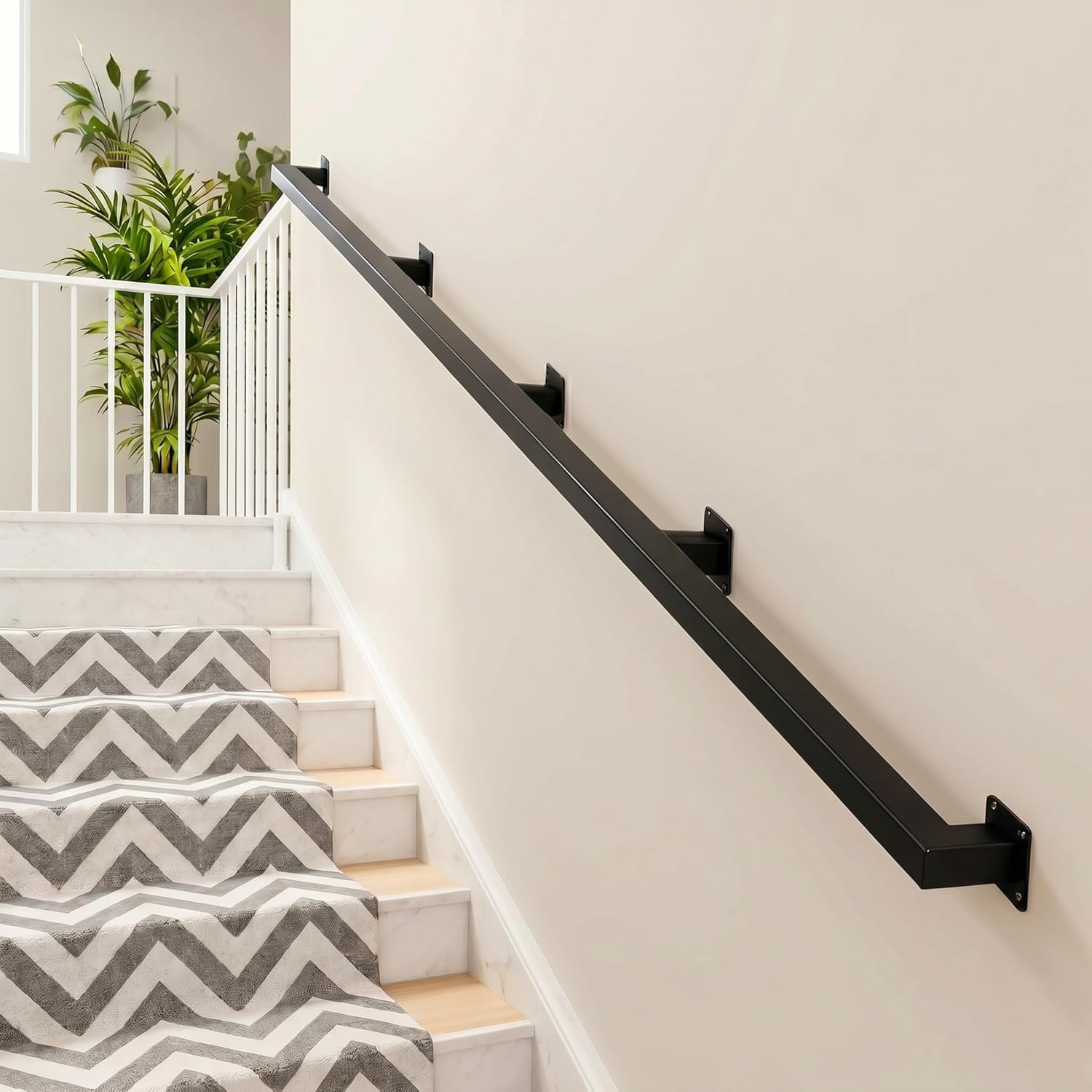
A 132-inch rail that links to more sections when your staircase keeps going.
Length is the whole argument for this one. At 132 inches it covers 12 inches more run than the two 10-foot rails above, and it is built on a modular system that the maker says expands up to 24 feet by linking extra sections. If your staircase is long enough that a 10-foot rail leaves a gap at the top, this is the fix. The bar measures 2.76 inches across — wide, in the same family as the CAVAOSEY square tube — and it is made from heavy-gauge iron in a reinforced rectangular shape designed to resist wobbling and flexing.
Capacity is 500 pounds on a bar the maker describes as surpassing standard 440-pound rails by 60 pounds. The finish is a high-temperature electrostatic paint process for rust, corrosion and scratch resistance, and the surface is described as non-slip even with wet hands. Owners describe the bar as premium-feeling — not too heavy, not too light, rock steady once it is anchored, with a crisp black finish that looks industrial. One buyer installed it on a long outdoor ramp after her husband slipped on a slick flat surface with nothing to grab.
Two buyer notes worth knowing. The supplied wall anchors draw the same complaint as the rest of this group, so plan on better ones or driving into studs. And a buyer of the smaller 5-foot version found it ships in two pieces that screw together, creating a joint in the middle — worth checking which length you are ordering. The 11-foot rail here is listed as one continuous unit with a small wrench included for joining sections.
Reasons it wins the long-run job
- 132 inches of coverage, extendable to 24 ft with extra sections
- 500-pound rating on a reinforced rectangular iron tube
- Electrostatic painted finish rated for indoor and outdoor use
- Non-slip surface that holds up in wet conditions
What you should know first
- The included anchors need replacing for a genuinely solid mount
- Adapts to wood, brick, concrete, stucco and drywall, but studs are strongly recommended
- Longer bars are physically harder to hold level while you mark your holes
Pick this when: your stair run is long or you want the option to extend it later without buying a whole new rail.
Consider a shorter bar instead if: your staircase is standard length — the extra inches just mean more holes to drill.
6. 7 FT Wooden Stairs Handrails, Wall Mount (Purife)
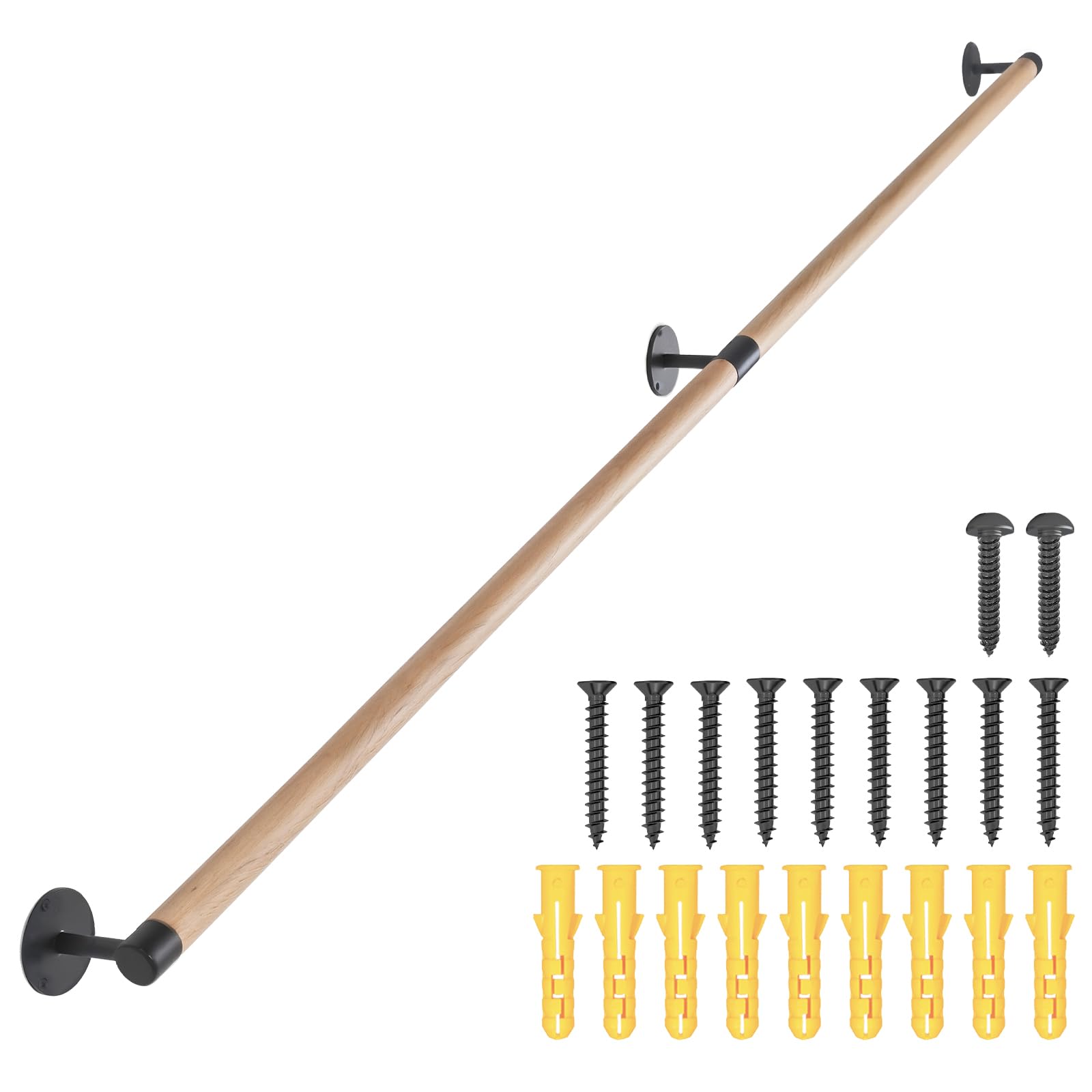
Beech wood instead of iron, for a rail that reads as furniture rather than safety equipment.
If the metal rails in this roundup would look out of place against your trim, this is the pick. The bar measures 3 inches across, the widest here, and it is cut from natural beech with visible grain and a surface that has been polished and painted twice. The round edge is the comfort detail — owners describe an easy-grip diameter and a nice hand-feel that reads as a proper banister rather than a grab bar. It mounts on heavy-duty metal brackets rated to hold 400 pounds.
What people respond to most is the craftsmanship, and the sturdiness comes a close second. A buyer with a knee injury called the 3-inch beech bar a large, easy-grip handle. Others have hung them as grab bars outside doors or used one as a ballet barre, which tells you how rigid the bar stays under repeated sideways load. Installation is straightforward with the included hardware, and the packaging consistently arrives in good shape.
Two practical notes. This listing is built around the 7-foot bar — the total length called out in the specs is 84 inches — so measure your run before ordering, because the family of rails runs from short lengths up to longer ones and the price will climb with size. And if your house is cement brick, as one installer found, you will need specialty screws; the standard kit is aimed at ordinary wall types. The wood itself is a soft natural material, so treat it the way you would any hardwood trim.
Why it stands out: beech grain, a 3-inch bar, and a double coat of paint combine into the one rail here that genuinely blends into a wood-furnished home.
The trade-off: wood needs more care than powder-coated iron, and the standard mounting hardware assumes a standard wall.
Choose the wood if: appearance matters as much as function and you want a rail that looks original to the house.
Stick with iron if: the rail goes outdoors in a wet climate or takes heavy daily contact.
7. 8ft Black Wrought Iron Stair Railing, Wall Mount (YuayiJubil)
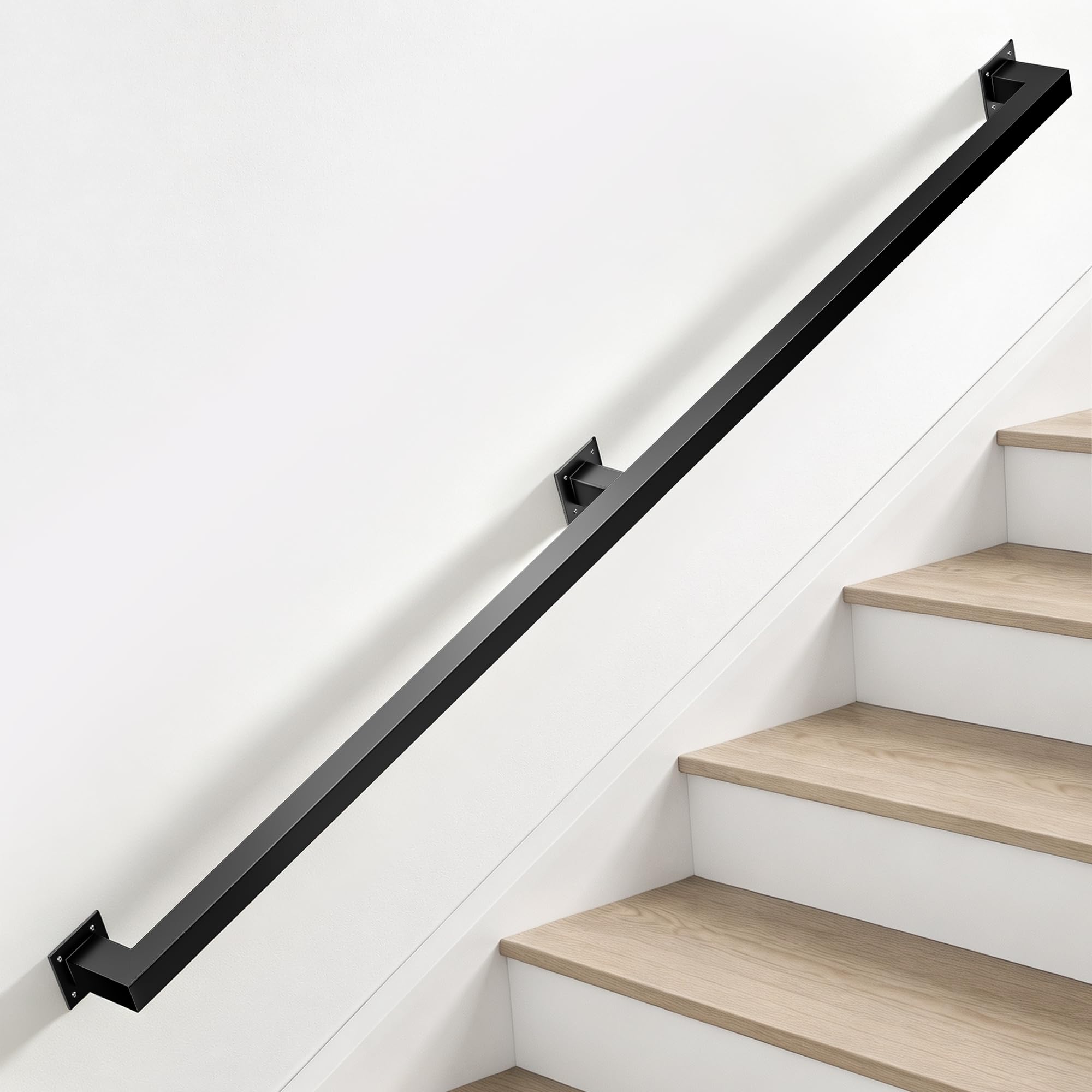
Built for the person doing this alone — a 67-year-old hung it without help.
Wood studs, brick or concrete — this rail is spec’d for all three, and what separates it is how little drama it causes on installation day. Thick square metal tubing with a reinforced structure, a matte black powder-coated finish, and a complete set of mounting expansion screws in the box. Owners describe it as very easy to put together and put up, and one 67-year-old homeowner installed theirs solo in what was previously a log home with only a chunky 4×4 to grab. That is the kind of report that tells you the hardware and the instructions are not fighting you.
Lengths run from 2 feet up to 15 feet to fit different layouts, and the 8-foot version here is a natural fit for basement stairs, hallway runs, loft access and attic steps. The look is deliberately industrial — square tube in matte black, which reads at home against farmhouse, rustic, modern and contemporary interiors. One owner came from a handrail they could not get a grip on and found this a big improvement.
Worth flagging: the listed capacity on this one is 250 pounds, half of what the iron rails above carry. For one person steadying themselves on a short indoor flight, that is more than enough. For a rail that doubles as a stumble-catch on steep stairs or takes hard lateral pushes, spend a little more and go with a 500-pound rail. Consider it a fit decision, not a flaw.
Right for: a straightforward indoor install where you want a sturdy, decent-looking rail with hardware that does not require a trip to the hardware store.
Look up the list if: you want the maximum load ceiling or a rail built to take hard sideways force.
8. Senmit 16 FT Wall Mount Industrial Iron Pipe Handrail

Sixteen feet of unbroken iron pipe for the run that no standard rail reaches.
If your staircase, loft or porch run is genuinely long, this is the only rail here built to cover it in a single piece. Sixteen feet. The pipe is heavy-duty iron with a rustproof coating, and the kit ships with the wall bracket, elbow, tee, mounting material and expansion screws — so the parts are all in the box for a straight, unbroken installation. The rail earns its keep across stairs and lofts, attic armrests, bathroom handrails, door handles, and both indoor and outdoor fences. The matte black finish keeps the look modern rather than industrial-raw.
The frame of owner feedback is positive on quality, appearance, sturdiness and how easy it is to get up, and it sits at decent value for the length. Two people make it far easier because of the sheer span you are holding while you mark and drive screws — measure first, drill, then attach. An owner who uses it as a basement handrail found it takes about an hour with a helper. If you are hanging this across light wood, the matte black contrast reads well.
Two honest notes. This listing is built around the 16-foot version, but the same family sells in 3, 5, 6.6, 8 and 10 feet as well, and one owner found the 4-foot size came in at 46 inches rather than 48 — so check the exact length you are ordering. And one buyer’s partner thought the finish looked like a paint seam. Neither is a dealbreaker; both are the kind of thing you would want to see before you drill holes in a wall.
The case for the long rail: no joints, no second rail to buy, no gap at the top of a long flight — one continuous sixteen-foot span.
Size it right: lengths in this family vary and have come in slightly shorter than listed on at least one size, so confirm the number before ordering.
Grab the 16-footer if: your run is long enough that piecing two rails together would leave you with a bumpy seam.
Go shorter if: your staircase is a normal height — the extra iron just means more bracketry and more holes.
Understanding the Specs
Load capacity (in pounds)
This is the weight a rail is engineered to hold when it is pushing or pulling away from the wall, like when you catch yourself mid-step. A 500-pound rating — as on the PNBO, CAVAOSEY and Byijpzi rails — is well above what a person steadying themselves ever applies. A 400-pound rail like the Purife wood bar is comfortably in the indoor range. The VEVOR at 155 pounds and the YuayiJubil at 250 pounds are built for lighter support, so match the number to how hard the rail might get leaned on. The higher the rating, the steadier the bar feels when you actually pull on it.
Rail diameter (in inches)
Diameter decides whether your hand closes around the bar or not. The group runs from a 1.18-inch round pipe on the PNBO up to a 3-inch wooden bar on the Purife, with the CAVAOSEY square tube at 2.36 inches, the Byijpzi at 2.76 inches, the SDNBHT round pipe at 1.5 inches, and the VEVOR at 1.96 inches. Round pipes let fingers wrap fully, which suits smaller hands. Wider square tube fills a large palm. There is no universal right answer — grip the bar before you mount it if you can, and pick the shape that fits the hand that will use it most.
FAQ
Will a 10-foot handrail cover my staircase?
Do I really need to replace the included wall anchors?
Can I mount a stair rail on drywall alone?
What is the difference between a 500-pound and a 250-pound handrail?
Is a square handrail or a round handrail easier to grip?
Can I use an indoor handrail outside on porch steps?
How do I install a wall-mounted handrail on brick or concrete?
Should I attach a stair rail to studs or use anchors?
How long is a 5-foot or 11-foot handrail in steps?
Can I cut a handrail to a shorter length?
Final Thoughts: The Verdict
For most staircases, the banisters and handrails winner is the Wall Handrail 10FT PNBO because it nails the three things that matter — a full 120-inch run, a 500-pound rating on a four-screw base, and a 1.18-inch round pipe that owners say grips better than the wood rail it replaced. If you want a rail that fills a large hand and looks industrial, the CAVAOSEY 10FT iron rail is the widest bar in the roundup. And if your steps have no wall beside them, the VEVOR 5 FT kit is the one that bolts to the ground and actually solves the problem nothing else here touches.
One nudge before you click buy: the number that makes or breaks these installs is the load rating, not the finish. Match it to how hard the rail will really be leaned on, and buy better anchors than the ones in the box.
How We Picked
We do not accept paid placement. Every pick is matched to a real buyer and a real use-case; we do not hands-on test units.
Sources & Methodology
Specifications: manufacturer listings and product documentation. Review insights: verified customer reviews, as of September 2026. Pricing: not shown on this page (it changes often); check the current price via the retailer link.
As an Amazon Associate, KitchPrep earns from qualifying purchases. This does not affect which products we feature.
Related Guides
