
Specs are compiled from manufacturer listings and verified buyer reviews and can change over time — please confirm the key details on the product page before buying.
Banh khot are tiny Vietnamese rice pancakes with lacy, crispy golden edges and a rich coconut-turmeric center. To get that perfect batch, you need a heavy pan with small, rounded wells that hold the batter and let steam crisp the rim. Your choice depends on hole count, material, and how you like to flip.
I’m Mohammad Maruf — the founder and writer behind KitchPrep. This guide is built by comparing the manufacturers’ published specifications and the patterns across verified customer reviews, so you get each pick’s real strengths and trade-offs instead of marketing spin.
From 4-cup nonstick ease to 12-hole cast iron tradition, here is the honest breakdown of the banh khot pan options worth your kitchen drawer space today.
Our Picks at a Glance
How To Choose The Best Banh Khot Pan
Before you buy, focus on three things: how many pancakes you want per batch, what kind of heat your stove gives you, and how much upkeep you are willing to do. Cast iron needs different care than nonstick aluminum, and that choice decides how crispy your edges get.
Material Matters: Cast Iron vs. Nonstick Aluminum
Cast iron soaks up heat and holds onto it, which is what creates that deep, even browning on the bottom of a banh khot. The trade-off is weight and maintenance — you have to dry it thoroughly or it can rust. Nonstick aluminum heats up fast and releases food easily, making it the lower-effort choice for weekday cooking.
Hole Count and Batch Size
Think about how many people you are feeding. A pan with 4 wells makes a small snack, while a 12-hole pan can produce a family-sized pile in one go. More holes means more even heat required, so heavier materials usually pair with larger capacities.
Heating Compatibility and Stovetop Fit
Your stove dictates what you can buy. Many nonstick pans won’t work on induction cooktops, while cast iron typically works on everything — gas, electric, ceramic, and induction. Measure your burner and check the pan’s diameter so the whole surface actually gets hot.
Quick Comparison
| Model | Best For | Material | Hole Count | Induction Ready | Amazon |
|---|---|---|---|---|---|
| TECHEF Egg Pan★ Best Overall | Easy cleanup & everyday use | Aluminum | 4 cups | No | Amazon |
| Tramontina Cast Iron | Family-size batches at once | Cast Iron | 12 cups | Yes | Amazon |
| KUHA Cast Iron | First-timers with a full kit | Cast Iron | 7 cavities | Yes | Amazon |
| Heaunzy Takoyaki Pan | Large, easy-to-flip cups | Iron | 7 holes | Yes | Amazon |
In-Depth Reviews
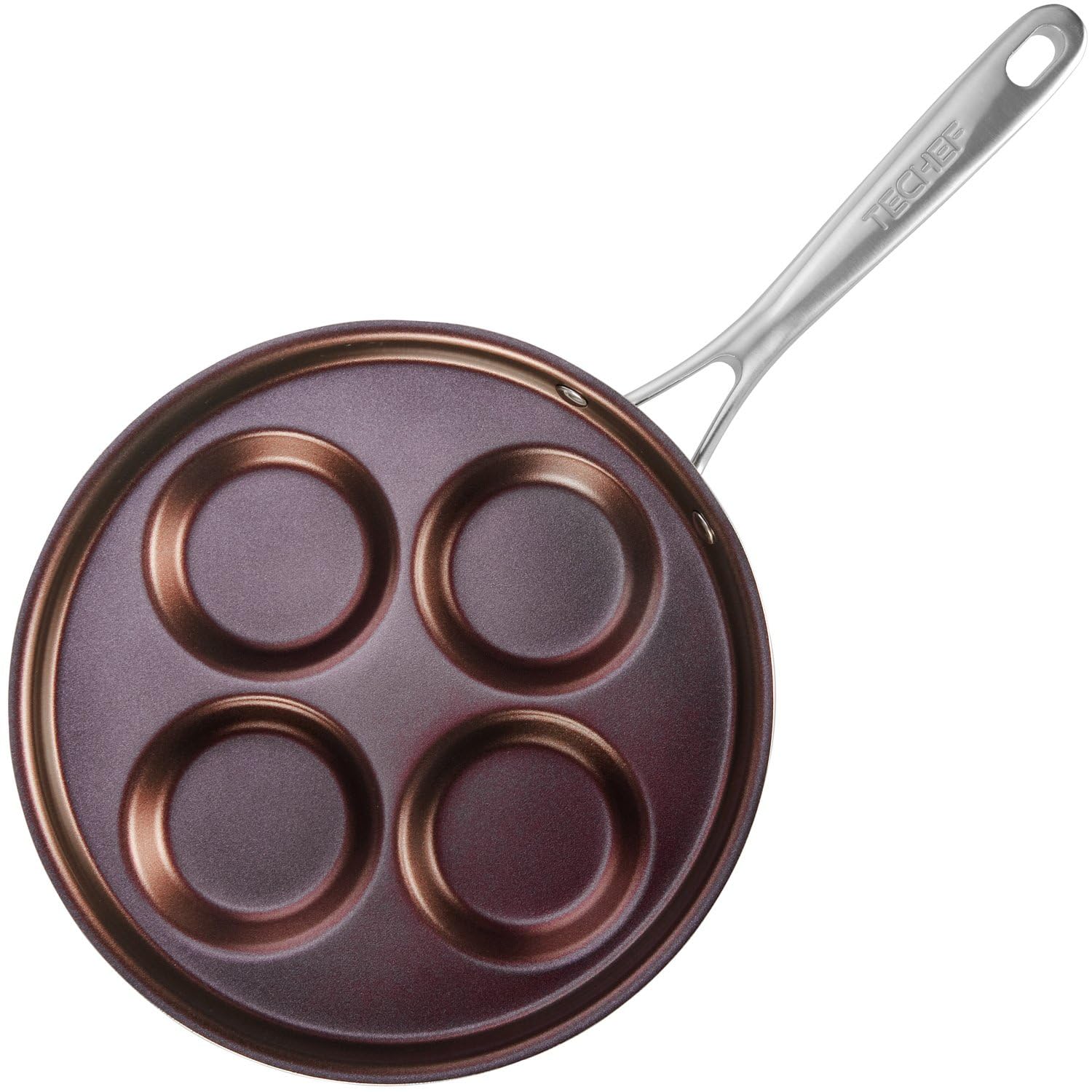
1. TECHEF Egg Pan Nonstick, Aluminium Plett Pan
Our pick — 4.5★ from 750+ verified ratings; the strongest balance of quality and price.
The nonstick workhorse that slides banh khot out whole, with zero scraping and barely any soap.
If you want crispy-edged banh khot without fighting the pan afterward, this aluminum 4-cup design is the pick that makes you look like you know what you’re doing. The nonstick surface is PFOA-free, and owners say eggs and pancakes slide out perfectly even with just a pea-sized bit of beef tallow — no butter blobs or oil pools needed. It spreads heat evenly across all 4 wells, so you get consistent golden bottoms instead of one burnt cup and three pale ones.
You can push this pan far beyond banh khot. It is oven-safe up to 450°F, which means you can start pancakes on the stove and finish them under the broiler, and the round wells also turn out hamburger sliders and mini crepes. After 5 years of steady use, buyers report it still poaches eggs perfectly: water, vinegar, cover, 4 minutes off heat. The catch is the stovetop limits — it works on electric, gas, and ceramic but explicitly excludes induction, and it is a hand-wash-only pan despite the easy-clean surface.
Owners find low-medium heat ideal; higher heat overcooks bottoms before tops set. The 10.25-inch footprint fits standard burners, and the stainless steel handle stays cool enough to manage. It is made in Korea and backed by a lifetime warranty, which explains why review pages are full of owners who replaced their messy egg rings with this single pan.
What wins people over
- Truly nonstick — food slides off without oil buildup
- Oven safe to 450°F for broiled tops and more
- Heats evenly across all four wells for consistent results
Know before you buy
- Not for induction cooktops
- Hand wash only; the nonstick finish demands gentle care
- Round cups can be awkward to flip with a regular spatula
Reach for it if: you want the most forgiving, low-maintenance banh khot pan that delivers even results and wipes clean in seconds.
Look elsewhere if: your kitchen runs on an induction cooktop or you want to make more than four pancakes per batch.
2. Tramontina Utsava Pre-Seasoned Cast Iron 12-Hole Appam Pan
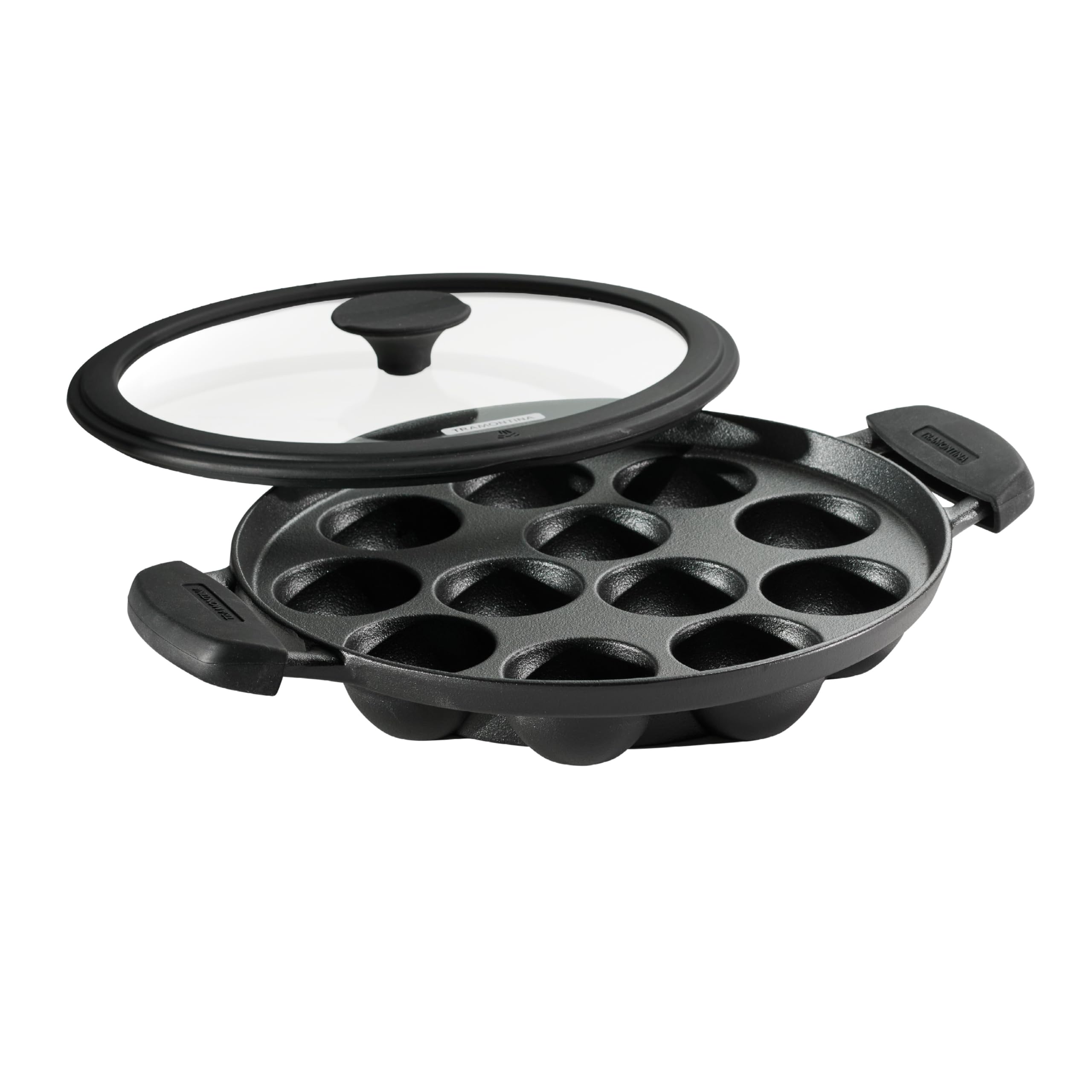
Twelve cast iron wells that go from induction burner to party platter in one heavy, even-heating pass.
This is the pan for feeding a crowd. With 12 cavities of heavy-duty cast iron, it holds 3 times the batter of the TECHEF 4-cup pan above, so one batch gets you a full platter of banh khot, takoyaki, or paniyaram instead of just a starter. Owners who searched for years for a family-size option report this one finally delivers — it handles a huge batch at once while staying steady on an induction cooktop, a common weak point for lighter pans.
The stone-grind polished interior comes pre-seasoned with natural oil, and owners mention food releases easily with just light oiling — no extra seasoning step needed before the first cook. It is oven-safe up to 450°F without the lid and 350°F with the tempered glass lid, which has a silicone rim that seals in heat for recipes that need covered steaming. A 15-year cast iron shopper found it lighter than a competing 7-slot Lodge pan yet still heavy enough to hold heat properly.
Cast iron has real demands, and the review pages show the trade-off clearly. The pan arrives without the silicone handle covers shown in some product photos, and the bare iron handle gets hot. One owner hit the classic cast iron pitfall — rust after washing when the pan wasn’t dried and oiled thoroughly, which turned the surface sticky. This is a pan that rewards proper care, not neglect.
Why it earns its place
- 12 wells cook a family-sized batch in one go
- Works on induction, gas, electric, and ceramic stovetops
- Pre-seasoned and polished for easy first-use release
Cast iron realities
- Very heavy — lifting and storing takes effort
- Must be dried and oiled after washing to prevent rust
- Silicone handle covers shown in photos are not included
Get it when: you regularly cook for a table of hungry people and own an induction stove that needs a pan with real thermal mass.
Think twice if: you want a lighter pan you can grab with one hand or you prefer set-and-forget nonstick care.
3. KUHA Cast Iron Aebleskiver Pan, Appam Paniyaram Pan
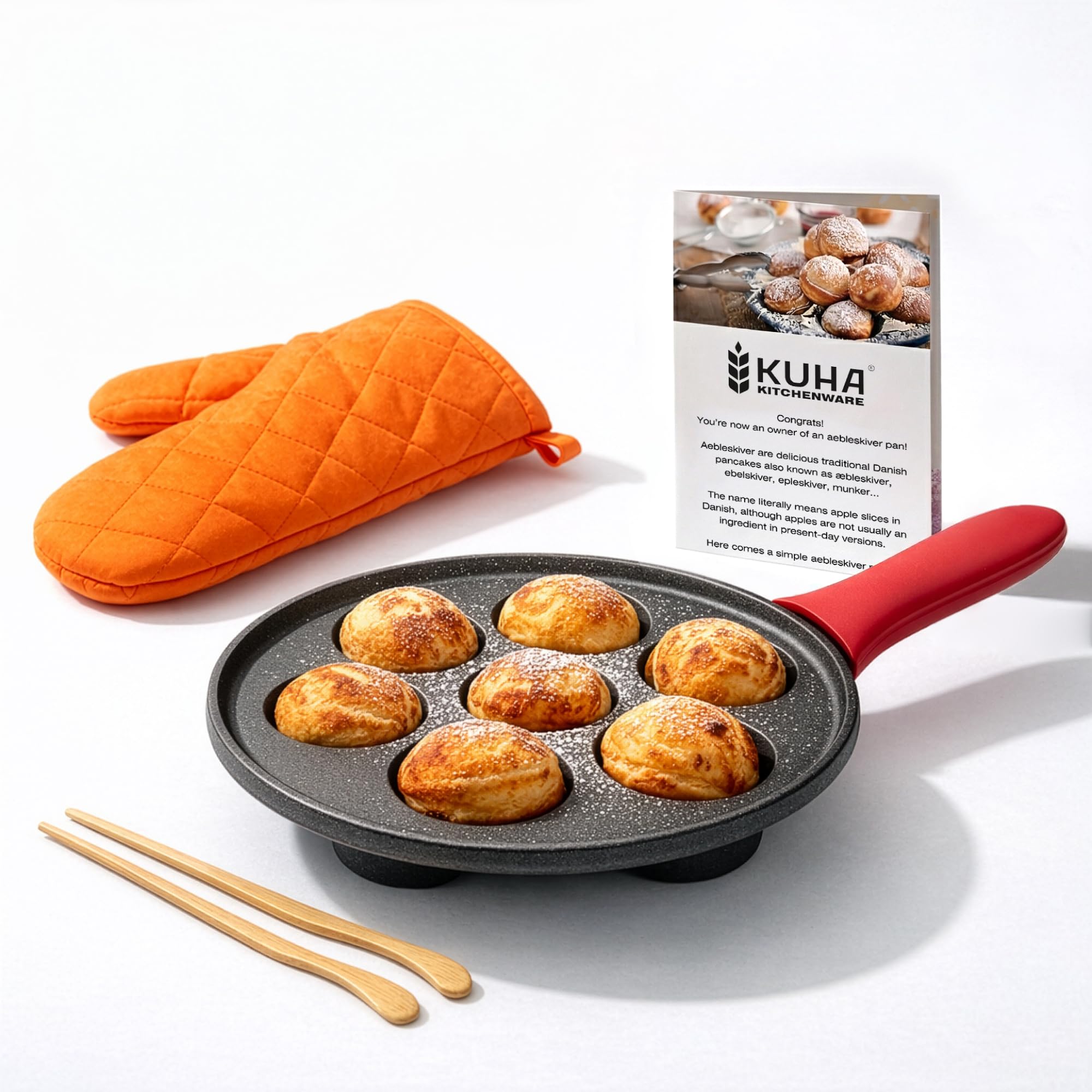
Everything a first-timer needs — skewers, mitt, and removable handle — packed around a seasoned 7.9-inch cast iron core.
Owners praise the KUHA pan’s quality most. — 38 buyers single out its quality. — and Functionality earns a strong second place. with Functionality earns 22 mentions.. It delivers exactly what cast iron promises: even browning and a golden finish, with the seasoning improving each time you use it. Beginners report spectacular first tries, with perfectly round pancake balls that flip easily and release cleanly thanks to the pre-seasoning, no sticky patches on the first cook.
This pan is a full kit, not just bare iron. It ships with bamboo skewers for flipping, a removable silicone handle cover, and a soft cotton oven mitt, so you are not hunting for tools on your first attempt. With a 7.9-inch diameter and 2-inch cavities, it hits a middle ground between the 4-cup TECHEF and the massive 12-well Tramontina — enough for a small gathering without the heavy lifting. It handles banh khot, aebleskiver, paniyaram, takoyaki, and Thai kanom krok all in one pan.
The honest catch is handling. The included accessories look helpful, but owners found the hot pad ineffective and the silicone handle cover still lets serious heat through — customers note the iron gets extremely hot to the touch even with the cover on, and one cover burned on first use. The pan needs low to medium heat and a steady hand, and cleaning takes more effort than nonstick, with oil stains lingering. It suits someone willing to learn cast iron’s quirks, not a cook who wants quick cleanup.
What makes it beginner-friendly
- Skewers, mitt, and silicone handle all included
- Pre-seasoned surface releases food on the first cook
- Compact 7.9-inch size suits small stovetops and storage
The honest trade-offs
- Handle and hot pad still get extremely hot — use the mitt
- Cast iron needs oil and elbow grease to clean well
- Non-stick behavior is inconsistent between owners
Best for the curious: newcomers who want one box with every flipping tool included and don’t mind learning cast iron care as they go.
Not the pick for: anyone who expects a cool-touch handle or the easy wipe-down of a nonstick coating.
4. Heaunzy Japan Large Aperture Takoyaki Pan, 7 Hole

A large-aperture iron pan that makes jumbo banh khot with easy flips and a satisfyingly thick base.
Banh khot lovers who want bigger, more substantial pancakes than the tiny traditional wells should look at this Japanese-style pan. Owners call it the best pan for Vietnamese banh khot., with cups so large that flipping them is easy — no wrestling a miniature pancake with a pick. The thick bottom holds heat strongly, which gives you that deep crisp on the outside while the center stays soft.
The surface is treated with safe vegetable oil rather than a chemical nonstick coating, and the raw iron construction is marketed to supplement dietary iron as you cook. It is not ready to use straight from the box though — the maker explicitly says you must season the pan first before the first cook, a step some new cast iron owners skip and then wonder why food sticks. The flat bottom with a hollowed-out design keeps the weight reasonable at 0.95 kg while working across induction, electric, gas, and ceramic stoves.
Two real caveats come up in the owner feedback. The pan arrives with handles that can look a bit worn for a new product, and some buyers expected a glass cover based on the product images that simply is not included. The large wells make it tempting to use metal skewers for flipping, but the maker warns that metal tools can leave scratches inside the holes — stick to wood or silicone to protect the surface.
What stands out
- Large cups are genuinely easy to flip, even for beginners
- Thick iron base holds heat for crispy edges
- Works on induction, gas, electric, and ceramic stoves
Watch out for
- No glass cover included despite product photos showing one
- Needs seasoning before first use
- Metal tools scratch the surface — use wood or silicone
Pick this when: you want substantial, easy-to-flip pancakes and are happy to season a raw iron pan yourself for the best crust.
skip it if: you want a ready-to-cook nonstick surface or expect the glass lid shown in the listing images.
Understanding the Specs
Hole Count and Well Depth
The number of wells decides your batch size — 4 cups makes a snack for one or two, while 12 holes covers a family. Deeper wells hold more batter for a thicker pancake, while shallower ones give you that thin, crispy-edged banh khot shape. Match the count to how many people you actually feed in one sitting.
Pre-Seasoned vs. Raw Iron
A pre-seasoned pan comes from the factory with baked-on oil that gives you a reasonable nonstick start. Raw iron, like the Heaunzy, needs you to season it yourself before the first cook or food will stick hard. Pre-seasoned saves you a step but still demands proper drying after every wash to avoid rust.
FAQ
Can I use a nonstick Banh Khot Pan on an induction stove?
What is the difference between a 4-cup and a 12-hole pan for banh khot?
Why did my cast iron pan rust after the first wash?
Do I need to season a pre-seasoned pan before first use?
What tools should I use to flip banh khot without damaging the pan?
Is a cast iron or nonstick pan better for crispy banh khot edges?
Can these pans make anything besides banh khot?
How hot can these banh khot pans get in the oven?
Final Thoughts: The Verdict
For most cooks, the best banh khot pan is the TECHEF 4-Cup — it is the crowd favorite of this set, blending a genuinely nonstick PFOA-free surface with even heat and oven flexibility that cast iron cannot match for everyday ease. If you feed a family and want one massive batch from an induction-friendly iron pan, reach for the Tramontina 12-Hole. And if you are brand new to the craft and want every tool included as you learn, the KUHA arrives ready with skewers, a mitt, and warm guidance for your first flip.
How We Picked
We do not accept paid placement. Every pick is matched to a real buyer and a real use-case; we do not hands-on test units.
Sources & Methodology
Specifications: manufacturer listings and product documentation. Review insights: verified customer reviews, as of September 2026. Pricing: not shown on this page (it changes often); check the current price via the retailer link.
As an Amazon Associate, KitchPrep earns from qualifying purchases. This does not affect which products we feature.
Related Guides
