
Specs are compiled from manufacturer listings and verified buyer reviews and can change over time — please confirm the key details on the product page before buying.
If you cut steel with an abrasive chop saw, you know the drill: sparks fly, the screech is deafening, and the edge comes out ragged. A bandsaw for metal cuts the same material in near-silence, throws almost no sparks, and leaves a straight, burr-free edge you can use right away. The real choice is between a portable saw you can carry up a ladder and a benchtop unit that stays in your workshop — here are 11 options, each picked for what it does best.
I’m Mohammad Maruf — the founder and writer behind KitchPrep. This guide is built by comparing the manufacturers’ published specifications and the patterns across verified customer reviews, so you get each pick’s real strengths and trade-offs instead of marketing spin.
The list below ranks the top contenders by cutting capacity, blade speed control, and portability, helping you match the right bandsaw for metal to your specific projects.
Our Picks at a Glance


How To Choose The Best Bandsaw for Metal
Before you buy, you need to match the saw’s physical size to the metal you cut most. A portable saw with a 2-inch throat is perfect for conduit and threaded rod, while a 5-inch deep-cut model handles angle iron and pipe. Benchtop units trade portability for a worktable that holds the stock steady, which changes how you use them entirely.
Portable versus benchtop
A portable band saw goes where the work is — up on a roof, down in a ditch, or out in the field. These are the tools electricians and plumbers reach for daily. Benchtop models, by contrast, bring the work to the blade on a fixed table, which suits a garage or small fabrication shop where you mostly cut stock down to size before assembly.
Blade speed matters more than you think
Metal needs slow blade speed, typically under 350 surface feet per minute, to avoid overheating the blade teeth. Many portable saws offer a variable speed dial so you can slow down for stainless and speed up for aluminum. Benchtop units often offer fixed pulley positions instead, giving you two to four discrete speeds to choose from.
Cut capacity defines the job
The cut capacity, listed in inches, is the largest piece of round or rectangular stock the saw can pass through. A 2-inch cut handles most conduit and all-thread. A 5-inch cut clears pipe, angle iron, and small beams. Measure your biggest common workpiece before you commit, because you cannot stretch a saw’s throat.
Quick Comparison
| Model | Best For | Cut Capacity | Blade Speed | Weight | Amazon |
|---|---|---|---|---|---|
| DEWALT DWM120K★ Best Overall | Deep cuts in steel | 5 inches | 100-350 SPM | 15 pounds | Amazon |
| BOSCH GCB18V-2NCompact Pick | Cordless portability | 2 inches | — | 7.3 pounds | Amazon |
| Makita XBP03ZBest Value | One-handed cutting | 2-1/2 inches | 630 ft/min | 9 pounds | Amazon |
| KFMK MBS125V | Benchtop versatility | 5 inches | 137-472 FPM | 16.96 kg | Amazon |
| DEWALT DCS378B | Brushless cordless power | 3-3/8 inches | 570 SFPM | 10.8 pounds | Amazon |
| Milwaukee 2929-20 | Deep-cut cordless | 5 x 5 inches | 550 SFPM | — | Amazon |
| Milwaukee 2729-20 | Proven deep-cut classic | 5 inches | — | 13.6 pounds | Amazon |
| KAKA BS-85 | Benchtop angled cuts | 3.3 x 4.1 inches | 40-88 MPM | 47 pounds | Amazon |
| Eastwood 20237 | Precise miter fabrication | 4.5 inches | 100-260 ft/min | 47 pounds | Amazon |
| Shop Fox W1715 | Automatic shutoff jobs | — | 78-180 FPM | — | Amazon |
| KAKA BS-912B | Heavy shop production | 9 inches round | 32-115 m/min | 573 pounds | Amazon |
In-Depth Reviews
1. DEWALT Portable Band Saw, Deep Cut, 10 Amp, 5-Inch (DWM120K)
Our pick — over 4.5★ from 750+ verified ratings; the strongest balance of quality and price.
The 5-inch deep-cut workhorse that makes pencil-thin, clean lines in angle iron look easy.
This is the saw professionals in welding shops and fabrication bays reach for when they need to chew through serious stock. The 10-amp motor delivers controlled power that handles heavy jobsite use, and the 5-inch deep cut capacity clears round or rectangular material that smaller portable units simply cannot fit. A variable speed dial from 100 to 350 SPM lets you dial down for hard steel or speed up for softer metal, so you are not stuck with a one-size-fits-all cut.
Buyers report it “cuts straight, clean, pencil-thin lines in angle iron (up to 2.5×2.5×3/8″) quickly and portably.” The adjustable speed dial and plenty of power earn frequent praise, and blade life beats expectations. An LED sight light keeps the cut line visible in dark spots, and a built-in hang hook lets you store it overhead without damaging the front handle. The integrated dual bearing blade guide rollers add durability to the blade support system, which helps the blade stay true cut after cut.
The recurring trade-off is the stock blade — several owners swap it for a Lenox blade immediately for better performance. This is also not a bench saw; you will want a third-party table or stand for vertical use, since DEWALT does not offer one. At 15 pounds, it is a two-hand tool for most cuts, not a one-handed overhead cutter.
What wins people over
- 10-amp motor with controlled power for tough jobsite work
- 5-inch deep cut handles angle iron and pipe up to 6 inches in some setups
- Variable speed dial from 100 to 350 SPM for material-matched cuts
- LED light and hang hook for dark, cramped work areas
- Blade tracking adjustment extends blade life
The honest trade-offs
- Stock blade is weak; plan to upgrade to a Lenox
- No DEWALT bench table exists — you need a third-party stand
- At 15 pounds, it is heavier than compact cordless options
- No trigger lock, so sustained cutting needs a workaround
Who it serves: Professional welders and fabricators who need a deep, accurate cut in steel and want the proven reliability of a 10-amp corded motor.
Who should pass: A plumber working overhead all day wants a lighter cordless tool — this one is built for power, not for one-handed use on a ladder.
2. BOSCH GCB18V-2N 18V Compact Band Saw (Bare Tool)
A featherweight 7.3-pound cordless that a full day of overhead cuts will not turn into an ordeal.
This Bosch is built for tight work areas, and the numbers back it up: it is up to 60% lighter and 40% more compact than standard deep-cut band saws, weighing just 7.3 pounds. That places it in a different weight class than the 15-pound DEWALT DWM120K above — a 2.1x gap that matters when you are holding the saw above your head. The 18V motor produces clean cuts with fewer sparks and almost no rework needed for burrs or tempering colors.
You can work all day on one charge, according to buyers: one ran it “on 6amp battery was operated full day, 300 cuts easily kindorf, emt 1.5″ work like a charm.” The saw cuts up to 2-1/2 inches deep in a single pass, so it handles conduit, EMT, and unistrut — the everyday materials an electrician faces. A tool-free blade guard and tool-free blade change let you swap blades fast on the job, and the rugged aluminum base shrugs off jobsite bumps.
The honest catch is battery choice. An 8Ah battery makes the saw front-heavy; owners suggest a 4Ah pack for better balance. It is also a loud, non-brushless motor, so a spare brush is worth keeping on hand. It uses 28-7/8-inch blades, which are harder to snap than some — a durability point electricians note favorably after six months of daily use.
Why it wins: It is the lightest, most portable option here, and the 4.5-amp 18V motor still drives 300 clean cuts in a day. The trade-off is a loud motor and the need to match your battery size to the job for balance. Best for the electrician who lives on a ladder, not the fabricator who needs deep cuts in heavy beams.
Reach for this if: You cut conduit, unistrut, and EMT overhead or in tight spaces all day and want a tool that feels barely there at 7.3 pounds.
Look elsewhere if: You need to cut 5-inch pipe or heavy angle iron — the 2-inch capacity here is for smaller stock.
3. Makita XBP03Z 18V LXT Lithium-Ion Cordless Compact Band Saw, Tool Only
The teal speed demon that slices through unistrut and all-thread “like butter” at 630 feet per minute.
Makita built this compact for speed, and the 630 ft/min blade speed makes it one of the quickest portable cuts in this lineup. That pace is why owners say it “easily cuts mild steel with no problems” and why it excels on conduit, unistrut, copper pipe, threaded rod, and angle iron up to its 2-1/2-inch capacity. The wheel cover encloses the blade outside the cutting area, which makes the saw suitable for one-handed operation per the ANSI standard — a real advantage when you need the other hand free.
The aluminum blade housing adds durability without bulk, keeping the saw at a light 9 pounds. An exterior blade adjustment gives more accurate blade tracking, which translates to better cutting performance and a blade that stays true. It comes with a 32-7/8-inch, 14 TPI blade and a hex wrench so you can start cutting right from the start.
One owner warns: “light duty bansaw blades are very easy to break, so show some finesse.” The included blade is sharp but not indestructible, and buyer feedback on durability is mixed — some find it strong enough, others report breakage. Use it as a precision tool, not a brute-force cutter.
Where it fits: This is the value pick because it pairs Makita LXT battery compatibility (shared across the brand’s huge cordless lineup) with the fastest blade speed in the portable class. It beats the BOSCH on speed — 630 vs an unlisted figure — and weighs only 1.7 pounds more. The blade fragility is the one thing to respect.
Choose it for: A Makita LXT owner who wants a fast, light, one-hand-capable cutter for unistrut, all-thread, and copper pipe.
Think twice if: You are hard on blades and want maximum durability — this one demands a gentle touch on the feed rate.
4. Tabletop Band Saw, 5’’ Cutting, 137-472 FPM, 10A Motor Metal Bandsaw
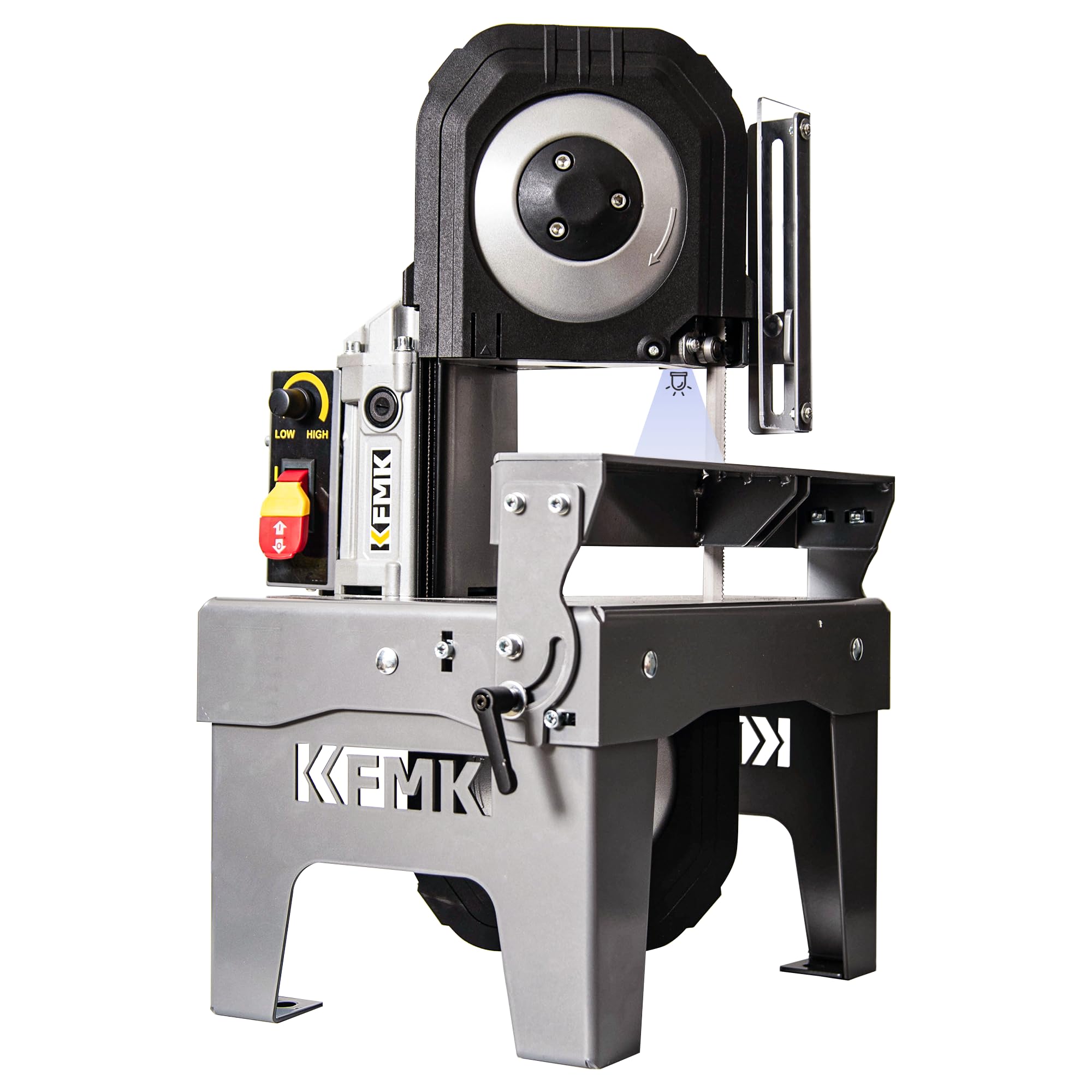
A benchtop 10-amp machine with a 5-inch throat that knife makers are using to profile 1095 steel.
This KFMK tabletop saw cuts deep enough for serious bench work, thanks to a 10-amp motor and a 5-inch cutting depth. The standout is the adjustable blade speed from 137 to 472 FPM (feet per minute, how fast the blade travels), which owners say handles varied materials — one shaped 30 knives from G10 and 1095 steel, another cut a 10-inch knife profile from 1095 successfully. The dual workbench design gives you a large platform for big pieces and a small precision table for intricate work.
Setup takes about 15 to 20 minutes with basic tools, and buyers describe it as sturdy with straight cuts. It accepts standard 44-7/8-inch blades even though the label says 45 inches, so replacement options are flexible. An LED spotlight and liftable worktable round out the features, and the variable speed dial is a separate control rather than integrated with the trigger — a detail knife makers specifically appreciate.
The honest friction points are noise and the blade-change process. It is loud, comparable to a Milwaukee cordless, and changing blades is a hassle. One buyer hit a top belt failure after about 10 cuts and found no repair instructions, though others report excellent long-term results. An occasional unit arrives with setup quirks, so check the belt tension early.
The bottom line: It is the most affordable way to get a 5-inch-throat benchtop saw with real speed control. Expect loud operation and a fiddly blade swap, and you have a strong value for a garage or small shop.
Best for: DIY metalworkers, knife makers, and hobbyists who need a fixed-table saw with wide speed range and do not mind some noise.
Not for: Anyone who needs to cut in the field — this is a bench tool, and the loud motor will annoy a quiet garage.
5. DEWALT 20V MAX XR Bandsaw, Brushless Motor, Portable and Cordless, 3-3/8 Inch Cut Capacity, Bare Tool Only (DCS378B)

The brushless cordless that a plumber can swing one-handed through dense metal without arm fatigue.
DEWALT’s brushless motor is the headline here, delivering 535 MWO at 570 SFPM for demanding commercial work. The brushless design means more power per battery charge and a tool that stays cool under sustained load. The 3-3/8-inch cut capacity sits between the compact 2-inch saws and the 5-inch deep-cut machines, making it a versatile middle ground for pipe, copper, steel, all-thread, and unistrut — which is exactly what a working plumber cuts daily.
Owners call it the best they have used for portability and balance. One buyer notes, “a woman and I am able to cut through dense metal, quickly and accurately, without the tool being too heavy on my arm.” A variable speed trigger and dial let you match blade speed to the material in two ways. The integrated blade guard protects you and the blade, and a built-in LED lights the cut line. It is also Tool Connect CHIP ready, so you can track the tool with a separately sold chip and the Site Manager app.
The catch is the ecosystem. This is a bare tool, so it only makes sense if you already own DEWALT 20V MAX batteries. The additional features like the lanyard attachment point and the Tool Connect chip require extra purchases. At 10.8 pounds, it is heavier than the 7.3-pound Bosch but lighter than the 15-pound corded DEWALT, splitting the difference nicely.
Why it earns the top performer tag
- Brushless motor delivers 535 MWO at 570 SFPM for demanding cuts
- 3-3/8-inch capacity handles pipe, copper, steel, and unistrut
- Variable speed trigger and dial for material-matched control
- Light enough and balanced enough for single-handed use
- Tool Connect CHIP ready for jobsite asset tracking
Know before you buy
- Bare tool only — needs a separate 20V battery and charger
- Tool Connect chip and lanyard are sold separately
- Heavier than the lightest compact cordless options
Pick this if: You are invested in DEWALT 20V and want a brushless, accurate, portable cutter that handles the full range of pipe and strut work.
skip it if: You are starting fresh with no battery platform — the corded DEWALT above gives you more capacity for the same depth of investment.
6. Milwaukee Electric – M18 Fuel DEEP Cut Band Saw
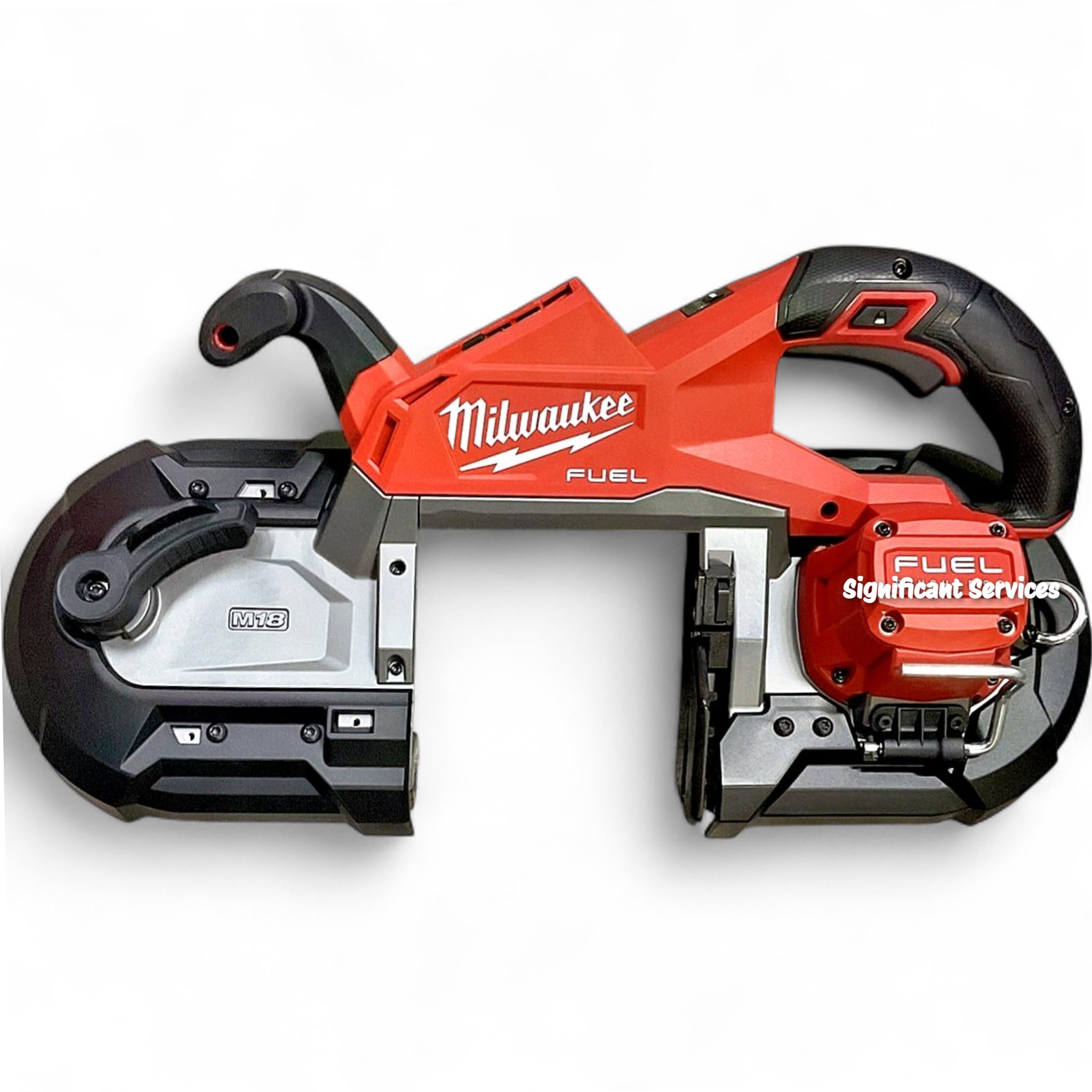
The cordless deep cut that delivers 5-by-5-inch capacity and a blade brake for sensitive materials.
Milwaukee brings its POWERSTATE brushless motor to a deep-cut cordless format, pushing 550 SFPM to handle the toughest applications. The 5 x 5-inch cut capacity matches the corded DEWALT DWM120K, but without the cord — a major advantage when you are working across a large jobsite. A cut-brake feature automatically stops the blade when selected, reducing the risk of damaging sensitive materials near the cut, which is a genuinely useful safety touch.
Rated for up to 78 cuts per charge in 1-5/8-inch unistrut, this saw is built for a full day of strut work. The integrated rafter hook lets you hang it overhead between cuts. Owners describe it as a “nice Milwaukee 18v band-saw” that works great, and it takes all M18 batteries, which is the real draw for anyone already in the Milwaukee ecosystem.
The value is genuinely mixed. Milwaukee M18 tools carry a premium price, and buyers know it — one notes “Pricy,” while another calls it “well worth the money” after years without one. You buy this saw for the platform compatibility and the deep-cut power, not for the lowest upfront cost.
The read: If you live in the M18 Fuel system, this is the deep-cut portable to own — proven power, real capacity, and the cut-brake feature no other pick here offers. The price is the only friction point, and committed Milwaukee users accept it.
Grab it for: A Milwaukee M18 user who needs 5-inch deep cuts cordlessly and values the blade-brake safety feature.
Balk if: You are price-sensitive or not already in the M18 battery ecosystem — the premium is steep to enter for one tool.
7. MILWAUKEE’S 2729-20 M18 Fuel Deep Cut Band Saw Tool Only

The M18 deep-cut legend that can chew through a 1-1/2-inch solid steel rod in about fifteen seconds flat.
This is the saw that built Milwaukee’s deep-cut reputation. Field users report cutting a solid 1-1/2-inch steel rod “in probably 10-15 seconds” — a level of performance owners say matches corded alternatives. The 5-inch blade capacity handles pipe, strut, and small beams, and the saw runs on the M18 battery platform with all the battery compatibility that implies. It is a must-have in the toolbox, as one buyer put it, largely because it is as capable as a corded unit yet fully portable.
The quality reputation is the strongest draw here. Owners call it “a work horse” and “damn good tool,” noting that with the right blade for the right job it “will cut through metal like butter.” A 90-degree cutting angle keeps cuts square, and the included blade is the standard Milwaukee high-speed steel unit. At 13.6 pounds, it is heavier than the newer 2929-20 model, but that weight gives you a solid, stable cut.
The weight is also the thing owners disagree on. Some find it heavy for overhead work, while others say the heft is worth the stability. The price is mid-to-high for a portable saw, but buyers consistently frame it as fair value for the performance — “you get what you pay for and this tool is no exception.”
The legend, quantified
- 5-inch deep cut capacity matches corded deep-cut saws
- Cuts 1-1/2-inch solid steel rod in 10-15 seconds
- Runs on the M18 platform with full battery compatibility
- 90-degree cutting angle keeps cuts square
- Proven in daily commercial electrician use
What to weigh
- At 13.6 pounds, it is heavy for sustained overhead cutting
- Price sits in the upper tier for portable saws
- Outdated by the newer 2929-20 model in some respects
Buy it for: A proven, powerful M18 deep cut that handles heavy pipe and rod with a track record of daily commercial use.
Hesitate if: You need the lightest possible cordless — this one trades some portability for its brute-force stability.
8. KAKA Industrial Benchtop Metal Cutting Band Saw 1000W, 40-88MPM Blade Speed, 0°-45° Adjustable Table, 3.3″x4.1″ Cutting Capacity BS-85
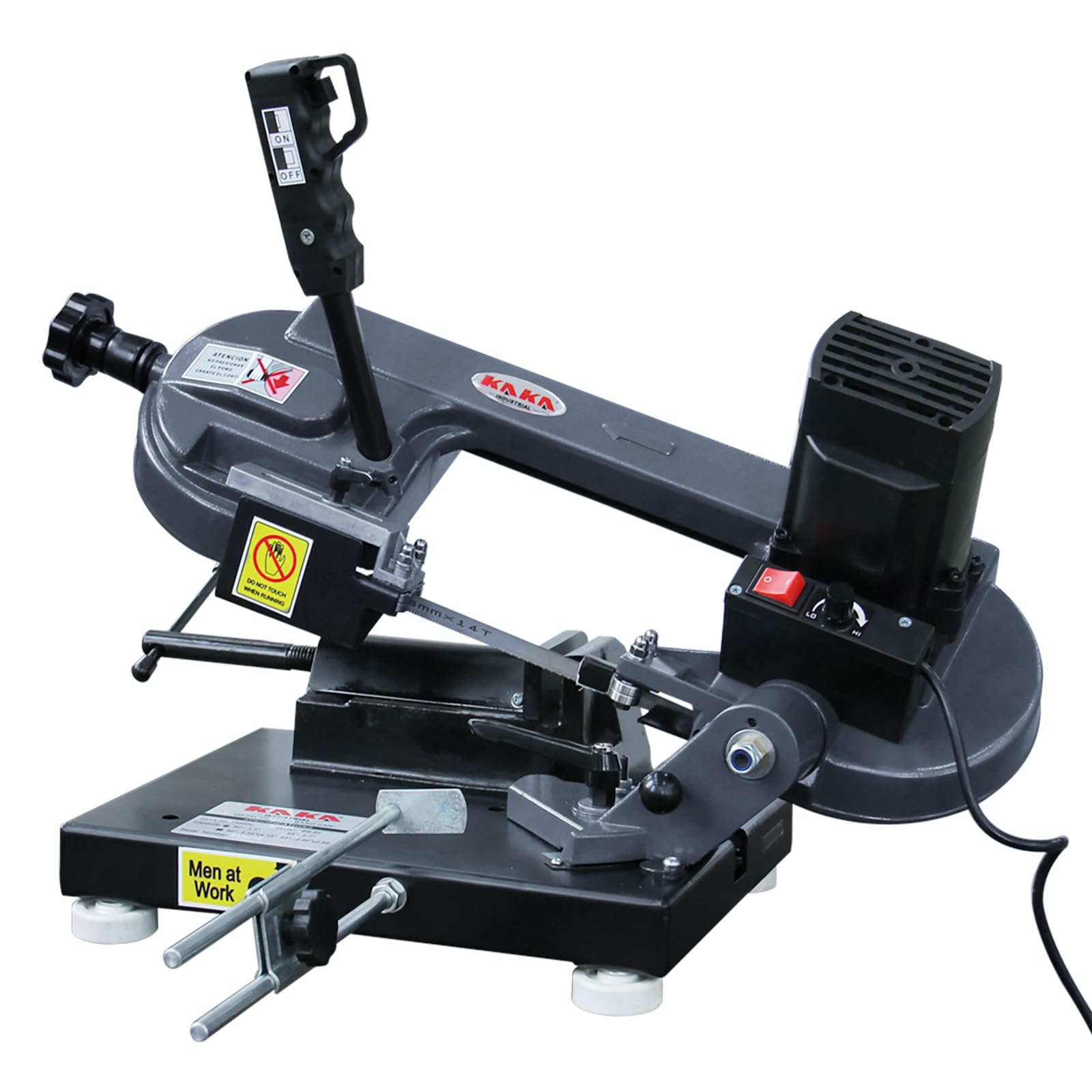
The benchtop 1000-watt cutter with a 0-to-45-degree tilting table that a metalworker says beats a saw.
For bench-mounted work, this KAKA brings a 1000W pure copper motor and a blade speed of 40 to 88 MPM, which suits metal, wood, plastic, and fiberglass. The real star is the worktable that adjusts from 0° to 45° for angled cuts — and owners mention it actually reaches 60° off 90, more than advertised. The cutting capacity is 3.3 inches round and 3.3 x 4.1 inches rectangular at 90°, covering pipes, rods, and sheet materials.
Professional metalworkers call the build quality superior to a HEM 120XL saw, praising the accurate angle indicator and quality parts with lathe work. Buyers are emphatic: “Goodbye cutoff saw. No sparks, quiet, accurate and easy to use!” The gear-driven system with automatic tension control on a 13 x 0.65 x 1325mm bi-metal blade (14 TPI) ensures smooth cuts and extended blade life. A large heat dissipation vent and low-noise design under 75dB keep it comfortable for prolonged runs.
The honest issues are the motor noise — it is loud — and some spec confusion. One buyer measured the motor at 750 watts rather than the listed 1000W, and blade size feedback is mixed. A gear tooth failure on the first use is a rare but real report. The included blade is aggressive, so expect a learning curve on thin material.
The honest take: For a benchtop unit, this delivers accuracy and angle range that punches far above its price tier — the build quality comparison to a saw is the headline. The motor noise and the occasional spec gap are the trade-offs for that value.
Reach for it: A garage or small shop fabricator who needs accurate angled cuts in stainless and mild steel without spending premium money.
Reconsider if: You need quiet operation — this motor is loud, and the spec discrepancy on wattage will bother precision-minded buyers.
9. Eastwood Benchtop Metal Aluminum Cutting Bandsaw Electric Portable Benchtop Steel
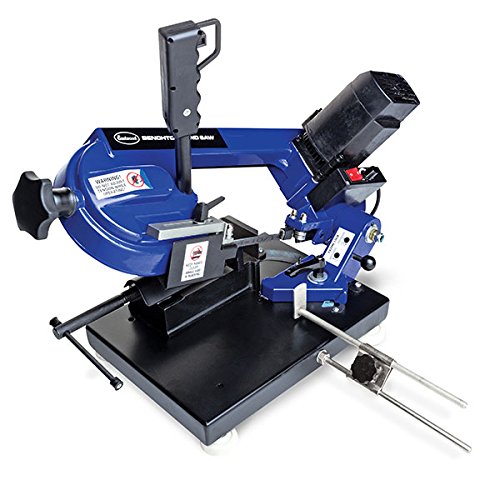
The electric hacksaw replacement that cuts 50 one-inch tubes and leaves the blade barely worn.
Eastwood built this benchtop saw for tubing fabrication, and owners confirm it delivers. The variable speed 1000-watt motor runs the blade at 100 to 260 ft/min, and the cutting geometry delivers perfect miter cuts from 90 degrees to 45 degrees. With a throat capacity of 3.25 inches and a width capacity of 4.5 inches, it handles the tube and plate stock common in fabrication work. A pistol grip handle with a speed control trigger gives you fingertip speed adjustment.
Real-world owners cut 50 one-inch tubes and 12 four-inch by quarter-inch plates with the blade still unworn, reporting accurate 90, 45, and 30-degree angles. They describe the cuts as smooth, precise, and thin — exactly what you want when fitting tubing for railings or frames. The 24-tooth blade and the included brake feature round out a package that buyers call “much better built than I thought it would be.”
The catch is small-piece handling. The blade sits about 1.5 inches from the clamp, which makes positioning small workpieces awkward. The 45-degree stop needs fine-tuning from the start. At 47 pounds, it is a permanent bench resident, not a tool you carry around.
Why it stands out: The blade durability is the headline — multiple owners push it through dozens of cuts with zero visible wear. For tube and plate fabrication with accurate miters, this is the pick, as long as you work with larger pieces and set up the 45-degree stop properly.
Choose it for: Fabricators cutting tubing and plate for railings, gates, and frames who need accurate 45-degree miters and long blade life.
Pass it by if: You frequently cut small pieces — the blade-to-clamp distance makes fine work fiddly.
10. SHOP FOX W1715 3/4 HP Metal Cutting Bandsaw

The horizontal bandsaw that cuts hundreds of hardened steel rods and shuts itself off when finished.
This Shop Fox is a horizontal bandsaw, meaning it holds the workpiece and lowers the blade through it automatically — a different motion than the portable saws above. The 3/4 HP, 110V, single-phase motor runs at 1,725 RPM and offers three blade speeds: 78 FPM at 40 RPM, 108 FPM at 60 RPM, and 180 FPM at 80 RPM. The blade is a 64-1/2 x 1/2 x 0.025-inch unit, and the saw includes an automatic shutoff that powers it down when the cut completes.
This is the saw for the ornamental metalworker cutting railings and gates. Customers note cutting “hundreds of hardened steel rods and had no issues” by running the blade slow. The auto-shutoff is a real convenience — you can start a cut and walk away, which is why one buyer “liked it so much I bought a second one.” The marked angle positions make repeatable cuts straightforward, though changing angles is slow.
The build quality is where opinions split. Some find it well-built and heavy-duty with straight, smooth cuts; others note the stand is flimsy and legs can tip when moving it. A tension knob failure within two months is a rare but real report. The included stand is low, so a riser helps for comfortable use.
The read: The automatic shutoff and the ability to cut hardened steel at slow speed make this a genuine production tool for ornamental work. The stand quality is the weak link, but the saw itself earns its keep — one owner bought a second.
Ideal for: A small shop or home garage cutting railings, gates, and hardened steel rods where hands-free automatic operation saves real time.
Not for: Anyone who expects a premium stand from the start — plan to reinforce or replace it.
11. Metal Cutting Band Saw, 9 in Round KAKA INDUSTRIAL BS-912B
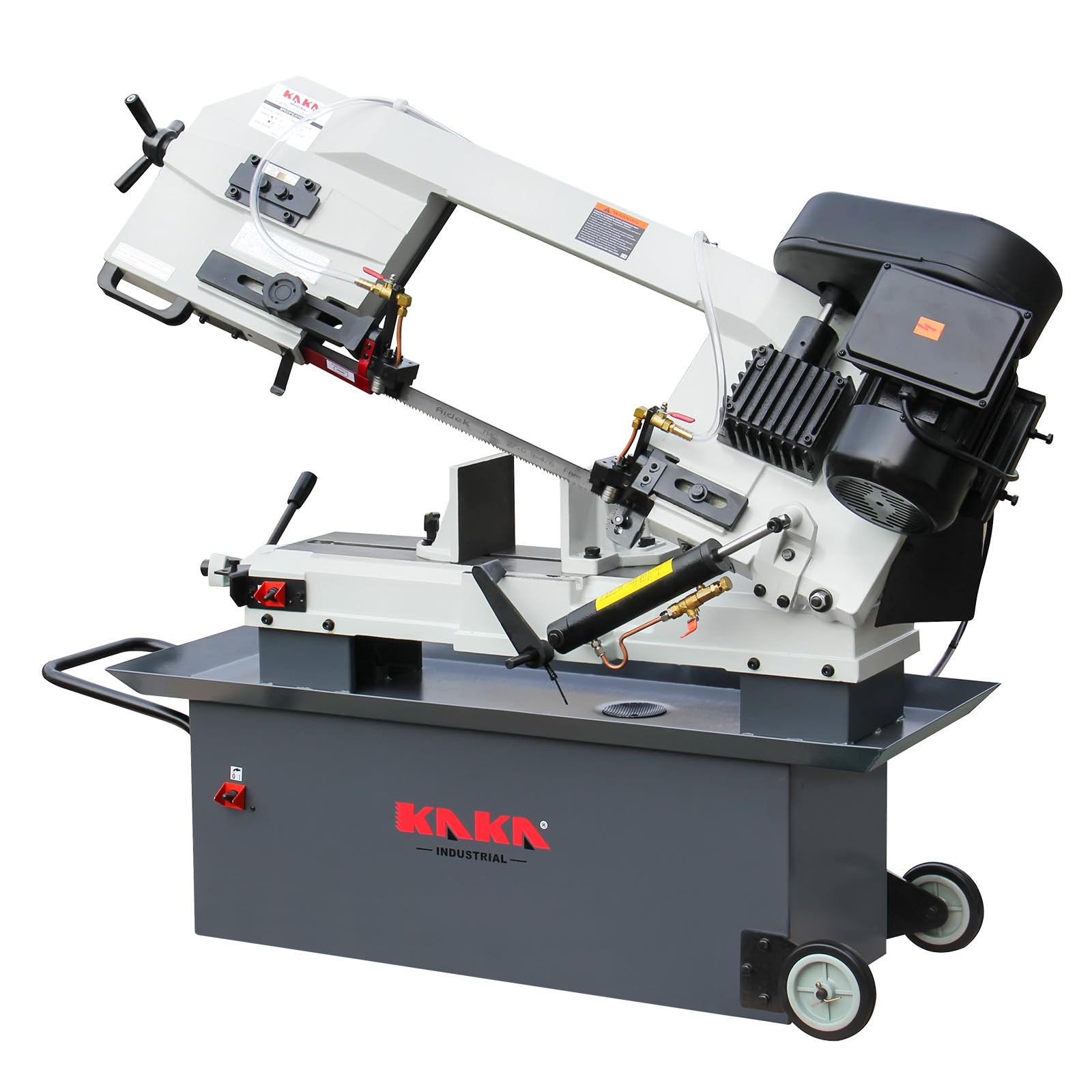
The 573-pound horizontal production saw that comes off the crate cutting dead straight with zero setup drama.
This KAKA is the heavy artillery of the list — a horizontal bandsaw with a listed 9-inch round capacity and 7 x 12-inch rectangular capacity at 90 degrees. The 1.1 kW / 1.5 HP single-phase motor runs on 115V or 230V, and four blade speeds from 32 to 115 m/min via a two-pulley V-belt drive give you flexibility across material types. The blade is a substantial 1 x 0.035 x 104-1/2 inch unit.
Hydraulic downfeed is the defining feature here. A hydraulic cylinder controls the saw bow descent, and the adjustable feed rate matches the cutting setup to your workpiece and blade choice — you set it and the saw feeds itself through the cut. The 45-degree miter vise rotates for angle cuts with a listed capacity of 6 inches round. A coolant system, adjustable blade guides, material stop, handle, and wheels round out a machine built for shop workflows.
Reviewers point out it “comes off the crate cutting dead straight” and call it shop grade quality with a fine coolant pump and chip trap. One noted it actually cuts 9 x 12-inch stock despite the 7 x 12-inch spec. The build quality feedback is mixed — one says very well made, another describes it as cheaply made, and a hydraulic bracket alignment issue needed washers to fix. This is a freight-delivery purchase, so plan for the delivery appointment.
The production case
- 9-inch round capacity handles the largest stock on this list
- Hydraulic downfeed with adjustable rate automates the cut
- Four blade speeds from 32 to 115 m/min for material flexibility
- 45-degree miter vise for angled production cuts
- Dual voltage 115V/230V motor fits varied shop setups
What to plan for
- 573 pounds requires freight delivery with a liftgate
- Build quality reports vary — some call it cheaply made
- Hydraulic bracket may need alignment adjustment
- Leveling feet and a chip guard are not included
Buy it for: A serious shop cutting large round and rectangular stock all day, where hydraulic downfeed and four-speed flexibility justify the investment.
Think hard if: You do not have the floor space or freight-delivery setup — this is a permanent production machine, not a weekend hobbyist tool.
Understanding the Specs
Cut Capacity
This is the largest piece of metal the saw can pass through, listed in inches of round or rectangular stock. A 2-inch capacity handles conduit and threaded rod. A 5-inch capacity clears pipe, angle iron, and small beams. Match this number to your biggest common workpiece — you cannot stretch a saw’s throat.
Blade Speed
Metal cuts best at slower blade speeds, typically under 350 surface feet per minute, to prevent overheating the teeth. Speeds are listed as FPM (feet per minute), SFPM (surface feet per minute), SPM (strokes per minute), or MPM (meters per minute). Variable speed dials let you match the pace to the material — slow for stainless, faster for aluminum.
Motor Power and Type
Portable corded saws are rated in amps, like 10 amps for heavy work. Cordless tools depend on the battery platform’s voltage, like 18V or 20V. Brushless motors deliver more power per charge and run cooler than brushed motors, but they cost more. Benchtop units are rated in horsepower or watts.
Weight and Portability
A 7.3-pound portable saw is comfortable for overhead work all day. A 15-pound deep-cut saw is a two-hand tool. Benchtop units from 47 to 573 pounds are permanent shop fixtures. Decide whether the saw travels to the work or the work comes to the saw before you look at anything else.
FAQ
Can a portable band saw cut stainless steel?
What is the difference between ahorizontal and a vertical band saw?
Does a bandsaw for metal need a coolant system?
Why does my band saw blade keep breaking?
Can I use a wood band saw for cutting metal?
How many cuts can I get on a single battery charge?
Is a brushless motor worth the extra cost on a band saw?
What blade length and type do I need for replacement?
How heavy a band saw do I actually need?
Can a portable band saw make miter cuts?
Final Thoughts: The Verdict
For most people, the bandsaw for metal winner is the DEWALT DWM120K because its 10-amp motor and 5-inch deep cut capacity handle the widest range of real jobsite work, from angle iron to pipe, with reliable power and a variable speed dial. If you want cordless portability for all-day overhead work, grab the BOSCH GCB18V-2N at just 7.3 pounds. And for bench-mounted production cutting with accurate miters, the KFMK MBS125V gives you a 5-inch throat and adjustable speed at a budget-friendly price that punches well above its tier.
How We Picked
We do not accept paid placement. Every pick is matched to a real buyer and a real use-case; we do not hands-on test units.
Sources & Methodology
Specifications: manufacturer listings and product documentation. Review insights: verified customer reviews, as of September 2026. Pricing: not shown on this page (it changes often); check the current price via the retailer link.
As an Amazon Associate, KitchPrep earns from qualifying purchases. This does not affect which products we feature.
Related Guides
