
Specs are compiled from manufacturer listings and verified buyer reviews and can change over time — please confirm the key details on the product page before buying.
When a grinder is too bulky and a hand file is too slow, a bandfile belt sander slips a narrow loop of sandpaper into tight corners to shave metal, weld, or wood with a quick back-and-forth motion. Your first decision is power source: a cordless model lets you move freely without a hose, while an air-powered one runs cool and light but needs a hefty compressor. Below, we break down the top performers so you can pick the one that fits the work you actually do.
I’m Mohammad Maruf — the founder and writer behind KitchPrep. This guide is built by comparing the manufacturers’ published specifications and the patterns across verified customer reviews, so you get each pick’s real strengths and trade-offs instead of marketing spin.
If you’re chasing clean welds and smooth edges in hard-to-reach spots, this roundup of the bandfile belt sander landscape points you to the model that fits your workflow.
Our Picks at a Glance


How To Choose The Best Bandfile Belt Sander
A bandfile is a specialist tool, so the right choice depends heavily on where and how you plan to use it. The biggest fork in the road is power source: cordless for portability and quick grab-and-go jobs, or pneumatic for continuous, high-output work where a compressor is already nearby.
Power Source: Cordless, Pneumatic, or Corded
Cordless models from DEWALT, Milwaukee, and Makita let you climb a ladder or reach into a tight engine bay without a hose trailing behind. The catch is runtime, which depends on your battery size and how hard the motor works. Pneumatic bandfiles are often lighter and can run indefinitely, but they consume air quickly — several buyers report needing a large compressor to prevent constant cycling. A few users prefer a corded electric for steady power, though these are less common in today’s lineups.
Motor Technology: Brushless vs. Brushed
The motor drives everything. A brushless motor (which uses electronic commutation instead of carbon brushes) runs more efficiently and typically lasts longer, so premium cordless picks use it. That means more runtime per charge and steadier power delivery — for example, the DEWALT 20V MAX XR claims more power than pneumatic versions, a bold statement supported by its brushless design that spins up to 5,600 ft/min.
Belt Size and Speed
Belt dimensions dictate reach and aggression. A 1/2″ x 18″ belt is the most common size for metalwork, offering a good balance of reach into tight spots and material removal. A smaller 3/8″ x 13″ belt on the Astro tool is even more maneuverable for fine detail work. Speed matters, too — look for a high surface feet per minute (SFPM) rating for fast cutting, but also for variable speed control so you can slow down for精细 work on plastic or thin metal.
Quick Comparison
| Model | Best For | Power Source | Belt Size | No-Load Speed | Weight | Amazon |
|---|---|---|---|---|---|---|
| DEWALT 20V MAX XR★ Best Overall | Cordless power for auto body | Cordless (Bare) | 1/2″ x 18″ | 5,600 ft/min | 3.7 lbs | Amazon |
| Milwaukee M12 FUELCompact Cordless | Compact M12 versatility | Cordless (Bare) | 1/2″ x 18″ | 3,600 RPM | 2.5 lbs | Amazon |
| Milwaukee 2482-20Precision Pro | top-tier cordless precision | Cordless (Bare) | 1/2″ x 18″ | 3,600 SFM (High) | — | Amazon |
| ONEAND 18V Belt Sander | Homeowners on a budget | Cordless (Bare) | 1/2″ x 18″ | — | 3 lbs | Amazon |
| Tezoro Air Belt Sander | Heavy metal grinding | Pneumatic | 1/2″ x 18″ | 16,000 RPM | — | Amazon |
| Astro Tools 3036 | Slim-profile detail sanding | Pneumatic | 3/8″ x 13″ | 16,000 RPM | 2.1 lbs | Amazon |
| Ryobi R18PF-0 | Versatile cordless shaping | Cordless (Bare) | 13mm x 457mm | 630 m/min | 2.2 lbs | Amazon |
| Ingersoll Rand 360-418 | Pro-grade air-powered finish | Pneumatic | 1/2″ x 18″ | 20,000 RPM | 2.4 lbs | Amazon |
| Makita XSB01Z | Long-reach wood & steel detail | Cordless (Bare) | 3/8″ x 21″ | — | 4.2 lbs | Amazon |
In-Depth Reviews
1. DEWALT 20V MAX XR Cordless Bandfile Power Tool Belt Sander (DCM200B)
Our pick — over 4.5★ from 500+ verified ratings; the strongest balance of quality and price.
A cordless bandfile that delivers pneumatic-level power without the air hose.
If you’re doing serious automotive restoration or sheet metal work, this DEWALT is the one that keeps pace. Its brushless motor (a design that’s more efficient and durable than older brushed motors) delivers more power than pneumatic versions, spinning the belt up to 5,600 ft/min — so it eats through spot welds with surprising speed. Owners who use it for auto spot welds report it’s durable under consistent use, and the variable speed dial and trigger give you fine control for finishing passes.
The 104° rotating arm is a standout for flexibility; you can angle the head to reach into tight engine bays or along a door edge without contorting your wrist. Belt changes are tool-free, which owners consistently praise — you can swap from a coarse 80-grit to a finer belt in seconds when you move from grinding to smoothing. At 3.7 pounds, it’s not the lightest here, but the power and build quality justify the heft.
Owners mention it’s handy for metal work and versatile enough for tasks like horse hoof dressing, where the low heat output keeps animals calm. It’s a bare tool, so you’ll need a 20V MAX battery and charger from your existing DEWALT lineup. The one thing to note: the forward handle is essential for control — some owners found skipping it caused the tool to gouge the workpiece.
Why it wins
- Brushless motor with 5,600 ft/min belt speed rivals air tools
- 104° rotating arm reaches awkward angles
- Tool-free belt changes are fast and easy
- Variable speed control for precision work
What to know
- Bare tool — no battery or charger included
- Heavier than some rivals at 3.7 pounds
- Handle is near-essential for controlled use
Reach for it if: you need cordless power that keeps up with metalwork and you already own 20V MAX batteries.
Think twice if: you’re starting from scratch with no DEWALT batteries — the added cost of a starter kit stings.
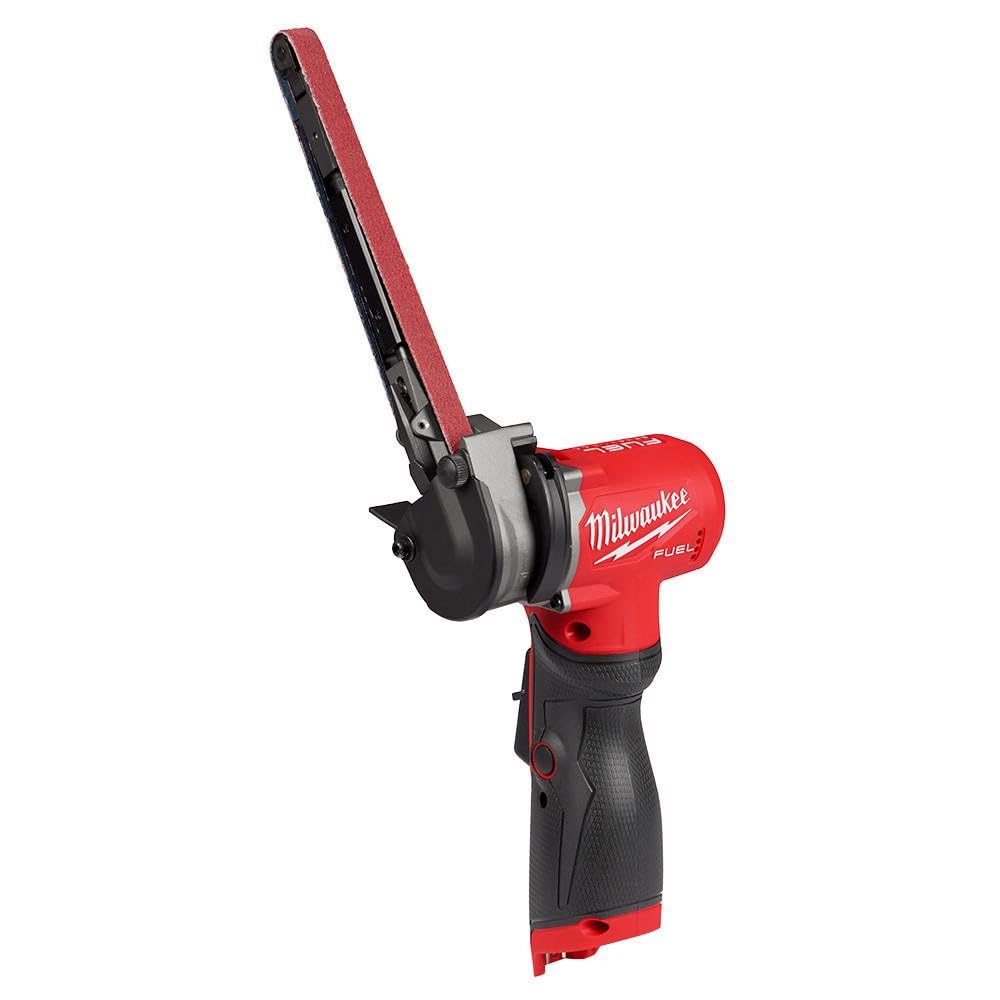
2. Milwaukee M12 FUEL 1/2″ X 18″ Bandfile (2482-20)
A featherweight M12 detail tool that surprises owners with its punchy brushless motor.
This Milwaukee stands out for its compact M12 platform (the 12V battery system), making it among the most maneuverable bandfiles available. Weighing just 2.5 pounds, you can hold it one-handed for long stretches, and the brushless motor delivers more punch than you’d expect from a 12V tool. Customers note using it to sharpen mower blades and knives, and even to remove spot welds in a rocker panel — tasks you’d usually think require a larger 18V or 20V machine.
The adjustable head rotation and reversible direction of rotation are the features that set it apart from cheaper cordless options. Reversing the belt direction can help when you’re sanding into a corner without the tool kicking back on you. Belt changes are easy, which owners appreciate for quick swaps between coarse and fine grits. it’s a versatile tool for both pros and DIYers who are already invested in the M12 ecosystem.
Versatility is the thing everyone raves about — owners use it for fine-tuning tile, detail work on wood, and light crown molding touch-ups. The trade-off is battery life; it’s a thirsty little tool under heavy load, so you’ll want a high-capacity M12 battery and a spare on hand for longer jobs. As a bare tool, you’re expected to supply your own battery and charger.
At 2.5 pounds, it’s 23% lighter than the DEWALT, easing fatigue during overhead or extended sessions.
Best for detail: Its compact size and low weight make it ideal for intricate work where a bigger tool is clumsy. The reversible belt direction is a genuine safety and control feature for corner work.
The honest catch: 12V power means you’ll swap batteries more often on heavy jobs. It’s a precision instrument, not a metal-hogging monster.
3. Milwaukee 12V FUEL 1/2″ x 18″ Sander with Speed Adjustment (2482-20)
A cordless bandfile that metalworkers rank as the best they’ve owned.
If you do serious metalwork — welding, fabrication, or restoration — this is the bandfile that pros keep coming back to. Owners who’ve owned three of this type of belt sander over the years say this cordless one is hands down the best, praising the build quality you expect from Milwaukee. It excels at spot weld removal, smoothing brazed joints, and cleaning tight spaces where other tools can’t fit.
The defining feature is the two speed settings — High at 3,600 SFM and Low at 1,800 SFM — combined with a variable speed trigger. This gives you real control: use high speed for aggressive material removal, then dial it down for fine finishing passes without gouging the metal. The forward and reverse rotation functions, a locking knob for continuous use, and a 360° rotating arm make it exceptionally versatile for accessing difficult angles.
Toolless belt changes and alignment adjustment keep you working instead of fiddling. The replaceable contact wheel extends the tool’s life in continuous applications. Owners use it for everything from woodworking to welding cleaning, noting it gets into hidden spots when carving or working in tight depths. It’s a bare tool that demands a big battery — owners stress you’ll want a high-capacity M12 battery on hand for sustained work.
Why pros pick it: The dual-speed control and reversible belt direction offer a level of precision that’s rare in a cordless bandfile. It’s built to Milwaukee’s standard, meaning it’ll take a beating.
The trade-off: It’s an investment, and you’ll need to feed it with quality M12 batteries to get the full experience. This is a tool for those who demand the best, not the cheapest.
4. Ingersoll Rand 360-418 Air Belt Sander (1/2″ x 18″)

A pneumatic powerhouse that runs cool and delivers continuous power beyond cordless limits.
When you have a compressor on hand, this Ingersoll Rand is a force to be reckoned with. The 0.6 hp air motor spins at 20,000 RPM and a blistering 4,700 SFPM, giving you the kind of continuous, high-output sanding that cordless tools can’t sustain. Reviewers point out it’s flawless for finishing welds on auto body repairs and reaching tight areas with pinpoint or flat grinding control — and after a year of use, it still shows no wear.
The tool-free articulating arm is a hallmark feature, letting you angle the head to reach into tight spaces, smooth and finish, or remove spot welds, burrs, and surface deposits. A handy power regulator lets you fine-tune the air pressure to control the cutting aggressiveness. It comes with a hex wrench and three Norton sanding belts in 60, 80, and 100 grit, so you have options right from the start.
Build quality is quintessential Ingersoll Rand — rugged and powerful, as one owner simply put it. Because it’s air-powered, it runs cool even during extended use, and belt changes are tool-free and fast. The main consideration is the same for any pneumatic tool: you need a compressor with enough output to keep it fed, and it can be loud in an enclosed shop.
What stands out
- 4,700 SFPM for rapid material removal
- Tool-free articulating arm for tight access
- Includes three Norton belts (60/80/100 grit)
- Rugged build that lasts for years
Before you buy
- Requires a capable air compressor
- Noise level is high — hearing protection advised
- Air consumption is significant under load
Reach for this if: you already have a large compressor and need endless runtime for production work or auto body finishing.
Look elsewhere if: you’re working in a residential setting without an air supply.
5. Astro Tools 3036 Air Belt Sander (3/8″ x 13″)

A slim-profile air file that reaches corners your fingers can’t.
This Astro Tools sander uses a smaller 3/8″ x 13″ belt, making it the most maneuverable option here for tight, intricate work. It’s a favorite among metalworkers and fabricators who need to get into corners on smaller pieces — one satisfied owner calls it a solidly constructed tool that really helps get into those hard-to-reach spots. At just 2.1 pounds, it’s featherlight for extended overhead or one-handed use.
Speed control is built into the tool, letting you dial in the pace for different materials and tasks. The non-slip handle grip keeps control secure even with gloved hands, and the simple belt tension lever makes changes quick and easy. It comes with three belts — 80, 100, and 120 grit — sized at 10mm x 330mm each, so you’re ready for immediate use.
The increased pulley space is a thoughtful design touch, allowing for newer, thicker belts to fit without issue. It’s praised for being solidly constructed and compact. The one recurring gripe is belt life itself, though owners are quick to note that’s not the tool’s fault — it’s just the nature of consumable sanding belts. While some wish for a trigger safety, it wasn’t a dealbreaker for them.
Perfect for corners: The 3/8″ width is ideal for detailed metalwork, getting into channels and corners where a 1/2″ belt won’t fit.
Fair warning: This is an air tool that needs a compressor, and the slender belt means slower material removal on large flat surfaces.
6. ONEAND 18V Cordless 1/2″ X 18″ Belt Sander (PSD101B)

A budget cordless file that cuts a half-day hand-sanding job down to 30 minutes.
If you’re a homeowner or DIYer not ready to drop premium money, this ONEAND (Ryobi-compatible) sander delivers remarkable value. One owner’s story sums it up: they spent half a day detailing doors by hand, then used this tool and did the same amount of work in 30 minutes with a better result. That kind of time savings is the real reason to own a bandfile at all.
Built on the RYOBI ONE+ 18V platform, it shares batteries with a vast ecosystem of tools many homeowners already own. At 3 pounds, it’s the lightest of the 1/2″ x 18″ cordless options, making it easy to maneuver. Owners find it extremely handy for multiple uses — sharpening knives (with skill), grinding nail heads and screws, beveling edges, and deburring metal. It reaches tight spots your fingers can’t get to.
Belt tracking is solid — it stays centered during use, which was a pleasant surprise for owners sanding in narrow channels. What wins people over here is the value: this is a genuinely useful tool that doesn’t demand a professional budget. It’s a bare tool, so you’ll need a ONE+ battery and charger. This is the pick that makes the most sense for general workshop duty.
The upside
- Exceptional value for the ONE+ ecosystem
- Lightest 1/2″ x 18″ cordless at 3 pounds
- Reaches tight spots with good belt control
- Ideal for quick shaping and deburring tasks
The limits
- Not designed for heavy, continuous metal removal
- Requires existing ONE+ battery investment
- Fewer speed control options than premium picks
Grab it for: occasional DIY jobs, sharpening, deburring, and quick fixes where portability and price matter most.
Pass if: you need daily professional-grade power and are not in the ONE+ ecosystem.
7. Ryobi R18PF-0 18V ONE+ Cordless Power File

A cordless file that shapes wood, metal, and tile using a three-sided belt.
For woodworkers and DIYers who want one tool for multiple materials, the Ryobi R18PF-0 is a smart addition to a ONE+ collection. Its defining feature is the 3-sided sanding belt, which allows for intricate work on wood, metal, and tile — you can use the flat side for large areas and the edges for tight internal corners. Shoppers say it does rapid material removal with coarser grits and then works well sanding out the scratches with finer grits.
The slim line and ergonomic handle design allow for easy maneuverability and intricate sanding in extremely tight spaces. It’s powered by the 18V ONE+ system, with variable speed control that lets you manage the 630 m/min belt speed to suit the material. The tool-less tension locking lever and belt tracking dial make quick belt fitting and adjustment a breeze, which owners rate highly. It’s supplied with 13mm x 457mm sanding belts.
Owners are impressed with the build quality for the price, calling it strong, reliable, and great value. It runs a bit warm during continuous use but doesn’t shut down — a minor note rather than a flaw. The recurring suggestion is a port for a vacuum attachment, which would help with dust management. Unlike the ONEAND, this Ryobi-branded unit is engineered for detail and finesse across many material types.
What impresses
- 3-sided belt enables intricate, multi-angle sanding
- Variable speed for material-specific control
- Tool-less belt changes are quick
- Strong value in the ONE+ line
Keep in mind
- Runs warm during extended continuous use
- No vacuum port for dust collection
- Best suited for lighter shaping, not heavy stock removal
Choose this for: a versatile cordless file for shaping wood, finishing ABS plastic, and detail work on metal, especially if you’re already on the ONE+ platform.
Consider something else if: your primary work is heavy-gauge steel or production metal removal.
8. Tezoro 1/2″ x 18″ Air Belt Sander Industrial Pneumatic Tool

An air-powered workhorse that chews through welds but demands a serious compressor to feed it.
This Tezoro pneumatic sander is built for aggressive metalwork — grinding, polishing, rust removal, and deburring on steel, aluminum, and brass. Its 180° adjustable angle and speed adjustment up to 16,000 RPM make it excellent for spot weld grinding and reaching into 90° curves like a car’s cowl or A-pillar. Owners who do auto restoration report it grinds welds fast and cuts evenly without digging in or leaving unwanted grooves, especially when paired with higher-quality 3M belts.
The tool features an auto belt tensioning system that keeps the belt aligned and prevents it from sliding off — a feature owners specifically praise. Belt changes are fast, and it includes 3 sanding belts (36, 40, and 60 grit), an air inlet interface, and a wrench to get you started. The ergonomic handle is comfortable to grip, and the simple trigger switch is easy to operate even during long sessions.
The downside is its heavy air consumption. Owners call it an air hog — a 60-gallon compressor kicks in every 30 seconds at 100 PSI, and a smaller 1 HP compressor might only run it for about 5 minutes before needing to catch up. It’s also loud, and the noise level gets mixed reviews. If you do production autobody work with a large compressor, this offers strong value and solid performance.
Where it shines
- 16,000 RPM speed for fast weld grinding
- 180° adjustable angle for tight access
- Auto belt tensioning keeps belt tracking true
- Includes 3 belts and wrench
The catch
- High air consumption — needs a large compressor
- Very loud during operation
- Stock belts wear faster; 3M belts recommended
Best suited for: the professional or serious hobbyist with a big compressor who needs continuous metal removal power at a value price.
Avoid if: you only have a small portable compressor — it will struggle to keep up.
9. Makita XSB01Z 18V LXT Brushless Cordless 3/8″ x 21″ Detail Belt Sander

A long-reach detail sander that offers corded-level performance with cordless convenience.
This Makita stands out with the longest belt in the group at 3/8″ x 21″, giving you more sanding surface and reach than shorter-band tools. It’s designed for detail work on wood and steel, and owners who build wood model automobiles find it reaches where a 1″ bench-top sander cannot, making it invaluable for shaping curves and getting into complex structures. One owner working on a modern timber frame calls it invaluable after switching from custom-width sanding blocks.
Delivering corded performance with cordless convenience, it uses a brushless motor that’s efficient and powerful. The compact sanding arm pivots up to 160° for compact storage and easy positioning, while an L.E.D. light adjusts to match the angle of the sanding arm — a thoughtful touch that illuminates your work area. An electric brake allows the tool to be repositioned faster, maximizing productivity between passes.
At 4.2 pounds, this is the heaviest pick here, a trade-off for its longer belt and larger 18V LXT battery. Owners recommend it strongly, calling it worth the money and their favorite Makita battery tool. You can also buy aftermarket belts that fit, which keeps consumable costs low. It includes a 3-year limited warranty, so you’re covered if something goes wrong.
A specialist’s tool: The long 21″ belt and pivoting arm make this the best choice for reaching deep into large workpieces like car bodies or wide panels where shorter tools can’t extend. The L.E.D. light is a genuinely useful feature.
Who should skip it: If your work is mostly small, tight metal corners, the heavier weight and longer nose might feel cumbersome compared to a compact M12 or air file.
Understanding the Specs
Specs tell you how fast, powerful, and precise a bandfile is. Here’s how to read them so you choose the right tool for your work.
Belt Speed (SFPM & RPM)
This is the single most important number for cutting speed. SFPM (Surface Feet per Minute) measures how fast the abrasive surface moves across your workpiece — a higher SFPM means faster material removal. The DEWALT hits up to 5,600 ft/min, while the Ingersoll Rand claims 4,700 SFPM. RPM (Rotations Per Minute) measures the motor’s spin, but SFPM is more representative of actual sanding speed. Look for a high SFPM for aggressive grinding, and variable speed so you can slow down for finishing fine metals or plastics.
Belt Size (Width x Length)
The belt dimensions determine the tool’s reach and aggressiveness. A 1/2″ x 18″ belt is the industry standard for metalwork — it fits into tight spots but still offers a decent surface area for material removal. A 3/8″ x 13″ belt (like the Astro) is slimmer for more intricate corner work. The Makita’s 3/8″ x 21″ is the longest, trading some maneuverability for greater reach. Match the belt size to the tightness of the spaces you typically work in.
Articulating & Rotating Arms
A bandfile’s superpower is its ability to get its head into awkward positions. Look for models with a rotating or pivoting arm — the DEWALT’s 104° rotating arm, the Milwaukee’s 360° rotating arm, and the Makita’s 160° pivoting arm all let you adjust the angle of the sanding head. This means you can hold the tool comfortably while the belt contacts the workpiece at the perfect angle, essential for reaching into engine bays, door jambs, or along weld seams.
Motor Type & Power Source
Brushless motors (found in the DEWALT, Milwaukee, and Makita models) run more efficiently and last longer than brushed ones, giving you more runtime and power. Your power source determines where you can work: cordless tools offer freedom but depend on battery life; pneumatic tools provide continuous power but need a compressor with enough CFM (Cubic Feet per Minute) output to avoid constant cycling. Pick based on your usual work setting.
FAQ
What’s the difference between a bandfile and a detail belt sander?
Which is better for metal work: cordless or air-powered?
How long do the sanding belts last?
Can I use a bandfile on wood, or is it just for metal?
Does a bandfile need a big air compressor to run?
Why does the sanding belt keep coming off my sander?
What is the difference between the two Milwaukee 1/2″ x 18″ bandfiles?
What grit sanding belt should I start with?
Final Thoughts: The Verdict
For most people, the winner is the bandfile belt sander from DEWALT because its brushless motor and 5,600 ft/min speed deliver undeniable power for metalwork without the hassle of an air hose. If you want featherlight precision for detail work, grab the Milwaukee M12 FUEL. And for the professional with a big compressor seeking endless runtime, the Ingersoll Rand is the one to reach for. Given the strong hardware and consistent praise across the lineup, these are all tools that will earn their place in your workshop.
How We Picked
We do not accept paid placement. Every pick is matched to a real buyer and a real use-case; we do not hands-on test units.
Sources & Methodology
Specifications: manufacturer listings and product documentation. Review insights: verified customer reviews, as of September 2026. Pricing: not shown on this page (it changes often); check the current price via the retailer link.
As an Amazon Associate, KitchPrep earns from qualifying purchases. This does not affect which products we feature.
Related Guides
