
Specs are compiled from manufacturer listings and verified buyer reviews and can change over time — please confirm the key details on the product page before buying.
If you want the short answer: buy the saw that fits your biggest cut, not the one with the biggest motor number. A band saw with a table earns its keep when the table stays flat and square, the blade tracks where you aim it, and the machine does not shake your workpiece off course. This guide covers eleven machines, from 31-pound benchtop units to 200-pound floor saws that resaw 12-inch logs.
I’m Mohammad Maruf — the founder and writer behind KitchPrep. This guide is built by comparing the manufacturers’ published specifications and the patterns across verified customer reviews, so you get each pick’s real strengths and trade-offs instead of marketing spin.
The quick comparison table up top lets you scan cutting height and width side by side, so you can rule out the wrong size before you read a single full review. Below are the best band saws with tables, matched to your cutting height, throat width, and bench space.
Our Picks at a Glance


How To Choose The Best Band Saw with Table
Most first-time buyers ask about horsepower and end up with the wrong machine. The number that actually decides what you can build is cutting height — the tallest piece of stock that can pass under the upper blade guide. A saw rated for 3-1/2 inches of cutting height cannot resaw a 4-inch block no matter how large its motor is.
Match the throat to your widest cut
Throat width (also called cutting width) is the distance from the blade to the column on your right — the widest piece you can push through sideways. An 8-inch throat handles cabinet doors and curved plywood work. A 9-inch throat takes a 9-inch board. If you plan to cut wide panels or resaw wide stock, match the throat to your widest cut — 8 to 10 inches on benchtops, 13-3/8 inches on the WEN BA1487.
Decide how you will change blades
Every band saw eats blades, so how hard the swap is matters more than most buyers expect. Look for a quick-release tension lever or a keyed blade change, and check that the blade length is a common size you can reorder easily. A common blade length like 59-1/2, 72, or 100-3/4 inches is easy to reorder, so you keep cutting instead of waiting on a shipment.
Check what the table is made of
The work table does two jobs: it holds your workpiece dead flat, and it tilts for bevel and angled cuts. Cast iron tables resist warping better than stamped steel; cast aluminum tables save weight on benchtop units. All the saws here tilt to at least 45 degrees, which covers picture-frame miters and most bevel work.
Quick Comparison
| Model | Best For | Cutting Height | Cutting Width | Blade Length | Amazon |
|---|---|---|---|---|---|
| QD-KYOHO 14-Inch Dual-Speed★ Best Overall | Big cuts and hardwood | 13 inches | 13-5/8 inches | 111 inches | Amazon |
| PioneerWorks 8-Inch BandsawBudget Champion | Budget benchtop work | 3-1/2 inches | 8 inches | 55-5/16 inches | Amazon |
| Hoteche 8-Inch Band SawMost Compact | Small curved cuts | 80mm at 90° | 8 inches | 1400mm blade | Amazon |
| SEESII Benchtop Band Saw | Scrollwork and curves | 3-1/8 inches | 8 inches | 55 inches | Amazon |
| SHOPMAX 10-Inch Benchtop | Deep single-pass cuts | 4.5 inches | 10 inches | 67.4 inches | Amazon |
| VIGO POWER 9-Inch Benchtop | Quiet garage workshops | — | 9-inch table saw | 62 inches | Amazon |
| WOODSKIL 9-Inch Band Saw | Light-to-medium craft work | 3-1/2 inches | 9 inches | 59-1/2 inches | Amazon |
| WEN BA3962 10-Inch | Small shops that resaw | 6 inches | 9-3/4 inches | 72 inches | Amazon |
| Rikon 10-Inch | Curves and carving prep | — | — | 70.5 inches | Amazon |
| JET JWB-10 | Shop-to-shop portability | 9 inches plus | 10-inch class | 67.5 inches | Amazon |
| WEN BA1487 14-Inch | Resawing logs and slabs | 8.85 inches | 13-3/8 inches | 100-3/4 inches | Amazon |
In‑Depth Reviews
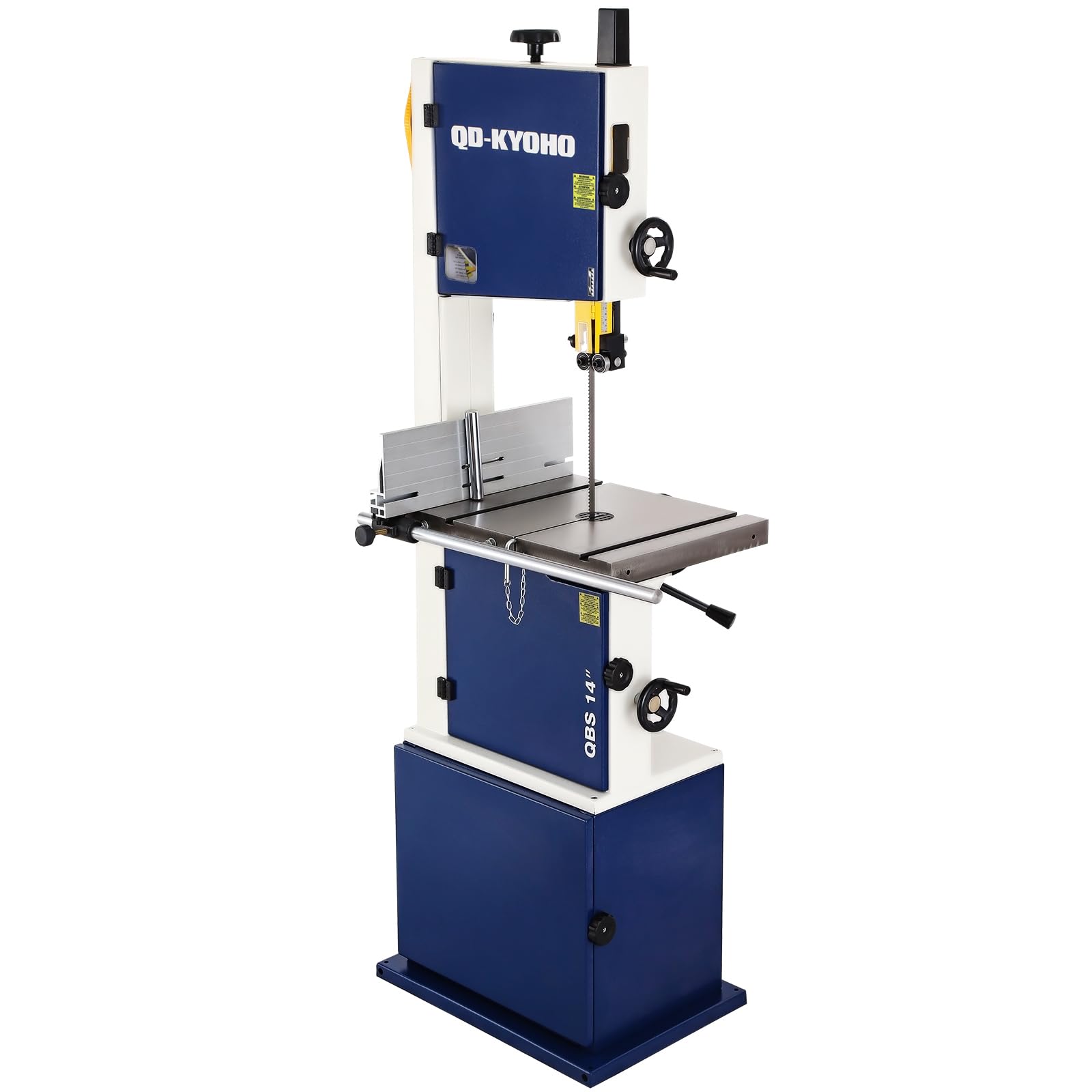
1. Band Saw, 14 Inch Bandsaw for Woodworking, 1445 & 2950 FPM Dual-Speed
Our pick — over 4.5★ from 90+ verified ratings; the strongest balance of quality and price.
A full 13 inches of cutting height and a 14 amp motor that never bogs down.
If you cut thick hardwood, this is the machine the whole list is measured against. It carries an enormous 111-inch blade and a 13-5/8 inch throat, so it swallows stock that would stop a benchtop saw dead. The table itself is a 21-1/2 inch by 15-3/4 inch slab of cast iron that tilts 45 degrees to the right and 5 degrees to the left, which covers bevels, miters, and the odd angled cut without fighting the workpiece.
The motor here is a different class from the little 2 and 3 amp benchtops further down. At 14 amps, it is a 7.0x jump in current rating over the Hoteche 8-incher and roughly 4.7x the PioneerWorks 3-amp unit. Two speeds let you pick your trade-off: 1445 FPM for hardwoods, 2950 FPM for a smoother finish on softwoods. A welded steel frame and dynamically balanced cast aluminum wheels keep the cut flat, and the upper and lower guide structure adjusts both vertically and horizontally so you can dial the blade in properly.
What wins people over is the build. Owners describe a machine that arrives needing real setup — one noted the manufacturer had not finished the assembly — and then runs smooth and quiet once the guides and tension are set. The cutting performance speaks for itself: buyers report running hundreds of feet of 6-inch cedar through it without a hiccup. There is an overload protection circuit to protect the motor, and the work light socket means you are not cutting in your own shadow. One honest note from the review pages: a rip fence whose unanchored end shifts right when clamped, so check it before a critical rip. That is a small fix on a saw this capable, and it is the kind of thing you notice once and correct permanently.
Resaw Capacity
- 13-inch cutting height and 13-5/8 inch throat handle wide, thick stock in one pass.
- Dual speeds of 1445 and 2950 FPM let you match hardwood and softwood.
- 14 amp motor with overload protection — far more headroom than any benchtop here.
- Cast iron table tilts 45° right and 5° left for bevel and miter work.
Blade Tracking
- Arrives needing real setup — budget time to adjust guides, tension, and tracking.
- At 34 x 25 x 74 inches it needs genuine floor space and a helper to position.
- The rip fence end shifts when clamped, so square it before a precision rip.
Buy for resawing: you cut thick, wide hardwood or need one saw that will not limit the next project.
Skip for small cuts: your bench is in a tight corner and you never cut beyond 4 inches.
2. PioneerWorks 8-Inch Bandsaw, 3-Amp Band Saw, 1800FPM Benchtop
Forty pounds of benchtop saw that cuts softer metals as readily as wood.
Here is the machine for the small garage bench where a 14-inch floor saw would never fit. The throat opens to 8 inches and the table is an 11.81 x 11.81 inch surface, so you have room to maneuver a cabinet door or a curved plywood piece. The real draw is the material range: the manufacturer lists wood, metal, copper, aluminum, and plastic as fair game at 1800 RPM, and a 60-tooth blade is part of the package. That is a wider material list than most saws in this size class offer.
Weight is the honest trade-off. At 40.1 pounds it is a full 29% heavier than the Hoteche 8-incher — a badge of the Q235 steel base that keeps vibration down, but also a reminder that this is a bench fixture rather than something you tuck on a shelf. The cutting capacity runs 80mm at 90° and 50mm at 45°, and the table tilts 0 to 45° for bevel work. A double safety switch and a removable safety key handle the start-up risk, which matters if curious hands share your workspace.
Assembly and setup land on the easy side, and the cut quality stays clean across soft metals. The dust setup is where buyers push back: the 2-inch port is small enough that fitting a shop-vac adapter takes improvisation — one buyer wrapped the connection in electrical tape to get a snug fit. The included blade situation is also worth checking on arrival; a couple of units showed up without the blade they expected. Neither issue sinks the saw, but neither is a surprise you want on day one. Check the box contents before you start assembling.
Quiet Operation: the metal-capable bench saw that punches above its price, provided you confirm the blade is in the box and own a little tape.
Reach for small work: you share a bench with other tools and want wood plus soft-metal capability in one compact unit.
Skip for heavy use: you want a shop-vac to connect straight from the start without adapting the port.
3. Hoteche 8-Inch Band Saw 2.0A Low Noise Two Cutting Height Benchtop
Thirty-one pounds and a twelve-inch table that tucks into a corner of the bench.
Space is the whole point here. At 16.14 x 12.2 x 25.98 inches, this is the smallest footprint on the list, and at 31 pounds it is light enough that one person can move it without a plan. The 12×12 inch table gives you a real work surface for the size, and the two cutting heights let you tackle thicker stock at one setting and thinner material at another without re-rigging the whole saw. The no-load speed is 1500 RPM from a 2 amp motor, which is modest — this is a saw for thin stock and hobby work, not resawing.
The step down in power is measurable. That 2 amp rating sits well below the 3 amp PioneerWorks and the 4.2 amp SHOPMAX, so you should expect it to work through pine, poplar, and thin hardwood at a patient feed rate rather than plowing through 2-inch oak. The cutting capacity runs 80mm at 90° and 40mm at 45°. The blade is a 1400×6.5×0.35mm high carbon steel unit, and the table tilts up to 45 degrees for bevels.
Where this saw earns honest scrutiny is the accessories. The setup directions read a little vague, and the recurring gripe from owners is the fence and miter guard — the rip fence does not always square up cleanly, and the plastic miter guard can struggle to line up. That is a real limitation for precision joinery, and it is worth knowing before you buy. On the flip side, several owners simply report it works as it should for the money and praise the value. If your projects are curved cuts and rough dimensioning rather than furniture-grade rips, those complaints never touch your workflow. The unusual blade length is the other thing to note: source replacements early so you are not left waiting.
Suits light tasks: the beginner or space-starved hobbyist who makes curved cuts and rough shapes on a crowded bench.
Not for thick wood: anyone chasing dead-square rip cuts or resawing — the fence and motor are not built for it.
4. SEESII Benchtop Band Saw for Woodworking, 3A-120V with 8″ Cutting Width
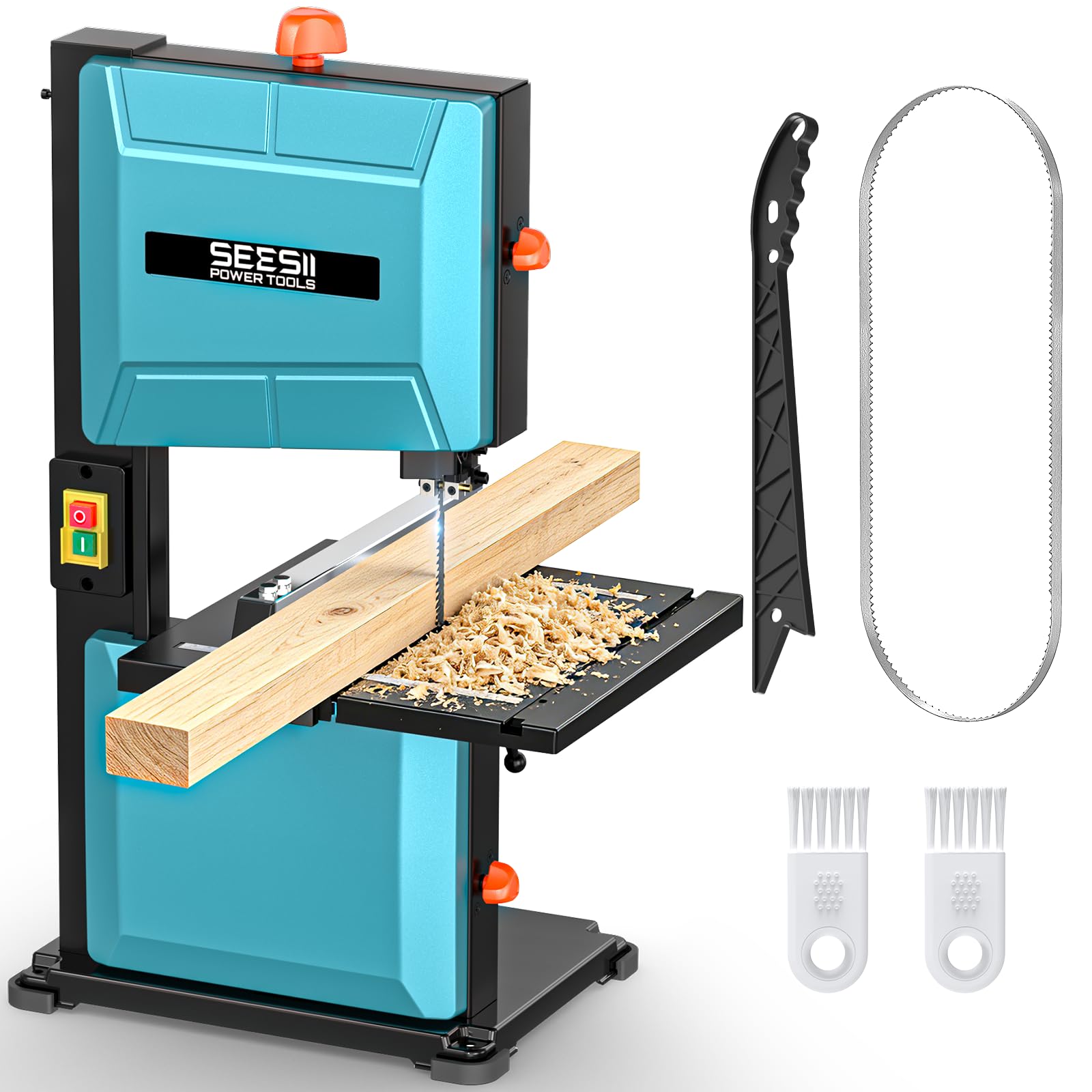
Built for scrollwork, model parts, and curves a jigsaw cannot hold steady.
This one is aimed squarely at the maker who cuts shapes, not lumber. The 8-inch throat takes plywood and cabinet doors, but the spec that tells the real story is the cutting height range from 1/8-inch veneers up to 3-1/8 inches, with tool-free height control. That range is what lets a model builder cut a dozen thin layers for a jewelry box or a toy part and never recalibrate between passes. The 350-watt motor runs at 1800 RPM with a 900 RPM blade speed, on standard 120V.
The tilting table is the standout feature. It uses a rack-and-pinion adjustment for 0-45° bevels — a geared system that lets you dial in an angle instead of fighting a loose bolt — and the 12×12 inch steel table comes with laser-etched measurement grids and a non-slip surface. A precision miter gauge locks at common angles, and the dual-sided fence flips between straight cuts and freehand curves. There is a full accessory bundle too: miter gauge, double-sided fence, carbon brush, and a magnetic angle guide.
Two safety-minded details separate it from the budget crowd. The dual power buttons prevent accidental starts, and the independent start/stop controls mean the saw does not spring back to life after a power interruption — a genuine consideration in a home garage. The 2-inch dust collection port and included blade brush keep the workspace manageable. Owners describe it as a sturdy little saw that outperforms what its price suggests, with one owner on a second unit after a different brand let them down. The catch is scale: a 55-inch blade and 3-1/8 inch ceiling mean this is a detail saw, full stop.
Portable Design: owners treat it as a scroll-work and detail saw, and the rack-and-pinion table plus dual safety switches make it a thoughtful kit for the price.
Limited Throat: cutting height tops out at 3-1/8 inches, so thicker resawing is off the menu.
Ideal for small shops: model builders, instrument makers, and anyone cutting layered curves who wants a geared table and safe controls.
Think again for big jobs: your main job is slicing thick stock — this saw is built for detail, not depth.
5. SHOPMAX 4.2 Amp 10-inch Benchtop Band Saw
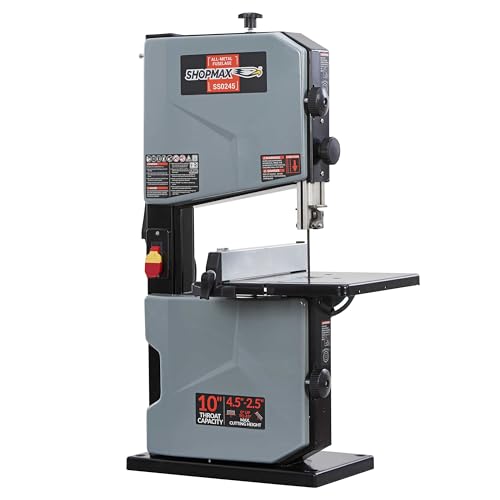
Cuts 4.5 inches deep and 10 inches wide — benchtop size, near-floor-saw reach.
If you want the deepest single-pass cut without giving up your bench, this is the machine. The 4.2 amp induction motor drives cuts up to 4.5 inches deep and 10 inches wide, and the 67.4-inch blade can run anywhere from 0.14 to 0.47 inches in width so you can swap between fine curves and straight rips. An induction motor is the durable type that runs on a rotating magnetic field rather than brushes, which is why it tends to be quieter and longer-lived than a brush motor. Ball bearings in the blade path keep the cut accurate, and the table tilts up to 45 degrees.
The frame earns its weight. At 54.7 pounds it is the heaviest benchtop entry on the list, and that comes from heavy-duty steel construction rather than stamped sheet. Owners describe the build quality as top-quality and solid, which tracks with the machine arriving in its brand box without damage and setting up easily. It is a saw you buy for stability — that mass is what keeps the blade from chattering on a deep cut. A dust-extractor connector lets you hook up a Shopmax extractor, and there is a fence included for the straight cuts, which the maker notes is more stable than a miter gauge on a small band saw.
The honest limit is weight and one recurring adjustment quirk. Fifty-four pounds is not a lot to slide, but it is a two-hand move, and one owner was already planning a wheeled base. The cutting performance draws mixed reactions in the review pages — some call it great, others find it works only after tuning. A few owners have wrestled with blades that would not stay tracking on the wheels, which is the classic sign of a guide adjustment that needs setting rather than a broken saw. Learn the tracking procedure before your first cut and this machine rewards the effort.
Choose for power: you need the deepest benchtop cut and want the stability that mass brings to a wide board.
Consider a smaller saw for tig: you cannot spare two hands and a fixed spot on the bench for it.
6. 9 Inch Benchtop Band Saw for Woodworking, 2.8A Portable Bandsaw
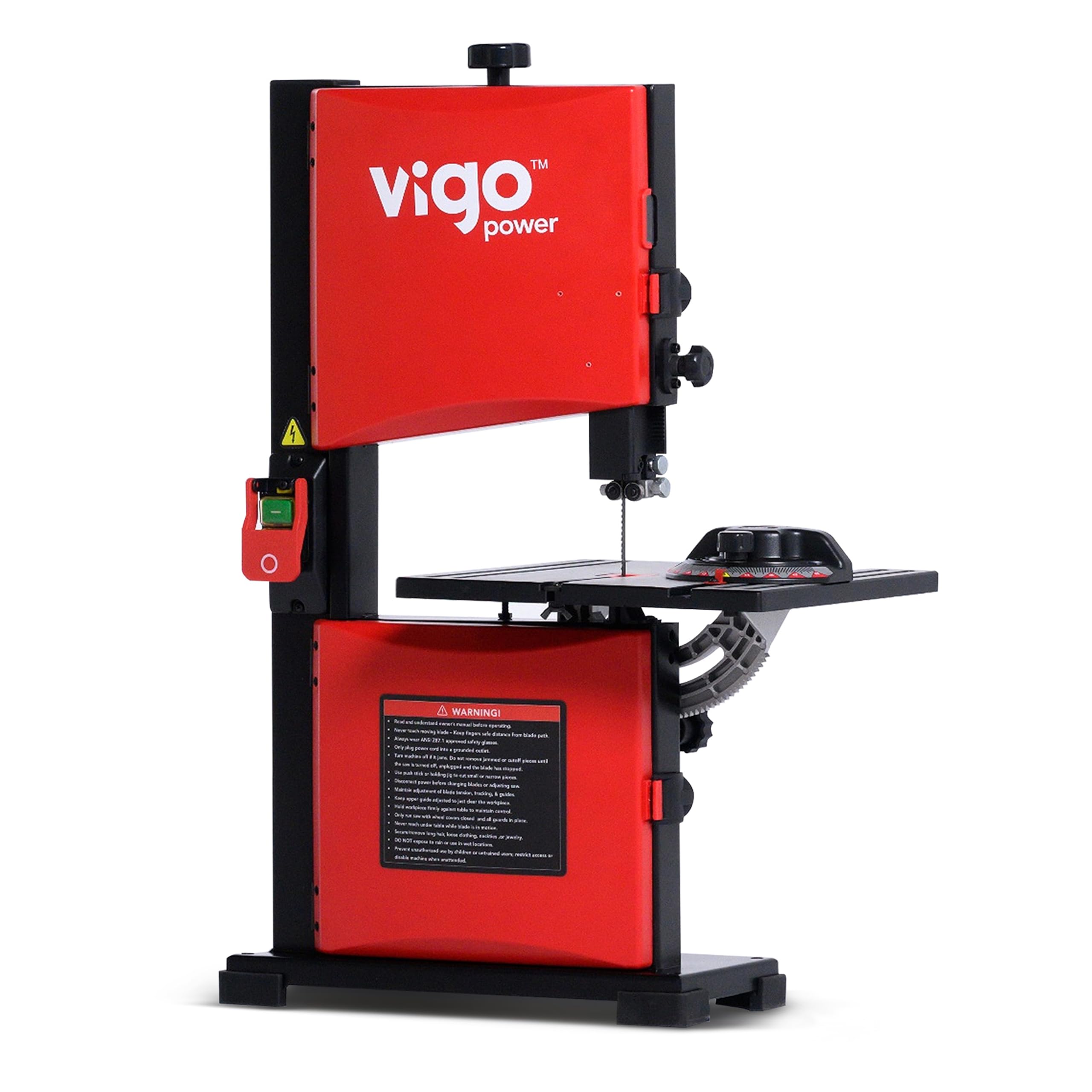
A quiet induction motor that lets you work without waking the whole house.
Noise is the reason to look at this one. It runs a 2.8 amp induction motor at 1725 RPM, and the design keeps vibration low, so it is a saw you can run in a garage or shared wall without it dominating the room. Two blade speeds — 1700 and 2500 FPM — let you trade cutting speed for control depending on what is under the blade. The 62-inch blade runs in a 12×12 inch cast aluminum table that tilts 0 to 45° for bevels and angled cuts, and a miter gauge comes in the box.
The frame and window are the thoughtful engineering. A reinforced steel frame holds everything steady, and there is a built-in blade tracking sight window so you can check blade position without disassembling the guards — genuinely handy when a blade starts wandering mid-project. The cleaning setup is also well handled: a 2-inch dust collection port connects to a shop vac, and an oversized paddle safety switch gives you a fast shutdown while a removable key stops unauthorized starts. For a home workshop with kids around, that combination is worth real money.
Owners are split on value. The saw cuts hardwood and soft materials cleanly and sets up simply, and the quiet operation gets consistent praise. Where the reviews get blunt is fit and finish — the plastic housing and a table that needed calibrating before the first square cut drew criticism, and one buyer found the miter gauge and blade would not sync for a 90° cut, working around it with a clamped fence instead. None of that stops the saw from cutting well; it just means you should plan on a setup session and possibly adding your own fence for dead-square work. The blade itself is worth upgrading early.
Compact Size: buy it for the quiet motor, the tracking window, and the safety switch — then budget an hour of setup and a fence upgrade.
Best for hobbyists: the noise-conscious hobbyist in a shared or living space who wants dual speeds and a tilting table.
Look past it for precision: you want furniture-grade accuracy straight from the box with no calibration.
7. WOODSKIL 9-Inch Band Saw, 3-Amp Benchtop Bandsaw, 2500 FPM
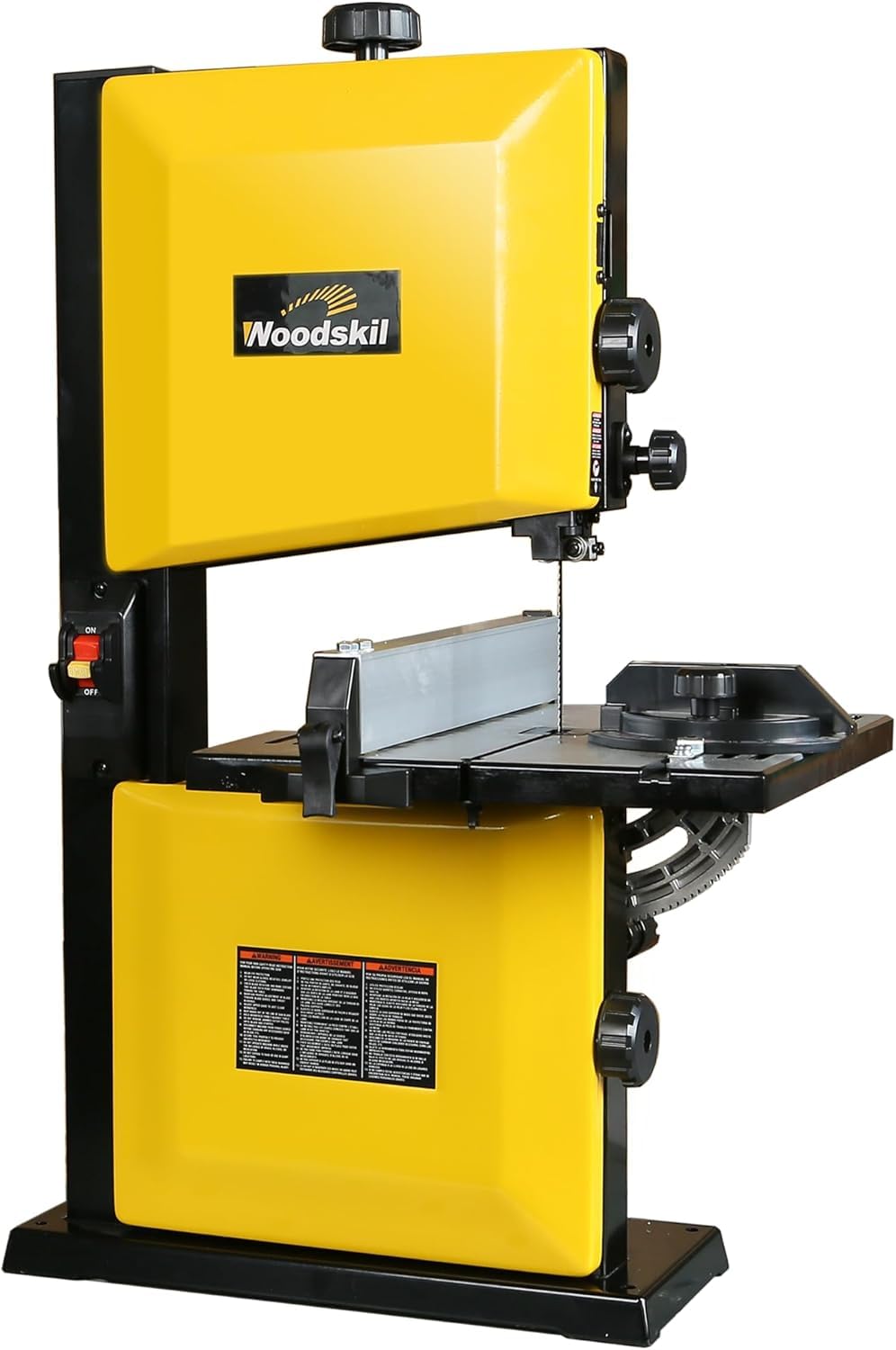
The proven beginner saw that cuts acrylic and hardwood without wandering.
For a first band saw, this is where most people should start their shortlist. A 1/2 HP motor drives a 2500 FPM blade speed with a 1720 RPM motor speed, the cutting depth maxes out at 3-1/2 inches, and the cutting width reaches 9 inches. The blade is a 59-1/2 inch unit available from 1/8 to 3/8 inches wide — a common size you can reorder anywhere — and the 12-5/16 x 11-7/8 inch cast aluminum table tilts 0 to 45° for bevels and angled work.
What veterans report is that quality control varies a little by unit. Most owners find assembly straightforward and the table squares to the blade, sometimes cutting a clean 90° on the first try. Others had to straighten a bowed miter gauge bar or accepted a fence that is functional rather than refined. The degree scale is rudimentary, so if you cut a lot of angles you may want a magnetic angle finder to double-check. None of that changes the fact that the saw runs and cuts well for the money, and the miter gauge and fence both come included.
The value here is the sheer volume of owner experience behind it. This saw has been in workshops long enough that its reputation is settled: hobbyists use it for projects of all sizes, and the ones who complain tend to be pushing it harder than a benchtop saw of this size was meant to go. One stalling issue traces back to belt tension and the variable-speed mechanism rather than the motor itself, which is a maintenance item you can address. Go slow on hardwood, keep the blade sharp, and this machine holds up. It is the saw most beginners should buy first.
Beginner Friendly
- 1/2 HP and 2500 FPM cut clean straight lines through hardwood at a slow feed.
- 59-1/2 inch blade in common widths is easy and cheap to replace.
- 12-5/16 x 11-7/8 inch cast aluminum table tilts 0-45° with a 120° miter gauge.
- Two-and-a-half-inch dust port with a wheel brush keeps the cut line visible.
Vibration Issues
- Miter gauge bar can arrive bowed and need straightening in a vise.
- The degree scale is basic — verify angles with your own gauge.
- Belt tension and speed changes need attention to avoid slipping.
Go with this for learning: you are buying your first band saw and want proven reliability at a hobbyist budget.
Step up instead for accuracy: you need to resaw boards thicker than 3-1/2 inches.
8. WEN Band Saw with Stand, 10-Inch, 3.5-Amp, Two-Speed (BA3962)

Six inches of resaw capacity on a stand that rolls into a corner.
This is the saw for the weekend woodworker who wants to resaw and still fit a car in the garage. The 3.5 amp motor cuts up to six inches deep and 9-3/4 inches wide, which is real resaw territory — enough to slice a glued hardwood block into thinner pieces. The 14-1/8 x 12-1/2 inch cast aluminum table bevels up to 45 degrees, and two speeds of 1520 or 2620 FPM let you pick between control and speed. It runs 72-inch blades from 1/8 to 1/2 inches wide.
The package is unusually complete for the price. You get a stand, a work light, a 3-in-1 dust port, a fence, a miter gauge, a 3/8-inch blade at 6 TPI, and a 2-year warranty. That TPI figure means six teeth per inch — a moderate count that balances speed and finish on general-purpose cuts. Owners comparing it to far pricier saws point out that it is one of the few affordable machines with a six-inch cutting capacity, so if resawing is your goal, this hits a spec that cheaper saws simply do not touch.
The trade-offs are specific and fixable. The work light is awkwardly positioned and owners often relocate it. The stand draws complaints for being overpriced as a separate item, so buying it bundled makes more sense. The stock blade is on the soft side — upgrade to a 1/2-inch blade with fewer teeth for serious resawing, and remember to reset blade tension if the motor stalls on a deep cut. There is also a wobble issue some owners run into if the stand or saw is not sitting level. Set it up carefully, add casters if you want to move it, and this becomes a genuine small-shop workhorse.
Two-Speed Control: six inches of resaw capacity and a full accessory kit make this the entry point to real resawing, as long as you upgrade the blade.
Assembly Required: the work light placement and a stand that benefits from a level floor and careful assembly.
Pick this for versatility: you want to resaw up to six inches without dedicating a whole bay of the garage to a floor saw.
Not the one for quick setup: you need a fast, heavy hogging saw — this is tuned for accuracy and space-saving, not brute throughput.
9. Rikon 10 Inch Bandsaw With Stand

A rugged steel column and tool-less guides make blade swaps a thirty-second job.
For carvers and modelers who change blades constantly, this is the thoughtful choice. The frame is a welded steel column and stands up to the work, and the upper and lower blade guides are spring-loaded and tool-less — no hunting for an Allen key to reposition a guide. A quick-release blade tension system and a large tension hand wheel make swapping a blade fast and consistent, which matters when you move between 1/4-inch blades for tight curves and wider blades for straight cuts. The 70.5-inch blade and machined cast iron table round it out, with a 3/4 x 3/8 inch miter gauge T-slot for accessories.
Carving prep is what this saw is best at. Owners mention it is extremely helpful for precutting carving blanks, and it handles tight curves without complaint. The table is machined cast iron, which is the premium option among table materials, and it holds a flat surface that resists warping during angled cuts. At 61.8 pounds it is heavy but still portable to a bench, and it does not eat a lot of floor space. Setup is easy and the stand is sturdy enough to hold the saw steady while cutting — the stand does not wobble beneath the blade.
The one recurring caveat is the rip fence. Owners note it can deflect about 1/8 inch under light pressure even on a clean base, which shows up when resawing a 2×4 as the cut wandering. That is a fence-rigidity issue rather than a saw problem, and it is easily worked around by adding a clamp or a better fence for long straight cuts. The blade that ships with it cuts well as a starter, and owners often order thinner 1/4-inch blades for detailed work. Two months of steady use without issue is the typical report, and it comes packed well enough to survive shipping.
Made for stability: carvers and detailed-work woodworkers who swap blades often and value tool-less adjustments.
Add your own fence for precisi: you plan heavy resawing — the stock fence deflects under pressure.
10. JET 10-Inch Woodworking Band Saw with Stand, 1/2 HP (JWB-10)

Benchtop or floor — a stand that lets you move the whole shop on a whim.
Flexibility is the pitch here. The compact benchtop design lets you carry the saw between shop locations, and the rigid steel stand lets it transition from the benchtop down to a floor position. The 1/2 HP induction motor handles various cutting applications, and a Poly-V drive system gets maximum power from the motor to the blade while cutting vibration — the Poly-V belt is a multi-ribbed design that grips better than a plain flat belt. Upper and lower ball bearing blade guides keep the blade stable, and quick-release blade tension makes retensioning fast and consistent.
The details are built for someone who cares about setup quality. The aluminum extruded fence is designed for smooth sliding and straight cuts, and owners put the cutting ability on display: one buyer cut through 4-inch blocks of redwood easily, noting minimum vibration, good power, and accuracy, plus the fact that it does not need much floor space. A 67.5-inch blade ships with it at 0.375-inch width and 6 TPI, and the package includes the stand, fence, miter gauge, and wrenches, backed by a 5-year warranty that drops to 2 years for commercial use.
Be clear-eyed about what you are getting. Customers note a real capacity quirk: it is not a full 10 inches, more like 9 inches plus. A minority of units arrive with drive-pulley and belt alignment issues that cause the belt to jump, needing adjustment or a replacement part to settle. And if you push it beyond softwoods into hard 2-inch stock, expect it to struggle — this saw is designed for hobbyist projects and small cuts. Treat it as a light-duty machine for a small shop and it will serve exactly as intended. Push past that ceiling and it will let you know.
Powerful Motor
- Converts between benchtop and floor use on its rigid steel stand.
- Poly-V drive and ball bearing guides keep cuts stable with low vibration.
- Quick-release blade tension and aluminum extruded fence speed up setup.
- Cut 4-inch redwood blocks cleanly without hogging floor space.
Heavy Weight
- Real cutting capacity is closer to 9 inches plus than a full 10.
- A minority of units need belt and pulley adjustment from the start.
- Light-duty motor struggles past softwoods and small hardwood cuts.
Worth it for professionals: a hobbyist who wants one saw that moves between a home bench and a workspace on a stand.
Not worth it for occasional us: cutting hard stock thicker than 2 inches — the 1/2 HP motor is built for small work.
11. WEN BA1487 Band Saw with Stand, Two-Speed, 14-Inch

Nine-and-a-half amps of resaw power that slices logs without bogging down.
This is the floor saw for turning logs into boards. The 9.5 amp motor cuts up to 8.85 inches deep and 13-3/8 inches wide, so it resaws thick logs in a single pass. The blade runs 100-3/4 inches long and takes widths from 1/8 to 1 inch, and the huge 21-1/2 x 15-3/4 inch work table bevels up to 45 degrees. Two speeds of 1480 or 3280 FPM let you choose between power on hard stock and speed on soft. It ships with a blade tension gauge, a circle cutting guide, a flexible work light, a 3-in-1 dust port, a fence, a 1/2-inch blade, and a miter gauge.
Owners resaw 12-inch logs on this machine with power to spare, and the throat is wide enough that the limit is usually your stock rather than the saw. That wide throat is the gap between this and the smaller WEN: the BA3962 above tops out at 9-3/4 inches wide, while this one opens to 13-3/8 inches. The circle cutting guide is a nice inclusion — the maker’s jig is a step above what some pricier brands ship. It runs about 200 pounds, so this is a fixed-position machine, and setup runs around 30 minutes. A blade tension gauge takes the guesswork out of blade changes, which is a real convenience on a saw this size.
The honest caveats are about the stand and the fence. Owners note the fence is a bit wonky and the thin metal legs on the base leave something to be desired, with some planning to upgrade the fence. The miter gauge’s T-slot fit is loose, and the stock blade is a starter rather than a keeper — upgrading the blade is almost assumed. What owners rave about is the resawing: it cuts hardwood like butter and handles jobs that would stall a benchtop saw. For the money, it delivers floor-saw capability, and one owner summed up the trade-off plainly: it is not as precise as machines costing far more, but for a non-professional, it is all you really need.
The right call for big project: your work is resawing logs and wide boards and you want floor-saw power on a fixed spot in the shop.
Choose smaller if space is tig: precision joinery on a bench is your focus — this saw favors raw cutting power over fine-tuned accuracy.
Understanding the Specs
Cutting Height and Width
Cutting height is how tall a piece of stock can pass under the upper blade guide, and cutting width (or throat) is how wide a piece you can push through sideways. Most benchtop saws here run 3-1/2 inches of height and an 8 to 10 inch throat, which suits curves, cabinet doors, and thin-stock work. If you need to resaw thick boards, look for a saw that clears six inches or more — that single number decides whether resawing is even possible. Alarge cutting height paired with a wide throat is what separates a hobby saw from a true shop machine.
Blade Length, Width, and Tracking
Blade length is fixed to the saw, so it decides how easily and cheaply you can replace a blade — common lengths like 59-1/2, 72, and 100-3/4 inches are easy to reorder. Blade width changes the job: narrow blades like 1/8 or 1/4 inch cut tight curves, while wider blades like 1/2 or 3/4 inch hold a straight line for resawing. Tracking is whether the blade stays centered on the wheels as it spins. Most cut problems reviewers point out trace back to guide bearing adjustment or blade tension rather than a broken machine.
FAQ
What does cutting height and throat width actually mean on a band saw?
Will an 8-inch band saw cut through two-inch hardwood?
How do I stop the blade from wandering off the cut line?
What size blade fits these band saws and how often do they need replacing?
Can I cut metal with a woodworking band saw?
Do I need to bolt a benchtop band saw to the bench?
What kind of table material should I look for?
Is a band saw with a stand better than a benchtop model?
How do I set up a new band saw so it squares correctly?
Are band saws with tables safe for a home garage workshop?
Final Thoughts: The Verdict
For most woodworkers, the winning band saw with table is the QD-KYOHO 14-Inch Dual-Speed because its 13-inch cutting height and 13-5/8 inch throat handle thick, wide hardwood in a single pass, and owners consistently report it runs smooth and quiet once set up. If resawing logs is your goal and you want floor-saw power, grab the WEN BA1487 14-Inch. And for a quiet benchtop saw that fits a shared space, the VIGO POWER 9-Inch is the one to reach for.
How We Picked
We do not accept paid placement. Every pick is matched to a real buyer and a real use-case; we do not hands-on test units.
Sources & Methodology
Specifications: manufacturer listings and product documentation. Review insights: verified customer reviews, as of September 2026. Pricing: not shown on this page (it changes often); check the current price via the retailer link.
As an Amazon Associate, KitchPrep earns from qualifying purchases. This does not affect which products we feature.
Related Guides
