
Specs are compiled from manufacturer listings and verified buyer reviews and can change over time — please confirm the key details on the product page before buying.
You bought a bandsaw to cut wood, not to shove 300 pounds of cast iron across a concrete floor every time you need it out of the way. A proper stand or mobile base fixes that one problem. It holds the saw at a comfortable working height, keeps it from shuddering while the blade is under load, and lets you roll it into a corner when you are done — without asking a neighbor for help.
I’m Mohammad Maruf — the founder and writer behind KitchPrep. This guide is built by comparing the manufacturers’ published specifications and the patterns across verified customer reviews, so you get each pick’s real strengths and trade-offs instead of marketing spin.
Two different jobs get lumped together under this search. Some of you have a benchtop bandsaw sitting on a workbench that is the wrong height, and you want a permanent steel foundation under it. Others have a heavy floor machine that is stuck in one spot, and you want wheels under it. The seven picks below split cleanly along that line, so figure out which camp you are in first — the right best band saw stand for you depends on it.
Our Picks at a Glance
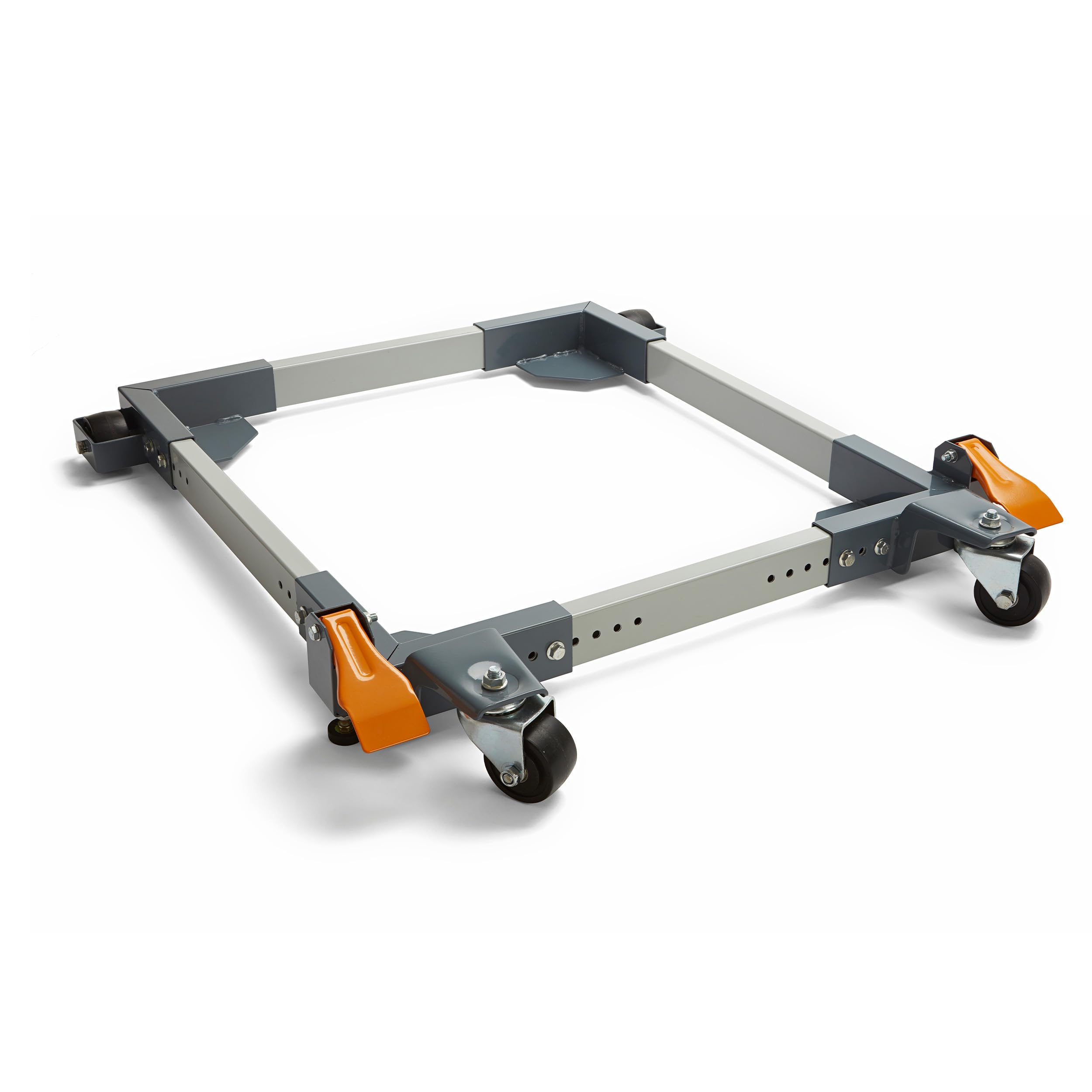

How To Choose The Best Band Saw Stand
There are really only two products hiding behind that one phrase, and buying the wrong one is the most common mistake in this category. A fixed stand is a stationary platform — four legs, a flat top, rubber feet on the floor. A mobile base is a rolling frame that lifts your existing machine a short distance and puts casters under it. If you mount a 300-pound saw on a fixed stand, your shop layout is now permanent. If you mount a benchtop saw on a mobile base, you have wheels under something that should not move while the blade is spinning.
Weigh your machine before anything else
Load capacity is the number that decides everything. Every stand and base in this category publishes one, and it is usually expressed in pounds. Leave real headroom — a base rated close to your machine’s weight will feel flexy and may not survive a bumpy shop floor. Note that some manufacturers rate capacity at the frame’s smallest configuration, with no rating given for the widest setting, so a big machine stretched out on a large base is the scenario worth thinking hardest about.
Wheels, casters, and how they lock
Four casters that all swivel turn tightly in a small shop. Bases with two fixed and two swivel wheels need a longer, straighter path and take more effort to reverse direction. Locking matters just as much as rolling: foot-operated levers that lift the frame off its wheels give you a genuinely immovable working position, while step-on caster brakes are easier to use but rely on the brake pads themselves holding firm.
Height, footprint, and vibration
Benchtop stands usually set the table at a fixed working height, and mobile bases lift your machine only an inch or so. Both numbers change where your hands and eyes land during a cut, so check them against your bench before buying. Vibration control is the other half of the equation — rubber feet on a stationary stand soak up the shake from a planer or grinder, while a rolling base is inherently less planted. If your machine has a cast-iron frame and you cut heavy stock, that trade-off matters more than the convenience of wheels.
Quick Comparison
| Model | Best For | Load Capacity | Type | Footprint / Size | Amazon |
|---|---|---|---|---|---|
| Bora Portamate PM-3500★ Best Overall | Heaviest floor machines | 1500 pounds | Mobile base | 26″L x 15″W x 4.75″H | Amazon |
| BORA PM-1000Best Value | Occasional shop movement | 400 pounds | Mobile base | 12″ x 12″ to 32″ x 32″ | Amazon |
| VEVOR Mobile Base | Mixed-size equipment | 500 pounds | Mobile base | 12″ x 12″ to 36″ x 36″ | Amazon |
| RIKON 10-Inch Steel Band Saw Stand | RIKON 10-300 / 10-305 saws | — | Fixed stand | 10″L x 10″W x 26″H | Amazon |
In‑Depth Reviews
1. Bora Portamate PM-3500 Industrial Strength Universal Rolling Mobile Base
Our pick — over 4.5★ from 400+ verified ratings; the strongest balance of quality and price.
Built from welded alloy steel to carry the machine that has been squatting in one corner for a decade.
The headline number is 1500 pounds (680 kg) of load capacity, the heaviest of any rolling dolly in this roundup. That is the figure that matters if you own a cast-iron bandsaw, a jointer, a freezer, or a safe — gear that simply cannot be nudged once it is down. Compare it to the 400-pound rating on the BORA PM-1000 and you are looking at a base built for a different order of machine entirely. The frame itself is alloy steel with welded corners, and it rolls on 3-inch ball bearing casters.
What wins people over here is the sheer rigidity. Owners run this under 775 lb cast-iron bandsaws, 900 lb Powermatic saws, and 1000 lb+ jointers, and the consistent report is that once the foot-operated cam levers lift the base off its wheels, the whole thing stops moving — no creep, no shimmy. The threaded adjustability in 1-inch increments lets you stretch the footprint from 20.75×23.75″ out to 28×33.5″, and the lift raises your machine under 1″, so your working height barely changes. Two people can have it assembled in roughly 30 to 40 minutes.
The honest catches are packaging and hardware. Several owners mention the box arriving with substandard packing, and the assembly instructions leave gaps — one buyer ended up cutting a crossbar to hit a specific width, and another drilled out the threads and fitted M10x1.5 rivet nuts because the bolts were engaging thin sheet metal. Neither is a dealbreaker; both are the kind of thing you solve once and forget. The base sits at 41 pounds, substantially heavier than the 12.9-pound BORA PM-1000, so plan on a two-person lift when you position it.
What Makes It The Top Pick
- 1500-pound load capacity — the highest in this lineup, sized for cast-iron floor machines
- Welded alloy steel frame with stiff square tubing that resists sagging under load
- Foot-operated locking levers clamp the base off its casters for a rock-solid cutting position
- Adjusts in 1-inch increments, with an optional PM-3036 extension rail kit for extra-large tools
Where It Asks For Patience
- Packaging quality gets flagged repeatedly — inspect the box on arrival
- Instructions are thin, and one width configuration may require trimming a crossbar
- At 41 pounds it is a two-person job to flip and position
Buy it if: your machine is genuinely heavy — cast-iron bandsaw, big jointer, table saw — and you are tired of it living in one spot forever.
Look at something lighter if: you are moving a benchtop saw around, because a 1500-pound-rated base is more steel than that job needs.
2. BORA Universal Mobile Base for Shop Equipment and Table Saw PM-1000
The entry ticket to a rolling shop — a base you can reshape by hand to fit whatever square or rectangular machine you own.
Start with the two numbers that define the job. This base carries 400 pounds (181 kg) and weighs 12.9 pounds itself, which makes it roughly a third the burden of the 41-pound Bora PM-3500 and a fraction of its capacity. The footprint swings from 12 x 12 inches all the way to 32 x 32 inches square, or 17 x 48 inches in a rectangle, adjusting in 1-inch increments. Like most bases here, it lifts your machine less than 1 inch, so table height barely budges.
Owners put this under miter saws, Ryobi table saws, a Harbor Freight blast cabinet on a plywood platform, and even a Tormek sharpening station, and the unifying reaction is that it simply works — the saw goes from stuck to mobile and stays planted when the cams drop it off its front wheels. Foot-operated locking levers do the clamping, and the 3-inch hard rubber wheels roll smoothly once the frame is lifted.
Two things show up again and again in the feedback, and you should hear both. The instructions are consistently described as vague — the parts counts sometimes do not match the box, one bolt is mislabeled, and you may finish assembly with barely enough fasteners, so check the hardware before you start. And the swivel casters can skid on sharp turns rather than rotating cleanly, which is a non-issue if you move a machine twice a year and irritating if you swap tools weekly. The assembly itself, done with simple hand tools, takes most people under an hour.
The value math: you are getting adjustable steel, four casters, and locking cams at the lowest entry point in this group — which is exactly why it is the base most hobbyists buy first. Just size your machine honestly against that 400-pound ceiling; a 400-pound saw on a 400-pound-rated base leaves no room for error, and nobody here is sure the rating holds at the frame’s widest setting.
Set it up backwards: the single best tip in the review pages is to assemble the frame an inch larger than your machine’s base, then tighten down — and to use all 24 screws. Reverse the lift levers inward so you can reach them with your foot.
Reach for this if: you want to get a midsize machine off the floor and rolling for the least money, and you are comfortable working out the assembly yourself.
Pass if: your equipment tips past 400 pounds or you need four swivel casters for tight pivots — the two fixed wheels here want a straighter line.
3. VEVOR Mobile Base, 500 lbs Weight Capacity, Adjustable from 12″ x 12″ to 36″ x 36″
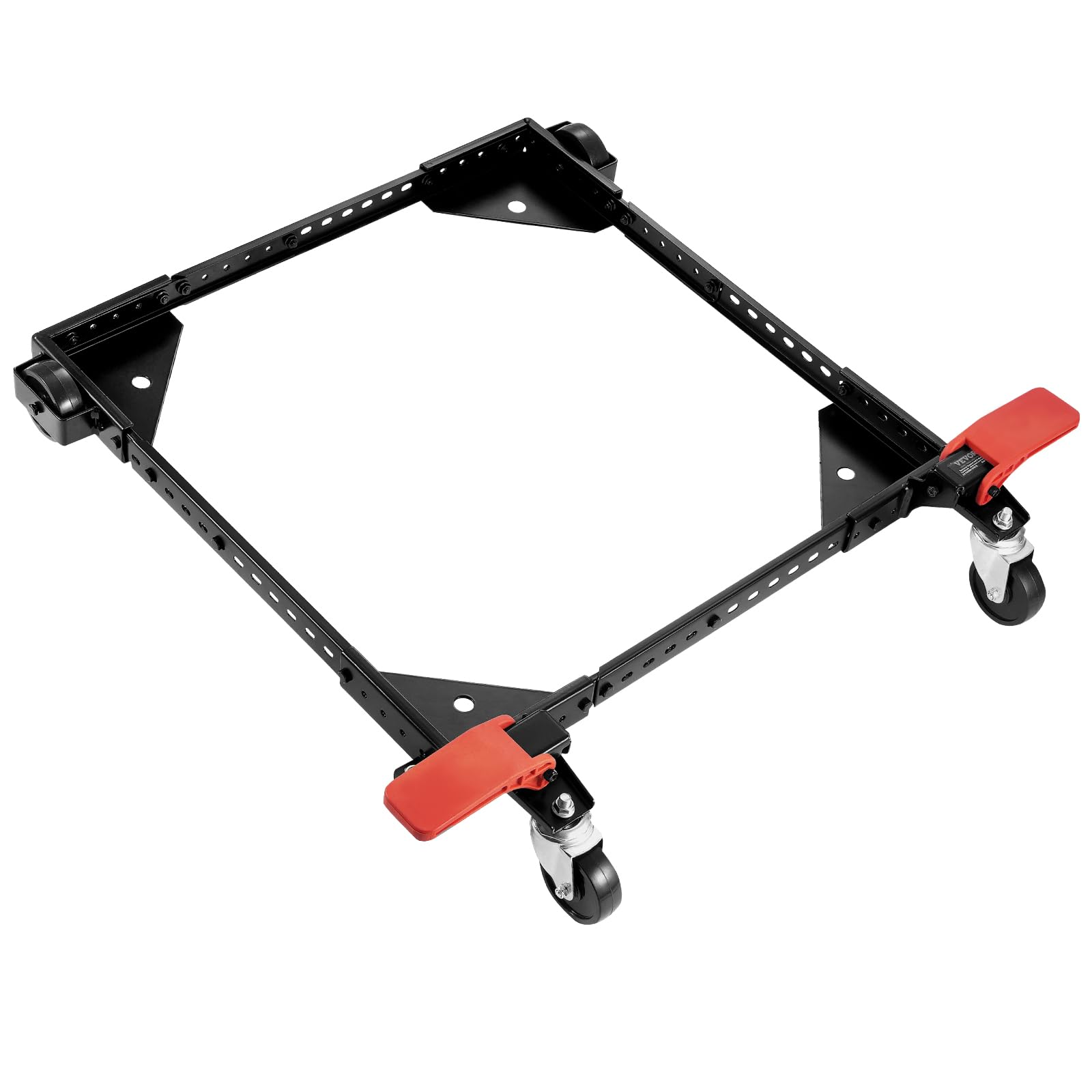
A carbon-steel frame that stretches wider than anything else in this lineup — and gives you one-inch steps to dial it in.
Take the stretch range first, because it is the reason to pick this one: the VEVOR adjusts from 12 x 12 inches out to 36 x 36 inches, which is a wider reach than the BORA PM-1000’s 32 x 32-inch ceiling. That extra span is what lets it swallow a heavy thickness planer, a 14-inch Delta bandsaw, or a very heavy table saw without a fight. The frame is thickened Q235 carbon steel, carries 500 pounds, and weighs 15.58 pounds on its own.
The consistory of owner praise here is about build quality — heavy-duty construction, easy rolling on all four casters, and a frame that moves with a fingertip once it is loaded. One-inch adjustment capability is specifically called out as what makes getting a perfect fit simple. It also arrives with lockable wheels, so you can plant the machine and lock it in place.
The recurring complaints are worth taking seriously but small. Some owners find it larger than their machine strictly needs, so it eats more floor space than the tool itself. Assembly wants a mixed set of wrenches and sockets and is described as somewhat complicated. And the locking mechanism draws mixed reactions — some like it, some find it fussy. The single best preparation tip: the casters ship dry, so grease them before you bolt anything together.
The fit story: this is the base for the person whose equipment does not match any clean square. A 16-inch jointer may want the side rails trimmed by 1.5 inches to fit; the 1-inch adjustability handles the rest, and multiple buyers report a perfect fit after trimming.
Worth it for: oversized or awkwardly shaped machinery that needs the widest adjustment window in this group, plus a strong steel frame at a mid-range price.
Think twice if: your shop is tight on floor space — this base runs large, and a couple of owners find it takes up more room than their machine warrants.
4. RIKON Professional 10-Inch Steel Band Saw Stand

The stand that bolts straight onto a RIKON benchtop saw and puts the table exactly where your hands want it.
This is a purpose-built stand, not a universal one, and that is the whole point. It is designed to fit RIKON 10-300 and 10-305 bandsaws plus the Sears 921400, and it bolts directly to the saw. Owners describe the table landing at the perfect working height with a stable footprint underneath — the kind of fit you do not get from a generic base with slotted rails.
Solid steel construction carries the load, and the stand weighs 13 pounds, so it stays manageable if you need to shift it around the shop. Four support braces and carefully angled legs give it stability, while non-slip rubber tips on all four feet grip the floor and protect your shop surface at the same time. At 10 inches by 10 inches by 26 inches, it takes up far less floor space than a cabinet-style stand, and it ships with all the hardware needed to assemble it right away.
Here is where the honest notes live. The stand is fixed-height and stationary — no wheels, no adjustability between the legs and the floor — so if you want to roll your saw, this is not the product. Owners also warn that you must follow the directions or the bolt holes will not line up, and that you should leave every bolt finger-tight until the whole frame is assembled and level. One practical tip worth borrowing: reverse the mounting bolts so the nut ends sit underneath, which saves your knuckles every time you reach past a leg.
One design quirk to know: a couple of owners flag the awkward corner where the bolts converge, and one unit arrived as a return missing a bolt with no instructions in the box. RIKON’s own schematic online covers the assembly if that happens to you. Once it is mounted and squared up, the feedback is consistent — solid stability and no vibration.
Pick this if: you already own a RIKON 10-300, 10-305, or Sears 921400 and want a low-profile stand that fits like it came in the saw’s box.
Skip if: you need wheels or an adjustable-height platform — this one is a fixed foundation by design.
Understanding the Specs
Load Capacity
The maximum weight a stand or base is rated to support, measured in pounds. This is the first number to check, because a base pushed to its ceiling will flex, squeak, and move under a cut. The rating also tells you what kind of machine the manufacturer built it for — a 400-pound base and a 1500-pound base are aimed at different owners. One thing to watch: a rating may be stated only for the frame’s smallest configuration, with no figure given for how capacity changes when you stretch the base out.
Caster Wheels And Locking
Wheel diameter and bearing quality decide how smoothly a loaded base rolls — 3-inch wheels with ball bearings handle rough garage floors and old wooden mill floors without stalling. Equally important is how the base locks. Foot-operated levers that lift the frame clear of its casters give you a genuinely immovable position; step-on caster brakes are quicker to use but rely on the brake pads holding. Four swivel casters turn tighter in small shops, while two fixed and two swivel wheels track straighter but resist sharp reversals.
Adjustability And Footprint
Mobile bases adjust along rails in fixed increments — one inch is the common step — so a base will only fit in whole-inch sizes rather than continuously. Check the published range against your machine’s base dimensions before you commit. Some owners end up trimming a rail to hit an exact width, which is a normal part of setup rather than a defect. The frame’s footprint also sets how much floor space the whole rig occupies once loaded.
Height And Vibration Control
Mobile bases lift your machine a small amount, typically under an inch, so table height stays close to what you are used to. A fixed benchtop stand, by contrast, sets a specific working height and stays there. Vibration is the other trade-off: rubber feet grip the floor and soak up shake from a planer, grinder, or drill press, which is why fixed stands are often chosen for high-torque machines, while a rolling base is inherently less planted but far easier to reposition.
FAQ
How much load capacity do I need above my machine’s actual weight?
Will a mobile base fit my specific bandsaw?
Should I choose a fixed stand or a rolling mobile base for a bandsaw?
Do mobile bandsaw bases lift the saw too high to work comfortably?
What is the difference between swivel casters and fixed casters on these bases?
How long does assembly take on a mobile base or bandsaw stand?
Can I use my own bolts if the included hardware is poor quality?
What is a portaband table and who is it for?
Do I need to grease the casters after receiving a mobile base?
Can I mount a larger top on a fixed bandsaw stand for a wider tool?
Final Thoughts: The Verdict
For most people shopping around, the best band saw stand depends entirely on which problem you are solving. If you own a heavy cast-iron floor machine that needs to move, the Bora Portamate PM-3500 is the safest pick — its 1500-pound capacity and welded steel frame are in a different class from everything else here, and It holds a 4.6-star rating from 445 owners. If you are working with a benchtop saw and want a stationary, low-vibration foundation, the VIGO POWER 700 lbs Tool Stand delivers a 26 x 14-inch MDF platform and four non-slip rubber feet for a dedicated workstation. And if you already own a portable bandsaw and want the accuracy of a fixed cutter without buying one, the SWAG Off Road V3.0 Portaband Table is the one that turns your handheld tool into a bench-mounted machine.
One honest note as you narrow it down: the VEVOR base is the only pick here that stretches to 36 x 36 inches, so if your equipment is oversized, that wider window may be the deciding factor rather than the headline capacity. Pick the job, then pick the stand.
How We Picked
We do not accept paid placement. Every pick is matched to a real buyer and a real use-case; we do not hands-on test units.
Sources & Methodology
Specifications: manufacturer listings and product documentation. Review insights: verified customer reviews, as of September 2026. Pricing: not shown on this page (it changes often); check the current price via the retailer link.
As an Amazon Associate, KitchPrep earns from qualifying purchases. This does not affect which products we feature.
Related Guides
