
Specs are compiled from manufacturer listings and verified buyer reviews and can change over time — please confirm the key details on the product page before buying.
Before you buy a band saw, ask yourself one honest question: how thick a board do you need to slice, and how often? The machines below range from a portable benchtop that tucks away to a 382-pound floor model that resaws stock in a single pass. Each saw below is matched to the real-world job it handles best, so you do not overpay for capacity you will never use or underspend and stall on your first cut.
I’m Mohammad Maruf — the founder and writer behind KitchPrep. This guide is built by comparing the manufacturers’ published specifications and the patterns across verified customer reviews, so you get each pick’s real strengths and trade-offs instead of marketing spin.
Resaw capacity, blade speed, and build weight separate a frustration-free tool from a frustrating one, and this breakdown of the band saw for woodworking market helps you buy the right one the first time.
Our Picks at a Glance

How To Choose The Best Band Saw for Woodworking
Most beginners pick a saw by its wheel size, but the spec that decides what you can actually build is the cutting height. This is the tallest piece of lumber you can feed through the blade, and it is the number that separates a saw for small hobby parts from one that can resaw a thick slab into bookmatched panels.
Resaw capacity is the real headline spec
If you want to slice a 6-inch block of hardwood into thinner veneers, you need a machine with at least 6 inches of cutting height. A saw with only 3-1/2 inches of clearance will cap you at small parts and light stock, no matter how powerful the motor feels.
Blade speed changes what you can cut cleanly
Faster blade speeds measured in feet per minute do not mean a better saw. Hardwoods like oak and maple cut cleaner at lower speeds so you avoid burning the wood, while softwoods and plywood rip faster at higher speeds. A two-speed saw lets you switch without buying a second machine.
Weight tells you about vibration
A heavy cast-iron saw stays planted and cuts smoothly, so you get cleaner lines on thick stock. A lighter benchtop model is easier to move but tends to vibrate more on deep cuts. Ask yourself if you need to carry it to a job site or whether it can live permanently on a stand in your shop.
Quick Comparison
| Model | Best For | Cutting Height | Throat Depth | Motor Power | Amazon |
|---|---|---|---|---|---|
| QD-KYOHO 9-Inch★ Best Overall | Portable hobbyist cutting | 3-1/2 inches | 9 inches | 1/3 HP | Amazon |
| VEVOR 10-InchBest Value | Budget metal and wood cutting | 6 inches | 9.65 inches | 1/2 HP | Amazon |
| WOODSKIL 10-Inch | Dual-speed hardwood work | 5-1/8 inches | 10 inches | 3.4A | Amazon |
| WEN 10-Inch | Six-inch resaw on a budget | 6 inches | 9-3/4 inches | 3.5A | Amazon |
| JET 14-Inch | Serious resawing and scroll work | 13 inches | 13-1/2 inches | 1.75 HP | Amazon |
| Powermatic 14-Inch | Quiet pro-level 14-inch cutting | — | — | 1-1/2 HP | Amazon |
| JET 15-Inch | Heavy production resawing | — | 15 inches | 1-3/4 HP | Amazon |
In-Depth Reviews
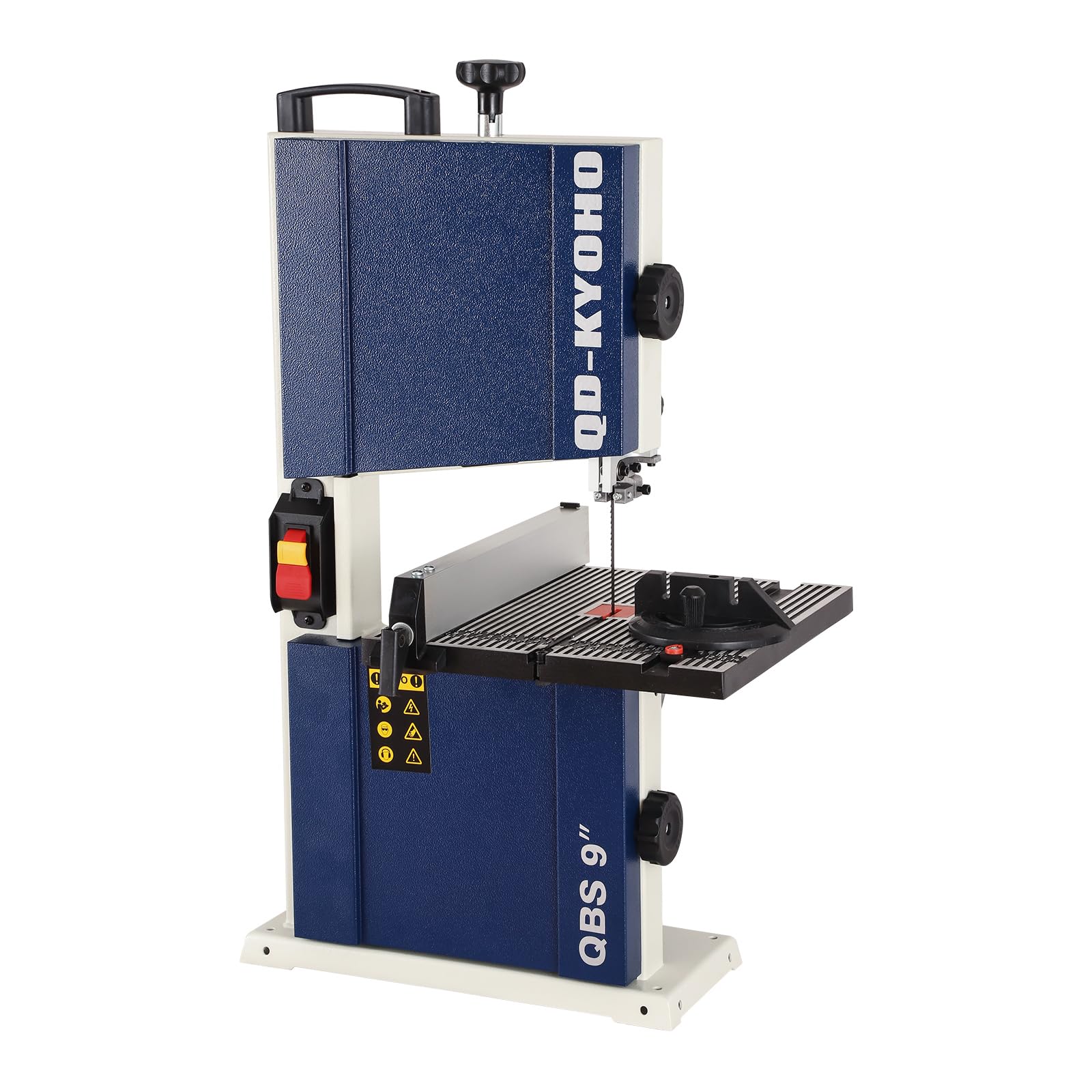
1. QD-KYOHO Portable 9-Inch Bandsaw
Our pick — over 4.5★ from 90+ verified ratings; the strongest balance of quality and price.
A crowd-pleasing benchtop that cuts clean enough for hobbyists without anchoring you to one spot in the shop.
The case for this one starts with what the review pages keep circling back to: build quality that genuinely surprises at this level. It is the rare budget-friendly saw where owners routinely call it solid and well worth the money, and where the assembly process goes smoothly enough that even first-timers finish in about 45 minutes. The consistent praise for quality is no accident — this is a 2 mm steel plate frame with a powder-sprayed finish built to hold its flatness over time.
You give up height for that portability. The cutting height tops out at 3-1/2 inches, so this is a saw for small parts, craft wood, and light stock rather than resawing thick boards. The 9-inch throat means you can still maneuver wider pieces, and the 62-inch blade runs on a 1/3 HP, 2.5 amp motor that starts quickly. Buyers report it handled hundreds of feet of 6-inch cedar without complaint, which tells you the motor punches above its modest rating for softwood work.
What makes it a joy rather than just a tool is the everyday convenience. A quick-release blade tensioning system and tool-free blade-guide adjustment mean you are not wrestling with wrenches between cuts, and the tilting table moves 45° right and 5° left for angled work. Vibration sits under 6 mm/s, which owners confirm as noticeably low for a machine this size.
What wins people over
- Quality construction stands out in reviews
- Tool-free blade changes speed up workflow
- Low vibration keeps cuts accurate
The honest limits
- 3-1/2 inch height caps heavy resawing
- Portable frame feels bulky on stairs
The smart pick if: you want a dependable, compact saw for hobby projects and occasional softwood cutting.
Think twice if: your plans involve resawing thick hardwood slabs — that job needs a taller machine.
2. VEVOR 10-Inch Two-Speed Benchtop Bandsaw
A 60.6-pound floor-standing machine that brings real cutting depth to the budget tier without pretending to be pro gear.
If your shopping list includes cutting both wood and softer metals like copper or aluminum, this VEVOR deserves a close look. The 1/2 HP, 370W motor delivers a serious 6-inch cutting height, which doubles the capacity of the portable pick above. You also get a 9.65-inch throat width, and the two-speed control lets you drop to 560 RPM for metal or spin up to 1100 RPM for wood — a flexibility most machines at this level simply lack.
Reviews split right down the middle on the accessories, and the honest read is that the core saw performs while the add-ons do not. The consensus is strong that this is excellent value for the money and genuinely powerful, matching the higher 6-inch capacity you would normally pay more for. Owners mention the saw itself works great, that the table and fence track accurately, and that the included miter gauge and fence have some play in them that is not adjustable — one owner fixed it with a shop-made slide rather than returning the machine.
The built-in stand raises the work to a comfortable height and adds storage, while the adjustable work light lets you aim illumination exactly where the blade meets the wood. The biggest recurring caution is durability of the stock blade, with several owners noting it breaks after minimal use — the common advice is to budget for an upgraded blade immediately.
The value read: a powerful motor and real 6-inch resaw depth make this the standout budget choice, but plan on replacing the blade and upgrading the fence.
Who it suits: the occasional-use woodworker who also wants metal-cutting ability without a second machine.
Grab it if: budget matters and you need 6 inches of cutting height with two-speed versatility.
Pass it by if: you demand production-grade precision — the accessory quality will frustrate you.
3. WOODSKIL 10-Inch Benchtop Bandsaw with Stand
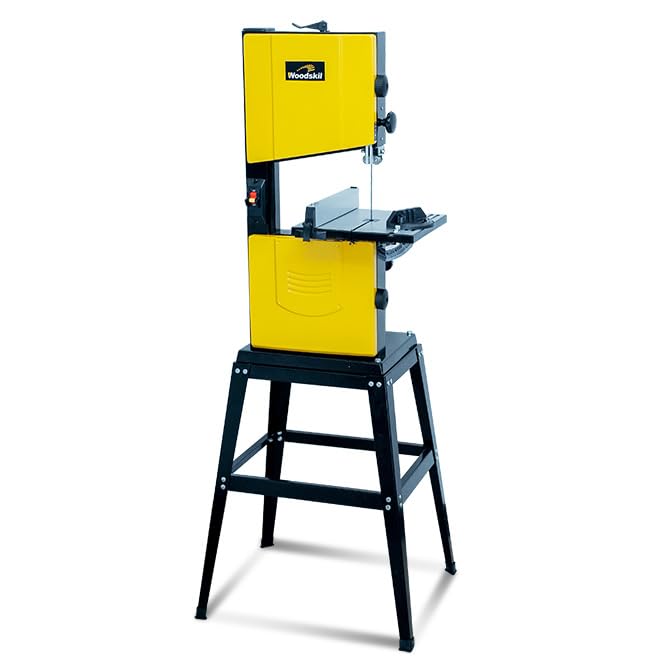
The dual-speed hardwood specialist that keeps oak and maple cutting clean without burning your workpiece.
Hardwood workers, this is the machine that gets the speed math right. Run it at 2360 FPM for oak and maple so the blade does not scorch the wood, then switch up to 3000 FPM for splinter-free cuts in softwood and plywood. Customers note it slices through 3/4-inch stock like butter, and the versatility earns regular mention from people using it for everything from furniture to knife-making handles.
The cutting height lands at 5-1/8 inches — enough to handle a 4×4 in one pass — while the 10-inch throat lets you guide wide panels for tabletops. Six ball-bearing guides support the blade from every angle and keep your cuts following the line rather than drifting into the waste side. That bearing count is what makes intricate scroll work and curved legs feel controlled instead of fighting you.
Maintenance is where this saw saves you real time. The quick-release tension system means one lift of the handle drops blade tension, and the side knobs open the saw door without any tools so you can swap blades and clean out sawdust in minutes. The included rip fence and miter gauge handle straight and angled cuts from the first day, and the 2-year warranty backs the whole package.
Why owners stay happy
- Dual speeds prevent burning on hardwoods
- Six ball-bearing guides fight blade drift
- Tool-free doors make blade changes fast
What to expect
- Miter gauge feels lightweight but functions
- Angle scales are basic, not precision-grade
Your pick if: you work mostly with hardwoods and want clean cuts at two speeds without buying a second saw.
Not for you if: you need to resaw stock thicker than 5-1/8 inches — step up to a floor model.
4. WEN 10-Inch Two-Speed Band Saw with Stand

The budget machine that quietly delivers six-inch resaw depth most rivals in this class cannot match.
Resawing is the headline act here. The 3.5-amp motor cuts up to six inches deep and 9-3/4 inches wide, and the crowd has noticed — owners call it the only affordable saw they found with true 6-inch capacity. One hobbyist successfully sliced a glued hardwood block measuring 5.5 by 6.5 inches into thin pieces, which is the kind of job that usually demands a machine costing far more.
The saw runs 72-inch blades ranging from 1/8 to 1/2 inch wide, and the two speeds shift between 1520 FPM for hardwood and 2620 FPM for faster softwood cuts. The spacious 14-1/8 by 12-1/2 inch cast aluminum table bevels up to 45 degrees for angled work, and the included work light, fence, and miter gauge mean you are ready to cut from the start. A 3-in-1 dust port keeps the workspace cleaner.
Quality and value dominate the happy feedback, with a clear theme that this is the perfect saw for the weekend-warrior woodworker. The honest trade-offs come from owners who pushed it harder: the stock blade arrives dull and can break early on long rips, and the fence needs a clamp to stay truly anchored. Budget for a better 1/2-inch blade and you have a seriously capable machine.
The real story: six inches of resaw capacity at a budget price makes this the value king for thick stock, but the accessory blade will not last.
Reach for it if: you want to resaw 6-inch hardwood without jumping to a premium floor model.
Choose this when: your projects center on resawing thick blocks and you are handy enough to swap in a quality blade.
Look elsewhere if: you expect industrial-grade precision straight from the box.
5. JET 14-Inch Woodworking Band Saw

A serious floor-standing resaw that slices 13-inch stock in one pass, built for the home shop that acts like a production line.
This is the saw you buy when your projects outgrow the benchtops. The 1.75 HP motor drives a 116-inch blade loop that resaws material up to 13 inches tall in a single pass — roughly four times the height of the portable pick at the top of this list. Owners describe it cutting through seasoned oak like a steak knife through filet, and the 13-1/2 inch throat gives you room to maneuver wide panels.
The blade range tells the full story of its versatility. It runs 116-inch blades from 1/8 inch wide for tight scroll work up to 3/4 inch for fast resawing, with independently adjustable ball-bearing guides keeping everything precise. The 360 square inch ground cast-iron table tilts 0 to 45 degrees right, and a coat of paste wax keeps stock sliding smoothly while preventing rust. At 272 pounds on its steel stand, this machine does not move — that weight is exactly why cuts stay smooth and quiet.
The review consensus splits on one practical point: assembly. Some owners set up in 90 minutes while others took about two hours plus another hour of alignment, and it is genuinely heavy to maneuver through doorways. Plan for a helper and a clear path. Budget also needs to include a blade — it ships without one — and the included resaw fence with easy-read scale is a genuine upgrade over cheaper machines.
The professional strengths
- 13-inch resaw capacity handles thick slabs
- Heavy cast iron stays stable and quiet
- Tool-less blade guides speed adjustments
Plan around these
- 272-pound weight needs a helper to position
- Blade sold separately adds to the cost
Worth it for: woodworkers who resaw thick stock regularly and want floor-model stability without industrial pricing.
skip it if: your shop is a small bench — the weight and footprint demand permanent floor space.
6. Powermatic 14-Inch Woodworking Bandsaw

A whisper-quiet 14-inch performer whose precision-balanced wheels and Carter tension system put it a cut above the pack.
Noise is the first thing owners mention about this Powermatic — it runs very quiet, a welcome change from the whine of lesser motors. The 1-1/2 HP Baldor motor drives precision-balanced nine-spoke cast iron wheels that cut vibration and create smoother blade travel, and the machined tables earn praise for being square, flat, and near-perfect. Buyers who have compared it directly against other 14-inch saws call the fit and finish superior.
The Carter quick-tension lever changes blades fast, and the detension setting extends blade life when the saw sits idle. A micro-adjustable dual bearing guide system above and below the table keeps blade control tight with less friction, and the tensioning gauge reads in blade-width increments so you dial in the right setting without guesswork. The included 6-inch riser block boosts resaw capacity, and an exclusive T-square style rip fence with a 4-inch resaw attachment keeps cuts true.
The 60-watt adjustable lamp shines directly on the cut line, and an included chip blower keeps sawdust off the blade so you can actually see where you are cutting. Reviews come with two honest notes: the included blade is not great and owners replace it, and the assembly process is easier with two people — the drive belt installation alone takes about 30 minutes with a partner. An occasional unit arrives with loose bolts or vibration issues that take real tuning to resolve.
The standout trait: quiet, smooth operation and superior build quality that justify the premium for detail-focused woodworkers.
Best suited to: owners who value precision, low noise, and fast blade changes over sheer raw power.
The pick for: the serious hobbyist who wants pro-grade smoothness and quiet operation in a 14-inch footprint.
Consider other options if: raw cutting height is your priority — the riser adds capacity but this is not a 15-inch saw.
7. JET 15-Inch Woodworking Bandsaw

The 382-pound production machine that resaws large stock and slices veneers with a quiet confidence nothing else here matches.
When resawing large pieces of wood, slicing veneers, and cutting book-matched panels is the daily job, this JET is the end of the search. The 1-3/4 HP motor drives a 133-inch blade loop through stock far thicker than anything on this list, and the precision-ground cast iron table provides the stability serious resawing demands. Owners describe it as extremely quiet for what it does, and the crowd favorite aspect is build quality that shows in every component.
The fence system features a micro-adjustable, dual-position side plate that owners call a genuine improvement over earlier models — a solid, strong saw that cuts thick hardwood with ease. Toolless, independently adjustable upper and lower ball bearing guides keep the blade tracking true, while the rigid four-sided guide post with rack and pinion adjustment gives optimum blade support through the cut. Cast iron handwheels and ergonomic knobs make every adjustment feel smooth and precise.
Blade changes get consistent praise for being genuinely simple — the reason owners most often cite for choosing this machine. A blade ships included at 133 inches long, 1/2 inch wide, and 6 TPI, which works fine as a starter. At 382 pounds, this is not a solo assembly job; owners note it handles best with the motor removed to lighten the load, and an occasional unit arrives with a bent base corner needing a shim. A magnetic LED light is the common add-on since it ships without one.
The heavyweight advantages
- Massive resaw capacity for large stock and veneers
- Micro-adjustable fence makes precise cuts easy
- Simple blade changes get constant praise
The honest cost of entry
- 382-pound weight needs serious planning and help
- No built-in light, so budget for a magnetic LED
The final word: if production-scale resawing and easy blade changes are non-negotiable, this is the saw your shop is missing.
Not the one if: you lack floor space or a helper to handle a machine this substantial.
Understanding the Specs
Cutting Height and Resaw Capacity
This spec tells you the tallest board the saw can slice through. Benchtop models typically offer 3-1/2 to 6 inches, while floor models reach 13 inches or more. If you plan to resaw thick stock into thinner boards or veneers, prioritize this number over wheel size — it directly determines what your projects can include.
Blade Speed in FPM
Feet per minute measures how fast the blade travels. Hardwoods like oak and maple cut cleaner at slower speeds around 1520 to 2360 FPM to avoid burning, while softwoods and plywood rip faster at 2620 to 3000 FPM. A two-speed saw lets you match the blade speed to the material without changing machines.
Throat Depth and Blade Length
Throat depth is the distance from the blade to the frame, which controls how wide a panel you can maneuver. Blade length must match your machine’s wheel size — a 14-inch saw needs a roughly 116-inch blade loop, while a benchtop 9-inch saw takes a 62-inch blade. Always buy the correct blade length for your model.
Motor Power and Table Quality
Amps and horsepower tell you how much cutting force the motor delivers. Heavier cast iron tables stay flat and stable, reducing vibration for cleaner cuts, while cast aluminum tables weigh less but may flex under pressure. A tilting table of 0 to 45 degrees enables bevel cuts for angled joints.
FAQ
What size band saw do I need for woodworking?
What is the difference between cutting height and throat depth?
Is a two-speed band saw worth the extra cost?
How thick a board can a 10-inch band saw resaw?
What blade length does my band saw need?
How important is a cast iron table on a band saw?
Can a band saw cut metal as well as wood?
How heavy should a band saw be for stability?
What resaw capacity do I need for bookmatched panels?
Why does my band saw blade drift during cuts?
Final Thoughts: The Verdict
For most hobbyists, the band saw for woodworking winner is the QD-KYOHO 9-inch because it pairs genuinely impressive build quality with easy assembly and low vibration at a friendly entry point. If you want dual-speed hardwood cutting, grab the WOODSKIL 10-inch. And for serious resawing of thick stock, the JET 14-inch is the one to reach for — its 13-inch capacity transforms what you can build.
How We Picked
We do not accept paid placement. Every pick is matched to a real buyer and a real use-case; we do not hands-on test units.
Sources & Methodology
Specifications: manufacturer listings and product documentation. Review insights: verified customer reviews, as of September 2026. Pricing: not shown on this page (it changes often); check the current price via the retailer link.
As an Amazon Associate, KitchPrep earns from qualifying purchases. This does not affect which products we feature.
Related Guides
