
Specs are compiled from manufacturer listings and verified buyer reviews and can change over time — please confirm the key details on the product page before buying.
If your bandsaw cuts wander and you have to fight the wood through every curve, the fence is usually the problem, not the blade. The right fence holds your workpiece square to the blade, locks down hard, and lets you tune out blade drift so your resaw cuts come out flat and even instead of tapered. This guide covers the nine fences worth putting on a 14-inch bandsaw or a jobsite table saw, from clamp-on aluminum extensions to magnetic fences that snap onto a cast-iron table.
I’m Mohammad Maruf — the founder and writer behind KitchPrep. This guide is built by comparing the manufacturers’ published specifications and the patterns across verified customer reviews, so you get each pick’s real strengths and trade-offs instead of marketing spin.
You will see which fences clamp on in under two minutes, which ones only hold on a cast-iron table, and which ones ask you to drill your own bolt holes. By the end you will know exactly which fence fits your saw, your table size, and the kind of cutting you actually do. The picks below cover the full range of the band saw fence market, from budget clamp-on guides to heavy cast-iron resaw systems.
Our Picks at a Glance


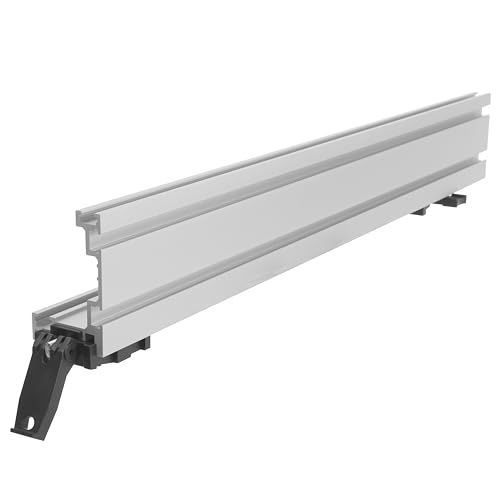
How To Choose The Best Band Saw Fence
A bandsaw fence is a straight guide bar that clamps or bolts to your saw table and gives your workpiece a flat surface to ride against as it moves into the blade. Without one, every cut is a guess. With a good one, repeats come out identical and resaw boards come out even in thickness.
Match the mount to your table
Fences attach three ways: clamping over your existing fence, magnets on a cast-iron or steel table, or bolting to your saw’s table holes. A clamp-on fence like the O’SKOOL guide needs a table edge to bite, while a magnetic fence only sticks to ferrous metal. Measure your table front to back before you buy, because a fence rated for an 18-inch table will not sit right on a small benchtop saw.
Look at the fence height and length
Height matters for resawing. A taller face supports tall stock so it cannot tip as it meets the blade, and a longer bar gives you more travel for long boards. A 36-inch or 46-inch extension roughly doubles the cut travel of a short stock fence, which is why so many owners of small saws add one.
Check the accessory slots
Slots cut into the face, top, and back take T-bolts, which are bolts with a flat rectangular head that slides into a track. Those bolts hold featherboards, stops, and feed supports. Look for slots sized for the bolts you already own: 1/4-inch and 5/16-inch are the common sizes, and a fence with mismatched slots can force you to source new hardware.
Quick Comparison
| Model | Best For | Mount Type | Fence Length | Fence Height | Amazon |
|---|---|---|---|---|---|
| BOW Products XT XTENDER 46″★ Best Overall | Portable and jobsite saws | Clamp-on (Bow T-Track) | 46 inches | 5 inches | Amazon |
| O’SKOOL 24 inch Straight Edge Guide ClampBest Value | Budget bandsaw upgrade | Clamp-on straight edge | 24 inches | — | Amazon |
| ProGrip Universal Bandsaw FenceMost Versatile | Dual-use bandsaw and drill press | Clamp-on straight edge | — | — | Amazon |
| BOW Products XT XTENDER 36″ | Tight shops and benchtop saws | Clamp-on (XT2 clamps sold separate) | 36 inches | 5 inches | Amazon |
| Grizzly Industrial H7584 | Grizzly 14″ resaw upgrade | Bolt-on retrofit | — | — | Amazon |
| CARTER MAGFENCE II | Cast-iron bandsaw tables | Switchable magnets | 16 inches | 3-1/2 inches | Amazon |
| Grizzly Industrial H7587 | Full cast-iron resaw system | Complete bolt-on system | — | — | Amazon |
| Shop Fox D3575 | Large cast-iron resaw setups | Complete bolt-on system | — | — | Amazon |
| Woodhaven 7280 | Drift-tuned 14″ saws | Bolt-on to existing table holes | — | — | Amazon |
In‑Depth Reviews
1. BOW Products XT XTENDER T-Track Table Saw Fence System, 46″ (Fence Only)
Our pick — over 4.5★ from 300+ verified ratings; the strongest balance of quality and price.
The 46-inch bar that turns a short stock fence into a full-length guide
This is the pick for anyone whose saw came with a stubby factory fence and who wants a real guide without buying a new saw. A clamp-on extension, it bolts nothing and drills nothing — Bow T-Track clamps bite onto the fence you already have, and the 46-inch bar gives your board a much longer straight edge to ride against. Owners describe it clamping squarely and securely to a Bosch 4100 in under two minutes, and one buyer sums up the size benefit plainly for anyone weighing length: “Bow XTender 46″ fence clamps squarely/secure in <2 min to Bosch 4100.” The extra travel lets you steer a long rip cut instead of fighting it.
The face rises 5 inches above the table, which is where the control comes from. A tall face keeps tall stock from tipping as it meets the blade, and it keeps your hands further from the cut line. The frame is extruded aluminum with a sandblasted anodized finish — a hard, non-reflective coating — and it measures 1 inch wide with a 4-inch flat face, so boards glide instead of catching on rough metal. Three T-slots sit on the face, top, and back, and they take 1/4-inch and 5/16-inch T-bolts for featherboards, stops, and feed supports. Milled rear slots let you shift the fence forward, centered, or back for infeed or outfeed work, and standoffs smooth the movement.
What buyers keep coming back to here is functionality as a category — how many different ways the thing works on one saw. It mounts on portable saws, cabinet saws, a UniSaw, Harvey machines, and bandsaws, so it follows you if you change saws later. The catch worth knowing up front: this listing is the fence only. The clamps that hold it to your saw sell separately, so budget your own clamping solution before you order, and if you have been using your saw’s built-in cut-width tape, you lose that direct reading once the extension is on. You trade the tape reading for the added control.
What earns it the top spot
- 46 inches of travel roughly doubles what a short stock fence gives you
- 5-inch tall face stabilizes tall stock and steep resaw cuts
- Three T-slots in 1/4-inch and 5/16-inch accept featherboards and stops
- Clamps on in about two minutes with no drilling on the saw
- Anodized aluminum extrusion with a 4-inch flat glide face
Before you click buy
- Fence only — the T-Track clamps that mount it are sold separately
- You give up your saw’s direct cut-width tape reading once it is installed
- At 46 inches it is a lot of bar for a cramped benchtop on a small stand
Right call for: anyone running a contractor, jobsite, or portable saw who wants cabinet-saw fence length without a cabinet-saw footprint, especially if you already own featherboards and T-bolt accessories.
Think twice if: your fence has no clampable rail edge, or you would rather not buy the clamps as a second purchase.
2. O’SKOOL 24 inch Straight Edge Guide Clamp with Band Saw Fence
Two tools in one box: a straight edge and a clamping bandsaw fence
Bought as a fence, kept because it also works as a clamping straight edge on sheet goods and a guide on a table saw, this is the entry point for anyone with a small saw and a small budget. The clamp body is aluminum alloy and nylon, it weighs 4.95 pounds, and it locks down firmly enough that buyers describe it as eliminating the play in a stock fence and letting them set a drift angle. One reviewer’s verdict on their WEN 10-inch saw says it as well as I can: “It Is Working Great In My Shop Placed On My WEN 10″ Band Saw.” One clamp covers bandsaw, table saw, and straight-edge cutting.
A quick-release mechanism handles attachment and removal, and the guide is marked so you can position it against a measurement instead of eyeballing it. It adjusts to fit tables up to 24 inches, which covers most benchtop and small 14-inch saws, and the clamp is designed to allow slight angle tweaks while locked — useful when your blade has a touch of drift and you want the fence parallel to the cut path rather than to the table edge. Functionality is the attribute buyers praise most about this one, which tracks with how many jobs the same bar handles.
Where it runs into limits is resaw height and table size. The tall resaw fence on this unit measures 3.5 inches, and owners who want to resaw stock that would use a 12-inch or greater capacity cut find that short. If you mostly saw 6-inch and under, that is a non-issue; if you bought your saw for its full resaw capacity, this fence will cap it. A few buyers also note it looks bigger than a small older Delta table, and one points out the T-track on the fence face does not fit standard T-track bolts, so you will need hex head bolts instead. Both are fit notes to check against your own saw.
Where the money goes: build quality and firm lockdown at a budget-tier level, with a 1-year warranty and support for setup questions behind it.
The honest catch: the 3.5-inch resaw fence height is the number to weigh before you buy, because it decides how thick a board you can stand up against the blade.
Buy it if: you want one clamp that fences a small bandsaw, guides a table saw, and squares up sheet goods, and your resaw work stays under that 3.5-inch fence height.
Look elsewhere if: you plan to resaw at your saw’s full capacity or you need standard T-track bolts to drop straight into the face slot.
3. ProGrip Universal Bandsaw Fence
One aluminum bar that fences a bandsaw today and a drill press tomorrow
If your shop has one small bandsaw and no dedicated drill press fence, this is the piece that covers both. Its built-in straight edge clamp mounts to any bandsaw table up to 18 inches front to back, and the included stop block turns it into a drill press fence for repeat hole spacing. Buyers running a 12-inch Craftsman put it to both jobs — three cams lock it down tight, and the aluminum body stays light enough to move between machines without a second set of hands.
Locking force comes from a triple cam system, which means three separate clamping points you tighten in sequence rather than one lever. The point of three is grip: a single lock can let a fence creep under a heavy push, while three cams spread that force along the bar. Owners confirm it holds — “Works and clamps down tight. Its tight but it does fit on my skil 9″ bandsaw” — and the same buyer describes a 9-inch saw as a snug fit rather than a drop-in. That snugness is worth knowing: a 9-inch table is at the small end of what this fence will clamp cleanly.
It weighs 4.39 pounds, which is the same aluminum-versus-rival story as the O’SKOOL above — and it is where these two close cousins part ways. This fence’s package measures 27.24 x 4.65 x 2.99 inches against the O’SKOOL’s 34.06 x 4.53 x 2.95 inches, so it travels in a smaller box. The recurring gripe in its feedback is squaring: a cam lock holds hard, but it does not self-align, so you still check the bar against the blade with a square after every lock. Owners describe doing exactly that — “I still have to check with a square that it’s straight after locking it down” — which is normal for clamp-style fences but worth knowing before you expect set-and-go.
Best for two-machine shops: the bandsaw-and-drill-press combination is the reason to pick this over a plain rip fence.
One thing to plan for: budget a few seconds with a square each time you lock it, since cam clamping holds position but does not guarantee it.
Reach for this if: you own a bandsaw up to 18 inches and want one adjustable bar that also fences your drill press.
skip it if: you want a fence that squares itself on every lock, or your table is smaller than a 9-inch saw’s footprint.
4. BOW Products XT XTENDER XT536 Table Saw Fence System, 36″ (Fence Only)

Ten inches shorter than the 46-inch version, and that can be the whole point
A small shop with a benchtop saw often cannot use a 46-inch bar without it hanging into the walkway. This is the same BOW extension concept cut down to 36 inches, which owners who work in tight spaces specifically pick for — one describes the 36-inch length as the right call for a limited-space shop that still wants to rip boards up to 6 feet. It adds the taller and longer working surface to portable, benchtop, cabinet, and band saw fences, and it carries the same 5-inch height and 1-inch width with a 4-inch flat face.
Construction is the story owners keep repeating. The extrusion is heavy, solid aluminum, well packaged, and it fits a spread of saws: a Ridgid TS3650 fence, a Skil jobsite saw, and a DeWalt 745 portable all come up, and the milled rear slots let it mount forward, centered, or back for infeed or outfeed reach. Three T-slots on the face, top, and back take 1/4-inch and 5/16-inch T-bolts for featherboards, stops, and feed control, and the bottom slot accepts BOW XT1 feed supports sold separately. The whole point of the add-on is that it upgrades the fence you already own instead of replacing it — one owner reports it easing rip-cut accuracy and giving a small saw the feel of a bigger machine, and another credits it with enabling safer resawing of long stock once featherboards were mounted.
Two honest notes before you commit. First, this listing is the fence only — the XT2 clamps that mount it are sold separately, so the fence reaches its potential only once you have the mounting hardware in hand. Second, one buyer measured the extrusion and found it not flat within moderate tolerance, with the bottom few inches the square part, and reported the T-track slot running small for a standard T-bolt, needing a 1/4-inch bolt machined to fit their guide. Check that slot against your T-bolts, but most buyers report accurate cuts and a good fit.
Why the shorter bar wins here
- 36 inches of travel fits benches where a 46-inch bar would be in the way
- Same 5-inch height and 4-inch flat face as the longer BOW model
- Milled rear slots allow forward, centered, or rear positioning
- Three T-slots accept Bow feed control and safety accessories
- Owners mention safe resaw of long stock once featherboards are added
Details to check against your kit
- Fence only — XT2 clamps are a separate purchase
- One owner measured the extrusion as not flat within moderate tolerance
- A face slot ran small for a standard T-bolt according to that same owner
Pick the 36-inch: when bench space is tight and your rips stay under the length a shorter bar can guide.
Step up to the 46-inch: if you regularly handle long boards and have the room for the extra bar to overhang.
5. Grizzly Industrial H7584 – Resaw Fence Attachment for 14″ Bandsaws

A tall removable fence you drop on for resawing, then set aside for daily work
This attachment exists for one reason: a taller fence face for resawing, removable when you want to get back to normal cuts. It is sold as a retrofit kit for existing Grizzly bandsaws and as a complete fence system for just about any brand of saw, and the extruded aluminum resaw fence comes off the base so you can lower the blade guides closer to the shorter fence for everyday work. Owners who resaw on a Grizzly call it a necessary addition, and they are not wrong about the logic — the taller face is what keeps a stood-up board from tipping as it feeds.
Construction is solid. Buyers describe it as well made and solid, and the handle materials listed are aluminum and cast iron, so the support pieces are not stamped sheet metal. Fit is the part to verify before ordering, because it is where this kit divides its audience. The listing describes it as fitting just about any brand of saw, but customers note that it does not fit every 14-inch Grizzly — one points out that it fits the G55-series 14-inch saws except the G555XL, and that the description could say so more clearly. Older Grizzly models that need full assembly come up too. Check your model number against the fit notes before you buy, not after.
There is a second issue worth sizing honestly: parts and returns. More than one owner reports the unit arriving with a part missing, and Grizzly’s return process on a missing-part unit involved a restocking fee plus return shipping that a buyer described as costing half the fence price. Owners who received a complete kit for the right model report it resaws very well. If you order, open the box and inventory the parts the day it lands so any missing piece is a support call, not a return.
The design logic: a removable tall fence gives you resaw height when you need it and normal fence height when you do not, without a second fence on the shelf.
Verify first: confirm your exact 14-inch model is on the fit list, and inspect the parts on arrival before you start assembly.
Worth it for: Grizzly 14-inch owners who resaw and want a tall removable face from the same brand as their saw.
Wrong pick if: you run a G555XL or another 14-inch model that reviewers point out this kit does not fit, or you want a fence that ships fully assembled.
6. CARTER MAGFENCE II Universal Magnetic Fence

Slap it on a cast-iron table and it holds square in about half a minute
No clamps, no bolts, no drilling — this fence sticks to any ferrous metal table using two switchable magnets, and it comes off just as fast to move to another machine. Owners on cast-iron tables describe setup taking around 30 seconds once the magnets are on, and one long-term user reports that resaw setup still takes that long months later. Switchable magnets are the key feature here: they hold around 90 pounds according to a buyer’s own testing, and you turn them off to release the fence instead of prying it. If you swap this fence between three machines in an afternoon, nothing else on this list matches the speed.
The body is a 16-inch long, 3-1/2-inch tall L-shaped aluminum extrusion with multiple T-slots, so accessories bolt on the same way they do on rail-mounted fences. Owners run it on a Shopsmith Mark V 500 cast-iron table, a restored 1980s Craftsman 12-inch saw, and a Central Machinery 14-inch saw, and the recurring experience is a couple of minutes of squaring the first time, then nothing after. It weighed 3.27 pounds and comes with Carter’s F.A.S.T. setup bars for squaring, which shortens that first-time adjustment. The hang-tag on this fence is straightforward: universal fit on most ferrous metal tables and compatibility with all MAGFENCE II accessories.
Two honest limits. First, ferrous metal only — a cast-iron or steel table takes it, but an aluminum table will not hold a magnet, so check your table material before you buy. Second, the fence can slide under enough side pressure, and owners who resaw thick lumber sometimes add a backup clamp behind the fence for that reason; thin and mid-thickness rip cuts are where it shines. An owner summing it up honestly put it this way: the fence is dead flat and the clamps work smoothly, but a heavy resaw push is the one place to reinforce it.
The case for going magnetic
- Switchable magnets grab around 90 pounds and release with a twist
- Setup runs about 30 seconds once squaring is done, per owners
- Moves between machines with no hardware to unbolt
- 16-inch L-extrusion with multiple T-slots for accessories
- Setup bars included to speed first-time squaring
The honest limits
- Works only on ferrous metal tables — aluminum will not hold it
- Heavy resaw cuts may need a backup clamp behind the fence
- 16 inches of length limits how far your board can ride
Ideal if: your saw table is cast iron or steel and you value moving the fence between machines in seconds over bolting it down once.
Not the one if: your table is aluminum, or your main job is resawing thick stock that pushes the fence sideways.
7. Grizzly Industrial H7587 – Resaw Fence Complete for 14″ Bandsaws

The whole fence system with a cast-iron bar behind it, not just a retrofit bar
Where the H7584 above is an attachment, this is the complete resaw fence system, and the weight tells you the difference. It ships at 16.1 pounds, which is the cast-iron support bar and the heavy body doing the work instead of a thin rail. Owners describe a thick cast-iron support bar with a decent aluminum body that fits an 80s Delta 14-inch saw with only longer front bolts needed, and one heavy-duty handle with a trustworthy stop and a rear support bar. If you have been running a stock fence that flexes under a push, the mass here is the upgrade — the aluminum rails and cast-iron body keep the fence square when the cut loads up. Owners also rate it above the Kreg and Laguna options they cross-shopped.
Assembly is straightforward — shoppers say it slides well, cuts accurately, and arrives square from the start. The dividing point is table fit, and the feedback is split, so read it carefully. On a 14×14 table it fits well; on a Jet JWBS 14DX Pro with a slightly deeper table the fence is not flush and needs adjustment to sit right; on a Jet with a shorter Grizzly table the outfeed bumper missed the rail until an owner cut the miter slot gauge and moved the bumper inward. Fans of the fence report easy install and improved cuts over a stock Delta fence; the mixed reports are all about matching the system to a table it was not specifically built for.
The small annoyances round out the picture. Documentation is thin — buyers report no written directions, just a diagram — and the ruler sticker on the fence gets called out as poor, with an awkward magnifier. A couple of owners also note missing fasteners on arrival. None of these touch how the fence performs once it is on and squared, which is the part that got owners to switch. It is a lot of fence, and if you do not resaw, it is more than you need.
The deciding spec: 16.1 pounds of cast-iron-backed system built to stay square under heavy resaw loads, not a clamp-on bar you carry in one hand.
Set expectations: plan to adjust the bumper and check the fence against your table before your first cut, and treat the ruler sticker as decoration.
Choose this when: you resaw regularly, you have a 14×14 table or are willing to adjust fit, and you want the rigidity a cast-iron support bar gives you.
Pass if: you do light ripping only, or your table is a size the fence will not sit flush on without modification.
8. Shop Fox D3575 Resaw Fence Complete Kit

A cast-iron bar milled flat on both sides, for people who measure their fence with a square
The headline here is the fence bar itself: cast iron, milled flat on both sides, paired with a tall and long extruded aluminum plate. Owners who have run cheaper fences on other saws describe it as sliding smoothly, locking square, and lifting off clean, with an adjustable position marker and a plate that lays down for thin stock. At 18.8 pounds it is the heaviest pick here, and that is the intent — mass resists the vibration and flex that lets a thin fence walk off square during a hard resaw. One owner went further and swapped the hollow thin-wall aluminum back rail for a 3/4-inch solid steel bar to support a table extension, treating this as the base of a bigger setup.
Its other strength is accuracy under real work. A buyer running a 14-inch Jet reports it resawing everything from pine to walnut dead center, and another credits it with precision for guitar blanks and enabling a dust extraction table that pulled about 98% of the dust. The identical fence shows up under Grizzly’s H7589 number, so if you cross-shop and find that model, you are looking at the same hardware. It comes with a 1-year warranty and lists metal materials with a white finish.
The biggest knock is documentation, and it is a real one: there are no manuals or installation instructions, so a buyer cannot confirm they have the right part or figure out install on their own. Two owners also report the kit needing work to fit a non-matching saw. One installed it on a Steel City 18-inch saw with a 20×20-inch table after two modifications and made a video explaining them; another had to redrill rail holes and add homemade spacers to fit a Jet 18-inch. The metal is excellent, but the kit assumes you can fit it yourself without instructions.
What the metal delivers
- Cast-iron bar milled flat on both sides for a true reference face
- Locks square and slides smoothly, then lifts off clean
- Plate lays down to guide thin stock without a gap
- Same hardware as Grizzly H7589 if you cross-shop
What you are signing up for
- No installation instructions included, per multiple buyers
- Non-matching saws may need redrilled holes, spacers, or a modified bumper
- 18.8 pounds of iron is not a fence you move between machines casually
Go for it if: you want a flat milled cast-iron bar and are comfortable fitting a fence yourself or working from a video.
Look at the Woodhaven below if: you would rather have written instructions and hardware that lines up on a standard 14-inch table.
9. Woodhaven 7280 Band Saw Fence for 14″ Bandsaws, Made in USA
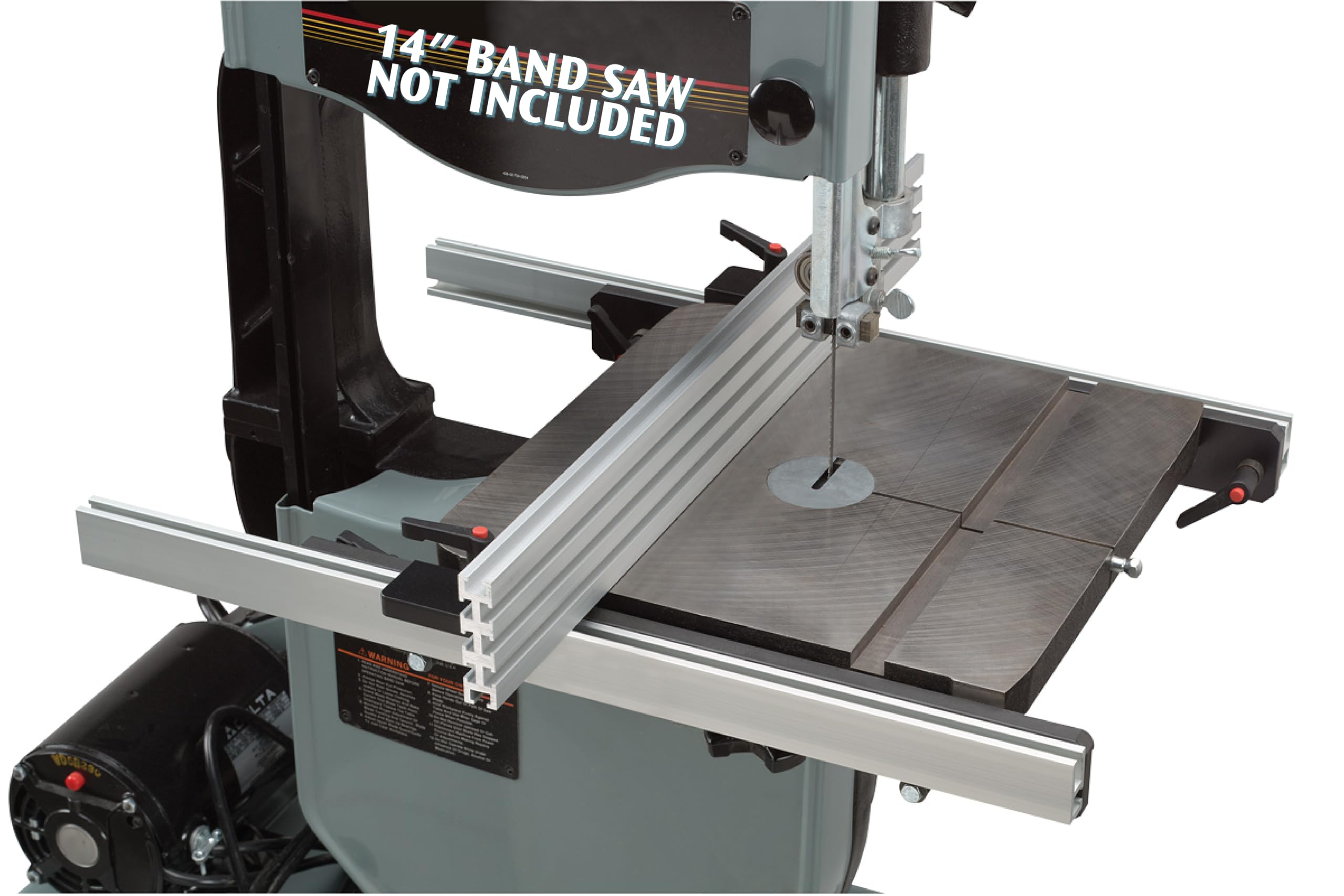
Two locks at each end and a drift dial you can tune without a test cut
Blade drift — the tendency of a bandsaw blade to cut at a slight angle instead of straight — is the reason most factory fences frustrate people, and this fence is built around fixing it. Two separate position locks, one at each end, hold the bar against creep, and two independent blade lead locks let you angle the fence to match your blade’s natural path. Owners describe it as easy to adjust for blade drift, and the setup is simple enough that people fitting it to a 66-year-old Delta/Milwaukee saw got it running from straightforward instructions. Unlike front-only fences, this one supports the table at both the front and back, which is what keeps a heavy rip from tilting the bar.
Fit is its strong card for a 14-inch saw owner. It is compatible with Delta, Jet, Ridgid, Powermatic, and Porter Cable 14-inch saws and attaches to existing table holes with no drilling on most models — a buyer who replaced a frustrating Jet factory fence describes assembly as simple and the table fit as perfect, with excellent blade drift and vertical square adjustments. There is an adjustable stop block included for repetitive cuts and tenons, and the body is extruded aluminum. If you run a different 14-inch saw, the included instruction sheet covers drilling four 1/4-inch holes to mount it, and a lifetime guarantee backs the whole thing.
The honest catches are the hardware and the documentation. One owner found a plastic lockdown handle that broke off the threaded bolt during assembly and had to glue it back on, with plans to swap both hold-down clamps for all-metal handles. Another spent 7 hours and two pieces of bar steel getting it adapted to a non-listed saw because the adaptability claim turned out to need real fabrication. There is also a hardware mismatch on older Craftsman tables, which are tapped for 1/4-20 screws while the included hardware ran 1/4-28 along with metric sizes. On a standard 14-inch table it goes together in an afternoon; on an oddball, budget a weekend.
The standout feature: dual blade lead locks let you dial out drift in seconds instead of making scrap test cuts, and support runs front and back.
Know before you order: check your table is one of the listed 14-inch models, because adapting to a different saw can mean fabrication work.
Made for you if: you own a listed 14-inch Delta, Jet, Ridgid, Powermatic, or Porter Cable saw and want to tune blade drift out of your cuts for good.
Order with care if: your saw is not on that list or its table is tapped for a bolt size the kit does not include.
Understanding the Specs
Mount Type
The mount is how the fence sticks to your saw, and it decides what saws it can go on. Clamp-on fences grip your existing fence or table edge and need no drilling, which is why they suit jobsite and portable saws you do not want to modify. Magnetic fences use switchable magnets and work only on ferrous metal — cast iron or steel tables — so check your table material first. Bolt-on systems use your table’s existing holes when the fence is made for your model, and they want a drill when it is not.
Fence Height and Length
Fence height is the taller face that supports stood-up stock. A 5-inch face gives tall boards something to lean against while you feed them, which is what makes resawing steady instead of wobbly. Length is the straight edge your board rides on, and more of it means more control through a long rip. A 46-inch bar gives you far more travel than a short stock fence, while a 16-inch magnetic fence keeps the footprint small and portable.
T-Slots and T-Bolts
T-slots are tracks cut into the fence that hold accessories with T-bolts — bolts with a flat head that slides into the track. Featherboards, stops, and feed supports all mount this way, so slot count and size is what decides what you can add. Look for slots sized for 1/4-inch and 5/16-inch T-bolts, the common sizes, and know that a slot cut small can force you to source hex head bolts or machine your own to fit.
Blade Lead and Drift Adjustment
Blade lead is the slight angle your blade cuts at because of its tension and set, and drift is that angle showing up as a wandering cut. Some fences have an angle bracket or lead locks that let you tilt the fence to match the blade’s real path instead of fighting it. That adjustment is what turns a wandering cut into one that tracks true, and it is the reason dual-end locking fences with independent lead locks earn special attention from people who resaw.
FAQ
Will a magnetic band saw fence stick to my saw table?
What does blade lead adjustment actually do on a fence?
How tall does a resaw fence need to be?
Will a 24-inch straight edge clamp fence fit my bandsaw table?
Can a band saw fence double as a drill press fence?
Do I need to buy clamps separately for a BOW XT XTENDER fence?
Why does my rip cut wander even with a fence locked down?
Will a 1/4-inch T-bolt fit the slots on every fence?
How long does it take to set up a magnetic fence versus a clamp-on fence?
Does a complete resaw fence system fit a Jet 14-inch bandsaw?
Is a taller 5-inch fence better than a lower fence for everyday cutting?
Final Thoughts: The Verdict
For most people buying the best band saw fence, the BOW Products XT XTENDER 46″ is the pick, because its 46-inch bar and 5-inch face turn a short stock fence into a full-length guide on jobsite, portable, and cabinet saws without any drilling — just add the clamps. If drift and repeatability are your battle and you own a listed 14-inch saw, the Woodhaven 7280 gives you dual-end locking and blade lead adjustment to tune wandering cuts out. And if your table is cast iron and you move between machines, the CARTER MAGFENCE II grabs hold in around 30 seconds and releases just as fast. If you want the safest pick, the BOW 46″ is the one most owners keep.
How We Picked
We do not accept paid placement. Every pick is matched to a real buyer and a real use-case; we do not hands-on test units.
Sources & Methodology
Specifications: manufacturer listings and product documentation. Review insights: verified customer reviews, as of September 2026. Pricing: not shown on this page (it changes often); check the current price via the retailer link.
As an Amazon Associate, KitchPrep earns from qualifying purchases. This does not affect which products we feature.
Related Guides
