
Specs are compiled from manufacturer listings and verified buyer reviews and can change over time — please confirm the key details on the product page before buying.
You want a metal privacy screen that is still standing after the first big storm, not one lying flat on your lawn. Any tall freestanding panel catches a gust, so what keeps it upright for years depends on the base, the stakes, and how much the frame weighs. Below are eight backyard metal privacy fences that people actually live with, sorted by what each one is genuinely good at.
I’m Mohammad Maruf — the founder and writer behind KitchPrep. This guide is built by comparing the manufacturers’ published specifications and the patterns across verified customer reviews, so you get each pick’s real strengths and trade-offs instead of marketing spin.
You are about to see panels that bolt into concrete, panels that push into mulch with no digging at all, and mid-size screens built to hide an AC unit rather than fence a whole yard. Sizes here range from a 42-inch utility screen up to a full 72-inch tall decorative panel, and every pick below is metal — steel, alloy steel, or powder-coated steel — never wood or vinyl. The shortlist covers the whole spread of a backyard metal privacy fence.
Our Picks at a Glance


How To Choose The Best Backyard Metal Privacy Fence
Every freestanding metal panel has the same weak point, and it is not the metal. It is the footing. A panel that is bolted down, staked deep, or weighed with sandbags holds through a storm; the same panel standing on bare legs tips over. Read the base design before you read the pattern.
Height decides the job, not the style
A 42-inch screen hides an air conditioning unit, a trash can, or pool equipment. It will not hide you sitting in a chair. A 71 or 72-inch screen blocks sightlines at eye level, which is what you want around a patio or a balcony. Pick the height by what you are hiding, then pick the pattern.
Open patterns, closed panels, and wind
Louvered slats and brick-pattern cutouts let air pass through, so gusts push less on the frame. A fully solid panel catches more wind and needs a heavier base or an anchor. If your yard takes real weather, an open pattern plus a deep base is the safer pair.
Digging versus staking
A no-dig panel pushes stakes straight into mulch, gravel, or soft soil, which is why it goes up in an afternoon. The trade-off shows up on hard ground: grass often needs a mallet or a pre-dug hole, and soft ground holds the panel less firmly than concrete does.
Matching the panel to where it stands
A screen against a brick wall, a screen zip-tied to a wrought-iron balcony railing, and a screen standing free on a lawn all load the frame differently. Decide your mounting surface first, because it changes which base and hardware you need more than color ever will.
Quick Comparison
| Model | Best For | Height | Panels | Material | Amazon |
|---|---|---|---|---|---|
| TUYOHW 72″ x 47″ Metal Outdoor Privacy Screen★ Best Overall | Patio and balcony privacy at eye level | 72″ | 3 | Metal | Amazon |
| COLRASN 42″ x 38″ AC Fence ScreenTop Performer | Hiding an AC unit or a 96-gallon trash can | 42″ | 3 | Metal | Amazon |
| TinFrey 72″ Louvered Faux Wood ScreenPremium Pick | Anchored privacy that keeps its shape | 72″ | 1 | Metal | Amazon |
| Oakland Living 6 ft. x 4 ft. Screen with Flower Box | A decorative divider with built-in planting | 6 ft. | 3 | Alloy Steel | Amazon |
| OTOSUNNY 71″ x 45″ Metal Privacy Screen | Both indoor room divider and outdoor panel | 71″ | 1 | Polyethylene-coated steel | Amazon |
| Sciyen 38″ x 42″ Modular Privacy Screen Kit | Custom layouts around multiple utilities | 42″ | 6 | Metal | Amazon |
| Kingido 3 Panel No Dig Privacy Fence Screen | Quick no-dig cover for yard eyesores | 42″ | 3 | Metal | Amazon |
| Washsemba 39″ x 48″ White Louvered Panel | Trash can and AC screening in white | 48″ | 3 | Metal | Amazon |
In‑Depth Reviews
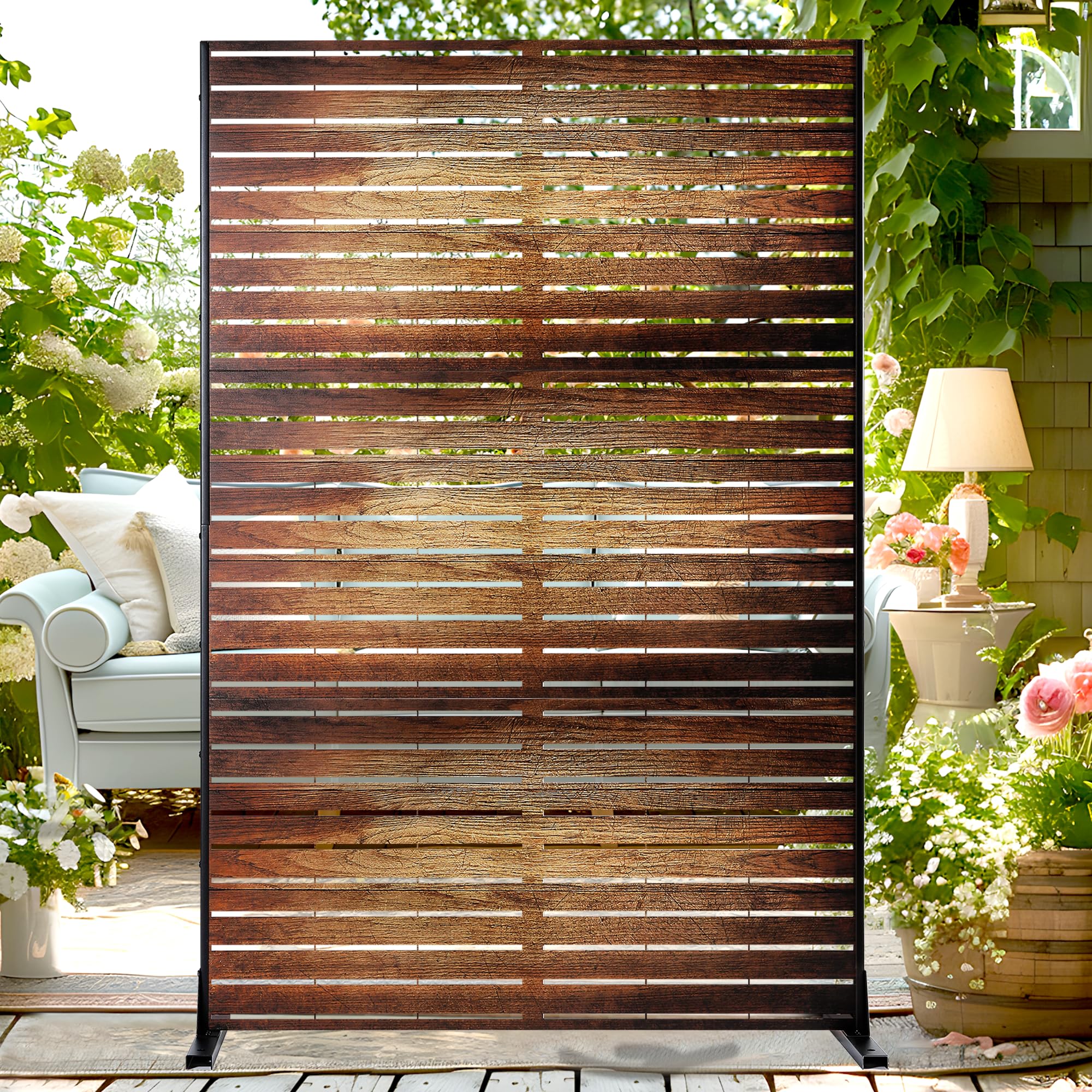
1. TUYOHW 72″ H x 47″ W Metal Outdoor Privacy Screen (3 Panels)
Our pick — over 4★ from 300+ verified ratings; the strongest balance of quality and price.
The tall decorative panel that turns a bare patio into a room.
This is the one for anyone who wants privacy at standing eye level rather than a low utility screen. At 72 inches tall and 47 inches wide, it stands a full 30 inches taller and 9 inches wider than the Kingido no-dig screen further down this list — 72″ against 42″ high and 47″ against 38″ wide. That gap is the whole point: you can stand on your patio and not be seen, instead of only covering what sits near the ground. It arrives as three panels in a gradient brown finish with a decorative pattern that is meant to be looked at, not just tolerated.
Buyers bring up the build more than anything else, and it is what wins them over. The metal is finished to resist rust, corrosion, and fading, so it keeps its look through wet seasons, and the frame is heavy enough to stand on its own without being bolted to a wall. As one owner put it after living with it for a season: “After six months outdoors, the finish still looks new.” Assembly earns the second-largest share of praise — the directions are clear and the tools come in the box, though two people make the job far easier, and one owner braced the top interior bracing wrong the first time and had to flip it.
The honest catch is wind on an exposed spot. This is a tall panel, and a tall panel needs either a railing to zip-tie to or something to anchor against. Owners on a windy third-floor balcony solved it by tying the frame to a wrought iron railing. Treat it as decor first and a privacy wall second, and it earns its place — it is not a fence you can lean a ladder against. The other real limit is the size of the cover: the 47-inch width hides a seating nook or a slice of a balcony, and a long open patio will take two screens.
Where it earns its keep
- 72″ height and 47″ width give true standing-height privacy, not just ground-level screening
- Rust-, corrosion-, and fade-resistant finish built to stay outside year round
- Straightforward assembly with the tools and directions included
- Decorative pattern reads as outdoor decor, not a plain gray barrier
What to plan around
- Two people are needed to get it standing comfortably
- A tall panel caught in the wind wants a railing or an anchor it can tie to
- One screen covers a nook, not a long stretch of patio
Reach for this if: you want your balcony or patio seating area genuinely screened at eye level and you have a railing or wall to steady it against.
Look elsewhere if: your ground is soft, unrestricted lawn with nothing to tie to — a staked utility panel holds better there.
2. COLRASN 42″ H x 38″ W Air Conditioner Fence Screen (3 Panels)
Twelve inches of stake does the work a concrete footing usually does.
The engineering choice here is the footing, and it is the reason this panel holds where thinner screens wobble. Each panel carries a 12-inch-long stake made of thickened metal with a sharpened tip, so it drives into sand, soft soil, or gravel and stays there. Buyers report the 12-inch stakes holding through hurricane-season wind without the panel shifting off the lawn. That stake length is what separates this from the Kingido no-dig screen below, whose ground spikes owners describe as coming up short in high wind.
Three panels give you 42 inches of height and 38 inches of width, which is sized for a specific job rather than a whole yard. That 42-inch height clears even a 96-gallon trash can, and the 38-inch width is built to close around an outdoor air conditioning unit. The metal is spray-finished with silicone caps on the pipe ends to keep rainwater out of the hollow legs, and the paint resists fading so the piece does not discolor the way a wood screen would. Layouts are flexible too: connect pieces let you set the panels in a straight line, an L, or a custom shape. The one build note the maker stresses is not to hammer the panels directly — use a board as a shim, or the pipe opening deforms and the rest will not fit.
Where this panel asks for care is the metal itself, which is thin enough to ding if you are rough with it during assembly. One owner wished it were a heavier gauge. It is also a screen for hiding equipment, not a fence for containing anything or blocking a view from a standing height. Judge it by that job and it delivers: it covers the ugly thing in your side yard, lets air move through to the AC unit, and stands on its own stakes.
Stake-driven stability: a 12-inch thickened-metal stake with a sharpened tip is the single detail that keeps this panel standing in wind, and it is what owners credit for holding through rough weather.
The finish and the fit: spray paint plus silicone pipe caps keep rain out, and the 42″ x 38″ panel is dimensioned exactly to swallow a trash can or an AC unit and little else.
Best for: a side yard that needs an AC unit or a 96-gallon bin out of sight, with soil soft enough to take a stake.
Think twice if: you want a panel that stands on a slope with no fixing, or a screen tall enough to block a neighbor’s second-floor view.
3. TinFrey 72″ Metal Outdoor Privacy Screen, Louvered Faux Wood
Thick slats, deep base, and anchors — this one is built assuming the wind will show up.
Most freestanding panels ask you to hope they stay put. This one hands you a 16-inch-deep base, a 37-pound frame, and expansion anchors in the box so you can bolt it into concrete or stone. It also tells you outright that it catches wind, and that you should anchor it, weigh it with sandbags, or tie it to a railing before use. That honesty is unusual, and it is why this panel holds its shape where a thin screen flexes.
Once the panel is standing, the slat thickness is the number that matters: the slats are 0.8 inches thick on a powder-coated frame, thick enough that the louvered sections do not bend out of shape the way thinner slats do. One panel covers nearly 24 sq ft, so a single unit screens a good chunk of a patio, and the angled slats block the view while letting air pass. Units connect to build a wider wall. Setup is genuinely quick: screws, wrench, brackets, and labeled parts all come in the box, and the maker frames it as a before-your-coffee-gets-cold job, though a buyer who hired help reported their handyman taking about 90 minutes. The faux wood finish shows the same color on both sides, so there is no raw black backside facing the neighbor.
The catch is the top-heaviness that comes with any 72-inch panel on a small base. One buyer found the support legs too light for the panel’s weight and gave up returning it because it was too heavy to lift and ship. That is the honest edge of the design, and it is exactly why the anchors are in the box: use them, and the balance problem goes away.
Why this one holds
- 16-inch-deep base and expansion anchors let you fix it into concrete instead of trusting the ground
- 0.8-inch thick louvered slats resist the flexing that warps thin panels
- Nearly 24 sq ft of cover per panel with angled slats that block sightlines and pass air
- Finished front and back, so both sides of the screen look intentional
The genuine trade-off
- Tall and top-heavy — it needs the anchors or ballast to feel solid
- Heavy enough that returning one is a chore if you change your mind
- Louvered slats filter sun rather than cast deep shade
Yes, if: you have concrete, stone, or a deck rail to anchor into — and you want the finished look on both faces.
Question mark if: you were planning to just set it down and walk away; that will not be stable enough.
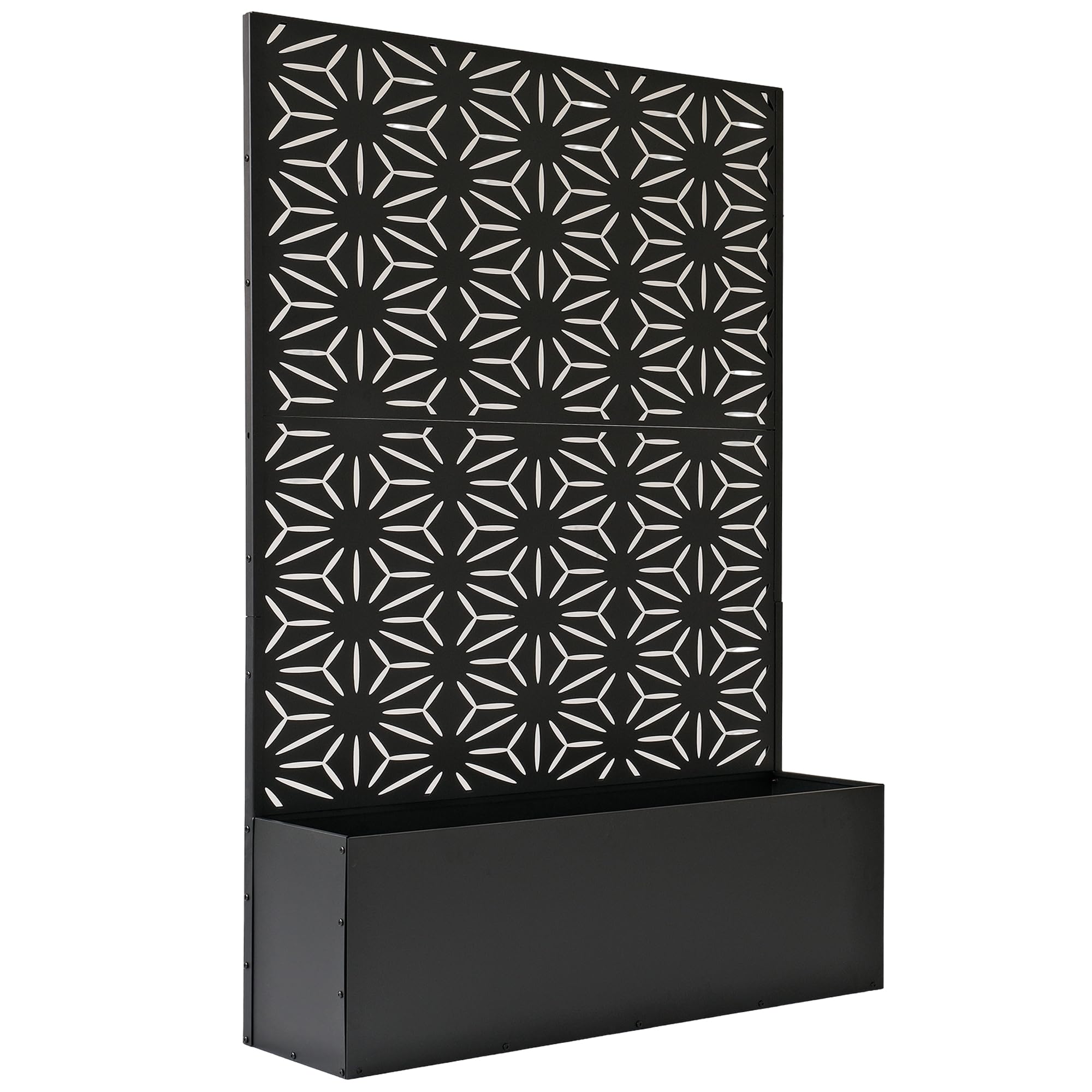
4. Oakland Living 6 ft. x 4 ft. Black Freestanding Metal Privacy Screen with Flower Box
A privacy screen that doubles as a planter — and assembles flat-out fast.
The standout here is the built-in flower box, 11″ L x 48″ W x 15.75″ H, which turns a plain divider into a planted feature. If you want the screen to blend into a garden rather than announce itself, this is the shape to look at. It stands 6 feet by 4 feet and is built from galvanized steel meant to shrug off weather.
Assembly is where owners are most vocal, and it is the panel’s strongest card — going together quickly and cleanly with good tools in the box. It can be set as a freestanding piece, worked into a corner, or joined to a longer arrangement, and the neutral black-and-geometric finish matches both modern and industrial patios. As a screen it does the decorative and privacy job: used with artificial plants for street-level privacy, or moved around a patio as the layout changes.
But here is the trade-off you have to size honestly: this is a light, decorative screen, not a wind-rated fence. Owners in open spots report it tipping in high wind unless the base is weighted — one filled it with 100 pounds of sand plus two pavers, and some found even stacked cinder blocks insufficient. Rust shows up at the metal-on-metal contact points, so a little touch-up prevention goes a long way. It is a beautiful piece for a sheltered courtyard or a covered porch, and a frustrating one on an exposed lawn with nothing to shield it.
Flower box is the reason to pick it: a 48-inch-wide, 15.75-inch-high planter is built right into the frame, so the panel carries greenery instead of just blocking the view.
Where it draws the line: the thin steel is decorative-grade — it wants a sheltered spot, and it is not the panel to trust against open wind.
Pick it for: a sheltered courtyard, covered porch, or patio corner where you want privacy with plants growing out of it.
Not for: an exposed lawn in a windy neighborhood — the frame is light, and the wind wins.
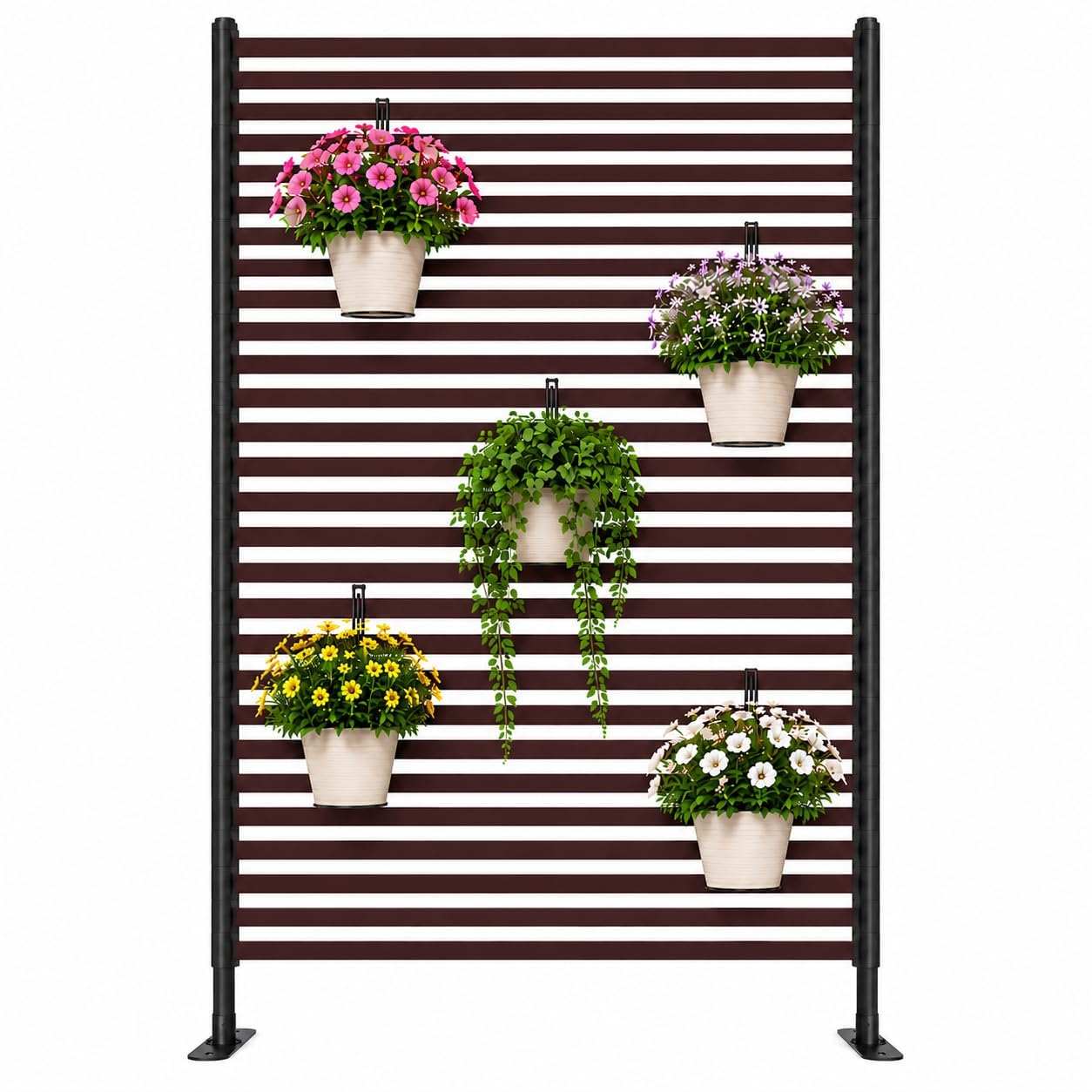
5. OTOSUNNY 71″ H x 45″ W Metal Privacy Screen Outdoor
Built to move — a patio screen today, a sunroom divider tomorrow.
Most of the panels here live outside forever. This one is designed to cross over: a 71-inch tall, 45-inch wide louvered screen that works as a backyard privacy barrier and as an indoor room divider for an apartment, living room, or sunroom. If you are renting and want a divider you can take with you, that flexibility is the reason to shortlist this one.
what separates it from the solid screens here is the louvered construction — slatted panels rather than hollow cutouts — which balances privacy with airflow so the space behind it does not go stale. Owners describe it as letting light through while still doing the privacy job, and some set it up against a neighboring property as a shield. It comes with hardware and step-by-step instructions, and it can be placed as a single panel or joined into a longer expandable fence. The happy buyers love how easy it is to assemble and how well it boxes in the ugly stuff, with one owner using it as an enclosure for an AC unit — though they had to improvise because they wanted the panels horizontal.
Here is the caution worth knowing before you buy: this is a freestanding panel, and freestanding panels with a louvered build are more sensitive to settling than a bolted one. A couple of owners found some components cracked or arrived imperfect, and the item can sit slightly off-level on uneven ground. It is also, at 71 by 45 inches, a single-panel screen — if your goal is a run of fence, you will want to plan to connect more than one.
The case to own it
- Works outdoors as a patio screen and indoors as a room divider — one purchase, two uses
- 71″ x 45″ louvered panels block the view while keeping air moving
- Single-panel placement or multi-panel expansion, so you can grow the coverage
- Hardware and step-by-step instructions included for a self-install
The parts to weigh
- A freestanding louvered panel can sit slightly off-level on uneven ground
- A few units arrive with cracked or imperfect components
- One panel covers one area — a long run takes more of them
Made for: renters and small-space owners who want a screen that moves between the patio and the living room.
Less ideal for: anyone fencing a long stretch of yard who needs one continuous structure.
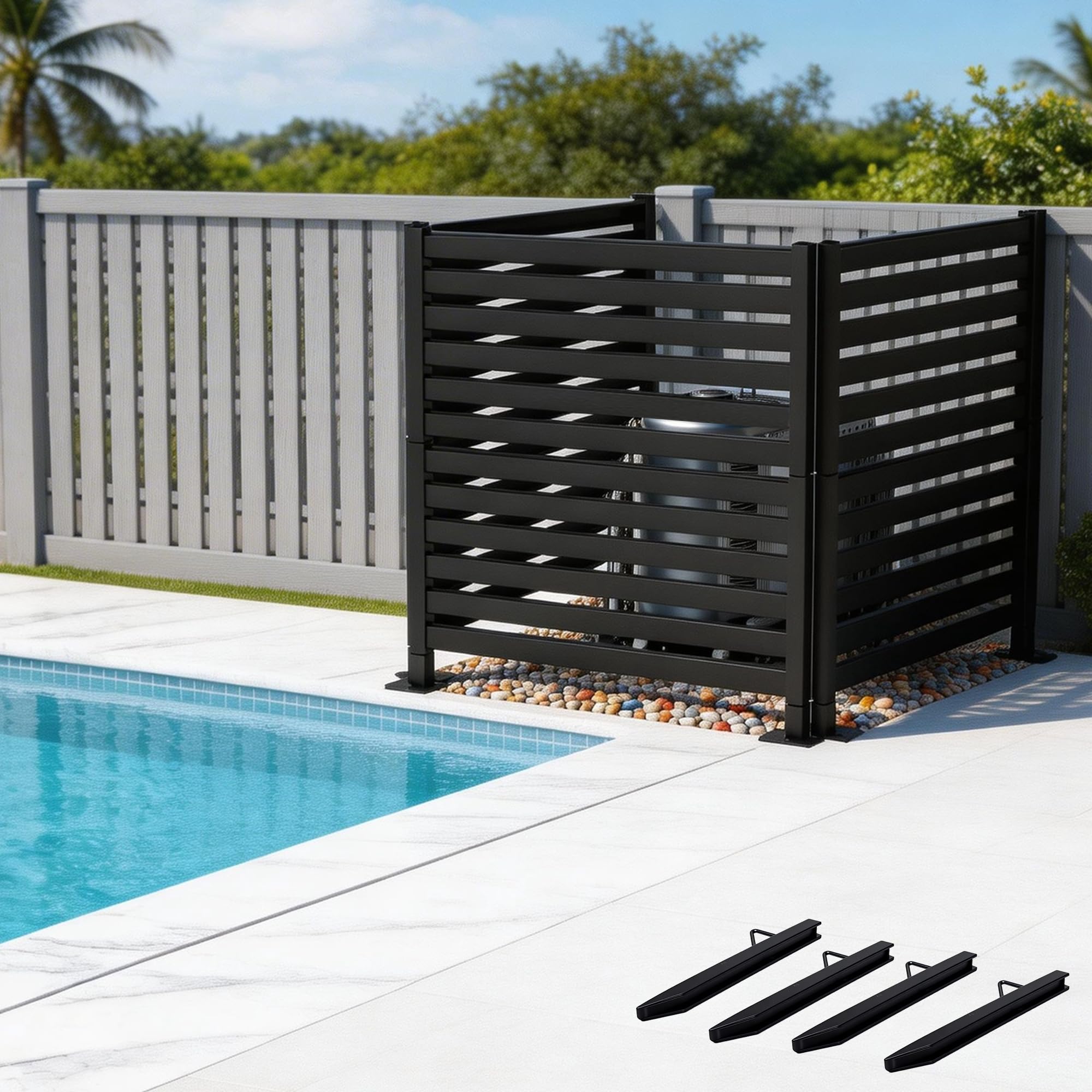
6. Sciyen 38″ W x 42″ H x 3 Modular Privacy Screen Kit
A build-your-own screen kit for yards that refuse to follow a straight line.
If your privacy problem is awkward — multiple AC units, a sloped corner, a garden you want to split — this kit is built for exactly that. It arrives with 6 panels, each 38″ x 21″, which you lock together into straight lines, L-shapes, U-shapes, or zigzags. There is a use for that flexibility no single fixed screen offers: you can wrap around utilities instead of just covering one face.
Owners put it together fast — one assembled two panels in about ten minutes — and it stands on the ground or mounts to a hard surface, with future expansion baked into the design. Slatted construction keeps air moving, so it doubles as garden fencing and as concealment for trash cans and AC units. The modern black look lands well: the ones who are happy describe a sturdy, good-looking panel that hides the eyesores they bought it for.
Two things to know before you order. First, the privacy sections are not as tall as the frame suggests — the screens total around 24 inches, enough to hide a unit or a low area, but nobody bought this to screen a hot tub. Second, quality is uneven: some owners mention it is not fully sturdy and needs extra support, and the included instructions are thin, with tiny pictographs and unnumbered parts bags. It is a kit, so plan on measuring your space and doing a little figuring yourself.
The kit advantage: six 38″ x 21″ panels that lock into L, U, straight, or zigzag layouts beat one fixed screen when your yard is awkwardly shaped.
The honest setting: the visible privacy covers roughly 24 inches, and the parts bags and instructions can leave you doing some guesswork.
Worth it when: you are hiding several utilities at once or shaping a corner of the yard, and you are comfortable with a little measuring.
skip it if: you want a single ready-made section you can pop in the ground — this rewards patient assembly.
7. Kingido 3 Panel No Dig Privacy Fence Screen, 42″ H x 38″ W
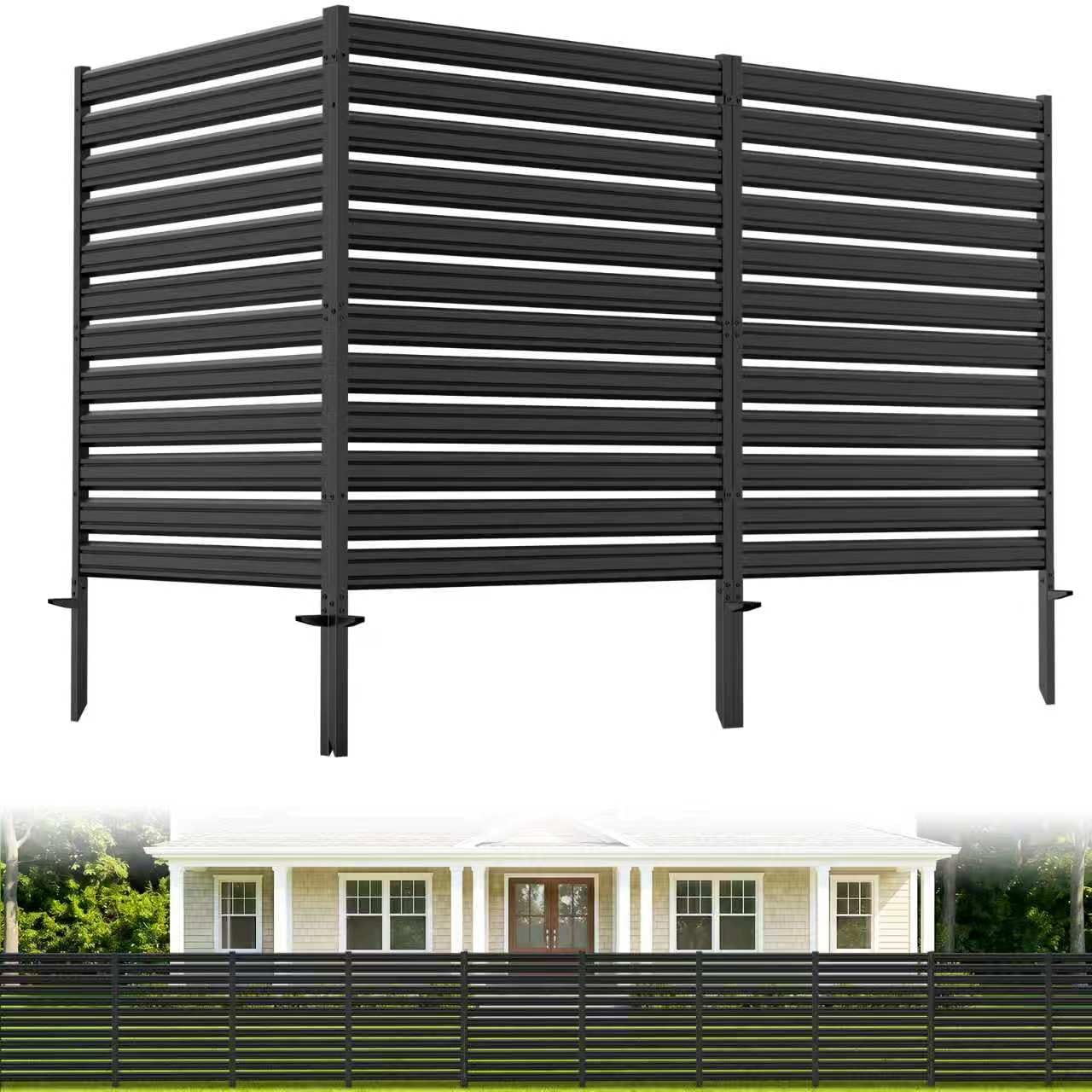
Push the stakes in, walk away, and stop looking at the trash bins.
This is the shortlist’s simplest install. There is no digging and no concrete: you connect the powder-coated steel panels and press the included stakes into the ground. For a renter or anyone who wants the eyesore gone in an afternoon, that is the whole appeal. Three panels give you 42 inches of height and 38 inches of width, positioned to conceal AC units, trash cans, pool gear, and heat pumps.
Buyers praise the look first: clean, modern lines that make a utility corner read as designed rather than neglected, and a self-described non-handy person got it standing alone. The slatted design keeps air moving, which matters when you are screening an AC unit that needs to breathe, and the panels can run in a straight line or an L to follow your space. Fitting easily into mulch is the easy version of the install; hard grass usually needs a mallet or a pre-dug hole.
The trade-off to plan for is sturdiness on soft, open ground. Customers note the ground spikes are thin, so in high wind the panel needs extra reinforcement or a sheltered spot. Because the model is new, its rust resistance is unproven over a full outdoor season. Treat it as a tidy, budget-friendly cover for a protected corner rather than a wind-rated fence, and it does its job well.
What it gets right
- No-dig setup — connect the panels and press the stakes in, no concrete needed
- 42″ x 38″ panels sized to hide AC units, trash cans, and pool equipment
- Powder-coated steel with a slatted design that maintains airflow
- Clean modern look for not much money
Where it needs help
- The thin stakes want more support in high wind
- Rust resistance is unproven over a full outdoor season
- Grass, versus mulch, needs a mallet or pre-dug hole to seat the stakes
Right for: mulch beds and sheltered side yards where you want an affordable no-dig cover for yard equipment.
Wrong for: an exposed, open lawn that takes real wind — the stakes are the weak point there.
8. Washsemba 39″ W x 48″ H White Metal Privacy Fence Panel (3 Panels)
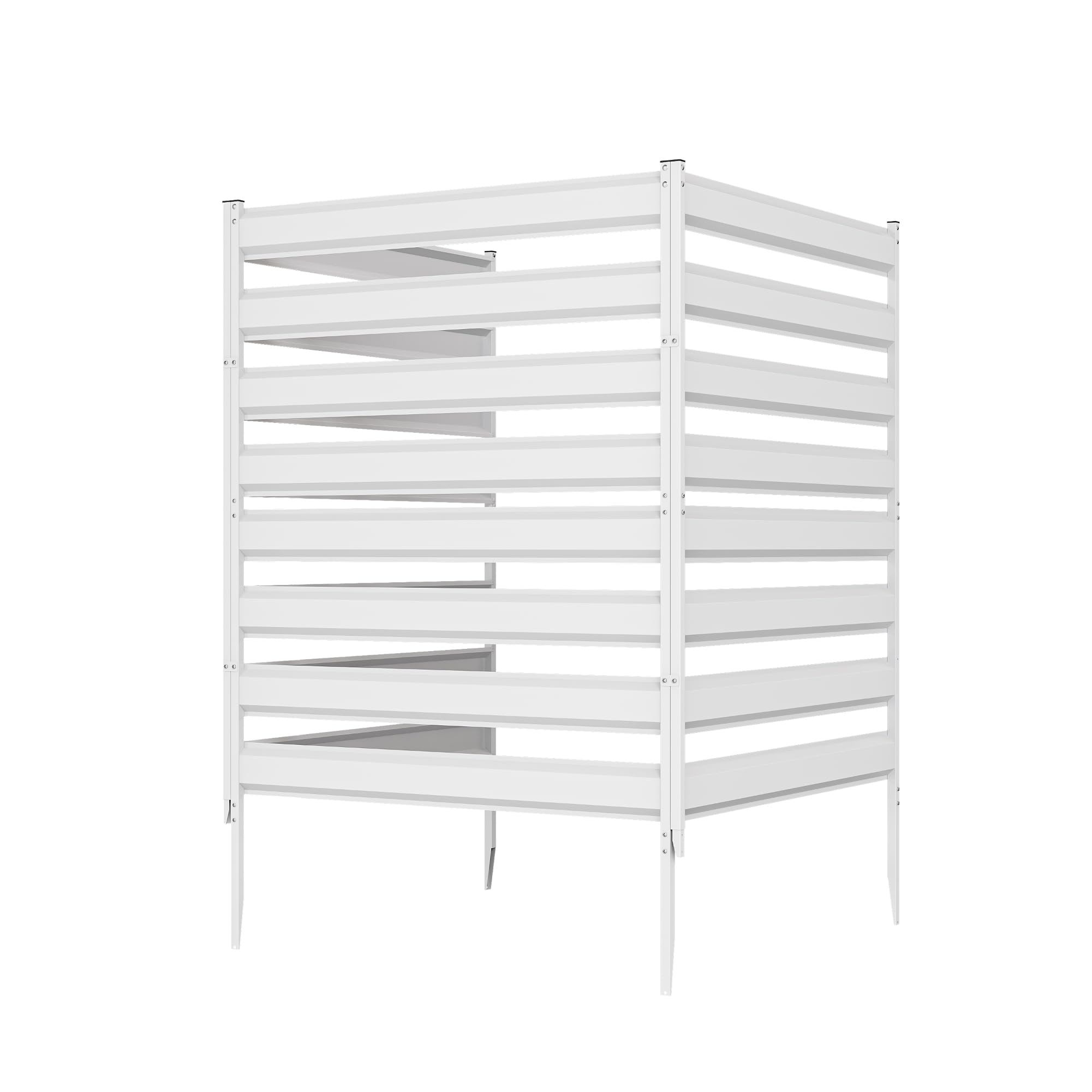
The white louvered screen that makes a trash bin look like landscaping.
A white metal panel solves a problem black panels cannot: it disappears into a light-colored fence line or a bright garden wall instead of standing out as a dark rectangle. This three-panel set measures 48 inches tall and 39 inches wide, so it sits between the low utility screens and the tall patio panels — the right height for hiding a bin or an AC unit without walling yourself in. It fits 32 to 96-gallon trash bins, and it takes spray paint if you want to change the color.
The vertical louvered slats do two jobs at once — they block the view and keep air moving, which is why it works around trash cans without cooking them into an odor trap and around an AC unit without choking off its heat. The 11.8-inch stakes are long enough to anchor firmly in soft soil, gravel, or sand, so it holds in loose ground, and assembly needs no special tools. Reviewers point out it going together quickly with a bit of muscle, and the white finish makes a utility corner look intentional. It fits together with panels that read as modular, so you can run it straight or turn a corner.
The place to be careful is the fit and finish. These panels can be stubborn to seat — one owner needed real strength and a heavy mallet to drive the metal into the openings — and a few units arrive with misaligned holes and short screws that make the job harder than it should be. Later shoppers say the powder coating holding up for years. Go in ready to work the pieces into place, and it rewards the effort.
Why white wins here: a bright louvered finish blends into a light fence line where a black panel would draw the eye to the very thing you are hiding.
The assembly reality: the sections can fight you into place — a heavy mallet and some patience turn a stubborn panel into a snug one.
Made for: a light-colored yard or fence line where you want a bin or AC unit screened in white.
Turn away if: you want a tool-free, five-minute install — this one asks for a little force to seat the panels.
Understanding the Specs
Height and what it lets you hide
Height is the fastest way to sort these panels, because it decides what the screen can conceal. A 42-inch panel is a utility height: it hides an AC unit, a trash can, or pool equipment at ground level. A 71- or 72-inch panel reaches standing eye level, which is what you need to screen a patio seat or a balcony. Match the number to the thing you are hiding before you look at anything else on the spec sheet.
Stakes, bases, and staying power
How a panel holds is the number buyers skip and then regret skipping. A long, thickened ground stake drives into soft soil, gravel, or sand and holds where a short stake pulls loose. A deep base — like the 16-inch base on the TinFrey panel — can be bolted into concrete or stone when you have a hard surface. A light frame on small legs tips in wind no matter how good it looks, so read the footing first.
Open patterns versus solid panels
Louvered slats and brick-pattern cutouts let air move through, so a gust pushes against them less and the view behind stays hidden. A solid panel blocks more, but it catches more wind and asks for a heavier base to stay upright. There is a second benefit to the open styles: around an AC unit or a bin, airflow keeps heat and odor from building up behind the screen.
Metal finish and weather
Every panel here is metal, but the finish is what keeps it looking new. Powder coating and spray finishes resist fading and rust, and silicone caps keep rainwater from pooling inside hollow pipes. Galvanized and coated steel hold up to rain and sun. In any metal screen, the contact points where metal meets metal are where corrosion tends to start, so a quick check on those joins pays off.
FAQ
What height metal privacy screen do I actually need?
Can a freestanding metal privacy screen stand without digging?
Will a metal privacy screen rust outside?
Should I anchor a tall metal privacy screen into concrete?
Do louvered panels give you privacy if they have open slats?
Can I hide an air conditioner without blocking its airflow?
How many panels do I need to cover a long stretch of yard?
Are these metal panels better than a wood privacy fence?
Can I put a metal privacy screen on a balcony or a deck?
How long does assembly take on a metal privacy screen?
Final Thoughts: The Verdict
For most yards, the backyard metal privacy fence worth starting with is the TUYOHW 72″ Metal Outdoor Privacy Screen. It is the pick that gives you real standing-height privacy — 72 inches tall and 47 inches wide across three panels — with a rust- and fade-resistant finish that holds its look through a full season outside. If your target is a single AC unit or a trash can instead of a patio seat, the COLRASN AC fence screen earns its spot on the strength of its 12-inch stakes alone. And for a screen you can anchor into concrete for a wind-safe finish, the TinFrey louvered faux wood panel with its included expansion anchors is the one to bolt down.
How We Picked
We do not accept paid placement. Every pick is matched to a real buyer and a real use-case; we do not hands-on test units.
Sources & Methodology
Specifications: manufacturer listings and product documentation. Review insights: verified customer reviews, as of September 2026. Pricing: not shown on this page (it changes often); check the current price via the retailer link.
As an Amazon Associate, KitchPrep earns from qualifying purchases. This does not affect which products we feature.
Related Guides
