
Specs are compiled from manufacturer listings and verified buyer reviews and can change over time — please confirm the key details on the product page before buying.
The question that actually matters is simple: how long will your sump pump keep running once the grid drops? A backup power supply for a sump pump is not a battery you buy once and forget, and it is not the same thing as a small computer UPS. It is an inverter, a charger, and an automatic transfer switch in one box, and the battery is usually sold separately. Get the pairing wrong and you find out during the storm, not before it.
I’m Mohammad Maruf — the founder and writer behind KitchPrep. This guide is built by comparing the manufacturers’ published specifications and the patterns across verified customer reviews, so you get each pick’s real strengths and trade-offs instead of marketing spin.
Below you will find the units that hold up under a real outage, from mid-range workhorses to top-tier dual-pump machines. The smartest move is matching your pump’s horsepower to the right wattage before you spend a cent on the best backup power supply for a sump pump.
Our Picks at a Glance

How To Choose The Best Backup Power Supply for a Sump Pump
Three numbers decide whether a backup will save your basement: the wattage the unit can hold continuously, the battery capacity in amp-hours you pair with it, and how fast it swaps to battery power when the grid dies. Everything else is comfort.
Wattage Must Clear Your Pump’s Startup Draw
A sump pump pulls a heavy surge the instant its motor kicks on, then settles into a lower running draw. That surge is why a 1/3 HP pump is often paired with a 2000W-class unit rather than a smaller one. Pure sine wave output keeps the motor running smoothly instead of buzzing or overheating. Units in this list range from 1500 watts up to 2500 watts, with some listing a peak wattage for that startup spike.
Amp-Hours Decide How Long You Stay Dry
The inverter does not store power. The deep-cycle battery does, and you buy it separately. Runtime is roughly the battery’s usable capacity divided by how hard your pump works, so a bigger battery buys longer coverage. One buyer’s 95AH AGM battery ran a 1/3 HP pump only 45 minutes before dropping to 11.8V. A 100Ah pairing usually runs a single pump through an overnight storm, while a 200Ah setup can carry two pumps.
Transfer Speed and Float Cycling
When utility power fails, the inverter has to flip to battery fast enough that the pump motor never stalls mid-cycle. Units here switch in as little as 10ms. That speed only matters for sensitive electronics; sump pump motors generally tolerate a short gap. What does matter is how often your pump cycles. A pump that fires every few minutes drains any battery quickly during a long storm.
Quick Comparison
| Model | Best For | Output | Charging Current | Battery Type Support | Amazon |
|---|---|---|---|---|---|
| OLTEANP 1500W Inverter Charger★ Best Overall | Single-pump homes that want a clean, monitored install | 1500W pure sine wave | 25A | LiFePO4, AGM, GEL, Flooded | Amazon |
| Cantonape 2000W Backup SystemBudget Champion | Budget-friendly single-pump protection | 2000W pure sine wave | 20A | GEL, AGM/SLA, Flooded/Wet | Amazon |
| VEVOR 2000W with LCDMost Reviewed | Running two pumps on a tighter budget | 2000W pure sine wave | 20A | 100Ah deep-cycle | Amazon |
| VUFUMSY 2500W Dual Pump | Two-pump basements with a 1HP primary | 2500W pure sine wave | Not listed | Lithium, AGM, gel, lead-acid | Amazon |
| VEVOR 2500W with LCD | Heavier loads on a mid-range budget | 2500W pure sine wave | 20A | 100Ah deep-cycle | Amazon |
| InsensVert 2500W UPS | Cleaner power for pumps plus sensitive gear | 2500W continuous / 5000W peak | 25A | GEL, AGM, SLA, Flooded, WET, EFB, LiFePO4 | Amazon |
| Viopumpo 2000W with Remote | Adjustable voltage for lithium batteries | 2000W pure sine wave | 25A | Up to 7 battery types | Amazon |
| PumpSpy 2000W Backup | Assembled-in-Michigan support and build quality | 2000W pure sine wave | Not listed | 12V deep-cycle | Amazon |
| Viopumpo 2500W with Remote | Whole-basement protection with dual-pump headroom | 2500W pure sine wave | 25A | Lithium, AGM, deep-cycle | Amazon |
In‑Depth Reviews
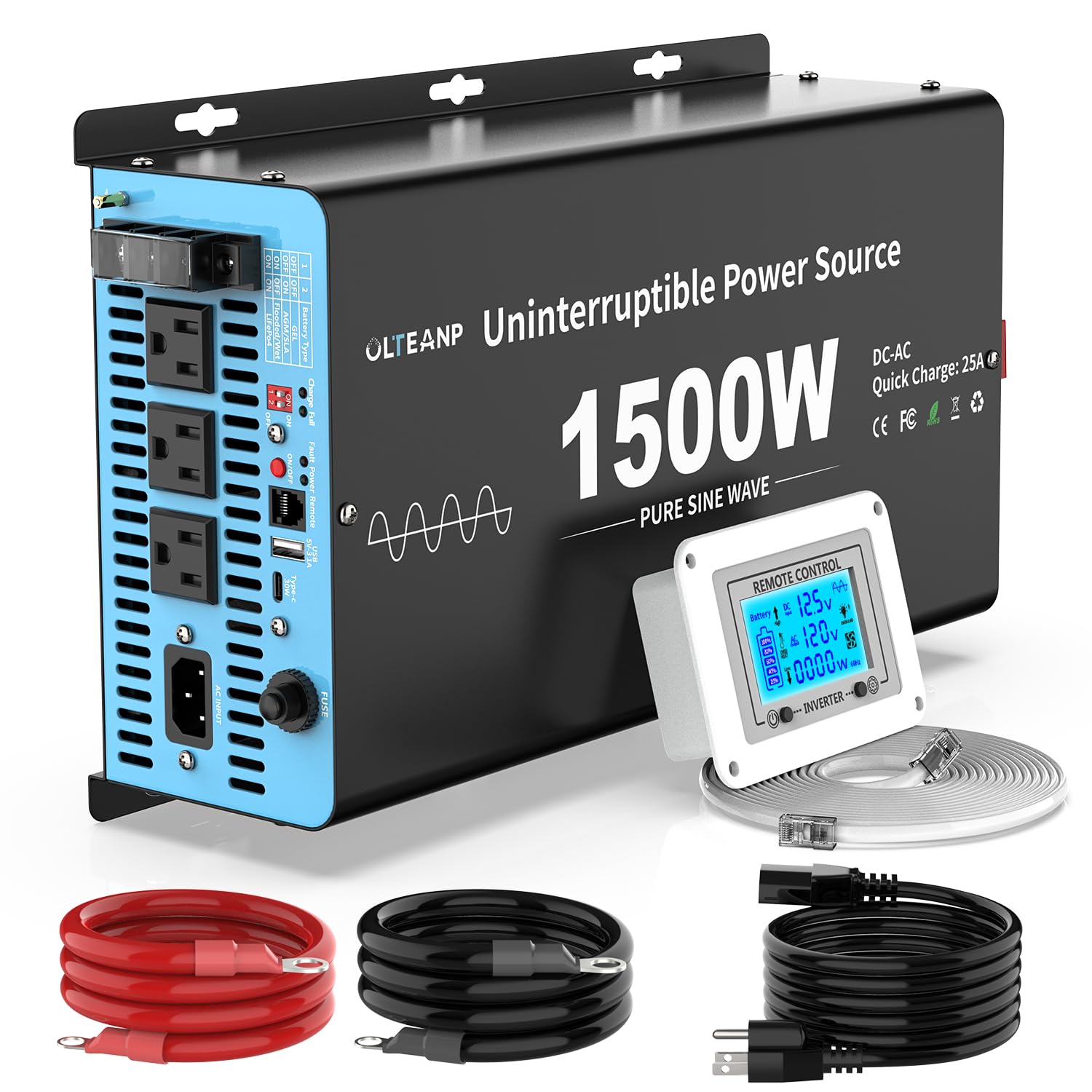
1. OLTEANP 1500W Sump Pump Battery Backup System
Our pick — over 4.5★ from 90+ verified ratings; the strongest balance of quality and price.
The box that charges fast, switches clean, and tells you exactly what your battery is doing.
Owners of this OLTEANP 1500W unit keep coming back to one thing: it just works as a backup. That is not faint praise for a device that only earns its keep during a storm. The 1500W pure sine wave output is clean enough to run a standard residential sump pump without the buzzing or heat you get from a cheap modified waveform. It is rated for 12V deep-cycle batteries, and it officially supports LiFePO4, AGM, GEL, and Flooded types, so you are not locked into one chemistry when your old battery dies.
Functionality is the aspect owners talk about most, and the design backs it up. The built-in 25A multi-stage charger is the fastest in this lineup. For comparison, the Cantonape 2000W charges at 20A, and the Viopumpo 2000W also lists 25A. At 25A, a drained deep-cycle battery refills in hours instead of overnight. The included LCD remote is another practical touch, letting you check battery voltage, load, and operating mode from the room you actually sit in, not from the damp corner of the basement.
The honest catch is the battery itself: it is not included, and this unit is picky about capacity. A smaller AGM battery will technically work, but pumping a 1/3 HP pump for hours will drain it fast. At 1500W, it cannot carry a 1HP primary pump or a second pump on backup. It suits a standard single-pump home, and the included UPS plug and battery cables mean no extra parts on install day.
Why owners keep it
- 25A charger is the fastest in this group, refilling a deep-cycle battery quickly after an outage.
- Pure sine wave output runs standard sump pumps cleanly and protects the motor.
- LCD remote shows voltage, load, and mode from anywhere in the house.
- Supports LiFePO4, AGM, GEL, and Flooded deep-cycle batteries.
Where it stops
- 1500W output is not enough for a 1HP pump or a two-pump setup.
- Battery not included, so your total cost depends on the capacity you add.
Rated for exactly this job: a single standard sump pump in a finished or flood-prone basement, where the goal is a clean, monitored install with the fastest recharge available.
If you run a 1HP motor: the 1500W ceiling will bottleneck you, and the 2000W Cantonape or a 2500W unit is the safer match.
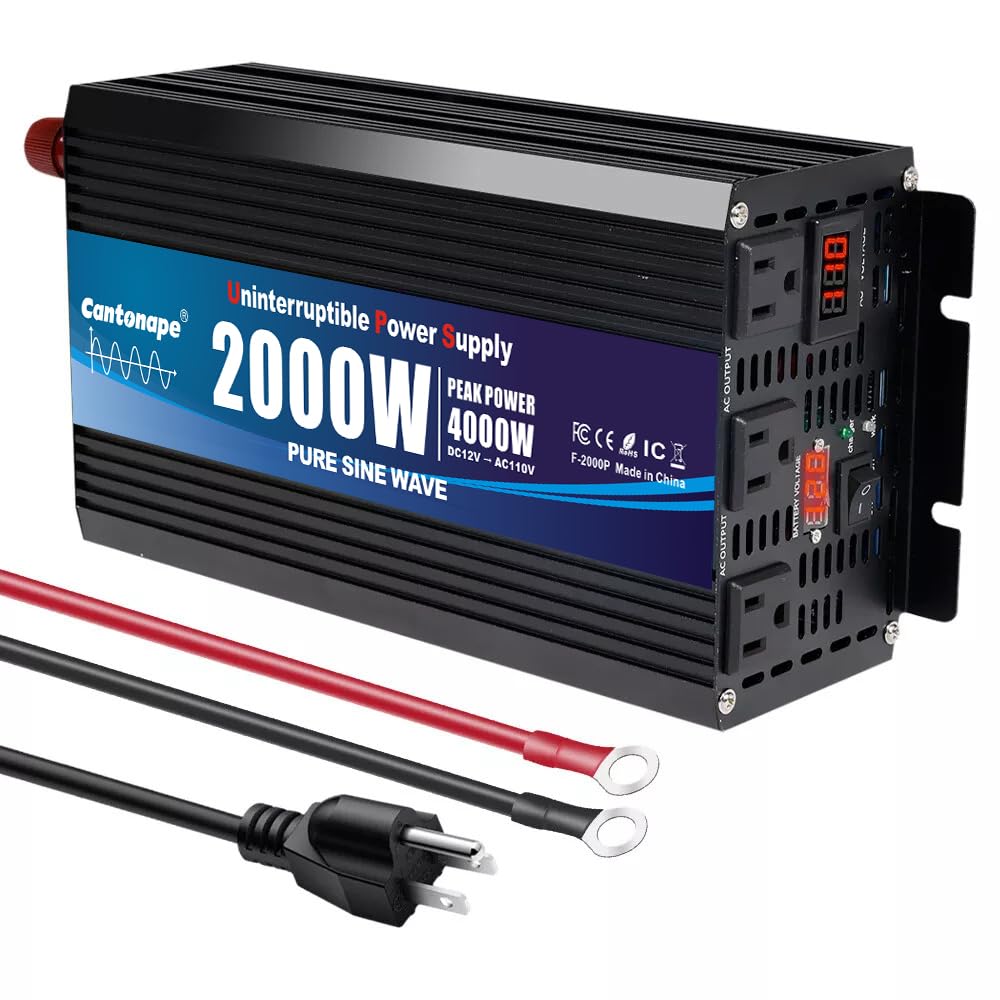
2. Cantonape 2000W Sump Pump Backup Battery System
More watts for less money, and it proved itself through eight hours of rain.
The Cantonape delivers 2000 watts where the OLTEANP above gives you 1500 watts, and it asks less money for it: 2000 watts vs 1500 watts. That extra headroom is not just bragging rights. It opens the door to heavier pumps, and one buyer ran a floating marine battery through an 8+ hour outage in constant rain and reported the pump never faltered. That is the scenario this category exists for.
Setup is genuinely plug-and-play. Owners note that you assemble the AC and DC cables, plug your pump into the AC socket, and you are done. A buyer tested it by unplugging the main pump, and their Zoeller kicked in instantly. The same buyer recommended the 2000W over a 1500W for a 1/3 HP pump, which lines up with the general rule that you want wattage headroom above your pump’s surge draw.
The trade-off is charging speed. The Cantonape’s 20A charger is slower than the OLTEANP’s 25A and the Viopumpo’s 25A, so replenishing a fully drained deep-cycle battery after a long outage takes longer. The manual is also printed small, which makes the first read-through a squint-fest. And like every unit in this category, the battery is not included.
The value case: 2000W of pure sine wave output and three AC outlets, backed by eleven positive functionality mentions from owners, at a price that undercuts almost everything else here. That combination of 2000W, three outlets, and a low price earns it the Budget Champion label.
Buy this if: you want maximum wattage per dollar and your priority is a workhorse that survived a real eight-hour outage.
Think twice if: you want the fastest possible recharge between storms and would rather pay for the 25A chargers on the top picks.
3. VEVOR 2000W Sump Pump Battery Backup with LCD
The most-reviewed unit here, with dual outlets that let two pumps share the load.
What VEVOR gets right is the everyday stuff. The 2000W inverter lists an operating current of 18.2A and two outlets, so two sump pumps can both sit on backup at once. Setup is a 3-pin plug design rather than hardwiring, which means no electrician and no risk of crossed wires. Performance is the aspect owners talk about most, and the consistent theme is simple: people test it by cutting the breaker or filling the sump pit, and it takes over immediately.
Charging is where VEVOR makes a number claim worth reading carefully. VEVOR states the 20A charger refills a 100AH battery in about 5 hours, which it describes as four times faster than a 5A charger. That is a useful benchmark: if you drain a 100AH battery during a long storm, you are looking at roughly an overnight recharge, not a quick top-up. The LCD panel with LED indicators keeps voltage, power, and battery level visible, which owners consistently call out as the feature that makes this feel trustworthy.
The catch is consistency. At 4.2 stars across 100+ ratings, this has the widest review base here and the widest range of experiences. The loudest gripes are about the instruction manual, which some describe as a rough translation, and about fan behavior, which cycles on during charging. A few heavier-duty units also report being louder than expected, though in a basement that rarely matters.
What two pumps gets you: 18.2A of operating current across dual outlets means two pumps can run simultaneously, which is the single most useful feature for a basement with a primary and a secondary pump.
Where to set expectations: the fan is audible and the manual is thin, so budget an evening to research safe battery configuration yourself before install.
Best for: the two-pump basement where both pumps need a seat at the backup table, and the buyer is willing to read up on battery sizing rather than rely on the manual.
Not for you if: you want the quietest unit on the shelf or a clear, well-written installation guide in the box.
4. VUFUMSY 2500W Sump Pump Battery Backup System
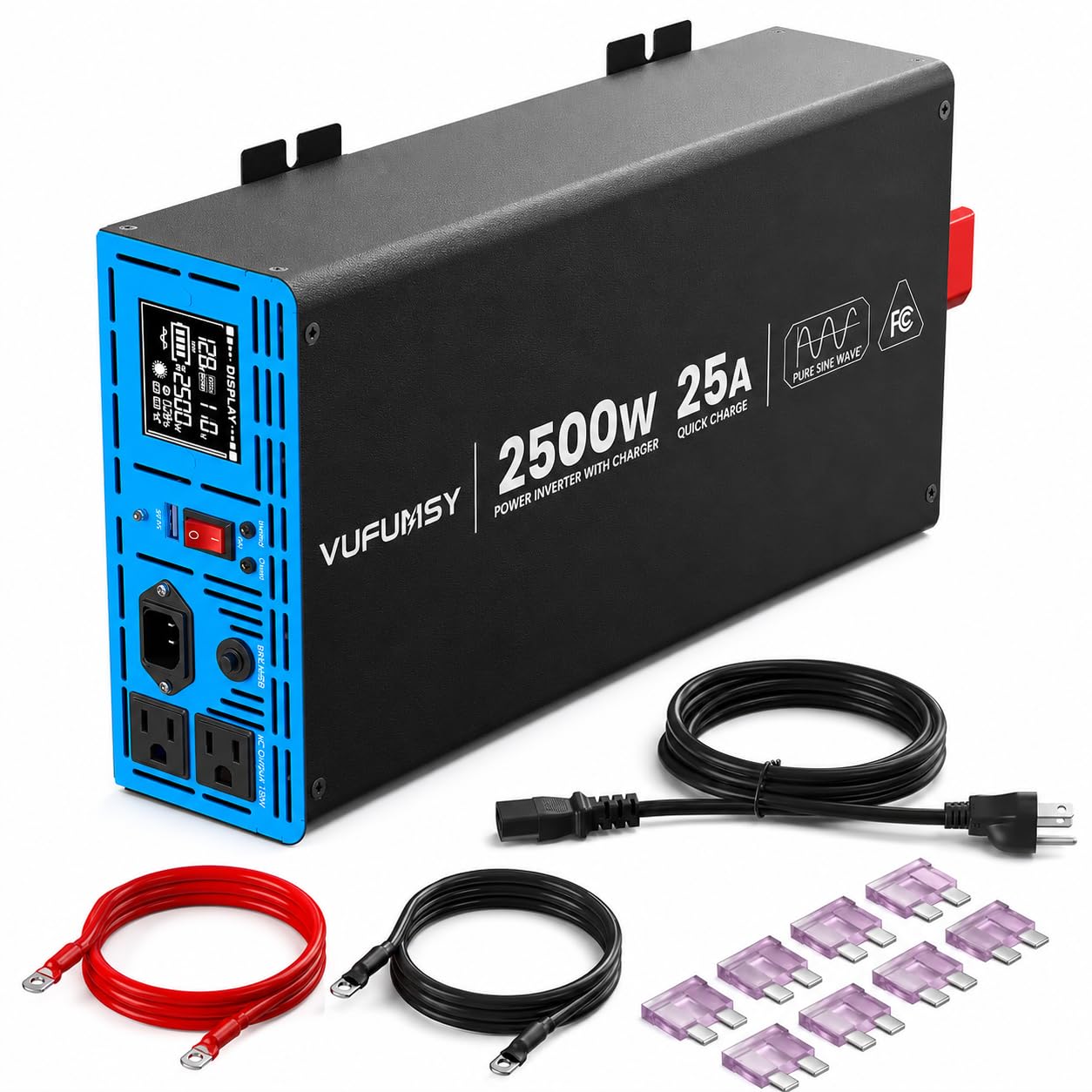
A 2500W unit built around a 1HP primary pump and a 1/3HP companion, with 2500W ready when both need power.
The VUFUMSY is the pick for the buyer who wants genuinely heavy loads handled. It is rated to run two pumps at once, and it names the pairing directly: a 1HP pump plus a 1/3HP pump. The battery math is spelled out too, which is rare and helpful. A 200Ah battery is what VUFUMSY specifies to run both pumps, while a 100Ah battery will run just the 1HP pump on its own. That removes the guesswork that trips up most first-time buyers.
You can install this yourself in minutes, according to VUFUMSY, with simple mounting, plugging, and connecting, and no rewiring. Buyers who did it themselves mention needing a hammer drill and Tapcon screws for the mounting. One owner found the 2500W fixed the lights dimming when the sump pump started, a nice side benefit of clean sine wave power (steady, smooth electricity that sensitive motors prefer). FCC certification (a US government stamp for electronic safety) is listed, and the protection set covers overload, over and low voltage, over-temp, short circuit, and reverse polarity.
The honest limit is speed and accuracy. This unit switches in under 15ms (milliseconds, or thousandths of a second), which is fast, but it is not the 10ms that the InsensVert unit above advertises. More importantly, buyers who tried it with computers and routers found 15ms is still too slow to stop sensitive electronics from rebooting. Reviewers also flagged the wattage and voltage readouts as imprecise, often reading zero when current is clearly flowing. That matters less for a pump than for a home office, but it is worth knowing before you buy.
What stands out
- 2500W output runs a 1HP and a 1/3HP pump simultaneously.
- Clear battery sizing: 200Ah for two pumps, 100Ah for one 1HP pump.
- DIY install in minutes with no rewiring and no electrician.
- FCC certified with reverse polarity, over-temp, and short circuit protection.
Where it stumbles
- 15ms transfer is too slow to keep computers or routers from rebooting.
- Display accuracy is inconsistent, with wattage readings sometimes showing zero.
- Some buyers found the instructions mediocre and the mounting hardware not included.
Land this one if: you have two pumps, one of them a 1HP, and you want the battery-sizing spelled out instead of guessed.
Look past it if: you also want to protect a router or desktop during outages, since 15ms is not fast enough for that job.
5. VEVOR 2500W Sump Pump Battery Backup with LCD

The 2000W VEVOR, scaled up to 2500 watts for the pumps that need the extra room.
If you looked at the VEVOR 2000W above and thought “not quite enough,” this is the same platform with the wattage turned up. Output jumps to 2500 watts with 22.7A of operating current and the same dual-outlet layout, so two pumps or heavier pumps get the headroom they need. The charging spec is identical at 20A, and VEVOR again states a 100AH battery recharges in roughly 5 hours.
The standout feature is the 20A charger, which buyers highlight for getting a drained battery back online reasonably quickly after an outage. Quality is the aspect owners praise most here, with battery life not far behind. Setup is quick, and the 3-pin plug design keeps it a plug-and-play job rather than a wiring project. The LCD readout shows voltage, power, and battery level, and owners watching their pump cycle draw say they like having that visibility.
Where this gets complicated is reliability. Reliability is the single most-discussed topic in this unit’s reviews, and the honest picture is mixed. Many buyers report zero trouble after long use, while a smaller set of units got stuck in battery mode and drained themselves. VEVOR’s customer service received mixed marks, with some buyers getting clear help and others facing slow responses. With 100+ ratings and mixed reliability reports, run a full drain-and-recharge test inside the return window.
What earns the label: 22.7A of current and 2500 watts of sustained output make this a genuine heavy-load unit, and 20A charging keeps the wait between outages manageable.
Test it early: run a full drain-and-recharge cycle within the first week to confirm yours is not one of the units that sticks in battery mode.
One for the heavy-load buyer: two pumps, or a single pump with a big surge draw, and a willingness to run an early test cycle on the unit.
Skip if you want dialed-in customer support: response times on service issues are inconsistent enough that self-reliance helps.
6. InsensVert 2500W Sump Pump Battery Backup UPS
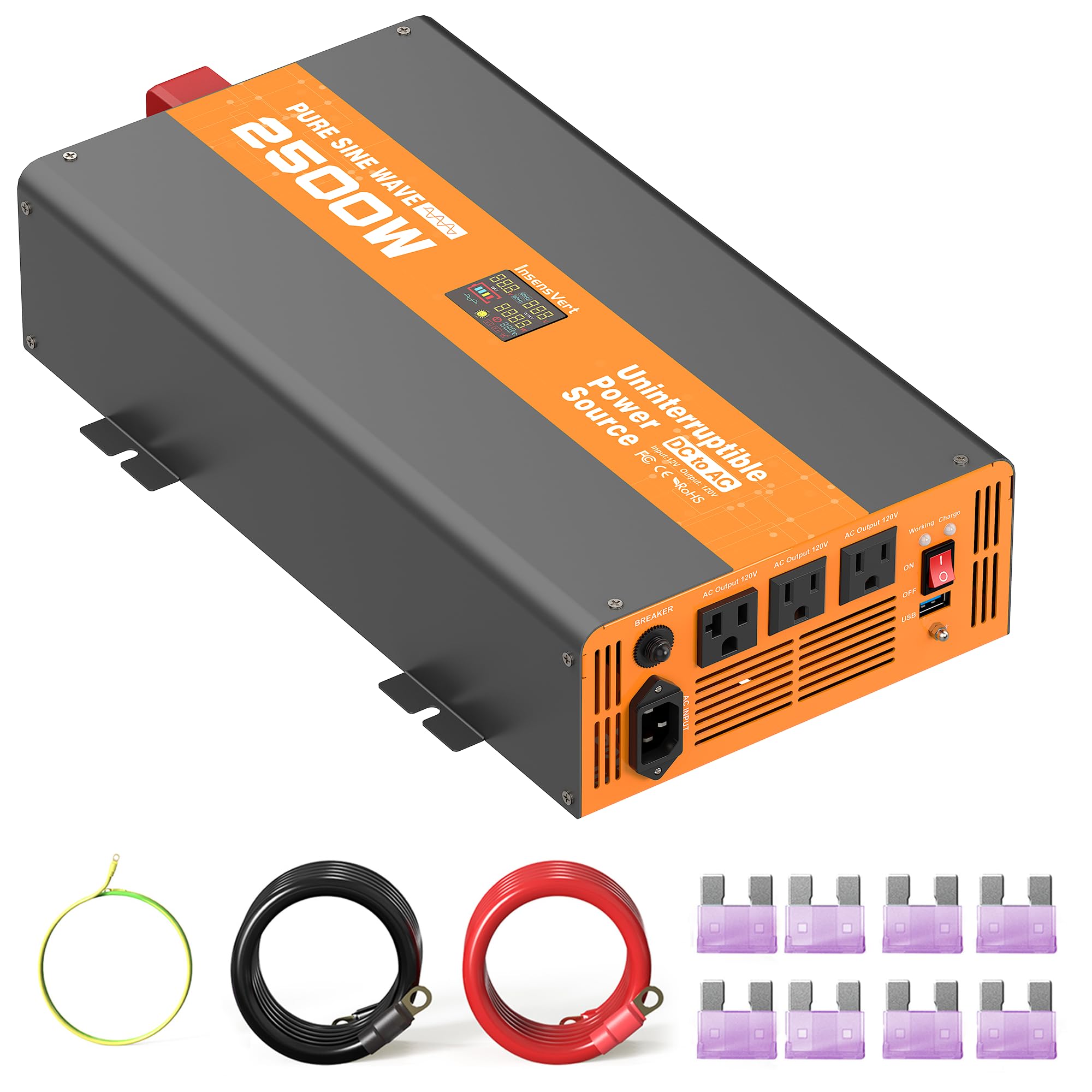
The fastest transfer and the cleanest waveform here, paired with the widest battery chemistry support.
Two numbers separate the InsensVert from the crowd. It switches to battery power in under 10ms, and it holds total harmonic distortion under 6%. That combination matters if you want to plug sensitive electronics into the same backup as your pump. It also lists 2500W of continuous output with a 5000W peak, which gives your pump’s startup surge a lot of room, and 23.3A of operating current across three AC outlets. Peak wattage is the number that matters when a motor first kicks on, and this is the only unit here that states one.
Battery compatibility is the widest in the group. It supports lead-acid chemistries including GEL, AGM, SLA, Flooded, WET, and EFB, plus lithium LiFePO4, so you can use whatever battery you already own or match the chemistry to your budget. The 25A three-stage charger recharges a 100Ah battery in about 4 hours, matching the fastest chargers in this lineup. Soft start technology ramps power gently during pump startup, which the maker says extends motor life by avoiding current surges. Heavy-duty 3AWG pure copper battery cables are included, along with a ground wire for shock protection.
The catch here is realism about float voltage. A few owners who run lithium batteries report the charger floating their 100Ah lithium at a voltage they consider too high, and they wish the float voltage were adjustable rather than fixed. That is a niche issue for a specific chemistry, not a dealbreaker for the AGM crowd. It is also note this is a relatively new arrival, so there is less long-term field data than the deeply reviewed units above.
The reasons to pick it
- Under-10ms transfer is the fastest in this group.
- Under-6% harmonic distortion keeps sensitive electronics and pump motors on clean power.
- 2500W continuous with a 5000W peak, the only listed peak wattage here.
- Widest chemistry support, from Flooded and EFB to LiFePO4.
- 25A three-stage charger refills a 100Ah battery in about 4 hours.
What to weigh first
- Float voltage is fixed, which some lithium users find too high.
- Newer product with less long-term reliability history than the more-reviewed units.
Reach for this if: you want one box to protect both your sump pump and any sensitive electronics, with the fastest switch and the widest battery flexibility.
Look elsewhere if: you plan to run a lithium battery and want to tune float voltage yourself.
7. Viopumpo 2000W Sump Pump Battery Backup with Remote
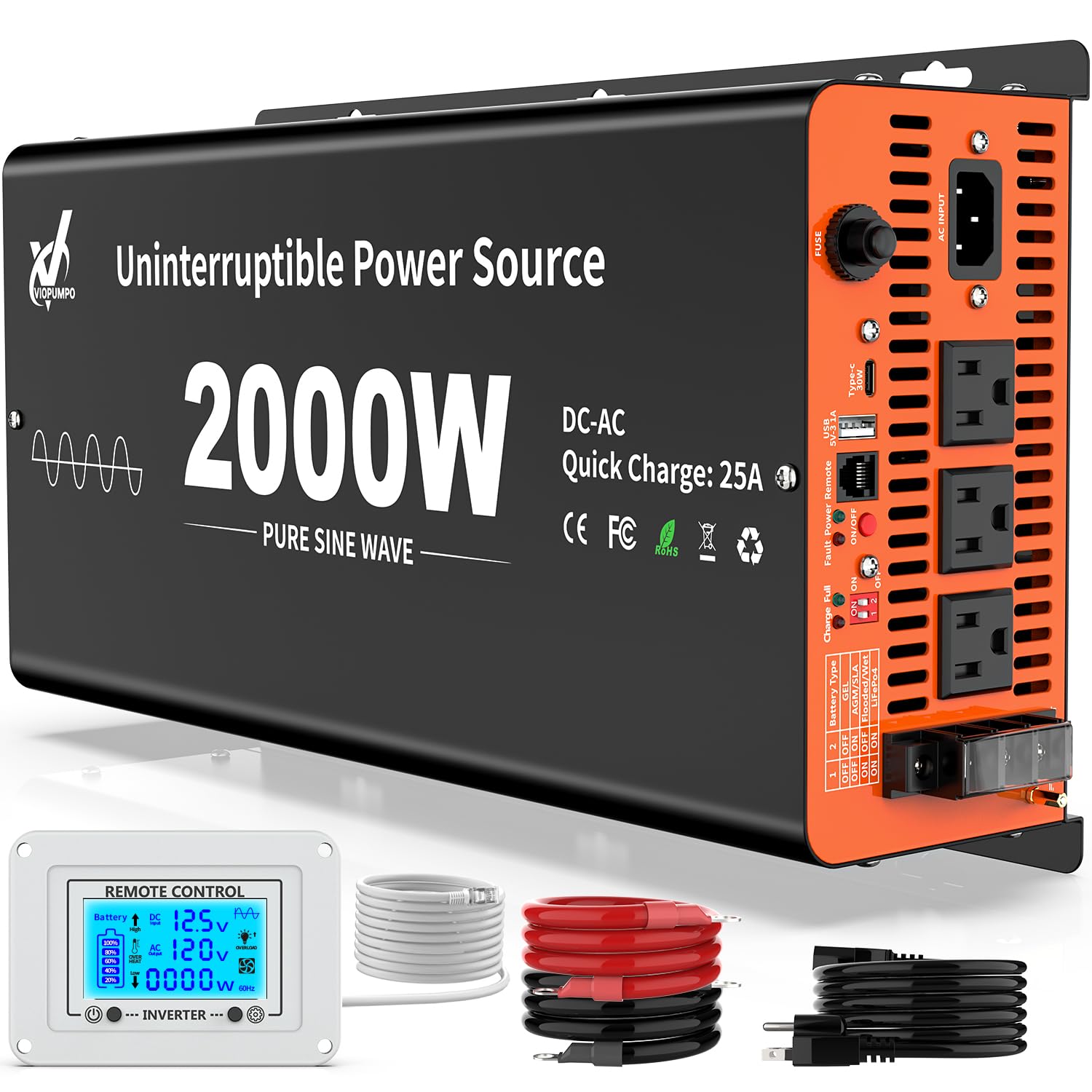
The adjustable-voltage unit that lets you tune the cutoff for the battery type you already own.
Most units in this category assume you know your battery chemistry and get on with it. The Viopumpo takes a different approach. It has an adjustable input voltage function spanning 9.5V to 11V, which lets you fine-tune the low-voltage cutoff for lithium batteries in particular. The maker frames this as reducing battery consumption and protecting battery health. Owners who know their battery well say it is one of the only inverters they have found that adjusts for battery type, which is saying something in a crowded field.
Performance is the strongest aspect here. Owners mention it runs two 1/3 HP pumps without issue. One owner powered a coal furnace fan for about 20 hours per outage through a whole winter, and a freezer test showed only a 20% drop in the first few hours of runtime with fridge and freezer both drawing. The 2000W output, 25A current, and three AC outputs put it in the upper tier for a single-pump or light dual-pump setup. The included LCD remote displays voltage, power, and charge status, and it can power the whole unit on and off.
The obvious thing to plan around is battery life. That is the most-discussed topic in this unit’s reviews, and the picture is split: some customers note it still working fine after three months, while others find it does not last as long as expected. A small number push it hard with heavy resistive loads like hair dryers and stoves, which is not what this unit was designed for, and those buyers run into trouble. Keep it to pumps and lighter backup duties and it performs as advertised.
Where it wins: the 9.5V to 11V adjustable cutoff and the 25A charger give you control most competitors do not offer, and 2000 watts stretches comfortably across a pump and a second device.
The gentle caveat: outlet spacing is tight enough that a large sensor plug can block adjacent sockets, and the battery still needs to be bought separately.
Choose it when: you want tunable voltage for lithium and enough power to run pumps and a secondary appliance.
Pass on it when: you need the fastest available transfer for sensitive electronics or want a warranty you can easily reach a rep about.
8. PumpSpy 2000W Sump Pump Battery Backup System

The Kalamazoo-built unit with a real support team behind it and a dedicated trickle charge.
PumpSpy does one thing that no other unit here advertises quite the same way: it maintains your battery with a “trickle charge” once the battery is fully charged, keeping it topped off and ready. That matters in a category where the battery is often the weak link, because a battery sitting unused for months between storms can lose its edge. The included smart cooling feature is also there to extend the unit’s life, and the whole thing is assembled and tested in Kalamazoo, Michigan, with a support team based there for install and troubleshooting questions.
On power, the 2000W output runs a pure sine wave 120 VAC waveform and can carry two primary sump pumps at once, as long as their combined draw stays at or under 16.6 Amps. Setup is deliberately simple: two grounded outlets and a USB charge port, with all install hardware included, right down to the wood and concrete screws and a concrete bit. One buyer was honest that they had never done anything like it before and finished in about 10 minutes. Functionality and ease of installation are the two aspects owners praise most.
The honest limit is scope. This is a single-purpose unit built for pumps and light backup, and it has no smart remote or app interface like the more connected units. It is also battery-agnostic: you must supply your own 12V deep-cycle battery, and PumpSpy recommends its own maintenance-free batteries. The one caution worth repeating to anyone shopping here is to read the description carefully, because “backup system” means the inverter and charger, not a bundled battery.
Why the support matters: a maker that tests its units in the same building as its support team is rare in this category, and buyers consistently find setup easy enough to finish in minutes.
What it does not do: no remote monitor, no app, no adjustable voltage. It is a straightforward box for a straightforward job.
Made for the buyer who wants a name and a voice: two light-to-moderate pumps, a preference for domestic assembly and support, and a willingness to supply a deep-cycle battery separately.
Not the fit if: you want remote monitoring, adjustable charging voltage, or headroom above a 16.6A combined draw.
9. Viopumpo 2500W Sump Pump Battery Backup System

2500 watts of pure sine wave power with the strongest owner sentiment in the lineup.
Everything the Viopumpo 2000W does well, this unit does with more headroom. Output climbs to 2500 watts of pure sine wave power, the charger stays at a fast 25A, and the remote LCD gives you voltage, power, and battery status from wherever you keep it. It supports deep-cycle lithium, AGM, and other deep-cycle chemistries, and the maker includes overcharge protection to defend the battery during long idle periods. The list price reflects that this is the premium end of the range.
Functionality is the aspect owners talk about most here, and the reliability stories back it up. One owner ran their pump, freezer, and modem through a four-hour outage on a single charge without a hiccup. Another, after the initial setup confused them, got it working and reported smooth AC-to-battery switchover that ran the sump pump with no interruption. The active monitor remote keeps status visible from a distance, and one buyer called it a better-than-average backup compared with what they had used before.
The honest catch is the pairing discipline this unit demands. Like every inverter here, it does not include a battery, and to get real runtime you need a genuinely large deep-cycle battery, ideally 100Ah or more. The manual is thin and some owners needed a YouTube video to sort out safe configuration, so budget a little research time. It is also the most expensive unit in this list, and the least reviewed of the top performers, meaning a shorter track record to judge from.
What justifies the top spot: 2500 watts, a 25A charger, and a 100+ rating base on a premium unit is about as strong a package as this category offers, and the four-hour outage story tells you the power delivery is real.
The thing to remember: you are buying the inverter and charger, not a battery. Pair it with a proper deep-cycle battery in the 100Ah range or larger for meaningful runtime.
Pick this for: the whole-basement protection buyer who wants top wattage, fast charging, and the reliability story owners most consistently endorse.
Consider a lower tier if: your pump is a single 1/3 HP unit and you would rather put the savings into a bigger battery.
Understanding the Specs
Watts and Peak Watts
Wattage is how much power the inverter can deliver continuously. A sump pump’s motor draws far more wattage in the split second it starts than it does while running, and that surge is why a 1/3 HP pump is often paired with a 2000W-class unit even though its running draw is much lower. Some units, like the InsensVert, also list a peak wattage for that startup spike. When in doubt, buy headroom, because underestimating the surge is the most common mistake and it only shows up when the pump fires during an outage.
Amp-Hours and Runtime Reality
Amp-hours describe how much charge a battery holds, and they decide runtime once the inverter switches over. This is why the battery capacities listed across these units typically sit around 100Ah, with larger 200Ah setups for two-pump runs. A common mistake is assuming the inverter itself stores power; it does not. The bigger your pump and the more often it cycles, the faster the battery drains, and a 100Ah battery running a single 1/3 HP pump will generally carry you through an overnight storm, not several days.
FAQ
Can a backup power supply for a sump pump run my pump automatically during an outage?
Will a 1500W inverter run a 1/2 HP sump pump?
Do these sump pump backup systems include a battery?
What battery type works best with a sump pump backup inverter?
How long will my sump pump run on backup power?
Is pure sine wave output really necessary for a sump pump?
What is the difference between a sump pump backup and a regular UPS?
Can I run two sump pumps off one backup power supply?
How fast does a sump pump backup recharge the battery?
Do I need to check my backup system between storms?
Final Thoughts: The Verdict
For most single-pump basements, the backup power supply for a sump pump winner is the OLTEANP 1500W Backup System, because it pairs the fastest 25A charger in this group with pure sine wave output and an LCD remote that keeps your battery status visible. It is built for a standard residential sump pump, and it earns the top spot on the strength of its core job. If you want more wattage for less money and a workhorse that survived a real eight-hour outage, grab the Cantonape 2000WBackup System, which delivers 2000 watts in a plug-and-play package. And for a two-pump basement with a 1HP primary that needs dual-pump support without guesswork, the VUFUMSY 2500W is the one to reach for, since it spells out exactly which battery runs which pump. Whichever route you take, test the system once before storm season arrives. Run one test cycle before storm season so you know it switches over.
How We Picked
We do not accept paid placement. Every pick is matched to a real buyer and a real use-case; we do not hands-on test units.
Sources & Methodology
Specifications: manufacturer listings and product documentation. Review insights: verified customer reviews, as of September 2026. Pricing: not shown on this page (it changes often); check the current price via the retailer link.
As an Amazon Associate, KitchPrep earns from qualifying purchases. This does not affect which products we feature.
Related Guides
