
Specs are compiled from manufacturer listings and verified buyer reviews and can change over time — please confirm the key details on the product page before buying.
When the power cuts out, the question is simple: which battery box keeps your fridge cold, your router alive, and your phone charged without waking the neighborhood like a gas generator? This guide breaks down nine real backup power stations by capacity, output, charging speed, and battery chemistry, so you can match one to your actual outage length instead of guessing. The short answer up front: the Jackery Explorer 1000 v2 is the safest all-round pick for most homes, while the Anker SOLIX C2000 Gen 2 wins if you want the newest high-efficiency design.
I’m Mohammad Maruf — the founder and writer behind KitchPrep. This guide is built by comparing the manufacturers’ published specifications and the patterns across verified customer reviews, so you get each pick’s real strengths and trade-offs instead of marketing spin.
You will see exactly how watt-hours translate to fridge hours, why LiFePO4 chemistry matters for a decade of use, and how fast each unit refills from a wall outlet. By the end you will know which of these is the right backup power station for your home, RV, or campsite.
Our Picks at a Glance


How To Choose The Best Backup Power Station
Buying a backup power station is really three separate decisions hiding in one product: how much energy you need stored, how much power you need flowing at once, and how fast you can refill it. Get the first one wrong and your fridge warms up overnight. Get the last one wrong and you are stuck waiting half a day before the next outage hits.
Match watt-hours to real appliance hours
Watt-hours (Wh) are the fuel tank — the total energy stored inside the battery. A fridge that sips roughly 100 watts per hour will chew through about 1,000Wh in ten hours of continuous running. That is why the Anker SOLIX F3000, with a 3,072Wh capacity, is quoted by its maker as running a 190W fridge for 42 hours, while a 1,024Wh unit does roughly a third of that. If your outages tend to be a few hours, a 1kWh pack is plenty. If you live somewhere storms knock the grid out for days, you want north of 2kWh.
Output watts and surge watts are two different numbers
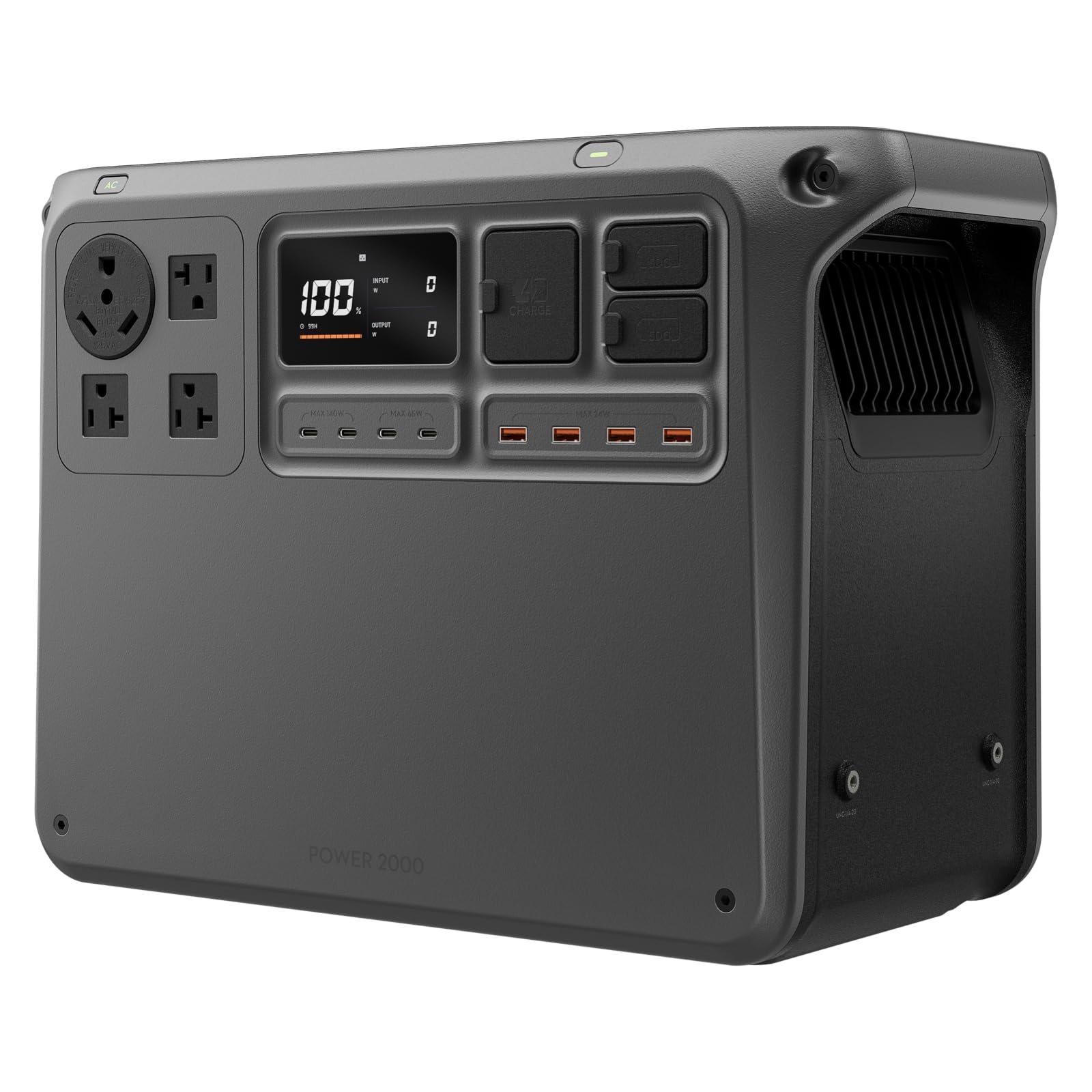
Continuous AC output is what the station can push hour after hour — the DJI Power 2000 lists 3000 watts, for example. Surge watts are the brief spike a motor needs to kick over, like a fridge compressor or a circular saw starting up. The Jackery HomePower 3000 lists a 7200W surge against its 3600W continuous output. Always check both, because a station that runs a fridge fine can still trip on a large power tool.
Recharge speed decides real-world usefulness
A backup you can refill in an hour is a very different product from one that takes most of a day. Fast-charging models use higher wall-input wattage to slam energy back in — the BLUETTI Elite 100 V2 claims a full recharge in about 70 minutes. Solar input matters too, but it is slower; the 1000W solar ceiling on several units here will top up a pack over a sunny day rather than in an hour. See the Understanding the Specs section for the full breakdown before you compare the picks below.
Quick Comparison
| Model | Best For | Capacity | AC Output | Battery Chemistry | Amazon |
|---|---|---|---|---|---|
| Jackery Explorer 1000 v2★ Best Overall | All-round home and camping backup | 1,070Wh | 1,500W (3,000W surge) | LFP | Amazon |
| EF ECOFLOW DELTA 3 PlusFastest Recharge | Fast-recharge UPS for gear and racks | 1,024Wh | 1,800W | LiFePO4 (LFP) | Amazon |
| DJI Power 2000Most Expandable | Whole-crew camping and light home backup | 2,048Wh | 3,000W | LFP | Amazon |
| BLUETTI Elite 100 V2 | Compact quick-charge home backup | 1,024Wh | 1,800W | LiFePO₄ | Amazon |
| BLUETTI Elite 200 V2 | High-capacity home and off-grid backup | 2,073.6Wh | 2,600W | LiFePO4 | Amazon |
| EF ECOFLOW DELTA 3 Max | High-draw appliances and job sites | 2,048Wh | 2,400W (3,400W X-Boost) | LiFePO4 | Amazon |
| Jackery HomePower 3000 | Whole-home essentials and RV hookup | 3,072Wh | 3,600W (7,200W surge) | LiFePO4 | Amazon |
| Anker SOLIX F3000 | Whole-house backup with expansion | 3,072Wh | 3,600W | LiFePO4 | Amazon |
| Anker SOLIX C2000 Gen 2 | Efficient compact rig and RV power | 2,048Wh | 2,400W (4,000W peak) | LiFePO4 | Amazon |
In‑Depth Reviews
1. Jackery Explorer 1000 v2 Portable Power Station
Our pick — over 4.5★ from 3,500+ verified ratings; the strongest balance of quality and price.
The 1,070Wh LFP station that runs a fridge, router, and lights through a multi-hour outage.
If you want the purchase you are least likely to regret, start here. The Explorer 1000 v2 stores 1,070Wh (watt-hours, a measure of energy) — about a fridge-day of energy — and pushes 1,500W (watts, a measure of power) of continuous AC power with a 3,000W surge for motor starts. That is the practical balance for running a fridge, a modem, some lights, and a fan through a multi-hour outage. And it carries a foldable handle at 23.8 lbs, so it moves between kitchen, garage, and campsite without a dolly.
The a neat extra is recharge speed. Jackery says you can push this unit from 0% to 100% in about one hour when you switch on emergency charging in the app, and it defaults to a 1.7-hour charge to protect battery health. Underneath sits an LFP battery rated to hold over 70% of its original capacity after 4,000 charge cycles, which the maker frames as a lifespan beyond 10 years of regular use. Ports are generous: two USB-C (one PD 100W), one USB-A, a DC car port, and three pure sine wave AC outlets.
What wins people over is sheer reliability — this model holds one of the strongest quality reputations in the entire category, and the broad pattern across owner feedback is a unit that just works, season after season, without drama. The honest downside? It is not a whole-home solution. Big corded tools are out of reach — as buyers report, a rigid 3hp (horsepower, a measure of motor power) shop vac dropped this pack from 95% to 60% in 15–20 minutes, and a 12-inch sliding miter saw refused to spin properly. Two hours of fridge cooling per charge is the realistic ceiling here.
What earns the top spot
- 1,070Wh capacity with 1,500W continuous and 3,000W surge output for real appliances
- Approximately 1-hour recharge via the app’s emergency charging mode
- LFP battery rated to 4,000 cycles with 70%+ capacity retention
- 23.8 lbs with a foldable handle for one-person transport
- 2 USB-C ports, 1 USB-A, DC car port, and 3 pure sine wave AC outlets
Where it stops
- Not built for high-draw corded tools — a rigid 3hp shop vac drained it to 60% in 15–20 minutes
- A 12-inch sliding miter saw would not start on it
- Solar panels are sold separately
Reach for this if: you want a proven daily driver for fridge, router, and small appliances through typical outages, or a camping pack you can recharge in about an hour.
Look elsewhere if: you need to run miter saws, shop vacs, or full home circuits — step up to a 2kWh-plus unit.
2. EF ECOFLOW Portable Power Station DELTA 3 Plus
The 1,024Wh LiFePO4 station with a 10ms UPS switch-over and a 40-minute charge to 80%.
Here is the number that defines this unit: 10 milliseconds. That is the switch-over time when the grid drops, fast enough that a network-attached storage box, a server, or a point-of-sale terminal never blinks. Paired with 1,024Wh of LiFePO4 storage and 1,800W AC output, the DELTA 3 Plus fills the gap between a camping pack and a rack-mounted battery. EcoFlow rates the battery for 4,000 cycles to 80% capacity, which it frames as a 10-year working life.
Charging is where it pulls ahead of the Jackery Explorer 1000 v2 on raw speed — 1,500W AC input gets this to 80% in 40 minutes, and as owners mention, from 27% to 100% in just 40 minutes on the wall. It is also the only unit here with 13 simultaneous AC and DC ports (AC is wall-style power, DC is car-style power), so you can run a rack, a fan, a fridge, and a phone bank at once. Power capacity and charging speed are the two features owners keep circling back to in reviews. The 2 USB-C ports on the Jackery outnumber this unit’s single USB-C, so if you are USB-heavy, weigh that difference.
There is an honest catch worth knowing before you buy: high idle consumption. At idle with AC on, this unit draws around 45W, so it will not sit on a shelf for weeks at a charge — you need to plan around it, or leave it plugged in. It is also heavier and bulkier than the Jackery at 16″L x 8″W x 11″H, which is measurably larger in footprint. If you want a storage drawer of power for surprise outages, that idle behavior is the trade-off.
Who this is built for: home-office users, small business owners, and anyone running a NAS, server, or always-on router who needs that 10ms UPS hand-off and the fastest possible recharge.
What to plan around: that idle draw means you cannot stash it for months — set a charging reminder or leave it wall-connected between outages.
Buy it when: your priority is a fast-refill UPS that protects sensitive electronics through short outages.
Pass on it when: you need zero idle drain for a grab-and-go emergency pack — the gap is real.
3. DJI Power 2000 Portable Power Station
2,048Wh of LFP storage that expands to 22.5kWh with add-on battery packs.
Most 1kWh packs top out at a fridge and a fan. This one shrugs at kettles, cookers, projectors, and impact drills thanks to 2,048Wh of LFP storage and 3,000W of continuous output. It ships with a 10ms UPS switch time — DJI notes that is twice as fast as its own Power 1000 — so your home computer, POS system, or security camera bank keeps running without a flicker. And it offers 15 ports, including dual full SDC ports, which matters if four or five people are camping together and all want to charge laptops, phones, and lights at once.
The standout spec is expansion. Supported add-on battery packs push this unit up to 22.5kWh — a number that turns it from a portable into a whole-house system with a five-year warranty behind it. Charging is quick too: 0% to 80% in about 55 minutes, and the maker quotes roughly 90 minutes to full. Owner feedback confirms it runs a mobile DJ rig for a 6-hour pool party set with only 25% battery used, and it has powered an entire camper with around 40 hours of continuous draw. Quality is the headline trait owners agree on most.
Two real caveats keep this from being perfect for everyone. DJI’s ecosystem has its own proprietary SDC connector standard (a special plug only DJI makes), which means you buy DJI’s own accessories — and customers note that some DJI solar and car charging peripherals have been on back-order for extended periods, forcing workarounds with third-party adapters. It also weighs 21.72 kg (about 48 lbs) — heavy enough that this is a two-person lift for most people. Weigh that against the price point, which sits in the premium tier, and it is worth a look only if you plan to grow the system.
The right buyer: someone starting a home energy system who wants a portable foundation that can scale up to 22.5kWh over time.
Think twice if: you want an off-the-shelf solar hookup today — DJI’s proprietary connectors and reported peripheral shortages add friction.
4. BLUETTI Elite 100 V2 Portable Power Station
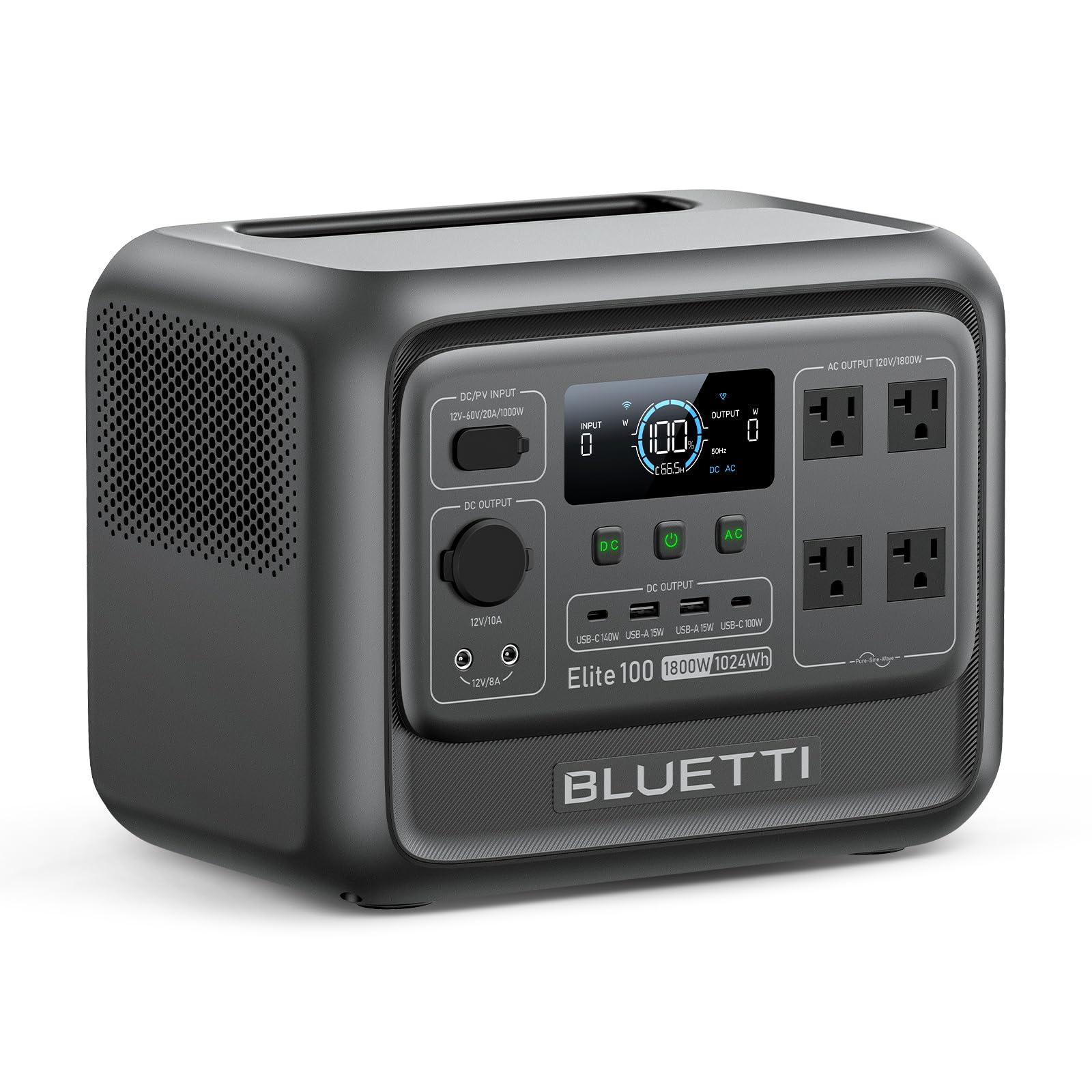
A 1,024Wh LiFePO4 station that is 35% smaller and 30% lighter than its class, refilling in 70 minutes.
Measure this one against the fridge in your kitchen. At 1,024Wh with 1,800W rated output and 2,700W of power-lifting headroom, the Elite 100 V2 covers the everyday essentials — fridge, router, lights, laptop, phone — with 11 ports to spread the load across. The recharge numbers are the headline: 1,200W TurboBoost AC charging or up to 1,000W of solar gets it back to full in roughly 70 minutes. That is fast enough that a midday outage becomes a non-event once the grid returns.
What makes this a great fit for smaller homes and apartments is the physical design. It weighs 25 lbs and drops into a 17L footprint — the maker notes it is 35% smaller and 30% lighter than comparable 1kWh packs, with a hidden one-handed carry handle. In silent mode it runs at 30dB, which the maker describes as 50% quieter than other stations of the same class. Even the fridge math is in its favor — BLUETTI says it holds a refrigerator for up to 48 hours during an outage. And with LiFePO4 cells rated at over 4,000 cycles to 80%, that is a decade-shaped purchase.
The honest limit is that 1kWh (kilowatt-hour, a unit of energy) still is not 2kWh. A couple of small appliances at once is fine; a window AC or a large power tool will trip it. And as with most batteries, a rare unit can arrive with a defect — buyers flag everything from a loud high-pitched fan buzz to a fault that showed up months in, though those reports are the exception rather than the pattern across the thousands who use it daily.
The value here: you pay mid-tier money for premium-tier recharge speed, a compact footprint that fits on a shelf, and LiFePO4 chemistry (lithium iron phosphate, a long-life battery type) that is meant to keep going past the decade mark — for a lot of small homes, this is the balance.
Ideal for: apartment dwellers and small households who want rapid recharge and an easy one-hand carry.
Skip it for: anything needing two big loads at once — the 1kWh ceiling is the honest trade-off.
5. BLUETTI Elite 200 V2 Portable Power Station

A 2,073.6Wh LFP battery rated for 6,000+ cycles and a claimed 17-year service life.
If you think of a power station as a long-lived appliance rather than a gadget, this is the one to beat. BLUETTI rates the Elite 200 V2’s LFP battery at over 6,000 cycles and a lifespan the maker describes as up to 17 years of everyday use — the longest cycle claim in this lineup by a clear margin. Capacity is 2,073.6Wh with 2,600W continuous AC output, and HyperWatt tech pushes 3,900W peak-lifting power for motor starts. That combination runs refrigerators, hair dryers, and coffee makers at the same time.
The battery cleverly sips power when idle — a standby draw of just 10W, which BLUETTI describes as three times lower than similar stations. That translates to longer runtimes from the same watt-hours. On recharge, three selectable modes give you flexibility: Turbo hits 0–80% in one hour at 1,800W, Standard fills at 1,440W in about 1.6 hours, and Silent trickles to full in 3 hours while running as quietly as 16–30dB. What sells this in practice is performance — reviewers point out ironing, running a shop vac, air-frying, and even running a portable AC on this pack, plus recharging from solar panels chained in series. And it scales: BLUETTI supports expansion to add capacity down the line.
The trade-off is weight. This is a 53.4-pound box, and buyers looking for an arm-weight backup will find it heavy. That is the price of the 2kWh class — the smaller Elite 100 V2 above cuts that to 25 lbs. If you plan to move it often, plan a cart or a partner. If it will sit by the fridge and wait for a storm, that weight is irrelevant.
Numbers that matter
- 2,073.6Wh capacity with 2,600W continuous and 3,900W power-lifting output
- 6,000+ cycle LFP battery with a claimed 17-year lifespan
- Standby draw of just 10W — three times lower than comparable units
- Three charging modes: Turbo (1 hour to 80%), Standard (1.6h), Silent (3h at 16–30dB)
- Expansion-ready for growing your capacity
What to budget for
- 53.4 lbs — heavy for one person to move regularly
- High-draw loads like a microwave plus air fryer together can trip an overload protection, then need a manual restart
- No user-set charge-limit controls for solar charging, which matters for long-term battery health
Choose this for: a fridge-plus-appliances backup that will still be performing when most other batteries have been recycled.
Do not choose it if: you plan to haul it weekly — 53.4 lbs is a workbench appliance, not a backpack.
6. EF ECOFLOW DELTA 3 Max Portable Power Station
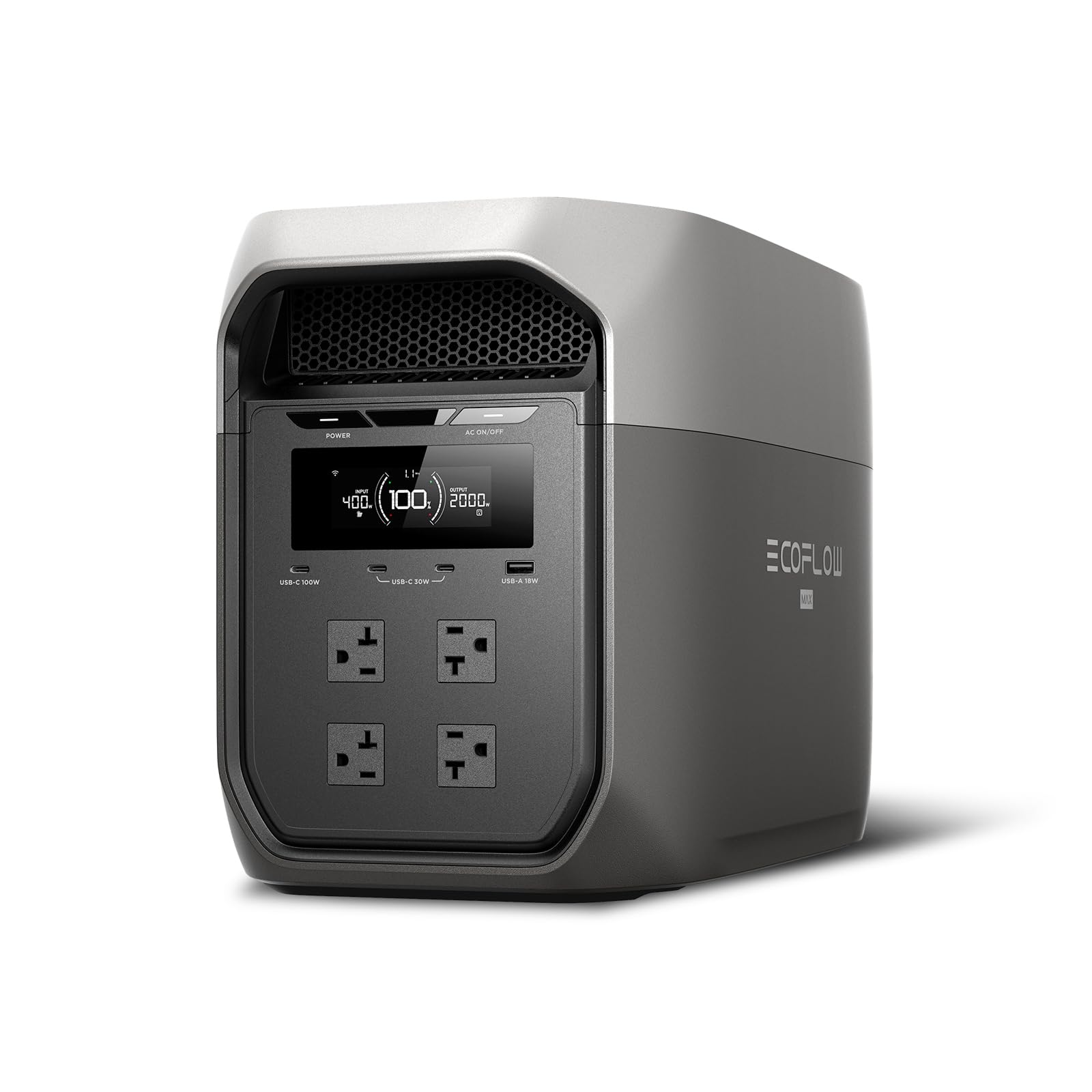
2,048Wh with 2,400W continuous and 3,400W X-Boost output for fridges, microwaves, and power tools.
The DELTA 3 Max is the unit that behaves like a small generator without the fuel smell. 2,048Wh of LiFePO4 storage (lithium iron phosphate, a long-life battery type) meets 2,400W of continuous output and up to 3,400W in X-Boost mode, which EcoFlow rates as enough for high-demand appliances like fridges, microwaves, and power tools. It runs on EcoFlow’s X-Stream charging tech, hitting 0–80% in 1.13 hours, and it packs a 10ms UPS transfer time (uninterruptible power supply, which switches to battery instantly) for home backup — the same class-defining number as its smaller sibling, the DELTA 3 Plus, but with double the storage. EcoFlow also backs it with a 5-year extended service plan.
Where it stands out among the load-haulers is the smart side. The EcoFlow app tracks energy in real time, lets you set charge priorities, and schedules charging and discharging around off-peak electricity windows to shave your bill. Owners lean on this for family desert-business use — running a waffle iron and one to two freezers off this pack, and citing the surge headroom as the reason it keeps up with startup spikes. Battery life and charging speed are the traits that recur in feedback, alongside a display that shows ports, wattage rates, and remaining runtime at a glance.
The catch here is the app pairing curve. Several shoppers say that WiFi setup is required before the app becomes truly useful, and its mode descriptions can be confusing on the first pass. The 12V car port on the rear also cuts the auto-off after some hours unless you disable that setting — one buyer nearly lost fridge contents because of it. Read the manual, or set the auto-off to never, before you trust this for unattended fridge duty.
The job this handles: running a fridge alongside a microwave, a job-site compressor, or a food-truck freezer without tripping the AC output.
Set it up carefully: spend ten minutes with the app and disable the auto-off on the 12V port before relying on it overnight.
Pick this if: you need higher surge to start fridges, compressors, and light power tools, without stepping to a 3kWh unit.
skip it if: you want a plug-and-play pack with no app setup — the EcoFlow app is the brake here.
7. Jackery HomePower 3000 Portable Power Station
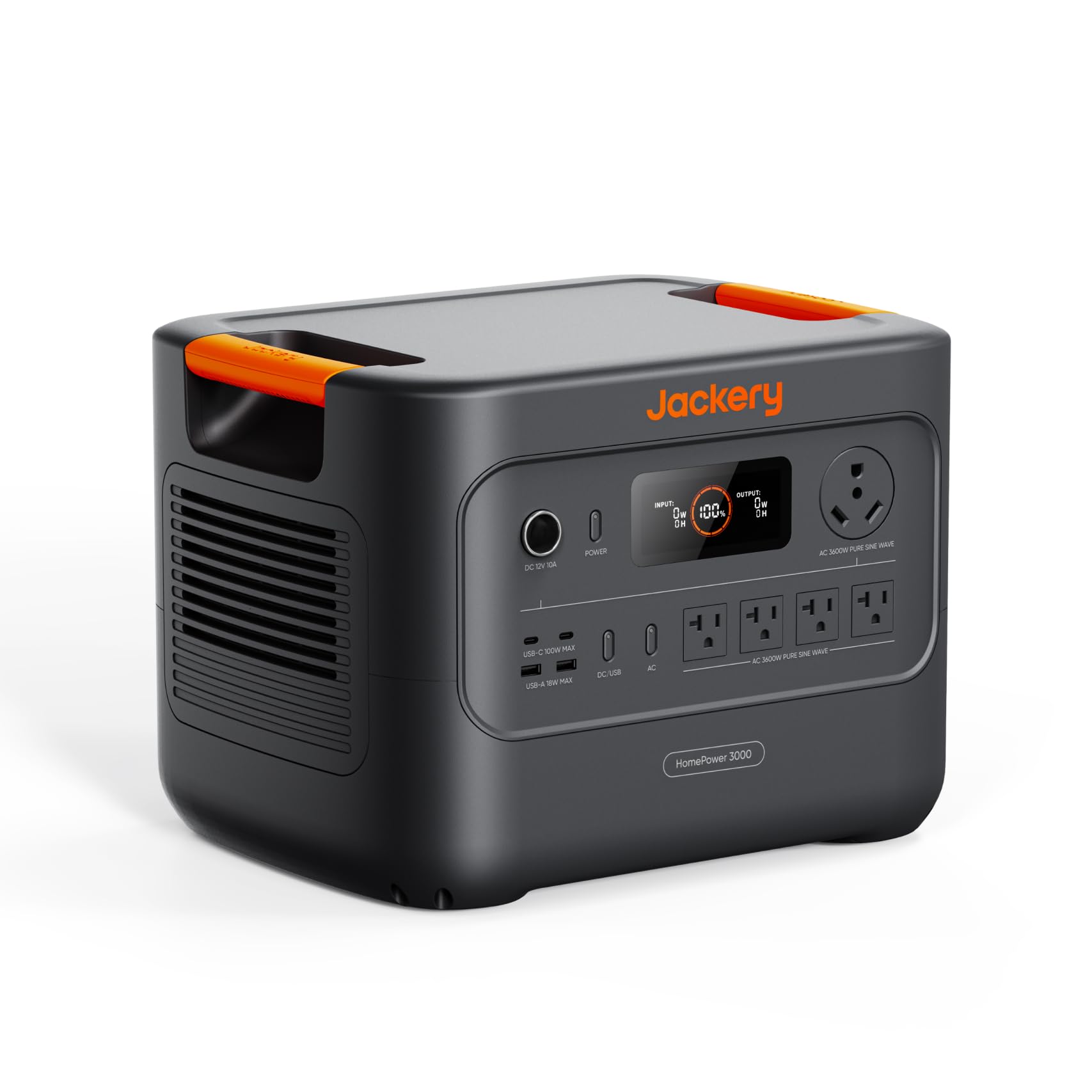
A 3,072Wh LiFePO4 station that is 47% smaller and 43% lighter than comparable 3kWh units.
Here is the power number that matters: 3,600W continuous output with 7,200W surge. That is the headroom to start a fridge compressor and a window AC on the same circuit, and by Jackery’s own accounting it can keep a household running essentials for up to 15 hours and a refrigerator going for 1 to 2 days. The 3,072Wh of LiFePO4 storage (lithium iron phosphate, a long-life battery type) behind that is rated to 4,000 cycles while retaining 70% capacity. A UL-certified UPS (uninterruptible power supply, tested by Underwriters Laboratories) switches within ≤20ms — slow enough that a mission-critical server might notice, fast enough for a security camera, medical fridge, or Zoom call.
The secret sauce is CTB technology, which Jackery says makes this the world’s first 3kWh-class portable to shrink the footprint by this much. It measures 47% smaller and 43% lighter than comparable-capacity units, and the honeycomb-style bottom shell adds stiffness. The full recharge takes 1.7 hours via hybrid AC and DC, or 2.2 hours from wall alone. And it is the only unit here with a built-in TT-30 RV port, which lets you plug a travel trailer straight into the station without adapters. That is why it shows up in so many RV-owner writeups.
Two factors to weigh. The first is noise — buyers report the fan runs around 60dB under any power draw, which makes this unsuited as a silent daily UPS that sits next to your desk. The second is temperature tolerance; one owner reported it failed as a diesel truck block heater source below 15°F, which points to keeping it for indoor or mild-climate use. Weight lands around 59.5 pounds, so treat it as a fixed appliance that occasionally moves.
Built for: RV owners who want a no-adapter TT-30 hookup and homeowners who want the biggest possible capacity from the smallest possible box.
Not built for: desk-side quiet UPS duty — the ~60dB fan makes noise a real factor.
8. Anker SOLIX F3000 Portable Power Station
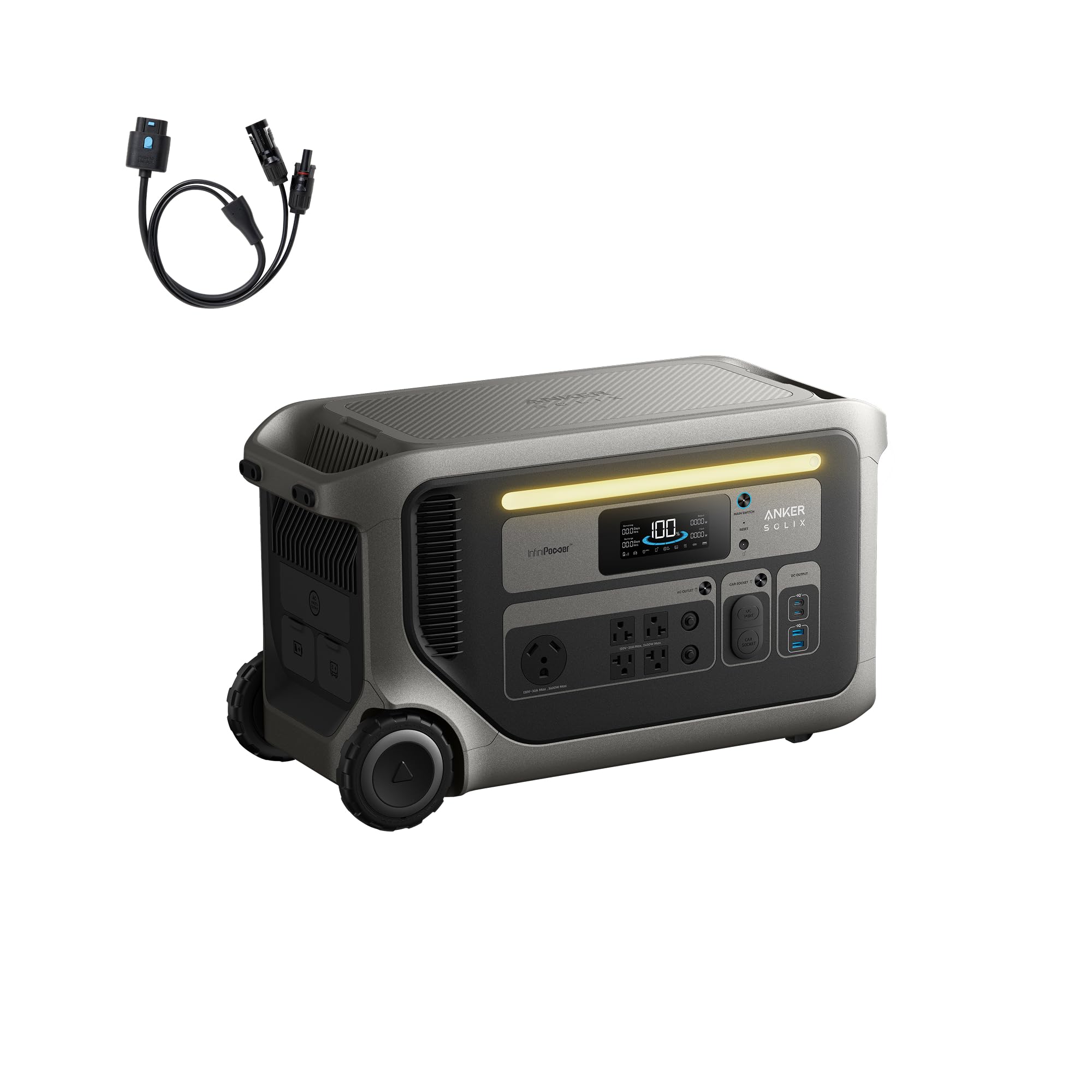
3,072Wh of LiFePO4 storage that expands to 24kWh for whole-house backup.
Anker built this for the buyer who wants whole-house protection, not camping convenience. 3,072Wh base capacity expands to 24kWh with add-on batteries — enough for Anker to quote 80 hours of outage-proof energy at full expansion. Idle management is a standout: the F3000 holds standby for 125 hours, and it runs a 190W fridge for 42 hours, both figures the maker lists. It supports 120V or 240V output by pairing two stations — useful for a well pump or an electric range. Charging is aggressive: up to 6,000W input when you combine a fuel generator and solar, the highest in this lineup.
Owners lean on this unit hard. It has run 60% of a home’s appliances in a full outage test, powered a 13k Coleman roof AC (13,000 BTU, a measure of cooling power) for 6–7 hours on one charge, and — thanks to pass-through generator charging at 3,600W — keeps running your appliances while recharging from a generator. That generator bypass is the difference, because on most stations you must stop drawing power to recharge quickly. The 6″ wheels and top handle make movement practical despite a 91.5-pound body. Setup is easy, manuals are clear, and support is described as responsive.
The two honest catches: WiFi stability and solar panel ergonomics. A few owners have reported frequent WiFi drops, which interrupts app monitoring though not the unit itself. And the 400W portable panel that ships in some bundles is oversized and fussy to aim — the owner who tested it saw only 550W combined from two panels, and recommended permanent bi-facial panels instead. If solar is your primary recharge plan, budget for better panels than the portable ones.
Where it earns its keep: whole-house backup with optional generator pass-through — you can recharge and run appliances at once, which changes what an outage looks like.
What to think about first: app monitoring is convenient but relies on WiFi that owners say drops occasionally; wired solar avoids the issue entirely.
For you if: you want a home backup that can grow from 3kWh to 24kWh over years, with generator and 240V capability.
For someone else if: you just need a portable camping pack — this is overkill at 91.5 pounds.
9. Anker SOLIX C2000 Gen 2 Portable Power Station
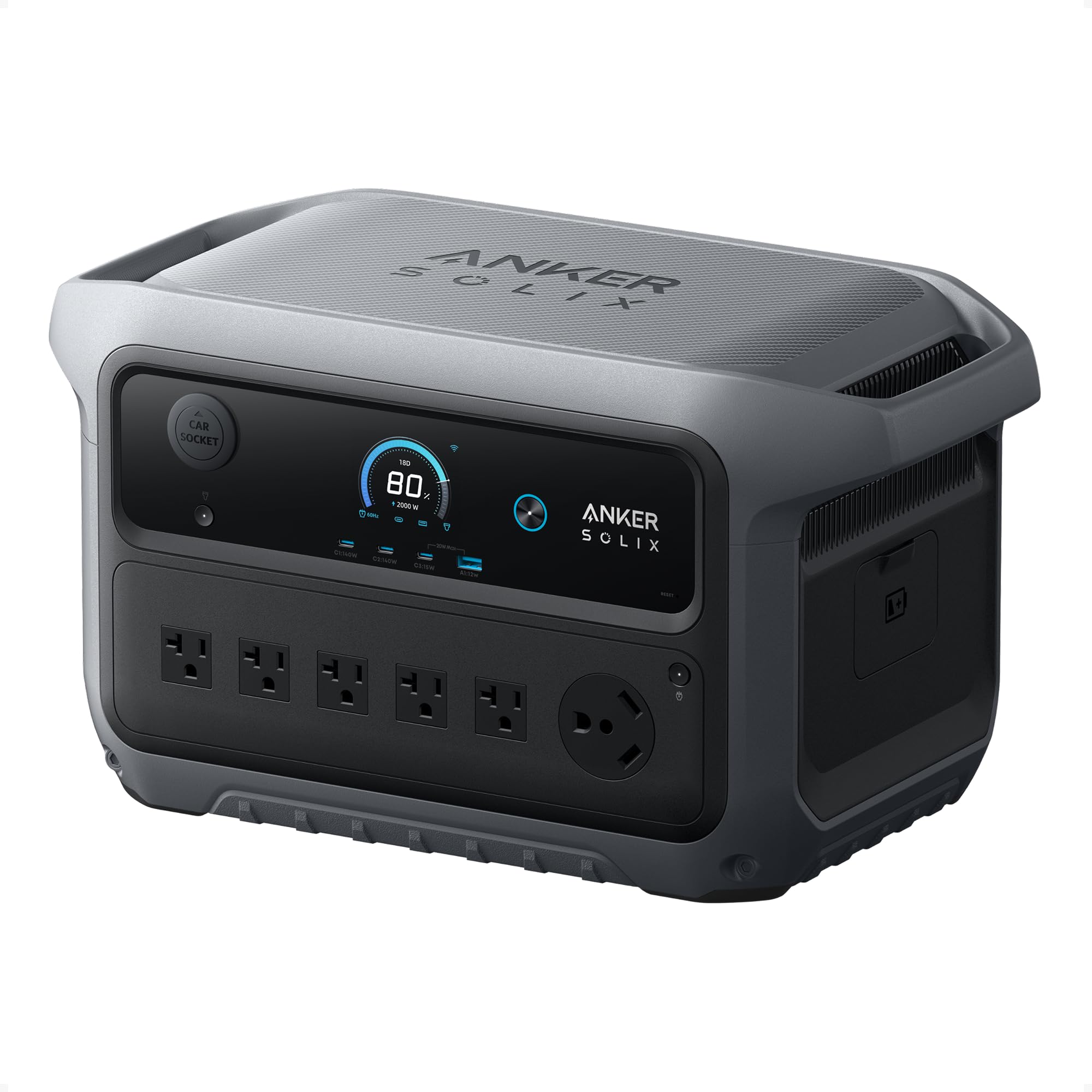
A 2kWh box that sips just 9 watts when idle and refills in under an hour.
Read the standby number first. The C2000 Gen 2 draws only 9W when parked, which Anker says is enough to run a dual-door fridge for up to 32 hours, and up to 64 hours if you add an expansion battery to reach 4kWh (kilowatt-hours, a unit of energy). That low idle draw also makes it a true grab-and-go station — you can park it for a week, come back, and still have nearly all your capacity intact. The recharge is even more impressive for the size: up to 58 minutes to full, and six ways to refill including AC, solar, and an 800W ultra-fast alternator charger (a car-engine charger) that Anker says reaches full in 3 hours from your car.
The physical package is what earns it the label here. The C2000 Gen 2 weighs 41.7 lbs and measures 18.1 × 9.8 × 10.1 inches — Anker describes it as 25% lighter and 29% smaller than similar products. That means it will travel in a truck, an RV, or a wheeled case without becoming a project to move. With 2,400W rated and 4,000W peak output, it also runs most window and RV air conditioners, which is rare in the 2kWh class. Owners lean on it for camper setups with the Anker Alternator Charger and roof solar, remote karaoke weekends, and reliable UPS work that kept internet and access points alive through outages.
The catch: as a UPS (uninterruptible power supply, which switches to battery instantly) it is not completely transparent. The 6–10 hour battery drain under UPS load is faster than a dedicated UPS would give you, and a firmware update that interrupted AC outputs once killed connected PCs for one owner — so if you plan to run a desktop on it, test the update flow before trusting it with critical gear. Otherwise, this is the best-balanced new-design station in this lineup for people who value efficiency and portability over raw size.
Why it earns the pick
- 2,048Wh capacity, expandable to 4kWh with an expansion battery
- Just 9W standby draw — the lowest idle power in this lineup
- Full recharge in 58 minutes via AC and solar combined
- 2,400W rated, 4,000W peak output — enough for window and RV AC
- 41.7 lbs, 18.1 × 9.8 × 10.1 inches — among the most compact 2kWh units here
What to think about
- 6–10 hours of UPS runtime — better as backup than permanent UPS replacement
- A prior firmware update killed AC output for one owner, so test the update before relying on it with critical electronics
- Overloads easily on two simultaneous big loads
Take this one: for an RV, a mobile work kit, or a home where you want the smallest possible 2kWh footprint with the fastest recharge.
Not the pick if: you need a silent always-on UPS for a desktop — the drain timing makes that a poor fit.
Understanding the Specs
Watt-Hours (Wh) — the fuel tank
Watt-hours are the total energy stored inside the battery — think of it as the size of the fuel tank. The higher the number, the longer you can run your gear. A 1,024Wh pack will run a fridge for roughly a few hours of cold retention, while a 3,072Wh unit is quoted in this category for up to 42 hours on a 190W fridge. Pick the watt-hours to match how long your outages typically run, not the biggest number you can find.
LiFePO4 (LFP) battery chemistry
LiFePO4 — also written LFP — is a specific lithium chemistry that trades a little weight for much longer life. Where an older lithium pack might hold up for a few hundred cycles, several stations here are rated for 4,000 cycles with 70% capacity retention or higher, and one is rated to over 6,000 cycles. That means you could charge it daily for years and still keep most of your original capacity. If you are buying once and expecting a decade of service, this chemistry is the reason.
Continuous watts vs. surge watts
Continuous watts are the steady output the station can hold — the number you use to size your day-to-day loads. Surge watts are the brief spike a motor draws on startup, like a fridge compressor kicking over or a circular saw spinning up. A unit rated 3,600W continuous with 7,200W surge is showing you both numbers — the first is your runtime ceiling, the second is your startup ceiling. Missing the surge number is the most common mistake buyers make.
UPS switch-over time (in milliseconds)
A UPS function means the station senses the grid drop and takes over automatically — the number that matters is how fast. A 10ms switch is a blink, fast enough to keep computers, network gear, and sensitive electronics running without a shutdown. The slower 20ms switch is fine for less sensitive gear like security cameras and pet feeders. Anything you see listed as ms is the lag between grid loss and battery takeover; smaller is better for critical electronics.
FAQ
How many hours will a backup power station run my refrigerator?
What is the difference between LiFePO4 and lithium-ion in a power station?
Will a 1kWh station run my window air conditioner?
How fast can these stations recharge from a wall outlet?
Can I connect solar panels directly to these stations?
Is a 10ms UPS switch-over fast enough for a home computer or server?
Do backup power stations make noise while charging or running?
How long do LFP batteries in these stations actually last?
Can I expand the capacity of these stations later?
Is one bigger station better than two smaller ones?
What is the difference between X-Boost and regular output rating?
Final Thoughts: The Verdict
For most households, the backup power station winner is the Jackery Explorer 1000 v2 because it hits the hardest-working compromise in the category: 1,070Wh of capacity, 1,500W of continuous output with a 3,000W surge for motor starts, an approximately 1-hour recharge through the app, and LFP battery chemistry (lithium iron phosphate, a long-life battery type) rated for 4,000 cycles — backed by the strongest reputation for day-in, day-out reliability across owners who have owned more than one of these. If you want the fast-recharge edge for a home office or studio with sensitive gear, grab the EF ECOFLOW DELTA 3 Plus with its 10ms UPS hand-off (uninterruptible power supply, which switches to battery instantly) and 40-minute jump to 80%. And for the most efficient new design in the 2kWh zip code, the Anker SOLIX C2000 Gen 2 is the one to reach for, with its 9W idle draw and 58-minute full charge. The whole category rewards planning more than spending, so take five minutes with your fridge’s wattage sticker and your typical outage length before you pick.
How We Picked
We do not accept paid placement. Every pick is matched to a real buyer and a real use-case; we do not hands-on test units.
Sources & Methodology
Specifications: manufacturer listings and product documentation. Review insights: verified customer reviews, as of September 2026. Pricing: not shown on this page (it changes often); check the current price via the retailer link.
As an Amazon Associate, KitchPrep earns from qualifying purchases. This does not affect which products we feature.
Related Guides
