
Specs are compiled from manufacturer listings and verified buyer reviews and can change over time — please confirm the key details on the product page before buying.
When the power goes out, the first thing you worry about is the food sitting in your refrigerator. A single outage can ruin hundreds of dollars in groceries, and the clock starts ticking the moment the lights flicker. This guide cuts through the noise to find the backup power that actually keeps your fridge running — and running long enough to matter.
I’m Mohammad Maruf — the founder and writer behind KitchPrep. This guide is built by comparing the manufacturers’ published specifications and the patterns across verified customer reviews, so you get each pick’s real strengths and trade-offs instead of marketing spin.
When the power goes out, your fridge keeps food safe only if the backup power can handle its wattage, capacity, and runtime. Here is how each pick measures up on all three, so you can choose the one that fits your home or camper.
Our Picks at a Glance

How To Choose The Best Backup Power for a Refrigerator
Matching a power source to your refrigerator is not about picking the biggest number on the box. It is about understanding how your fridge actually uses electricity — and it uses it in two very different ways.
Running watts vs. surge watts
Your fridge draws a steady amount of power while the compressor runs — this is the running wattage, usually a few hundred watts. But when the compressor kicks on, it needs a brief burst of extra power called surge watts, which can be two to three times higher. A backup unit must handle that surge or it will trip off every time the fridge cycles.
Capacity determines runtime
For a battery power station, the capacity measured in watt-hours (Wh) decides how long your fridge stays cold. A 2,000Wh station might run a typical fridge for 20 to 35 hours, while a 3,000Wh unit pushes that to a day or two. Gas generators, by contrast, run as long as you keep adding fuel.
Quick Comparison
| Model | Best For | Battery Capacity | Output Power | Weight | Amazon |
|---|---|---|---|---|---|
| BLUETTI AC200L★ Best Overall | Whole-home flexibility | 2048Wh | 2400W | 61.4 lbs | Amazon |
| Oxseryn 4400W GeneratorFuel Freedom | Unlimited fuel runtime | — | 4400W peak | 56 lbs | Amazon |
| DABBSSON 2000LBest Value | Camping & job sites | 2048Wh | 2200W | 41 lbs | Amazon |
| Anker SOLIX S2000 | Fridge-specific runtime | 2010Wh | 1500W | 35.7 lbs | Amazon |
| EcoFlow DELTA 3 Max | Fast recharging | 2048Wh | 2400W | — | Amazon |
| Anker SOLIX C2000 Gen 2 | Powering multiple appliances | 2048Wh | 2400W | 41.7 lbs | Amazon |
| BLUETTI Elite 200 V2 | Daily off-grid use | 2073.6Wh | 2600W | 53.4 lbs | Amazon |
| Jackery HomePower 3000 | Multi-day outage backup | 3072Wh | 3600W | 59.5 lbs | Amazon |
In‑Depth Reviews
1. BLUETTI AC200L Portable Power Station
Our pick — over 4.5★ from 500+ verified ratings; the strongest balance of quality and price.
The do-everything power station that turns a fridge outage into a non-event.
This 2048Wh unit runs your fridge, and then some — buyers report it handles a 1500W kettle and a 12000 BTU A/C for four hours on solar. With 2400W of continuous AC output and a 3600W Power Lifting surge mode, the compressor kick-on that stalls lesser stations is nothing here.
It recharges from 0 to 80% in 45 minutes on a 2400W AC input., so you can top it up between outages or overnight on cheap electricity. The 11-port setup includes AC, USB, a car port, 100W PD, a 30A RV port, and a 48V/8A DC port — enough for almost any home or camping setup. The 61.4-pound frame is the honest trade-off; it is built to move around, not to be carried daily.
The B300K expansion batteries push capacity to 8192Wh, turning a weekend backup into a genuinely long-term solution. Performance and reliability are the two most-praised qualities in owner feedback, and the option to start at 2048Wh and grow later makes this the smartest first purchase in the category.
What Wins People Over
- Fast 45-minute recharge to 80%
- Expandable to 8192Wh with add-on batteries
- 30A RV port for camper plug-in
Reality Check
- 61.4 pounds is heavy — two people for long carries
- Premium-priced for the 2048Wh class
Reach for this if: you want one station that covers fridge, RV, camping, and home backup, with room to expand later.
Look elsewhere if: you need the lightest possible unit — the 41-pound options below are easier to haul.
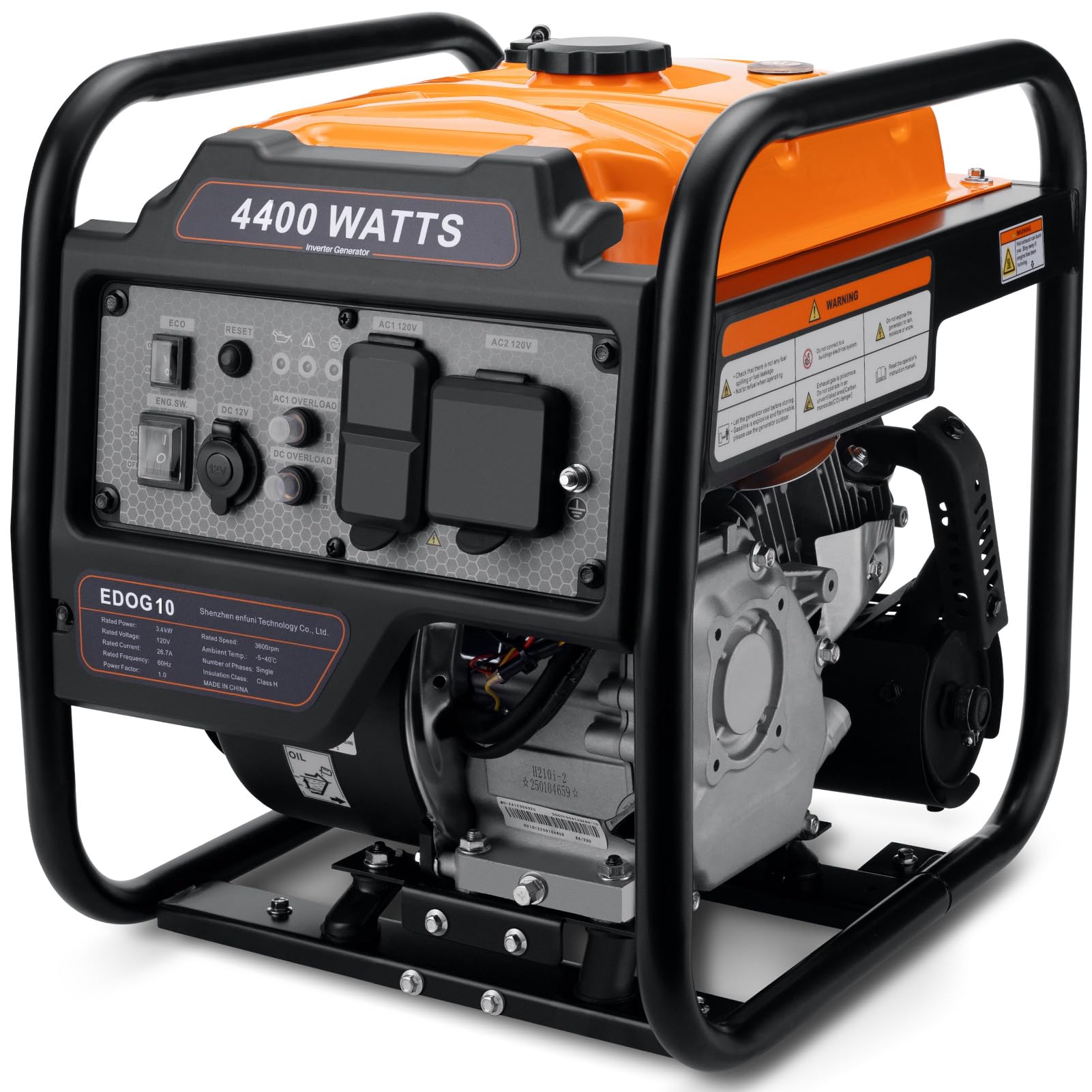
2. Oxseryn 4400W Inverter Generator
The gas-powered workhorse that runs your fridge, freezer, AC, and microwave all at once.
Battery stations eventually run dry. This 4400W inverter generator keeps going as long as you have gasoline — owners mention running a fridge, freezer, AC, and microwave simultaneously, and even a welder, without breaking a sweat. The 3400 running watts give you headroom that a 2kWh battery simply cannot match for heavy multi-appliance use.
The 2-gallon fuel tank runs up to 14 hours at 25% load in ECO mode., with a fuel gauge so you know when to refill. At 56 pounds, it is lighter than many stations half its power, and the 19″L x 15.6″W x 19.1″H frame tucks into a garage corner. Under 72 dBA from 23 feet away — noticeably quieter than a conventional unit, though still a gas engine you will keep outdoors.
The smart-buyer caveat is reliability variance: most customers note trouble-free operation across hundreds of hours, but a few experienced failures within weeks. For occasional storm backup, this is exceptional value; for daily heavy reliance, an established generator brand may be the safer call.
Best for: extended outages where fuel is available and you need to power more than just the fridge.
Who it beats: any battery station on raw run-forever endurance — a full tank outlasts a weekend.
Fair warning: gas, exhaust, and maintenance are yours to manage; this is not a set-and-forget indoor appliance.
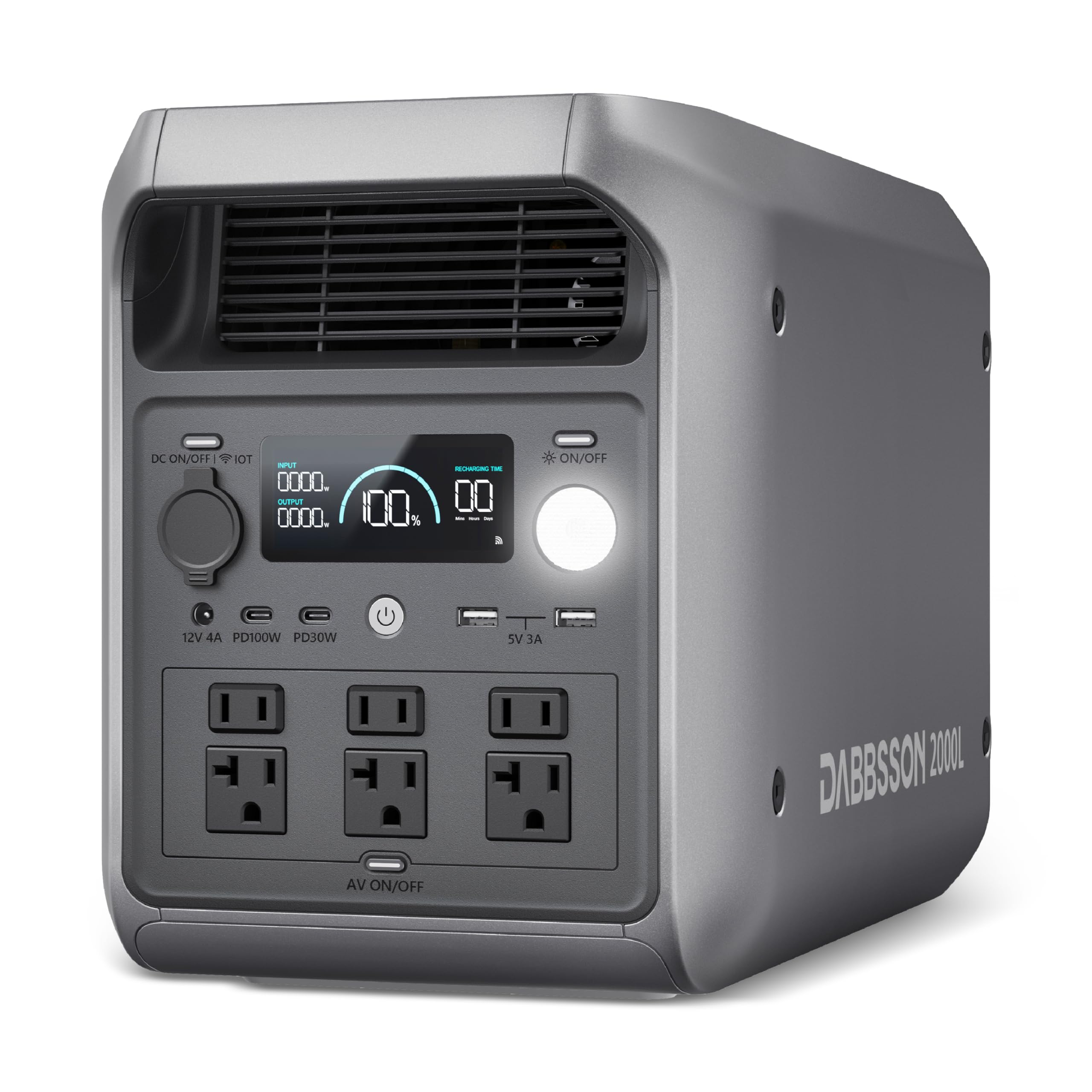
3. DABBSSON Portable Power Station 2000L
A 2048Wh station that undercuts the big names while undercutting them on weight too.
At 41 pounds, this is a standout light option for a 2kWh-class station — noticeably easier to carry than the 61.4-pound BLUETTI AC200L above. The 2200W continuous output with a 3300W surge boost handles a refrigerator, heater, grill, or power tools, and the six AC outlets let you run several at once.
The headline is the 1-hour full recharge from AC input., which is exceptional for this capacity class. Semi-solid LiFePO4 cells promise over 4000 deep cycles to 80% capacity, lasting well over a decade of daily use. — and the UL94-V0 flame-retardant housing is a meaningful home-safety feature. Solar input up to 800W MPPT gives you off-grid flexibility.
Buyers consistently praise the reliability, build quality, and fast charging, with the 5-year warranty (3 years standard plus a 2-year extension) backing the value story. The trade-off is the plastic shell, which some owners felt was less premium than metal alternatives — a fair note, not a flaw.
The Appeal
- 41 lbs — lightest 2kWh-class pick here
- 1-hour full recharge
- 5-year warranty coverage
The Trade-off
- Plastic housing feels less sturdy than metal rivals to some
- Fans can get audible under heavy load
Best for: campers and job-site users who want 2kWh capacity without the usual 60-pound carry.
Think twice if: you plan to run heavy loads for hours daily — the fan noise and plastic shell matter more then.
4. Anker SOLIX S2000 Portable Power Station
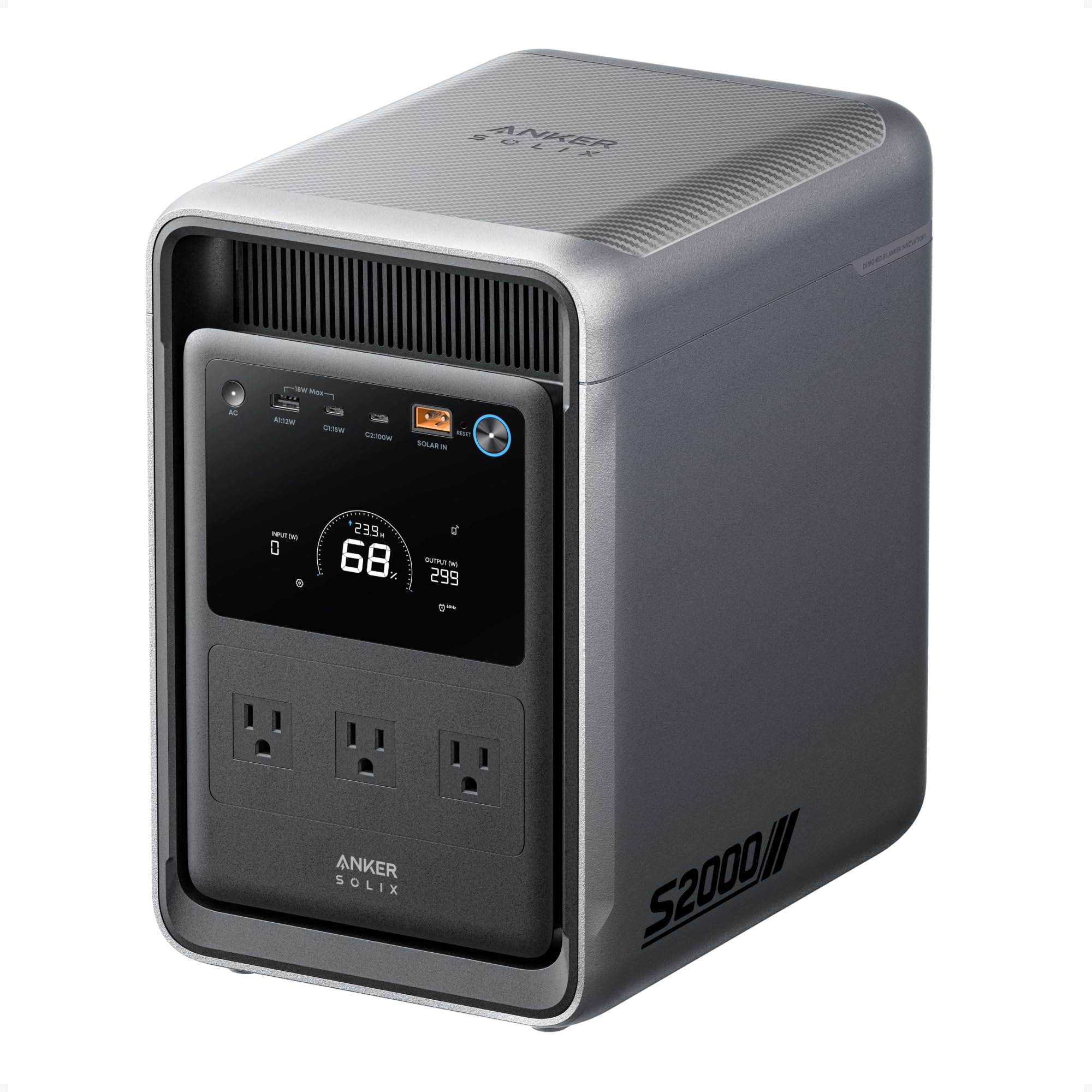
Engineered for exactly one job — keeping your fridge cold for 35 straight hours.
This is the most fridge-obsessed station on the list. Anker designed the S2000 around a 6W idle power draw and 10% higher efficiency, which lets it run 20% longer than other 2kWh systems — a full 35 hours of refrigerator backup. One owner confirmed that runtime in a real 35-hour test.
You can keep this station right next to the fridge because it weighs only 35.7 pounds and measures 8.2 x 11.1 x 12.7 inches — the smallest and lightest 2kWh unit here, 30% smaller and 25% lighter than the industry average. Its 1500W continuous output (with a 3000W peak) runs most home essentials, and the 8 front-and-rear outlets let you plug in without clutter.
The 314Ah LFP cells are rated for 10,000 charge cycles, translating to a 15-year lifespan. The honest mixed note is noise: most owners find it very quiet, but a few find the fan droning during a 1200W fast charge. With up to 400W solar input and six recharge methods, it is a genuinely flexible fridge companion.
Built for: homeowners who want a dedicated, compact fridge backup that hits the advertised 35-hour mark.
Pick this over the BLUETTI AC200L if: light weight and fridge-specific runtime matter more than raw surge headroom.
Note: no 12V DC port — check your 12V accessories before committing.
5. EF ECOFLOW DELTA 3 Max
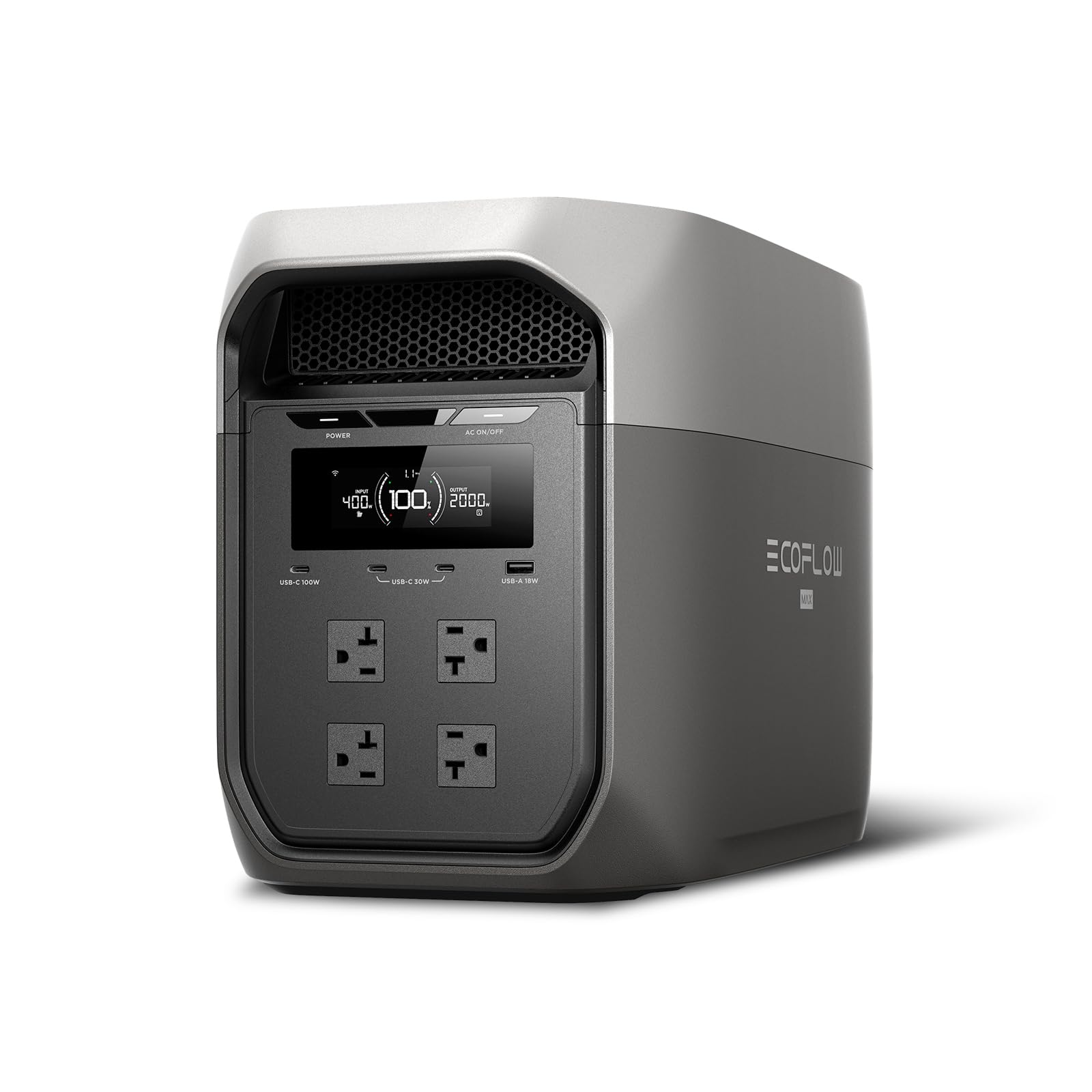
Charges from empty to 80% in just over an hour — the fastest prep-for-storm station here.
When a storm is rolling in, you do not want to wait all day to charge your backup. The DELTA 3 Max uses EcoFlow’s X-Stream technology to hit 0-80% in 1.13 hours, so you can go from dead to nearly full during the lead time before an outage. Owners praise the charging speed as the standout feature, with some noting it can even run in surge power for several seconds.
With 3400W continuous output (via X-Boost, a feature that boosts power for heavy loads), this unit runs 99% of household appliances — fridges, microwaves, and power tools. Its transfer time of less than 10ms (the gap when power switches from wall to battery) keeps computers from resetting during an outage. The 2048Wh LiFePO4 battery is rated for 10 years of daily use., and the 5-year service plan covers repairs.
The EcoFlow app lets you monitor energy use in real time and set smart charging priorities, which helps cut electricity costs over time. It is a heavier, substantial unit aimed at serious home backup and RV use — the aluminum and plastic build feels durable, and owners describe it as an investment that makes a difference when outages hit.
Standout trait: the 1.13-hour recharge that no other 2kWh station here matches — top it up between brief outages with ease.
Reach for this if: you face rolling outages and need a station that recharges as fast as it discharges.
Look elsewhere if: you want the lightest haul — heavier than the S2000 and DABBSSON picks.
6. Anker SOLIX C2000 Gen 2
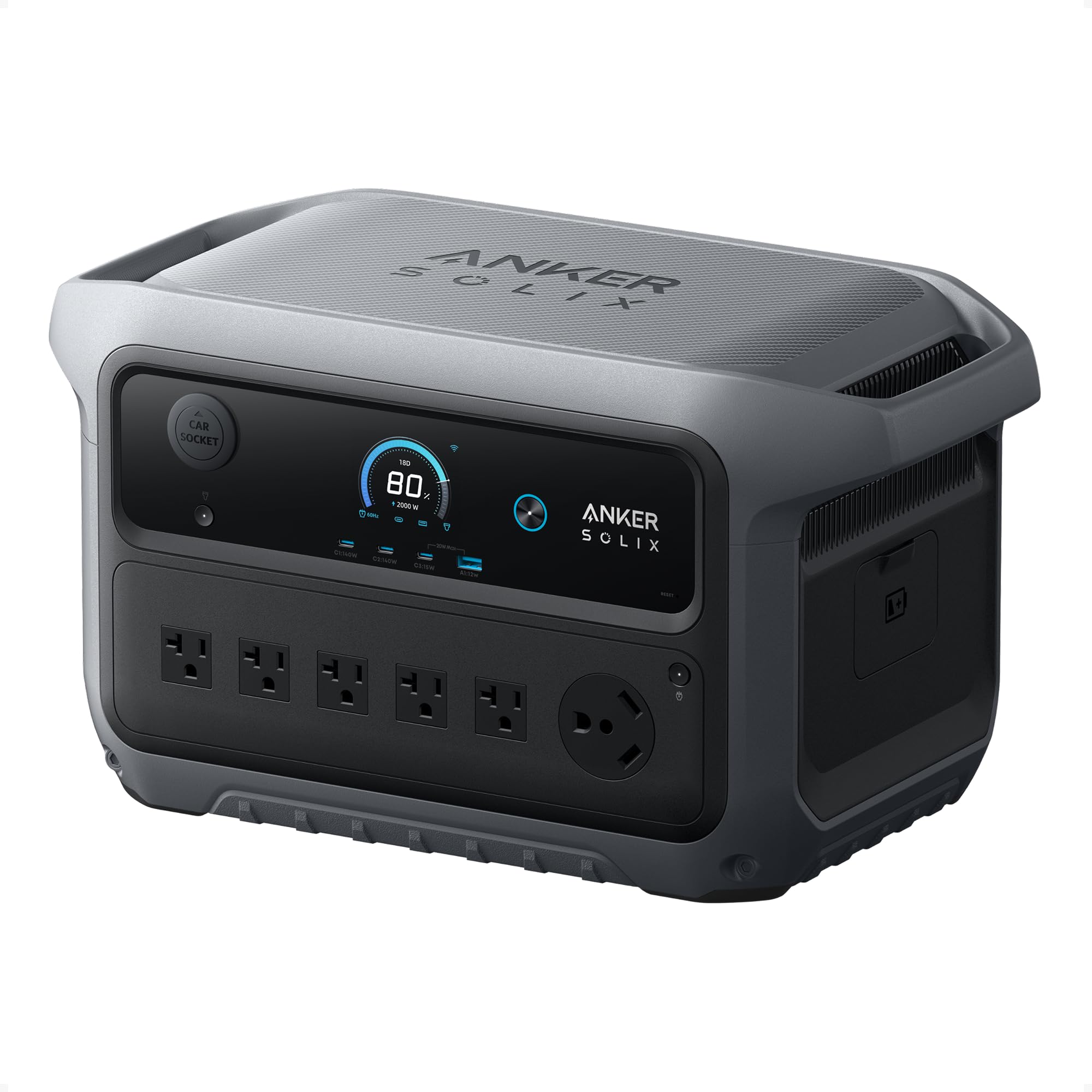
The 4000W peak that runs your fridge plus your window AC, all from a 41.7-pound box.
This is the power station for people who refuse to choose between a cold fridge and a cool room. The 2400W rated output with a 4000W peak handles most window and RV air conditioners alongside your refrigerator, and the 2048Wh capacity runs a dual-door fridge for up to 32 hours. Add the expansion battery and you hit 4kWh — a full 64 hours of fridge runtime.
At 41.7 pounds and 18.1 x 9.8 x 10.1 inches, it is 25% lighter and 29% smaller than similar products, and the 9W standby draw means it sips power while waiting for an outage. Full charge in 58 minutes via AC and solar is outstanding, and the 800W alternator charging hits 100% in 3 hours from your car — 8 times faster than a standard car socket.
Reviewers point out running a TV, fridge, and WiFi for over 10 hours, with one noting continuous backup for up to three days. Performance is the single most-praised aspect by a wide margin, and the frequent outage users consistently describe it as a strong alternative to a gas generator for short power losses. The main honesty note: it will not run a large AC for long, and the app’s runtime estimates can be off for cycling loads.
Why It Earns Its Spot
- 4000W peak runs fridge plus AC
- Expandable to 4kWh for 64-hour fridge runtime
- 58-minute full recharge
Honest Limits
- Won’t run a large AC for extended periods
- Weight gets mixed feedback — 41.7 lbs still needs effort
Best for: households that want one station running a fridge plus a window AC through a hurricane weekend.
skip it if: you only need fridge power — the lighter S2000 covers that for less.
7. BLUETTI Elite 200 V2

The 17-year-lifespan station that runs your fridge, freezer, and air fryer all day, every day.
Most backup power sits idle waiting for a storm. The Elite 200 V2 is built for daily off-grid use, with a 2073.6Wh capacity and 2600W continuous output that easily runs a refrigerator, freezer, air fryer, and microwave. The 3900W Power Lifting mode handles the startup surge of high-draw appliances without a hiccup — up to 9 devices at once.
The differentiator is the longevity story: a CNAS-certified automotive-grade LiFePO4 battery rated for over 6000 cycles and a 17-year lifespan. The standby draw is just 10W, so it wastes less energy between uses than most rivals. It carries 4 AC outlets, 2 USB-C at 100W, 2 USB-A, and a 12V car port.
Buyers describe it as the best station they have owned, running fridges for 24 hours while staying quiet and compact. The 53.4-pound weight is reasonable for the class, and the hold-to-start buttons prevent accidental power-on. The honest gaps: no 30A RV port, and the rubbery buttons feel less premium than the rest of the build.
Built for: off-grid homeowners and serious campers who use their station daily, not just when the lights go out.
Pick this if: you want the longest-lived battery chemistry on this list — 6000 cycles beats every rival here.
Check first: no 30A RV port — RV owners should look at the BLUETTI AC200L instead.
8. Jackery HomePower 3000
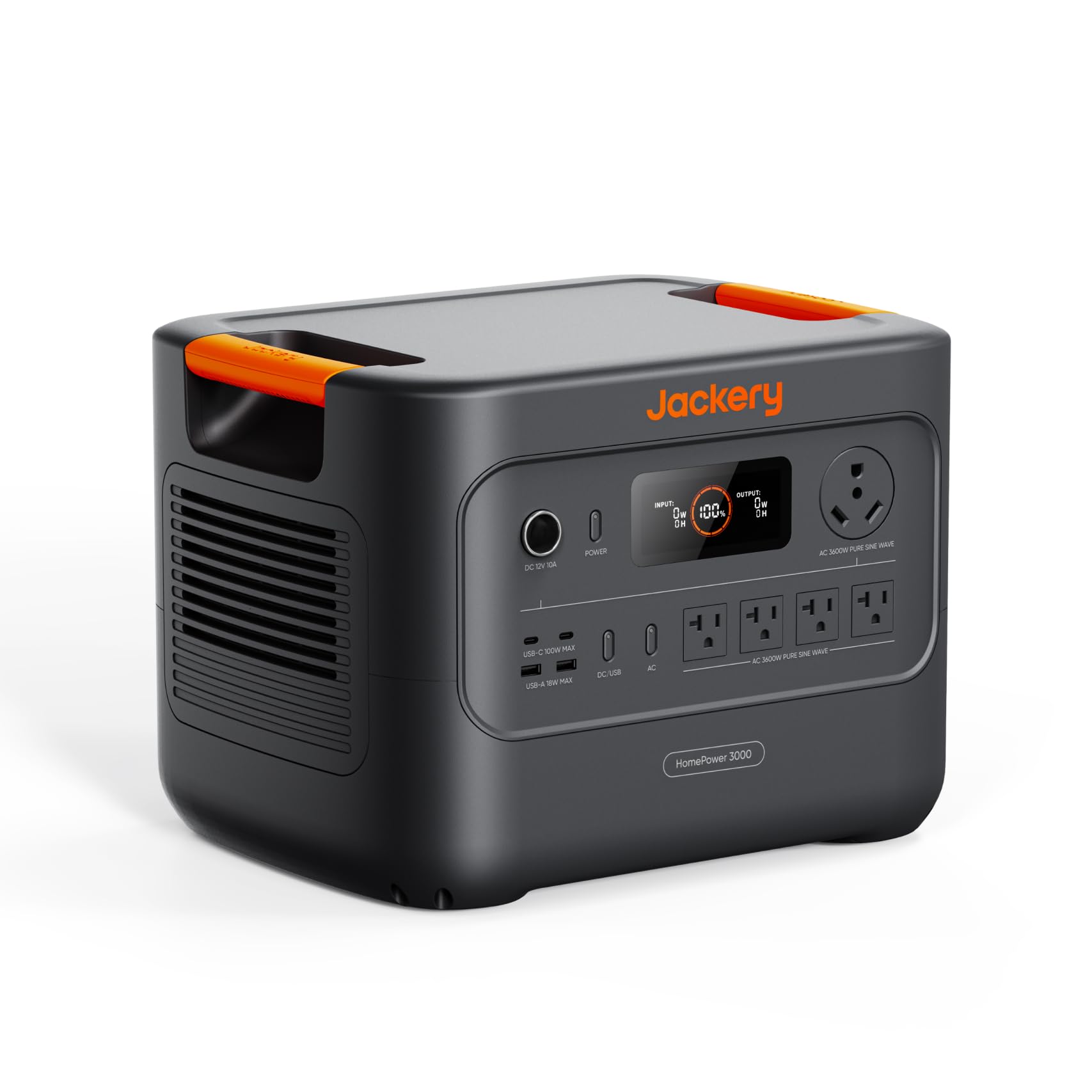
The 3072Wh station that keeps a Whirlpool side-by-side running for 30-plus hours.
When a storm could leave you dark for days, capacity is king. The HomePower 3000 packs a massive 3072Wh into a 59.5-pound frame, and owners confirm it powers a Whirlpool side-by-side refrigerator for 30+ hours. With a 3600W output and 7200W surge, it runs a household — fridge, fan, WiFi router, lights — for up to 15 hours, or keeps a fridge going for 1 to 2 days.
The ≤20ms UL-certified UPS switch keeps security cameras, medical refrigerators, and even Zoom calls running through unexpected blips. The built-in TT-30 RV port offers direct camper plug-in, which is exactly why some owners chose this over the BLUETTI options. Dual 100W PD ports fast-charge phones, tablets, and drones.
ChargeShield 2.0 tech extends the LiFePO4 battery to 4000 cycles while retaining 70% capacity. It fully recharges in 1.7 hours via hybrid AC and DC, or 2.2 hours via AC alone. The honest trade-offs: it is heavy at 59.5 pounds, the fan can run noisy (~60dB) on any power draw, and a handful of owners found charging performance inconsistent in extreme cold.
Why It Stands Out
- 3072Wh — class-leading capacity for multi-day outages
- TT-30 RV port for direct camper hookup
- 7200W surge handles any fridge startup
Fair Caveats
- Fan noise on any power draw bothers some
- Heavy 59.5 lbs needs two hands
Best for: multi-day outage backup where fridge + essentials must run for 30+ hours.
Think twice if: you want a silent daily UPS — the fan is audible whenever power is drawn.
Understanding the Specs
Watt-hours (Wh) vs. watts (W)
Watt-hours measure total battery capacity — the fuel tank. Watts measure the instantaneous power output — the engine size. A fridge needs enough watts to start (surge) and enough watt-hours to run for hours. A 2048Wh station can run a typical fridge for roughly 20-35 hours, while a 3072Wh unit pushes toward 1-2 days.
Surge vs. running watts
Every compressor fridge needs a brief surge of power when it kicks on — often 2-3 times its running draw. A station rated for 1500W continuous might need 3000W peak to handle that startup. Always match the surge rating to your fridge’s startup draw, not just its steady running watts.
FAQ
Will a 2048Wh power station run my refrigerator overnight?
How many surge watts does a refrigerator need to start?
Can a gas generator run a fridge longer than a battery station?
Is it safe to run a power station indoors for a fridge?
How long does a LiFePO4 battery last for daily fridge backup?
What is the difference between the Anker S2000 and the C2000 Gen 2?
Can I recharge a power station with solar panels during a long outage?
How do I know the right wattage for my refrigerator?
Is the Jackery HomePower 3000 better than the BLUETTI AC200L for fridge backup?
Will a 3600W station like the Jackery HomePower 3000 run my air conditioner too?
Final Thoughts: The Verdict
The backup power for a refrigerator winner is the BLUETTI AC200L because it balances 2048Wh capacity, 2400W output, and 45-minute recharge with expandability to 8192Wh — the most flexible fridge backup for the money. If you want unlimited runtime with fuel, grab the Oxseryn 4400W generator. And for the lightest fridge-specific backup, the Anker SOLIX S2000 hits its advertised 35-hour mark in a 35.7-pound frame.
How We Picked
We do not accept paid placement. Every pick is matched to a real buyer and a real use-case; we do not hands-on test units.
Sources & Methodology
Specifications: manufacturer listings and product documentation. Review insights: verified customer reviews, as of September 2026. Pricing: not shown on this page (it changes often); check the current price via the retailer link.
As an Amazon Associate, KitchPrep earns from qualifying purchases. This does not affect which products we feature.
Related Guides
