
Specs are compiled from manufacturer listings and verified buyer reviews and can change over time — please confirm the key details on the product page before buying.
When the grid drops, you want your fridge cold, your router blinking, and your phone charged — without dragging a gas can through a storm. That is the whole point of home backup power. This guide breaks down the picks that actually carry a house through an outage, from plug-in battery stations you can wheel into the kitchen to whole-home generators that kick on by themselves.
I’m Mohammad Maruf — the founder and writer behind KitchPrep. This guide is built by comparing the manufacturers’ published specifications and the patterns across verified customer reviews, so you get each pick’s real strengths and trade-offs instead of marketing spin.
You will see how capacity, output, and switchover speed decide what each unit can run, plus the honest trade-offs owners hit in real outages. Every pick below is a serious candidate for the best backup power for a home.
Our Picks at a Glance

How To Choose The Best Backup Power for a Home
Two numbers decide whether your backup power works when the grid goes down: how much energy you can store (capacity, measured in watt-hours), and how much power you can push out at once (output, measured in watts). Get those wrong and your unit dies in an hour, or it trips the moment your fridge compressor kicks on.
Capacity in Wh tells you how long, wattage tells you how much
Capacity in watt-hours (Wh) is your runtime budget. A bigger Wh number means more hours before you need to recharge. Output wattage is your ceiling — it decides whether a microwave or space heater even turns on. Continuous watts are what the unit can hold all day; surge watts cover the brief spike when a motor starts.
Transfer time decides what survives
Transfer time is how fast the unit switches to battery when the grid dies. Anything around 10 milliseconds keeps computers, routers, and medical devices running without a blink. A unit with a slow switch just reboots everything.
Battery chemistry and fuel choice
LiFePO4 (a lithium iron phosphate battery) holds up to thousands of charge cycles and runs cooler than older lithium packs. If you need days of runtime rather than hours, a dual-fuel generator running on gasoline or propane stores its energy in a fuel can instead of a battery.
Quick Comparison
| Model | Best For | Battery Capacity | Continuous Output | Type | Amazon |
|---|---|---|---|---|---|
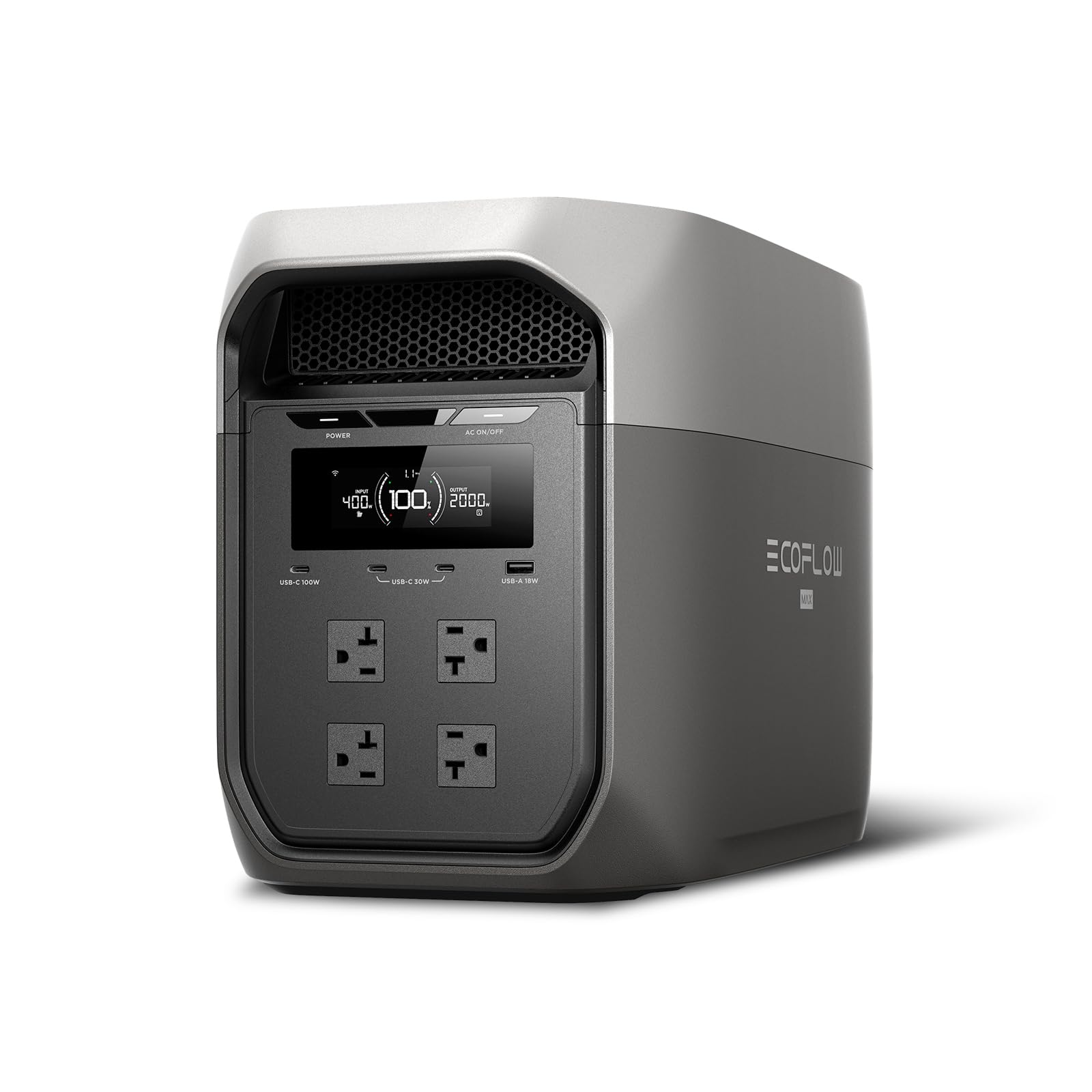
| EF ECOFLOW DELTA 3 Max★ Best Overall | Fastest-charging all-rounder | 2048Wh | 2400W (3400W X-Boost) | Battery Station | Amazon |
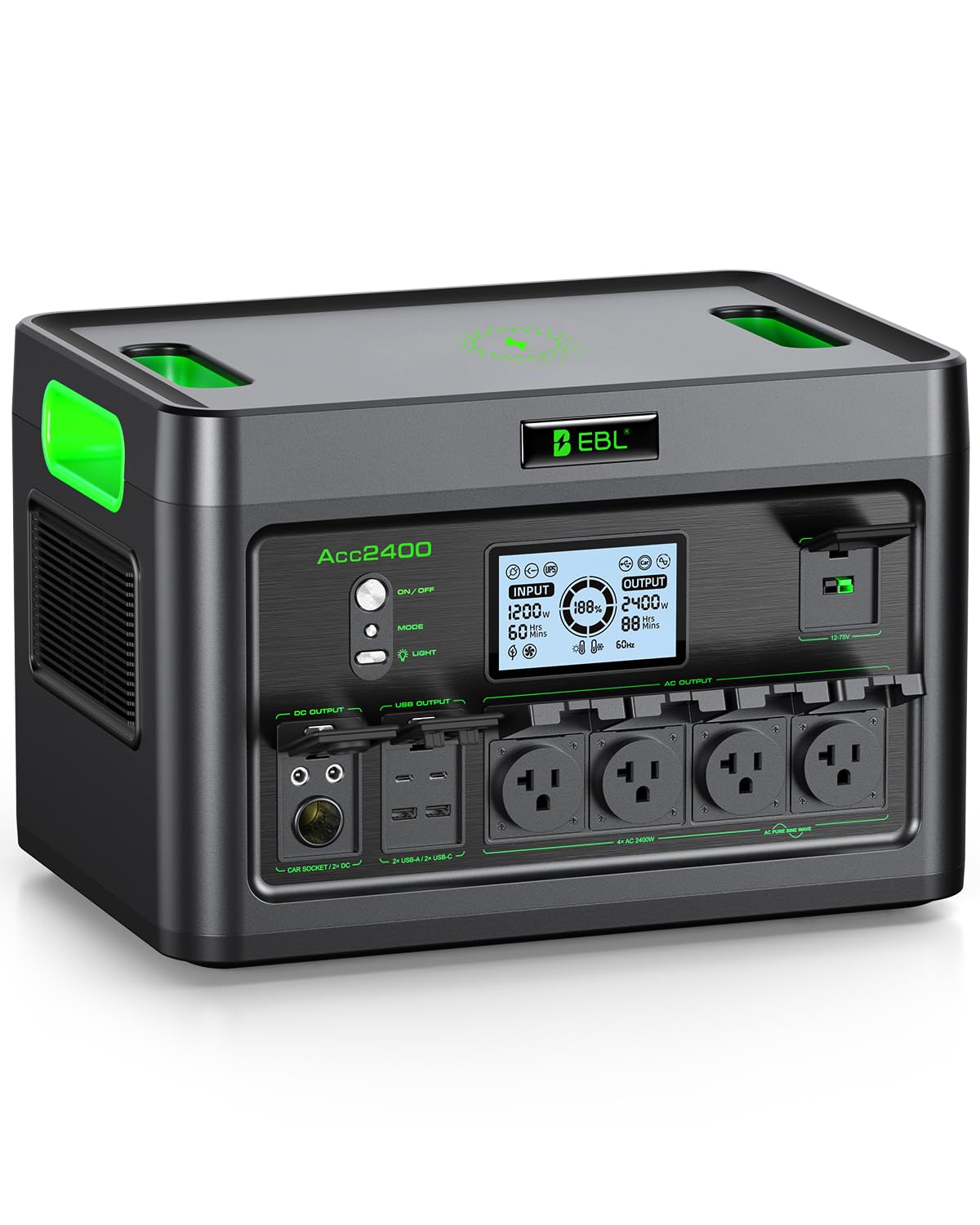
| EBL 2400W Portable Power StationBest Value | Big appliances on a budget | 1843.2Wh | 2400W | Battery Station | Amazon |
| DuroStar DS13000MXBest Dual Fuel | Whole-home gas or propane | — | 13,000W peak | Dual Fuel Generator | Amazon |
| PECRON F3000LFP | Expandable battery backup | 3072Wh | 3600W | Battery Station | Amazon |
| Anker SOLIX S2000 | Compact fridge backup | 2,010Wh | 1,500W (3,000W peak) | Battery Station | Amazon |
| Westinghouse 13500 Peak Watt | Storm-season whole house | — | 9,500W (propane) | Dual Fuel Generator | Amazon |
| Jackery HomePower 3000 | RV and home essentials | 3072Wh | 3600W | Battery Station | Amazon |
| EF ECOFLOW Delta 3 Ultra | Silent overnight backup | 3072Wh | 3600W | Battery Station | Amazon |
| DuroMax XP13000HXT | Natural gas convenience | — | 13,000W | Tri Fuel Generator | Amazon |
| ECO-Worthy Cubix100 | Whole-home off-grid storage | 30.72kWh (6-pack) | — | Server Rack Battery Kit | Amazon |
| Generac Guardian 22kW | Hands-free permanent power | — | 22,000W | Standby Generator | Amazon |
In‑Depth Reviews
1. EF ECOFLOW DELTA 3 Max Portable Power Station
Our pick — over 4.5★ from 550+ verified ratings; the strongest balance of quality and price.
A 2048Wh pack that refills to 80% before your coffee finishes brewing.
Charging is where it pulls away though. EcoFlow’s X-Stream system takes this unit from 0 to 80% in just over an hour (1.13 hours), and the display counts that fill-down in real time. You are not sitting around for a full overnight top-up.
Plenty of owners run serious loads off it. One family business uses it to run a waffle iron and two freezers at once, firing up the surge for several seconds while holding 2400W continuous. Lights, TVs, routers, and a run of camping gear all draw from the same box. The 3400W X-Boost mode (a setting that briefly pushes past the normal limit) covers high-demand appliances, and the built-in hand truck softens the 48 lb carry.
The quiet factor tells you why it lives indoors. Switchover lands under 10 ms (milliseconds, meaning it reacts faster than your eye can track), so plugged-in computers ride straight through a blink. Fan noise stays low, which matters at night. You also get a full 5-year service window and app control that tracks energy use and schedules charge cycles. Owners call it a long-term buy for the money, not a stopgap.
What earns its keep
- 2048Wh capacity at 2400W continuous with 3400W X-Boost headroom
- 0–80% recharge in 1.13 hours via X-Stream charging
- Under-10ms transfer keeps computers and sensitive gear alive
Worth knowing before you buy
- 48 pounds, but a bundled hand truck offsets the drag
- Some charging-capability notes stay mixed — set your own input limits in the app
- The app’s mode descriptions are a puzzle the first time through
Best for: households that want one quiet box for outages, camping, and road trips.
Think twice if: you need days of runtime — that calls for a fuel generator, not a battery this size.
2. EBL 2400W Portable Power Station LiFePO4 Battery for Home Use
The mid-tier unit that ran a window AC when a pricier box would not.
This is the pick for anyone who wants to run a big appliance without stepping into premium territory. It puts out a full 2400W continuous from its 1843.2Wh LiFePO4 battery, which is less stored energy than the Delta 3 Max’s 2048Wh — but the raw output is identical, so the same high-draw devices stay in play. The story owners keep telling is the air conditioner test: where an EcoFlow unit would not fire up a 615W window AC, this generator ran it four hours straight through peak heat.
The port count is the other headline. You get 12 outputs in total — four AC sockets at 2400W max, two USB-A, two fast-charging USB-C, a car port, two DC ports, and a wireless charging pad on top. Twelve connected devices at once covers a family group or a multi-device campsite without unplugging anyone. The intelligent emergency mode switches to backup in 0.1 seconds (a tenth of a second), fast enough to protect computers and file drives from a mid-project shutdown.
Built for the long haul, the lithium iron phosphate cells are rated for more than 3500 charge-discharge cycles, and the body is shock-resistant and flame-retardant with a built-in protection system against overcharge, over-discharge, short circuits, and heat. Dual-side handles help with the 54 to 55 lb carry. The honest catch is recharge speed and consistency — a couple of units have arrived with outlet faults or slow refills, so test yours fully in the first week while support is fresh.
Why it stands out: 12 output ports and a 0.1-second emergency switch make it feel far bigger than its price tier suggests.
The fair caveat: budget-tier battery stations show more variance in recharge speed and occasional outlet faults, so give it a full test run early.
Reach for this if: you want to run kettles, hair dryers, or a window AC and want maximum ports for the money.
Look elsewhere if: you prize tight quality consistency — the higher-rated picks below cut that risk.
3. DuroStar DS13000MX 13,000-Watt Dual Fuel Portable Generator
Whole-home wattage you can fuel with gasoline or propane, no permanent install required.
When you need to keep an entire house alive for days rather than hours, this generator hands you 13,000 watts from a 500cc four-stroke engine and lets you pick the fuel. Run it on gasoline for maximum output, or switch to propane for longer stretches and cleaner running — the front-facing selector swaps fuel in seconds. The 50-amp outlet is transfer-switch ready, meaning a proper hookup can carry your whole panel instead of a spiderweb of cords. Owners routinely power a 1.5-ton AC, a split unit, fridge, stove, microwave, TVs, and a water heater at once.
Starting it is a button press or a tap on the included remote, and the heavy-duty steel frame is built to shrug off weather and repeated use. What reassures owners most is the consistency of the build; the quality and reliability notes dominate the feedback, and most units crank on the very first try. Deep service reputation is not the reason to buy it — the day-one ease is.
The carbon monoxide alert cuts the engine automatically if dangerous fumes build up, which is a genuine safety win in a garage or storm shelter. Two honest cautions from the field: the oil drain tube sits awkwardly near the wheel and can snag during moves, and a bad CO sensor placement has shut a unit down early in rare cases. Treat it as a machine that wants airflow and clear ground. Also plan for the weight and size — a hand truck earns its keep here.
Pure value read: 13,000W of dual-fuel power with electric and remote start is a serious amount of capability for a portable frame.
The real-world note: maintenance chores like the oil drain location and the occasional touchy CO sensor are the price of entry on a machine this size.
Best for: storm-belt homeowners who want a portable that can genuinely run the whole house on a transfer switch.
Not the one if: you want silent, zero-maintenance power — a battery station suits indoor living better.
4. PECRON Portable Power Station F3000LFP, 3072Wh Solar Generator
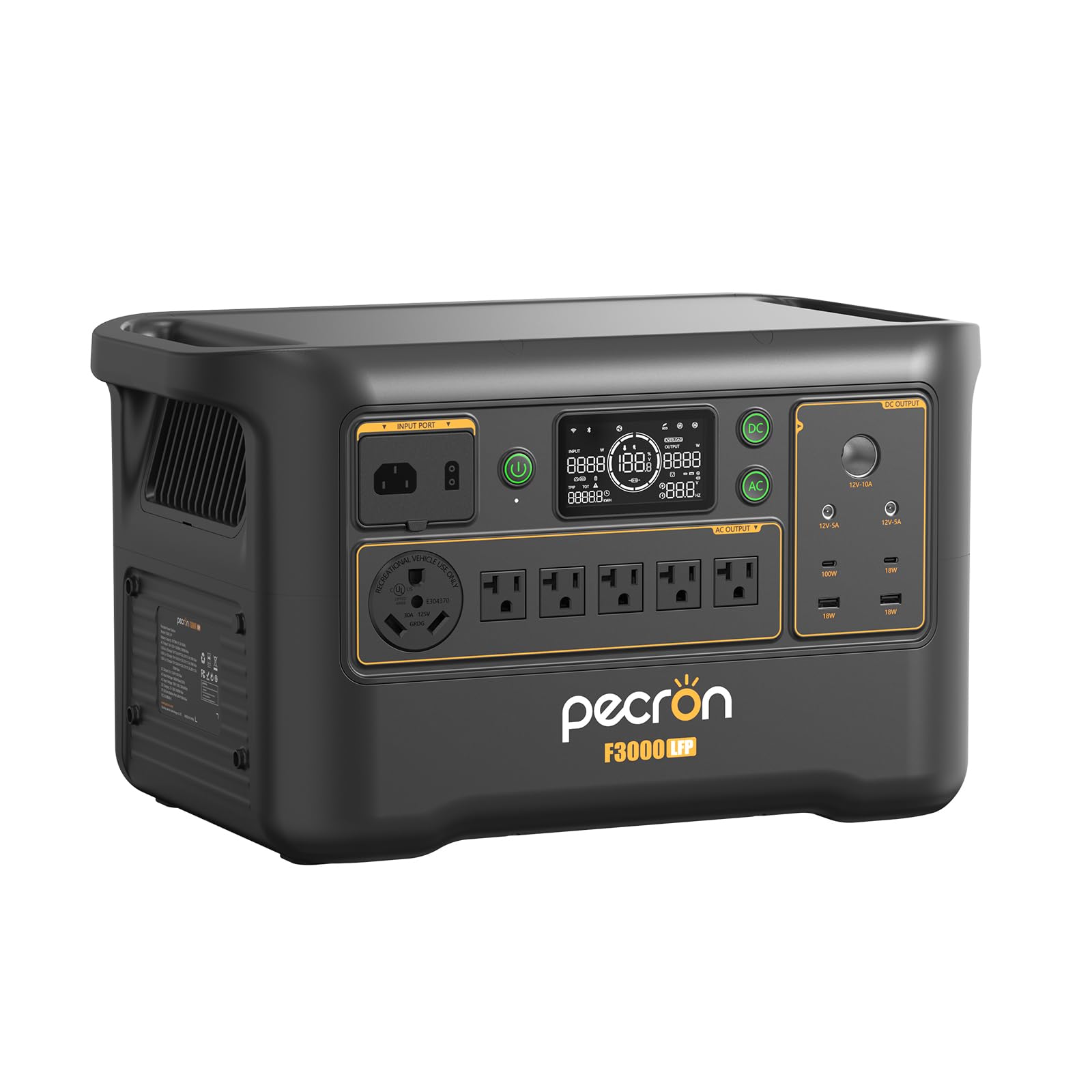
A 3072Wh box that grows with you — add batteries and push capacity toward 10752Wh.
You get 2–3 days of home essentials before you ever think about a recharge, thanks to a 3072Wh LiFePO4 battery (a lithium iron phosphate battery — a chemistry built for long cycle life). what separates it from fixed-capacity stations is the expansion path: you can chain on batteries and scale the whole system toward 10752Wh, so your investment grows instead of going stale. The 3600W pure sine wave output (clean power that runs motors and electronics safely) handles heavy appliances — refrigerators, air conditioners, power tools. It holds 13 devices across 6 AC outlets, 2 USB-C (100W PD for laptops — PD is Power Delivery, a fast-charging standard), 2 USB-A, a carport, and 2 DC 5525 outputs.
Refilling it is fast. AC input at 1800W max takes it from 0 to 100% in about two hours, and you can stack solar (up to 1600W input) and car charging into that same window. The UPS mode switches over in 8 to 20 milliseconds, which keeps a desktop and monitor coasting through a blackout — owners have ridden out 40-plus outages on this exact behavior. The single biggest surprise is efficiency: it runs a fridge for 24 hours using roughly 1200Wh, where comparable units burn through far more.
Owners consistently praise how much output it delivers per pound. Two caveats sit alongside the praise. At 63.3 pounds it is a two-hand lift, and the fan cycles often enough to notice when it is working hard. The app also wants an internet login for basic Bluetooth functions and the manuals read awkwardly, so budget a little setup patience on day one.
Where it shines
- 3072Wh expandable toward 10752Wh keeps the system useful for years
- 1800W AC input refills 0–100% in about 2 hours
- 8–20ms UPS switch protects computers and medical devices
Before you commit
- 63.3 pounds — a two-hand carry, not a one-arm grab
- App needs login for even Bluetooth control; manuals read poorly translated
- Fan noise is noticeable under heavy load
Best for: buyers who plan to keep adding batteries rather than replacing the whole unit.
skip it if: you want a silent, set-and-forget experience — the fan and app friction are the trade-off for that expansion.
5. Anker SOLIX S2000 Portable Power Station, 2,010Wh
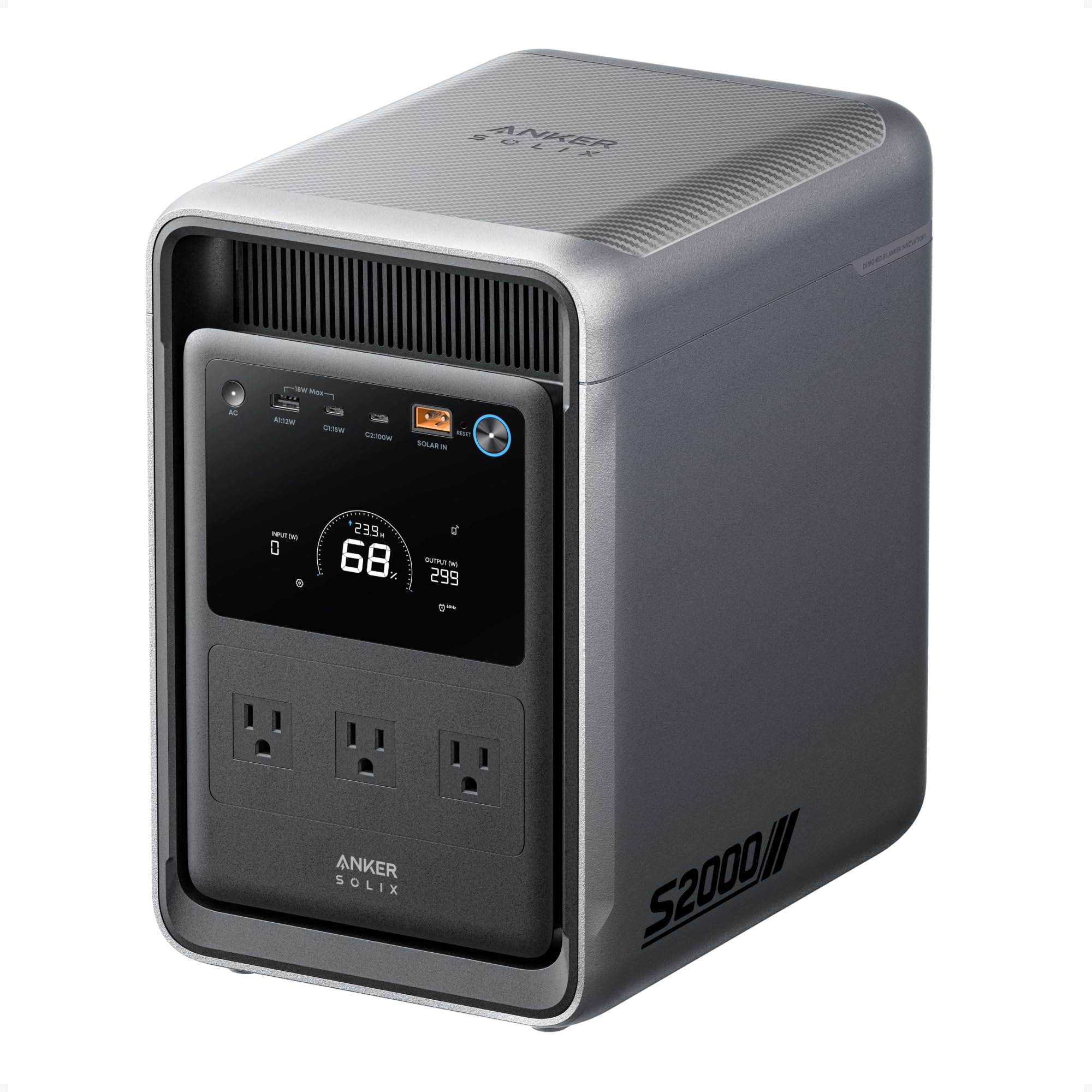
Under 36 pounds with two thousand watt-hours inside — the one you can actually carry.
Here is a spec that changes how you live with it: 35.7 pounds. That is lighter than almost every other 2kWh station here, and it is genuinely smaller too, measuring 8.19 x 11.1 x 12.7 inches. Where the EF ECOFLOW Delta 3 Ultra tips the scale at 72.1 pounds, this one moves from room to room without a hand truck. Inside sits a 2,010Wh LiFePO4 battery with 1,500W continuous and 3,000W peak output, plus six ways to recharge including up to 400W solar.
Runtime is its calling card in the reviews — a full-size fridge gets 27 hours on a single charge, and one owner measured a 220L fridge pulling just 3% per hour. The UPS switchover lands under 10 milliseconds, so a desktop or router never notices the grid drop. Storm and TOU (time-of-use) modes let it run on a schedule to shave costs during peak-rate hours. Eight outlets split front and rear give you a cleaner cord layout — though note there is no 12V DC port.
Owners lean on it as a night-shift fridge runner during planned generator shutdowns, and the recurring gripe is the fan, which gets loud during a 1,200W charge. The chemical burn-off smell on first charge is normal and fades after a cycle. Both are the price of a compact shell that still hits 2,010Wh.
Standout spec: 35.7 lbs and the smallest footprint in its capacity class make it the portable pick of the bunch.
The trade-off: loud charging fan and a first-charge odor — minor, but noticeable on day one.
Right for you if: you need a fridge-capable station light enough to move single-handed and stash in a closet.
Not for you if: you need more than 1,500W continuous output for big loads.
6. Westinghouse 13500 Peak Watt Dual Fuel Portable Generator
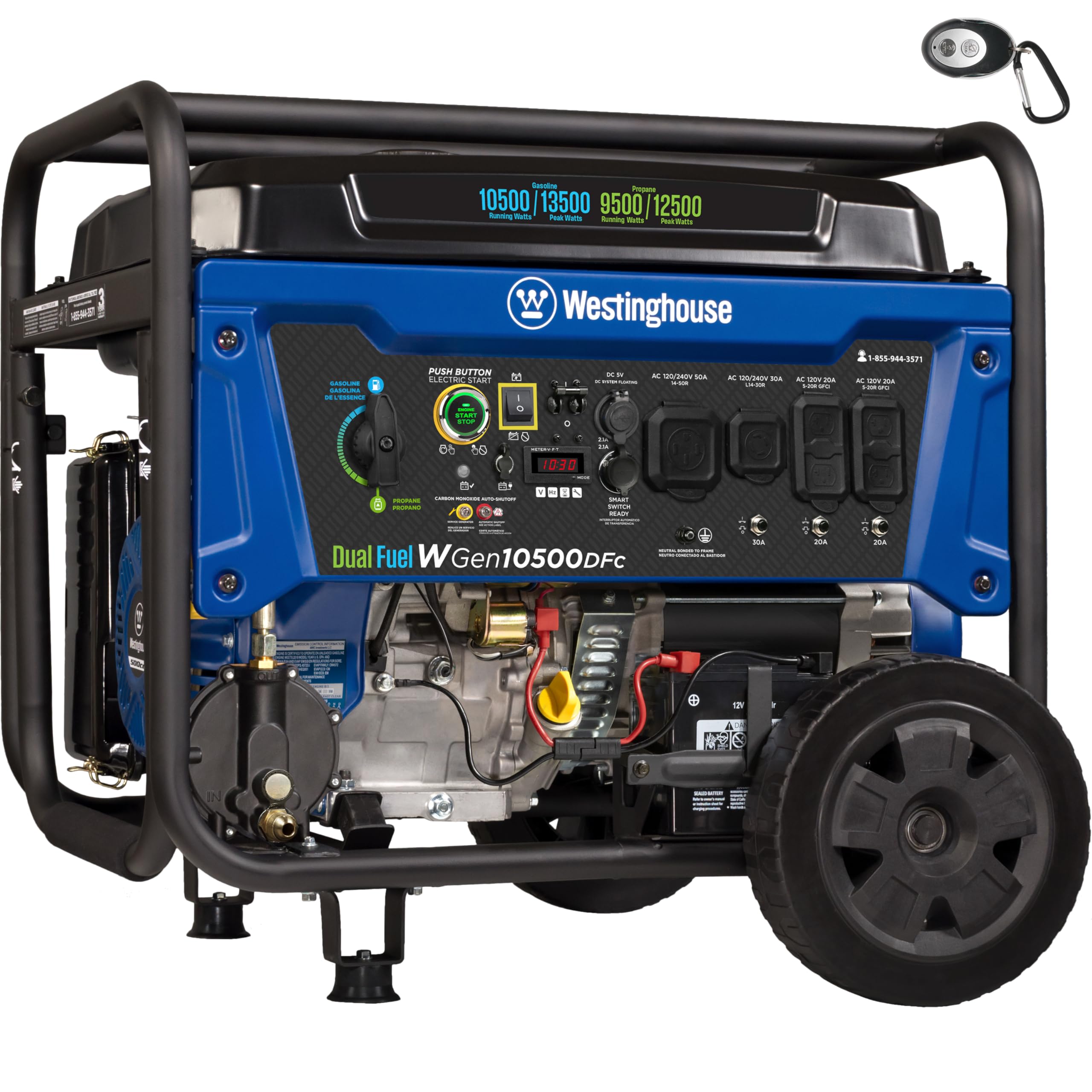
A fuel-flex portable that hits 9,500 running watts on propane and starts from a key fob.
If hurricane season is your worry, this unit’s numbers are the ones you want on the box. It delivers 13,500 peak watts (the brief surge for motor starts) and 10,500 running watts (the steady draw) on gasoline, or 12,500 peak and 9,500 running watts on propane. It runs up to 19 hours on a 9.5-gallon tank, with a fuel gauge telling you where you stand — so you get a full night of power without a refill scramble at 2 a.m.
Outlet coverage is thorough: two GFCI household receptacles, a 30-amp transfer-switch-ready outlet, and a 50-amp RV-ready outlet — all with rubber covers to keep weather out. Start it with the key fob remote, a button, or the recoil pull as backup. The 500cc four-stroke overhead-valve engine runs a cast-iron sleeve for durability and shuts down automatically on low oil or improve carbon monoxide. Owners praise the build quality and reliability most — units that crank on the first try and settle in to work.
Noise is the split verdict you should weigh. Some owners find it far quieter than expected at load; others find it loud enough to notice. For a machine this size that is normal. Pairing it with a 50-amp transfer switch turns the whole house into its job, and plenty of owners buy it specifically for that hookup after a previous storm.
Fuel-flexibility play: gasoline for raw output, propane for longer cleaner burns — with a 19-hour gasoline runtime on a full 9.5-gallon tank.
Real-world note: noise sits in the eye of the beholder, and this unit is heavy at 230 pounds, so plan the install spot before delivery.
Best for: storm-season homeowners who want a portable with remote start and propane as a backup fuel.
Not for you if: you need silent operation or cannot accommodate a 230-pound footprint.
7. Jackery HomePower 3000 Portable Power Station, 3072Wh
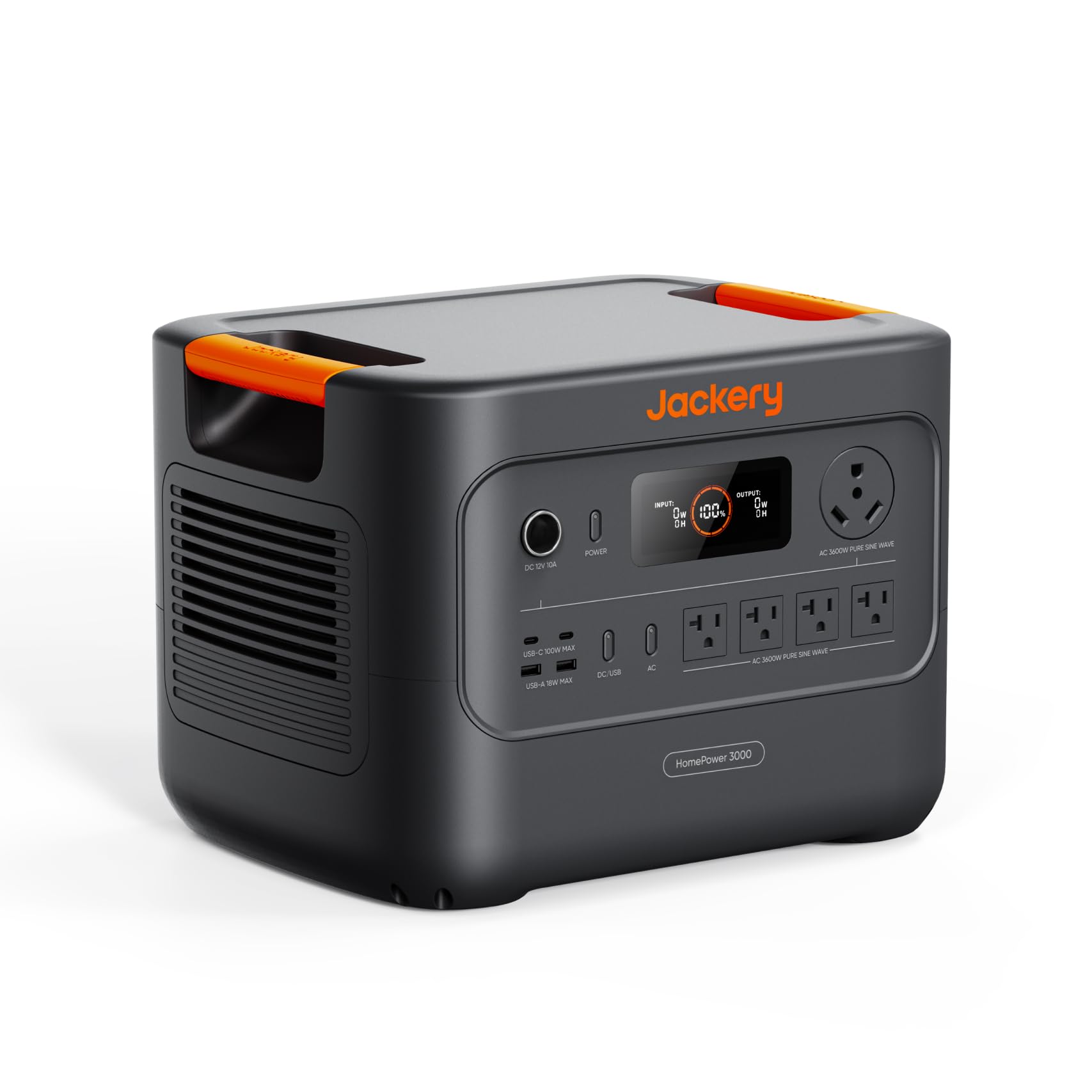
The one with a built-in 30-amp RV outlet and a 7200W surge that starts compressors.
For travel-trailer owners this is the clean answer: a built-in TT-30 RV port lets you plug your camper straight into the station without an adapter, and the 7200W surge is what handles a fridge compressor’s kick-on. The 3072Wh battery holds a fridge for one to two days, or keeps a house’s essentials — fan, router, lights — running up to 15 hours. On the output side it delivers 3600W continuous backed by a LiFePO4 battery rated for 4,000 cycles at 70% retained capacity.
It checks the speed and size boxes too. A full recharge takes 1.7 hours via hybrid AC and DC or 2.2 hours on AC alone, and paired with two SolarSaga 200W panels it reaches 80% in 9 hours of sun. At 59.5 pounds it is far lighter than the EF ECOFLOW Delta 3 Ultra’s 72.1 pounds and covers that capacity in a smaller shell. Dual 100W PD ports charge phones and drones fast, and the ≤20ms UPS (an uninterrupted switch to battery) keeps security cameras and pet feeders online during a storm.
Owners run these through camping seasons and RV trips, with charge times under two hours being the repeated point of praise and the 30-amp hookup the fan favorite for direct camper power. The caution to keep in mind: a handful of buyers were disappointed with the price tier, and the fan hits around 60dB under any draw — too loud to sit beside you as a daily UPS.
Gets the nod for: the hybrid AC+DC 1.7-hour recharge and the direct 30-amp RV hookup no competitor here matches.
One caution: the ~60dB fan makes it a poor desk companion, and the price tier divides opinion.
Right for you if: you split time between home outages and RV camping and want one box for both.
Not for you if: you need whisper-quiet operation — the fan is audible throughout use.
8. EF ECOFLOW Delta 3 Ultra 3072Wh Power Station
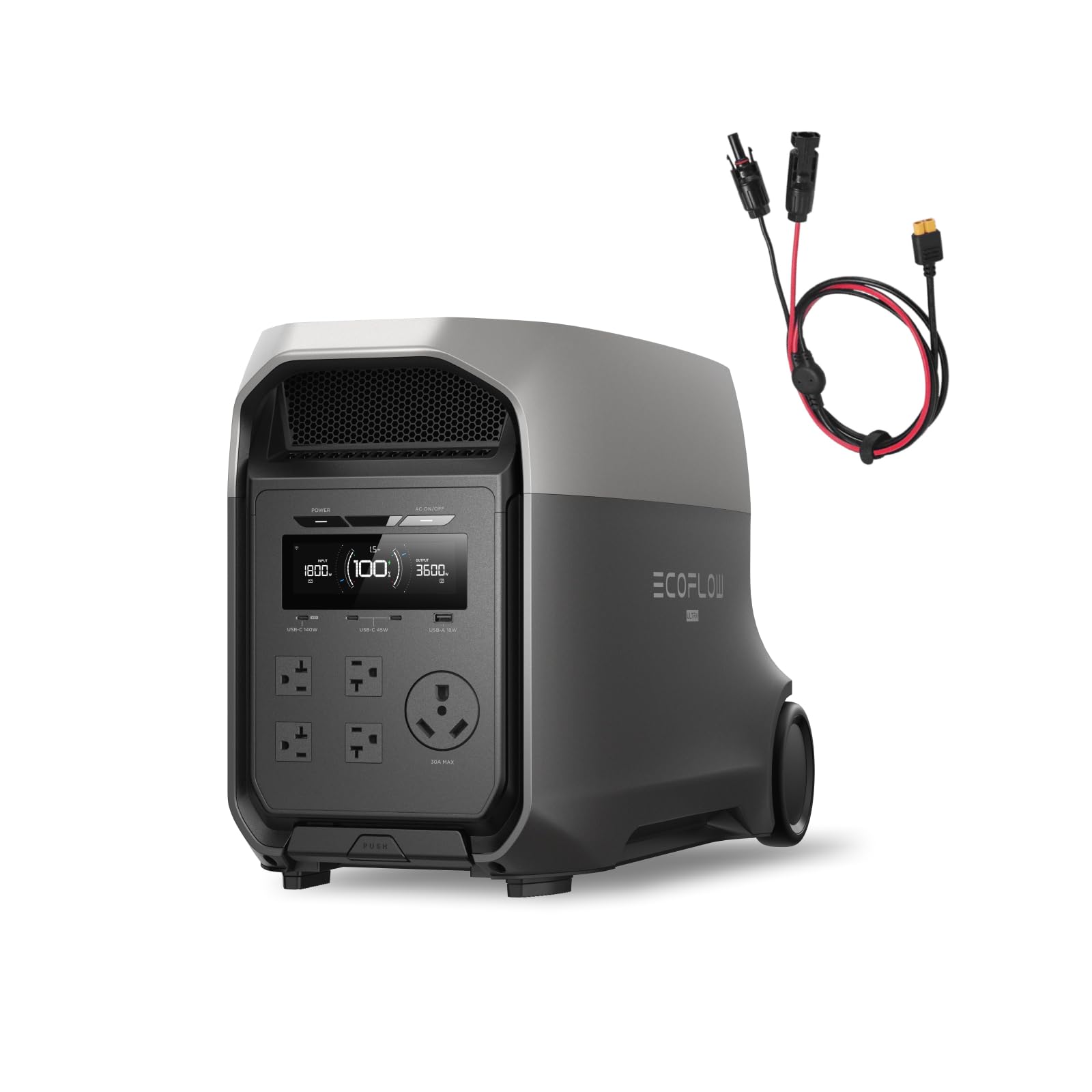
25 decibels under load — the backup box you forget is even running overnight.
Here is the number most people never consider, until they try to sleep next to their power station: 25 decibels. That is the noise floor of the Delta 3 Ultra under load, thanks to X-Quiet 3.0 cooling. Where the Jackery HomePower 3000’s fan reaches about 60dB, this unit sits quiet enough for a bedroom, a small apartment, or an RV at night. Inside you still get 3072Wh of LiFePO4 storage and 3600W of continuous output backed by 7200W of surge — so a refrigerator, microwave, or space heater just works.
Your electronics never notice the outage: switchover happens in under 10 milliseconds (faster than a blink) and needs no manual prompt, so PCs, Wi-Fi routers, and medical devices coast through untouched. Owners describe it as living next to outages — one resident in an outage-prone area calls the switch “instantaneous.” You get four 20-amp outlets, a 30-amp RV outlet, and four USB ports, all on a chassis with built-in wheels and a telescoping handle, so the 72.1 pounds rolls instead of lifts.
Recharging stays fast through the wall socket or solar (up to 800W input), and EcoFlow’s app handles remote shut-off and usage logs. The honest catch is that the app is the only control path — there is no open API, and some users want open-source monitoring and off-grid flexibility this unit does not hand you. Fine for standard home backup; a sticking point for tinkerers.
Why people keep it
- 25dB running noise is quiet enough for overnight bedroom use
- 3072Wh / 3600W output handles fridges, microwaves, and heaters
- Under-10ms transfer plus wheels and a pull handle for 72.1-pound portability
Where it holds back
- App-only configuration with no open API cuts off tinkerers
- Not expandable — 3072Wh is your ceiling
- 72.1 pounds is heavy despite the wheels and handle
Best fit for: apartments and bedrooms where fan noise would keep you up during an outage.
Skip if: you want to add battery modules later or run open-source monitoring.
9. DuroMax XP13000HXT 13,000-Watt Tri Fuel Generator
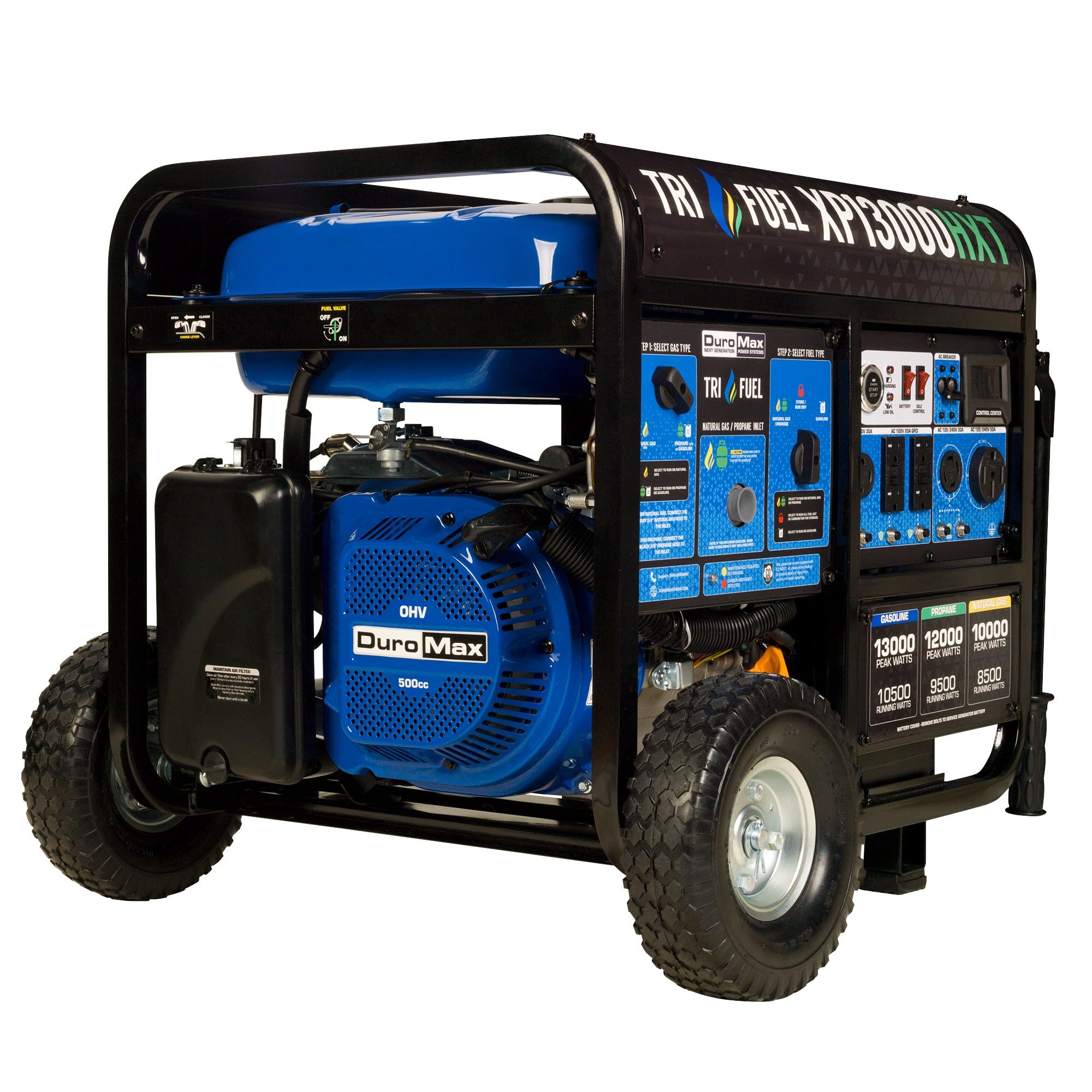
Run it on gasoline, propane, or piped natural gas — no fuel runs ever interrupt you.
The reason this earns its spot is fuel freedom. Gasoline, propane, or natural gas — the front-facing selector swaps between them in seconds, and with natural gas you can tie into the home’s own line and never touch a fuel can during an outage. It cranks out 13,000 watts from a 500cc overhead-valve engine with the same push-button and remote start convenience as the dual-fuel pick, plus a transfer-switch-ready 50-amp outlet for whole-house hookups.
You get a real safety layer for garages and storm season: a carbon monoxide alert (CO is the odorless gas engines give off) cuts the engine automatically if fumes get dangerous. The engine runs a 500cc four-stroke and manages gasoline or LP (liquid propane) operation through the same ignition. The unit ships with the full accessory kit — oil funnel, spark plug wrench, tool set, wheel and handle kit, propane regulator, and 15-foot natural gas hose. Owners describe it as a quality power source that runs an entire home and sets up easily.
It lives in the garage or lean-to, not the corner of your kitchen. But if you have natural gas at the house, nothing else matches the convenience of never hauling fuel again.
Tri-fuel advantage: gasoline, propane, or natural gas on the same 500cc engine gives you the widest fuel options of any portable here.
Weight reality: at 240 pounds it is a permanent install, so pick its spot before delivery day.
Best for: homes with piped natural gas that want unlimited-runtime whole-house backup.
Look elsewhere if: you want portability — this is a garage fixture despite the wheel kit.
10. ECO-Worthy Cubix100 48V 600Ah Server Rack Battery Kit
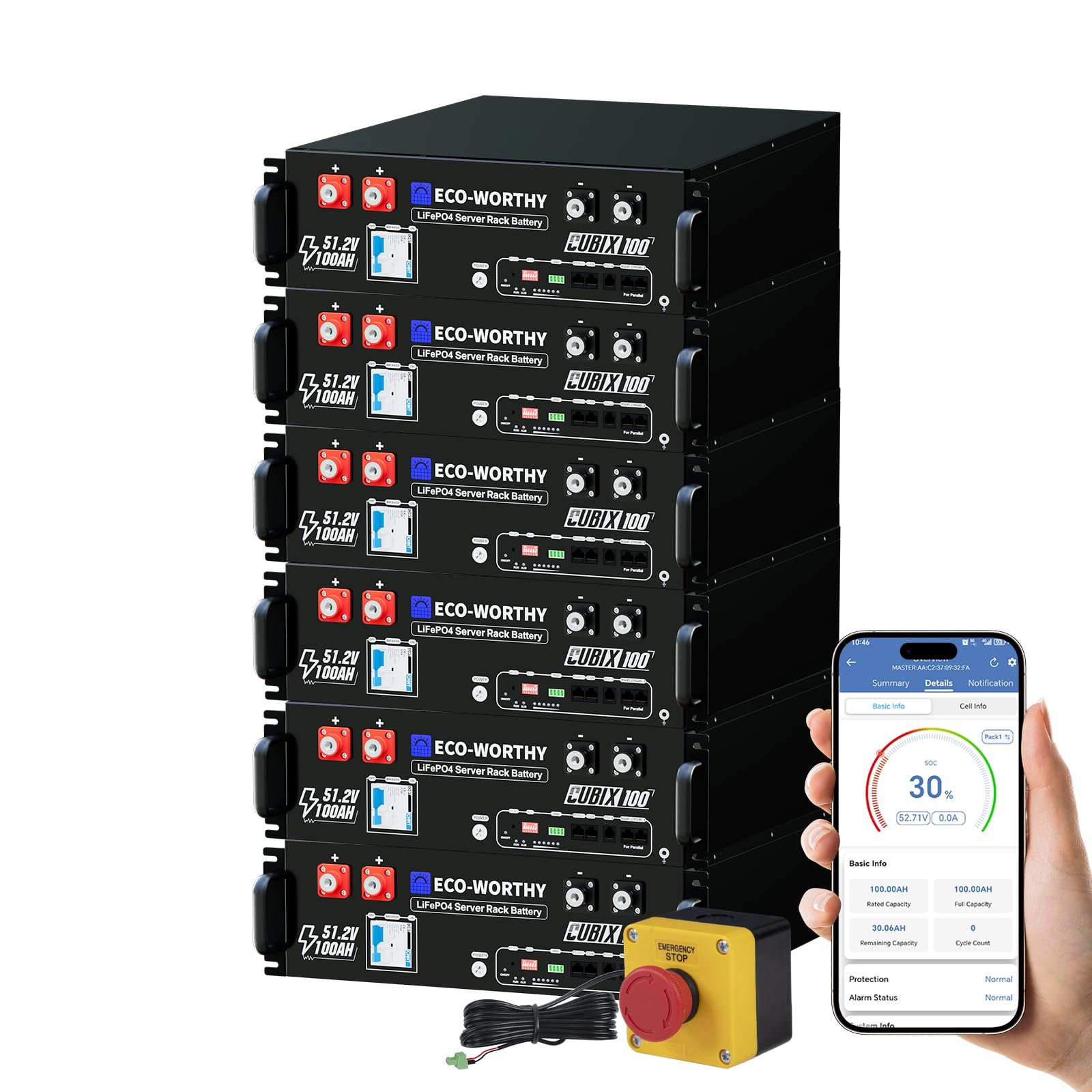
30.72kWh of stored power — enough to run an entire household off the grid.
This is not a plug-in box; it is the battery bank that makes whole-home off-grid living possible. The six-pack of 51.2V 100Ah server rack batteries stores up to 30.72kWh — enough to cover an entire household’s daily electricity — and the whole system carries UL9540, UL1973, and CEC listings after third-party testing by Intertek. If you are pairing it with a hybrid inverters, the built-in CAN/RS485 interfaces with multiple communication protocols let it talk to leading systems, plus built-in Bluetooth and WiFi let you watch status from the ECO-WORTHY app.
Scalability is the long play here. Each battery weighs 600 pounds and mounts vertically in a standard server rack, and you can parallel up to 32 units — pushing total capacity toward 163.8kWh (kilowatt-hours, the same unit your power bill uses) — so you grow capacity by adding units instead of replacing the bank. Grade A LiFePO₄ cells (lithium iron phosphate, a long-cycle-life chemistry) handle the cycle life, and the kit ships with parallel cables, communication cables, grounding wires, protective terminal covers, and everything needed for a clean install. A 10-year limited warranty and 24-hour tech response back it.
Off-grid buyers report months of steady voltage and capacity that matches the rating. The one nitpick that surfaces is the missing on-unit screen; you rely on the app and your inverter’s display for readouts. For a bank this size in a rack, that is a small thing.
Whole-home scale: 30.72kWh across six rack-mounted 100Ah batteries with room to parallel toward 163.8kWh is genuine off-grid territory.
Nothing to overlook: no onboard screen means you lean on the app and inverter for data, and the 600 pounds per unit make this a permanent install.
Built for: off-grid setups and homeowner battery banks paired with a hybrid inverter.
Not the pick if: you want a single portable box — this needs a rack and a permanent spot.
11. Generac Guardian 22kW Home Generator with Transfer Switch
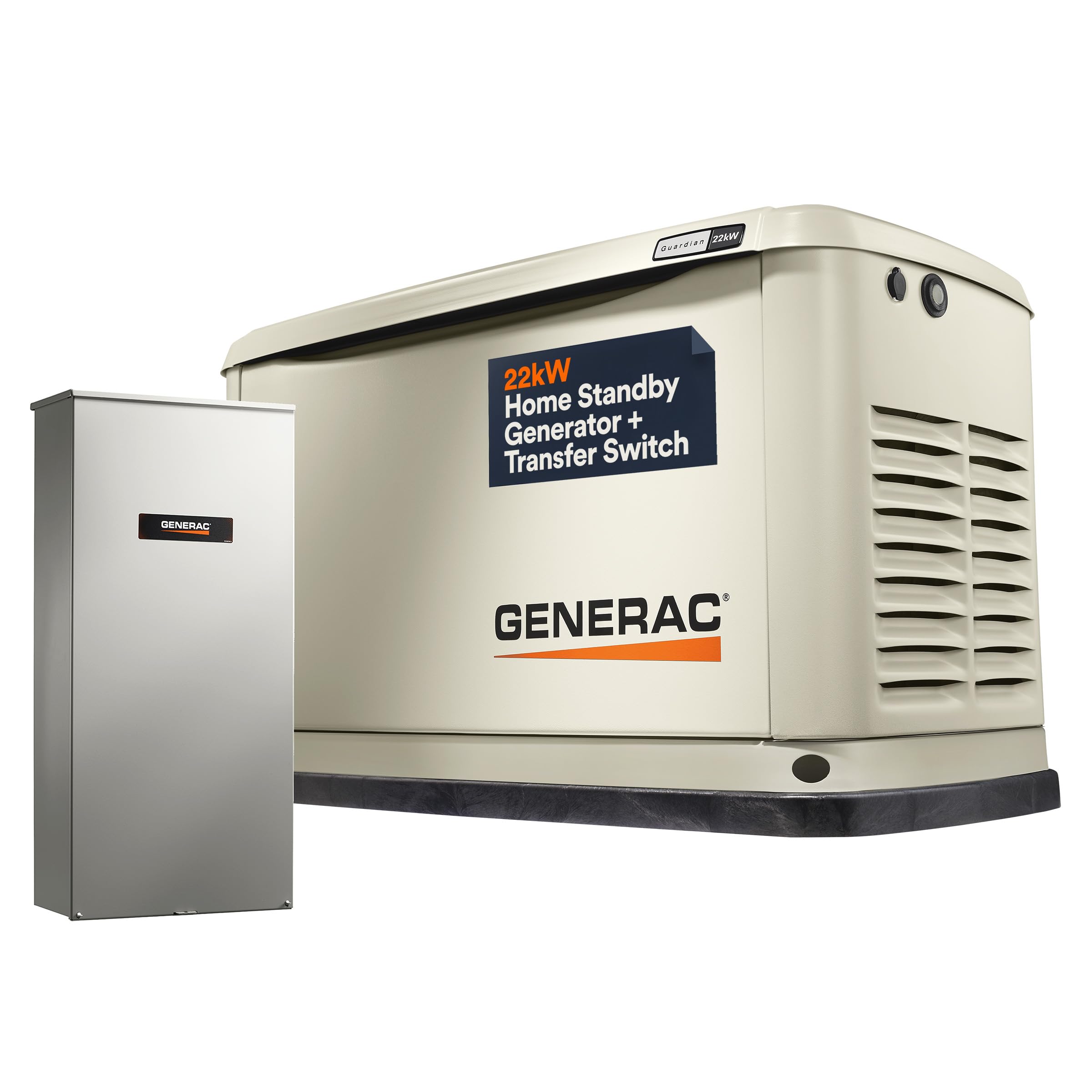
The permanent one — it powers your whole house automatically, before you wake up.
For a home that wants zero participation in the outage, this is the setup. The Generac Guardian packs a 22,000-watt output running on natural gas or propane, paired with a 200-amp NEMA 3R smart transfer switch that activates automatically. When the grid dies, the generator starts and takes over without you touching a thing. Owners running a 5-ton AC, heat pump, and a full house of loads report it carries everything at once, with one measured start of 10 seconds from grid drop to running.
The G-Force 1000 Series engine drives the power with what Generac calls True Power Technology — clean, stable output with under 5% harmonic distortion, which protects sensitive electronics. WiFi monitoring through the Mobile Link app lets you check status and maintenance alerts from anywhere, so a trip no longer means wondering if the generator is ready. It ships with a 5-Year Limited Warranty on the transfer switch.
Installation is a licensed-electrician job — that is not optional, and it is the biggest hidden line on the plan. A few owners note that the app’s monitoring subscription and the unit’s dependence on a control board for startup are friction points, so read the setup requirements before buying. Buyers who wanted whole-house protection without a weekly checklist land here.
What it delivers: 22,000 watts of automatically-triggered whole-home power with a 200-amp transfer switch and WiFi monitoring from anywhere.
What to plan for: professional installation, plus the reality that the control board, not a manual switch, runs the show.
Ideal for: homeowners who want outage protection that runs itself, with or without anyone home.
Wrong choice if: you want portable power you can move or take camping — this is a permanent wired install.
Understanding the Specs
Watt-hours and output watts
Watt-hours (Wh) measure how much energy a station stores — think of it as a fuel tank. A 3072Wh model holds more runtime than a 2048Wh one, so the fridge runs longer between charges. Output watts measures how much power it can push at once — that decides whether a microwave or AC unit turns on. Match both to your heaviest appliance and your longest runtime need.
LiFePO4 cycle life and switchover speed
LiFePO4 (lithium iron phosphate) batteries handle thousands of charge cycles and run cooler than standard lithium, so a station rated for 4,000 cycles stays useful for years. Switchover speed, measured in milliseconds, decides whether your plugged-in electronics survive a blink. Under 10ms keeps computers and routers alive; anything slower means a reboot.
FAQ
How many watt-hours do I need to run a refrigerator overnight?
What is the difference between a battery power station and a gas generator?
Can a portable power station run a window air conditioner?
How fast can a home backup battery recharge after an outage?
Is a transfer switch required for whole-house backup?
What switchover time protects a computer during a blackout?
SOLIX S2000, and Jackery HomePower 3000, all listed under 10ms. The PECRON F3000LFP switches in 8 to 20ms, and the Jackery HomePower 3000 in ≤20ms. Anything in that range keeps a desktop and router running without a reboot.
Can two power stations be linked together for more capacity?
Will a standby generator run on natural gas instead of propane?
How long do home backup batteries actually last?
Can I charge a home battery with solar panels?
How heavy is a home backup power station to move?
Final Thoughts: The Verdict
For most homes, the best backup power for a home is the EF ECOFLOW DELTA 3 Max: 2048Wh LiFePO4, 0–80% recharge in 1.13 hours, 3400W X-Boost, and an under-10ms transfer that keeps electronics alive. If quiet overnight operation matters more than capacity, the EF ECOFLOW Delta 3 Ultra runs at just 25dB under load (about a whisper). When you want to run whole-house loads for days rather than hours, the DuroStar DS13000MX and the Westinghouse 13500 Peak Watt give you dual-fuel runtime you can refuel on demand. And if you would rather never think about an outage again, the Generac Guardian 22kW starts itself and carries the whole house automatically. Start with the top pick, then move down the list only after matching capacity and output to your heaviest appliance.
How We Picked
We do not accept paid placement. Every pick is matched to a real buyer and a real use-case; we do not hands-on test units.
Sources & Methodology
Specifications: manufacturer listings and product documentation. Review insights: verified customer reviews, as of September 2026. Pricing: not shown on this page (it changes often); check the current price via the retailer link.
As an Amazon Associate, KitchPrep earns from qualifying purchases. This does not affect which products we feature.
Related Guides
