
Specs are compiled from manufacturer listings and verified buyer reviews and can change over time — please confirm the key details on the product page before buying.
When the grid drops at 2 a.m., you want one thing: the fridge, the router, and the lights still working without dragging a gas can into the garage. A battery-based backup generator for a solar system stores energy in large lithium cells instead of burning fuel, so it runs indoors, makes almost no noise, and can recharge from the sun when the outage stretches on. If you want the simplest path, a mid-range portable station around 1024Wh to 2048Wh covers most fridges and routers; if you need to carry a whole house through a storm, you step up to a higher-capacity unit or a tri-fuel machine that never runs out of fuel.
I’m Mohammad Maruf — the founder and writer behind KitchPrep. This guide is built by comparing the manufacturers’ published specifications and the patterns across verified customer reviews, so you get each pick’s real strengths and trade-offs instead of marketing spin.
Emergency power is a big purchase, so it pays to compare battery capacity, output, and recharge speed before you commit. This guide breaks down the backup generator for a solar system so you can match one to how you actually live.
Our Picks at a Glance


How To Choose The Best Backup Generator for a Solar System
Buying backup power is not about the biggest watt-hour number on the box. It is about matching three things to your life: how long you need to run, how much load you need to start, and how you will refill the battery when the sun is behind clouds for days. Get those three right and the unit runs your essentials without a second thought; miss one and you feel it every outage.
Match watt-hours to what you actually run
Watt-hours (Wh) are the size of the fuel tank. A fridge might sip power on and off, while a space heater gulps it continuously. The bigger the Wh number, the longer your fridge, router, and lights run before you recharge — so list your must-run items, add up their watts, and estimate the hours you need. Memory for the fridge, Wi-Fi, a few lamps, and phone charging is very different from running a window air conditioner or a microwave.
Separate continuous watts from peak watts
Continuous watts are what the unit can supply steadily; peak watts are the short surge a motor or compressor needs when it kicks on. A refrigerator or pump may pull a spike for a second at startup, so the peak number matters for whether the appliance starts at all. Look at the continuous rating for your steady loads and the peak rating for anything with a motor.
Plan how you will recharge during a long outage
This is where solar integration matters. Most of these units accept solar panels through an MPPT controller (a circuit that squeezes the most power out of your panels), plus AC from a wall outlet and often a car or dual-input option. Think about your worst case — a storm that blocks the sun for days — and whether you can top up from a wall outlet, a gas generator, or a car. Fast AC recharge is the safety net that keeps a quiet battery unit practical when the panels are not producing.
Quick Comparison
| Model | Best For | Capacity (Wh) | Output (W) | Battery Type | Amazon |
|---|---|---|---|---|---|
| EF ECOFLOW DELTA 3 Plus★ Best Overall | Fast-charging home office backup | 1024Wh | 1800W | LiFePO4 | Amazon |
| DABBSSON 2000LLongest Runtime | Long-run fridge and appliance backup | 2048Wh | 2200W | Semi-Solid LiFePO4 | Amazon |
| AFERIY P210Quietest Performer | Quiet overnight hurricane backup | 2048Wh | 2400W | LiFePO4 | Amazon |
| BROWEY S1600 | All-in-one with panel built in | 1024Wh | 1600W | LiFePO4 | Amazon |
| GRECELL Acc2400 (station only) | High-wattage tools and appliances | 1843.2Wh | 2400W | LiFePO4 | Amazon |
| GRECELL Acc2400 + 200W Panel | Ready-to-solar home backup | 1843.2Wh | 2400W | LiFePO4 | Amazon |
| BLAVOR S1600 | Grab-and-go with a folding panel | 1024Wh | 1600W | LiFePO4 | Amazon |
| Anker SOLIX S2000 | Longest fridge runtime per charge | 2,010Wh | 1,500W | LiFePO4 | Amazon |
| ABOK Ark3600 | Heavy jobs with wheeled mobility | 3840Wh | 3600W | LiFePO4 | Amazon |
| Jackery HomePower 3600 Plus | Whole-home backup with expansion | 3584Wh | 3600W | LiFePO4 | Amazon |
| Westinghouse WGen14500TFc | Extended outages with unlimited fuel | — | 14,500W running | Gas / Propane / Natural Gas | Amazon |
In‑Depth Reviews
1. EF ECOFLOW Portable Power Station DELTA 3 Plus 1024Wh, 1800W, LFP Battery
Our pick — over 4.5★ from 650+ verified ratings; the strongest balance of quality and price.
The desk-side guardian that refills to 80 percent before your coffee cools.
For a home office or a small apartment where the router and the laptop must survive a blink, this is the pick that makes the most sense. It delivers 1800W of continuous output from a 1024Wh LiFePO4 battery (lithium iron phosphate — a chemistry that holds up to far more charge cycles than older lithium-ion), and the 10 ms switchover means it behaves like a true UPS, flipping to battery so fast that a desktop, NAS, or point-of-sale terminal never notices the grid dropped. Owners consistently describe it as plug-and-play, quiet, and easy to carry from room to room.
Speed is the headline. With 1500W AC input it reaches 80 percent in 40 minutes, and solar charging hits 80 percent in 1 hour and 100 percent in 70 minutes; the 800W alternator does 80 percent in 1 hour. A buyer summed up the pace simply: “It charged from 27% to 100% in 40 minutes. I plugged in a fan to it and it worked perfectly. It runs very quietly. Light weight and easy to move.” Against the DABBSSON 2000L, the EcoFlow carries half the stored energy — 1024Wh versus 2048Wh — but its 1500W wall recharge is the faster of the two by a wide margin.
With the EcoFlow ecosystem you can stack additional DELTA 3, DELTA Pro 3, or DELTA 2 Max battery packs to push capacity up to 5kWh, and the app layers on 12-hour storm and outage alerts plus a usage dashboard. The honest trade-off is idle draw: leave the AC inverter on and it bleeds power in a few days, and 1024Wh will not carry a fridge overnight the way a 2kWh unit will. The ten-millisecond switchover and sub-hour recharge are what the home-office crowd raves about, so if your priority is protecting electronics rather than running the whole kitchen, nothing here beats it.
expandable battery capacity
- 1500W AC input refills to 80 percent in 40 minutes
- 10 ms UPS switchover protects computers and servers
- LiFePO4 cells rated for 4000 cycles to 80 percent
- Expandable to 5kWh with matched battery packs
app control learning curve
- 1024Wh is modest — not a full-kitchen overnight unit
- Idle inverter draw can empty it in a few days if left on
- Heavier than its trim footprint suggests
home backup ready: you want instant UPS protection for a home office, NAS, or small apartment and value a recharge you can watch happen.
budget tight: your overnight needs run past a laptop and a router — the capacity here is the one thing you cannot stretch.
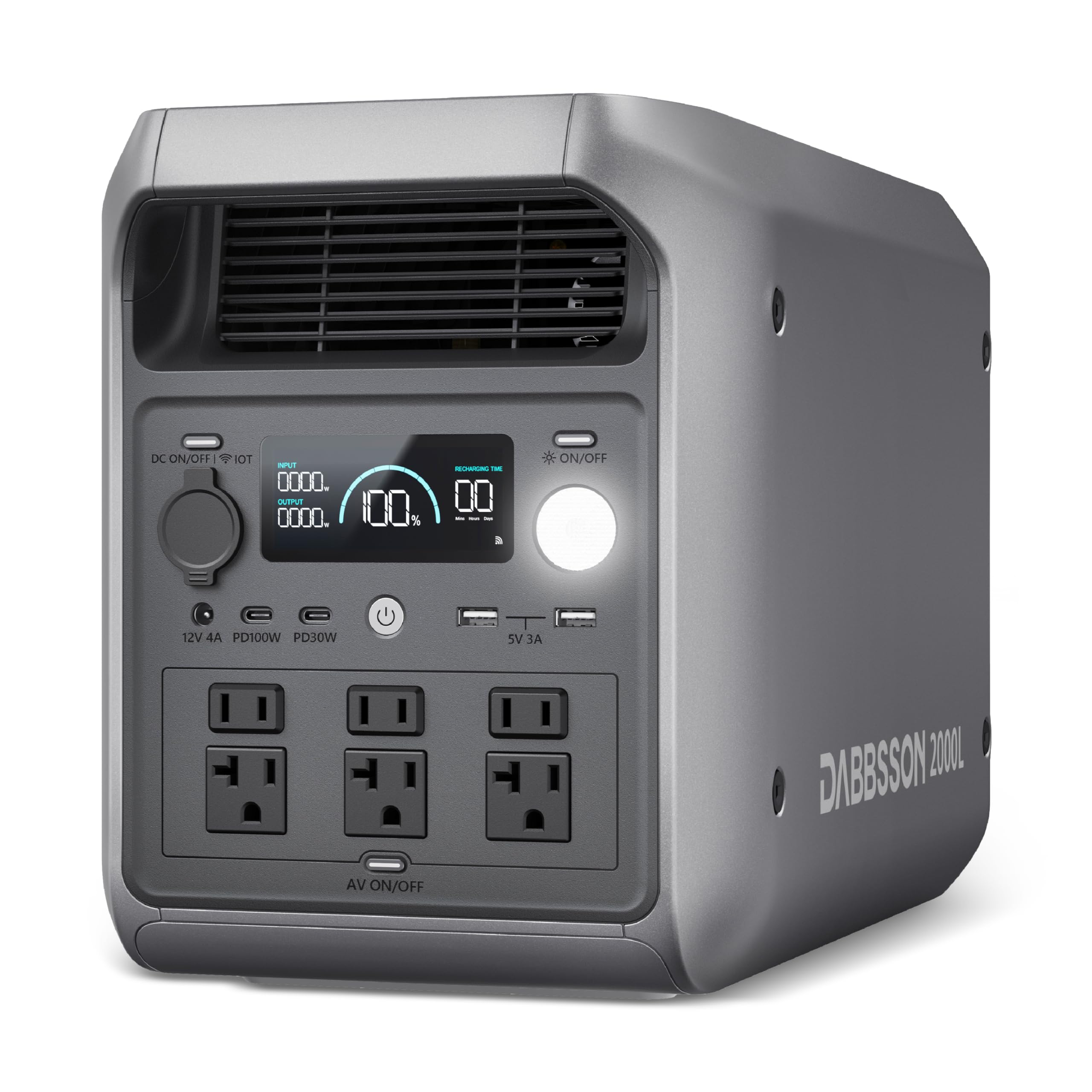
2. DABBSSON Portable Power Station 2000L, 2048Wh Semi-Solid LiFePO4 Battery, 2200W AC Output
Enough stored energy to run the fridge through dinner and still have charge to spare.
If your idea of backup power is keeping the kitchen alive, this one carries double the stored energy of the EcoFlow above — 2048Wh versus 1024Wh — and it kicks out 2200W of continuous power with a 3300W surge so heavy appliances actually start. It uses semi-solid LiFePO4 cells inside a UL94-V0 flame-retardant housing (a plastic rated to resist catching fire), and the maker rates them for 4000-plus deep cycles. It also fuels six AC outlets, so the whole counter can stay live at once during an outage.
Run times here are the stuff of household legend. One owner reported running a Keurig, an air fryer, a microwave, and two freezers plus two fridges at the same time for 7.5 hours, and a fridge on its own for 20.7 hours. A buyer’s note captures the mood: “Didn’t think I’d need it so soon, but a power outage yesterday put it to use. The battery life is excellent. I was able to charge multiple things for hours.” At 41 lb it is heavy for a hand carry, but it is built to be moved to the campsite or the job site and back again.
The most-discussed gripe across owners is the app and software, with a few noting a stubborn Wi-Fi connection or energy-management settings that would not hold. Consider it a scheduling quirk rather than a power problem — the core delivery is rock-solid. The trade-off to know going in is the fan: it ramps up under high load and can cycle audibly.
semi-solid state safety: 2048Wh feeding 2200W continuous means long, patient runtimes — the fridge-and-freezer pairing that a smaller station can only dream about.
heavier than average: the smart-app side is the weak link, so set your charging schedule at the unit, not on your phone, and you will rarely think about it.
large appliances: households that want the fridge, freezer, and small kitchen appliances to keep running when the power goes — and to keep running for hours.
need portability: you need to carry it up stairs one-handed; at 41 lb this is a two-hand or wheel-it-in-the-garage proposition.
3. AFERIY P210 Solar Generator 2048Wh Portable Power Station 2400W (4800W Peak)
Night-quiet power with a port for practically everything you own.
Anyone who has slept next to a running generator knows the point of this unit: silence. It runs at under 30 dB at full load and just 16 dB under normal load, so it fades below a whisper when you use it to power gear overnight. Inside is a 2048Wh LiFePO4 battery with a 2400W pure sine wave inverter (clean, wall-outlet-style power) and a 4800W peak, feeding sixteen ports — six AC outlets plus USB and Type-C connections — so everything stays plugged in at once. The maker rates the cells for 3500-plus cycles and backs the unit with a multi-year extended warranty.
Solar charging, though, is where you need to read the fine print. The MPPT controller caps solar input around 350W no matter how many panels you connect, so if you plan to lean hard on the sun for refills, temper your expectations and let AC charging carry the load.
The UPS mode is the one design wrinkle worth knowing: with AC input connected it runs in bypass and caps output, so big loads belong on the DC or solar side. Pair that limit with the genuinely low noise and the port crowd, and it slots in beautifully as a bedside or living-room backup.
off-grid living: quiet operation and a dense bank of outlets matter more to you than squeezing the last watt out of your solar panels.
grid-tied only: your plan is a large solar array — the input ceiling will leave some of it unused.
4. BROWEY 1600W (3200W Peak) Portable Power Station with Built-in Solar Panel
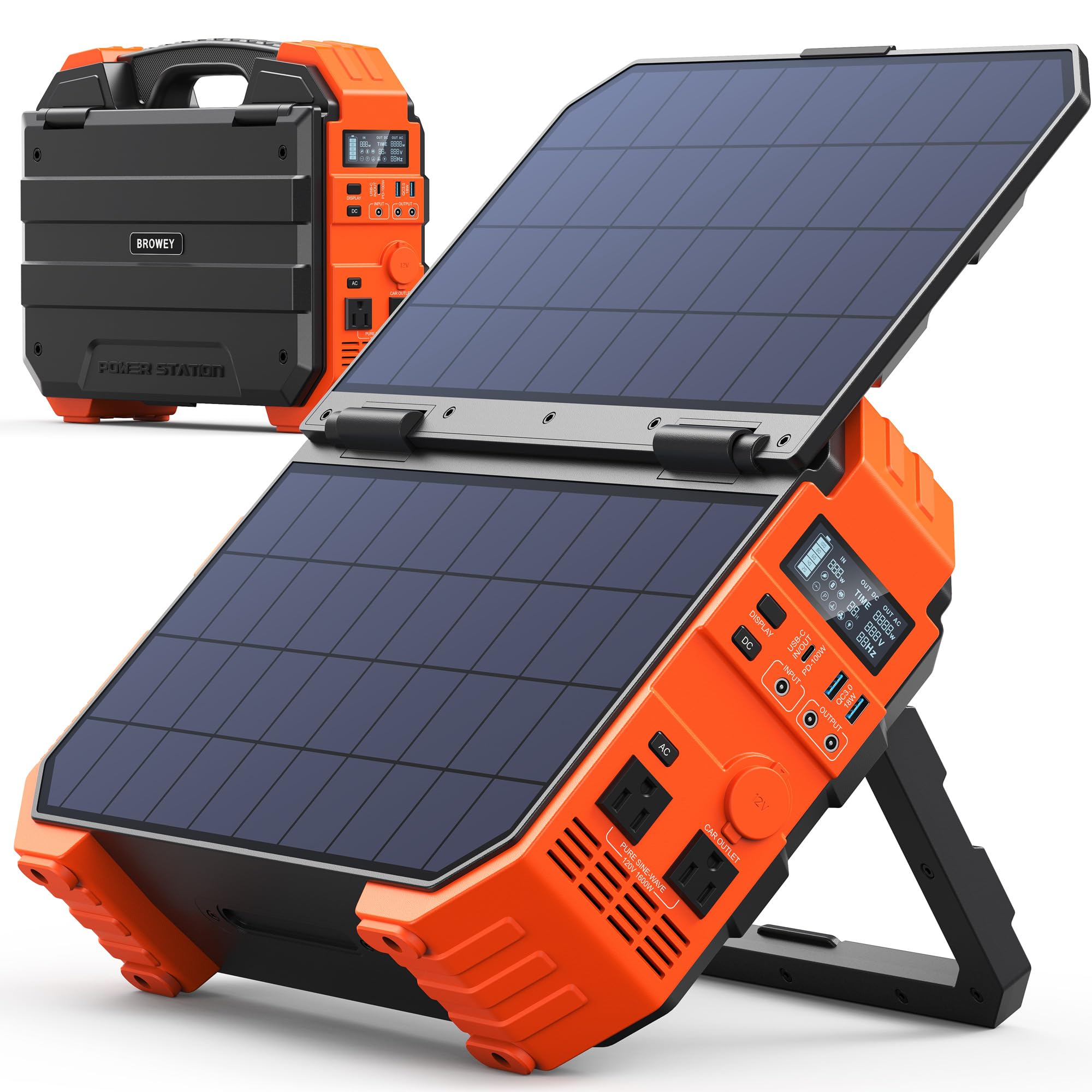
The generator that carries its own solar panel right in the lid.
What sets this one apart is the built-in 40W solar panel and MPPT controller folded into the body — you do not have to remember a separate panel, which makes it the easiest of the group to grab for camping, fishing, or a day in the RV. It packs a 1024Wh LiFePO4 battery and a 1600W pure sine wave output with a 3200W peak, so it handles a refrigerator or a CPAP machine with room to spare, and the extra external panel port lets you push solar input up to 200W when you want faster top-ups.
Reliability is what owners keep coming back to. It is well-built, holds its charge, and several describe powering a fridge right through an outage. One owner reported running a refrigerator, a washing machine, a window AC unit, an e-bike, and a lawn mower from it without tripping anything — the kind of headroom that makes it a genuine household safety net rather than a phone charger. Recharging takes about 3 hours to hit 80 percent through the AC adapter and 100W USB-C port together.
Charging speed is the aspect buyers rate most unevenly, so set expectations: the built-in panel is a trickle source meant to keep things topped up in the field, and a couple of owners did report units needing a warranty replacement — the maker honored those. Weighing 26.5 lb and carrying an iF Design Award nod, it stays easy to move for its capacity.
high surge wattage: the all-in-one design turns a two-bag chore into a single lift, and the 3200W peak gives real appliances the jolt they need to start.
solar recharge slow: the 40W panel onboard is a keeper-upper, not a fast charger — for quicker refills, side in an external panel or use the wall.
power tools: campers, fishers, and RV owners who want one grab-and-go box with the panel already attached.
solar reliant: someone chasing maximum solar input on a fixed array — step to a unit with a larger MPPT ceiling.
5. Portable Power Station 2400W Solar Generator for Home Use (GRECELL Acc2400)
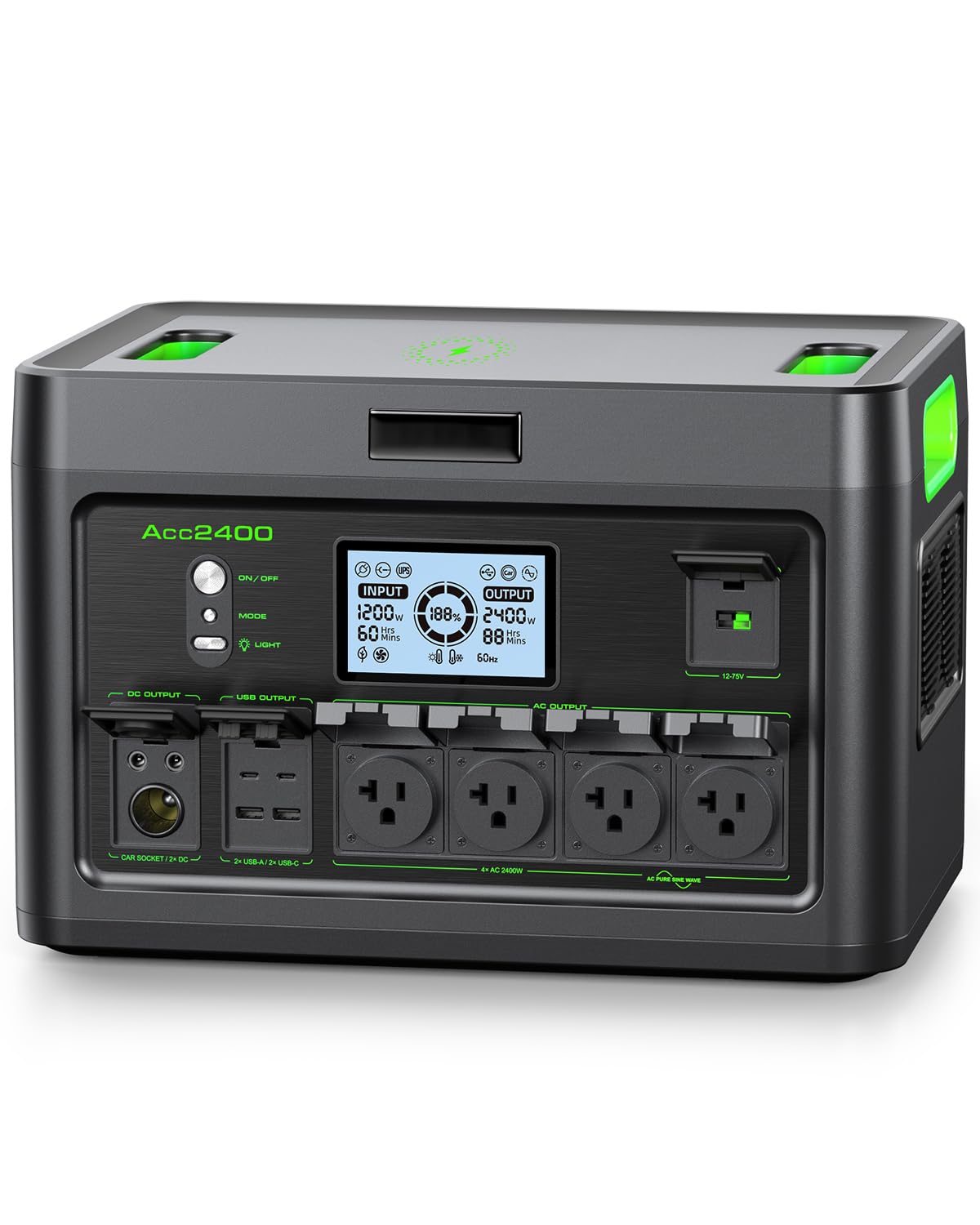
Big inverter, twelve outlets, and a two-hour wall refill for serious household loads.
This GRECELL unit is built for someone who wants to run the heavy stuff — workshop tools, kitchen appliances, and a window air conditioner — without a parade of adapters. The 1843.2Wh LiFePO4 battery feeds a 2400W output and pure sine wave power, and there are twelve ports in total, including four 2400W AC outlets, two 100W USB-C PD ports for laptops, two 18W Quick Charge USB-A ports, DC sockets, a 12V car port, and even a 10W wireless charging pad on top. It acts as a true UPS, switching to battery in 0.1 seconds when the grid drops.
Recharge speed is the standout: with bidirectional inverter technology it refills fully from a wall outlet in 1.6 to 2.5 hours with no bulky brick, and if you combine 800W MPPT solar with AC you can finish in as little as 1.8 hours. Buyers report it holding charge for days, charging phones and tablets quickly, and running a fan and laptop with ease; one buyer even confirmed it running a sump pump’s main AC motor showing 433W on the display.
The one feature some buyers find hit-or-miss is the wireless charging pad — a couple of owners reported it not working, though everything else performed. The onboard LiFePO4 cells are rated for 3500-plus cycles, and smart cooling fans boost heat dissipation to keep it steady under load. At 55.5 lb, plan on setting it where you need it rather than carrying it around.
home emergency: you want a high-wattage hub with enough outlets to run a workshop bench or a small kitchen all at once.
camping only: wireless top-up charging is a must — that pad is the weak point owners mention.
6. 2400W Portable Power Station with 200W Solar Panel 1843.2Wh Solar Generator (GRECELL)
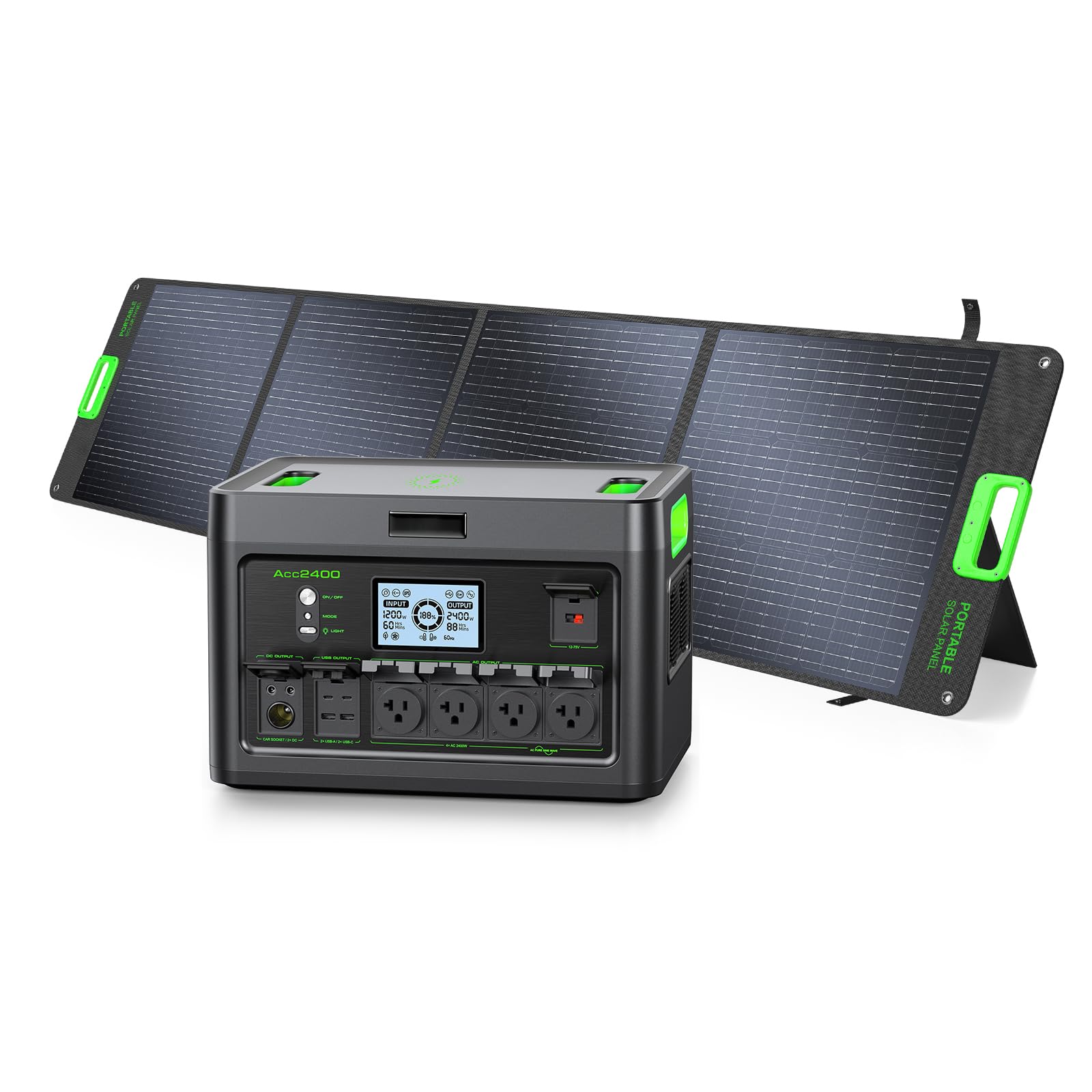
The same stout core, now with a folding panel in the box.
This is the panel-included version of the GRECELL station above, and it is the pick for anyone who wants to open one box and be solar-ready rather than hunting for a matching panel later. The core is unchanged: an 1843.2Wh LiFePO4 battery with a 2400W pure sine wave inverter and a 4800W surge, enough to run refrigerators, microwaves, coffee makers, power tools, and window AC units. The bundled 200W panel uses monocrystalline cells in a six-layer ETFE lamination rated for up to 23.5 percent conversion efficiency.
Charging flexibility is the whole point of the bundle. The station refills from 0 to 100 percent in as little as 1.6 to 2 hours on a standard wall outlet, and faster still when you combine panels with AC. The panel itself ships with an MC-4 to 4-in-1 cable carrying XT60, Anderson, DC7909, and aviation connectors, so it plays nicely with a range of generators — and, with a separate controller and clips, it can top up 12V batteries too. Owners rate the build quality highly and like that the case is easy to carry and store.
Battery life is the most uneven aspect in owner feedback — some find it charges beautifully while others wish it were more powerful for their loads — and one solar-focused buyer found daily top-ups from the sun slower than hoped, recommending AC charging for anything substantial. The 200W panel is best thought of as a complement, not a full replacement for the wall.
solar panel bundle: the bundled 200W panel and its multi-connector cable remove the compatibility guesswork that trips up first-time solar buyers.
panel efficiency modest: solar top-ups are a slow trickle compared with the wall, so treat the panel as a backup-to-the-backup, not your main refill.
rv trips: buyers who want generator and panel in one purchase and value the broad connector set for future flexibility.
station only: you already own panels — the core unit sells on its own and you would be paying for a panel you have.
7. BLAVOR 1600W Solar Generator, 1024Wh Power Station with Built-In 40W Panel

A briefcase-sized power bank that unfolds its own panel when you stop to rest.
For road trips, fishing, and off-grid overnights, the Blavor earns its spot by being one of the lightest ways to carry a serious battery. It weighs 26 lb and unfolds a built-in 40W solar panel, so there is no separate panel to pack, and its 1024Wh LiFePO4 battery is rated for 4000-plus cycles. The 1600W output with 3200W peak runs a mini fridge, laptops, phones, and lights quietly, and an external-panel port accepts up to 200W if you want to charge faster.
Owners like the smart design — a sturdy build, a carry handle, and a step-down fold-out panel that doubles as its own stand. It runs cool while working, stays easy to transport, and the bidirectional 100W USB-C port fast-charges a laptop as well as it charges from the wall. A real standout is the runtime: one buyer ran a 26 cubic foot refrigerator for about five hours on a charge, which puts it firmly in the genuine backup category rather than the gadget tier.
Solar expectations deserve a candid note. The built-in 40W panel is genuinely a trickle charger — a winter buyer measured only about 25 to 28W of input in direct sun and found the cooling fan eating into what little it collected. That is the nature of a panel this size; used as a maintainer alongside wall or external-panel charging, it is a convenience rather than a shortfall.
tailgating: travelers who want one tidy case that holds power and can slowly top itself off in the sun.
high power needs: you expect meaningful solar refills from the onboard panel — treat it as a maintainer, not a charger.
8. Anker SOLIX S2000 Portable Power Station, 2,010Wh, 3,000W Peak, Home Backup
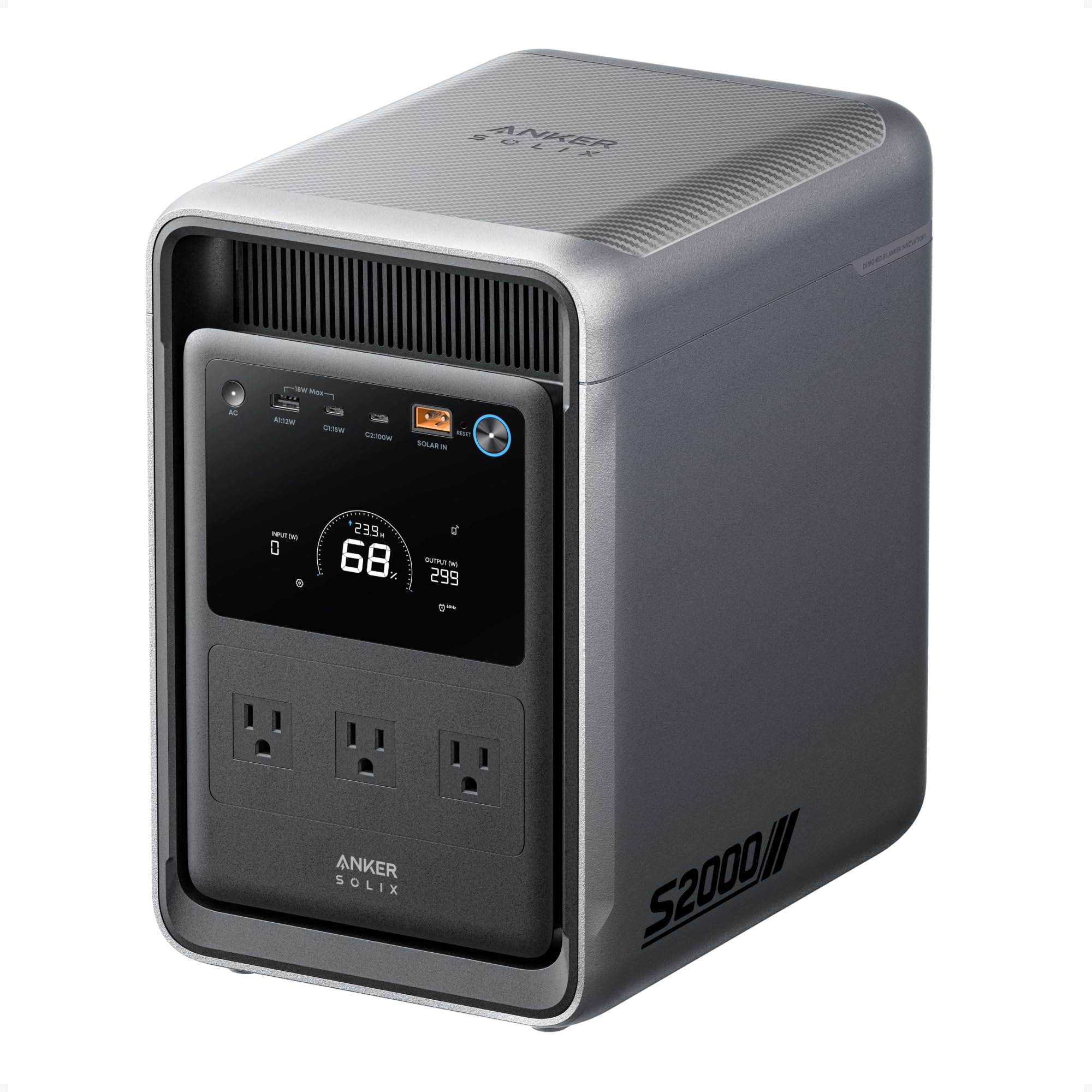
The rare 2kWh box that hides behind a couch and still keeps a fridge cold for a day and a half.
If space is your constraint, this Anker is the one to notice. It packs a 2,010Wh LiFePO4 battery into a body measuring just 8.2 by 11.1 by 12.7 inches and weighing 35.7 lb, which the maker calls the smallest and lightest 2kWh station in its class. A 6W idle draw and high efficiency let it run a refrigerator for up to 35 hours on a single charge — a claim owners back up in practice, with several reporting their fridge running well past a full day and still holding charge.
The battery is built for the very long haul: 314Ah LFP cells rated for 10,000 charge cycles, which the maker equates to a 15-year lifespan. It offers 1,500W continuous output and a 3,000W peak, six ways to recharge including up to 400W of solar, and eight outlets split front and rear so always-on appliances live at the back. The sub-10 ms UPS switchover makes it a genuine desktop-replacement for a traditional battery backup. What owners rave about most is reliability — this is the unit people trust to quietly do its job through a 13-hour outage.
Two honest trade-offs live here. There is no 12V DC port, so a car-fridge or cigarette-lighter device needs a workaround, and the fan gets noticeably loud during fast charging. Neither undercuts the core strength: for a fridge-and-router setup in a tight space, few units in this group deliver this much runtime from this small a box.
compact high capacity
- 2,010Wh in a body just 8.2 x 11.1 x 12.7 inches
- Up to 35-hour fridge runtime on one charge
- 10,000-cycle LFP cells rated for a 15-year lifespan
- Sub-10 ms UPS switchover for home-office gear
premium price
- No 12V DC port for car-fridge style devices
- Fan is loud during high-wattage fast charging
apartment living: apartment and small-home buyers who need a fridge to survive a long outage but have no room for a full-size generator.
cost sensitive: you rely on a 12V car port — this one leaves that connector off the panel.
9. ABOK Ark3600 Portable Power Station 3600W, 3840Wh LiFePO4 Battery
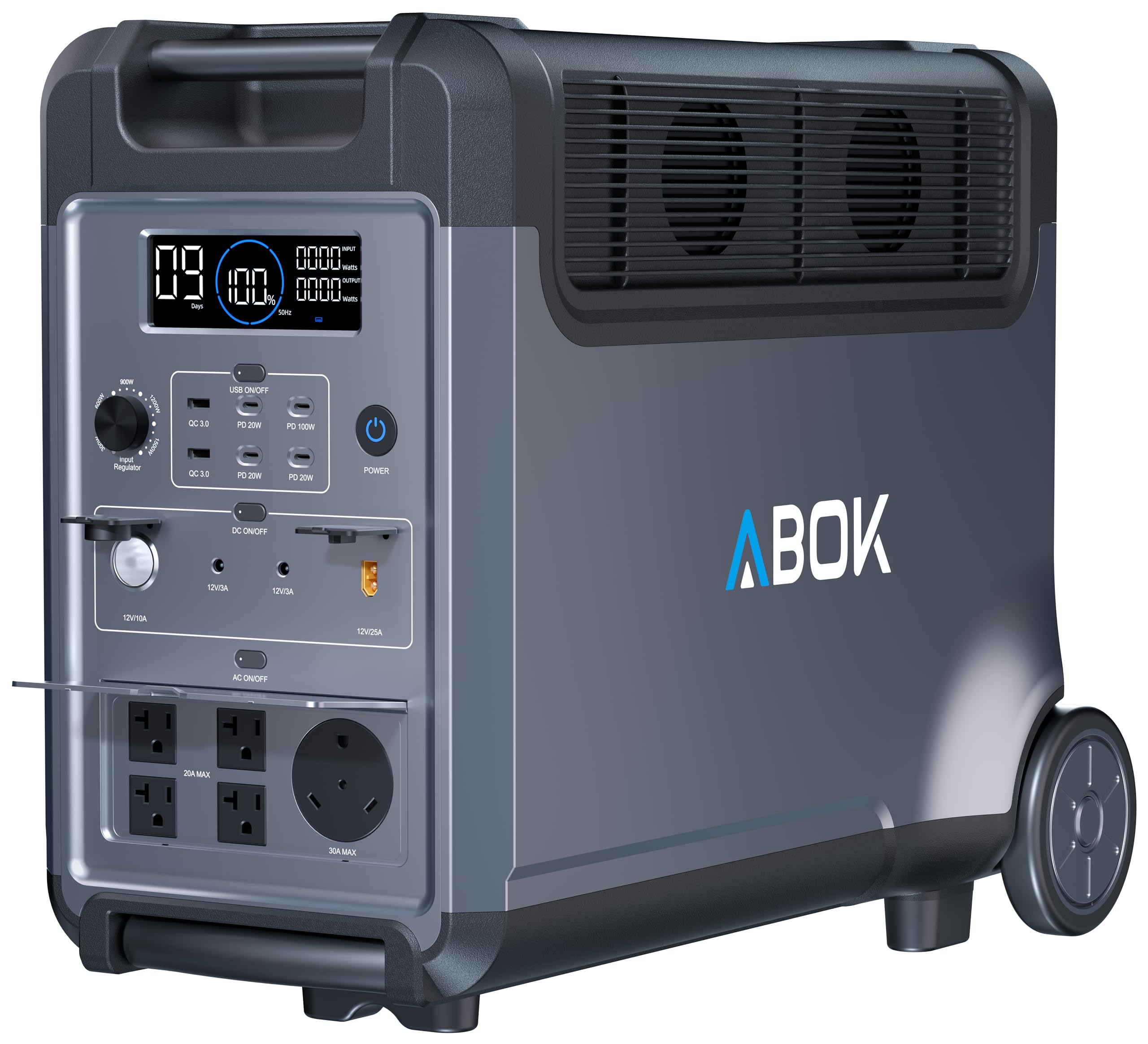
A wheeled power plant for job sites and storm season that rolls where you need it.
When the load gets serious, this ABOK steps into whole-home territory with a 3840Wh battery that expands to 11520Wh, a 3600W rated output, and 4500W of peak power to start stubborn appliances. It carries fifteen output ports and a combination of AC, PV, and car charging that can refill the battery in about 1.29 hours with AC and solar together. The real differentiator is the design: a telescoping handle and durable wheels turn a 92 lb unit into something you actually roll from the garage to the living room.
The contractor crowd puts it through its paces. One tradesperson ran a wet vac, a heat gun, an SDS-Max drill, tool batteries, and phones simultaneously and ended the day still at 22 percent. Another ran a 58-quart fridge from Saturday morning to Monday afternoon and still had 64 percent left. It even kept a van’s fridge alive through sweltering heat. What wins owners over most is the value — this much capacity and output for the money stands out against bigger-name rivals, and the wheels make the weight a non-issue in practice.
Two limits to keep in mind. The socket plug covers are the weak spot, described as easy to break, and the output is 120V only — no 240V for anyone wiring it into a well pump or similar. Let the tool batteries and portable fridges handle the day and the shortcomings stay minor.
lifepo4 long lifespan: 3840Wh expandable to 11520Wh plus a 3600W inverter puts real appliances — and a full day of job-site tools — well within reach.
heavy weight: the plug covers are flimsy and the unit tops out at 120V, so leave 240V appliances to a different solution.
whole home: your outages are long, your loads are heavy, and you want to roll a large battery to the fridge rather than carry it.
frequent travel: anyone who needs 240V for a well pump or heavy-duty equipment.
10. Jackery HomePower 3600 Plus & 2x200W Solar Panels, 3584Wh, 3600W AC Output
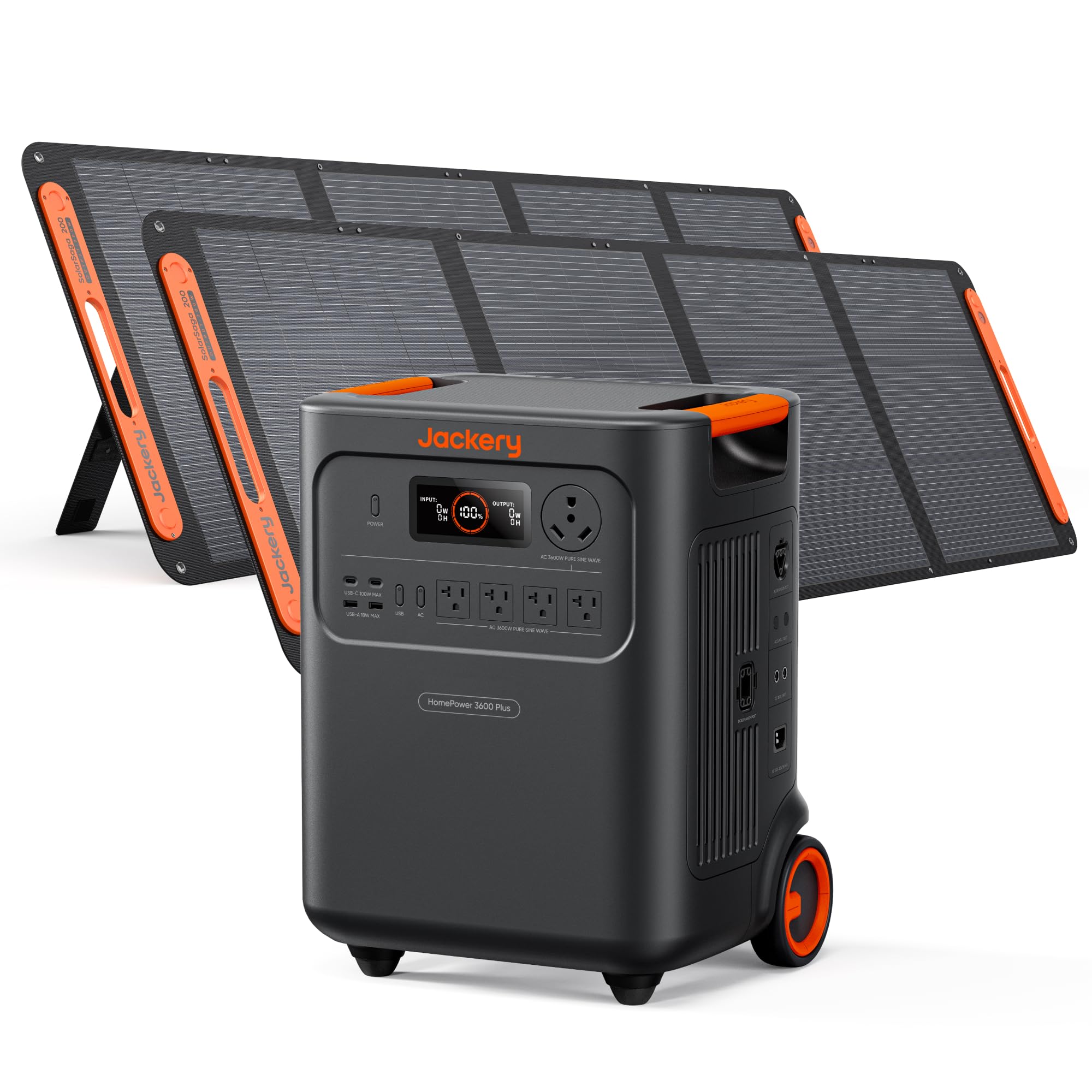
Built to carry a household on its back, then roll quietly back to the corner.
This is the pick for someone who wants a serious pocket of stored energy without the permanent installation of a standby system. The HomePower 3600 Plus delivers 3600W of output, a 3584Wh battery that expands to 21kWh per unit or 43kWh with multiple units, and it comes bundled with two 200W solar panels — so the box is literally ready to catch sunlight. It uses high-temperature ceramic-membrane battery cells, and the maker rates the pack for 6000 cycles and a 10-year lifespan.
In the house it handles real work. Customers note charging it from 0 to 100 percent in about two hours, running a fireplace, a fridge, a freezer, an LED lamp, and an internet box for a full day-plus, and using it as a UPS for a computer and a sump pump. During a storm-season test it powered a fridge freezer, a garage freezer, a Wi-Fi modem, a router, a security system, and cameras through a seven-hour outage on just 18 percent of stored charge. The luggage-style wheels and telescopic handle make the 77.2 lb body surprisingly easy to move — owners describe rolling it like a suitcase.
Two honest notes. Solar refills are slower than the wall, and the panels need positioning and sometimes longer cables to reach good sun. The weight is real too, so an older or smaller person will want to keep it on the ground and roll it rather than lift it. Pair it with the wall for quick refills and the panels for quiet maintenance, and the system stays remarkably capable.
permanent backup: homeowners who want expandable, fume-free whole-home backup that plugs in simply and rolls out of the way.
rental property: wall charging is your fast lane — solar is the slow, quiet top-up, so plan both.
11. Westinghouse WGen14500TFc Tri-Fuel Home Backup Portable Generator
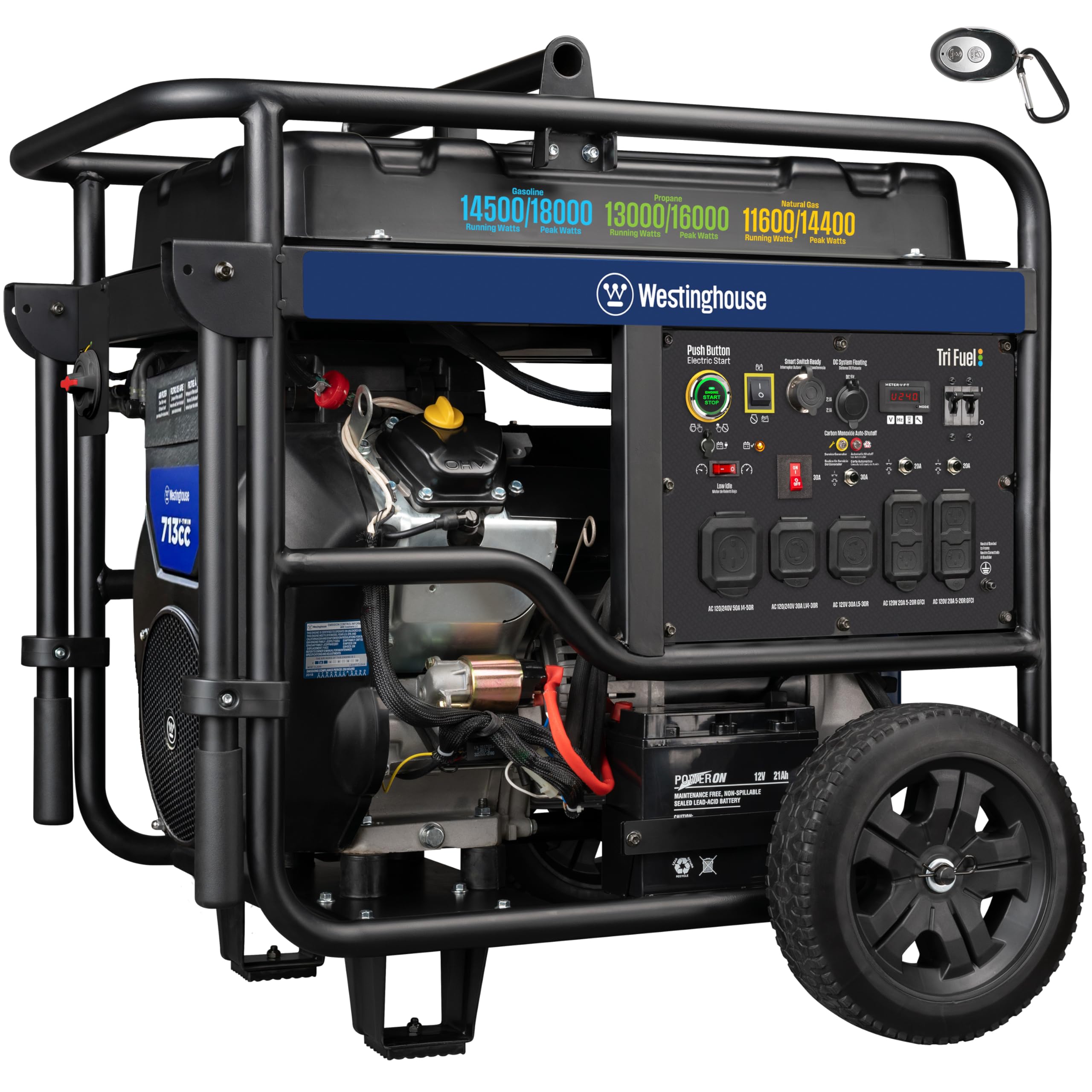
The fuel-burning anchor of the list, for outages that outlast any battery.
This one belongs in the conversation for a very specific reason: when a storm knocks out the grid for days and the sun never cooperates, a battery can only cycle what it has stored. The Westinghouse runs on gasoline, propane, or natural gas — a tri-fuel setup that keeps you going no matter what you can get your hands on. It produces 18,000 peak watts on gasoline with 14,500 running watts, backed by a 713cc V-Twin OHV engine and a 10.5-gallon tank rated for up to 16 hours at 25 percent load. Its outputs are transfer-switch and interlock-kit ready for homeowners wiring it to a panel.
At less than 5 percent THD (total harmonic distortion — a measure of how clean the electrical wave is), it is safe for sensitive electronics like phones, computers, and TVs, and the durable copper windings help it run cooler. Push-button and remote electric start make firing it up straightforward, and features like automatic low-oil shutdown, low idle mode, and a CO sensor with shutdown cover safety. The carbon-monoxide sensor automatically cuts the engine if it detects dangerous exhaust levels nearby. Owners sum it up bluntly: “What a beast of a generator. Powers my whole house.”
The main thing to weigh is the nature of a fuel machine — it needs oil, fuel, and outdoor placement where the exhaust can vent, unlike every battery unit above. Starting performance is the most uneven aspect in owner feedback, so keep it well maintained. For any outage measured in days rather than hours, that trade is worth it.
extended outages: rural and storm-prone homes facing multi-day outages where refuelable, clean-wave power is the only thing that truly covers the whole house.
noise sensitive: you need quiet, fume-free indoor power — a battery station is the safer, simpler fit for that.
Understanding the Specs
Capacity (Wh) — the size of the tank
Watt-hours tell you how much stored energy a station holds. The bigger the Wh number, the longer your fridge and router run before you must recharge. A fridge that cycles on and off draws far less over an hour than a space heater running continuously, so size the battery to the appliances you actually need to keep alive. In this group, capacity ranges from 1024Wh on the compact models to 3840Wh on the wheeled heavyweight, with several strong picks at 2kWh for all-night fridge coverage.
Output (W) and peak — starting what you plug in
Output is the steady power a unit can supply, while peak is the brief surge it handles when a motor or compressor starts. A refrigerator or pump may need a quick spike far above its running watts, so the peak number decides whether that appliance starts at all. Check continuous watts for steady loads like lights and routers, and peak watts for anything with a motor, such as a fridge compressor or sump pump. External panels and hybrid charging keep these stations topped up during an outage, which is the whole point of solar-ready backup.
FAQ
Can a battery power station really back up a solar system?
How many watt-hours do I need to run a refrigerator overnight?
What is UPS switchover and why does it matter for a home office?
Is LiFePO4 better than the older lithium-ion battery for backup power?
Will these stations run a window air conditioner?
How long does a solar top-up take compared with wall charging?
Can a battery station and a gas generator be used together?
Do these power stations need regular maintenance to stay ready?
What size peak watts do I need to start a fridge or a power tool?
Are indoor battery stations safer than a fuel generator for home backup?
Final Thoughts: The Verdict
For most people hunting down the right backup generator for a solar system, the best overall pick is the EF ECOFLOW DELTA 3 Plus because its 10 ms UPS switchover and sub-hour recharge make it the most practical home-office guardian, all from a mid-range frame. If what you need is fridge-and-freezer endurance, the DABBSSON 2000L doubles the stored energy at 2048Wh and runs appliances for hours on end. And when an outage stretches past what any battery can hold, the Westinghouse WGen14500TFc is the refuelable anchor that keeps a whole home alive on gasoline, propane, or natural gas.
Whatever you choose, size it for your longest realistic outage, not the average one. The strongest picks here are the ones reviewers point out running reliably through real outages, so buy before the next storm rather than after it.
How We Picked
We do not accept paid placement. Every pick is matched to a real buyer and a real use-case; we do not hands-on test units.
Sources & Methodology
Specifications: manufacturer listings and product documentation. Review insights: verified customer reviews, as of September 2026. Pricing: not shown on this page (it changes often); check the current price via the retailer link.
As an Amazon Associate, KitchPrep earns from qualifying purchases. This does not affect which products we feature.
Related Guides
