
Specs are compiled from manufacturer listings and verified buyer reviews and can change over time — please confirm the key details on the product page before buying.
A storm rolls in, the grid goes dark, and suddenly the fridge hum, the router light, and the sump pump’s steady beat are the only things standing between you and a very bad week. That is what a home backup generator is really for—not tailgating, not camping, but keeping your daily life running when the utility can’t. This guide sorts through the options to find the backup generator cost for a home that fits your power needs and your budget, from portable workhorses to whole-house standby systems.
I’m Mohammad Maruf — the founder and writer behind KitchPrep. This guide is built by comparing the manufacturers’ published specifications and the patterns across verified customer reviews, so you get each pick’s real strengths and trade-offs instead of marketing spin.
When the grid goes down, you need to know which backup generator will keep your fridge running while staying affordable. These picks balance cost, power, and fuel type so you can match one to your home’s needs.
Our Picks at a Glance


How To Choose The Best Backup Generator Cost for a Home
Before you look at any model, figure out what you actually need to keep running. A fridge, a few lights, and a phone charger is a very different machine than one that also runs a well pump, a furnace, and a window AC unit.
Portable vs. Standby: Know the Trade-Off
A portable generator sits outside, gets wheeled out during an outage, and is hooked up with heavy-duty cords or a transfer switch. A standby generator is installed permanently by an electrician, runs on your home’s natural gas or a large propane tank, and turns on automatically when the power dies. Standby units cost a lot more and require professional installation, but you don’t have to lift a finger when the lights go out.
Wattage: Running vs. Starting
Every motor in your home—like the one in a refrigerator or AC compressor—needs a burst of extra power to start, called surge or peak watts, before settling down to its normal running watts. You need a generator whose peak output can handle the biggest surge and whose running output can handle everything running at once. Most home essentials fall into the 3,000 to 6,500 running-watt range.
Fuel Choice Changes Your Experience
Gasoline is the most common and gives you the most portable power, but it goes bad if stored long-term. Propane stores indefinitely and burns cleaner, but you get slightly fewer watts from the same engine. Natural gas, available only on standby or tri-fuel models, gives you unlimited run time as long as the gas line is intact. Think about which fuel you can actually stockpile before an emergency.
Quick Comparison
| Model | Best For | Running Watts | Fuel Type | Weight | Amazon |
|---|---|---|---|---|---|
| Westinghouse 6500W Dual Fuel★ Best Overall | Whole-home essentials on gas or propane | 5300W (gas) | Gasoline / Propane | — | Amazon |
| WEN 5600-Watt PortableBest Value | Budget-conscious basic backup | 4500W | Gasoline | 112.4 lbs | Amazon |
| maXpeedingrods 4000W InverterCompact Inverter | Quiet, clean power for sensitive gear | 3200W | Gasoline | 48.5 lbs | Amazon |
| Anker SOLIX S2000 Power Station | Indoor-safe, silent battery backup | 1500W | Battery (LFP) | 35.7 lbs | Amazon |
| WEN 6800W Dual Fuel Inverter | Cleaner power with electric start | 5100W (gas) | Gasoline / Propane | 99.2 lbs | Amazon |
| DuroStar DS13000MX | Heavy-duty whole-home power | – | Gasoline / Propane | — | Amazon |
| DuroMax XP12000E | High-output 120V/240V flexibility | 9500W | Gasoline | 217 lbs | Amazon |
| Jackery HomePower 3000 + Solar | Solar-rechargeable, silent backup | 3600W | Battery + Solar | 59.5 lbs | Amazon |
| Westinghouse iGen12000TFc | Tri-fuel whole-home inverter power | 9000W (gas) | Gas / Propane / NG | 191 lbs | Amazon |
| Generac Guardian 10kW | Permanent, automatic whole-home backup | 10,000W | Natural Gas / LP | — | Amazon |
| Generac Guardian 26kW | Maximum whole-home automatic power | 26,000W | Natural Gas / LP | — | Amazon |
In‑Depth Reviews
1. Westinghouse 6500 Watt Dual Fuel Home Backup Portable Generator
Our pick — over 4.5★ from 950+ verified ratings; the strongest balance of quality and price.
The do-everything home backup that runs 14.5 hours on gas or propane.
This Westinghouse is the pick of the bunch because it nails the two things a backup generator must do: keep running for a long time and let you choose your fuel. Gasoline gives you 5300 running watts and 6500 peak watts, while propane delivers 4800 running and 5800 peak, so a 4.7-gallon tank with a fuel gauge keeps the lights on for up to 14.5 hours. That beats the WEN 5600 below, which tops out at 12.5 hours on a full tank.
The 274 CC four-stroke engine with a cast iron sleeve is built for years of service., and it has automatic low-oil and carbon monoxide (CO) shutdown—so it kills itself rather than risk your family’s safety. The panel covers every wiring scenario: a household duplex receptacle, an RV-ready TT-30R 30-amp outlet, and a transfer-switch-ready L14-30R 30-amp outlet, all with rubber covers. It even arrives with oil, a funnel, a propane hose, and a wheel kit in the box.
Buyers report it started right up on the first pull and ran an entire 30-amp RV including the air conditioner. The only honest caveat is the noise—it’s a conventional open-frame unit, so it hums along louder than an inverter model, which matters less when the alternative is a dark, hot house.
Why It Wins
- Dual fuel gives you flexibility—gas for max power, propane for clean, storable fuel.
- Cast iron sleeve engine and CO sensor for long life and safety.
- 14.5-hour run time from a 4.7-gallon tank.
Who Should Skip
- Loud by inverter standards—not ideal for quiet neighborhoods.
- At over 100 pounds, it needs the wheel kit to move around.
Reach for this if: you want one generator that powers your fridge, sump pump, and lights for days on either fuel.
Think twice if: you need whisper-quiet operation for close neighbors.
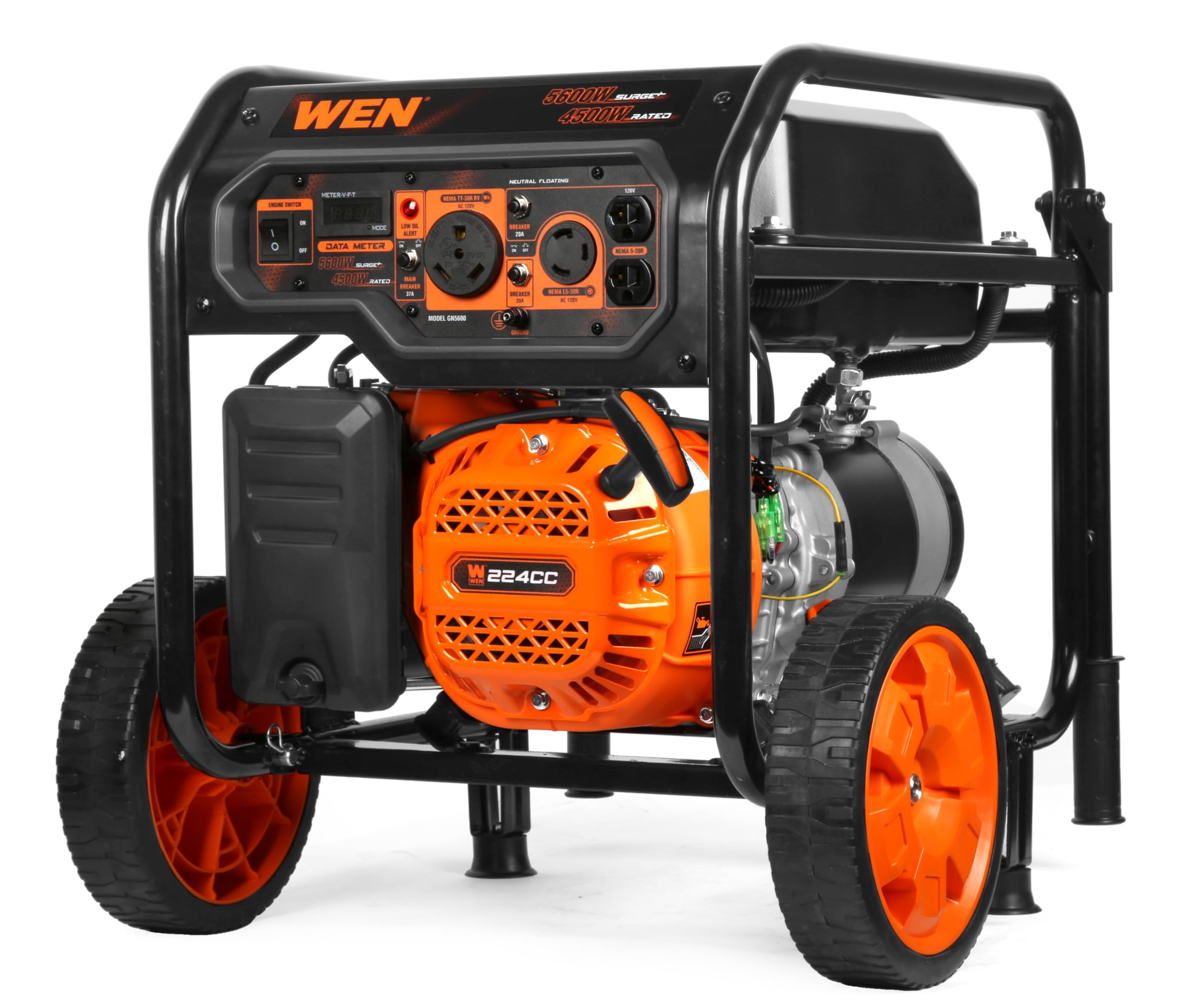
2. WEN 5600-Watt Portable Generator (GN5600)
The budget workhorse that cranks first pull, even after months of daily use.
If you want dependable backup power without spending on features you won’t use, the WEN 5600 is it. It delivers 5600 starting watts and 4500 running watts—enough for a fridge, lights, and a window AC—from a 4.3-gallon gas tank that stretches to 12.5 hours at half load. The panel includes two standard 120V outlets, an RV-ready 30-amp TT-30R outlet, and a transfer-switch-ready NEMA L5-30R twist lock receptacle.
You can move this 112.4-pound unit from storage to the yard thanks to the included wheel and handle kit. One off-grid owner runs it daily to charge trailer batteries and reports it “cranks first pull 99% of the time.” The 224cc compliant engine is backed by a three-year limited warranty, so you get coverage if something goes wrong.
The catch is it runs on gasoline only, so you’ll need to keep fuel fresh and on hand. A few owners found it heavier than expected, and one recommended running a fuel treatment through the first tank to prevent surging.
The Strengths
- Reliable first-pull starting, even after 9 months of daily use.
- Transfer-switch-ready outlet lets you power hardwired circuits.
- Long 12.5-hour run time on a single tank.
The Trade-Offs
- Gasoline only—no propane option for long-term storage.
- Heavy at 112.4 pounds; plan for rolling it on the included wheels.
Best for: first-time buyers who want a proven, affordable generator for weekend outages.
Not ideal for: anyone who wants fuel flexibility or an ultra-quiet inverter.
3. maXpeedingrods 4000 Watt Inverter Generator with Bluetooth
A featherweight 48.5-pound inverter that runs your sensitive electronics cleanly.
This is the generator for people who care about their laptop, TV, and phone as much as their fridge. It produces 4000 peak watts and 3200 running watts of clean power—meaning the electricity is smooth enough for sensitive electronics without the flicker you get from cheaper units. At just 48.5 pounds, it’s less than half the weight of the WEN 5600 above, a 2.3x gap that makes it genuinely easy to lift into a truck or carry to a campsite.
The standout feature is the Bluetooth app, which shows you power output, fuel level, voltage, frequency, and run time right on your phone. You can even switch ECO mode on and off from the app to save fuel. Owners mention it “maintains 3100-3150W, peaks 3900W” and runs a 13,000 BTU AC for hours very quietly.
The honest downside is the app can be finicky to connect, and the compact 145 cubic centimeter engine means you’re getting less raw power than the bigger units. One owner warned the electronic choke can be a problem if the battery dies, so keep an eye on the battery health between uses.
What Stands Out
- Clean inverter power keeps laptops and phones safe.
- Bluetooth app tracks fuel, output, and run time remotely.
- Lightweight 48.5-pound design with a 145cc engine.
What Holds It Back
- App connectivity can be unreliable for some users.
- Less raw power than non-inverter units of similar price.
Choose this if: quiet operation and clean power for your devices matter more than maximum wattage.
skip it if: you need to run big 240V appliances or a central AC.
4. Anker SOLIX S2000 Portable Power Station
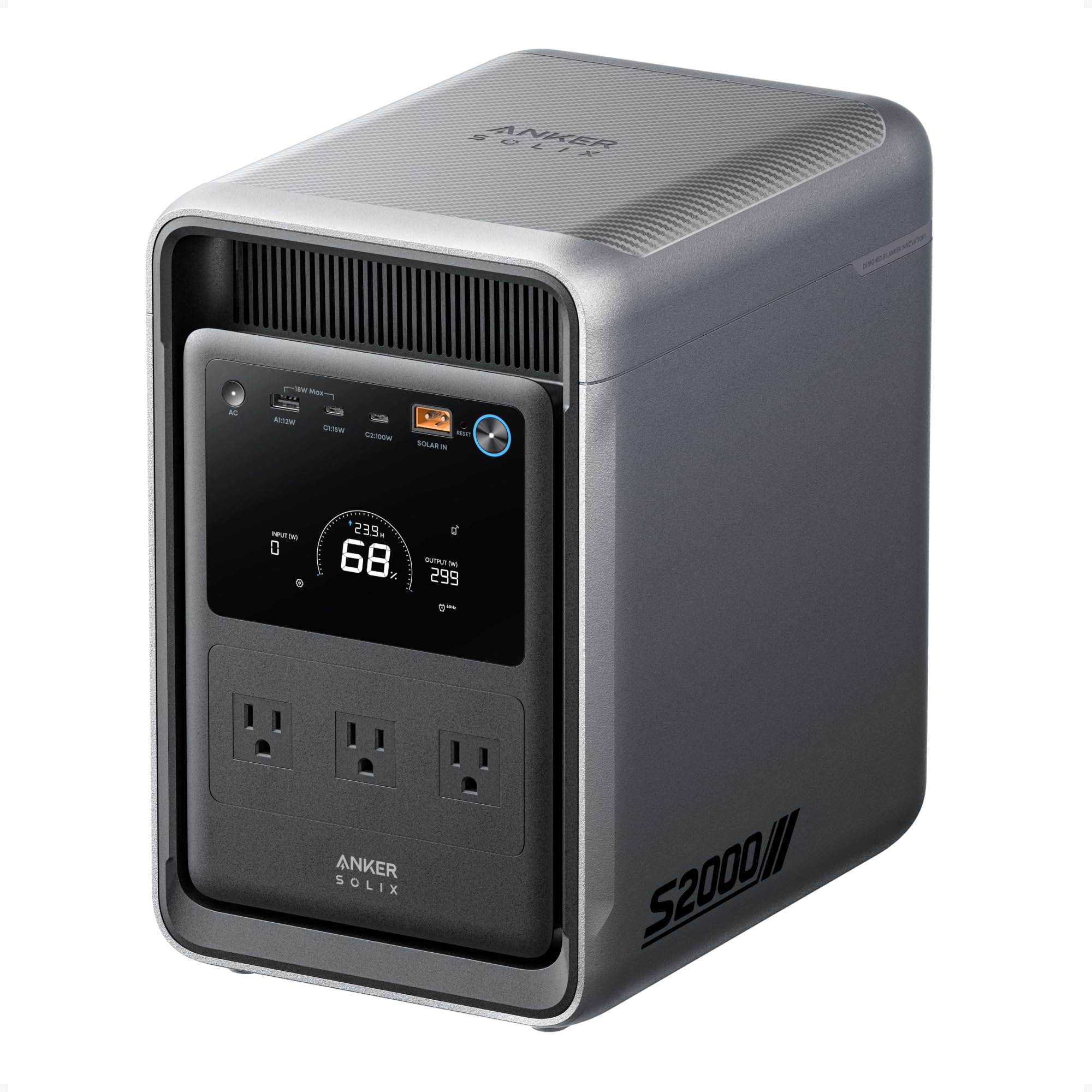
The silent, fume-free battery backup you can run safely inside your house.
Here’s the big difference: this is a battery, not a gas engine, so you can run it indoors with zero fumes and zero noise. With a 2,010Wh capacity and 1,500W continuous output (3,000W peak), it powers 99% of home essentials, and its efficiency means a fridge stays cold for up to 35 hours on a single charge. It’s also remarkably portable at just 35.7 pounds, making it the easiest unit here to carry from room to room.
The 314Ah LFP cells are rated for 10,000 charge cycles, translating to roughly a 15-year lifespan. It recharges in six ways, including up to 400W of solar input, so you can top it up from the sun during an extended outage. Eight outlets spread across the front and rear keep your setup tidy, and the UPS mode switches over in under 10 milliseconds, so a connected computer never blinks during an outage.
The trade-off is capacity, not power—at 1,500W running, you can’t run a central AC or a well pump. Owners found the fan a bit noisy during fast charging, and there’s no 12V DC port for car accessories. But for keeping the fridge, router, and phones alive overnight in silence, it’s exceptional.
The Big Wins
- Silent and fume-free—safe to run inside.
- 10,000-cycle LFP battery lasts years.
- 35-hour fridge backup in a 35.7-pound package.
The Limits
- 1,500W running output won’t handle big appliances.
- No 12V DC port for car accessories.
Perfect for: apartment dwellers, office workers, or anyone who can’t run a gas generator safely.
Not for: whole-home power or running 240V appliances.
5. WEN 6800-Watt Dual Fuel Electric Start Inverter Generator (DF680iX)

Inverter-clean dual-fuel power with push-button electric start.
You get clean, quiet power from this WEN because it’s an inverter generator (a type that produces stable electricity safe for sensitive electronics). It runs on two fuels: 5100 rated watts on gas (6800 surge) or 4500 rated watts on propane (6000 surge), enough to run a fridge, lights, and a window AC. The electric start means you won’t pull a cord in the cold and dark.
A unique feature here is the bonded-neutral 240V configuration, which provides low-power Level 2 charging for battery and hybrid electric vehicles—something you won’t find on most portables. The WEN Watchdog CO Shutdown Sensor automatically kills the engine if dangerous carbon monoxide builds up, and the fuel shutoff burns the carburetor dry before stopping, which extends engine life and cuts maintenance. It’s ready to roll with onboard wheels, a telescoping handle, and a six-foot LPG regulator hose.
Owners say it “ran both A/C’s 15,000 BTU” on a 30A plug and is quiet at 25 feet. The recurring feedback is that it’s heavy at 99.2 pounds and the noise is mixed—quieter than an open-frame, but not silent. A few noted reliability issues after months of heavy use, so regular maintenance matters.
Why It Impresses
- Electric start with remote for cold, dark mornings.
- 240V bonded-neutral for EV Level 2 charging.
- CO Watchdog shutdown protects your family.
The Catch
- At 99.2 pounds, it’s a two-person lift to load in a truck.
- Dual-fuel inverter tech costs more than a basic portable.
Grab this if: you want inverter-clean power plus the flexibility of propane and EV charging.
Look elsewhere if: you need maximum wattage per dollar and don’t care about clean power.
6. DuroStar DS13000MX 13,000-Watt Dual Fuel Generator

The big 500cc dual-fuel that powers an entire house, including a 3-ton AC.
When your backup plan involves running everything—central AC, fridge, stove, microwave, TVs, water heater—you need the DuroStar DS13000MX. Its 500 cubic centimeter engine delivers 13,000 watts of reliable power, enough that customers note running a 3-ton AC unit without issues. The dual-fuel design lets you choose gasoline for maximum power or propane for longer run times and cleaner emissions, switched with a simple front-facing fuel selector.
Starting is easy with the push-button electric start, or you can use the included remote control from inside the house. The durable all-metal steel frame and reinforced power panel are built to take harsh weather and heavy use for years. Safety is covered with a CO sensor that shuts the unit down automatically if dangerous carbon monoxide levels are detected.
The 50-amp outlet makes it transfer-switch-ready, so you can power your entire home by connecting directly to a transfer switch. Owners who powered their whole house through storms found it quiet and fuel-efficient, though one noted a CO alarm issue that shut the unit down after about 20 minutes despite proper placement—a rare but serious report. Heavy is an understatement here; plan on using the wheel kit or a hand truck.
The Powerhouse
- 13,000 watts runs a whole house, even a 3-ton AC.
- Remote electric start for convenience.
- 50-amp outlet for direct transfer switch hookup.
The Reality
- Massive and heavy—moving it is a project.
- CO sensor can be sensitive; placement matters.
Right for: large homes where a blackout means running central air and major appliances.
Wrong for: small spaces or anyone who can’t handle moving a heavy machine.
7. DuroMax XP12000E 12,000-Watt Electric Start Generator

The 457cc workhorse farmers and homesteaders rely on for heavy daily loads.
The DuroMax XP12000E is a serious machine for serious power needs. Its 457cc OHV engine pushes out 12,000 starting watts and 9,500 running watts, so it easily handles a 3-ton HVAC surge and can power an entire 200-amp house. Owners running it 6 days a week, 8 hours a day at 80% load found the oil stayed clean and it never missed a beat, making it a genuine workhorse for farms and homesteads.
The MX2 technology is the clever part—it lets you choose between running both 120V and 240V simultaneously, or switch to 120V-only to get maximum power from each of the 120V receptacles. That flexibility is a lifesaver when you need to run multiple heavy tools or appliances. Low oil shut-off protects the investment, and idle control drops the RPMs when power isn’t needed, saving fuel and reducing noise on job sites.
At 217 pounds, this is not a portable generator in the camping sense—it’s a stationary power plant on wheels. Owners note it’s loud compared to inverter models, and the battery access is awkward. A few found the rated power at 9500W running rather than the 12,000W the marketing name suggests. But for raw, reliable output, it’s a top contender.
Raw Power
- 9,500 running watts powers a whole home and heavy tools.
- MX2 tech gives full power on 120V or split 120V/240V.
- Idle control saves fuel when demand is low.
Heavy Cost
- 217 pounds—essentially stationary.
- Loud by inverter standards.
- Rated 9,500 running watts, not the 12,000 the name implies.
Best for: homesteads, farms, and job sites that need sustained, heavy-duty power.
Avoid if: you need something quiet or easy to move frequently.
8. Jackery HomePower 3000 with 2x 200W Solar Panels
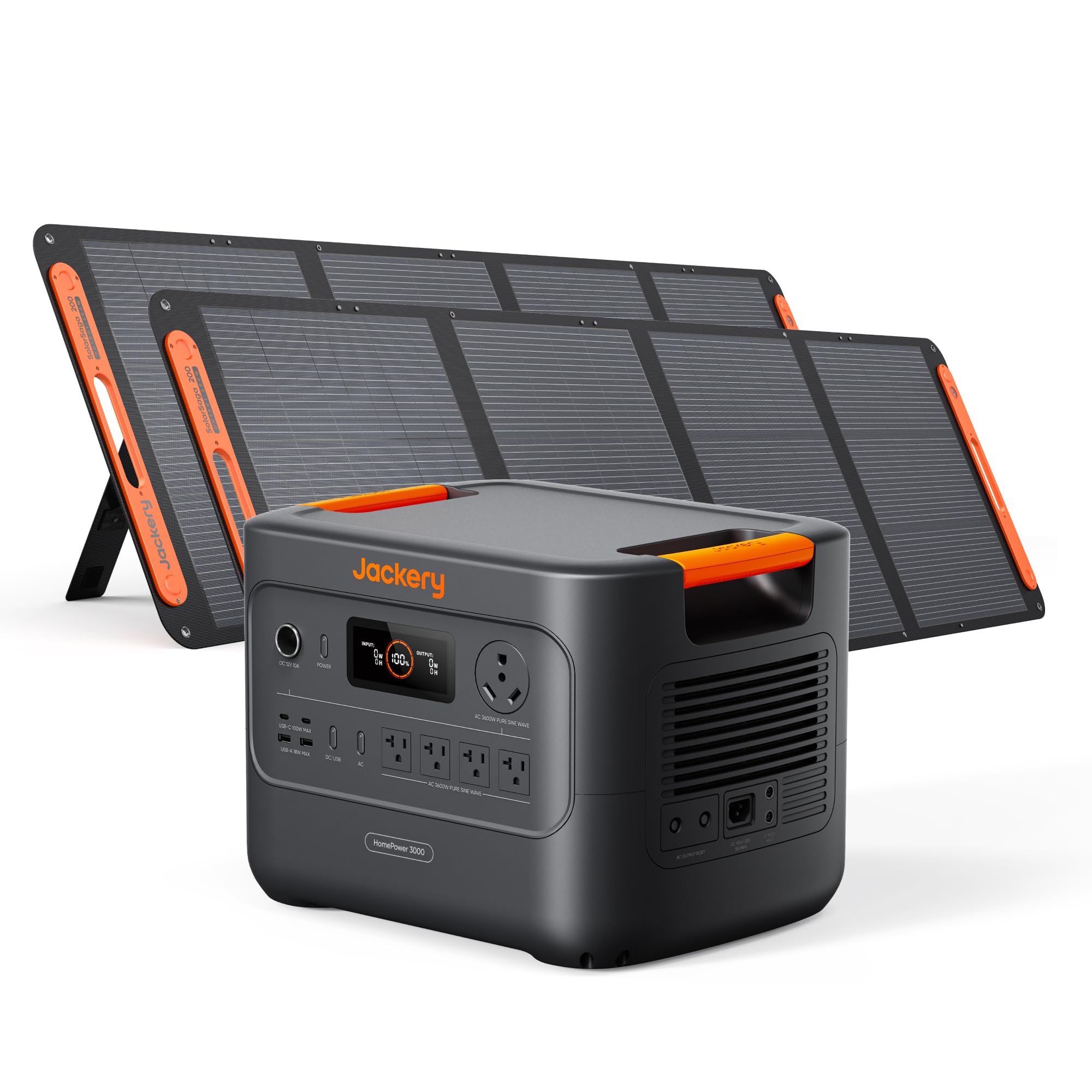
A 3,072Wh solar-charged battery that keeps your home running for up to 15 hours.
The Jackery HomePower 3000 is for people who want backup power that never needs gasoline. With a 3,600W AC output (7,200W surge) and a 3,072Wh capacity, it powers home essentials—fridge, fan, WiFi router, lights—for up to 15 hours, and reviewers point out it kept a refrigerator running for 1 to 2 days. Run it with the included 200W solar panels, and it charges up to 80% in 9 hours of sun.
The UL-certified UPS switches in under 20 milliseconds, keeping security cameras, medical refrigerators, and Zoom calls uninterrupted during outages. The dual 100W PD USB-C ports fast-charge phones and drones, and the built-in TT-30 RV port makes it a plug-and-play companion for camper life. The LiFePO4 batteries retain 70% capacity after 4,000 cycles, making this a decade-plus investment.
The trade-off is that at 59.5 pounds, it’s heavy, and you’ll likely want the optional wheel kit. Some owners found the charging speed mixed, and the solar panel charging in real-world conditions can be slower than the marketing suggests. But for silent, fume-free, solar-rechargeable backup, nothing else here comes close.
Why It’s Different
- Solar panels included—recharge for free from the sun.
- 3,072Wh capacity runs a fridge for up to 2 days.
- Silent, fume-free operation safe for indoors.
The Cost of Convenience
- Heavy at 59.5 pounds; wheel kit is extra.
- Solar charging is slow—plan for full sun days.
Choose this if: you want a clean-energy backup that works indoors and recharges from the sun.
pass on it if: you need 240V power or have a week-long outage without sun.
9. Westinghouse iGen12000TFc Tri-Fuel Inverter Generator
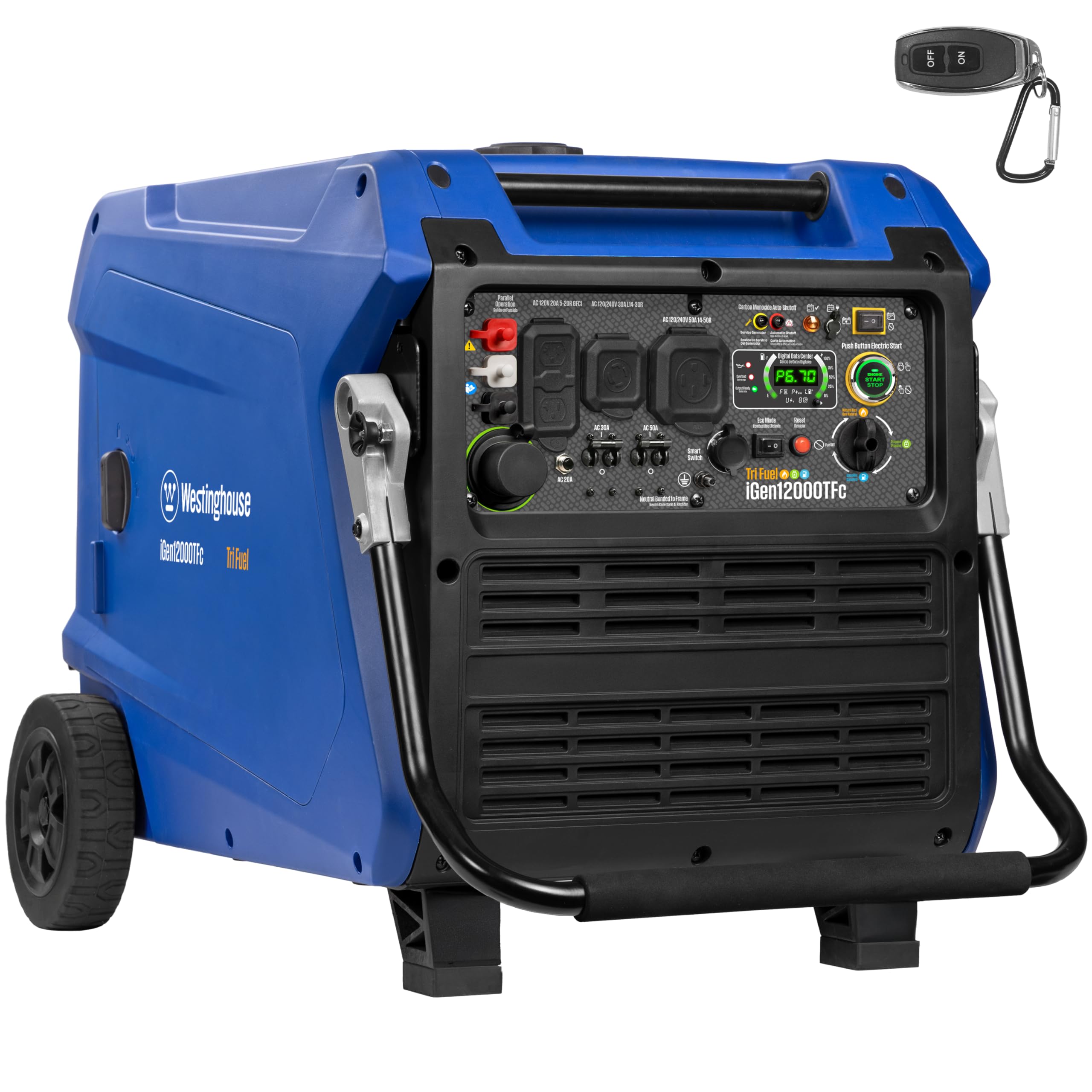
The quiet tri-fuel inverter that’s safe for your electronics and neighborhood.
This is the gold standard for portable whole-home backup. The iGen12000TFc runs on gasoline (12,000W peak/9,000W running), propane (11,000W peak/8,100W running), or natural gas (9,800W peak/7,200W running)—so you can use whatever fuel is available in an emergency, including an unlimited natural gas line. Its inverter tech keeps total harmonic distortion (the electrical noise that can harm sensitive electronics) at or below 3%, making it safe for your TV, computer, and modem.
It’s also remarkably quiet for its size, with insulation and mufflers bringing noise down to as low as 64 dBA—quiet enough for a residential neighborhood. The 457cc OHV engine runs up to 19 hours at 25% load on a 7.9-gallon tank, with inverter tech cutting fuel use by up to 50% versus traditional generators.
The LED data center shows fuel level, power output, remaining run time, voltage, and lifetime hours in real time. It’s transfer-switch-ready with a 14-50R 50A outlet and an L14-30R twist lock, and it’s parallel-capable to double your output. Owners found it “super quiet” and reliable, with the only real gripe being the battery drains while sitting—so keep it on a maintainer between outages.
The Flagship Edge
- Tri-fuel flexibility: gas, propane, or natural gas.
- ≤3% THD keeps sensitive electronics safe.
- As quiet as 64 dBA—neighborhood friendly.
The Premium Price
- At 191 pounds, it’s a serious lift.
- Battery drains while sitting; needs a maintainer.
Worth it if: you want the best of everything—quiet, clean power, and fuel flexibility.
Overkill if: you only need to power a few basics for a night.
10. Generac Guardian 10kW Home Standby Generator

The permanently installed guardian that turns on all by itself when the power fails.
You never have to think about this Generac Guardian 10kW because it’s a standby system—installed permanently outside by a licensed electrician—that powers your home automatically within seconds of an outage. Its 10,000 watts of True Power output runs with under 5% harmonic distortion (a measure of electrical noise), so your electronics stay safe. The 100-amp 16-circuit transfer switch connects directly to your home’s electrical panel.
The Mobile Link Wi-Fi connectivity lets you track performance and maintenance alerts from your phone, anywhere in the world. It runs on natural gas or LP gas, so fuel is essentially unlimited as long as your gas line is intact. The rugged aluminum enclosure is built for years of outdoor use, and it’s proudly engineered and assembled in the USA with a 5-year limited warranty.
One owner reported their previous unit lasted 24 years, underscoring its durability. The catch is the price—significantly higher than any portable—plus installation costs that vary with how far your electrician has to run the wiring and gas line. Owners say it sounds like a power mower from outside, but it’s fine indoors and barely noticeable with a sound barrier.
The Convenience
- Automatic start—no lifting, no pulling, no cords.
- WiFi monitoring from anywhere.
- Runs on natural gas—never refuel.
The Commitment
- High upfront cost plus professional installation.
- Requires a natural gas line or large propane tank.
Ideal for: homeowners who want true hands-off protection and have natural gas available.
Not for: renters or anyone on a tight budget who just wants emergency basics.
11. Generac Guardian 26kW Home Standby Generator
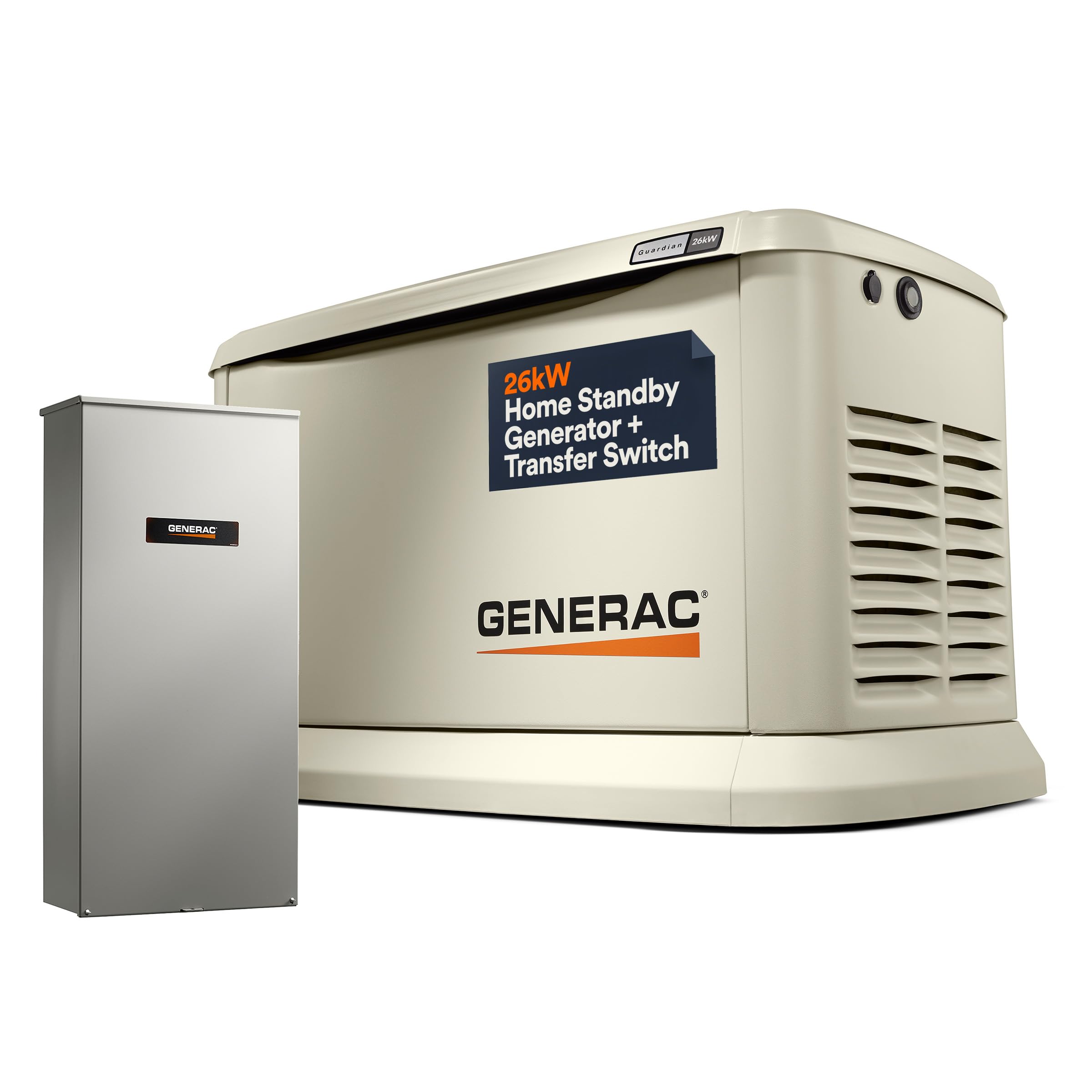
The 26,000-watt automatic system that powers an entire estate, no matter what.
At the top of the heap is the Generac Guardian 26kW, a standby generator designed for the largest homes and the highest demands. Its 999cc G-Force 1000 Series engine delivers 26,000 watts of stable, clean power with under 5% harmonic distortion—enough to run every appliance in a big house simultaneously, including central air, electric water heaters, and a well pump. The included 200-amp transfer switch connects directly to your main panel for whole-home coverage.
Like its smaller sibling, it features Mobile Link Wi-Fi monitoring, letting you track status and maintenance alerts from your phone. The 5-year limited warranty and USA assembly speak to its quality. It runs on natural gas or LP gas, so you never have to store fuel or fill a tank in a storm.
Owners are emphatic—this is “the unit to have at your house,” with one calling it the best investment and buying it for a second home. The realistic downsides are the very high purchase price, the need for professional installation, and the fact that a propane conversion kit and battery are not included. Noise is loud enough to notice from inside, but owners accept it as the sound of the house staying safe and lit.
Ultimate Power
- 26,000 watts powers an entire large home.
- 200-amp transfer switch for whole-panel coverage.
- Automatic start with WiFi monitoring.
The Investment
- Premium price plus professional installation.
- Conversion kit and battery sold separately.
- Moving it requires a lift gate or forklift.
Choose this if: you own a large home and want every system running through any outage.
Consider smaller if: your home doesn’t have heavy electric loads like central AC or electric heat.
Understanding the Specs
Running Watts vs. Peak Watts
Running watts (also called rated watts) is what a generator delivers continuously, and it’s the number that matters most for your daily load. Peak watts (or surge watts) is the extra burst of power needed to start motors in appliances like fridges and AC compressors. Your generator needs enough peak power to handle the biggest surge and enough running power for everything on at once. Add up the running watts of your must-haves, then add the largest surge, to find your minimum.
Dual Fuel and Tri-Fuel Systems
A dual-fuel generator runs on gasoline or propane, letting you choose between maximum power (gas) and cleaner, longer-storable fuel (propane). A tri-fuel unit—found mostly on premium inverter models and standby systems—adds natural gas, which gives you unlimited run time as long as your gas line is intact. Propane and natural gas both store indefinitely, while gasoline degrades after a few months without a stabilizer, so think about which fuel you can actually stockpile.
FAQ
How many watts do I need to run a house on a generator?
What is the difference between a portable generator and a standby generator?
Can I use a generator indoors to power my home?
Is it better to run a generator on gasoline or propane?
Do I need a transfer switch or can I use extension cords?
What does inverter technology do in a generator?
How long can a generator run continuously?
Can I power my RV with a home backup generator?
What is a CO (carbon monoxide) sensor and why does it matter?
What is the difference between a battery power station and a gas generator for home backup?
Do I need electric start or is a pull cord enough?
How much does it cost to install a standby home generator?
Final Thoughts: The Verdict
For most homes, the backup generator cost for a home winner is the Westinghouse 6500 Watt Dual Fuel because it delivers 5300 running watts on gas—enough to keep your home running—plus the flexibility of propane and a 14.5-hour run time. If you need a silent, fume-free option for indoors, the Anker SOLIX S2000 is a battery station that keeps a fridge cold for up to 35 hours. For hands-off protection, the Generac Guardian 10kW starts itself automatically when the grid drops, using your natural gas line.
How We Picked
We do not accept paid placement. Every pick is matched to a real buyer and a real use-case; we do not hands-on test units.
Sources & Methodology
Specifications: manufacturer listings and product documentation. Review insights: verified customer reviews, as of August 2026. Pricing: not shown on this page (it changes often); check the current price via the retailer link.
As an Amazon Associate, KitchPrep earns from qualifying purchases. This does not affect which products we feature.
Related Guides
