
Specs are compiled from manufacturer listings and verified buyer reviews and can change over time — please confirm the key details on the product page before buying.
When the power drops, the first question isn’t about wattage or waveforms — it’s whether your fridge stays cold, your router keeps the internet alive, or your CPAP runs through the night. That’s what a backup battery power supply actually does for you: it buys time, protects your gear, and keeps the essentials running when the grid doesn’t cooperate. This guide breaks down nine very different units — from a 2.5-pound pocket generator to a 41-pound home powerhouse — so you can match the right one to your real-life needs without drowning in spec sheets.
I’m Mohammad Maruf — the founder and writer behind KitchPrep. This guide is built by comparing the manufacturers’ published specifications and the patterns across verified customer reviews, so you get each pick’s real strengths and trade-offs instead of marketing spin.
From a 1,070Wh camping companion to a 2,010Wh home essential, find the right backup battery power supply for your situation with clear, honest comparisons.
Our Picks at a Glance


How To Choose The Best Backup Battery Power Supply
Think about what happens during your next outage. Do you need ten minutes to shut down a computer safely, or ten hours to keep a fridge and a router running? The answer separates the two big families of backup power: uninterruptible power supplies (UPS units) and portable power stations. Each product below fits one of those jobs, so start with your scenario before you compare specs.
Capacity vs. Output: The Two Numbers That Matter
The first is capacity, measured in watt-hours (Wh) — the total energy stored, which tells you how long something can run. The second is output, measured in watts (W) — the maximum power a unit can deliver at any instant, which tells you what it can start. A fridge might draw 150W but spike higher when the compressor kicks on, so you need enough watts to cover the surge and enough watt-hours to cover the hours.
Battery Chemistry: What “Long Life” Actually Means
Lithium Iron Phosphate (LiFePO4) batteries are the current standard for modern units because they handle thousands of charge cycles before degrading. Older lead-acid batteries, found in many traditional UPS units, are cheaper but wear out faster and need more frequent replacement. If you plan to use the unit weekly for years, LiFePO4’s higher upfront cost often pays off in avoided replacements.
UPS vs. Power Station: The Switching Speed Question
A UPS is built to switch to battery in milliseconds — fast enough that a computer never notices the power blinked. Power stations often have an uninterruptible power supply (UPS) mode too, but their real strength is long runtime and portability. If you’re protecting a desktop PC or a NAS from data loss, you want the fast switchover. If you’re keeping a fridge going for a day, you want the large capacity.
Quick Comparison
| Model | Best For | Capacity | Output | Weight | Amazon |
|---|---|---|---|---|---|
| Jackery Explorer 1000 v2★ Best Overall | Camping & heavy appliances | 1,070Wh | 1,500W | 23.8 lbs | Amazon |
| Daran Portable Power StationBudget Champion | Phones & laptops on the go | 89.6Wh | 100W | 2.5 lbs | Amazon |
| APC UPS 600VANetwork Protector | Computer & router protection | — | 330W | — | Amazon |
| CyberPower AVRG900LCD | Multi-device desktop setups | — | 480W | — | Amazon |
| GOLDENMATE 1000VA | Light-duty office electronics | 153.6Wh | 600W | — | Amazon |
| CyberPower OR500LCDRM1U | Rack-mounted network gear | — | 300W | 18 lbs | Amazon |
| LIBRIDS 640Wh | Home backup & CPAP | 640Wh | 600W | — | Amazon |
| DABBSSON 2000L | Whole-home essentials | 2,048Wh | 2,200W | 41 lbs | Amazon |
| Anker SOLIX S2000 | Fridge & long outages | 2,010Wh | 1,500W | 35.7 lbs | Amazon |
In‑Depth Reviews
1. Jackery Explorer 1000 v2 Portable Power Station
Our pick — over 4.5★ from 3,500+ verified ratings; the strongest balance of quality and price.
The versatile crowd-pleaser that goes from campsite to blackout without missing a beat.
The Jackery Explorer 1000 v2 earns the top spot because it runs big appliances and still stays portable. Its 1,500W AC output (the power available from its wall outlets) and 3,000W surge peak (a brief burst for starting motors) handle real loads — buyers report keeping three small fridges, an ice maker, and a fan running for 7-8 hours on boats at anchor, and CPAP users say a full night of use only drains about 20% of the battery. At 23.8 pounds with a foldable handle, you can actually move it, which is why it’s the most-praised pick here with a 4.7-star rating from over 3,500 owners.
The defining feature is the 1,070Wh LiFePO4 battery (a type that handles far more charge cycles than old lead-acid) rated to keep over 70% of its original capacity even after 4,000 charge cycles. Add fast charging via the Jackery App — a one-hour 0-to-100% emergency mode, plus a quieter 30 dB overnight setting — and you’ve got a unit that refills as fast as it drains. The front-mounted AC outlets make it easy to swap devices, and the 100W USB-C PD port charges laptops without their adapters.
What wins people over is the build quality — over 580 owners single it out — followed by charging speed. The honest trade-off: it’s lighter than its big rival, the EcoFlow Delta 2, at 23.8 lbs, but it lacks the 12V barrel ports (round DC plugs) some RVs and radios need, and it only accepts Jackery’s own solar panels for solar input. Reviewers sum it up: “Powers boat at anchor via 110V-to-50A pigtail: runs 3 small fridges, ice maker, fan for 7-8 hours.” It’s not a home-backup replacement — one long-term owner noted it’s not quite enough for a full-time van with a car fridge on week-long trips — but for camping, tailgating, and short outages, it’s the most flexible all-rounder on this list.
Why it wins
- Handles heavy loads like fridges and power tools at 1,500W sustained
- Fast 1-hour full charge in the app’s emergency mode
- LFP battery built for over a decade of regular use.
Know before you buy
- No 12V barrel port for some RV accessories
- Solar charging works only with Jackery’s own panels
The pick for: campers, CPAP users, and anyone who wants one portable unit that can also run real appliances in a pinch.
Look elsewhere if: you need whole-home backup for days, or you already own third-party solar panels you want to use.
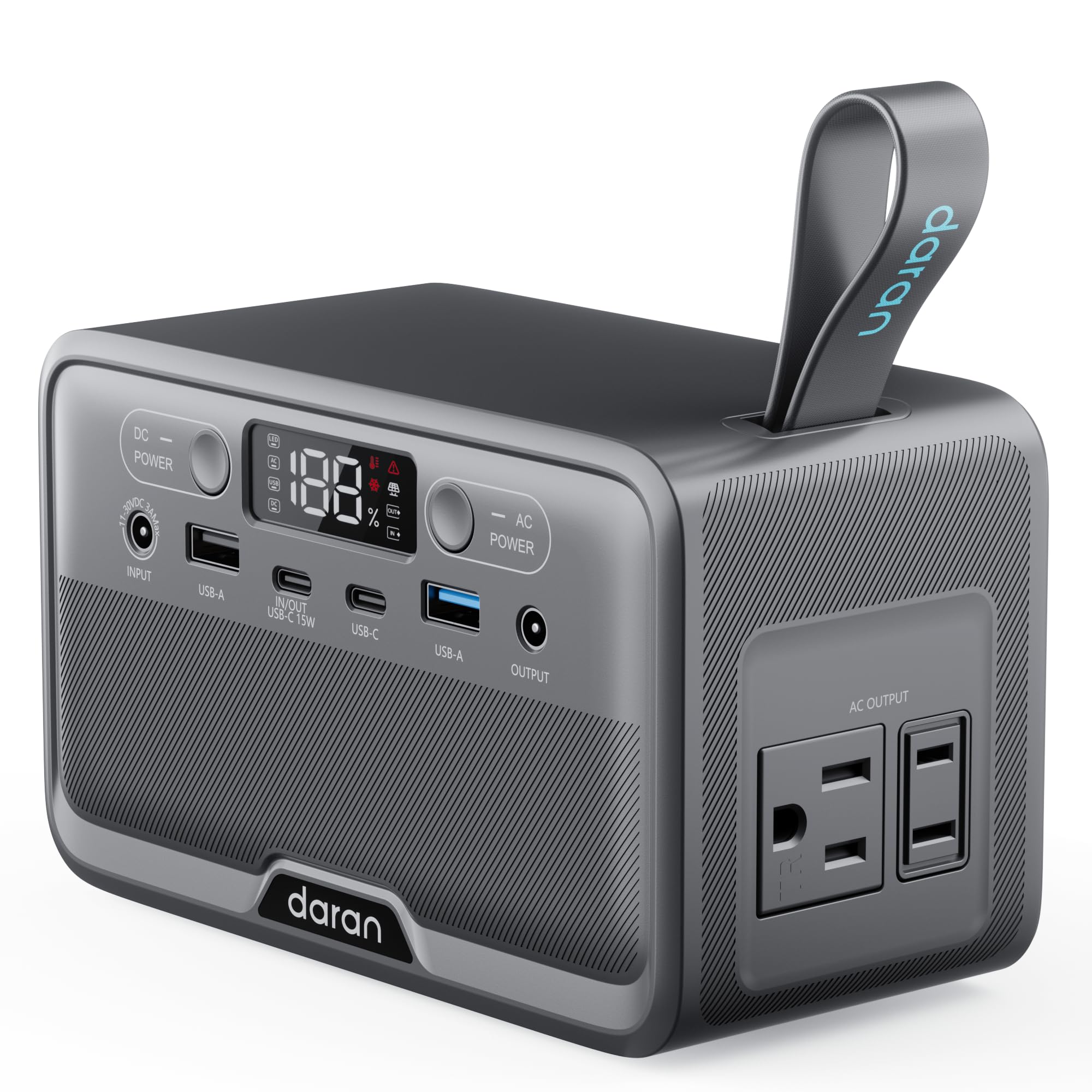
2. Daran Portable Power Station 89.6Wh
The pocket-sized sidekick that disappears into a backpack until you need it.
If the Jackery above is the sledgehammer, this Daran is the scalpel — a featherweight 89.6Wh unit (watt-hours, a measure of stored energy) that weighs only 2.5 pounds, about the size of a smartphone. It sits at the extreme opposite end of the capacity spectrum from the 1,070Wh Jackery (an 11.9x gap in stored energy), and it’s the one you’ll actually toss in a daypack for a hike or a plane ride — its sub-100Wh rating keeps it FAA-compliant for carry-on. It’s the budget-friendly entry point into backup power that still gets the battery chemistry right, with a LiFePO4 (lithium iron phosphate) pack rated for 3,500+ charge cycles.
The quiet operation is the sleeper hit here. It runs fanless, so it’s genuinely silent while charging a laptop or phone in a hotel room or tent. Its 100W output (200W peak) powers laptops, cameras, and a mini-fridge, and there are 7 output ports total — two AC sockets, two USB-C, two USB-A, and a DC5521 port. Owners mention it reliably runs a Starlink Mini over AC for short stops, and one ham radio operator got about 12 hours of use on moderate draw, calling it good value for the capacity.
The trade-offs are real but fair at this size. The fan gets loud during AC wall charging — one owner found it annoying as a UPS for that reason — and recharging the battery is slow by modern standards. Solar input works (the panel is sold separately), even on overcast days per one report. What wins people over is the build quality, with over 180 owners praising it, followed closely by reliability. This is the right backup for one job: keeping phones, tablets, laptops, and small devices alive when you’re away from an outlet — not for running a fridge or powering a desktop through an outage.
Who it fits: travelers, commuters, and light campers who want a silent, carry-on-friendly reserve of power for small gadgets.
Not for: anyone hoping to run AC appliances or keep a computer lab alive — that needs the watt-hours of a bigger station or a true UPS.
3. APC UPS 600VA/330W Battery Backup
The desktop guardian that keeps your PC and router alive through every flicker.
Where the Jackery and Daran are about long portable runtime, this APC is a true uninterruptible power supply (UPS) — the kind that switches to battery in an instant so your computer never blinks during a brownout. It’s built for one primary job: keeping a computer, Wi-Fi router, and NAS running through an outage long enough to either ride it out or shut down safely. At 600VA/330W, it’s sized for a desktop and its peripherals, not for fridges.
The layout is what makes it a desk staple. It packs 7 outlets total — 5 with battery backup and surge protection for your critical gear, plus 2 surge-only outlets for less important items like a printer or lamp. A built-in 1.5A USB port keeps your phone charging even when the power’s out. Customers note it keeps a DSL router, LED light, and a Nest cam running for roughly 3 hours, and one long-time fan said it kept their modem and router up through outages for years.
The smart-money detail is the user-replaceable battery — you swap in an APC RBC154 (a standard replacement battery) when it ages out instead of tossing the whole unit. That’s a big deal because the most-discussed downside is lifespan variance: some units run for years on heavy gaming rigs, others have failed within six months. It also lacks Wi-Fi or app alerts, which one owner docked a star for. The reputation is why it’s among the most-reviewed UPS (uninterruptible power supply) units in its class, trusted by buyers who want the brand that’s kept their gear safe for decades — reviewers sum it up: “The only battery backup brand I’m comfortable using.” If your goal is instant desktop protection with a low long-term cost, this is the proven play.
The strong points
- Instant battery switch keeps PCs and network gear from dropping
- Swappable battery lowers the cost of ownership over time
- 7 outlets with a mix of backup and surge-only ports
Worth noting
- Runtime is short — roughly 23 minutes at a 100W load
- No app or Wi-Fi for remote status alerts
Reach for this if: you want a set-and-forget protector for a desktop computer, router, and NAS with an easy path to replace the battery later.
Think twice if: you’re expecting to power appliances or want hours of runtime — that’s the job of a power station.
4. CyberPower AVRG900LCD Intelligent LCD UPS

The outlet monster that stabilizes a whole workstation through voltage wobbles.
CyberPower’s AVRG900LCD earns its place with one number: 12 outlets. That’s six battery-backed and surge-protected, plus six more surge-only — enough to organize an entire desk of electronics without daisy-chaining power strips. It’s a 900VA/480W UPS, a step above the APC for anyone running multiple machines, a workstation, and networking gear in one spot. The 45-degree offset plug and 5-foot cord make it easier to fit behind furniture without crushing the cord.
The “AVR” in the name is the feature buyers with dirty power actually notice. Automatic Voltage Regulation corrects minor fluctuations — the dips and spikes from a solar array cycling or heavy appliances starting — without ever switching to battery, which preserves battery life for true outages. One owner running on solar/generator power said it “works perfectly buffering power interruptions” with no issues. Data line protection is built in too, shielding phone-line surges from reaching your gear.
Where this one shines over the APC is the software. The free PowerPanel management app lets you configure auto-shutdown, works with Linux, and one owner running a 72W load saw 62 minutes of runtime with a shutdown set at 5 minutes. The catches: the four-digit beeping on battery can get annoying, the LCD is bright, and it won’t power on unless plugged into a wall outlet. It’s backed by a 3-year warranty including the battery and a connected equipment guarantee. For a multi-device desktop or workbench that needs steady voltage and graceful shutdowns, this is the mid-range balance.
Best for: households with fluctuating power and several devices that need both battery backup and clean, regulated voltage.
Watch out for: the bright display and audible alerts — you may want to tuck it away or adjust settings via the software.
5. GOLDENMATE 1000VA/600W Lithium UPS

The modern tower UPS that swaps old lead-acid for a decade of LiFePO4 life.
GOLDENMATE takes the traditional UPS and upgrades the part that usually dies first: the battery. Instead of a lead-acid cell that needs replacing every few years, this 1000VA/600W unit (volt-amps and watts, both power ratings) uses a Lithium Iron Phosphate (LiFePO4) battery rated for 5,000+ charge cycles and a lifespan over 10 years — maintenance-free for up to a decade. That’s the whole value proposition: it’s built to outlast several ordinary UPS units, and it delivers pure sine wave output, meaning clean power that’s safe for sensitive electronics.
It’s noticeably lighter and more compact than lead-acid rivals with the same rating, and buyers praise the looks. One owner running an 185W load of TV, computer, and audio gear got roughly 3 hours of runtime — a number that reflects the 153.6Wh internal battery. The 8 NEMA outlets with surge protection and an intelligent LCD panel showing real-time battery and power status round out a genuinely modern package. A low-noise cooling fan stays under 50 dB and only kicks in during heavy battery use.
The honest trade-offs are scattered through the feedback. There’s no AVR (automatic voltage regulation) and no surge protection built into the battery side, the battery is not user-replaceable, and a few reviewers point out the outlets sit a bit cramped for large plugs. The buzzer can be silenced with a single touch of the multi-function button. Buyers praise the performance most — nearly 190 owners call it out — with value for money close behind. This is the pick for an office or home workspace where you want the longevity of LiFePO4 without buying a full portable power station.
Why choose it
- LiFePO4 battery rated for 10+ years and 5,000+ cycles.
- Pure sine wave output protects sensitive electronics
- Lighter and more compact than lead-acid equivalents
Consider this
- Lacks AVR and surge protection on the battery side
- Battery is non-replaceable — the unit is the lifespan
Grab it for: a tidy home office where you’d rather not fuss with battery swaps for the next decade.
skip it if: you need surge protection for a high-value workstation or plan to oversize your load beyond 600W.
6. CyberPower OR500LCDRM1U Smart App LCD UPS

The shallow 1U unit that slides into a network rack and quietly guards the stack.
For anyone with a home lab or a small network rack, this CyberPower is the form factor that fits. It’s a 1U rackmount UPS (meaning it takes up just one rack unit of vertical space) at 500VA/300W, designed to protect routers, switches, NAS units, and modems. Its shallow depth — about 9.25 inches — fits neatly into small wall-mounted or compact cabinets where deeper UPS units won’t go. One owner loaded it with a UniFi gateway, a router, a Synology NAS, and a fan at 25% load and saw about 32 minutes of runtime.
What makes it a homelab favorite is the Linux-friendly management. Native.deb packages via USB enable graceful NAS shutdown and even weekly self-tests, and the optional RMCARD205 card adds remote network management with outage alerts through a phone app. The four battery-backed outlets plus two surge-only give you room for the whole rack, and the multifunction LCD shows runtime in minutes and battery status so you spot problems before they cause downtime.
The recurring reality check is sizing. At 300W, this is meant for modest loads — one owner running a router, 16-port switch, NAS, mini PC, and fiber modem still got over 20 minutes. But another who pushed it near its limit found the warning beep and returned it for a larger CyberPower model, advising others to size up. Expect a faint plastic smell on first use that dissipates, and give it the recommended 8-hour initial charge. It’s backed by a 3-year warranty including batteries and a connected equipment guarantee. For clean rack protection of network gear with real software support, this is the specialist’s choice.
Built for: homelab owners and small offices with a network rack who want tidy, shallow protection with Linux-native shutdown software.
Not for: heavy loads or full-size servers — keep the draw modest or step up to a larger VA unit.
7. LIBRIDS Portable Power Station 640Wh
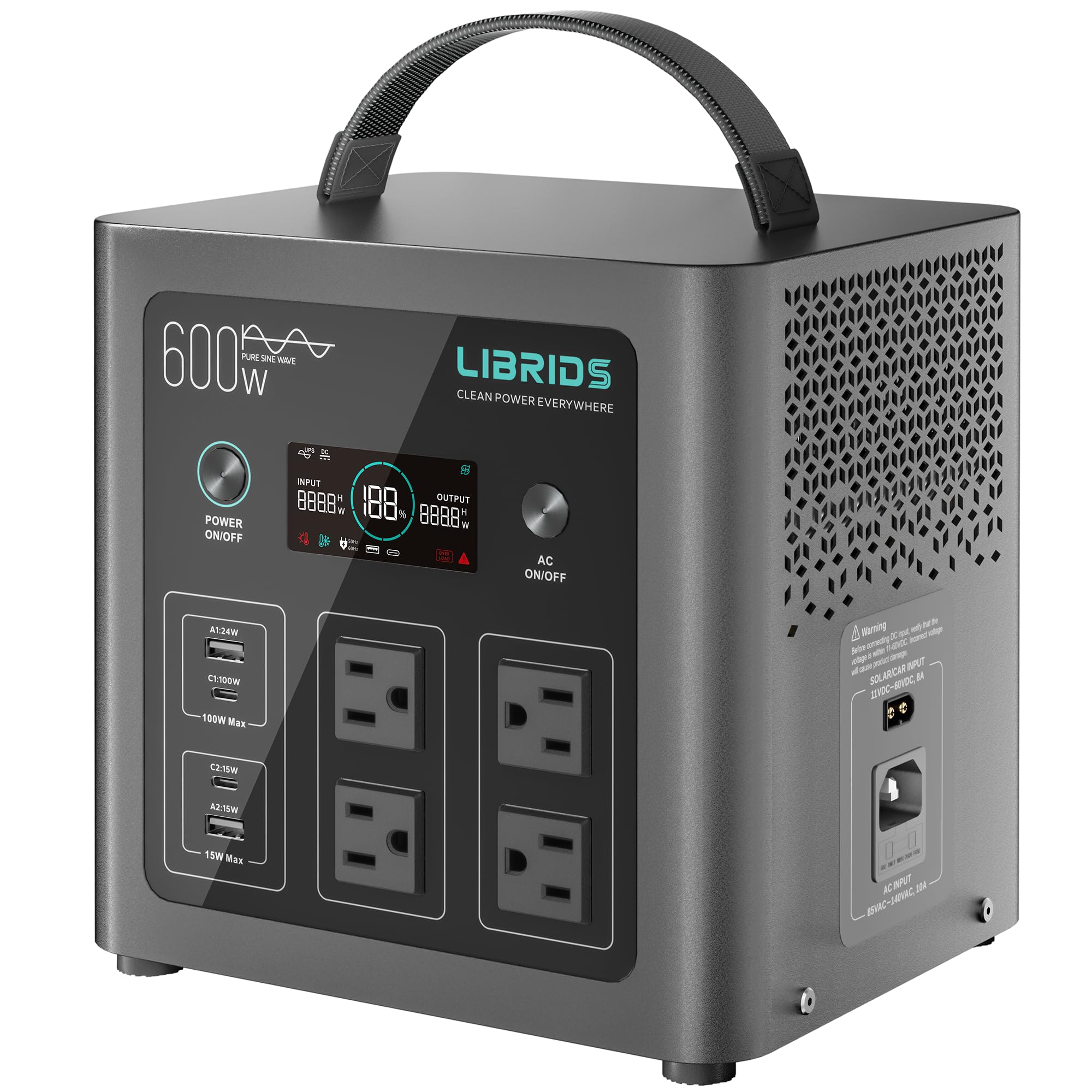
The metal-clad mid-ranger that bridges UPS-speed switching and real portable capacity.
LIBRIDS sits in an interesting middle ground: it’s a 640Wh portable power station with a genuine 10ms UPS mode (milliseconds, the time it takes to switch to battery) — fast enough to keep a CPAP or router running through a blip without interruption — plus enough capacity to matter for an evening. The built-in UPS switchover means it doesn’t just store power for camping; it actively protects essential devices during outages. With a 600W output and 1,200W surge (via the brand’s PowerRaise tech for appliance startup loads), it handles fridges, fans, and CPAP machines.
CPAP users are the standout fans here. One report shows a Resmed Airsense 11 running a full 7 hours on just 24% of the battery — making this a strong pick for sleep apnea patients who lose power overnight. Another owner powered a 45L fridge for a 3-hour drive using about half the capacity. The four AC outlets plus USB ports mean you can run up to 8 devices at once, and the automotive-grade LiFePO4 battery is rated for 4,000+ cycles inside a durable metal enclosure that aids heat dissipation.
Recharging is quick — a full charge in 1.5 hours from AC — and the pure sine wave inverter makes it safe for sensitive electronics like laptops and medical devices. The 5-year warranty lowers the long-term ownership cost. The honest limit: 600W won’t start a Keurig (one owner docked a star for exactly that) or other high-draw appliances you might expect from a bigger station. Buyers praise the fast charging and solid metal build, noting it’s compact enough for both camping and home backup. The review pages sum it up: “Charges super fast — done in 1.5 hours.” This is the mid-range pick if you want portable capacity AND the safety of instant UPS switching for a CPAP or router.
What stands out
- 10ms UPS switchover protects CPAP and network gear smoothly
- Full charge in 1.5 hours keeps it outage-ready
- Metal shell feels solid and runs cool
Set expectations
- 600W output won’t start high-draw appliances like single-serve coffee makers
- Marked “Indoor Use Only” — keep it dry and out of the rain
The right fit: CPAP users, RV owners, and anyone who wants one unit that does both instant UPS duty and multi-hour portable runtime.
Pass if: you need to run kitchen appliances or power tools that draw more than 600W continuous.
8. DABBSSON Portable Power Station 2000L
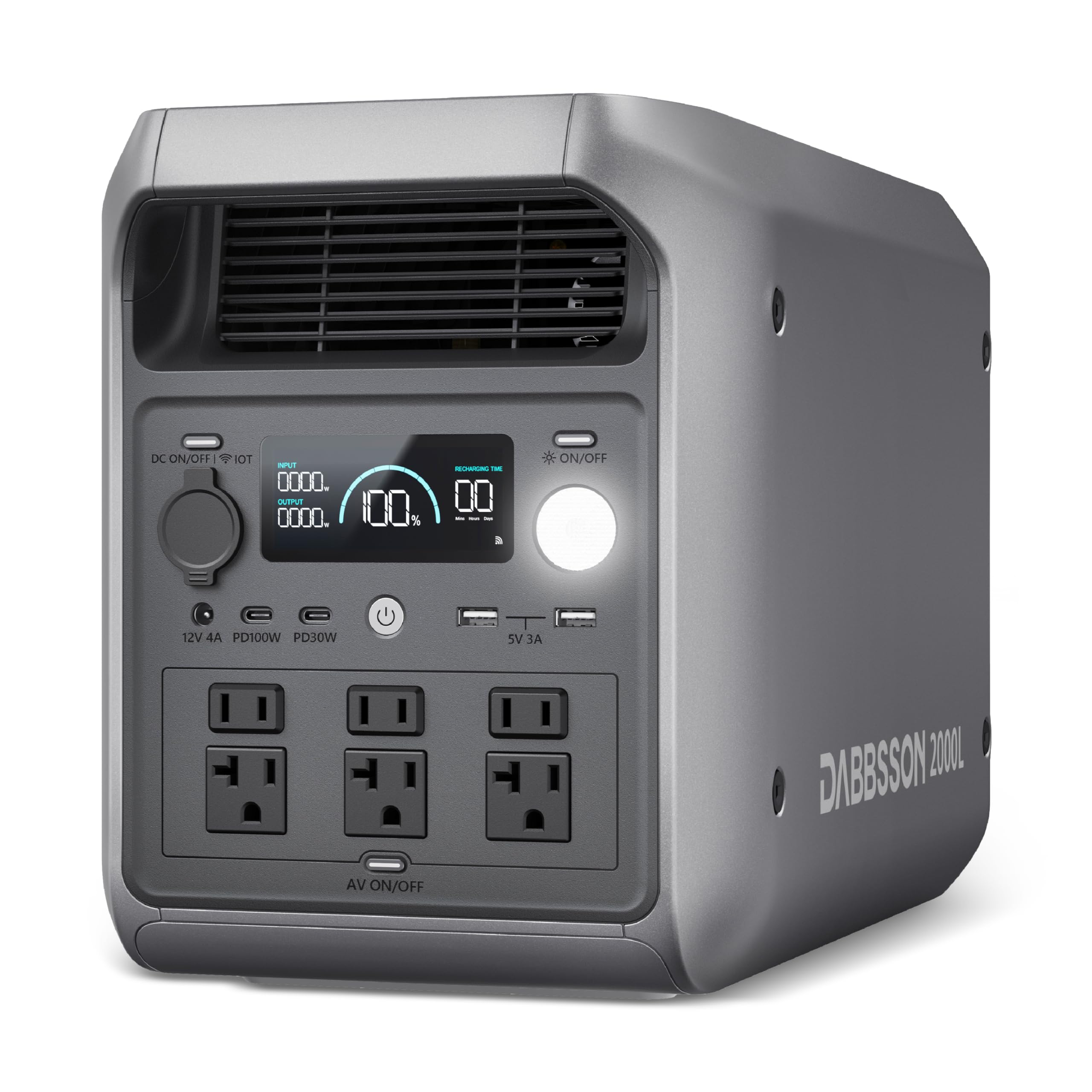
The 41-pound powerhouse that runs whole households through multi-day outages.
When the goal shifts from protecting a desk to powering a home, the DABBSSON 2000L is the serious answer. Its 2,048Wh capacity paired with a 2,200W continuous output (3,300W surge boost) means it can reliably run refrigerators, heaters, grills, and power tools — the kinds of loads a smaller station can’t touch. Six AC outlets spread the power across multiple devices at once, making it a genuine whole-home essential during extended blackouts.
The advanced semi-solid LiFePO4 battery is the tech story here. It’s rated for 4,000+ deep cycles to 80% capacity — over 10 years of daily use. — and it’s wrapped in a UL94-V0 flame-retardant housing (a safety standard for materials that resist burning). The brand claims 1.3x longer runtime than comparable 2,048Wh stations., and buyers confirm it runs mini fridges, coffee makers, and even an e-bike charge. Recharge is genuinely fast for this class: full in about 1 hour via AC, with solar input up to 800W MPPT for off-grid refills.
The <10ms EPS switch gives it a true uninterruptible function for computers, NAS, and routers — no data loss when the power cuts. Smart app control over Wi-Fi and Bluetooth lets you adjust charging speed, set schedules, and monitor usage remotely, which owners rate as a real convenience. It weighs 41 pounds, which buyers acknowledge is expected at this capacity but note is “slightly heavy” — plan for where you’ll store it and how you’ll move it. Reliability is the most-praised aspect, noted by over 60 owners, with build quality close behind. Backed by a 5-year warranty, this is the premium-tier pick for serious home backup and off-grid setups.
The heavy-duty wins
- 2,048Wh runs fridges and heaters for extended outages
- 3,300W surge boost starts demanding appliances
- 1-hour AC recharge is ultra-fast for its class
Weigh it up
- 41 pounds needs a planned storage spot and some muscle
- Fan noise can be audible under heavy load
Choose this for: whole-home essentials, off-grid living, and job sites where 2,200W of continuous output is genuinely needed.
Skip if: you only need to keep a router or a single PC up — that’s overkill, and the weight will frustrate you.
9. Anker SOLIX S2000 Portable Power Station
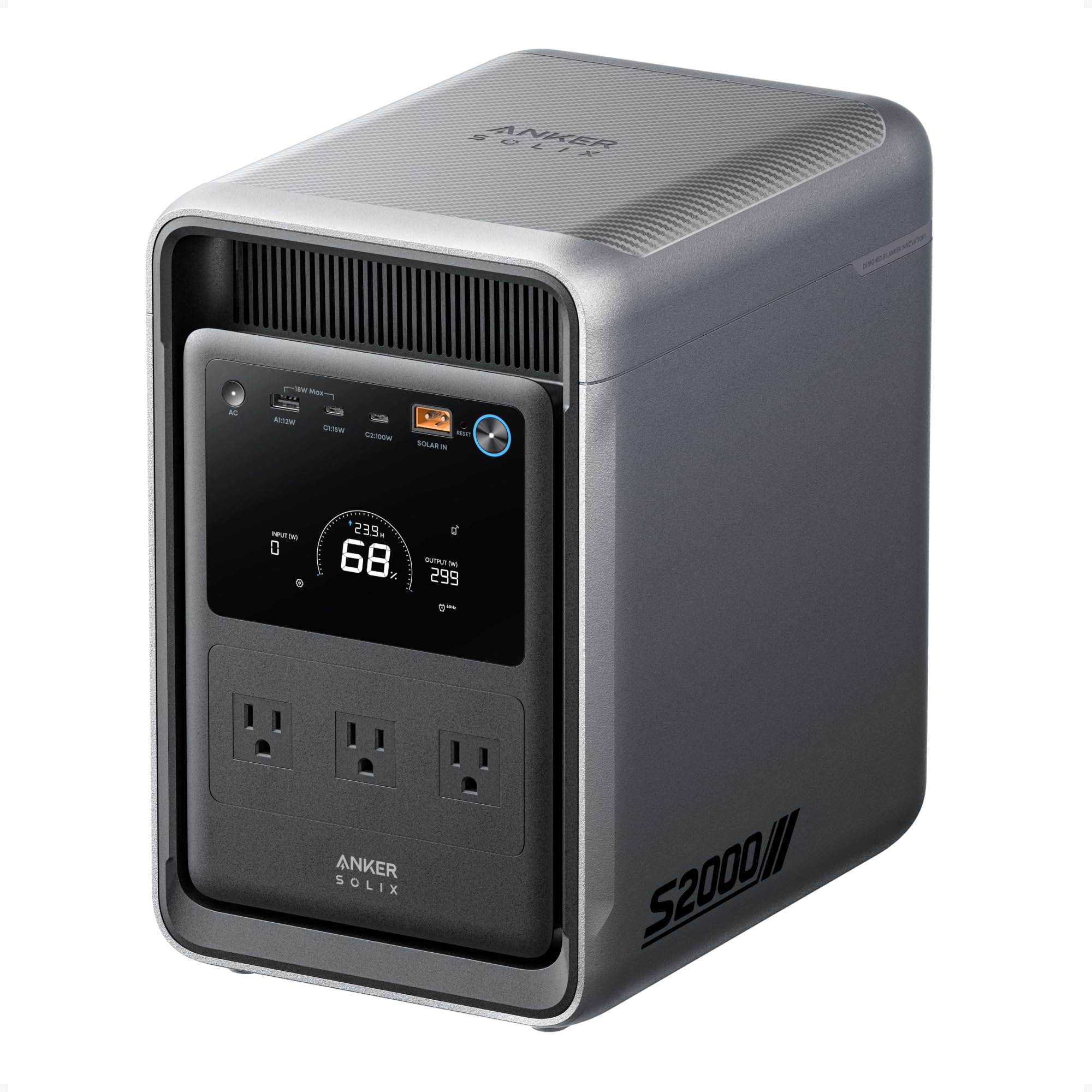
The efficiency champion that squeezes 35 hours of fridge time from a 2kWh frame.
Anker’s SOLIX S2000 goes after the same 2kWh class as the DABBSSON but wins on physics: it’s built to waste less power. With a low 6W idle draw and 10% higher efficiency, the brand claims it runs 20% longer than other 2kWh systems. — and owners confirm the headline number, with one reporting a full fridge ran for roughly 30 hours down to 20% battery and another hitting the advertised 35 hours. That efficiency is the whole pitch: more of what’s in the tank actually reaches your appliances.
It’s also the lightest and smallest 2kWh station here — 35.7 pounds versus the DABBSSON’s 41, and 30% smaller than the industry average per the brand. The 314Ah LFP cells are rated for 10,000 charge cycles and a 15-year lifespan.. Its 1,500W continuous output and 3,000W peak cover 99% of home essentials, per Anker., and the <10ms UPS switchover makes it a smooth home-office protector — one owner rode a 30-hour outage charging from 33% to 100% in 1.5 hours and still had power to spare afterward.
The layout is thoughtful: 8 outlets split across the front for everyday devices and the rear for always-on appliances, keeping cables tidy. No 12V DC port, which is note for RV users. Recharging is flexible — up to 400W solar input plus AC, generator, alternator, or car outlets, six ways total. The recurring caveat is the fan: it’s quiet at low loads but gets noisy during a 1,200W fast charge, and one unit had a strong burning smell on first charge that dissipated. Performance is the most-praised aspect, with reliability a close second across the feedback. The review pages sum up the value: “ran continuously for 35 hours as advertised.” For buyers who want maximum runtime per pound and per watt-hour in a premium home-backup unit, this is the efficiency leader.
Why it leads on efficiency
- 35-hour fridge backup claim backed by owner reports
- Lightest and most compact 2kWh unit in this list
- 10,000-cycle LFP battery for a 15-year lifespan.
Know the limits
- Fan noise ramps up noticeably during fast charging
- No 12V DC port for RV accessories
Pick this if: fridge longevity during long outages is your top priority and you want the lightest premium 2kWh station to move around.
Look past it if: you need sustained output above 1,500W or a 12V car port — the DABBSSON covers those.
Understanding the Specs
Watt-Hours (Wh) — The Size of the Tank
Watt-hours tell you the total energy stored, like the size of a fuel tank. A higher number means the unit can run a given device for longer. To estimate runtime, divide the capacity by what a device draws — a 100W load on a 1,070Wh station runs roughly 10 hours. Real-world factors like inverter efficiency and battery age will always reduce that estimate a bit.
Watts (W) — The Width of the Pipe
Watts measure the maximum power a unit can deliver at any moment — how much it can start at once. A fridge might average 150W but spike to 600W when the compressor kicks in, so your station needs watts to cover the surge. Check both the continuous output and the surge peak (often labeled “Power Boost” or “surge”) before plugging in appliances.
LiFePO4 vs. Lead-Acid Batteries
Lithium Iron Phosphate (LiFePO4) batteries handle thousands of charge cycles before degrading, which is why modern stations rate them for 3,500 to 10,000 cycles and 10+ year lifespans. They’re also lighter and more compact than lead-acid batteries found in traditional UPS units, which typically need replacement every few years. The trade-off is a higher upfront price.
Sine Wave Output vs. Simulated
Pure sine wave output delivers clean, stable power that closely matches what comes from a wall outlet — safe for sensitive gear like laptops, CPAP machines, and medical devices. Simulated sine wave (also called modified sine wave) is fine for most computers and network gear but can cause issues with some motors and audio equipment. If you’re protecting sensitive electronics, look for pure sine wave.
FAQ
What’s the difference between a UPS and a portable power station?
How do I know how long a power station will run my fridge?
Can a backup battery power supply run a CPAP machine all night?
What does the VA rating on a UPS mean?
How long do LiFePO4 batteries actually last?
Can I recharge a power station with solar panels?
What’s the difference between pure sine wave and simulated sine wave?
Can I fly with a portable power station?
Final Thoughts: The Verdict
Across the board, the backup battery power supply winner is the Jackery Explorer 1000 v2 because it’s the rare unit that genuinely balances heavy-duty output, portability, and fast recharging — the crowd favorite with a 4.7-star rating and over 3,500 owners behind it. If your priority is keeping a desktop or network rack alive through flickers with instant switching, grab the APC UPS 600VA for its swappable battery. And for whole-home essentials that must last through multi-day outages, the Anker SOLIX S2000 is the one to reach for — its 35-hour fridge backup claim is backed by real owner reports of continuous runtime.
How We Picked
We do not accept paid placement. Every pick is matched to a real buyer and a real use-case; we do not hands-on test units.
Sources & Methodology
Specifications: manufacturer listings and product documentation. Review insights: verified customer reviews, as of September 2026. Pricing: not shown on this page (it changes often); check the current price via the retailer link.
As an Amazon Associate, KitchPrep earns from qualifying purchases. This does not affect which products we feature.
Related Guides
