
Specs are compiled from manufacturer listings and verified buyer reviews and can change over time — please confirm the key details on the product page before buying.
If you want the short answer: for most homes, the Jackery Explorer 1000 v2 is the safest place to start. It stores 1,070 watt-hours of power, pushes 1,500 watts through its outlets, and weighs 23.8 pounds — light enough to carry from the garage to the kitchen when the lights go out. Below you’ll find eleven units sorted by what they actually do best, from carry-anywhere boxes to whole-circuit backups you park next to the breaker panel.
I’m Mohammad Maruf — the founder and writer behind KitchPrep. This guide is built by comparing the manufacturers’ published specifications and the patterns across verified customer reviews, so you get each pick’s real strengths and trade-offs instead of marketing spin.
Every pick here stores its own power and runs without fuel or fumes, so you can use it indoors. What follows is a plain-English walkthrough of capacity, output, and recharge speed to help you choose the right backup battery generator.
Our Picks at a Glance

How To Choose The Best Backup Battery Generator
A backup battery generator is not a fuel generator with a different label. There is no pull cord, no oil change, and no carbon monoxide to vent through a window. It stores electricity in a battery and hands it back through regular wall outlets. That changes what you should compare. Instead of horsepower and fuel tank size, you are shopping on three numbers: stored capacity, continuous output, and recharge time.
Match watt-hours to what you actually want to keep running
Watt-hours (Wh) tell you how much total energy the battery holds. A fridge that sips 100 watts while its compressor runs will not consume that continuously, because it cycles on and off. That is why a 1,070Wh unit can keep a car fridge going for two days while the same battery drains in under an hour running a shop vac. Add up the wattage of the devices you truly need, guess how many hours a day they run, then pick a capacity with room to spare.
Continuous watts versus surge watts
Continuous output (sometimes listed as rated or AC output) is what the unit can supply indefinitely. Surge peak is a short burst that covers the moment a motor kicks on — a fridge compressor, a furnace blower, a circular saw. If you only look at continuous watts, a fridge may trip the unit the instant it starts. Buyers who plan to run anything with a motor should check the surge number too.
Recharge speed decides how long an outage hurts
A big battery you cannot refill is a paperweight after day two. Wall-charging speed matters, but so does maximum solar input. Units that accept a wide solar voltage window give you far more options when you are buying panels. If you live somewhere with real winter storms, this one spec can matter more than a few hundred extra watt-hours.
Quick Comparison
| Model | Best For | Capacity | AC Output | Weight | Amazon |
|---|---|---|---|---|---|
| Jackery Explorer 1000 v2★ Best Overall | First-time home backup and camping | 1,070Wh | 1,500W | 23.8 lbs | Amazon |
| BLUETTI Elite 100 V2Best UPS Response | UPS-grade desk and router protection | 1,024Wh | 1,800W | 25 lbs | Amazon |
| PECRON F3000LFPBest Capacity Per Dollar | Home essentials for two to three days | 3,072Wh | 3,600W | 63.3 lbs | Amazon |
| Anker SOLIX S2000 | Long refrigerator runtime | 2,010Wh | 1,500W continuous (3,000W peak) | 35.7 lbs | Amazon |
| EF ECOFLOW DELTA 3 Max | Fast recharge and RV weekends | 2,048Wh | 3,400W X-Boost | — | Amazon |
| ABOK Ark3600 | Jobsite and heavy rolling loads | 3,840Wh | 3,600W (4,500W peak) | 92 lbs | Amazon |
| AFERIY P310 | Big expandable solar bank | 3,840Wh (to 11.5kWh) | 3,600W (7,200W peak) | 104.7 lbs | Amazon |
| Jackery HomePower 3000 | RV 30-amp direct and home essentials | 3,072Wh | 3,600W (7,200W surge) | 59.5 lbs | Amazon |
| BLUETTI Elite 300 | Compact 3kWh RV travel | 3,014Wh | 2,400W (4,800W surge) | 58 lbs | Amazon |
| EF ECOFLOW DELTA Pro | Expandable whole-home-scale storage | 3,600Wh (to 25kWh) | 3,600W (4,500W X-Boost) | 99 lbs | Amazon |
| Anker SOLIX F3800 | 240-volt appliances and EV charging | 3,840Wh (to 53.8kWh) | 6,000W | 132.3 lbs | Amazon |
In‑Depth Reviews
1. Jackery Explorer 1000 v2 Portable Power Station, 1,070Wh, 1,500W
Our pick — over 4.5★ from 3,500+ verified ratings; the strongest balance of quality and price.
The 23.8-pound carry box that empties a wall outlet into itself in about an hour.
This is the unit most people should buy first. It holds 1,070 watt-hours and delivers 1,500 watts continuously, with a 3,000-watt surge peak that lets it start a fridge compressor or a small AC without tripping. At 23.8 pounds it is the lightest 1,500W unit here, and the foldable handle makes one-handed carry realistic. Owners routinely describe it as the sensible middle: the crowd favorite at 4.7 stars across 3,500+ ratings.
The headline trick is recharge speed. Switch on emergency charging in the Jackery app and the battery goes from empty to full in roughly an hour; leave it in the default mode and it takes about 1.7 hours to protect battery health. Jackery’s ChargeShield 2.0 handles the current management, so it charges fast without cooking the cells. A quiet 30 dB overnight mode keeps the fans from whining next to a bedroom.
What wins people over is the sheer dependability. Car-camping families run a 12-volt car fridge on it for up to two days; fire-season residents in the mountains lean on it through public safety power shutoffs to keep a refrigerator and a mini deep freezer cold until the grid returns. The 1,070Wh pack runs a CPAP for roughly four nights on DC at 15–20 percent nightly draw — silently, with no exhaust. As buyers put it: “Handy, quick charging, long lasting.”
Where it separates itself
- 1,070Wh capacity with a 1,500W continuous / 3,000W surge output — enough for fridges, electric pots, and small AC units.
- One-hour emergency recharge from 0 to 100 percent through the Jackery app; 1.7 hours in default battery-health mode.
- 23.8-pound frame with a foldable handle — light enough for a road trip, light enough for a hotel room.
- LFP battery rated to hold over 70 percent of original capacity after 4,000 charge cycles — ten-plus years of use in Jackery’s framing.
- Two USB-C ports (one at 100W PD), one USB-A, one 12-volt car port, three pure sine wave AC outlets, and built-in LED lights.
The trade-offs worth knowing
- Not a whole-home solution — running a week-long stationary setup with a compressor fridge will drain it faster than you’d like.
- Solar charging is locked to Jackery’s own panels, so you can’t mix in a cheaper third-party array.
- No 12-volt DC barrel ports, which some camper-van owners specifically want.
Best for: the first-time buyer who wants one battery that covers camping, road trips, and short outages without needing a second person to lift it.
Look elsewhere if: you need to run a house-sized load for multiple days — that’s what the PECRON and DELTA Pro picks below are for.
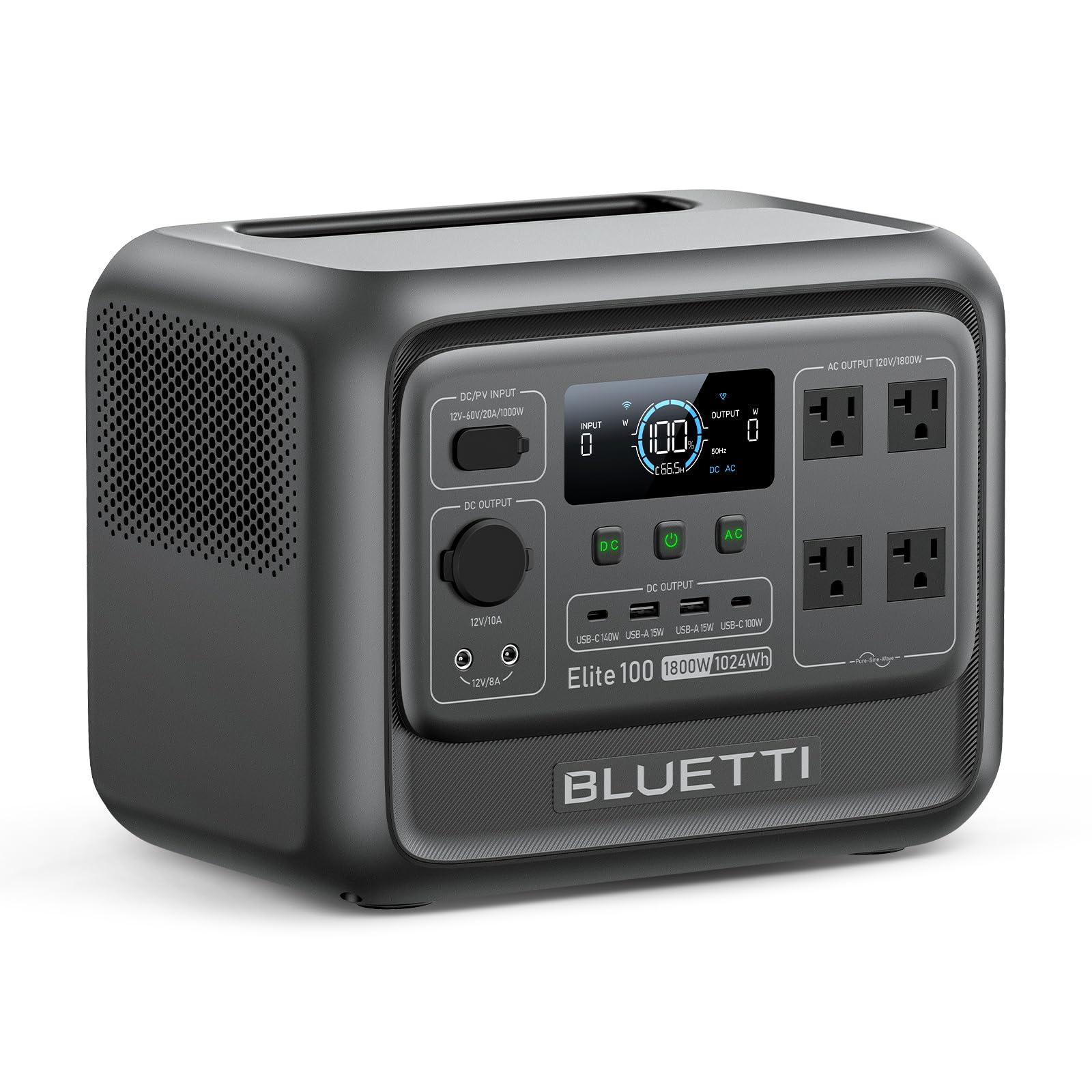
2. BLUETTI Elite 100 V2 Portable Power Station, 1024Wh, 1800W
Ten-millisecond switchover — the unit that keeps your router and PC alive before they know the grid is gone.
If your real worry is a mid-Zoom-call blackout rather than a hurricane, this is the pick. The 10ms UPS transfer (a UPS — uninterruptible power supply — is the smooth handoff between wall power and battery) happens faster than any device downstream can notice. Plug your router, your PC, and your modem into it and let it sit there permanently. Compare that to the Jackery Explorer 1000 v2 above, which has no built-in UPS mode and forces a manual restart when the power drops.
The 1,024Wh cell and 1,800-watt AC output handle a 90 percent slice of everyday appliances, with a 2,700-watt Power Lifting mode that bumps those figures momentarily for harder starts. It carries a 3,600-watt surge peak — 20 percent higher than the Jackery Explorer 1000 v2’s 3,000W peak — which is the kind of headroom that matters when a fridge compressor or a circular saw first kicks on. At 25 pounds it is 5 percent heavier than that same Jackery, but the hidden handle makes one-handed carry straightforward.
The standout report comes from an off-grid astrophotographer running a telescope mount, two cameras, a mini PC, and a tablet — a setup that draws about 60W to start, settles near 34W, and spikes under 50W while slewing, giving a reliable 6.5 to 7 hours of runtime. That is real-numbers proof that steady small loads stretch a pack far beyond what a watt-hour label suggests. It refreshes from empty in about 70 minutes via 1,200W TurboBoost AC charging, and runs at 30 dB in silent mode, which is quiet enough for a bedroom.
Recharge reality check: The 70-minute full charge demands a heavy 1,200W wall draw, so plug it into a dedicated circuit rather than a power strip shared with a space heater.
Who notices the 17-liter frame: Owners moving this from a camper to a garage shelf without help — the hidden handle is what earns the portability praise.
Worth the upgrade if: you already know you want one unit that does permanent UPS duty on your home-office gear and still travels on weekends.
Skip the swap if: you only need camping power and never plug a desktop into the wall behind it — that job belongs to the Jackery above.
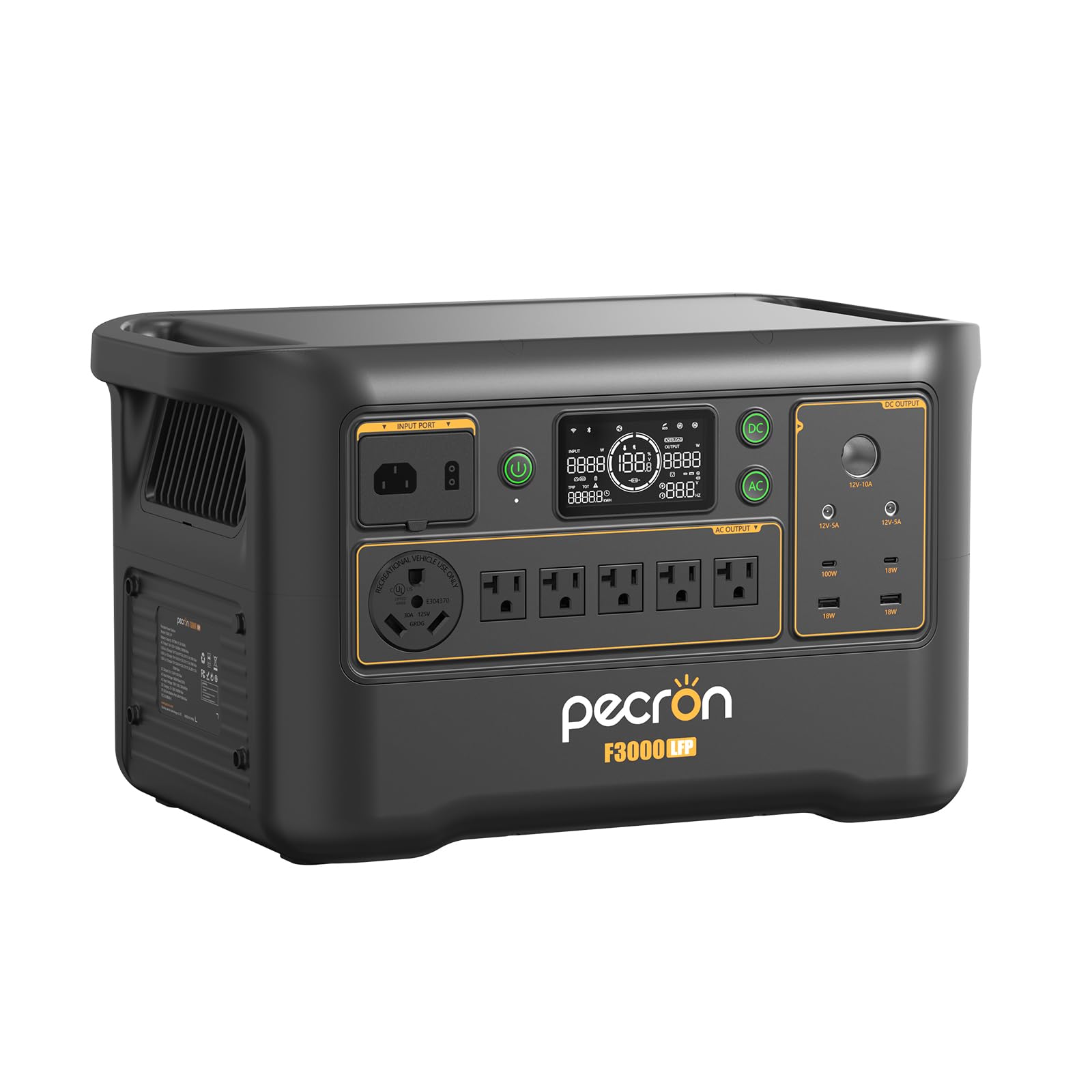
3. PECRON F3000LFP Portable Power Station, 3072Wh, 3600W
The three-day residential backup that happens to be built around the industry’s favorite battery chemistry.
This is where the numbers get serious. The 3,072 watt-hour capacity is three times the 1,024Wh of the BLUETTI Elite 100 V2 above, and the 3,600-watt AC output is 2.4 times the 1,500-watt rating of the Jackery Explorer 1000 v2. PECRON frames it for two to three days of home essentials, and that claim matches what the raw math suggests. Flip the switch and thirteen devices run at once off six AC outlets, two 100W USB-C ports, two USB-A ports, one car port, and two DC 5525 outputs.
The recharge story is just as aggressive. Pump wall power in at 1,800 watts and the whole pack refills from zero in two hours. Add solar at up to 1,600 watts across a 25-120 volt window, or split AC, solar, and car charging simultaneously, and you rarely need to plan around the battery. If two to three days is not enough, add the EP3800-48V expansion battery (sold separately, and it needs the XT120-M cascade cable to attach) and push capacity to 10,752Wh.
Owners with real track records here measure the value in watt-hours per dollar against the big-name competition and come out ahead. A five-month update from a household that has ridden out more than forty separate outages with no issues and an average of four hours apiece is the kind of feedback that turns a spec sheet into a purchase decision. The recurring caveats are worth flagging: the fan is audible while charging, the app asks for a login every time, and 63.3 pounds makes it a two-person lift if you move it around the house.
Numbers that carry the case
- 3,072Wh to 10,752Wh expandable — the widest capacity ladder in this roundup.
- 1,800W wall charging produces a full refill in about two hours.
- Up to 1,600W solar input with a 25-120V window, so it accepts a wide range of third-party panels.
- Thirteen output ports and 3,600W continuous pure sine wave output run power tools and appliances together.
The honest catches
- 63.3 pounds is real weight — plan for a permanent spot rather than shuffling it between rooms.
- Fan noise during charging is noticeable; the app requires an internet login before Bluetooth pairing.
- The EP3800 expansion battery needs an XT120-M cascade cable that is not included with either piece.
Buy this if: you want the most stored energy for the money and are happy to park it next to the breaker panel.
Not for you if: you need to throw it into a car every weekend — the ABOK and BLUETTI Elite 300 below trade capacity for wheels.
4. Anker SOLIX S2000 Portable Power Station, 2,010Wh, 3,000W Peak
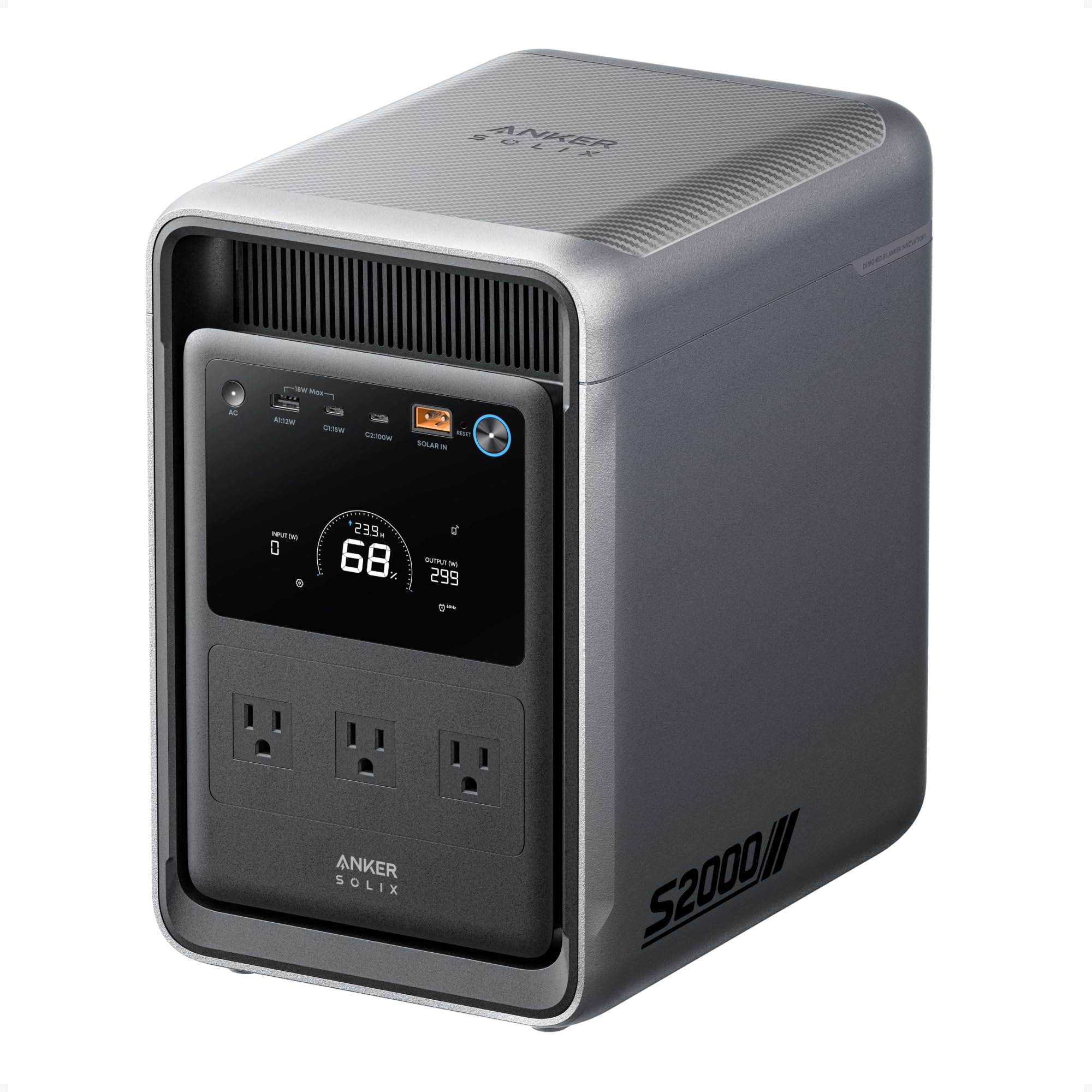
A 35.7-pound box built for one job: keeping the refrigerator cold through a long outage.
Most power stations brag about peak wattage. This one brags about idle draw, and that is the number that decides how long a fridge actually stays cold. Six watts of idle drain and 10 percent higher efficiency than other 2kWh systems translate to Anker’s 35-hour refrigerator backup claim. Its 10,000-cycle LFP battery is the longest cycle rating here — double the 4,000 cycles of the Jackery Explorer 1000 v2 and PECRON F3000LFP.
The physical numbers are just as unusual for the capacity. At 8.2 × 11.1 × 12.7 inches and 35.7 pounds, Anker calls it the smallest and lightest 2kWh power station — 30 percent smaller and 25 percent lighter than the industry average, in Anker’s own words. Compare it to the 63.3-pound PECRON above with the same broad use case and the frame difference is obvious the moment you lift one. Eight outlets split front and rear, an including rear ACs that stay live for always-on appliances, plus a 10ms UPS switchover for the whole home office.
What pushes this pick up the list is the CPAP and fridge crowd. One owner left it running a refrigerator for 27 hours straight starting from 100 percent and finishing at 5 percent, then recharged the unit in about two hours. Another tracked a 220-liter fridge for 30 hours without a full drain, and a third reported running lamp, refrigerator, coffee maker, and a gas tankless water heater’s electric start through a 13-hour outage with roughly 30 percent to spare. The build tolerates app-free use if you never want to pair it.
One real downside: the fan is noisy during its fastest 1,200W charging session — fine overnight once it finishes, but you’ll notice it if the unit is in a bedroom closet.
Compatibility catch worth checking: there is no 12-volt DC port and no expansion battery support, so plan for this to cap out at 2kWh.
Perfect when: one refrigerator and a handful of small loads during winter storm season is your entire backup plan.
Skip if: you want to grow capacity over time — this unit has no battery-expansion path, so the PECRON or AFERIY picks are better platforms.
5. EF ECOFLOW DELTA 3 Max Portable Power Station, 2048Wh, 2400W
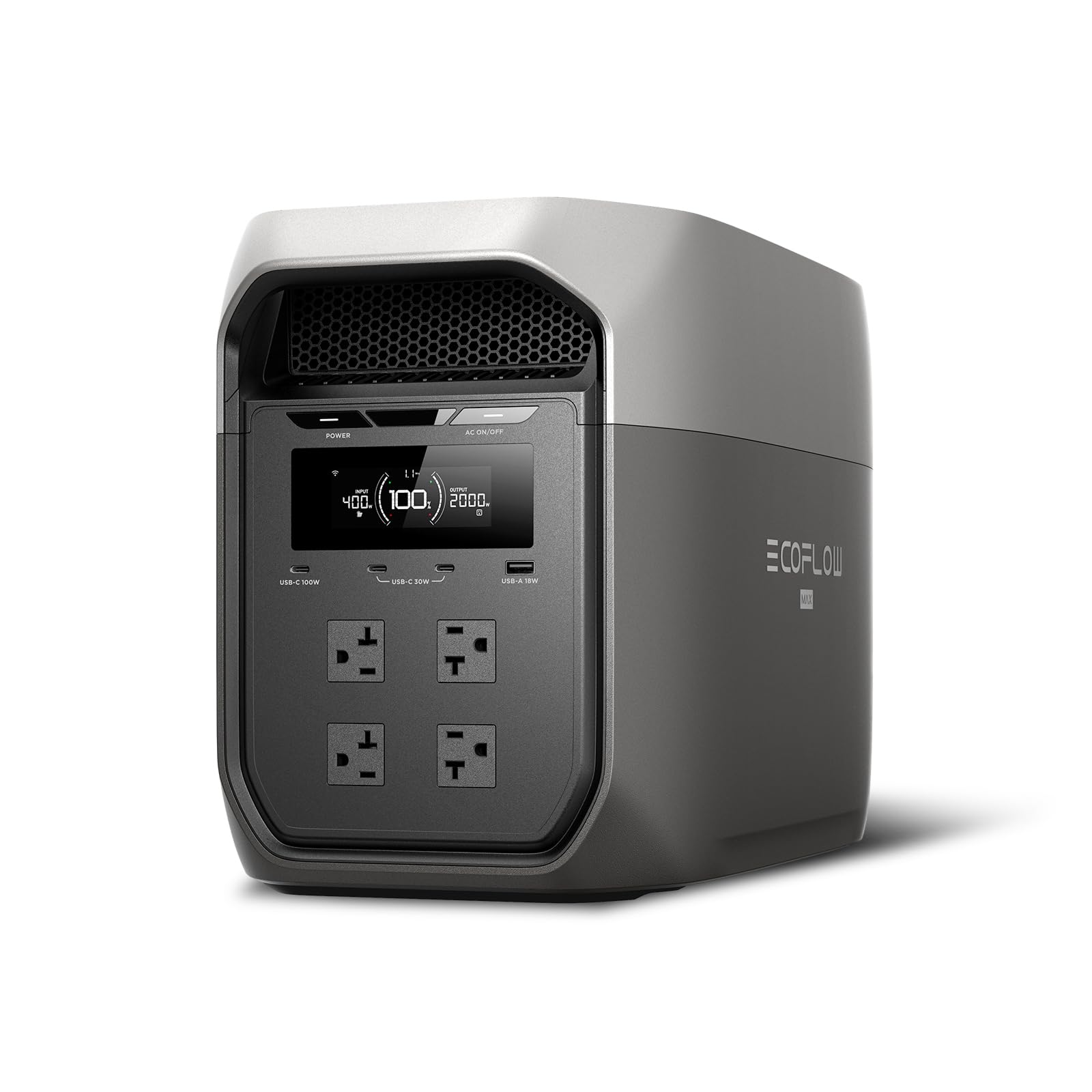
Two thousand watt-hours that refill eighty percent in barely over an hour of wall time.
EcoFlow’s X-Stream charging system is the reason this pick exists. A 2048Wh battery recharged to 80 percent in 1.13 hours is fast for this capacity class, and the 3,400W X-Boost mode means the 2,400W continuous rating can run appliances that would ordinarily overload a battery this size — fridges, microwaves, and power tools all fall inside its reach. The 10ms UPS transfer time keeps sensitive electronics like computers and medical devices off the grid’s pulse during a switchover.
Long-term ownership economics lean in its favor too. EcoFlow rates the LiFePO4 cells for 10 years of daily use and backs the unit with a 5-year service plan. Connect to the EcoFlow app and you can monitor energy use in real time, set smart priorities, and schedule charging and discharging to line up with whatever your utility is doing that day.
Field reports back up the spec story. In steady use for two weeks, wall and solar charging both behaved as advertised; a bigger XT60i cable open up more current for faster solar charging than the standard XT60 door allows. The fan spins quietly at 1,700 watts of wall draw — front intake, rear exhaust — and battery temperature settles around 100 degrees at a 70-degree ambient and drops fast once charging ends. One caution worth passing along: the XT60i cable configuration has to be right before it will let the extra current through.
Why it earns its slot
- No competitor in this roundup recharges a 2kWh pack to 80 percent faster — 1.13 hours from the wall is the fastest in its class here.
- X-Boost technology reaches 3,400W continuous, letting a 2,400W-rated unit run gear it would otherwise refuse.
- 10ms switchover protects computers, routers, and home-office equipment during an outage.
- EcoFlow’s 5-year service plan plus a LiFePO4 layout rated for a 10-year working life.
What to plan around
- The 12-volt car plug sits awkwardly on the back of the unit, which some owners find annoying to reach.
- Front control buttons are hard to see in dim light — you’ll want the app once the lights are out.
- Smart-home network pairing requires Wi-Fi for the initial setup, so configure it before you head off-grid.
Choose it when: you want the shortest wait between “battery’s dead” and “battery’s ready” — road trips, RV weekends, and pre-blackout prep.
Not the right one if: you need whole-panel 240-volt capability — save that decision for the Anker SOLIX F3800 at the bottom of this list.
6. ABOK Ark3600 Portable Power Station, 3840Wh, 3600W
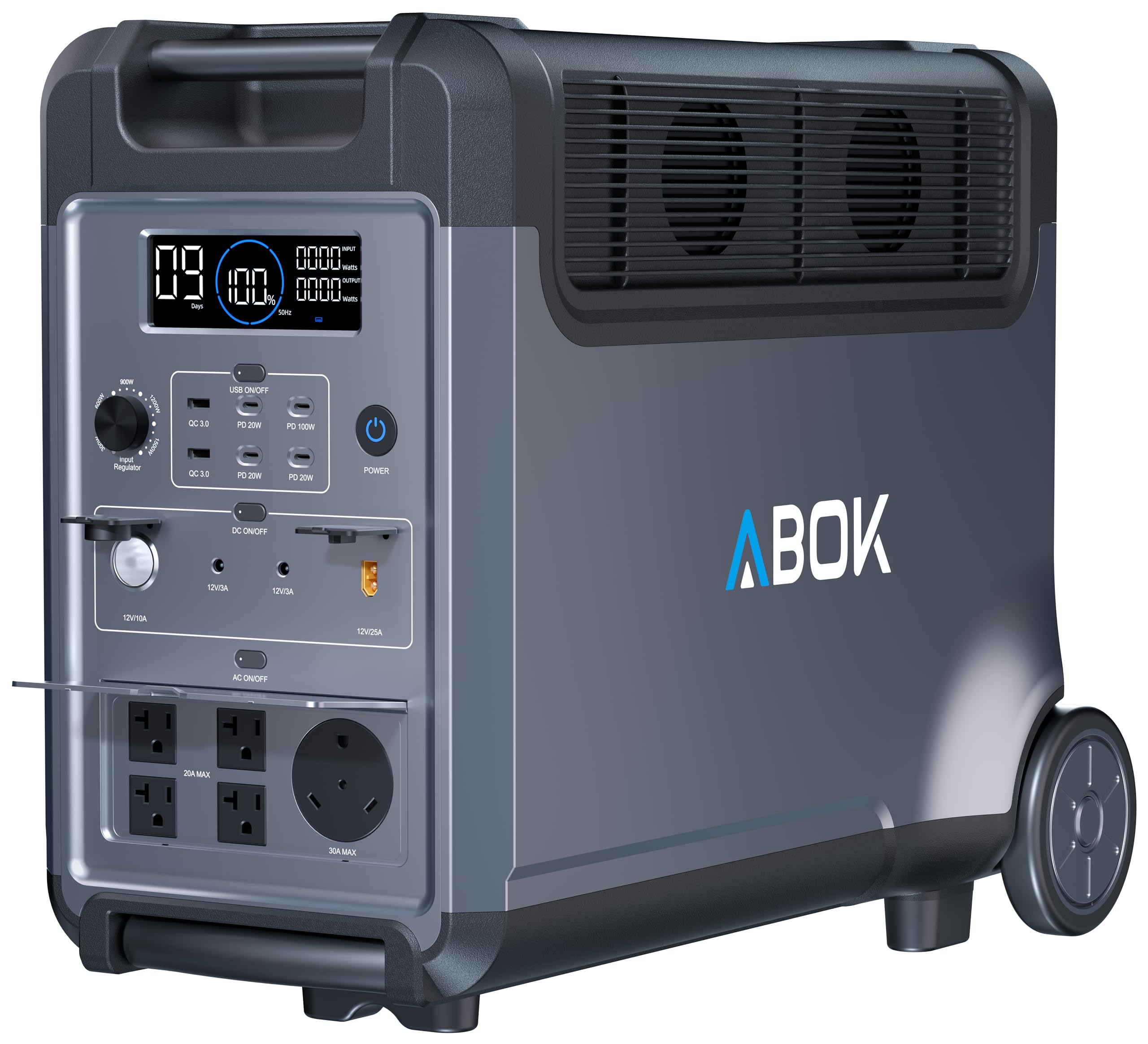
Ninety-two pounds of rolling power with a telescoping handle meant to move like luggage.
Wheels and a pull-up handle change what a heavy power station can do. A contractor-shaped workload is exactly what the Ark3600 was built to withstand: running a wet vac, a heat gun, and an SDS-Max drill all at the same time and finishing the day at 22 percent charge is the kind of use-case this unit invites. Ninety-two pounds is real weight, but the wheels mean you roll it into place instead of asking a second person to help.
The numbers line up for a mixed home-and-job backup. 3,840Wh of storage scales to 11,520Wh with expansion packs, and the 3,600W rated output with a 4,500W peak covers 99 percent of household appliances in ABOK’s own framing. Fifteen output ports — including a 30-amp AC outlet, four 20-amp AC outlets, three PD 20W USB-C ports, one PD 100W USB-C, USB-A QC3.0 ports, DC5521 barrels, an XT60, and a cigarette lighter port — mean you can charge cordless tool batteries, phones, and full appliances without swapping cables.
The DC and portable-fridge crowd gets a special callout here. A 58-quart Euhomy 12-volt fridge in a van through a 97-degree weekend ran from Saturday morning to Monday afternoon on the cigarette lighter port and finished with 64 percent still showing. Charging gets done in multiple ways — 1,500W wall input, 2,000W PV solar, and 120W car input — with a full AC-plus-solar combination taking about 1.29 hours and AC-only topping out at 3 hours. The compact 21.6 × 12.6 × 18.5 footprint keeps the shell manageable despite the weight.
What stands out
- Telescoping handle and wheels turn 92 pounds into a rollable suitcase.
- EV-grade LiFePO4 cells rated for over 4,000 cycles and up to 10 years of use.
- 15 output ports including a 30A AC, four 20A ACs, and a PD 100W USB-C — the most in this roundup.
- 3840Wh scalable to 11,520Wh with expansion batteries.
Two things to weigh
- The Bluetooth app has no built-in documentation — you learn the features by trial rather than a manual.
- Output tops out at 120 volts, so 240-volt appliances like dryers stay off the list.
Best pick when: the unit lives in a garage, a jobsite, or a camper shell and rolls rather than lifts.
Reach elsewhere when: you actually need 240-volt capability — this one only delivers 120 volts.
7. AFERIY 3840Wh Portable Power Station, Expandable to 11520Wh

An expandable 3.8-kilowatt-hour bank that scales to 11.5kWh with a pull handle for the trip.
This is a platform, not a one-and-done box. The 3840Wh LiFePO4 pack is 3.84 kilowatt-hours to start and accepts expansion batteries up to 11.5kWh total, which is close to double what the ABOK Ark3600 above will hold at its own max. The 3,600W continuous output with a stated 7,200W peak sits in the big-boy tier, and the built-in UPS gives a switchover under 10 milliseconds so computers, security cameras, and medical freezers do not notice the grid going down.
Solar is where AFERIY leans in hardest. The unit accepts an adjustable charging-speed configuration with as fast as 1.5 hours to full under supported input conditions, and the seven-year support window plus a UL Listing (a third-party safety certificate) appeals to buyers who want a paper trail. Fifteen output ports cover AC, USB-A, USB-C PD 3.0, DC5521 barrels, XT60, and a 12-volt car socket. The smart app handles charge and discharge monitoring, scheduling, light modes, and remote power-off.
Real-world solar testing here reaches past a single panel. An off-grid RV owner running four 445-watt JA Solar panels recharges the pack quickly, and a freelance video editor working out of a van described the 1-hour charge gaining 40 percent while running a laptop, 4K monitor, and coffee maker. Capacity is the notable soft spot — the pack runs a full RV with everything except air conditioning, so overnighters usually need an expansion battery to last through the night. It is also 104.7 pounds, which is where the pull handle earns its keep.
What justifies the size: the 11.5kWh expansion ceiling puts this in workstation territory — powering a mobile office and appliances simultaneously is what it is designed around.
The complaint that shows up: app reliability is hit or miss, and one unit arrived unable to charge at all before Aferiy replaced it directly.
The pick if: your use case is a van, cabin, or workshop where the power station grows alongside a solar array.
Look past it if: you need reliability under one roof and value a simple plug-and-play over an expandable platform — the PECRON above is steadier from the start.
8. Jackery HomePower 3000 Portable Power Station, 3072Wh, 3600W
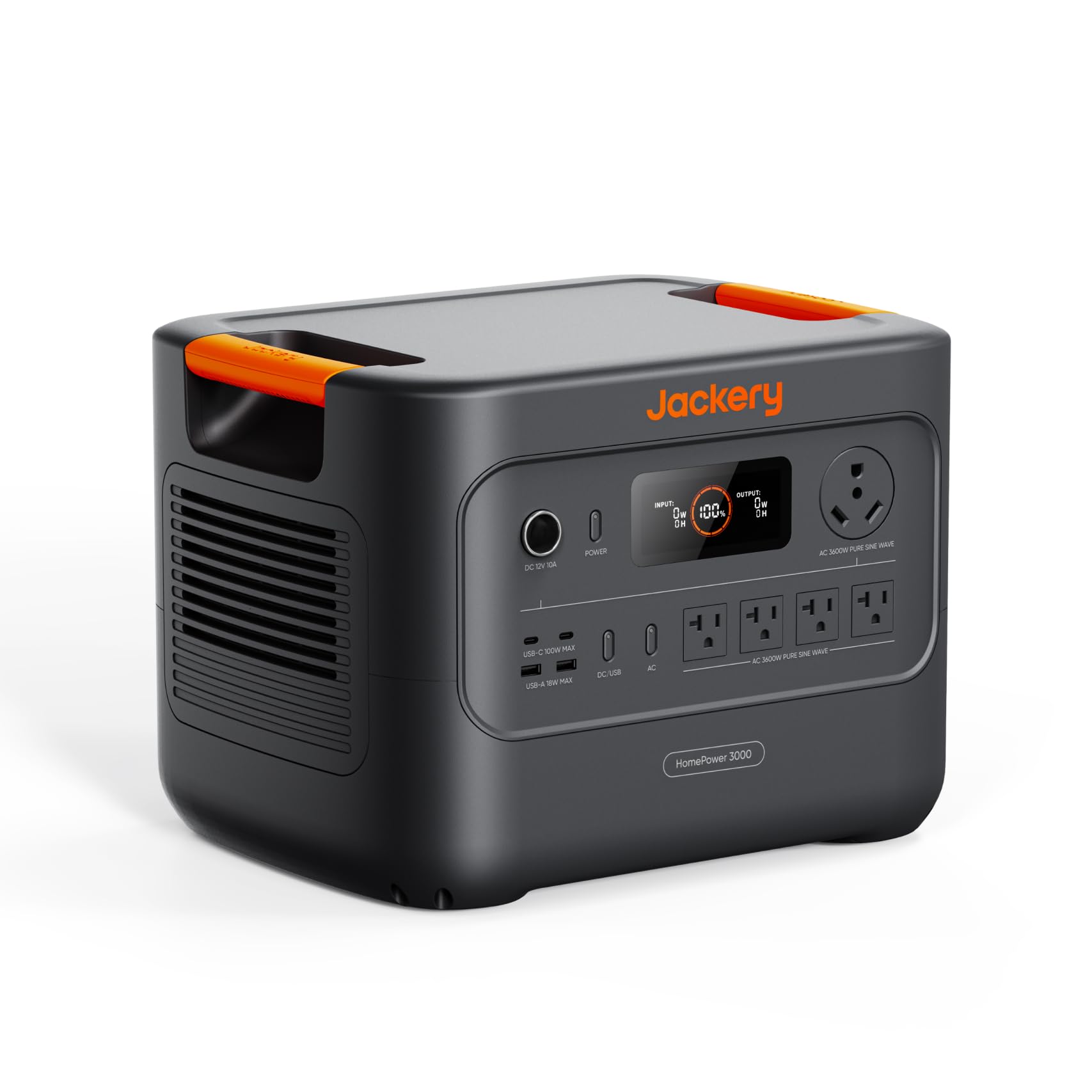
A camper-ready 3kWh pack with an onboard TT-30 outlet — no adapters required at the pedestal.
Forty-seven percent smaller and 43 percent lighter than comparable 3kWh units is what Jackery’s CTB technology buys you here, and the payoff shows in the 59.5-pound frame. The 3,072Wh LiFePO4 battery runs a household’s essentials for up to 15 hours and keeps a refrigerator alive for one to two days, backed by a 3,600W continuous output and a stated 7,200W surge. That surge number is the one that decides whether the fridge compressor trips the unit on start.
The built-in TT-30 RV outlet is the standout detail. It lets you plug an RV directly into the HomePower 3000 without a 30-amp to 15-amp adapter, which is a small-sounding convenience that pays off every single time you set up camp. The UPS circuit switches in under 20 milliseconds, which Jackery notes is UL-certified, and is fast enough to keep security cameras, medical refrigerators, Zoom calls, and pet feeders running without interruption. Dual 100W PD USB-C ports top off laptops, phones, and drones in parallel.
Recharging is where the HomePower 3000 flexes hardest. Hybrid AC and DC input pushes a full charge in 1.7 hours; wall-only takes 2.2 hours. Paired with two SolarSaga 200W panels, it can reach 80 percent in about 9 hours of sun. An owner who dry-camped a 30-foot travel trailer ran the air conditioner, microwave, fridge, TV, and Starlink through the direct 30-amp connection and got roughly three-plus days of runtime when the air conditioner was off. The recurring gripe is that the fan is audible at around 60 dB under heavier draw, so it is not a quiet-desk companion.
The RV crowd’s real win: rollout to a campsite without adapters or a second box to carry turns what used to be a 10-minute setup into a two-minute plug-in.
What 59.5 pounds feels like: two handles get it from the truck bed to the deck, but plan the location before you start moving it.
Buy this if: you dry-camp or travel with an RV and want onboard 30-amp shore power in a compact footprint.
Think twice if: your backup is for a home office with a desk right next to the unit — the fan noise under load is real.
9. BLUETTI Elite 300 Portable Power Station, 3014.4Wh
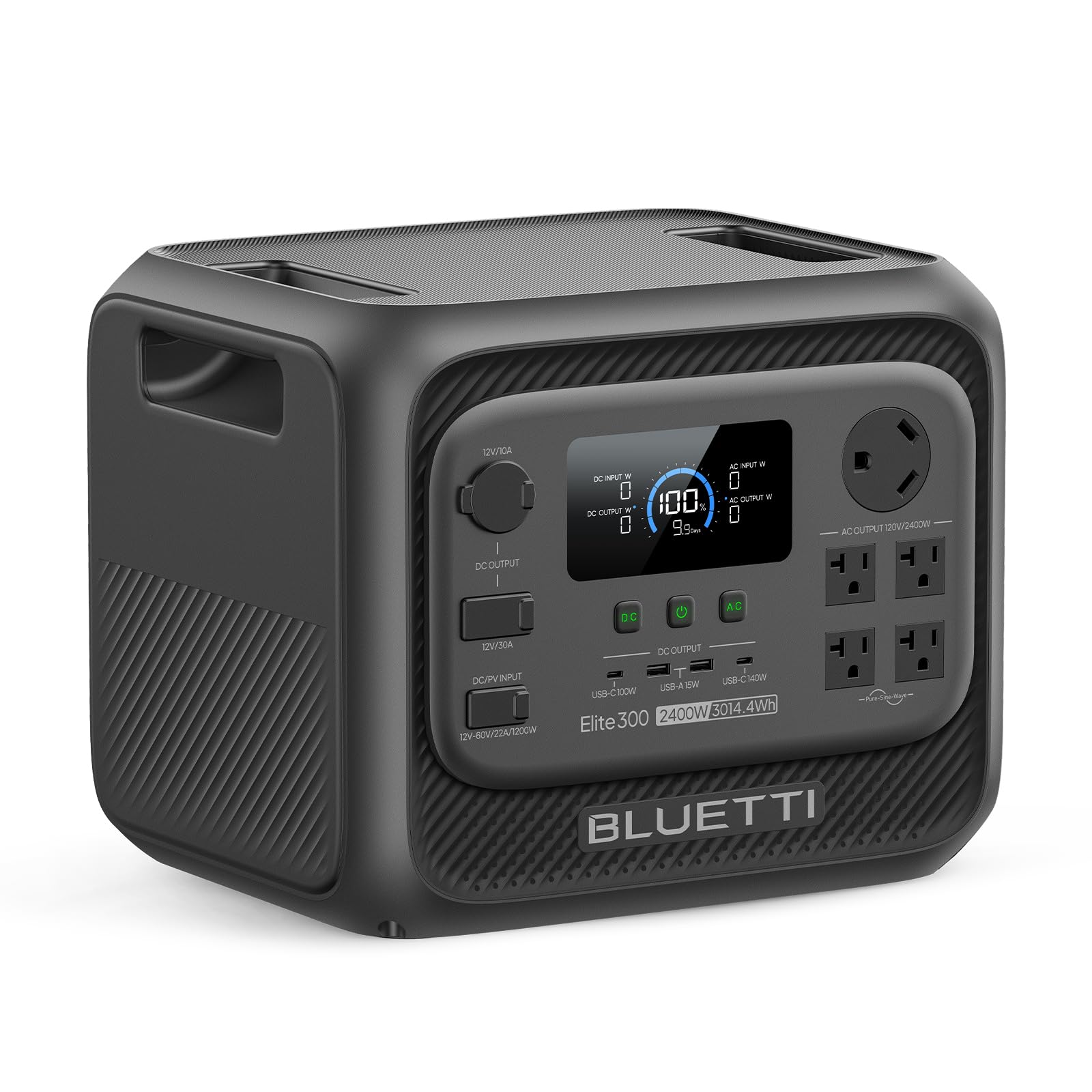
Three kilowatt-hours packed into a shell roughly the size of two ammo cans.
Compare it to the 63.3-pound PECRON F3000LFP above and the physical size difference is the moment you notice what the 58-pound weight actually represents. It is genuinely compact enough to leave in a closet rather than reserve a shelf for it.
The RV-specific design is the real differentiator. An onboard TT-30 outlet plus a 12-volt, 30-amp DC feed matches what camper vans and travel trailers actually want — running 12-volt fridges, water pumps, and diesel heaters directly off the pack without AC conversion. The 2,400W continuous output climbs to a 4,800W surge for kettles and resistive loads, and the 10ms UPS switchover guards computers, routers, and home-office equipment. It charges to 80 percent in as fast as 78 minutes, and the LiFePO4 battery holds up over 6,000 cycles — second only to the Anker SOLIX S2000’s 10,000 cycles in this roundup.
Field notes focus on the small details that add up to quality of life. A battery life that runs an entire weekend of camping on a single charge, a display that is admittedly dull in bright outdoor light, a fan hum that stays tolerable at 2,400W continuous, and solar input reaching about 520W with a 480-watt bifacial panel. The genuinely restrictive part is expandability — the pack tops out at roughly 3,000Wh with no battery-expansion path. Solar input is also capped at 60 volts and 20 amps, so pairing it with an existing van’s 600-watt array is not straightforward.
The RV-friendly spec people miss: the 12-volt, 30-amp DC output can run a 12-volt fridge or diesel heater directly, without the efficiency loss of converting to AC first.
The expansion wall: no extra batteries can be added, and going above 60 volts on the solar input bricks the MPPT controller, so existing van solar systems need to be re-checked first.
Great fit for: camper-van and travel-trailer owners who want one compact pack that speaks RV power natively.
Look elsewhere if: you want to grow capacity over years — this one is capped at its shipped size.
10. EF ECOFLOW DELTA Pro Portable Power Station, 3600Wh, 3600W
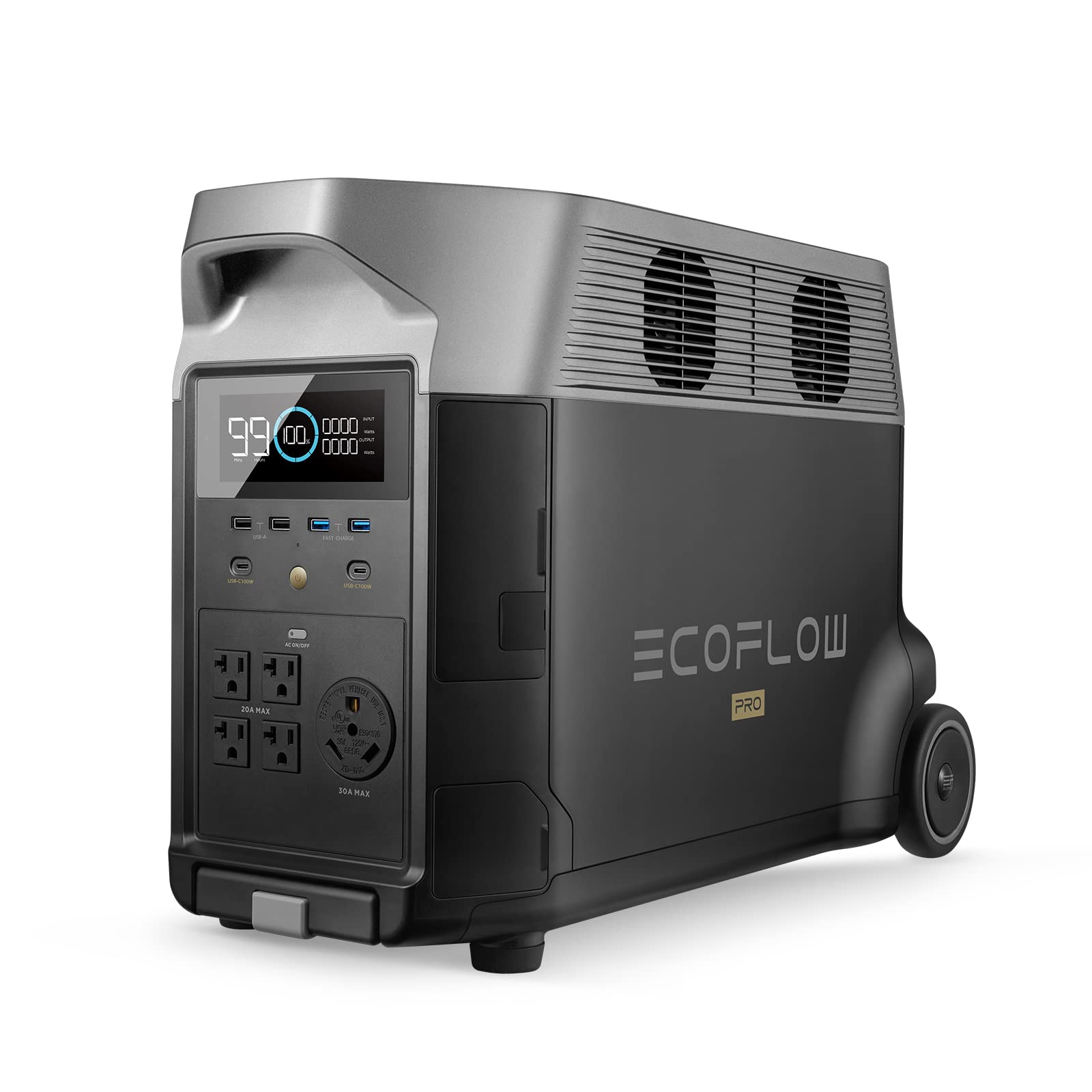
Sixty watts shy of a four-thousand-watt-hour battery that grows to twenty-five kilowatt-hours.
The DELTA Pro is the platform play at the top of this list. A 3,600Wh LFP battery scales to 25kWh with extra batteries or Smart Generators, giving you a path to whole-home-level storage without replacing the base unit. The single-unit AC output is 3,600 watts, expandable to 4,500 watts through X-Boost technology, and two units can pair to reach 7,200 watts combined. Fifteen output paths — including two USB-A, two USB-A Fast Charge, two 100W USB-C ports, five AC outlets, two DC outlets, a car port, and an Anderson connector — mean you can plug nearly anything in at once.
X-Stream charging is the fastest wall-charge setup here: 1.8 hours from a 240-volt outlet at 3,000 watts, 2.7 hours from a standard 1,800-watt wall outlet, or 2.8 hours from four 400-watt solar panels. EcoFlow lists conversion efficiency up to 23 percent on the solar path. Five recharging routes — EV station, solar, wall, smart generator, and car outlet — combine with a Wi-Fi and Bluetooth app that monitors charge level, temperature, and charge/discharge times.
Real-world feedback focuses on endurance. Owners describe running a fridge and lights through an outage and finishing the night at 30 percent, and the unit’s tolerance for sustained loads like a heat press at a vendor market without voltage drops is the kind of thing a gas generator cannot match quietly. The honest caveat is that this is a 99-pound unit that is heavy over long distances and noisy under heavy load — plan a permanent or on-a-cart placement rather than routine lifting.
Why it holds the top tier
- 3,600Wh base capacity expands to 25kWh with add-on batteries and Smart Generators.
- Fastest wall charge in this roundup — 1.8 hours from a 240V outlet at 3,000W.
- Five ways to charge: EV station, solar, wall, smart generator, car outlet.
- 15 output methods including five AC outlets, two 100W USB-Cs, and an Anderson connector.
The things to plan for
- 99 pounds makes it a permanent installation, not a lift-and-go box.
- The solar input caps at 15 amps, which limits how aggressive you can get with panel wiring.
- Fan noise under heavy load is noticeable in a quiet room.
Ideal if: you want a home-backup foundation you can grow with over years rather than replace.
Overkill if: your entire backup plan is a fridge and a router — the Anker SOLIX S2000 does that for far less footprint.
11. Anker SOLIX F3800 Portable Power Station, 3,840Wh

The only 240-volt dual-voltage unit on this list — the one that runs the dryer, not just the fridge.
240-volt output is what separates this unit from every other pick above. A 6,000-watt AC output with 120-volt and 240-volt sockets runs appliances the rest of this list cannot touch — dryers, well pumps, and full-home backup circuits. The 3,840Wh base capacity expands by up to six battery packs to 26.9kWh, and pairing two F3800 units with 12 batteries reaches a capacity Anker frames as enough for two weeks of power. Two units combine for a 12,000-watt maximum AC output. The NEMA 14-50 port can also act as an EV charging outlet at 6,000 watts, no special grounding accessories needed.
Longevity is deliberately engineered here. Anker’s InfiniPower technology combines EV-class LFP batteries, a smart temperature management system, and impact-resistant construction, and Anker backs it with a 5-year warranty and a 10-year lifespan claim. Solar input goes up to 2,400 watts to refill those cells. The English-language marketing line “no more limitations when you’re powering your dryer” is not a stretch — dual-voltage capability is the specification that flips this unit from camping gear into home wiring gear. A 5-year warranty behind a 132.3-pound unit is what makes that kind of home-anchored purchase coherent.
The 132.3-pound weight is the obvious trade-off. Owners describe this as an installation, not a portable box — permanent cart or dedicated spot in the garage. Warm-weather operation is smoother than cold: below 10 degrees Celsius or 50 degrees Fahrenheit, the battery management system limits current, dropping the DC output to around 710 watts and the AC output to around 685 watts until the pack warms up. In warm conditions, solar charging from a 400-watt panel runs in the 1,500 to 1,600-watt range and wall charging finishes under 2 hours. An owner running a window AC in a Florida summer described solar recharge taking around six hours even through cloudy days.
The upgrade worth doing first: a firmware update open up simultaneous AC and solar charging, and owners universally recommend applying it before the first outage hits.
The soft spot in cold weather: the battery management system throttles current below 10 degrees Celsius or 50 degrees Fahrenheit — winter storm scenarios need to plan for that.
The right pick when: you need 240-volt capability, dryer-level output, or EV charging from a battery — nothing else here does any of those.
Not the right pick when: portability outranks total capability — 132.3 pounds is not a number that moves.
12. Anker SOLIX F3800 Portable Power Station, 3,840Wh
The only 240-volt dual-voltage unit on this list — the one that runs the dryer, not just the fridge.
240-volt output is what separates this unit from every other pick above. A 6,000-watt AC output with 120-volt and 240-volt sockets runs appliances the rest of this list cannot touch — dryers, well pumps, and full-home backup circuits. The 3,840Wh base capacity expands by up to six battery packs to 26.9kWh, and pairing two F3800 units with 12 batteries reaches a capacity Anker frames as enough for two weeks of power. Two units combine for a 12,000-watt maximum AC output. The NEMA 14-50 port can also act as an EV charging outlet at 6,000 watts, no special grounding accessories needed.
Longevity is deliberately engineered here. Anker’s InfiniPower technology combines EV-class LFP batteries, a smart temperature management system, and impact-resistant construction, and Anker backs it with a 5-year warranty and a 10-year lifespan claim. Solar input goes up to 2,400 watts to refill those cells. The English-language marketing line “no more limitations when you’re powering your dryer” is not a stretch — dual-voltage capability is the specification that flips this unit from camping gear into home wiring gear. A 5-year warranty behind a 132.3-pound unit is what makes that kind of home-anchored purchase coherent.
The 132.3-pound weight is the obvious trade-off. Owners describe this as an installation, not a portable box — permanent cart or dedicated spot in the garage. Warm-weather operation is smoother than cold: below 10 degrees Celsius or 50 degrees Fahrenheit, the battery management system limits current, dropping the DC output to around 710 watts and the AC output to around 685 watts until the pack warms up. In warm conditions, solar charging from a 400-watt panel runs in the 1,500 to 1,600-watt range and wall charging finishes under 2 hours. An owner running a window AC in a Florida summer described solar recharge taking around six hours even through cloudy days.
The upgrade worth doing first: a firmware update open up simultaneous AC and solar charging, and owners universally recommend applying it before the first outage hits.
The soft spot in cold weather: the battery management system throttles current below 10 degrees Celsius or 50 degrees Fahrenheit — winter storm scenarios need to plan for that.
The right pick when: you need 240-volt capability, dryer-level output, or EV charging from a battery — nothing else here does any of those.
Not the right pick when: portability outranks total capability — 132.3 pounds is not a number that moves.
