
Specs are compiled from manufacturer listings and verified buyer reviews and can change over time — please confirm the key details on the product page before buying.
When the power goes out in January, your pellet stove stops feeding pellets — and the house starts cooling fast. A backup battery keeps that auger motor turning and the room warm, but only if you match the unit to your stove’s startup surge. This guide walks through the real numbers that matter, from wattage to transfer time.
I’m Mohammad Maruf — the founder and writer behind KitchPrep. This guide is built by comparing the manufacturers’ published specifications and the patterns across verified customer reviews, so you get each pick’s real strengths and trade-offs instead of marketing spin.
This list uses flexible matching, not exact model matches, so a slightly different watt or capacity can still power your stove. The main choice is simple: do you want a backup battery for a pellet stove that stays in one spot, or one you can carry with you?
Our Picks at a Glance

How To Choose A Backup Battery For A Pellet Stove
A pellet stove is not a simple light bulb load. Its auger motor cycles on and off, its combustion blower runs continuously, and the igniter draws a heavy spike when it first fires up. That startup spike — the surge — is what trips most undersized backup units. Understanding surge versus running wattage is the single most important thing you can do before buying.
Match Surge Wattage First, Running Wattage Second
Your stove’s nameplate lists a running wattage, but the igniter and auger together can pull two to three times that for a few seconds at startup. A unit rated at 1500W continuous with 3000W peak output gives you the headroom to handle that spike without shutting down. If your backup only matches the running wattage, it may work fine in mild weather and fail on the coldest night of the year.
Decide Between a UPS and a Portable Power Station
A traditional UPS — an uninterruptible power supply — switches to battery in milliseconds, which keeps a running stove from noticing the outage at all. A portable power station typically switches in under 20ms and can also run a fridge, charge phones, or travel to a campsite. If your stove is your only critical load and you want zero interaction, a UPS is simpler. If you want one device to cover the whole house during a storm, a portable station earns its keep.
Check Battery Chemistry Before You Commit
Lead-acid batteries in older UPS units typically last a few years before needing replacement. Lithium iron phosphate — LiFePO4 — is the chemistry to look for if you want a unit that sits idle for a decade and still holds a charge. It also tolerates deeper discharges without the voltage sag that makes a stove’s controller reboot.
Quick Comparison
| Model | Best For | Output Power | Battery Type | Outlet Count | Amazon |
|---|---|---|---|---|---|
| CyberPower AVRG900LCD★ Best Overall | Stove + electronics protection | 480W / 900VA | Lead-acid | 12 | Amazon |
| CyberPower AVRG900UBest Value | Whole-desk protection during outages | 480W / 900VA | Lead-acid | 12 | Amazon |
| VTOMAN FlashSpeed 300Best for Travel | Portable stove backup on the go | 300W | LiFePO4 | 7 | Amazon |
| LIBRIDS 640Wh | Fast-recharge home backup | 600W / 1200W surge | LiFePO4 | 8 | Amazon |
| GOLDENMATE 1000VA | Long-life lithium UPS replacement | 600W / 1000VA | LiFePO4 | 8 | Amazon |
| GOLDENMATE 1500VA | High-wattage stove and PC protection | 1000W / 1500VA | LiFePO4 | 8 | Amazon |
| PECRON F3000LFP | Multi-day whole-home backup | 3600W | LiFePO4 | 13 | Amazon |
| Anker SOLIX S2000 | Quiet compact fridge and stove backup | 1500W / 3000W surge | LiFePO4 | 8 | Amazon |
| Jackery HomePower 3000 | Extended overnight home backup | 3600W / 7200W surge | LiFePO4 | Multiple AC/USB/DC | Amazon |
In‑Depth Reviews
1. CyberPower AVRG900LCD Intelligent LCD UPS Battery Backup
Our pick — over 4.5★ from 650+ verified ratings; the strongest balance of quality and price.
The compact tower that bridges furnace blips and stove shutdowns without hunting for a switch
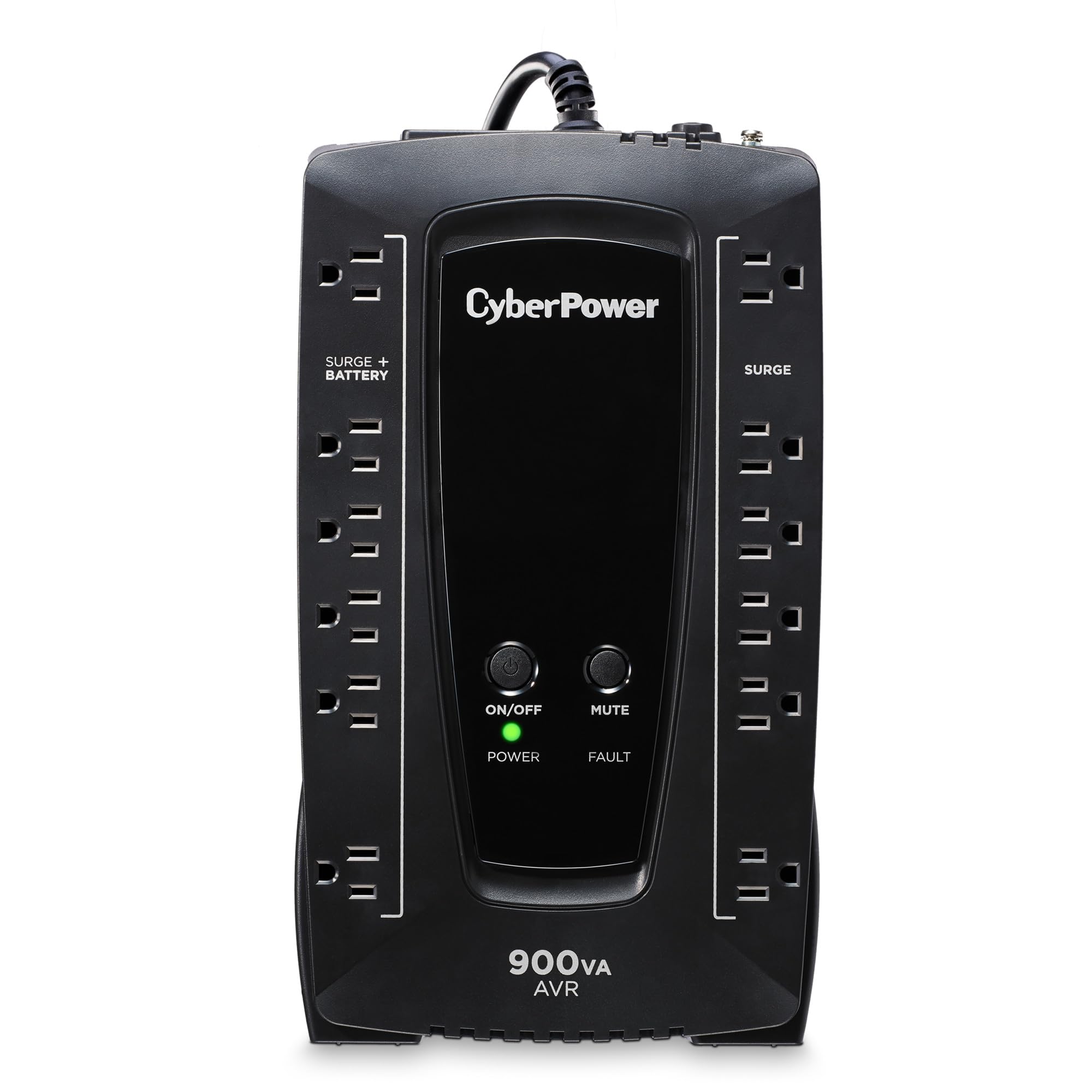
The AVRG900LCD is the crowd favorite of this lineup — 4.6 stars across 600+ ratings — and it earns the top spot by doing the boring thing exceptionally well. It delivers 480W continuous through 900VA of capacity, which covers a pellet stove’s control board, auger, and combustion blower together as long as the igniter cycle has finished. Automatic Voltage Regulation keeps the stove’s electronics on clean power during brownouts without ever switching to battery, so a flickering grid doesn’t trigger a restart sequence mid-burn.
Twelve NEMA outlets split into six battery-backed and six surge-only, so you can plug the stove into a protected slot and leave lamps or a phone charger on the surge side without draining the reserve. The compact form factor measures 3.5 x 12.2 x 7 inches — noticeably smaller than the VTOMAN FlashSpeed 300’s 10.24 x 4.72 x 7.87-inch footprint — so it tucks against a wall or behind a cabinet. It also holds a serious edge in port count: 12 outlets versus the 7 on the VTOMAN, more than double the available connections.
Buyers report running two PCs and two monitors at 175–200W for 18–20 minutes off battery, so a stove pulling similar wattage can hold its burn through a short outage. A NAS owner on an island with constant outages wrote it “has not let me down with way more time than needed to properly shut down.” The recurring gripe is the beeping alarm, which cannot be disabled, and charging takes a full 8 hours before first use.
What it handles well
- 480W continuous / 900VA keeps a stove’s blower, auger, and controller running
- AVR corrects brownouts without touching the battery
- 12 outlets (6 battery, 6 surge) — the widest count in this lineup
- Compact 3.5 x 12.2 x 7 in footprint fits tight corners
- UL-certified build with a 3-year warranty covering the battery
Where it asks for patience
- The alarm beeps on battery and cannot be turned off
- Needs a full 8-hour charge before first use
- Lead-acid cell — expect replacement in a few years, not a decade
The case for it: If you want a proven, small-footprint UPS that quietly protects a pellet stove’s electronics and keeps the auger running through short outages, this is the pick.
Consider alternatives: The 8-hour initial charge and un-silenceable beep make it a poor fit if you need a unit running the moment it arrives or if noise is a dealbreaker in a living space.
2. CyberPower AVRG900U AVR UPS Battery Backup and Surge Protector
The desk-and-stove workhorse with a wall-mountable body and software that shuts things down properly
The AVRG900U is the sibling of our top pick, sharing the same 480W/900VA core and 3.5 x 12.2 x 7-inch compact chassis but trading the LCD for a leaner package that mounts on a wall. Twelve NEMA outlets split between battery-backed and surge-only, so the stove and its controller can live on protected slots while other appliances ride out the surge side. AVR handles minor voltage swings without switching to battery, and the pre-charged battery means you can wire it up and rely on it the same day, unlike the 8-hour first charge required by the LCD model above.
Real owners value its runtime. Owners mention roughly 30 minutes at 115–150W, which covers a stove’s steady-state draw through most short outages. A cable modem and switch owner tested it during a real outage to keep network gear running without a hiccup. It also delivers 900VA and 480W from the same compact plastic enclosure, UL-certified, with a 3-year warranty that includes the battery.
The knock here is long-term durability of the lead-acid cell. One owner reports the battery went bad within five months, and another saw it fail three months after warranty. Those are outliers against a mostly happy base, but they’re worth naming. If you want the same footprint with a lithium cell that should ride a decade, the GOLDENMATE 1000VA below is the more durable path.
The practical read: For a stove that needs a wall-mounted protector with immediate availability and automatic voltage regulation, this hit the same 480W mark as our top pick with a simpler face.
What gives me pause: Lead-acid chemistry means you may replace the battery sooner than a lithium unit, and a small set of buyers hit failures inside the first year.
Reach for this if: You want a wall-hung UPS that pairs stove protection with router and modem backup, and you’d rather not deal with an LCD screen or a long first charge.
Look elsewhere if: You want a battery that likely outlives the next decade — lithium competes on that measure.
3. VTOMAN FlashSpeed 300 Portable Power Station, 300W 230Wh LiFePO4 Battery
Seven pounds of lithium that recharges from empty before you finish your coffee
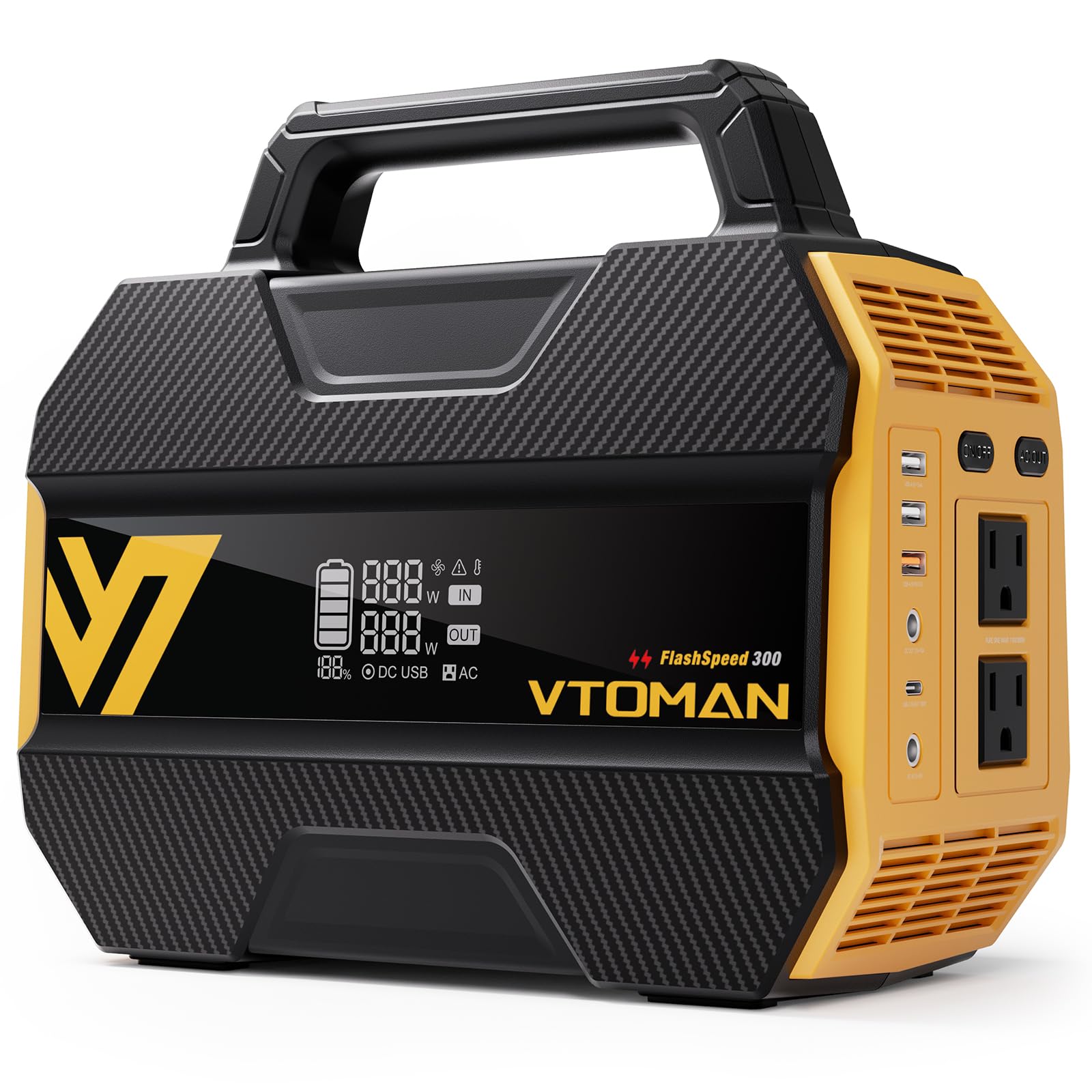
For a pellet stove, the FlashSpeed 300 handles the small auxiliary load — its control board, a circulation fan, or a short outage where you want something you can grab and relocate. It delivers 300W of continuous output and a 230Wh LiFePO4 battery (a lithium iron phosphate battery that lasts many charge cycles) rated for over 3000 cycles, which the maker claims delivers a lifespan six times longer than conventional batteries. At just 7 pounds across a 10.24 x 4.72 x 7.87-inch body, it is the most portable unit here by a wide margin — the PECRON F3000LFP, by comparison, weighs 63.3 pounds on a 19.3 x 11.6 x 11.1-inch frame.
What makes it useful beyond portability is the pass-through behavior. Owners confirm it works as a pass-through UPS that auto-switches to battery during an outage and restores power in about 4 seconds at full load. The 100W PD USB-C port recharges the station to 80% in roughly two hours from a wall outlet. Seven outlets — 2 AC, 1 USB-C at 100W, 3 USB-A, 1 DC — cover a stove controller plus a phone, a light, and a laptop at the same time. A built-in LED light adds three modes (steady, strobe, SOS) for outage work in a dark room.
The honest catch: 300W continuous is well under what a pellet stove’s igniter pulls, so it won’t cycle the stove on its own from cold. It’s a sustain-power unit, not a full-stove starter. The AC inverter also drains the battery slowly even with nothing plugged in, so owners who leave it wired in should expect a slow self-discharge between uses.
Where it shines: A 7-pound LiFePO4 pack that doubles as a phone, lamp, and CPAP backup for the same outage that takes down the stove, with a 4-second automatic transfer at 100% load.
The honest limit: 300W continuous cannot start a pellet stove’s igniter — this is sustain-and-carry power, not a whole-stove solution.
Pick this for: A travel-friendly, light-as-a-cinder-block station that keeps the stove’s steady-state load running and doubles as an emergency light and phone bank.
Skip the recharge if: Your stove’s startup surge exceeds 300W — a higher-output station or a dedicated UPS is the better answer.
4. LIBRIDS Portable Power Station 640Wh, 1200W Surge, Solar Generator 4 AC
A metal-shell cube that refills from empty in an hour and a half flat
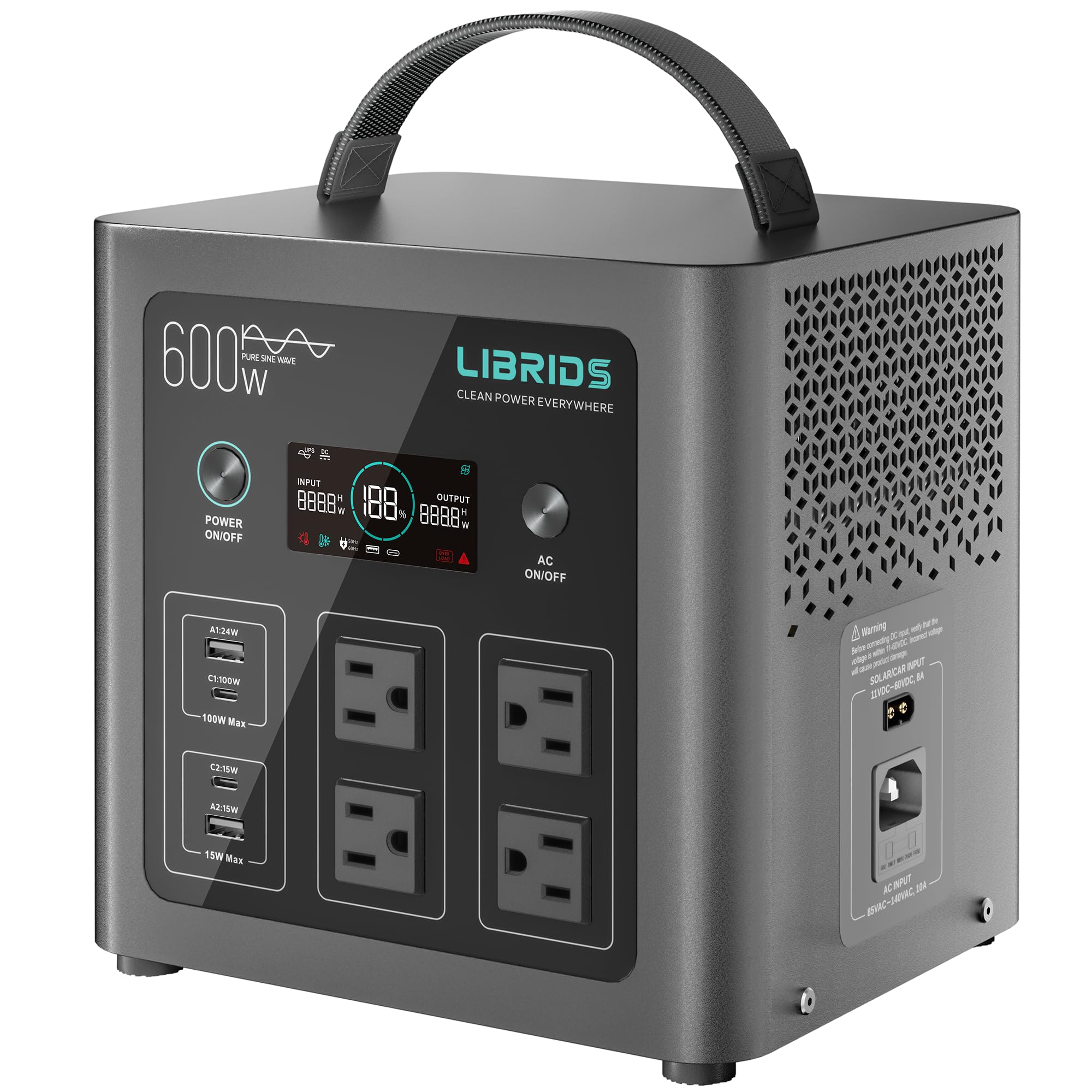
The LIBRIDS is the fastest-charging portable station on this list, and that single number is why it matters for stove owners: 1.5 hours from empty to full on a wall outlet. When you know a storm is rolling in, that turnaround means you can top the unit off during a single evening and have it ready before the grid fails. It delivers 600W continuous with 1200W of surge through its 640Wh LiFePO4 battery, using PowerRaise technology to handle appliance startup loads — precisely the moment a stove’s igniter would otherwise trip a smaller unit.
Its 10ms UPS switchover is faster than the transfer time on many comparably priced stations, and the pure sine wave output is what makes it safe for the stove’s control board and other sensitive electronics. Eight output ports — four AC plus USB — cover a stove, a router, a phone, and a small fan simultaneously. The automotive-grade LiFePO4 cell is rated 4000+ cycles, and the entire unit sits in a metal enclosure that dissipates heat better than the plastic shells on most competitors.
Real owners put the capacity to work. A CPAP user ran a ResMed AirSense 11 for seven hours using only 24% of the battery, and another kept fishing lights lit for hours on a single trip. The stove-relevant takeaway is that 640Wh handles meaningful loads for hours, not minutes. One honest limitation: the maker’s own labeling requires indoor or dry-weather use, so this is not a unit to leave outside in the rain.
What stands out: A 640Wh LiFePO4 station with a 10ms UPS handoff, pure sine wave output, and a 4000-cycle cell, wrapped in a metal enclosure that runs cooler than most of the plastic competition.
Plan accordingly: The 1.5-hour AC charge is only useful if you actually charge ahead of the outage — leave it empty through the storm and you’re starting from zero.
Best for: Emergency-prepared stove owners who want a fast-recharging 640Wh station that handles igniter surge and keeps running for hours.
Not for you if: You plan to leave the unit permanently outdoors — the manufacturer specifies dry, well-ventilated conditions only.
5. GOLDENMATE 1000VA/600W Lithium UPS Battery Backup & Surge Protector, Gray

A lithium UPS built to sit in a closet for a decade without needing a battery swap
Replacing the lead-acid battery in a traditional UPS every few years gets old fast, and that’s the problem GOLDENMATE engineered against. This unit packs a LiFePO4 battery rated beyond 5000 charge cycles with a maker-claimed lifespan of over 10 years — roughly four times the runtime cycle life of the lead-acid CyberPower picks above. For a pellet stove that only calls on the backup a few times a season, that durability translates to a unit you install and forget about.
Continuous output lands at 600W with 1000VA of capacity, delivered as pure sine wave so the stove’s control board sees clean power. Eight NEMA 5-15P outlets carry both surge protection and battery backup, and a Battery Management System with PP45 terminals manages charging and discharging safely. The color LCD shows real-time battery and power status. A cooling fan kicks in under heavy load and stays under 50 dB, which is roughly the sound of a quiet conversation — unobtrusive for a living-room install.
Customers note the unit holding a 185W load for roughly three hours off one 600W charge, which would keep a pellet stove running through a long evening outage. A corporate AV setup runs three of these at the front of house and reports they’ve already saved a show during a brief outage. The honest limitation is transfer time — one measured it at 20ms (20 milliseconds, the brief gap before backup power kicks in), which is fine for electronics but means a running stove’s flame will not stay lit through the switch the way it would on a dedicated AVR unit.
What owners keep
- LiFePO4 cell rated for 5000+ cycles and a 10-year maker lifespan — no battery swaps
- 600W continuous / 1000VA with pure sine wave output
- Eight protected outlets on battery + surge
- Color LCD shows live battery and power data
- Cooling fan stays under 50 dB — quiet enough for living areas
Where it lands short
- Roughly 20ms transfer time — a burning stove will not carry through the switch
- 150W-scale loads drain the 600W reserve faster than the heavier lithium units
- A periodic U55 overload error can require unplug and replug
Built for: Owners who want a lithium UPS that won’t need a battery swap for a decade and prefer a compact, quiet install in a living space.
Think twice about: Running a live pellet stove through this — the transfer time is not fast enough to keep the flame lit mid-switch.
6. GOLDENMATE 1500VA/1000W Lithium UPS Battery Backup & Surge Protector, White

A heavier, higher-output lithium tower that treats a pellet stove and a gaming rig with equal respect
Where the 1000VA GOLDENMATE tops out at 600W, this 1500VA model almost doubles the ceiling to 1000W continuous with a 51.2V, 5.8Ah LiFePO4 pack storing 296Wh. Pair that with AVR (automatic voltage regulation, which fixes voltage sags and surges without touching the battery) and you have a unit that can keep a stove’s auger cycling through a real outage without ever dropping to reserve power during ordinary brownouts. The lithium cell is rated beyond 3000 cycles with a maker-claimed 10-year lifespan, and the outlet panel is deliberately spaced wider than most competitors so bulky stove-controller plugs fit alongside standard cables.
A user running an Alienware PC with a 1kW PSU (power supply unit) alongside two monitors, speakers, and an external drive reports no issues over two weeks. Another running a gaming PC plus monitors during a real outage saw the unit hold for about an hour before hibernating Windows at 5% battery — software that also works through the front-panel USB port and the Windows battery monitor, no app required. Two USB charging ports on the front panel (one USB-C, one USB-A) add 10W of device charging.
The trade-offs are physical. At 15 kg and 16.73 x 6.3 x 11.81 inches, this is a substantial piece of furniture-grade equipment, and the maker itself notes the larger transformer adds weight versus the smaller 1000VA sibling. The core honesty check: this UPS runs on utility AC power, and the maker explicitly warns that generator-supplied power may not meet the unit’s input requirements, so it will stay in battery mode and not recharge. One owner also reports the outlet panel uses an uncommon C20-style plug.
Standout engineering: AVR plus 1000W continuous and 296Wh of lithium on a spaced outlet panel — this is a UPS designed for homes that also run serious electronics.
Know before you buy: Generator-fed power may not register as valid AC input, so this is not the unit to pair with a portable generator feeding the whole house.
Choose this if: You want a higher-output lithium UPS that protects both a pellet stove and a PC rig on the same unit, and you have room for a substantial 15 kg tower.
Go smaller if: Your stove is the only critical load and wall or floor space is tight — the 1000VA version covers that role with less bulk.
7. PECRON Portable Power Station F3000LFP, 3072Wh Solar Generator, 3600W LiFePO4 Battery Home Backup
Three kilowatt-hours of lithium that runs the stove, the fridge, and the freezer through a two-day outage
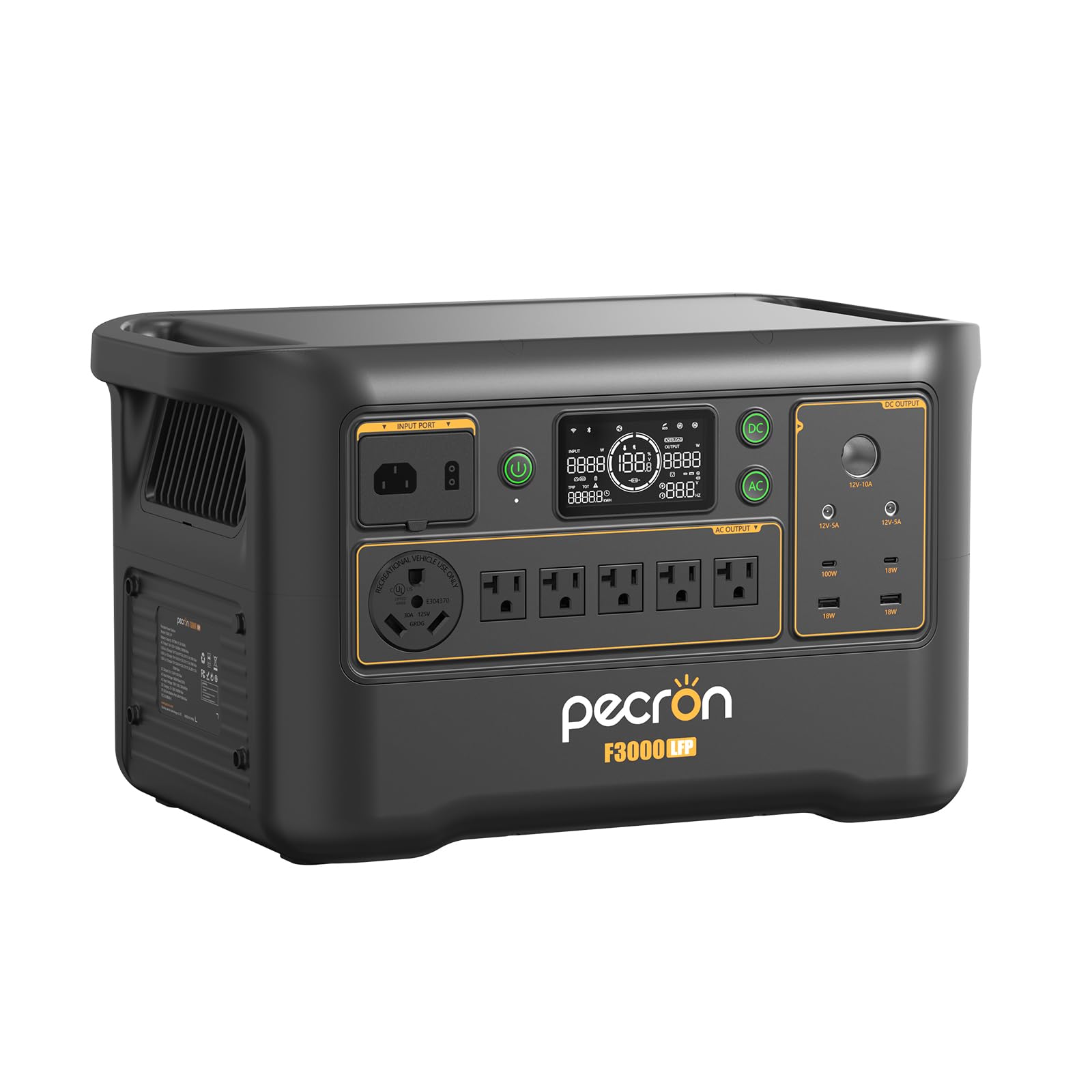
When the outage lasts longer than an evening, 3072Wh changes the math entirely. The PECRON F3000LFP delivers 3600W of pure sine wave output (clean, stable power like a wall outlet) across 13 ports — six AC outlets, two 100W USB-C, two 18W USB-A, a carport, and two DC 5525 outputs — enough to run a pellet stove and a household’s essential appliances off one box. The LiFePO4 battery is expandable up to 10752Wh via a separate EP3800-48V battery pack, so a homeowner can add capacity as their backup needs grow. Home backup for two to three days is the maker’s stated expectation.
Recharging is the standout here. A 1800W AC input takes the F3000LFP from zero to 100% in two hours, and triple-charge (AC plus solar plus car) tops it up even faster. Solar input accepts up to 1600W at 25–120V, so a moderate array can keep the station topped off through a multi-day outage. Its UPS mode switches in 8–20ms, which keeps a stove’s electronics stable, and the app gives real-time power monitoring so you can see exactly what the stove is drawing.
The trade-offs are real. At 63.3 pounds across 19.3 x 11.6 x 11.1 inches, this is not a grab-and-run unit — it’s a semi-permanent fixture, and owners consistently note the weight. The charging fan also runs audibly under load. The app requires internet for Bluetooth pairing, and manuals are translated poorly enough that first-time setup takes patience. One owner reports a unit that failed within a few days and had a hard time with return shipping given the weight.
The scale play: 3072Wh expandable to 10752Wh, 3600W continuous, and 13 ports make this the one station here that can genuinely run a home’s critical loads through a multi-day outage.
The physical reality: 63.3 pounds is a permanent-install commitment, and the fan noise plus a login-required app are the friction points owners flag most.
Best for: Whole-home outage prep where a single 3072Wh station is expected to run a stove, fridge, and freezer for days without a generator.
Look at smaller options if: You need something portable, or you aren’t prepared for a 63-pound box that stays put during storm season.
8. Anker SOLIX S2000 Portable Power Station, 2,010Wh, 3,000W Peak, Home Backup
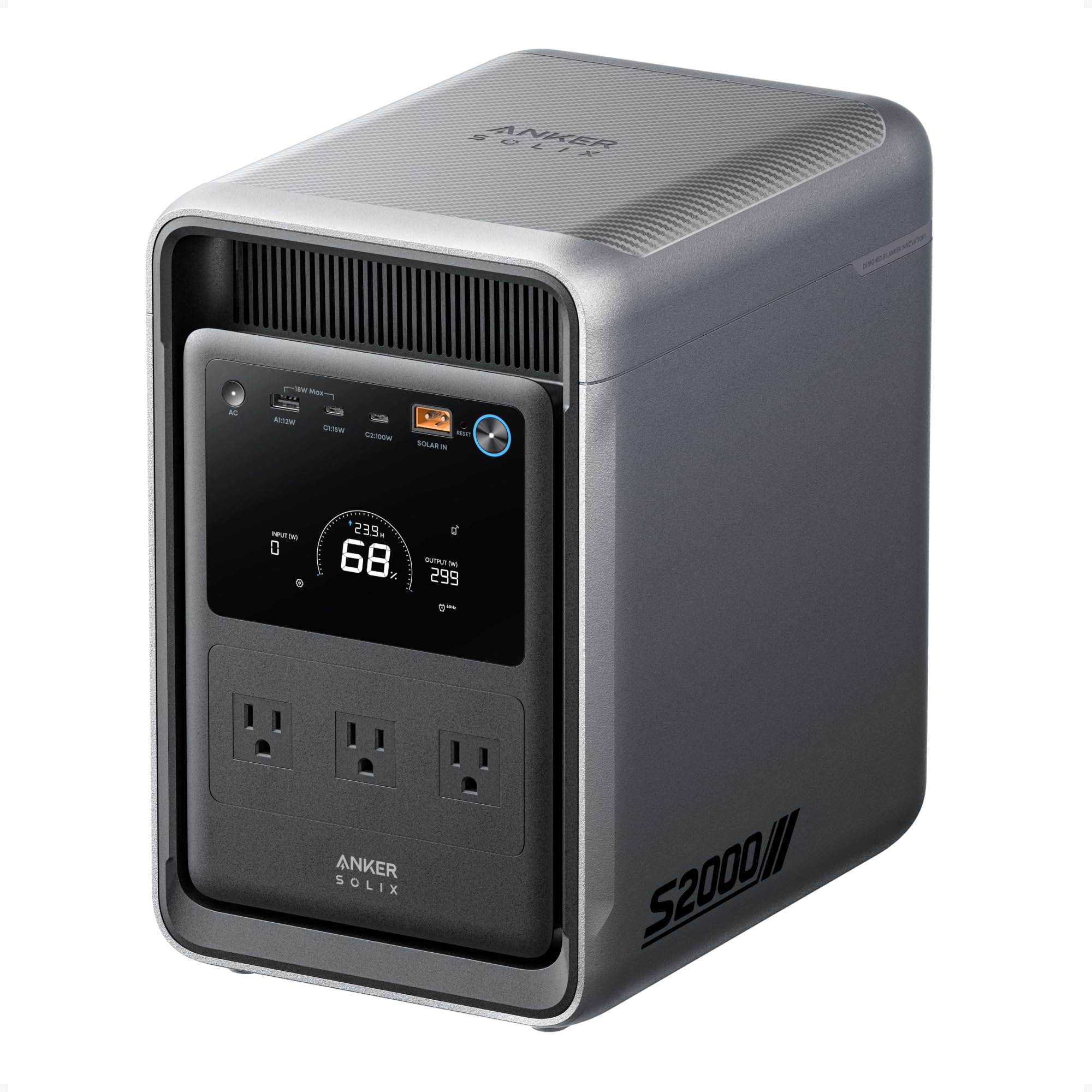
The lightest 2kWh station here, with a 15-year cell and under-10ms transfer
The Anker SOLIX S2000 packs 2,010Wh into a frame just 8.2 x 11.1 x 12.7 inches and 35.7 pounds — the maker claims 30% smaller and 25% lighter than the 2kWh industry average, which lines up with it being the lightest high-capacity unit here. Its 314Ah LFP cells (lithium iron phosphate, a long-life battery chemistry) are rated for 10,000 cycles with a claimed 15-year lifespan, and the 1,500W continuous output with 3,000W peak gives you the surge headroom to handle a pellet stove’s igniter without a hitch. Six watts of idle draw and 10% higher efficiency than comparable systems mean the unit sips power between uses instead of draining itself flat on the shelf.
A fridge test logged 27 hours from full to 5%, and a 220L fridge run lasted up to 30 hours on a single charge — this is a unit that runs a real household load for a full day. Its under-10ms UPS switchover (the gap before backup power takes over) is faster than the transfer windows on most competitors, which matters for a stove controller that reboots on the briefest dip. Eight outlets split front and rear keep always-on loads tidy. Six charging options including 400W solar, wall outlet, alternator charger, car outlet, and generator round out the flexibility.
The trade-offs are honest and specific. One owner notes the fan gets loud while charging at 1,200W, and a chemical burn-off smell shows up on the first charge before dissipating. Solar input caps at 400W, half of what the PECRON accepts, so a bigger panel array won’t charge any faster. There’s also no 12V DC port and no expandable battery support, unlike the PECRON above.
The engineering win: 2,010Wh and 10,000-cycle LFP cells packed into 35.7 pounds with a sub-10ms UPS transfer — a rare combination of light and capable.
Where it caps out: 400W max solar input and no DC port or expansion battery mean this is a self-contained unit, not a scalable system.
Built for: Households that want a light, compact 2kWh station for stove and fridge backup and need the fastest possible transfer to keep sensitive electronics up.
Consider the PECRON instead if: You want expansion batteries or a bigger solar input — this Anker is a self-contained answer.
9. Jackery HomePower 3000 Portable Power Station, 3072Wh, 3600W AC Output
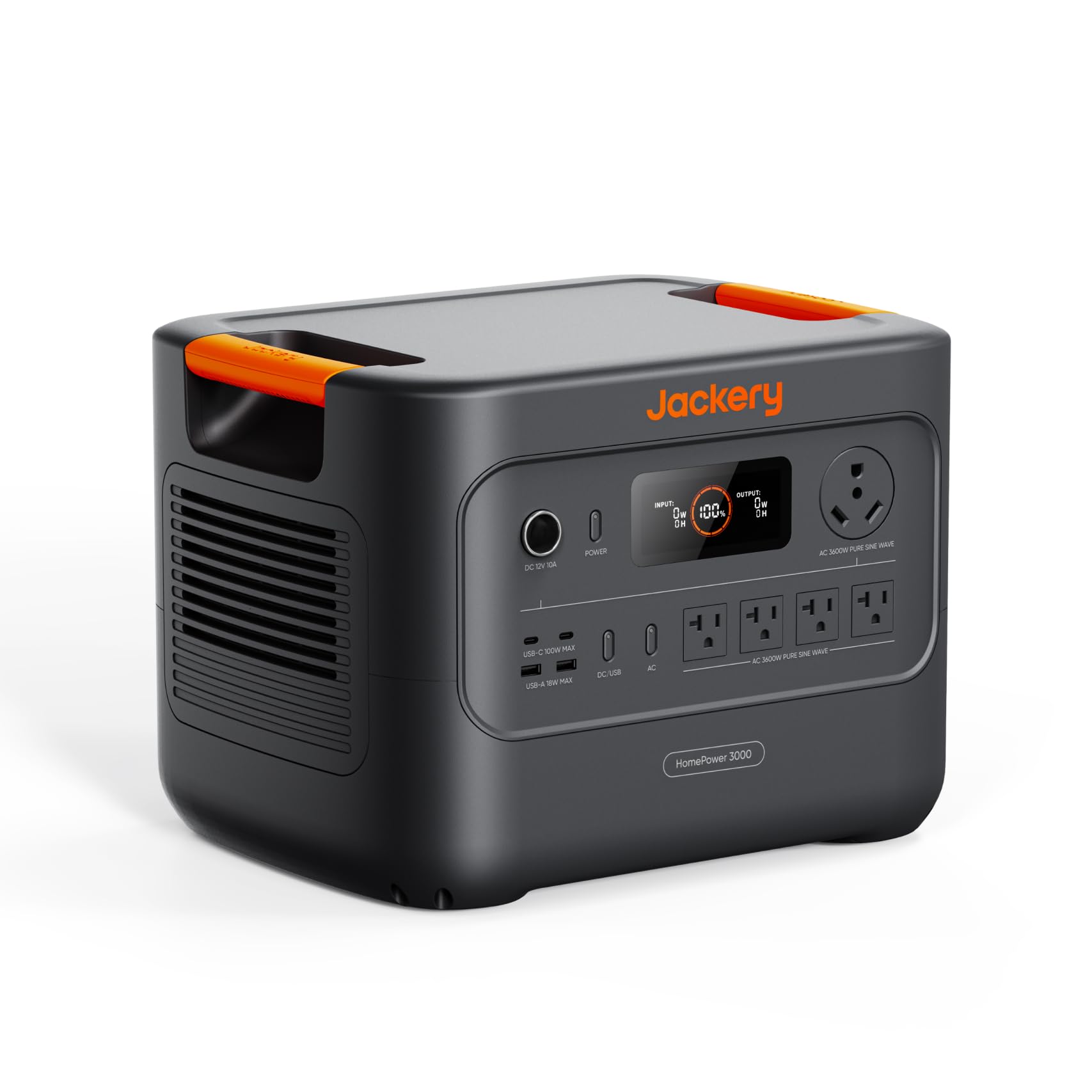
The 7200W surge monster built for the moment a compressor or igniter kicks on
On paper, the Jackery HomePower 3000 shares the PECRON F3000LFP’s 3072Wh capacity and 3600W continuous output, but it pulls ahead on surge: 7200W peak versus the PECRON’s spec. That headroom is exactly what a pellet stove’s igniter needs, and it’s what makes the Jackery more forgiving with any appliance that starts hard. The LiFePO4 cell is rated for 4000 cycles while retaining 70% capacity, and the UL-certified UPS switches in 20ms or less. Recharge time lands at 1.7 hours via hybrid AC and DC, or 2.2 hours on AC alone — fast enough to prep during a warning window.
Owners vouch for the runtime. One reports the unit holding essential loads for 30+ hours on a single charge and keeping a fridge cold well past a day. Another runs an office freezer and other gear through repeated outages. A dedicated fridge-backup user noted the 7200W surge rating was the deciding factor — a smaller Jackery 1000 unit couldn’t handle the compressor start, but the HomePower 3000 handles it without complaint. A 30A outlet lets an RV plug directly into the unit, no adapter required.
The trade-off is weight and noise. At 59.5 pounds across 16.4 x 12.8 x 12 inches, it’s a two-person lift, and owners describe building dollies just to move it around. The fan runs audibly — one measured it around 60 dB under any draw, which is on the loud end for an indoor install. The maker also flags the weight explicitly and positions it as portable despite the bulk.
Why owners commit to it
- 7200W surge headroom — the highest peak here — for hard-starting appliances
- 3072Wh LiFePO4 rated for 4000 cycles retaining 70% capacity
- Recharges in 1.7 hours via hybrid AC + DC, 2.2 hours on AC
- 30A outlet plugs an RV straight in, plus a dedicated TT-30 port
- UL-certified UPS switches in 20ms or less
The compromises
- 59.5 pounds — a real two-person lift that most owners move on a dolly
- Fan noise around 60 dB under load rules it out for a bedroom install
- Solar input pairs best with 2x200W panels for meaningful recharge speed
Reach for this if: Your stove, fridge, or well pump starts hard and you want the highest surge rating here plus a 1.7-hour recharge before the storm hits.
Look at the Anker instead if: Portability and quiet operation matter more than peak surge watts.
Understanding the Specs
Surge Wattage vs Running Wattage
The number on the box that matters most for a pellet stove is the peak or surge rating, not the running wattage. An auger motor, combustion blower, and igniter together can spike to several times the steady draw for a couple of seconds when they kick in. A unit rated 1500W continuous with 3000W peak, or 3600W continuous with 7200W surge, gives that spike somewhere to go. A backup that only matches running wattage may work for months and fail the one time it’s cold enough to need the igniter at full draw.
Transfer Time and Why It Matters
Transfer time is how long the unit takes to switch from wall power to battery when the grid drops — measured in milliseconds. Anything under about 20ms is generally described as fast enough to keep electronics running without a reboot. A traditional UPS switches in the low single-digit milliseconds; portable power stations typically switch in 8–20ms. If your stove’s controller takes more than a second to reset, transfer time isn’t critical. If it reboots the ignition sequence on any dip, it absolutely is.
FAQ
How many watts does a pellet stove need from a backup battery?
Can a UPS run a pellet stove during a power outage?
Will a 300W power station actually run my pellet stove?
How long will a 2kWh or 3kWh power station last running a pellet stove?
Is LiFePO4 better than lead-acid for pellet stove backup?
Can I run a pellet stove and a refrigerator on the same backup battery?
What is the difference between a UPS and a portable power station for a stove?
Will my pellet stove run on a pure sine wave output or does it need a modified sine wave?
How do I recharge a backupbattery during a long outage without a generator?
Does a backup battery need to match my stove’s amperage as well as its wattage?
Can I leave a backup battery plugged in all the time?
Final Thoughts: The Verdict
For most homes, the backup battery for a pellet stove winner is the CyberPower AVRG900LCD because it pairs 480W of continuous output with automatic voltage regulation, 12 outlets, and a small upright footprint that slips against a wall. The 4.6-star rating across 600+ owners speaks to how reliably it does the boring job of keeping electronics up during outages.
If you want the lithium upgrade with a decade of lifespan and no battery swaps, grab the GOLDENMATE 1000VA/600W Lithium UPS — it delivers the same clean power on a 5000-cycle cell. And for storm-season whole-home prep where a pellet stove and a fridge need to run for days without a generator, the PECRON F3000LFP is the one to reach for, with 3072Wh and 3600W on tap.
One final nudge: the pellet stove’s igniter is the number most buyers forget until the first cold outage, so match a unit’s peak or surge rating to your stove’s startup draw before anything else. Everything else — capacity, chemistry, outlet count — can flex once the surge box is ticked.
How We Picked
We do not accept paid placement. Every pick is matched to a real buyer and a real use-case; we do not hands-on test units.
Sources & Methodology
Specifications: manufacturer listings and product documentation. Review insights: verified customer reviews, as of September 2026. Pricing: not shown on this page (it changes often); check the current price via the retailer link.
As an Amazon Associate, KitchPrep earns from qualifying purchases. This does not affect which products we feature.
Related Guides
