
Specs are compiled from manufacturer listings and verified buyer reviews and can change over time — please confirm the key details on the product page before buying.
Your alarm panel is beeping every few hours and the keypad is flashing a trouble light — that usually means one thing: the rechargeable battery behind the panel door has aged out and needs a straight swap. The good news is you do not need a service call to fix it. You need a 12-volt sealed lead-acid battery with the right amp-hour capacity (Ah — how much charge it stores) and the right terminal size for your panel’s wiring. This guide covers the nine backup batteries worth considering for a home alarm system, what each one is actually good at, and how to pick the one that fits your panel without a technician’s bill.
I’m Mohammad Maruf — the founder and writer behind KitchPrep. This guide is built by comparing the manufacturers’ published specifications and the patterns across verified customer reviews, so you get each pick’s real strengths and trade-offs instead of marketing spin.
Most panels take a 12-volt SLA battery in the 5Ah to 8Ah range, but terminal width and physical size decide whether it drops straight in or fights you. What follows is a straight read on the backup battery for a home alarm system that fits your box.
Our Picks at a Glance


How To Choose The Best Backup Battery for a Home Alarm System
The most common mistake is ordering the right voltage but the wrong physical size. A 12-volt battery comes in several case dimensions, and your panel’s plastic cradle only accepts one. Measure the old battery before you order anything.
Match the amp-hour rating first
Amp-hours (Ah) tell you how much charge the battery stores, and in an alarm panel that number sets how long the system runs on battery alone during a power cut. A 5Ah battery holds less reserve than a 7Ah or 8Ah unit. If your panel shipped with a 7Ah battery, replace it with a 7Ah or 8Ah rather than dropping to a 5Ah — you will lose standby time without gaining anything. Going up slightly in capacity within the same case size is generally fine because the panel’s charger tops up whatever it’s given. What you should not do is install a battery with a smaller Ah rating than the one you removed.
Get the terminal type right
The metal tabs where your panel wires connect come in two common widths. F1 terminals are the narrower spade (a flat slide-on connector), and F2 terminals are the wider version. Some batteries ship with F1 tabs plus plastic adapters that widen them to F2, which widens your options. If your panel’s spade connectors are loose on the tabs, that is a sign you have the wrong terminal size — not a defective battery. Check the old battery’s tabs against the new listing before you commit.
Quick Comparison
| Model | Best For | Capacity | Terminal | Weight | Amazon |
|---|---|---|---|---|---|
| Power Sonic PS-1250F1★ Best Overall | Most alarm panels, best all-rounder | 5Ah | F1 | 1.8 lb | Amazon |
| Power Sonic PS-1250 General PurposeWidest Compatibility | Broad device compatibility | 5Ah | F1 | — | Amazon |
| Casil CA1280Longest Reserve | Larger panels needing more reserve | 8Ah | F2 | 5 lb | Amazon |
| Casil CA1272 | Verizon FiOS and UPS boxes | 7.2Ah | F2 | — | Amazon |
| Interstate FAS1055 | Fire and security panels | 5Ah | F1 | 3.1 lb | Amazon |
| UPG Security Alarm System Battery | Verizon FiOS BBU replacement | 7Ah | F1 | 5 lb | Amazon |
| Yuasa NP7-12 | Older panels, exact fit | 7Ah | F1 | 5.2 lb | Amazon |
| Energizer EN7-12 | Long storage, low self-discharge | 7Ah | F1 (F2 adapters) | 5.1 lb | Amazon |
| Miady 12V 7Ah (2 Pack) | Two panels or a spare on the shelf | 7Ah | F2 (F1 adapters) | — | Amazon |
In‑Depth Reviews
1. Rechargeable Sealed Lead Acid Battery PS-1250 12V 5.0AH @ 20-hr. 12V 4.5 AH @ 10-hr. (PS-1250F1)
Our pick — over 4.5★ from 950+ verified ratings; the strongest balance of quality and price.
The panel battery owners reach for when they want the swap done before the beeping starts again.
Here is the number that matters for most alarm panels: 12 volts and 5 amp-hours. That rating is sized for the standby draw of a typical security panel, and it is the exact battery many DSC panels ship with. You get 5Ah at a 20-hour discharge rate and 4.5Ah at a 10-hour rate, which is a technical way of saying it delivers full capacity for slow, steady drains like a panel sitting idle on backup power.
The AGM construction (absorbent glass mat — the fiberglass layer that holds the electrolyte, so nothing sloshes or spills) means you can mount it flat, upright, or on its side inside the panel box. It also shrugs off the vibration and bumps a wall-mounted panel sees. At 1.8 pounds it slots in without stressing the mounting bracket, which matters if your panel sits on a hollow interior wall.
What sets this one apart from the rest of the field is how consistently it just works. Across 900+ ratings, buyers report it as an exact replacement that drops into standard DSC panel cradles without coaxing. Most owners get three to four years of service, typical for a standby SLA battery. The trade-off worth knowing: 5Ah is the lower end of the capacity range, so if your panel drives heavy peripherals or you want longer blackout coverage, step up to a 7Ah or 8Ah unit instead.
Where it earns its keep
- F1 terminals match the standard spades on most DSC and similar panels
- 1.8 lb weight is the lightest in this lineup, so the panel bracket barely notices it
- Sealed AGM design mounts at any angle with no spill risk
Worth weighing first
- 5Ah is the lowest capacity pick here — less reserve for extended outages
- Confirm your panel uses F1 tabs, not the wider F2 style
The default answer: If you want a drop-in replacement for a standard alarm panel and nothing fancy, this is it — the price is entry-level and the fit is proven.
Skip if: Your panel needs F2 terminals or more than 5Ah of standby reserve.
2. Power Sonic PS-1250 Rechargeable Sealed Lead Acid Battery 12V 5AH for General Purpose, Medical, Emergency Lighting, Fire and Security with F1 Terminals
Same 12-volt, same 5Ah, but built for the wall-wart jobs beyond the alarm panel.
This is the general-purpose sibling of the PS-1250F1 above, and the difference is in the construction. It uses six internal cells in a valve-regulated, maintenance-free configuration — meaning the battery handles its own pressure balance and never needs water. The ABS case shrugs off vibration and impact, and the case holds up in the tight, warm space inside an alarm panel cabinet.
That broad build is why it shows up in emergency lighting, fire panels, medical devices, and the occasional camper van 12-volt setup in the owner notes. One owner reports the previous PS-1250 in the same alarm system lasted eight years. You are getting the same terminal layout as the F1 model above — 3.54 inches deep, 2.76 inches wide, 4.21 inches tall — so the physical fit into a panel cradle is identical.
Here is the honest caveat worth flagging: how long this battery lasts draws mixed feedback. Some owners get five years out of it; a few report a much shorter run before replacement is needed. One buyer notes the battery arrived with a good float voltage (the voltage it holds while just sitting on standby) and reports it holding up well over time. The note about a USA brand not manufactured in China comes up often in the reviews — but longevity is the variable here, not build quality.
Under the lid: Six cells, valve-regulated, AGM construction — the same proven chemistry as the best-seller above, packaged for a wider spread of low-power 12-volt devices.
The realistic read: This battery is roughly the same size and weight as the F1 model and costs a little more, so it earns its slot when you want a general-purpose spare on the shelf for alarm, gate, or emergency-light duty.
Reach for this if: You want one 12-volt 5Ah battery that works across alarm, emergency light, and small 12-volt projects, with a US-brand assurance behind it.
Look elsewhere if: Your panel needs F2 terminals or more than 5Ah of reserve capacity.
3. Casil CA1280 12V 8Ah SLA/AGM Sealed Lead Acid Maintenance-Free Battery – F2 Terminals
When your panel needs the biggest tank in the lineup, this is the one that holds its charge longest.
Capacity is where this battery wins. At 12 volts and 8 amp-hours, it stores 11% more charge than the Casil CA1272 at 7.2Ah that sits lower in this list. That means more minutes of panel operation during an extended blackout — worth having if you have security cameras, cellular communicators, or door sensors drawing extra current off the same panel. It carries F2 terminals, which are the wider spades, so check your panel’s connectors first.
The AGM build means zero water top-ups and no leaks, and the F2 fast-on terminals connect with no modification to the panel wiring. The weight is the real story though: at 5 pounds this battery is 2.8 times heavier than the PS-1250 at 1.8 pounds. That is the direct cost of the extra 3 amp-hours of capacity, and it makes the panel bracket work harder. If your panel sits on a stud wall with a hollow cavity behind it, tighten that bracket before you set this one in.
Owners treat this mainly as a Verizon FiOS backup replacement, and the feedback is direct: the fit works, the capacity holds, and the swap is far cheaper than replacing the whole backup unit. The recurring caveat from owners is service life — the summary notes some units are reporting under two years in FiOS duty. A trickle of owners also mention that the terminal orientation needed a slight bend or a drill-out to accept a machine screw in non-FiOS applications, so if you are retrofitting into a tight panel cavity, have your small screwdriver handy.
The capacity math: 8Ah beats the 7.2Ah CA1272 by a measured 11% more charge, and it doubles the reserve of a 5Ah panel battery — real headroom when the grid is down overnight.
Fitting note: F2 terminals only. If your panel has F1 spades you will need adapters, and the 5-pound weight is not bracket-friendly on a hollow wall.
Built for: Larger panels and FiOS boxes where extra standby time is worth the heavier battery.
Not the one if: You have F1 panels or a lightweight mount that cannot hold 5 pounds comfortably.
4. Casil CA1272 12V 7.2Ah SLA/AGM Sealed Lead Acid Rechargeable Maintenance-Free Battery – F2 Terminals

The FiOS box whisperer — the battery that makes the hourly beeping stop.
Across hundreds of reviews, owners describe the same fix: the FiOS unit beeps hourly, the battery is swapped, and the beeping stops the moment it seats. The fit is exact for FiOS boxes and old APC UPS units, and the 7.2Ah capacity (amp-hours, a measure of how much charge it stores) is a real step up from the 5Ah batteries above — with a measured 11% less charge than the 8Ah Casil CA1280, but at a smaller, lighter 5.94-inch length that fits tighter enclosures more easily.
Installation requires no tools according to owner reports, and the F2 terminals line up with the FiOS BBU’s connection points directly. The value angle is what shows up over and over — a fraction of what a technician or the Verizon OEM channel would charge, and the same performance and weight as the original. If you are working inside an APC UPS or a similar sealed backup unit, the same 7.2Ah case size and F2 tabs generally drop straight in.
The one downside flagged fairly often is the outer packaging from Amazon occasionally arriving beat-up with items loose in the box. The batteries themselves are well-boxed inside their own carton, so the damage is rarely the battery’s fault, but inspect before you install. Battery life is the other thing to size honestly — a good share of owners mention four to five years, and the trade-off is that a few units run shorter. That is standard for standby SLA duty.
Why it wins the swap
- 7.2Ah holds nearly as much charge as the 8Ah Casil for a smaller, lighter footprint
- F2 terminals mean a tool-free drop-in for Verizon FiOS BBU and many APC UPS units
- Value priced well below the OEM replacement channels that owners were quoted
Where it falls short
- Battery life is not uniform — the panel and cabinet heat decide most of it
- Amazon outer packaging has arrived loose or damaged for some shipments
The FiOS answer: If your beeping box says Verizon or APC, this is the exact replacement most owners recommend without a second thought.
The one to skip if: You need F1 terminals — this one ships with the wider F2 spades only.
5. Interstate Batteries SLA Battery 12V 5Ah AGM Power Patrol FAS1055

A fire-and-security battery built by a name that has been in the game longer than most panels have existed.
Interstate’s Power Patrol line is purpose-built for fire alarm, security, and access-control panels, which is exactly where this battery lands. The spec sheet is clean: 12 volts, 5 amp-hours, F1 terminals on a 3.54 x 2.76 x 3.98-inch case, and a 12-month performance warranty. The sealed AGM/VRLA construction means the electrolyte stays put regardless of how the panel sits, and the battery mounts in any orientation without spill risk.
What gives this one its slot beyond the spec is the brand reach. Interstate has been supplying batteries since long before rechargeable alarm backups became standard, and the manufacturer’s own 7-Point Quality Protocol is spelled out on the packaging. The FAS1055 compatibility list is broad enough to cover Honeywell, ADEMCO/ADI, Silent Knight, and Duracell alarm hardware, so if you have a branded panel with a less-common battery spec, this is a good first check. At 3.1 pounds it is slightly heavier than the PS-1250 but noticeably lighter than the 5-pound Casil 8Ah.
The one hiccup that shows up in buyer notes is a unit occasionally arriving flat — before first charge. That is a delivery-and-storage issue rather than a design one, and the refund process is described as smooth in the reviews where it happened. The other honest caveat is battery life: reports range from short to very long, so treat any single lifespan claim with caution. What that means practically is simple — put this one on a trickle charge before install if the case feels cold and dead to the touch.
The brand case: For fire and security panels with branded compatibility lists, Power Patrol by Interstate is a name most installers will recognize and a warranty most buyers will actually trust.
One thing to check: Verify your unit arrives charged before you install — a few shipments have landed flat, and the panel charger will not always top up a fully dead cell quickly.
Best for: Fire and security panels where brand-name assurance and a listed warranty matter more than the cheapest price on the shelf.
Think twice if: You are replacing a 7Ah or 8Ah original — this 5Ah unit gives up standby reserve.
6. UPG Security Alarm System Battery 12V 7.2AH SLA Security Certified-Electronics

Sixty-plus interchangeable part numbers and a direct fit for the Verizon FiOS backup box.
What you get here is a 12-volt, 7.2Ah sealed lead-acid replacement that covers a staggering list of original part numbers — from the ubiquitous UB1270 and PS-1270-F1 to the SLA1075 and UT-1270. If you are hunting down a battery for an older panel and the label is faded, the UPG part list is a strong starting point for cross-referencing. The F1 terminals match the narrow spades used on most residential alarm panels and the FiOS BBU.
In practice, this is the battery owners reach for when their Verizon FiOS BBU starts its beep. Install is described as straightforward across the owner notes; nobody is reporting a fight with the terminal posts. At 5 pounds it is a genuinely heavy battery, matching the Casil CA1280 in weight, so plan accordingly if your mounting hardware is light duty.
Where this battery needs an honest asterisk is service life. Two of the middle-range reports sit in the 3-5 year window. That variance is the reality of SLA chemistry — heat and charger behavior dominate — but it also means you should not bank on this one to stick around the way a premium-branded option might.
The case for it
- Compatible with 60+ original part numbers — crossover coverage for hard-to-source panels
- F1 terminals fit both alarm panels and the Verizon FiOS BBU directly
- Direct swap ends the continuous FiOS beeping that drives owners to replace
The case against
- Battery life is the most-reported concern — reports range from under a year to eight years
- Terminals sit slightly shorter than some OEMs, so the positive wire can feel loose
Pick this if: You are replacing a Verizon FiOS BBU battery or chasing down a hard-to-match panel part number — the compatibility list is the longest in this lineup.
Pass if: You want the number of years out of a battery to be the deciding factor — the profile here is more variable than the rest.
7. Yuasa NP7-12 12V/7Ah Sealed Lead Acid Battery with F1 Terminal

The battery many old alarm panels were actually built around — right down to the terminal width.
Yuasa’s NP7-12 is a spec-for-spec match for the battery used in a lot of older alarm installations, and that shows up the moment the panel door opens. Owners with panels going back decades — one describes a 35-year-old security system — report this battery dropping in with the same terminal positions and dimensions as the original, a two-minute swap. The F1 terminal is the narrower 0.187-inch slide-on spade, so if your panel wiring has that width, this battery goes on without adapters.
Specs line up tight: 12 volts, 7 amp-hours capacity, 5.94 x 2.56 x 3.7 inches, and about 5.2 pounds — a slightly heavier case than the Power Sonic 5Ah options and close to the 5-pound Casil CA1280. That heft is the trade-off for the extra 2Ah of capacity over a 5Ah battery, giving more reserve when the grid drops. The build quality earns consistent praise — the battery feels stiff and well-sealed, and owners describe it as backing up alarm panels without drama.
The one caution is battery life. Reports split between owners getting five to seven years and others reporting replacement needed at the 12-month mark. Both outcomes appear in the same set of reviews, which suggests the panel’s charging behavior and the cabinet environment matter as much as the battery itself. If your panel has a history of cooking batteries — hot cabinet, no ventilation — do not bank on this one outlasting the previous occupant.
Exact-fit benefit: For panels that originally shipped with a Yuasa NP7-12, this is the cleanest possible replacement — same terminal width, same 7Ah capacity, no wiring gymnastics.
Longevity reality: Owner outcomes span five-to-seven years on the good end and a year on the short end, so treat lifespan as charger-dependent rather than brand-guaranteed.
The OEM-match move: Buy this one if your old battery was a Yuasa NP7-12 and you want the identical part rather than a cross-reference.
Not the best fit if: Your panel uses the wider F2 spades or you need 8Ah of reserve.
8. Energizer EN7-12, 12 Volt 7 Amp Hr, Long Lasting Sealed Lead Acid AGM
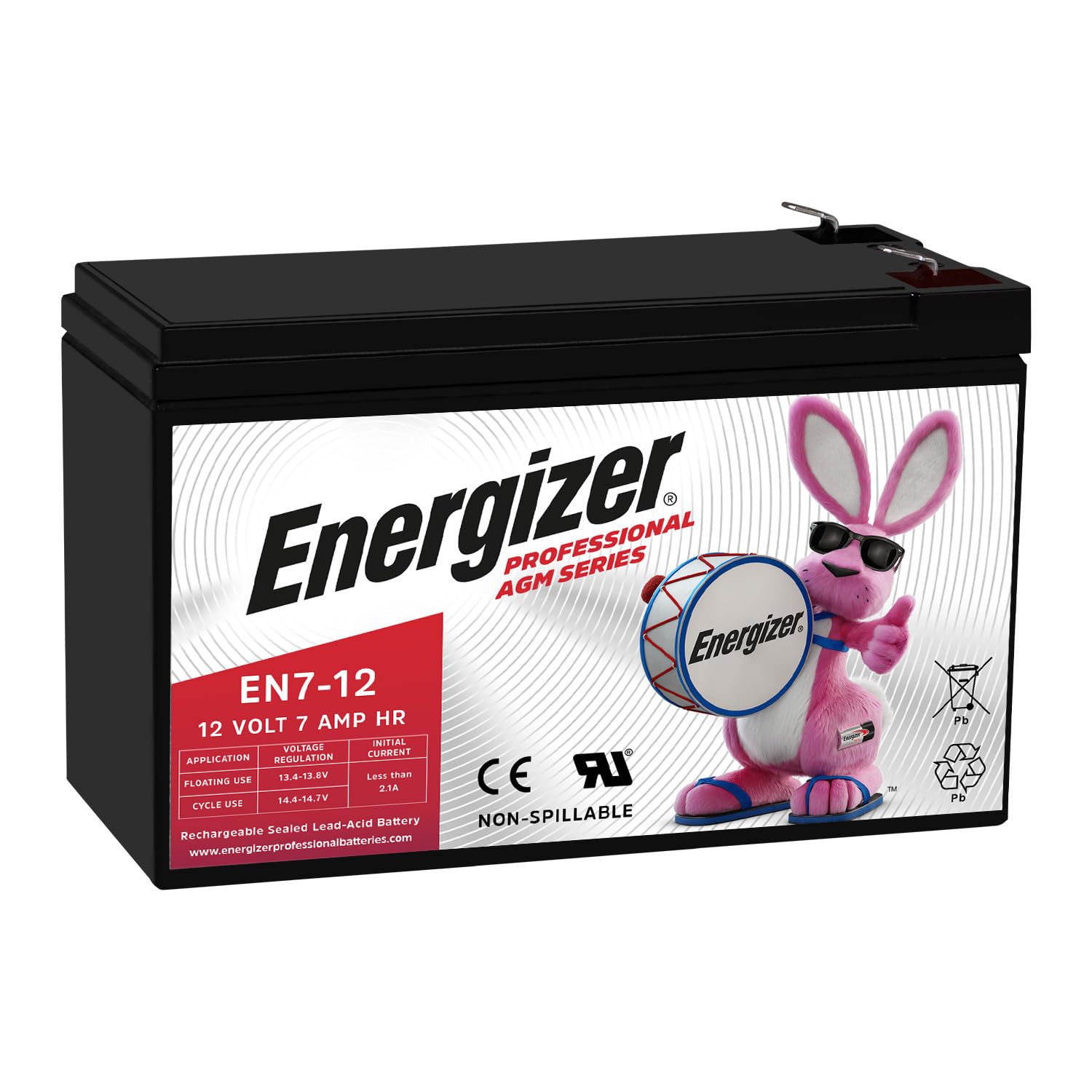
The backup battery built to sit on a shelf for months and still fire up on command.
Low self-discharge is the headliner here. Energizer’s EN7-12 keeps most of its charge during long storage, which is the property you want from a spare you keep in the garage for the day the panel battery dies without warning. It is a 12-volt, 7 amp-hour AGM unit that runs in alarm panels, gate openers, UPS backups, and FiOS routers — the kind of universal 12-volt role used across small electronics. The spill-proof, valve-regulated design has overpressure venting built in, so there is zero acid-leak drama and no water to add, ever.
Terminal flexibility is another thing that makes this one popular: it ships with F1 spades on the battery plus F1-to-F2 adapters in the box. That means the same battery fits both narrow and wide panel connectors — one fewer thing to get wrong when you are ordering. At roughly 5.1 pounds, this matches the general weight class of the other 7Ah options. It is certified to UL safety standards and CE certified, and it comes with a two-year manufacturer’s warranty — one of the longer warranties in this lineup.
The realistic complaint from the review pages is value-for-money. This battery sits at the higher end of the price range for what it is, and opinions on whether the premium is worth it go both ways. What you are paying for is the name, the low self-discharge, and the two-year warranty. If you are replacing a battery every year and want the longest coverage possible, that math tilts in Energizer’s favor. If you are looking for the cheapest 7Ah swap, another pick in this list will serve you just as well.
Standout features
- Low self-discharge keeps a spare ready through months of storage
- F1-to-F2 terminal adapters included — fits either panel terminal width in one purchase
- Two-year manufacturer warranty is among the longest in this lineup
Points to weigh
- Pricier than comparable 7Ah batteries here — owners split on whether the premium is worth it
- A few customers note the unit arriving needing a charge before first use
Reach for it when: You want a spare that survives months on a shelf and a warranty that covers two years, plus one battery that fits either F1 or F2 panel wiring.
Consider the alternative if: Price sensitivity wins — a few of the entry-level picks here deliver the same 12-volt role at a lower cost.
9. Miady 12V 7Ah Rechargeable Sealed Lead Acid Battery (2 Pack)
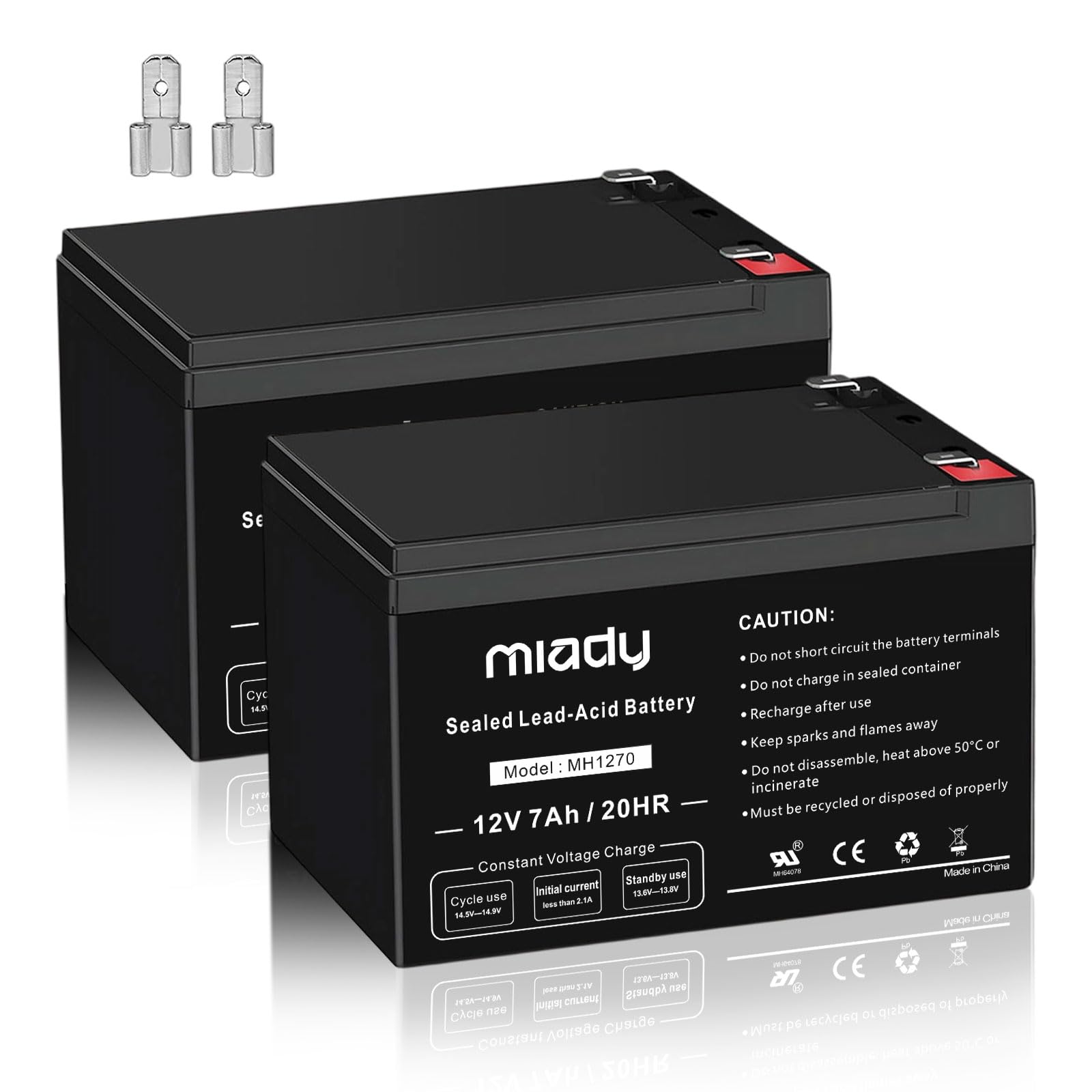
Two 7Ah batteries and the terminal adapters you need — spares handled in one order.
The obvious play with this listing is the count. You get two 12-volt, 7 amp-hour sealed lead-acid batteries in one purchase, plus four F2-to-F1 terminal adapters in the box. That means if you have two alarm panels in the house — or you want a spare on the shelf for the next beeping panel — one order covers both. The F2 terminals are standard on the battery, and the included adapters convert them to the narrower F1 fitting used on most residential alarm panel wiring.
Construction is the expected AGM/VRLA combo — sealed, spill-proof, maintenance-free, and stable across a wide temperature range thanks to the ABS case. Owner reports confirm the batteries fit into FiOS boxes, UPS units, ION speakers, trail cameras, and stairlift packs — quite a spread of low-power 12-volt devices. That said, batteries arrive uncharged, so plan on a full charge before final install into a panel that will not top them up quickly. The ABS plastic holds up well and shrugs off vibration.
The caveat most worth flagging here is consistency. The two-pack holds 4.5 stars across nearly a thousand reviews; most reviewers point out the batteries working as expected, while a small minority report one failing to hold charge after a couple of months. The pack is at the top end of the price range in this lineup, but factored per battery you are still well below what a single-branded replacement costs. Just test both batteries on a trickle charger (a low, steady charger that keeps a battery topped up) before you commit them to a panel.
Best for two-panel houses: If you need to refresh batteries in more than one device, the per-battery math here is favorable, and the extra F1 adapters cover older panels without a separate purchase.
Skip if you only need one: A single-battery pick above will serve a single-panel household at a lower entry cost and without leaving a spare to store.
Ideal for: Homes with multiple alarm panels, FiOS boxes, or UPS units on the same refresh schedule — one order, adapters included, no return trip to the store.
Not the pick if: You need just one battery and want to keep the initial outlay as small as possible.
Understanding the Specs
Amp-hours (Ah) — how much reserve you actually get
Amp-hours measure how much charge the battery stores, and in an alarm panel that number decides how many hours your security system keeps running on battery after the power cuts out. A 5Ah battery holds less reserve than a 7Ah or an 8Ah. If your panel originally shipped with a 7Ah unit, dropping to a 5Ah reduces your blackout window; stepping up to an 8Ah like the Casil CA1280 gives the most reserve of any pick here. Match the original Ah or go slightly up within the same case size — never down.
F1 vs F2 terminals — the fit decision most buyers get wrong
Terminals are the metal spade tabs where your panel wires slide on, and they come in two widths. F1 is the narrower 0.187-inch version, and F2 is the wider 0.250-inch style. If you order the wrong width, the wire slides on loosely or not at all, and owners often mistake that for a defective battery. Some picky installations come down to the terminal — the Power Sonic PS-1250F1, Interstate FAS1055, UPG Alarm Battery, and Yuasa NP7-12 all use F1, while the Casil CA1280 and Casil CA1272 use the wider F2. Energizer’s EN7-12 ships with F1 spades plus F2 adapters in the box, and the Miady 2-pack includes F1 adapters for its F2 terminals, so those two cover both panel styles without a separate purchase.
FAQ
Will a 5Ah battery safely replace the 7Ah battery in my panel?
How do I know if my panel needs F1 or F2 terminals?
How long should a backup battery last in a home alarm system?
Do I need to disconnect the alarm panel’s power before swapping the battery?
Why is my new battery arriving uncharged?
Can I use a UPS or FiOS backup battery in an alarm panel?
Is AGM better than a standard flooded lead-acid battery for alarm panels?
Will an 8Ah battery overload my alarm panel’s charger?
Does the brand of alarm backup battery matter for compatibility?
What is the difference between the Power Sonic PS-1250F1 and the PS-1250 general purpose version?
Final Thoughts: The Verdict
For most home alarm panels, the backup battery for a home alarm system winner is the — 12 volts, 5Ah, F1 terminals, and a proven drop-in fit for standard panels. It is the lightest battery in this lineup at 1.8 pounds, mounts at any angle, and its fit as an exact DSC replacement keeps coming up in the owner reputation. If you need more blackout reserve, grab the Casil CA1280 with its 8Ah capacity. And for a FiOS box or a two-panel home, the Miady 2-Pack hands you two batteries, terminal adapters, and a spare on the shelf. If you want a name-brand pick with the longest warranty, the Energizer EN7-12 covers two years and ships with both terminal types in the box. Whatever you choose, match the voltage, the amp-hour rating, and the terminal width of the battery you pull out — do those three things and the beeping stops this afternoon, not next week.
How We Picked
We do not accept paid placement. Every pick is matched to a real buyer and a real use-case; we do not hands-on test units.
Sources & Methodology
Specifications: manufacturer listings and product documentation. Review insights: verified customer reviews, as of September 2026. Pricing: not shown on this page (it changes often); check the current price via the retailer link.
As an Amazon Associate, KitchPrep earns from qualifying purchases. This does not affect which products we feature.
Related Guides
