
Specs are compiled from manufacturer listings and verified buyer reviews and can change over time — please confirm the key details on the product page before buying.
When the power cuts, the real test isn’t the darkness — it’s whether your router, PC, and security gear survive the drop. A back up power supply bridges that gap, keeping your internet alive and giving your computer a graceful shutdown instead of a sudden death. This guide sorts the standby UPS units from the portable power stations, so you match the hardware to what you actually plug in.
I’m Mohammad Maruf — the founder and writer behind KitchPrep. This guide is built by comparing the manufacturers’ published specifications and the patterns across verified customer reviews, so you get each pick’s real strengths and trade-offs instead of marketing spin.
Here are the nine most reliable back up power supply options that keep your home network and electronics running through even the longest outage.
Our Picks at a Glance


How To Choose The Best Back Up Power Supply
Every backup box does the same basic job — keep power flowing when the wall socket dies — but the size of the battery and the shape of the unit change how useful it is for your specific setup. You’re not buying a gadget; you’re buying minutes of uptime during a storm or a grid hiccup.
Match the wattage to the gear you actually run
The VA (volt-amp) number on the box is the headline spec, but the watt (W) figure is what tells you what you can plug in. A 350VA unit pushes about 210W, which is enough for a router and modem, while a 600VA unit at 330W can also carry a desktop PC. Add up what you need before you buy — the runtime drops fast the more you draw.
Decide between a UPS and a portable power station
A traditional UPS sits on your desk, always online, and switches to battery in milliseconds when the power blips. A portable power station is a bigger battery brick you can carry to a campsite, and newer models also switch fast enough (around 10ms) to protect a PC. If your priority is pure desk protection, a UPS is simpler; if you want power you can also take camping, a station earns its place.
Check the battery chemistry for long-term cost
Most budget UPS units use sealed lead-acid batteries that last a few years before you swap them. Lithium iron phosphate (LiFePO4) batteries cost more up front but last several times longer — some rated for 5000+ charge cycles — which can mean a decade of service without a replacement. If you plan to keep the unit for years, the lithium premium often pays off.
Quick Comparison
| Model | Best For | Capacity | Outlets | Battery Type | Amazon |
|---|---|---|---|---|---|
| CyberPower ST900U★ Best Overall | Home office & entertainment | 900VA/500W | 12 | Lead-acid | Amazon |
| Eaton Tripp Lite BC350Compact Pick | Modem & router only | 350VA/210W | 6 | Sealed Lead Acid | Amazon |
| APC BE600M1Most Popular | Computer & network gear | 600VA/330W | 7 | Lead Acid | Amazon |
| CyberPower AVRG900LCD | Voltage fluctuation protection | 900VA/480W | 12 | Lead-acid | Amazon |
| DaranEner NEOZ | Camping & emergencies | 192Wh/300W | 2 AC | LiFePO4 | Amazon |
| APC 850VA Pro | Workstations & brownouts | 850VA/510W | 8 | Lead Acid | Amazon |
| GOLDENMATE 1000VA | Long-life lithium UPS | 1000VA/600W | 8 | LiFePO4 | Amazon |
| LIBRIDS 640Wh | Whole-home essentials backup | 640Wh/600W | 4 AC | LiFePO4 | Amazon |
| BLUETTI Elite 30 V2 | CPAP & travel power | 288Wh/600W | Multiple | LiFePO4 | Amazon |
In‑Depth Reviews
1. CyberPower ST900U Standby UPS
Our pick — over 4.5★ from 900+ verified ratings; the strongest balance of quality and price.
This 12-outlet UPS keeps a full desk running through a 7-hour outage.
The headline here is the 900VA/500W capacity — that’s 50% more power capacity than the APC 600VA below — and it shows in what you can plug in. Six outlets give battery backup and surge protection, while another six offer surge-only, and four are widely spaced so bulky power bricks don’t block their neighbors. During a real 7-hour outage, buyers report it powered a PS4 and TV through a safe shutdown after just a two-hour initial charge.
The battery holds for around 3 years, and if it does age out, the unit is backed by a 3-year warranty that includes the battery plus a connected equipment guarantee. The free PowerPanel management software shows real-time load stats — buyers watching an 80-180W draw on a gaming PC could see exactly what the unit was handling.
The main caveat: under a heavy load, expect roughly 10-20 minutes of battery before shutdown, and the alarm can be annoying until you disable it. The green power design keeps things efficient, but this isn’t a unit for running a fridge — it’s for protecting electronics and getting a clean shutdown.
What Wins Owners Over
- Outstanding outlet capacity — 12 total, so a full desk plugs in at once
- Rated for a 3-year battery life with warranty coverage included
- Buyers praise the build quality and how well it protects NAS and firewall gear
The Honest Trade-offs
- Runtime under load is just 10-20 minutes, so it’s for shutdown, not endurance
- The alarm beeps on battery and must be silenced manually
- A few units arrive with jammed outlets that need a firm push to open
Grab it for: anyone with a gaming PC, TV, and router who wants one box to cover the whole entertainment setup with real protection.
Think twice if: you need to keep a device running for hours — this is a shutdown-and-save unit, not a mini generator.
2. Eaton Tripp Lite BC350 350VA UPS
This compact UPS quietly keeps your modem and router alive during a blackout.
At 5 x 7.99 x 2.99 inches, this is the compact option — roughly 40% smaller footprint than the CyberPower ST900U above — and it slips beside a router or under a TV stand with ease. The 350VA/210W rating is modest, so this is best for a few modest devices, but the 316-joule surge rating plus sine wave output in AC mode mean your gear stays protected and clean.
What wins people over is the reliability — the most-praised aspect by a wide margin — and the replaceable internal battery. Buyers specifically love that when the battery dies, you swap it instead of tossing the unit, and one owner keeps cameras, a modem, and a router running on it. The comment “my power to my 6v and internet did not skip a beat” sums up the experience for many rural homeowners.
The catch is battery life: rated at just 12 minutes, which is a 1.9x shorter runtime than the APC BE600M1’s 23 minutes, so this is for keeping a connection during a blip, not a long storm. A few owners note the battery performance disappoints, and the quiet operation means silence until the alarm warns of low battery.
Why It’s a Fan Favorite
- Compact size fits in tight spaces — a big plus for tidy setups
- Battery is user-replaceable, avoiding a full-unit replacement later
- Reliability is the standout praise across the review consensus
Small-Print Reality
- 12-minute runtime is short — enough for a quick save, not endurance
- Low wattage means only a router and modem, not a full PC
- Occasional unit arrives with a non-working receptacle
Reach for this if: your only goal is keeping the internet alive through brief power drops — it nails that single job cheaply.
Look elsewhere if: you have a desktop PC or need long runtime, since the wattage and battery both run small.
3. APC UPS 600VA/330W BE600M1
This popular APC offers 23 minutes of runtime and a USB port for phone charging during outages.
This is the crowd favorite — a 4.5-star rating across tens of thousands of owners — and the reasons show up fast. The 600VA/330W rating delivers 23 minutes of runtime at a 100W load, which beats the Eaton Tripp Lite BC350’s 12 minutes by nearly double, and that’s enough to ride out most real outages. Five outlets offer full battery backup and surge protection, with two more surge-only for less critical gear.
The built-in 1.5A USB port works even when the power’s out, so your phone charges while the router stays on for 30-45 minutes of network runtime, as owners mention. The battery is user-replaceable with the APCRBC154 replacement, sold separately, so you refresh the unit in minutes when it ages out rather than buying new.
Durability is the honest caveat — a buyer running six units since 2021 had one fail after 2.5 years with a shrill beep, another after six months, so QC varies at this volume. For a heavily loaded gaming PC, runtime is short, and two outlets are surge-only, not battery-backed.
What the Masses Love
- 23-minute runtime at 100W is strong for the size and class
- USB port charges a phone during an outage
- Easy battery swap keeps long-term costs low
The Verdict’s Fine Print
- Reliability is mixed — most units last years, some fail within months
- Battery backup only reaches 5 outlets, not all 7
- Requires a 10-hour charge time to reach full capacity
Best for: a home office or network rack that needs one reliable, well-known unit with a phone-charging bonus.
Keep in mind: with this many units sold, a defective one slips through occasionally — check it soon after arrival.
4. CyberPower AVRG900LCD Intelligent LCD UPS

This 900VA/480W UPS corrects voltage dips via AVR before the battery is ever tapped.
The defining feature here is Automatic Voltage Regulation (AVR), which smooths out minor power fluctuations without switching to battery — so your gear stays on a stable feed even when the grid wobbles. At 900VA/480W with 12 outlets (six battery-backed, six surge-only), it covers a workstation, network devices, and home entertainment simultaneously, and data line protection guards electronics from surges arriving via telephone lines.
The LCD screen shows real-time status, and the free PowerPanel software is Linux-compatible, a rarity that buyers appreciate. One owner ran a 72W load and got 62 minutes of runtime with an auto-shutdown at 5 minutes of battery left — a smart safety net for a desktop. The staggered outlet layout fits bulky plugs without losing a slot.
The trade-off is the physical unit — at 3.5 x 12.2 x 7 inches it’s a bit longer than some rivals, and the LCD can be bright in a dark room. It won’t power on without a wall connection, so it’s strictly a desktop fixture, not a portable box.
The Upgrade Perks
- AVR corrects voltage dips without tapping the battery
- LCD status screen plus Linux-compatible management software
- 12 outlets with wide spacing for bulky power adapters
Know Before You Buy
- Bright LCD may bother you in a dim room
- Beeps frequently on battery — fixed by plug-in order, but it’s a quirk
- No power without a wall connection, so no portability
Choose this for: an office with flaky voltage — the AVR actively prevents crashes before the battery even engages.
skip it if: you want a unit you can unplug and carry — this one needs to stay wired to the wall.
5. DaranEner Portable Power Station 192Wh
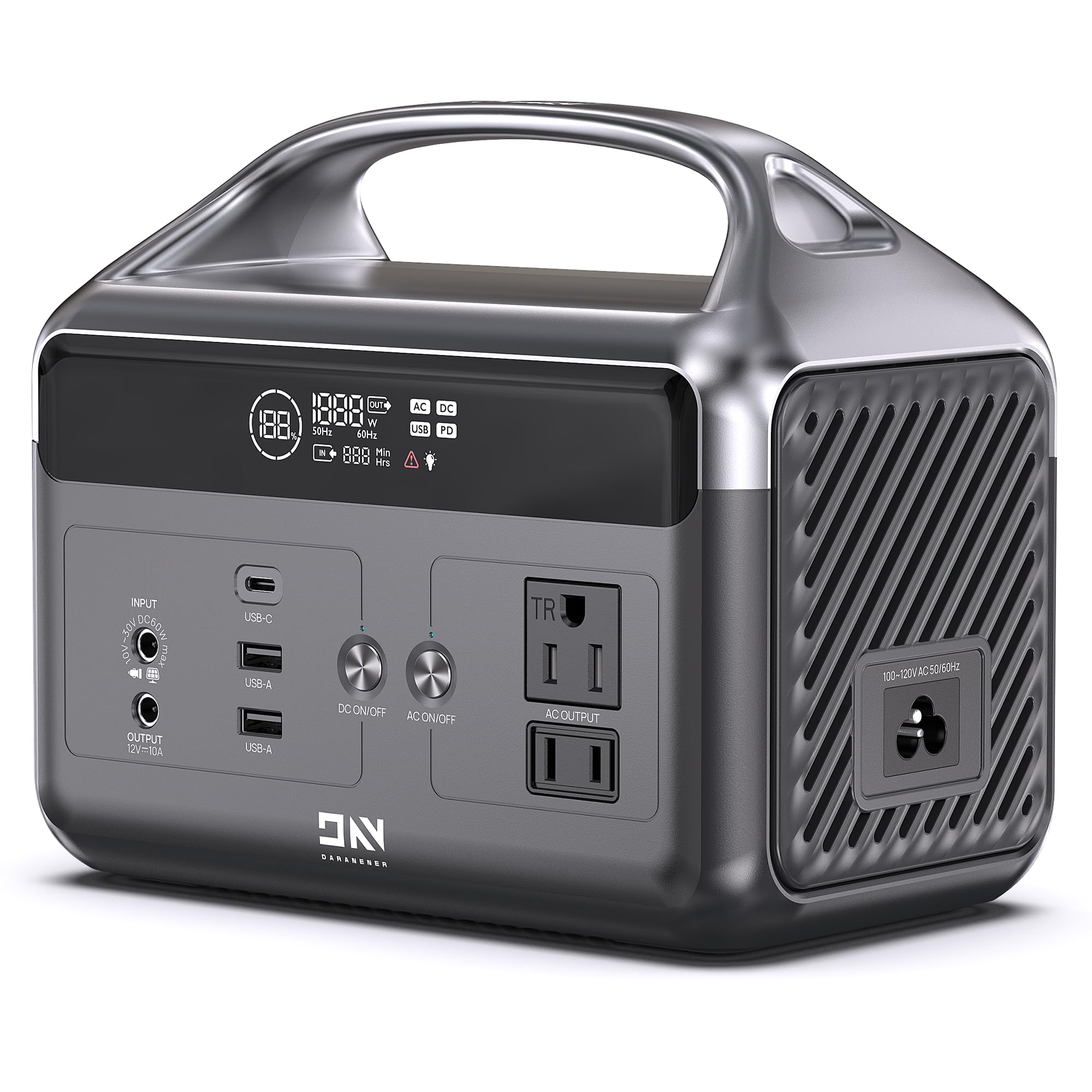
This 5.73-pound station runs a CPAP all night or inflates camp mattresses all weekend.
This is the portable play — a LiFePO4 battery rated for 3500+ charge cycles, meaning it outlasts standard lithium-ion by up to 10 times per the manufacturer, at just 5.73 lbs. The 192Wh capacity feeds a 300W pure sine wave output (600W surge), which is plenty for phones, tablets, laptops, fans, and lights — though not for rice cookers or mini-fridges that exceed 300W.
You can charge six devices at once through two 300W AC outlets, a USB-C PD port at 60W, two USB-A ports at 18W, and a 12V DC output. Recharging is flexible too — AC wall at max 100W, a car charger, or a compatible solar panel at 60W DC input, with an MPPT controller optimizing solar efficiency. A built-in LED flashlight offers four brightness modes including SOS for emergencies.
Customers note strong real-world performance — one CPAP user measured 7-31 hours of runtime depending on breath cycle, and campers inflate queen mattresses all weekend on a single charge. The honest note: some units arrive fully drained, so owners advise two full charge/discharge cycles after receipt, and the mixed feedback on battery life means not every unit holds a charge exactly as advertised.
What Impresses
- Light at 5.73 lbs — smaller than a toaster, easy to carry
- LiFePO4 chemistry rated for 3500+ cycles
- Charges up to 6 devices at once with fast USB-C PD
The Small Print
- 300W limit excludes high-draw appliances like hair dryers
- Some arrive fully discharged and need exercising first
- Charging time is moderate — not a fast top-up unit
Ideal for: campers and emergency-kit builders who want one light, versatile box for phones, fans, and medical gear.
Not for: running a kitchen appliance or anything that draws above 300 watts.
6. APC 850VA/510W Pro UPS

This 850VA tower delivers 29 minutes of runtime, coaxial protection, and AVR that handles brownouts down to 88V.
This is the step-up APC for a serious workstation — 850VA/510W delivers over 29 minutes of backup at a 100W load, and the included coaxial and Ethernet surge protection guards the path a lightning strike often takes. The 8 outlets split into 4 battery-backed for essentials and 4 surge-only for peripherals, so a full desk gets smart coverage.
The AVR here actively boosts low voltage brownouts from 88V up and trims surges of +/-13% back to a stable 120V, which matters in areas with dirty power. It’s ENERGY STAR certified at 92%+ efficiency, and the Active PFC compatibility means gaming PCs with power-hungry PSUs won’t trip it. One owner’s unit survived a nearby lightning strike that fried a modem on coax — the computer stayed fully protected.
Reviewers point out the battery terminals and setup aren’t as refined as APC’s bigger units, though the unit performs reliably at 4.6 stars. A few have dealt with defective units after a thunderstorm, and APC’s warranty process took up to 3 weeks for one replacement — so test it early.
The Premium Edge
- 29+ minutes runtime at 100W covers longer outages
- Coaxial and Ethernet surge protection for the whole path
- AVR corrects brownouts as low as 88V without battery drain
The Fine Print
- Setup with battery terminals is fussier than smaller APC units
- Warranty claims can take weeks to resolve
- Not built for sustained desktop use — use it for safe shutdown
Spring for this if: you run a serious PC or NAS in an area with frequent brownouts and want top-tier surge coverage.
Pass it by if: you just need a modem and router alive — the extra wattage and coaxial ports would go unused.
7. GOLDENMATE 1000VA/600W Lithium UPS

The white lithium tower with 5000+ charge cycles and a color LCD, built to outlast a decade of blackouts.
The LiFePO4 battery lasts over 10 years and 5000+ charge cycles, cutting total cost of ownership by over 40% versus lead-acid, per the maker. For a 1000VA/600W pure sine wave unit powering computers and telecom gear, that longevity makes it a true buy-once investment.
The unit packs eight NEMA 5-15P outlets with surge protection, a color LCD showing real-time battery and power conditions, and a low-noise cooling fan under 50 dB that only kicks on during heavy battery use. A buzzer mute function lets you silence the alarm with a single touch of the switch below the LCD panel. Buyers running a 185W load measured about 3 hours of runtime.
The honest catch: there’s no AVR or surge protection on the AC path per owners, and the battery is non-replaceable — so if it fails, the unit is done. It handles light duty (under 500W) beautifully, but for a heavy server closet or where voltage fluctuates, the lack of voltage regulation is a real gap.
The Lithium Advantage
- 10-year battery life with 5000+ cycles — a true long-term buy
- Lightweight compared to lead-acid rivals at 4.8 kg
- Color LCD with real-time monitoring and buzzer mute
What’s Missing
- No AVR or surge protection on the AC path, per owners
- Battery is not replaceable — full unit replacement when it ages out
- Best under 500W loads; not for heavy or server-closet use
Choose it for: a home office that wants a decade of maintenance-free power with a clean sine wave and zero replacement hassles.
Avoid it for: areas with shaky voltage — you’ll want the AVR of a CyberPower or APC instead.
8. LIBRIDS Portable Power Station 640Wh
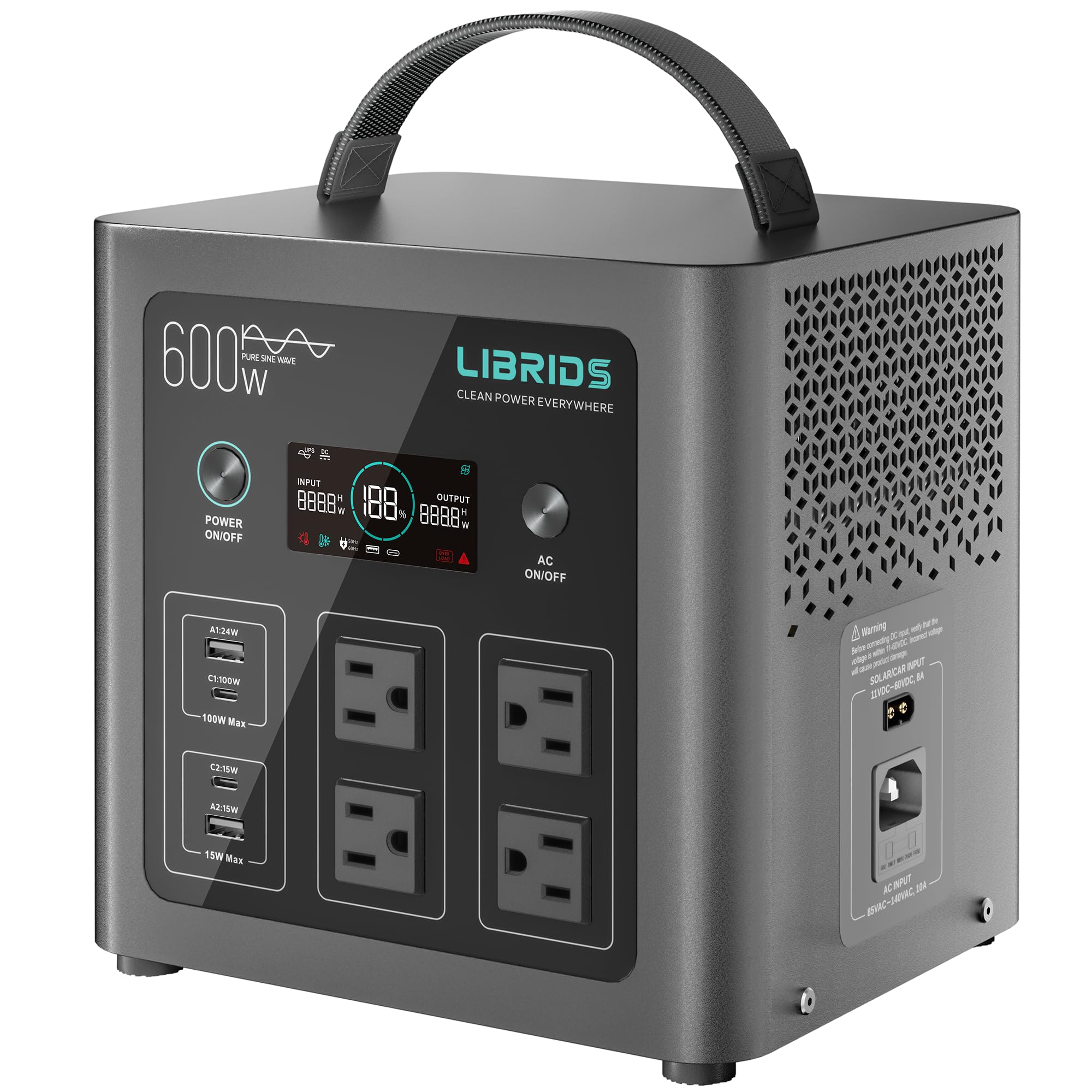
The 640Wh metal brick that switches to battery in 10ms — fast enough to protect a live PC mid-save.
This bridges the gap between a desk UPS and a camping generator — a 640Wh LiFePO4 battery with a 10ms UPS switch that keeps WiFi routers, CPAP machines, and essential devices running without a blip. The 600W output with 1200W surge handling on PowerRaise technology means it can even start appliances with a heavy initial draw, like a mini-fridge.
The 4 AC outlets plus USB ports power up to 8 devices at once, and the pure sine wave inverter is safe for sensitive electronics like laptops and medical gear. The metal enclosure improves heat dissipation, and buyers praise the solid build and sleek look. Recharge speed is the standout — a full charge in just 1.5 hours via AC wall power, so it’s ready fast after you drain it.
The automotive-grade LiFePO4 battery is rated for 4000+ cycles, backed by a 5-year warranty. Real-world tests show it powered a 45L fridge for 3 hours using about 50% capacity, and a CPAP ran 7 hours on just 24% battery. The one miss: it couldn’t start a Keurig, so high-draw appliances need more headroom than 600W provides.
Why It Wins
- 10ms UPS switch is fast enough for delicate electronics
- Full charge in 1.5 hours keeps downtime minimal
- Metal shell with solid build quality per owners
The Limits
- 600W output won’t start high-draw appliances like a Keurig
- At 640Wh, it’s heavier and less pocket-friendly than smaller units
- Indoor use only — not for rain or wet conditions
Reach for this if: you want one device that powers a home office during outages and doubles as serious camping gear.
Look past it if: your backup needs are purely a router and modem — this is far more capacity than that job requires.
9. BLUETTI Elite 30 V2 Portable Power Station
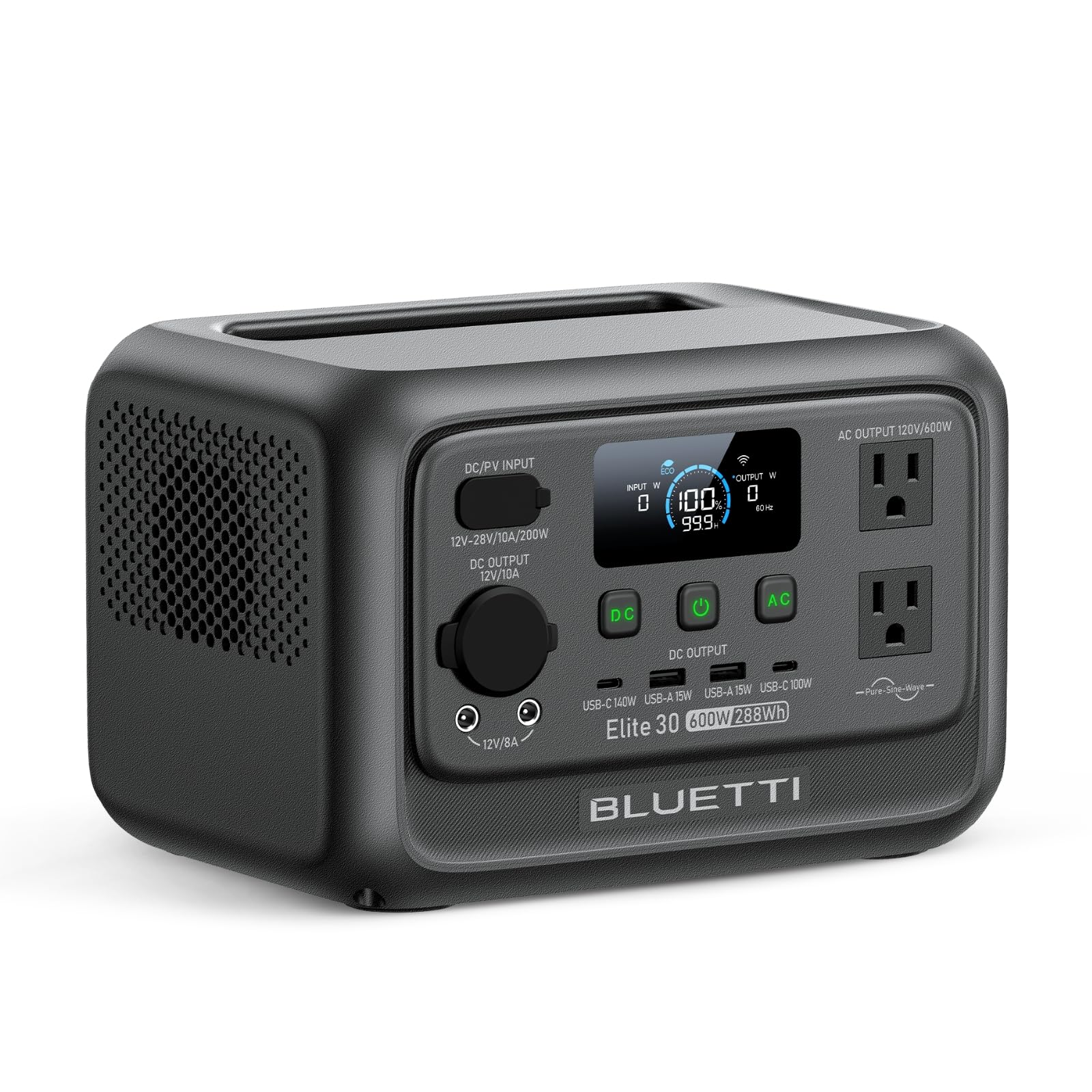
The 9.4-pound entry station that delivers 600W continuous and a 10ms UPS switch for storm-proofing your desk.
The Elite 30 V2 is the gateway to portable power — 288Wh capacity in a 9.4 lbs package that fits under a desk or in a car trunk. The 600W continuous output matches the bigger LIBRIDS above despite a smaller battery, and Power Lifting Mode pushes it to 1500W surge for brief heavy draws like a small kettle or toaster. A 10ms UPS switch protects laptops, routers, and CPAP machines from sudden cuts.
Charging is the efficiency story — 380W fast wall charge gets you 0-80% in 45 minutes and 0-100% in 70 minutes, with solar and car charging options for flexibility. Buyers love using it as a UPS alternative for a home server, with one running a homelab on it and reporting no server hiccups during switchover. The WiFi app shows real-time wattage and battery status.
At 4.4 stars, the feedback is solid though not flawless — the app is handy but there’s no USB shutdown feature, so you enable Pro mode (code 888888) for auto-restart. The 288Wh capacity runs a fan for 8 hours or WiFi for 6 hours per owners, so it’s for overnight essentials, not multi-day outages.
The Smart-Buy Perks
- Fast 70-minute full recharge keeps it ready
- 600W continuous output matches premium rivals
- Light 9.4 lbs and compact under-desk footprint
The Trade-offs
- 288Wh is modest — overnight essentials, not multi-day power
- No USB shutdown; Pro mode code needed for auto-restart
- Small battery means high-draw appliances drain it fast
Grab it for: a CPAP user, home-lab tinkerer, or weekend camper who wants real portable power at a friendly entry point.
Move up if: a long hurricane outage is your scenario — you’ll want the 640Wh of the LIBRIDS above.
Understanding the Specs
VA vs. Watts — What Actually Matters
VA (volt-amps) is the marketing number on the box, but watts tell you what you can plug in. A 1000VA unit delivering 600W can run a desktop PC and monitor, while a 350VA unit capped at 210W is really only for a router and modem. Add up the wattage of everything you want protected, then leave 20-30% headroom so the UPS isn’t running at its ragged edge.
Runtime Under Load
Runtime isn’t fixed — it shrinks as you draw more power. A unit rated for 23 minutes at 100W will last far less with a gaming PC pulling 300W. The honest rule: a UPS gives you time to save your work and shut down cleanly, not to keep working for hours. If you need sustained power, look at the portable power stations with larger watt-hour (Wh) capacities.
FAQ
How long will a back up power supply keep my router running?
What’s the difference between a UPS and a portable power station for home backup?
Can I run a CPAP machine on a back up power supply?
How often do I need to replace the battery in a UPS?
What does AVR do and do I need it?
Will a UPS protect my equipment from a lightning strike?
How many outlets do I actually need on a UPS?
Why is the UPS beeping and how do I stop it?
Can a back up power supply replace my generator?
How long does it take to charge a portable power station before first use?
Final Thoughts: The Verdict
The best overall choice for a back up power supply is the CyberPower ST900U — its 12 outlets and 900VA/500W capacity cover a full desk setup, and the connected equipment guarantee backs it up. If a compact unit that just keeps your modem and router alive is the goal, the Eaton Tripp Lite BC350 nails that job with a replaceable battery. And for a CPAP user or camper who needs portable power, the BLUETTI Elite 30 V2 delivers 600W in a 9.4-pound frame you can carry anywhere, with a 10ms switchover that protects your gear in a blink.
How We Picked
We do not accept paid placement. Every pick is matched to a real buyer and a real use-case; we do not hands-on test units.
Sources & Methodology
Specifications: manufacturer listings and product documentation. Review insights: verified customer reviews, as of September 2026. Pricing: not shown on this page (it changes often); check the current price via the retailer link.
As an Amazon Associate, KitchPrep earns from qualifying purchases. This does not affect which products we feature.
Related Guides
