
Specs are compiled from manufacturer listings and verified buyer reviews and can change over time — please confirm the key details on the product page before buying.
When the grid drops, your first question isn’t “which generator has the most features”—it’s “will this one actually run my fridge, my furnace, and my lights without me becoming an electrical engineer overnight?” Match the generator’s running watts to your home’s actual appliance load, not the highest peak wattage. A 13,000-watt unit is overkill for a 5,000-watt load, while a 3,600-watt inverter can’t handle central AC.
I’m Mohammad Maruf — the founder and writer behind KitchPrep. This guide is built by comparing the manufacturers’ published specifications and the patterns across verified customer reviews, so you get each pick’s real strengths and trade-offs instead of marketing spin.
back up generator for home choices come down to fuel type, power output, and how you plan to connect it to your house.
Our Picks at a Glance


How To Choose The Best Back Up Generator for Home
Before you even look at brands, you need one number: your total running watts. Add up what you must keep alive during an outage—refrigerator, furnace blower, a few lights, your modem, and maybe a window AC—and that sum is your floor. A portable generator that cranks out that running wattage while also offering a peak buffer for motor start-ups is your realistic target.
Fuel Type Decides Your Emergency Strategy
Gasoline is the most common and easiest to source, but it goes stale and can be scarce during regional disasters. Propane stores indefinitely and burns cleaner, but you need tank space. Natural gas gives you unlimited runtime straight from your home’s line, yet it ties you to whichever utility is also down. Dual-fuel and tri-fuel machines let you switch, which is why they dominate serious home-backup picks.
Connection Method: Extension Cords vs. Transfer Switch
Running heavy cords to individual appliances is fine for a few hours, but a transfer-switch-ready generator—look for a 30-amp L14-30R or 50-amp 14-50R outlet—lets a licensed electrician wire it into your panel. This lets you power hardwired circuits like a well pump or furnace directly from your panel.
Quick Comparison
| Model | Best For | Running Watts | Fuel Type | Run Time | Amazon |
|---|---|---|---|---|---|
| Westinghouse 6500 Dual Fuel★ Best Overall | Best Overall | 5300 | Gas & Propane | 14.5 hrs | Amazon |
| Westinghouse 4650 Peak WattCompact Value | Compact Essentials | 3600 | Gas | 14 hrs | Amazon |
| WEN GN5600Budget Champion | Value Long Runtime | 4500 | Gas | 12.5 hrs | Amazon |
| WEN 56360i Inverter | Quiet Camping & Electronics | 2900 | Gas | — | Amazon |
| BLUETTI AC180 Solar | Clean Solar Backup | 1800 | Electric & Solar | — | Amazon |
| DuroStar DS13000MX | Whole-Home Heavy Lifter | — | Gas & Propane | — | Amazon |
| DuroMax XP13000HXT | Whole-Home Tri-Fuel | — | Gas, Propane & NG | — | Amazon |
| EcoFlow DELTA Pro | Expandable Battery Bank | 3600 | Electric & Solar | — | Amazon |
| Jackery HomePower 3000 | Whole-Home Quiet Battery | 3600 | Electric & Solar | — | Amazon |
| EcoFlow DELTA Pro Ultra | Max Battery Scalability | 7200 | Electric & Solar | — | Amazon |
In‑Depth Reviews
1. Westinghouse 6500 Watt Dual Fuel Home Backup Portable Generator
Our pick — over 4.5★ from 950+ verified ratings; the strongest balance of quality and price.
The dual-fuel workhorse that pairs whole-house ambition with a genuinely painless first start.
This dual-fuel generator balances whole-house power with flexible fuel options. On gasoline it delivers 5300 running watts and 6500 peak watts, while propane drops that to 4800 running watts and 5800 peak watts. The 274 cc Westinghouse 4-stroke engine with a cast iron sleeve is built for years of pulls, and the automatic low oil shutdown protects it when you’re distracted by a storm.
Buyers report it saved two fridges’ worth of food, recharged a sump battery, and still had room to run a modem, TV, lights, and a hair straightener during a prolonged outage. The 4.7-gallon fuel tank keeps it going for up to 14.5 hours, which is 2 hours longer than the WEN under review here. It ships with oil, a funnel, a propane hose, and a wheel kit—so you’re not hunting for accessories before your first blackout.
What wins people over is the quality—over 270 owners single out build integrity—and the ease of use that follows a clear manual. The noise level is the recurring trade-off; this is an open-frame generator, so it’s audible, but owners in RVs note that keeping cool in summer easily beats the sound.
Where It Shines
- Dual fuel flexibility lets you switch from gas to propane instantly
- Transfer-switch-ready 30A L14-30R outlet for hardwired home backup
- 14.5-hour runtime on a 4.7-gallon tank covers overnight outages
Where It’s Loud
- Open-frame design means it’s not a whisper-quiet inverter
- LED lights in your home may flicker, as owners noted
Your best buy if: you want a genuine whole-house portable that runs on whichever fuel is available, backed by a 3-year warranty.
Think twice if: you need silent operation near living spaces or you only power a handful of small devices.
2. Westinghouse 4650 Peak Watt Portable Generator
A lighter, single-fuel Westinghouse that powers a camper or a room full of essentials without the extra bulk.
If the dual-fuel 6500 above feels like more machine than you need, this one trims the size—and the price—while keeping the same family DNA. It produces 3600 running watts and 4650 peak watts from a 212 cc 4-stroke engine, which is 62 cc smaller than its big brother. That size difference shows in real life: at 100.6 pounds, it’s the lighter, more maneuverable choice for moving between garage and driveway.
Owners mention it runs a whole camper including the AC and microwave at the same time. Over 200 owners praise its performance, with reliability cited by more than 150. One useful tip from the review pages: follow the exact startup order—switch on, choke on, fuel on, gas last—and you’ll get a first-pull start every time.
Its gas-only 4-gallon tank gives up to 14 hours of runtime, and the fuel gauge takes the guesswork out of longer outages. The RV-ready TT-30R 30-amp outlet plus two household duplex receptacles mean you can feed both your camper and a few home appliances at once.
What Owners Love
- Flawless right-out-of-the-box performance with minimal assembly
- 100.6-pound weight is manageable for a capable portable
- Quieter operation than many open-frame rivals
Keep in Mind
- Gasoline-only fuel, so no propane flexibility
- Some owners call it pretty heavy for its output
Reach for this if: you want Westinghouse reliability for a camper, a workshop, or a critical room of the house.
Best for smaller loads: this won’t feed a whole house with central AC, so size your expectations to essentials.
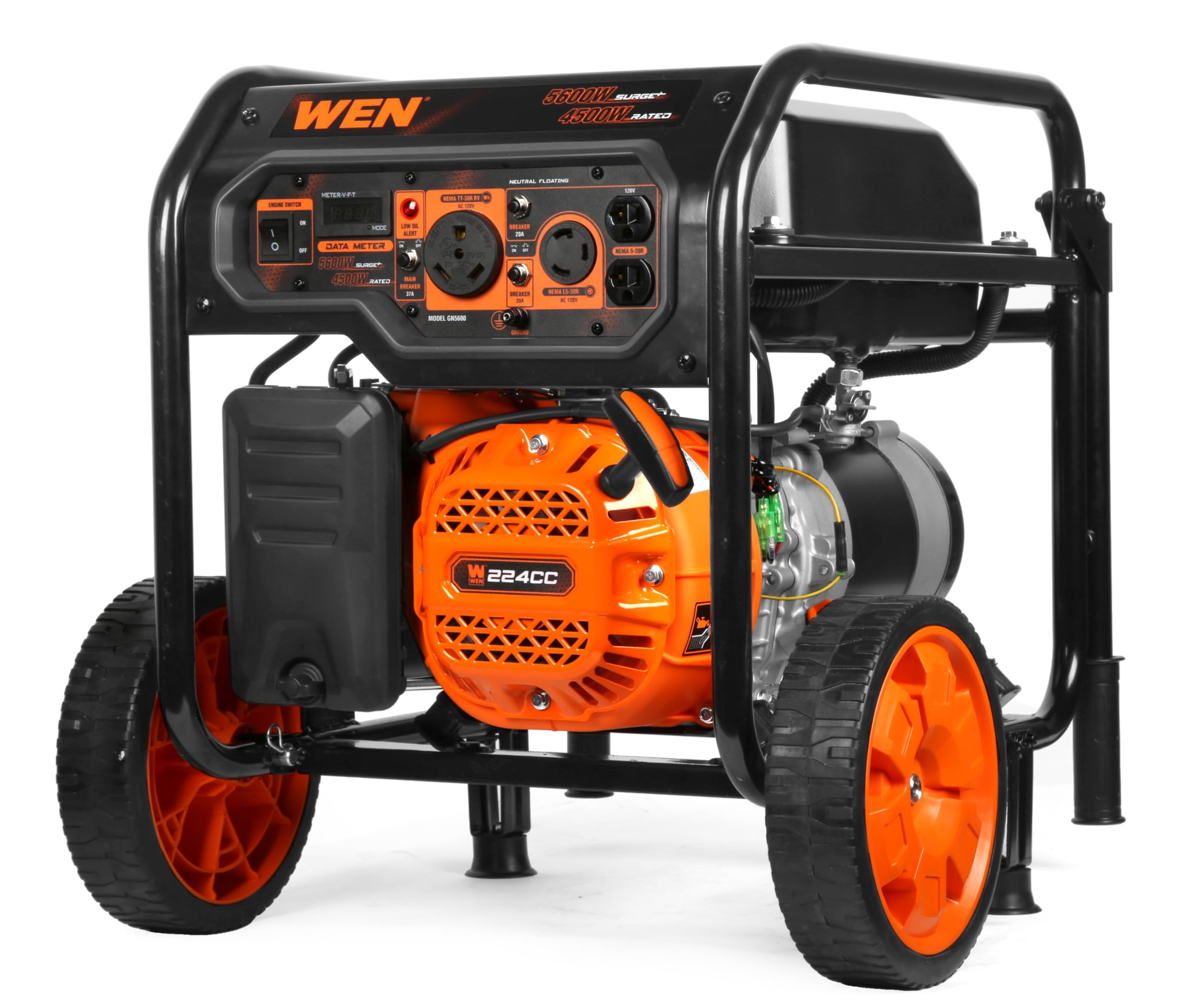
3. WEN 5600-Watt Portable Generator, 224cc, Transfer-Switch and RV-Ready (GN5600)
The budget pick that proves a low price doesn’t have to mean a short lifespan—just ask the off-grid owners.
This WEN earns its place with a genuinely remarkable owner story: someone running it daily for 9 straight months to charge trailer batteries reports it cranks on the first pull 99% of the time. For a generator in this price tier, that kind of daily-driver reliability is the exception, not the rule. It produces 5600 starting watts and 4500 running watts from a 224 cc compliant engine.
Run time is where this one steals value from pricier rivals: the 4.3-gallon tank delivers up to 12.5 hours of half-load run time. The packed panel includes two standard 120V 5-20R 20-amp outlets, one RV-ready TT-30R 30-amp outlet, and a transfer-switch-ready NEMA L5-30R twist lock.
The whole package arrives with a wheel and handle kit, so moving a 112.4-pound machine between storage and use is genuinely easier than the number suggests. Owners in hurricane country say it’s the right call for repeated seasonal outages, and off-grid users vouch for its stamina.
Why It’s a Steal
- Daily-use reliability that owners trust for 9 months straight
- Transfer-switch-ready outlet for hardwired home connection
- Affordable entry into serious home backup capacity
The Fine Print
- One owner found it heavier than the advertised 60-some pounds
- A first-run surge is possible—running cleaner through the tank helps
Grab it for: budget-minded buyers who need honest 4500 running watts and don’t mind a gasoline-only machine.
Not for: anyone needing propane flexibility or a feather-light unit.
4. WEN 3600-Watt Portable Inverter Generator, RV-Ready, Quiet and Lightweight (56360i)

The 46-pound inverter that turns quiet, clean power into a camping and home-electronics ally.
Here’s the trade secret about inverter generators: they produce “clean power,” meaning the electricity is steady enough to safely charge smartphones, tablets, and laptops without the flicker or surge damage that open-frame units can cause. The 149 cc engine generates up to 3600 surge watts and 2900 rated watts, which owners confirm runs a 13,000 BTU AC unit fine on a hot day.
At just 46 pounds, this is the lightest serious generator on this list by a wide margin—a full 66 pounds lighter than the 112.4-pound WEN GN5600 above. That weight difference changes who can use it: anyone who can lift a large bag of dog food can move this from car to campsite. Customers note roughly 4 hours per tank running an AC on a hot day, and about 1 gallon per 5 hours at lighter loads.
The fuel shutoff is a smart longevity feature—it runs the carburetor dry before shutting down, which prevents stale gas from gumming up the works during long storage. The panel includes two three-prong 120V receptacles, one TT-30R RV receptacle, one 12V DC receptacle, and two 5V USB ports.
Why It’s a Favorite
- 46-pound weight makes it genuinely portable for camping and travel
- Clean inverter power protects sensitive phones and laptops
- Fuel shutoff extends engine life between outages
Know the Limits
- 2900 rated watts won’t run heavy tools or a whole house
- You’ll need to change oil every 25 hours, with no filter
Ideal for: RVers, campers, and anyone who needs backup for electronics and a window AC, not a whole house.
Weakness to accept: it’s not built for powering central AC or large appliances.
5. BLUETTI AC180 Solar Generator with 200W Solar Panel Included

The silent solar bridge that covers short outages and keeps your TV running for 10 hours on one charge.
This is a completely different animal from a fuel generator: no exhaust, no pull cord, no gasoline to store. It’s a 1152Wh battery pack with an 1800W inverter output that jumps to 2700W when you trigger the boost via the app. The included 200W solar panel replenishes the full battery in 4.8 to 9.6 hours of good sun, and the AC180’s 1440W flash charge refills it from a wall outlet in about an hour.
Reviewers point out it powers a 38-inch TV for 10 hours on a single charge and runs a mini air conditioner and ice maker without complaint. The battery life is what wins people over, with over 50 owners praising it, followed by the power output. It also works as a home battery backup with a 20-millisecond UPS switchover, so a blip in grid power won’t reset your router or security system.
The 11 outlets—including 4 AC outlets, USB, and wireless charging—make it a versatile companion, but the weight gets mixed feedback. At roughly 35-40 pounds, it’s not something you’ll casually carry, and owners suggest wheels for regular movement.
The Quiet Advantage
- Truly silent operation—no engine noise at all
- Refills free from the sun after the initial cost
- 20-ms UPS keeps sensitive electronics running through blips
Consider This
- 1152Wh capacity is for essentials, not whole-house days
- Heavy for its size at roughly 35-40 pounds, and the fan is audible under load
Perfect for: apartment dwellers, short-outage regions, and anyone who wants clean solar power without fuel logistics.
Not for: multi-day whole-house outages or anyone needing to run central AC.
6. DuroStar DS13000MX 13,000-Watt 500cc Dual Fuel Portable Generator

A 13,000-watt whole-home force with a remote start that makes you feel like you’re in a command center.
This is the machine you buy when “backup” means “keep the entire house running, including the AC.” The 500 cc dual-fuel engine delivers 13,000 watts of power, and shoppers say it handled a 1.5-ton AC, fridge, stove, microwave, TVs, and a water heater simultaneously without flinching. One owner even ran a 225 stick welder on its 240-volt setting without issues.
The 50-amp outlet is the key spec here—it connects directly to a whole-home transfer switch, which is the same connection type as the big Westinghouse 28000 below but at a fraction of the size and cost. Push-button electric start plus a remote control means you can fire it up from inside while the storm rages outside.
Owners most praise its quality and value, while the CO sensor adds automated shutdown protection. A few owners note occasional reliability hiccups—one experienced CO alarm shutdowns despite proper placement—so it’s worth testing yours in a safe open area before you truly need it.
Whole-Home Muscle
- 13,000 watts feeds an entire house including central AC
- 50-amp outlet for direct transfer switch connection
- Remote electric start from the comfort of indoors
Handle With Care
- Recurring CO alarm issue reported by an occasional owner
- Large and heavy—plan for a hand truck at delivery
Choose this if: you need whole-home capacity without stepping up to the premium mega-watt class.
Be aware: a “yard art” scenario is possible if your unit hits a CO sensor fault, so verify in a test run.
7. DuroMax XP13000HXT 13,000-Watt 500cc Tri Fuel Generator
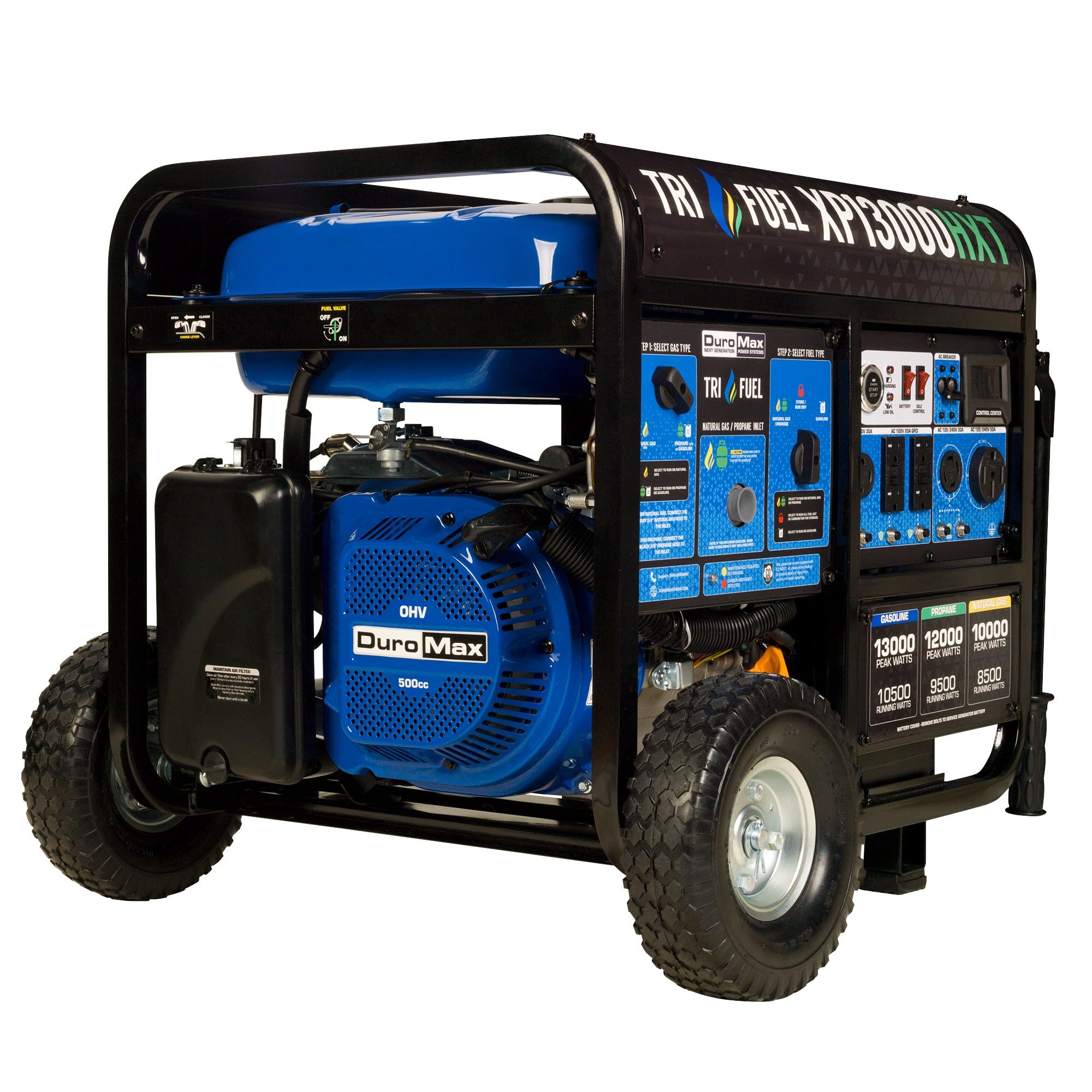
The tri-fuel titan that turns natural gas into unlimited home backup—no gas station runs required.
Here’s the difference that matters during a week-long outage: this DuroMax runs on gasoline, propane, or natural gas. That third option is a standout because natural gas comes straight from your home’s utility line, meaning you never run out of fuel as long as the gas grid holds. Owners say it’s “so far best investment I have ever done” when comparing a roughly total install to a K permanently-mounted Generac system.
The 500 cc OHV engine produces 13,000 watts, and with the 50-amp transfer-switch-ready outlet plus push-button and remote start, it behaves like a much more expensive standby unit. One natural-gas-focused owner notes you’ll need a 225K BTU/hr line—a 3/4-inch pipe is recommended—so plan that with a plumber before the storm hits.
Owners praise the build quality and the included accessories: a 15-foot natural gas hose, propane regulator, remote control, and wheel kit all ship in the box. The customer service also earns repeated shout-outs, from replacing a dead battery after 3 months to shipping missing feet within 3 days.
The Fuel Freedom
- Natural gas operation means unlimited runtime during long outages
- Three fuel choices protect you from any single shortage
- Brushless alternator and 50-amp outlet for whole-home hookup
Setup Reality
- Natural gas line installation requires professional planning
- At 240 pounds, it demands space and a strong dolly
Worth it for: homeowners who want near-standby convenience with natural gas and don’t want a permanent install price tag.
Skip if: you lack a natural gas line or can’t handle a 240-pound machine.
8. EF ECOFLOW Portable Power Station 3600Wh DELTA Pro
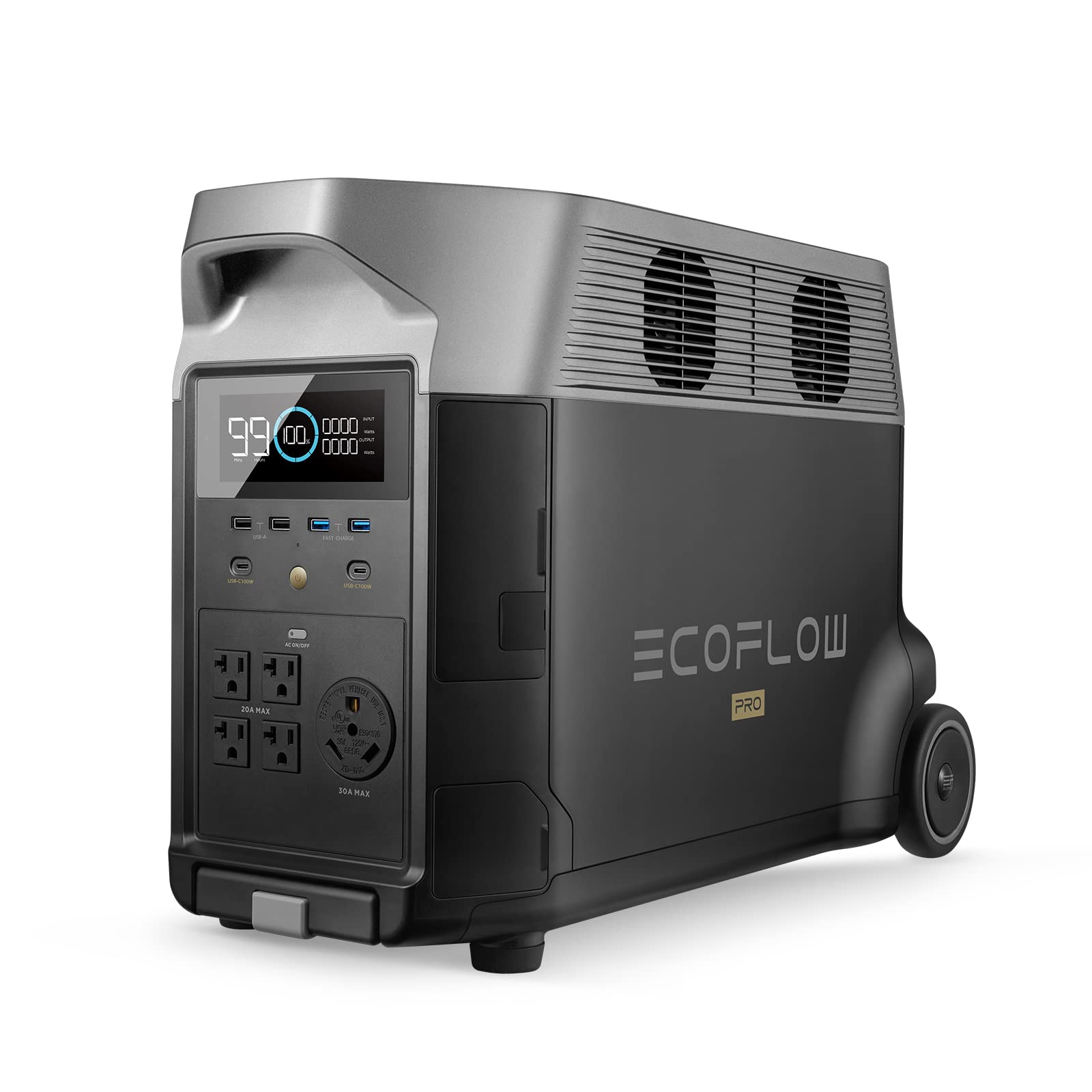
A 3600Wh battery fortress that powers a fridge overnight and still has 30% left for the morning.
For buyers who want zero fumes and zero fuel runs, this is the serious answer. The DELTA Pro packs a 3600Wh LFP battery with a 3600W AC output, expandable to 4500W with X-Boost technology. Pair two units and you hit 7200W—enough to power most of a home. One owner reports it powered a fridge and lights overnight and still had 30% charge left.
Charging speed is the standout spec here. A full recharge takes just 1.8 hours from a 240V outlet at 3000W, or 2.7 hours from a standard 1800W wall outlet. Solar input tops out with 4×400W panels for a full charge in 2.8 hours, thanks to up to 23% solar conversion efficiency. With 15 output methods—including two USB-C at 100W, five AC outlets, and a car port—this powers everything from a vendor market heat press to home essentials.
The smart app control via Wi-Fi or Bluetooth lets you monitor charge level, temperature, and individual device power draw in real time. This is quieter than any gas generator and requires no maintenance beyond keeping the battery charged. Owners call it a “standout for vendor markets” and praise its practical reliability for outages.
The Battery Advantage
- Silent, fume-free operation safe for indoor and garage use
- 1.8-hour full recharge from a 240V outlet is class-leading
- Expandable from 3.6kWh up to 25kWh with extra batteries
Honest Trade-offs
- Heavy at 99 pounds, with a noisy fan under heavy load
- 3600Wh capacity, while large, still isn’t multi-day whole-house power
Best for: outage-prone homes that want clean, quiet backup and the option to grow capacity over time.
Not ideal for: week-long outages without solar or generator recharging options.
9. Jackery HomePower 3000 and 2x200W Solar Panels
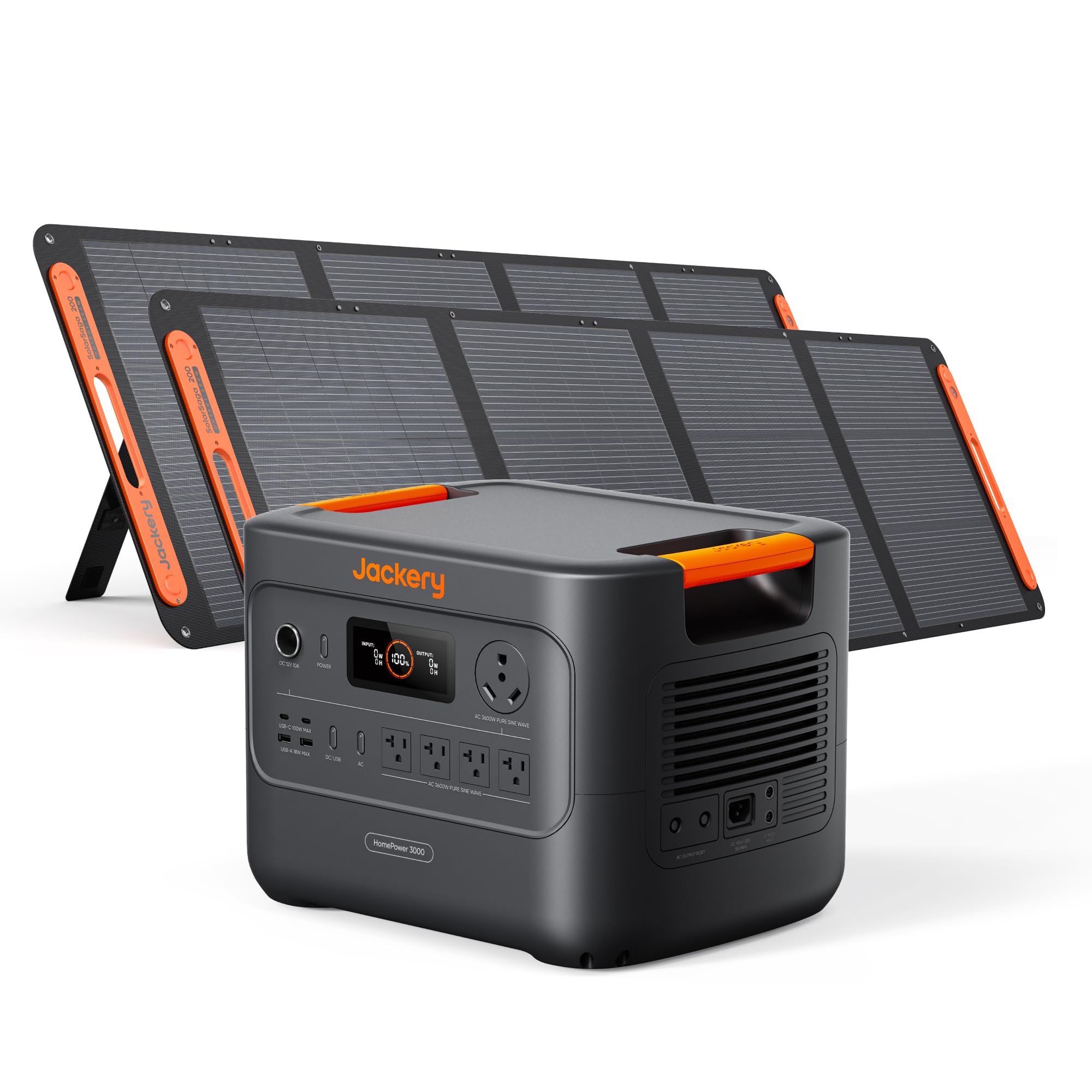
A 3kWh solar battery that keeps three fridges and a freezer humming for 4.5 hours without a single decibel.
If you’re weighing a fuel generator against a battery bank, this Jackery makes the battery case compelling. It holds 3072Wh of LiFePO4 capacity with a 3600W AC output (7200W surge), and one owner ran three refrigerators and one freezer through a 4.5-hour outage without breaking a sweat. The manufacturer rates it for up to 15 hours of household power, keeping a fridge running for 1 to 2 days.
The ≤20ms UPS certification means the switchover is smooth—security cameras, medical refrigerators, and Zoom calls don’t even blink during a grid failure. The two included 200W solar panels charge it up to 80% in about 9 hours of sun, while a wall outlet does a full charge in 2.2 hours. Owners also report it charges two e-bikes, two cell phones, and powers a TV and internet simultaneously.
Over 45 owners praise its build quality, with value for money a close second. The dual 100W PD ports fast-charge phones, tablets, and drones, and the built-in TT-30 RV port adds plug-and-play camper power. It’s also notably lighter than its capacity suggests, which matters when you’re hauling it from garage to patio.
Why It Stands Out
- 3kWh of silent, fume-free backup power for essentials
- UL-certified UPS switches in under 20 milliseconds
- Solar panels included make it self-sufficient after the initial charge
Know Before You Buy
- At 59.5 pounds, it’s heavy and owners recommend a wheel kit
- Battery capacity is finite without additional panels or recharging sources
Pick this if: you want silent, solar-rechargeable backup that handles a full day of essentials and protects sensitive electronics.
Consider the alternative: multi-day off-grid survival still favors a fuel generator’s unlimited runtime.
10. EF ECOFLOW DELTA Pro Ultra 6144Wh Power Station

The 120V/240V battery system that replaces a gas generator for whole-house duty, expandable to 90kWh.
This is the most serious battery backup on the list, and the only one that delivers true 120V/240V split-phase power like a utility feed. The DELTA Pro Ultra packs 7200W of AC output from a 6144Wh battery, which owners confirm runs a 3-ton central air conditioner. And unlike smaller stations, this one handles 240V appliances—dryers, well pumps, and EV chargers—natively.
The scalability is the headline: start with one 6144Wh battery for two days of essential power, then expand to a colossal 90kWh for over 30 days of essential power for a standard North American household. Owners connecting to a 10-circuit transfer switch report running a full day without solar, and days with it. One vanlifer notes EV charging works, though it maxes out around 6100W rather than the advertised 7200W.
Recharging a single battery takes just 2 hours from a wall outlet—faster than any other 6kWh solar generator. It also features a 0-millisecond transfer UPS for sensitive electronics and a “silent mode” where all fans stay off for the first half hour while outputting 2000W.
The Whole-Home Battery
- 120V/240V output powers central AC and heavy 240V appliances
- Expandable from 6.1kWh to 90kWh for weeks of backup
- 0-ms UPS protects sensitive equipment from any grid blip
Reality Checks
- Owners mention occasional battery percentage inaccuracies and standby drain
- Premium investment that requires a real understanding of your loads
Choose this for: a permanent-feeling, whole-home battery solution with unlimited expansion and zero fuel dependency.
Consider the catch: the learning curve and upfront cost are steep, and some owners note the advertised specs don’t always match real-world performance.
Understanding the Specs
Running Watts vs. Peak Watts
The running watts number is what a generator sustains hour after hour—this is the figure to match against your appliance list. Peak watts (sometimes called surge watts) is the short burst needed to start motors, like a refrigerator compressor or AC unit kicking on. If your running needs are 5,000 watts, a generator with 6,000 running watts gives you comfortable headroom for those motor starts without tripping.
Fuel Type and Runtime
Gasoline offers the highest wattage per gallon but degrades in storage. Propane burns cleaner and stores indefinitely but produces slightly less power—notice it on the Westinghouse dual-fuel, which drops from 5300 to 4800 running watts on propane. Natural gas ties you to your utility line for unlimited runtime but requires professional installation. Runtime figures like “14.5 hours” assume a specific load, so expect less at higher draw.
FAQ
How do I determine the generator wattage my home needs?
What is the difference between a dual fuel and tri fuel generator?
Can I connect a portable generator directly to my home’s electrical panel?
Is an inverter generator worth the extra cost for home backup?
How long can a generator run continuously?
Which is safer for home backup, a gas generator or a battery power station?
What is the difference between a 30-amp and 50-amp generator outlet?
Is a solar generator powerful enough to run a refrigerator?
How long does it take to charge a solar generator?
What maintenance does a portable generator need during an outage?
Final Thoughts: The Verdict
For the majority of shoppers, the back up generator for home winner is the Westinghouse 6500 Dual Fuel because it delivers a genuine whole-house 5300 running watts while giving you the fuel flexibility to switch between gas and propane when one runs scarce. If you prioritize silent, clean power for essential circuits and already have solar ambitions, the Jackery HomePower 3000 is the strongest battery pick—it ran three fridges and a freezer through a 4.5-hour outage with zero noise. If you have a larger home with central AC and want one machine to handle everything, the Westinghouse 28000 at 20,000 running watts is the most capable portable we’ve evaluated, and the DuroMax XP13000HXT is the intelligent mid-point with natural gas for unlimited runtime.
How We Picked
We do not accept paid placement. Every pick is matched to a real buyer and a real use-case; we do not hands-on test units.
Sources & Methodology
Specifications: manufacturer listings and product documentation. Review insights: verified customer reviews, as of September 2026. Pricing: not shown on this page (it changes often); check the current price via the retailer link.
As an Amazon Associate, KitchPrep earns from qualifying purchases. This does not affect which products we feature.
Related Guides
