
Specs are compiled from manufacturer listings and verified buyer reviews and can change over time — please confirm the key details on the product page before buying.
When the power cuts out, you want your internet and computer to keep running. The CyberPower ST900U is the safest pick for that job, and the APC BE600M1 is the one most households end up happy with. A backup battery — also called a UPS (uninterruptible power supply) — is not a generator and not a giant power bank. It is a brick that sits between your wall outlet and your gear, holds a small battery inside, and takes over the instant the mains voltage drops. That tiny gap of time saves your router from a 4-minute reboot, your desktop from a dirty shutdown, and your NAS from corrupted files.
I’m Mohammad Maruf — the founder and writer behind KitchPrep. This guide is built by comparing the manufacturers’ published specifications and the patterns across verified customer reviews, so you get each pick’s real strengths and trade-offs instead of marketing spin.
Most people shop this category wrong. They chase the biggest VA (volt-ampere) number they can afford, then plug a laser printer or a space heater into it and wonder why the battery dies in two minutes. The real deciding factors are boring: what you are actually powering, how many watts that load draws, and if you want a battery you can swap out yourself later. This guide walks through nine real units — the ones that protect a router for hours, the ones built for a workstation, and the ones that quietly self-destruct if you overload them. Below, I break down each pick by what it is genuinely good at, so you can match one to your house instead of guessing.
Our Picks at a Glance


How To Choose The Best Back Up Battery
Start with the load, not the label. Walk around the room and write down every device you want to stay alive: router, modem, the optical network terminal your fiber company mounted on the wall, a desktop tower, a monitor, a security camera hub. Then look at the wattage printed on each power brick. Add them up. That total is your real requirement, and it decides everything else.
Match the watts, then ignore the VA
A UPS is rated two ways: VA (volt-amperes, the theoretical ceiling) and watts (the real working limit). The watt number is always the smaller, honest one. The CyberPower ST900U is rated 900VA but only 500W, and the Staples TECH 650VA lists 650VA against 360W. Treat the watt figure as the wall you cannot climb. If your total load sits above it, the unit will either shut down or drain in seconds.
Decide how long you actually need
Runtime is quoted at a specific load, and it collapses fast as you add devices. A router and modem combined might draw 15 to 20 watts, which is why the network-only units can stretch hours. A gaming desktop with a monitor can pull 175 to 200W, which is why the same class of box drops to under half an hour. Be honest about which camp you are in. If you only need to ride out a blink, a small unit does it. If you want to keep working through a long outage, you need headroom.
Quick Comparison
| Model | Best For | Capacity | Outlets | Battery Type | Amazon |
|---|---|---|---|---|---|
| CyberPower ST900U★ Best Overall | Whole desk protection | 900VA / 500W | 12 | Sealed | Amazon |
| TalentCell Mini UPS 27000mAhRouter Specialist | Router-only, DC gear | 27000mAh / 97.2Wh | 4 DC + USB | Lithium Ion | Amazon |
| Staples TECH 650VABest Value | Modem and router | 650VA / 360W | 8 | Lead Acid | Amazon |
| Eaton Tripp Lite BC350 | Wall-mount corners | 350VA / 210W | 6 | Sealed Lead Acid | Amazon |
| APC BE600M1 | Home office staple | 600VA / 330W | 7 | Lead Acid | Amazon |
| SKE VL425 | Small space, vertical | 425VA / 240W | 7 | Sealed Lead Acid | Amazon |
| APC BE500G3 | Desk and wall mount | 500VA / 300W | 6 | Lead Acid | Amazon |
| CyberPower AVRG900LCD | Workstation and NAS | 900VA / 480W | 12 | Sealed | Amazon |
| GOLDENMATE 1000VA | Long-haul lithium | 1000VA / 600W | 8 | LiFePO4 | Amazon |
In‑Depth Reviews
1. CyberPower ST900U Standby UPS Battery Backup and Surge Protector
Our pick — over 4.5★ from 900+ verified ratings; the strongest balance of quality and price.
The one that keeps a whole desk of gear alive at once, and tells you nothing annoying while it does.
This is the pick for a home office or gaming corner where everything lives on one strip. Twelve outlets sit on the back — six of them stay powered by the internal battery and surge protection, six are surge-only for the things you do not care about losing mid-session. Four of the twelve are spaced wide enough to swallow a bulky transformer brick without stealing the neighbor’s slot. Draw is generous for the tier: 900VA of capacity against a real 500W working limit, which is comfortably above what a mid-range desktop plus monitor plus networking gear pulls.
The build quality is what wins most people over — that and the sheer number of outlets, since almost nobody has enough wall sockets once they add a modem, a router, a monitor and a console. The included PowerPanel software tracks load in real time and shows voltage swings, so you can actually see how much headroom you have left instead of guessing. One buyer powers a micro ATX gaming PC, a 7.1 home theater, a 50″ TV and a slow cooker off it, and watches the software read 80-180W of live draw. Another put it on a son’s PS4, plasma TV, Apple TV and DVD player, lost power two hours after setup for seven hours, and the console still shut down cleanly with no save file lost.
Charging to full takes around eight hours, so set it up before storm season, not during it. The honest trade-off: under heavy load the battery window is short — one user measured only 10 to 20 minutes before it drained — and the alarm is loud enough that most owners hunt down the mute setting. The outlets occasionally ship stiff and refuse a plug on the first try; powering off, unplugging, and forcing the unit’s own plug into each one opens them up. It carries a 3-year warranty that covers the battery itself, which is longer coverage than most in this price class offer.
The reasons it takes the top spot
- Twelve outlets with six on battery, and four spaced wide for transformer bricks
- 900VA / 500W gives real headroom for a desktop plus a full networking stack
- PowerPanel software reports live wattage and voltage fluctuations
- 3-year warranty that includes the battery, plus a connected equipment guarantee
Before you commit
- At full load the battery window is short, around 10 to 20 minutes
- Full charge takes about 8 hours, so plan ahead
- The alarm is loud in battery mode and needs silencing
Buy it when: you want one box to cover an entire desk of gear and you value the software readout. Look at the APC BE600M1 instead if you only need to nurse a router and a modem through the night.
Prepare for: a loud alarm and a real 8-hour charge time before it is fully ready.
2. TalentCell Mini UPS 27000mAh 97.2Wh Lithium ion Backup Battery Pack
No AC sockets at all — and that is exactly why it keeps a modem breathing for a full day.
This is not a wall-strip replacement; it is a pack that feeds low-power DC devices directly, which is the entire point. Capacity is 27000mAh, listed as 11.1V / 8800mAh inside, built from lithium ion cells. Output splits across four DC 12V ports, one DC 9V, and two USB 5V sockets, plus an 18W USB-C PD output and a USB-A. The DC barrel ports are 5.5mm by 2.1mm, so check your router’s input jack before ordering — if it is not that size, you will need an adapter. Input is 12.6V at 2A. One head-to-head worth noting: where a wall unit like the CyberPower ST900U runs on 120 volts and 15 amps, this one takes 12.6 volts at 2 amps, a much smaller feed matched to small electronics.
You get hours of runtime, not minutes. Buyers report a Spectrum modem and router pair riding through 4+ hours on the 12V barrels, and one tester measured about 5.5 hours at a 10.5W load on a discharge test. The size advantage is real: at 6.3 x 5.51 x 1.3 inches it is far slimmer than the 7.88 x 14.13 x 4.63 inch Staples TECH 650VA, so it slips into a structured wiring cabinet that has no floor space to spare. Weight comes in at 700 grams. Protection covers short-circuit, over-current and over-charge/discharge. Keep the total load under 37W or the pack drains quickly — one user recommends maxing out at two devices rather than filling every port.
The catch is lifespan, and it is worth hearing honestly. One buyer’s unit ran a WiFi router fine for just over a year, then the batteries stopped holding charge — roughly 1 year and 4 months of service. A teardown of another unit found 11 of 12 internal cells dead and the cells are non-removable. That makes it a router-and-modem pack, not a whole-desk UPS. Treat it as inexpensive insurance for a single low-draw job and it does that job better than anything with AC sockets.
Best for network-only backup: the DC-only design and 27000mAh capacity deliver hours of runtime where an AC unit would shrug.
Weigh the lifespan: the cells are not swappable, and at least one unit tapped out after about 16 months.
Right fit: anyone whose priority is keeping the internet alive through a long outage with no desk space to spare. skip it if your goal is protecting desktops and office peripherals, where a 120V unit is the better match.
Watch out for: the port size. If your device input is not DC 5.5 x 2.1mm, budget for an adapter.
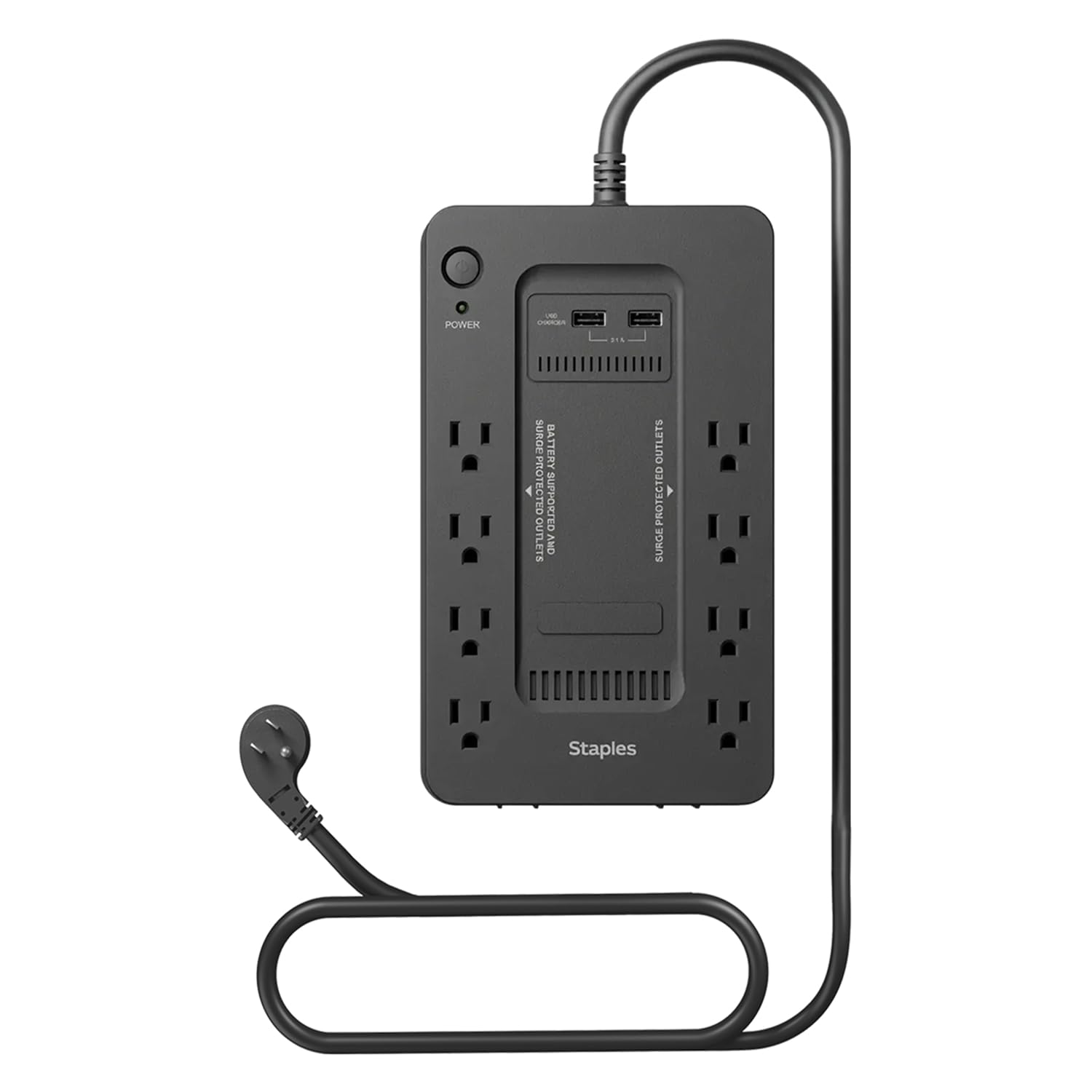
3. Staples TECH 650VA UPS Battery Backup, 8 Outlets, Surge Protection
The internet-rescue box: it does one job, kills the reboot wait, and asks for very little.
Power quality is what carries this one — it is the trait that earns the most praise from the people who own it, with value running a close second. Eight outlets split between battery-backed and surge-only circuits, rated at 650VA / 360W, which is plenty for a modem, a router and a couple of chargers. Built-in surge protection guards the hardware itself, and the whole thing tucks under a desk without fuss. Compared to the CyberPower ST900U’s 900VA / 500W rating, this is the lighter-duty unit, and it costs less for that reason.
The defining benefit is the elimination of that annoying 3 to 4 minute wait while your modem reboots after every flicker. One buyer sums it up as “Keeps internet modem on during outages/blips, eliminating 3-4min reboot waits,” and that is the entire value proposition in one line. Another runs a WiFi router off it that needs to hold for 6 hours when the power fails. A third used it through Florida’s brief summer interruptions to keep an Eero system powered. Nothing dramatic — just the internet never dropping.
Two things to know before you buy. The unit emits a beep roughly every 30 seconds while running on battery, and the fix is a double-click on the power button to silence it — a genuine bother if you live somewhere with frequent outages, and the maker intends that beep as an alert for critical equipment. Lead-acid cells sit inside, so this is not a ten-year battery. Stay under the 360W ceiling, since exceeding it is the fastest way to ruin any UPS. For a router shelf, it is the simple, low-risk pick.
What earns its keep
- Kills the 3 to 4 minute modem reboot after every outage or flicker
- Eight outlets with a mix of battery-backed and surge-only circuits
- Simple plug-and-play — no software or setup involved
- Compact enough to disappear under a workstation
What to look past
- Beeps every 30 seconds on battery until you double-click the power button
- Lead-acid cell, not a long-life lithium chemistry
- 360W ceiling means it is not built for a heavy desktop rig
Pick it for: the modem and router shelf, where killing the reboot wait is the whole goal. It is simply the right shape for that one task.
Look elsewhere if: you need to nurse a full desktop through an outage or you cannot tolerate an alert beep.
4. Eaton Tripp Lite BC350 350VA Small UPS 210W Battery Backup Surge Protector

Tiny, mountable, and built so the battery can be swapped instead of the whole unit.
At 350VA / 210W this is the smallest unit on the list, and it is honest about that. Six outlets, three of which carry both battery backup and surge protection while the other three are surge-only; the wide spacing means bulky power bricks do not eat two slots at once. The surge rating is 316 joules. Battery mode runs on PWM sine wave output, while AC mode uses sine wave output in normal operation. It mutes itself entirely in both line and battery modes — the alarm only fires on a low battery or a fault, which is a real difference from the units that beep through an entire outage. Bottom mounting tabs let you hang it on a wall where there is no floor space.
Reliability is the trait that carries it — clearly the thing owners value most, with value for money a solid second. Owners describe it cleaning up messy rural power; one reports power went out on a computer, Mac mini, printers and TV setup and everything stayed steady. Another used it under Florida storm outages after growing tired of a 10-minute WiFi restart, and it survived an outage without the network dropping. It also earned the label “Sine I got it my power has gone out. Although I have a whole generator the power to my 6v and internet did not skip a beat.” A short in-line cord at 5 feet makes wall mounting flexible.
The recurring gripe is noise — the negative trait that comes up most often, though the alarm technically only sounds on faults or low battery, so some units seem louder than the design intends. Battery life is the other honest limit; expect around 12 minutes of runtime, and one buyer got a unit with two dead receptacles right from the start. The trade you make for that compact footprint is capacity, so keep the load light. The upside is a replaceable internal battery, so when the cells age out you swap them rather than scrap the box, backed by a 3-year warranty and a lifetime connected equipment guarantee.
Reach for this if: you have a cramped or wall-mounted setup and you want a battery you can replace when it dies. Look at the Staples TECH 650VA instead if you want twice the outlet count for a modem shelf.
Know the ceiling: 210W and about 12 minutes of runtime, so it protects light gear only.
5. APC UPS 600VA/330W Battery Backup for Computer, Router, NAS, BE600M1

The default household pick: a name people already own and rarely think about, backed by a swappable battery.
APC’s entry unit sits at 600VA / 330W with a rated 23 minutes of runtime at a 100W load, and a 10-hour charge time. Seven outlets cover the desk: five carry full battery backup plus surge protection, and two are surge-only for the less important peripherals. A built-in 1.5A USB port keeps a phone charging even while the mains are down, which is a small thing that matters in a long outage. The internal battery is user-replaceable with an APC replacement battery (APCRBC154, sold separately) — swap it in minutes instead of buying a new unit.
What people value most is plain functionality — it just works — with quality a close second. A buyer who runs cameras and sensors off it reports 4+ hours testing a modem, router and TV streaming, and appreciates that it does not beep while on battery, plus it auto-powers back on after a full drain. Another kept a router and modem up for 30 to 45 minutes through a storm. The plug-and-play nature of it is the reason it ends up in so many homes; there is nothing to configure.
The honest caveats: it runs loud enough that some owners notice a whining hum when it is plugged in and running, and the sealed lead-acid battery has a finite life — one owner reports a fresh battery for an older unit arriving fast, which is exactly the replacement path this design is built around. There is no LCD to read status, the form factor is bulkier than the slimline units, and the replacement battery can cost more than half the unit itself. Capacity is modest, so treat it as brief-outage and surge protection rather than long-haul backup. The 23-minute rating at 100W is the number to hold onto when you size your load.
What makes it the safe default
- 23 minutes of rated runtime at a 100W load
- Five battery-backed outlets plus two surge-only, all well spaced
- Swappable internal battery, so you do not replace the whole unit
- 1.5A USB port keeps a phone alive during an outage
What you accept
- No LCD readout — status comes from indicator lights only
- Bulkier than the slimline competition
- Replacement battery can cost more than half the unit itself
Best match for: the household that wants the well-known brand, an easy setup, and a battery they can replace in a couple of years without buying new hardware. The GOLDENMATE below is the choice if you want lithium endurance instead.
Heads up on: the audible hum some units produce, and the modest 330W ceiling.
6. SKE SMART KEY ENERGY 425VA/240W UPS Battery Backup Surge Protector, VL425

Stands up or lies down, and adds a network and Type-C port the wall units skip.
Power capacity is the strength owners point to most, and for a 425VA / 240W box that is saying something. Seven outlets are onboard: five black ones carry battery backup and surge protection, two white ones are surge-only. Unusual for this tier, it adds an RJ45 port for network line surge protection plus two USB outlets and a Type-C outlet for charging a phone or laptop. Automatic Voltage Regulation uses simulated sine wave output to steady dirty incoming power, which is the feature that protects gear from brownouts rather than full blackouts. At 11.7 x 3 x 6.7 inches and 8 pounds it can stand vertically or lie flat, so it fits a shelf or a gap behind furniture.
The design decision that pays off is the battery: a Phillips screwdriver and a few minutes gets you a fresh cell, so the unit outlives its original battery. Owners run modems, routers and ONTs off it with uninterrupted internet, and one measured roughly 45 minutes on a low-power ONT from the 5Ah battery. Others use it to bridge a TV, cable box and Roku through brief brownouts until a home generator spins up — exactly the use case this capacity is built for. It must be charged overnight before its first real test.
Two things to square before buying. Only five of the seven outlets are battery-backed; the two white ones are surge-only, and it is easy to plug a critical device into the wrong pair. And the replacement battery (RT1250B, not the A variant) can be pricey and hard to track down, so the swap-friendly design is only a win if you can actually source the cell. One owner had the unit die after nine months when it began alarming and would not power on again, though the battery itself still tested healthy. For modems, routers and ONTs it is well suited; for a desktop it does not have the headroom.
Where it earns its place: the vertical-or-flat form factor plus RJ45 and Type-C ports make it the most flexible shape on this list for a tight shelf.
The honest limit: 240W caps it below a workstation, and the replacement battery can be costly and scarce.
Choose it when: shelf space is tight and you want network and USB-C ports built in. The APC BE600M1 is the safer bet if you want a widely available replacement battery.
Remember: only five of the seven outlets run on the battery — check the colors before you plug in.
7. APC 500VA/300W Backup Battery Power Supply for Home Office, BE500G3

Wall-mountable and slim, with the USB-C port this price class usually forgets.
Power quality leads the praise here, with compact size second — and the size claim holds up. This unit is built for the person who wants a slim brick under a desk or screwed to a wall in an apartment or dorm. Six well-spaced outlets are onboard: four carry battery backup plus surge protection, and two are surge-only. It adds USB-C and USB-A ports sharing 5V/3A, so you can charge a laptop or phone straight off the unit. Runtime is rated at up to 17 minutes at a 100W load, with an 8-hour charge time.
Where it shines is networking gear. One buyer runs an Omada controller, gateway, PoE+ switch, three ceiling access points and an outdoor AP off it, and reports about 2 hours of battery life on that stack — comfortably enough to ride out a solar transition. Others use it for a TV and stereo setup, or to keep a PC and WiFi alive through blips. If you have been burned by cheap brownout protection, this is a cleaner class of device for that job.
The honest downsides worth naming: the ports get mixed feedback because some PC connections do not shake out cleanly, and the lead-acid battery imposes the same finite life as the rest of this class. The size does mean less capacity, so it is not the unit for a power-hungry rig. Backed by a 3-year warranty and a equipment protection guarantee, it is a sensible pick if the wall-mount form factor and the USB ports are what you actually need — and a worse one if raw wattage is the priority.
Pick it for: a small desk, an apartment, or a networking cabinet where a slim, mountable shape and a USB-C port matter more than maximum wattage. The CyberPower AVRG900LCD handles heavier loads if you need the headroom.
Think twice if: your load runs heavy, since 300W is a modest ceiling.
8. CyberPower AVRG900LCD Intelligent LCD UPS Battery Backup

The one with the screen: read your watts and estimated backup time at a glance.
Power capacity is the number that defines this unit, and it is the trait owners value most, with power management second. It runs 900VA / 480W through twelve NEMA 5-15R outlets — six on battery backup and surge protection, six surge-only — with a five-foot cord and a 45-degree offset right-angle plug for a tight wall outlet. Automatic Voltage Regulation corrects minor dips and surges without switching to battery, which stretches the cells over plain units. Data line protection covers surges riding in on a phone line, and the built-in USB software provides configurable auto-shutdown, including Linux support, so your machine can close itself down safely when the battery runs low.
Runtime scales well for a workstation. One owner runs a main PC with three drives and a 32″ monitor plus a laptop with a 28″ monitor at 175 to 200W, getting 18 to 20 minutes — enough to bridge to a generator or shut down cleanly. Another keeps a NAS, modem, computer and peripherals running on an island with a single set of power lines and constant outages, and reports the UPS gives plenty of time to shut down 100TB of storage without data loss. That is the exact scenario a workstation-class UPS exists for.
The recurring complaint is the beeping — it sounds frequently when on battery, and one owner notes the LCD is very bright for a dark room. One unit reportedly ran 6.5 years before dying without warning, which is the honest end-of-life for a sealed cell; the battery in a sealed UPS is not the permanent fixture people imagine it to be. There is no battery replacement built into this one’s design, so budget for a new unit when it eventually gives out. The 3-year warranty includes the battery, and it carries a connected equipment guarantee.
What makes it the workstation pick
- 900VA / 480W with 12 outlets, six of them battery-backed
- LCD shows load and estimated backup time
- AVR smooths voltage dips without draining the battery
- Configurable auto-shutdown software with Linux support
What to plan for
- Frequent beeping while on battery with no easy disable
- Bright LCD can be intrusive in a dark room
- Sealed, non-replaceable battery — expect to replace the whole unit eventually
Right choice for: a workstation or NAS stack where you want to see your load and get a clean auto-shutdown. The GOLDENMATE below is the better pick if you want a battery that lasts the better part of a decade.
Expect to live with: the beeping, and to buy a whole new unit when the sealed battery finally ages out.
9. GOLDENMATE 1000VA/600W Lithium UPS Battery Backup & Surge Protector

The lithium one you buy once: swap out lead-acid forever and get pure sine wave output to boot.
This is the different-chemistry pick, and performance is what buyers highlight first, with value second. Its LiFePO4 battery is rated for over 10 years and 5000+ charge cycles, and the maker claims a 40% lower total cost of ownership than lead-acid. Where the CyberPower AVRG900LCD needs a new unit when its sealed cell dies, this one is engineered to outlive several lead-acid boxes. It runs 1000VA / 600W through eight NEMA 5-15P outlets with a pure sine wave output, which is the cleanest waveform here — matched by the Eaton Tripp Lite BC350 in AC mode but ahead of the simulated sine wave units.
At 4.8 kg it is light and compact for its capacity, and owners running it against lead-acid CyberPower and APC units notice the difference. It has a low-noise cooling fan that sits under 50 dB and only spins up during heavy battery use, plus a color LCD for real-time battery and power monitoring. One crew runs three of them on a corporate A/V setup and reports they saved a live event during a brief outage. Another powers an A/V system at around 185W with roughly 3 hours of runtime, using pure sine wave output for the whole rig — solid endurance for the money at this level.
The genuine limits are worth flagging. It is a 600W ceiling, and some owners mention runtime closer to 3 to 4 hours than the longer figures occasionally cited — the load you attach changes the number dramatically, so size it carefully. It has no USB or network shutdown port for auto power-off, the outlets are packed close enough that bulky AC transformers can crowd each other, and the batteries are not user-replaceable, so the 10-year lifespan is the whole lifespan. It also omits AVR and a surge rating, so it is not the box for a refrigerator or a large motor. Buy it if you want a decade of battery life and pure sine wave output and can live with a 600W ceiling and no auto-shutdown port.
Why it stands out: the LiFePO4 chemistry and 5000+ cycle rating mean this is the unit most likely to still be working when the lead-acid boxes around it have been replaced.
Consider the ceiling: 600W and no auto-shutdown port, with batteries that cannot be swapped when they eventually age.
The right buyer: someone who wants one long-life unit for a light-to-medium load and values pure sine wave output and compact size. The APC BE600M1 is the budget-friendly alternative if the lithium premium is out of reach.
Go in knowing: the batteries are not replaceable and there is no auto-shutdown data port.
Understanding the Specs
VA vs Watts
VA stands for volt-amperes, a theoretical load ceiling; watts are the real power drawn. The watt figure is always the smaller, more honest number. The CyberPower ST900U lists 900VA but only 500W, and the Staples TECH 650VA lists 650VA against 360W. When you size a load, use watts. If your total device wattage exceeds the watt rating, the UPS will either trip or drain in seconds regardless of how large the VA number looks.
Runtime at a Fixed Load
Battery time is always quoted against a specific load, because the same unit powers a router for hours and a desktop for minutes. The APC BE600M1 is rated 23 minutes at a 100W load; the CyberPower AVRG900LCD owner gets 18 to 20 minutes at 175 to 200W. Lower your draw and the runtime climbs. That is why network-only gear and whole-desktop loads need different units even though the boxes look similar.
FAQ
Can I plug a printer or space heater into a backup battery?
How long will a backup battery keep my router online?
What is the difference between battery-backed and surge-only outlets?
Will a backup battery protect my equipment from a lightning surge?
Do I need pure sine wave or is simulated sine wave fine?
Can I replace the battery myself or do I buy a new unit?
How loud is the alarm and can I silence it?
Does a backup battery make noise when it is running normally?
Will a UPS work with fiber internet and a phone line into my house?
How much load can a small 350VA unit realistically handle?
Is a lithium backup battery worth the extra over lead-acid?
Final Thoughts: The Verdict
For most homes, the back up battery that earns its place is the CyberPower ST900U — twelve outlets, 900VA / 500W of real headroom, and software that shows you exactly how much load you are pulling. If your priority is keeping just the internet alive through a long outage with no desk space to spare, the TalentCell pack is the better shape for that job. And if you want a single unit you can set up and forget for years, the GOLDENMATE lithium unit is the one built to outlast the lead-acid boxes. Match the unit to your real load before you buy, and any of these will keep the power on when the grid blinks.
How We Picked
We do not accept paid placement. Every pick is matched to a real buyer and a real use-case; we do not hands-on test units.
Sources & Methodology
Specifications: manufacturer listings and product documentation. Review insights: verified customer reviews, as of September 2026. Pricing: not shown on this page (it changes often); check the current price via the retailer link.
As an Amazon Associate, KitchPrep earns from qualifying purchases. This does not affect which products we feature.
Related Guides
