
Specs are compiled from manufacturer listings and verified buyer reviews and can change over time — please confirm the key details on the product page before buying.
If rain sheets off your roof and lands right on the doorstep, a back door awning is the fix — and the hard part is picking one that survives wind instead of rattling loose by spring. The short answer: buy for panel thickness, bracket material, and drainage direction, not for looks alone. A thin corrugated sheet with plastic arms will flex and crack; a polycarbonate panel on aluminum or powder-coated steel holds its shape. This guide covers nine real options, from budget-friendly kits to premium all-metal builds, so you can match one to your wall type and weather without guessing.
I’m Mohammad Maruf — the founder and writer behind KitchPrep. This guide is built by comparing the manufacturers’ published specifications and the patterns across verified customer reviews, so you get each pick’s real strengths and trade-offs instead of marketing spin.
A back door that catches sideways rain soaks the threshold, the frame, and the floor inside. The picks below are sorted by what actually holds up outdoors, and each one is a genuinely solid back door awning for a different wall, budget, and climate.
Our Picks at a Glance
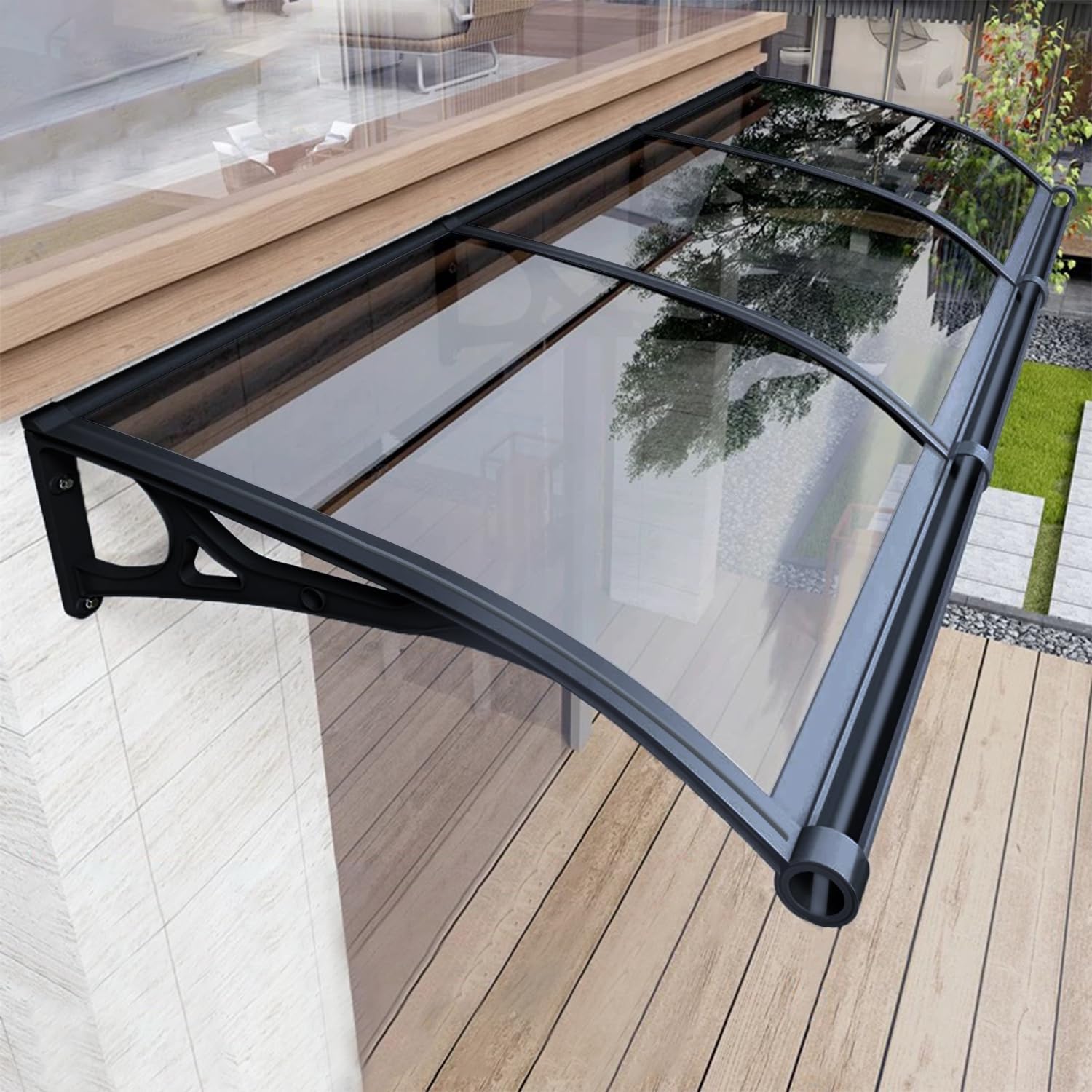

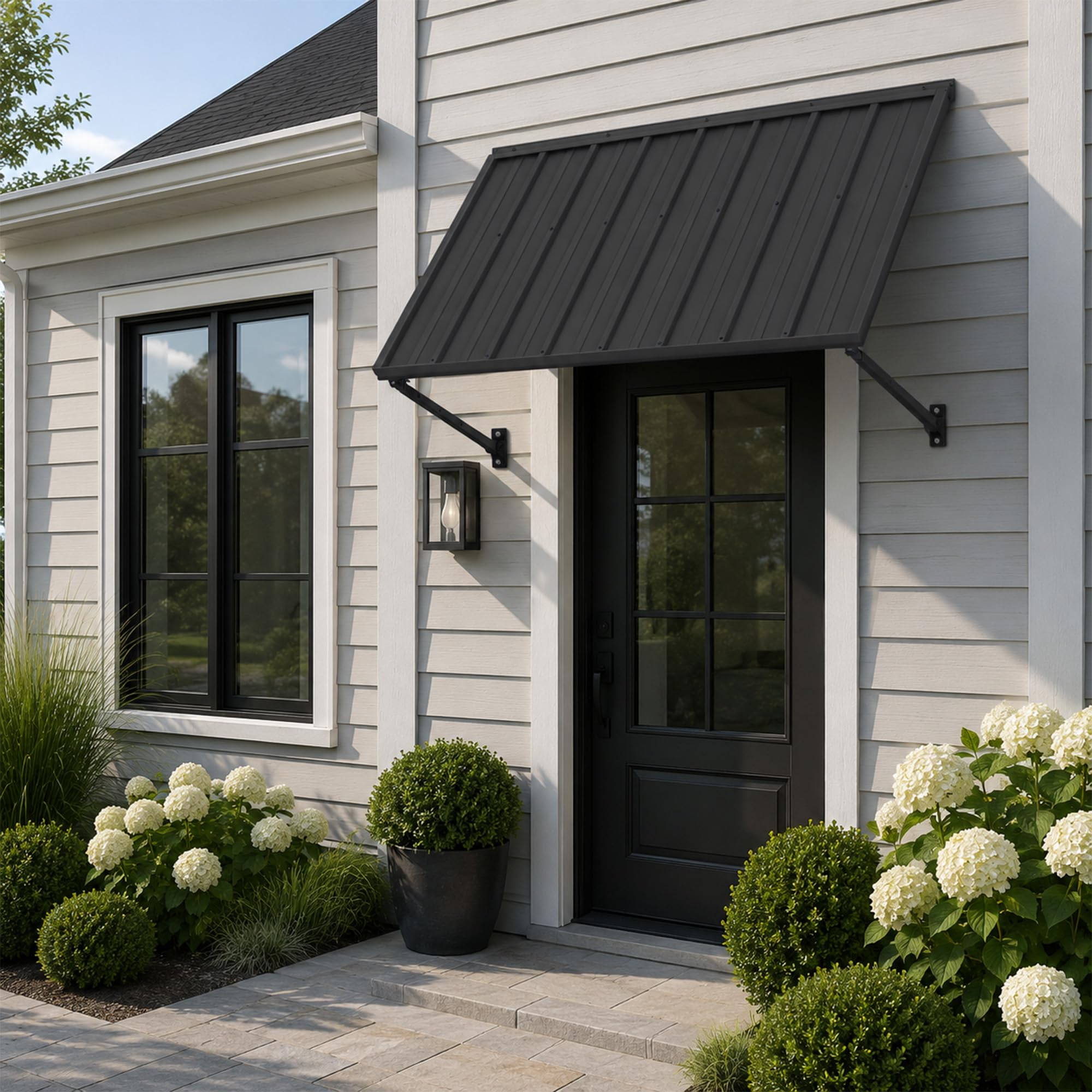
How To Choose The Best Back Door Awning
The mistake most first-time buyers make is shopping by width alone. A 78-inch canopy on flimsy brackets will sag in wind, while a smaller panel on solid arms stays true for years. Get the four basics below right and the rest is easy.
Match the panel material to your weather
Polycarbonate is the material to look for. It is a tough transparent plastic that shrugs off impact far better than glass and does not go brittle the way cheap acrylic can. Hollow-sheet panels — the ones with ribbed channels running through them — are lighter and diffuse harsh light, so your entryway stays bright without glare. Solid panels feel denser and usually carry more load, but they also add weight on the wall.
Check the brackets, not just the board
The panel is the part you see; the brackets are the part that fails. Aluminum arms resist rust and hold up in coastal air. Powder-coated steel is heavier and stiffer, which matters on wide canopies where flex is the enemy. ABS plastic brackets are common at lower price points and are perfectly workable on a small door panel, but they are the first thing to twist if someone leans on the awning.
Get the projection distance right
Projection is how far the awning sticks out from the wall — the single number that decides how much rain and afternoon sun it actually blocks. A 24-inch projection shades a door and the step directly beneath it. Something closer to 48 inches reaches further out and can cover a wider landing or protect a window from low sun. If your door sits under a deep porch, less projection is fine; if rain pours straight down the face of the wall, go bigger.
Plan for the wall you actually have
Brick, concrete, and wood all work with the expansion bolts that come in the box. Stucco and siding are the tricky ones — they need toggle bolts or added framing because the anchors that come included may not bite. Also decide your drainage direction before you drill. A panel with a front gutter or a directional drain that pushes water to one side keeps splash off your threshold, while a flat panel can let water pool at the seam.
Quick Comparison
| Model | Best For | Projection | Panel Width | Panel Material | Amazon |
|---|---|---|---|---|---|
| KIZYRQ Door Entrance Awning★ Best Overall | Best Overall | 24″ | 39″ | Polycarbonate + Aluminum | Amazon |
| VIVOHOME 38″ x 78″ AwningWidest Coverage | Wide sliding doors | 38.2″ | 78″ | Polycarbonate + ABS + Aluminum | Amazon |
| Kozyard Adjustable Door AwningAdjustable Pick | Adjustable tilt | 22″–31″ | 55″ | Powder-coated iron | Amazon |
| GGNEBAI 40″x60″ Door Awning | Medium doorways | 39.5″ | 59.5″ | Polycarbonate + ABS + Aluminum | Amazon |
| Palram Aquila 2050 | Premium build | 80.75″ | 36.25″ | Polycarbonate + Aluminum | Amazon |
| VEVOR 38″ x 78″ Door Awning | Directional drainage | 38″ | 78.23″ | Polycarbonate | Amazon |
| Tangkula 38″ x 46″ Awning | Best Value | 38″ | 46″ | Polycarbonate + Aluminum + PP | Amazon |
| GGNEBAI 32″x40″ Door Awning | Compact entryways | 23.62″ | 39.37″ | Polycarbonate + ABS + Aluminum | Amazon |
| Goplus 48″ x 40″ Window Awning | Budget pick | 48″ | 40″ | PC sheet + ABS | Amazon |
In‑Depth Reviews
1. KIZYRQ Awning for Door Entrance, 24″ x 39″ Polycarbonate with Aluminum Brackets
Our pick — over 4.5★ from 100+ verified ratings; the strongest balance of quality and price.
The compact armored one: 220 lbs of load capacity on a panel barely wider than your door.
This is the pick for a standard single back door that catches sideways rain. It measures 24 inches deep by 39 inches wide, which is a modest footprint on the wall. What separates it from nearly everything else here is the rated weight tolerance — up to 220 lbs / 100 kg. That is not a number you hang a Christmas wreath from; it is the load the polycarbonate panel (a clear, impact-resistant plastic) and aluminum alloy brackets are built to take before they bow. That is why this one sits at the top of the list for a door that catches falling branches or heavy snow loads.
What wins people over is the fit and finish, not the size. Owners consistently describe the build as sturdy, and the recurring note is that the transparent panels look noticeably better than the cheaper corrugated polycarbonate brands — the sort of ribbed plastic sheet you see on sheds. The front aluminum gutter pushes rainwater sideways instead of letting it sheet down the wall, so your threshold stays dry rather than pooling right where you stand with groceries. Hidden rubber gaskets seal the joints, which keeps out the drip-through that plagues flat panels. One buyer used it unconventionally, mounting it about 18 inches above a shed window AC unit as a rain and snow cover, and reported it worked as advertised.
Here is the catch worth knowing before you buy: assembly is a two-person job in practice. The thin clear sheets have to be threaded into the slots and brackets, and that takes patience and ideally a helper. A few owners swapped the included lag bolts for their own heavier hardware when mounting to a particular wall. Buyers report: “The afternoon sun poured directly into our kitchen window. This awning made such a difference that I took the blind down. It was easy to install and very sturdy. I would definitely recommend it.” If you are handy and have a second set of hands for twenty minutes, the result is a genuinely solid 4.6-star canopy — the crowd favorite across 100-plus ratings — and the best all-round pick here.
What earns the top spot
- 220 lbs / 100 kg weight tolerance backed by aluminum alloy brackets — far above the small canopies in this group
- Impact resistance rated 250–300 times stronger than glass
- Front aluminum gutter plus hidden rubber gaskets keep joints sealed and water flowing sideways
Where it asks a little work
- Panel-to-slot assembly takes two people and some patience
- Included lag bolts may not suit every wall; a few owners swapped them
Best for: A standard back door that takes real weather and needs a panel strong enough to shrug off snow load and impacts.
Look elsewhere if: You need to cover a wide sliding door — this 39-inch width will leave the far side of a wide opening exposed.
2. VIVOHOME Polycarbonate Window Door Awning, 38″ x 78″ Brown
Seventy-eight inches of coverage, built for the wide opening a narrow canopy cannot reach.
The number that decides this one is the width: 78 inches across. Compare that to the 39-inch KIZYRQ above and you can immediately see the difference in reach — this is the pick for a sliding patio door or a double-wide back entry where a small canopy leaves half the opening in the rain. It is a two-piece panel design, 2×5 mm thick, which is how it covers that much span. Two smaller panels overlap so they blend into what looks like a single sheet, and the pairing adds stability across the span. Rated load is up to 30 lbs.
The installation story is genuinely mixed, and honesty matters here. Some owners had it up quickly, describing it as easy to put together. Others found the two-piece assembly awkward — threading and aligning the two panels by yourself is the fiddly part, and it goes better with a second person. What buyers agree on is the result: it does what an awning should, keeping rain off the doorway. One owner fitted it unconventionally, using it as a rain and snow cover roughly 18 inches above a shed window AC unit, and reported it working well. The leak-proof aluminum bars seal the joint between panels so water does not seep through the seam, and the anti-UV coated surface handles sun without fading.
Worth weighing against the narrower options: if you only have a standard single door, the extra span is wasted material and extra wall to drill into. But if you are covering a slider or a porch step that runs long, this is the value math working in your favor. The 4.2-star panel across 200-plus ratings is a fair reflection — most owners are happy, the assembly caveat is the one recurring note.
What it solves: A span problem. If your back door opening is wide enough that a 39-inch panel covers only half, this 78-inch version reaches across and keeps the whole threshold dry.
The trade-off: Two-piece assembly is the recurring gripe. It threads together easily enough with two people, but solo it is a challenge — budget a helper and an afternoon.
Reach for this if: You are covering a wide sliding door or a long stretch of wall that single-panel awnings cannot span.
Skip the extra width if: You have one standard door — you will pay for coverage you never use and drill twice as many holes.
3. Kozyard Adjustable Door Window Awning, 4-Level Tilt, 55″W × 32″ Sloped Panel
The only one here you can re-aim by season, with a metal canopy instead of plastic.
Every other pick in this guide is fixed — you bolt it on and live with the angle. This Kozyard is different. It has four adjustable angles, so you can drop it low to block harsh summer sun and tip it up in cooler months for airflow. That flexibility matters on a back door that faces the afternoon sun for part of the year and open sky the rest. It measures 55 inches wide by 32 inches deep, with adjustable projection running from 22 to 31 inches. The construction is powder-coated iron, not polycarbonate — a solid metal canopy that resists rust, fading, and bending.
Where it separates from the plastic-backed group is capability in rough weather. It is rated for up to 20 inches of fresh snow and 60 MPH wind when installed per the maker’s guidelines. There is also a built-in front gutter that pushes rainwater away from the doorway even in wind-driven rain. What buyers praise most is how it comes together — the assembly and appearance are the two most-talked-about aspects, and instruction quality gets its own nod. Pre-drilled holes align, the hardware is quality, and a ratchet wrench or Allen socket speeds the many screws. Owners describe it adding character to a plain wall and keeping sun off a bedroom window.
The honest limits: tilt introduces the possibility of water sitting where it should not. This is the one place the feedback turns mixed — a couple of owners note the top does not drain cleanly, so keep the tilt aimed away from the wall and clear of standing water. At 108 inches and 82 inches, larger builds need two people for the final lift. And it can fit siding walls and uneven stepped surfaces, which is rare in this group. A well-built 4.4-star option across 100 ratings, and the obvious pick if you want one awning to do two jobs.
Why it stands out: Four tilt positions plus a powder-coated iron canopy instead of plastic — the only pick here you can seasonally adjust or install on siding and stepped walls.
One thing to plan for: Adjustable angles mean water can rest on top if you set the tilt wrong — angle it away from the wall and it drains fine.
Worth it if: You want one canopy that adapts to summer shade and winter sun, built from metal rather than polycarbonate.
Think twice if: You want a set-and-forget panel — this rewards a little tuning, not a fire-and-forget install.
4. GGNEBAI 40″x60″ Door Awning Exterior with Leak-Proof Sealing
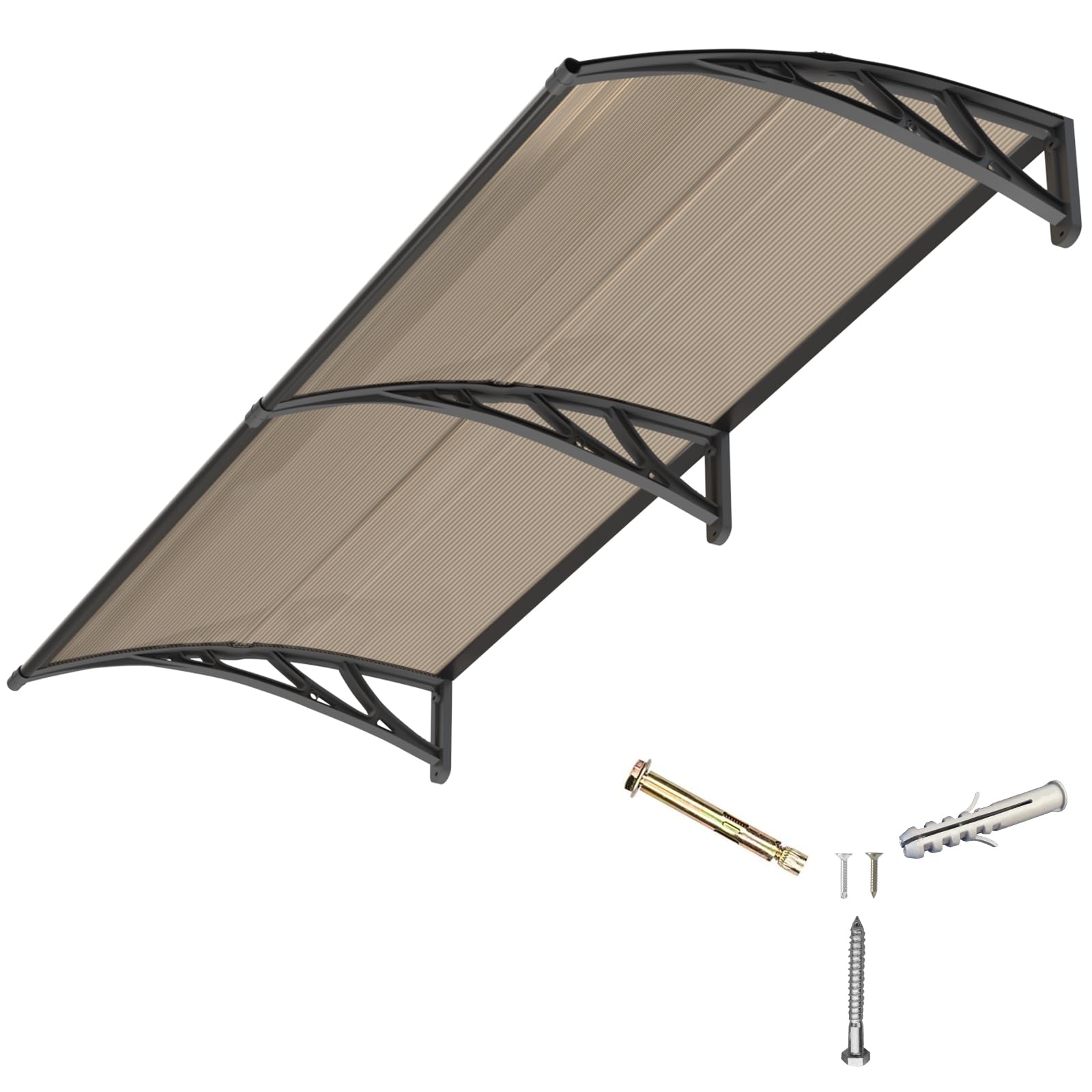
A mid-sized canopy that puts its effort into sealing every joint, not just the look.
At 39.5 inches deep by 59.5 inches wide, this sits in the middle of the size range — bigger than a standard door canopy without going full patio-wide. What it leans into is water management. The design calls for secure sealing at every joint, and the maker recommends adding glass glue (not included) at the seams during assembly to lock down a weatherproof finish. You also get five types of screws in the box so the hardware matches concrete, brick, or wood instead of forcing one anchor type on every wall. Panels are hollow polycarbonate with ABS brackets and corrosion-resistant aluminum rods.
What buyers respond to most is how it looks once it is up — appearance and installation are the two things owners talk about most, and both land positive. Owners describe it installing easily on a wood frame and solving a real problem: roof water splashing into a dog door, and steps getting soaked. One note in the reviews flags that this budget-friendly canopy covers about 39 inches rather than the full 40, so if you are measuring tight to the inch, leave a small margin. Furnished lag screws ran large for some walls, and a couple of owners swapped in smaller screws or added caulk at the back.
The honest follow-up a buyer should ask: will it hold up to heat and sun over the long haul? That is the mixed point in the feedback, with durability, size, and material quality drawing a range of opinions rather than a clear verdict. Setting the arms parallel matters too — if one sits off, the front skews and you may need a shim. It is a solid 4.4-star pick where appearance and installation carry the day, and a reasonable middle-of-the-road choice between the small and wide canopies.
Why owners like it
- Seals at every joint, with a leak-proof design that keeps water off the threshold
- Five screw types cover concrete, brick, and wood
- 59.5-inch width handles a mid-size doorway without crowding the wall
Keep in mind
- Recommended glass glue at the seams is not included
- Durability draws mixed feedback — how it ages under heat is the open question
- Included lag screws run large for some walls
Good fit for: A doorway where sealing beats size — you want dry steps and a wide-ish canopy without jumping to full-porch scale.
Reconsider if: You need a build proven over many seasons — this one is newer to the market and works better for the patient buyer.
5. Palram – Canopia Aquila 2050 7′ x 3′ Door/Window Awning
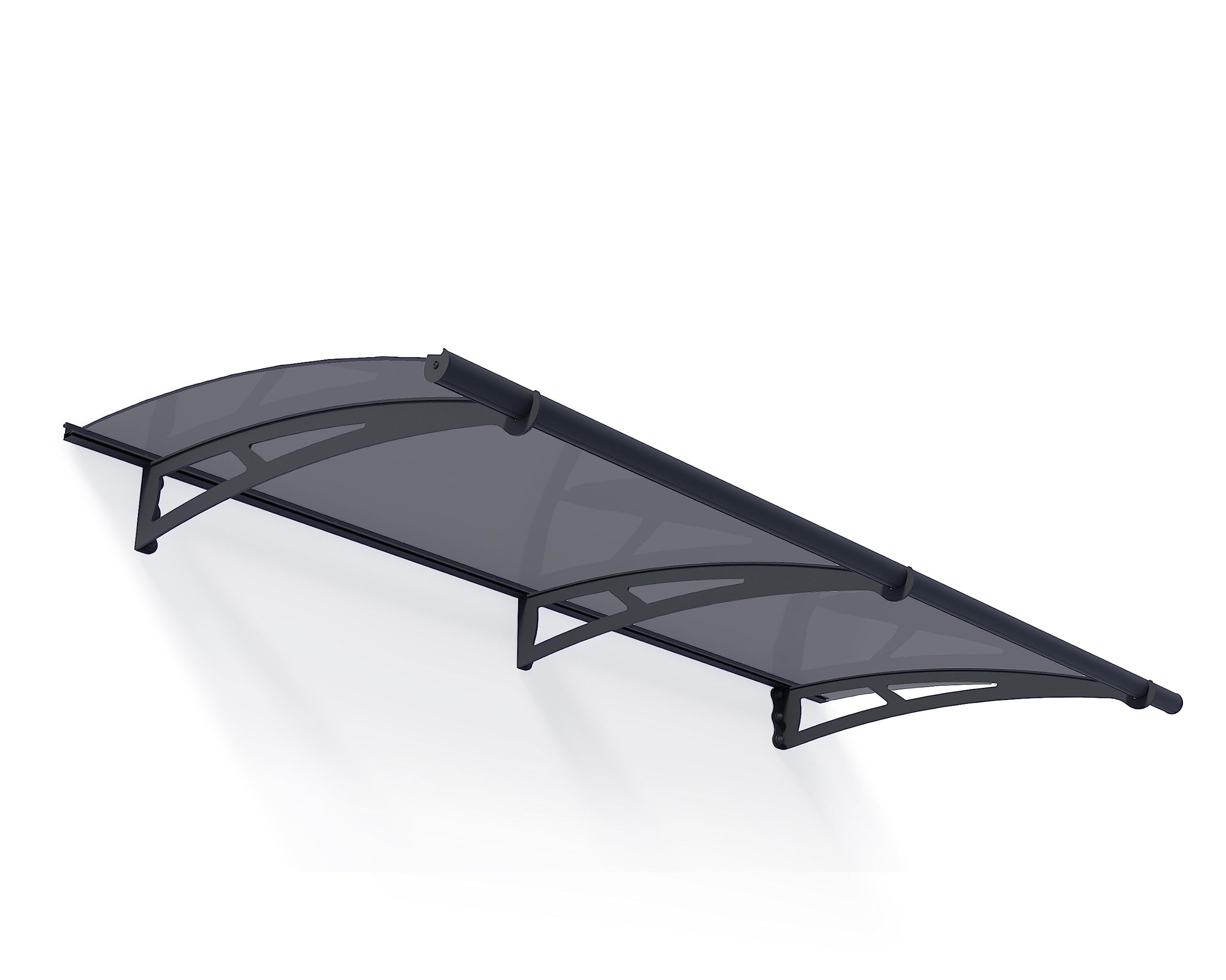
A 51-pound steel-framed canopy that feels permanent the moment it is bolted up.
This is where the money goes. The Aquila comes in at 51 pounds with a durable galvanized steel metal frame (steel coated in zinc to stop rust) under clear polycarbonate panels — the heaviest build in this guide by a wide margin. It spans 80.75 inches deep by 36.25 inches wide, and it carries a 3-year limited warranty, something none of the budget kits offer. Clear panels mean it blocks the sun’s rays without blacking out your view of the sky, and the powder-coated steel brackets hold their shape against flex in a way thin plastic arms simply do not.
Ask owners what they value and the answer is consistent: how it looks, how sturdy it feels, and that it works. The all-metal construction with heavy steel supports is the recurring theme, and there is a specific appreciation for the visibility — the clear panel lets you look up and still see sky rather than a dark slab over your head. It handles light rain and weather protection well, keeping a porch dry. Compared to the corrugated plastic builds lower on this list, the difference is the frame: thick powder-coated steel instead of plastic.
The honest catch is installation, and it is a bigger one here. It is heavy and awkward, and the instructions mostly cover masonry walls — if you are mounting to a wood soffit, you will need to frame it and source your own bolts. It took two people and, for one owner, a contractor to sort the mounting on wood studs. The included anchors can fail on stucco, where toggle bolts and caulking are the fix. It also arrived with damaged packaging more than once, though the seller replaced a unit promptly. The 4.4-star rating across 300 ratings fits a premium pick that rewards a sturdy wall and a careful install.
The premium case: A 51-pound galvanized steel frame, clear panels that keep the sky visible, and a 3-year warranty — the most permanent-feeling canopy here.
The install reality: Heavy and best done with two people; the instructions assume masonry, so wood and stucco walls need custom framing and their own anchors.
Choose this when: You want a metal-framed, warrantied canopy that looks built-in and you have a solid wall plus a second pair of hands.
Pass if: You are mounting to a soft or uneven surface and want a straightforward one-person job.
6. VEVOR Awning for Door Entrance, 38″ x 78″ with Drainage & ABS Bracket
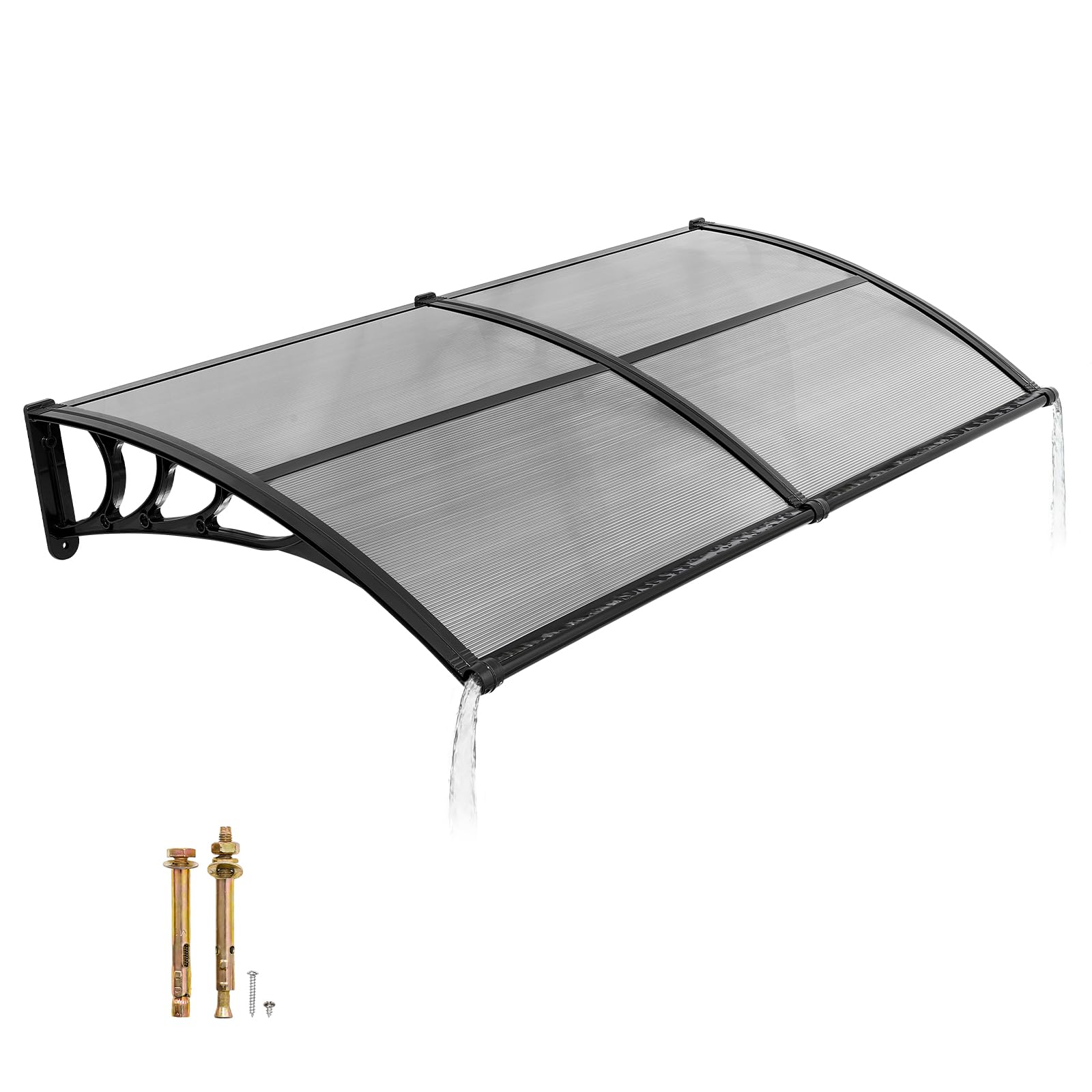
A full-width slider canopy with a drain sink that routes water away from the door.
At 78.23 inches wide and 38 inches deep, this covers the same wide span as the VIVOHOME above but comes at it from a different angle — literally. The standout is the upgraded directional drainage sink: a channel that guides rainwater off to one side instead of letting it sheet down the wall and pool at the threshold. It is smoky gray rather than clear, so it cuts glare and adds shade without going dark. Panels are high-transparency polycarbonate with reinforced ABS brackets, and the maker rates them shock-resistant, flame-retardant, and noise-reducing.
It ships with a complete accessory kit and two types of mounting screws for brick, concrete, or wooden walls, and it carries UPF 50+ protection to knock down summer heat. On the wall it weighs 11.4 pounds, light enough for one strong person to hoist while another drives screws. Owners appreciate how it looks and how lightweight it is to handle, and one owner reported it holding up well past six months.
Now the real talk, because this one earns honest sizing. Assembly is genuinely fussy — the metal slots run too tight for the panels and may need widening with a screwdriver, and the frame slots can arrive misaligned. Several owners needed two people, and a few drilled extra holes to stop the frames springing off the curved panels. A handful describe the material as cheap plastic, and one returned it over concerns the wind rating would not hold. The fasteners drew a specific complaint about needing an electric ratchet to seat the bolts. It is a 4.0-star canopy across 900-plus ratings — solid for a wide, draining, budget-conscious slider cover, provided you go in ready to fuss with the assembly.
Where it delivers
- Directional drainage sink keeps water away from the doorway, not sheeting down the wall
- 78.23-inch width covers a wide sliding or patio door
- 11.4 pounds — light enough to hoist into place with help
What to expect
- Assembly is truly fiddly — tight slots and misaligned frame channels
- Fasteners need an electric ratchet for some installs
- A few owners question the material’s long-term wind durability
Made for: A wide slider on a budget where directional drainage matters more than a flawless bolt-together.
Not for you if: You want a clean, quick assembly — this one rewards patience and an extra tool or two.
7. Tangkula 38″ x 46″ Window Awning for Sunlight, Rain & Snow Protection

A mid-width canopy with a real snow-load number and the option to link more on.
The spec that earns this its spot is the 44 lbs snow load, paired with UPF 50+ sun protection, water resistance, and grade 4 wind resistance. It measures 38 inches deep by 46 inches wide by 11 inches high, spanning a standard-to-mid door with a little to spare. Panels are premium PC sheets — that is polycarbonate, the tough transparent plastic — on solid ABS triangular brackets and aluminum bars, and the hollow panel design helps drop the heat of direct sun. The package arrives with 4 sets of expansion bolt kits, 2 PC sheets, 3 fixing bars, and 2 brackets, and you can join multiple awnings side by side to build a wider shaded run.
What buyers like most is exactly what you hope for: it looks good and it does its job. Appearance and functionality both draw consistent praise, and it holds up against real weather. It has weathered rain, wind, and heat without leaking, and taken 35 mph gusts and a foot of snow with only a slight sag that knocked off easily. The hollow-sheet build keeps light coming through in a soft tint rather than blocking it fully.
Be straight about the materials, though. This is a value-tier canopy, and the feedback is mixed on build quality — a few owners describe the plastic as cheap and one had to tape a seam where the two corrugated panels meet. The included compression bolts drew criticism for failing on some walls, so factor in a hardware upgrade, and treat the larger sizes as a two-person install. For a mid-width, snow-rated awning at a value-tier price across 900-plus ratings, it is a fair trade: good looks and proven weather performance, in exchange for materials you may want to reinforce.
The value read: A 44 lbs snow load, UPF 50+, and side-by-side linking at a value-tier price — plenty of canopy for a standard door without premium spend.
Where to reinforce: Materials are the mixed point. Budget for better bolts than the included compression type and seat the panel joint tightly to keep it water-tight.
Pick this if: You want snow-rated shade and rain cover over a standard door and would rather spend less than go premium.
Look up-market if: You want a canopy that needs zero reinforcement straight from the start.
8. GGNEBAI Door Awning 32″x40″ Window Awning with Enhanced Sealing
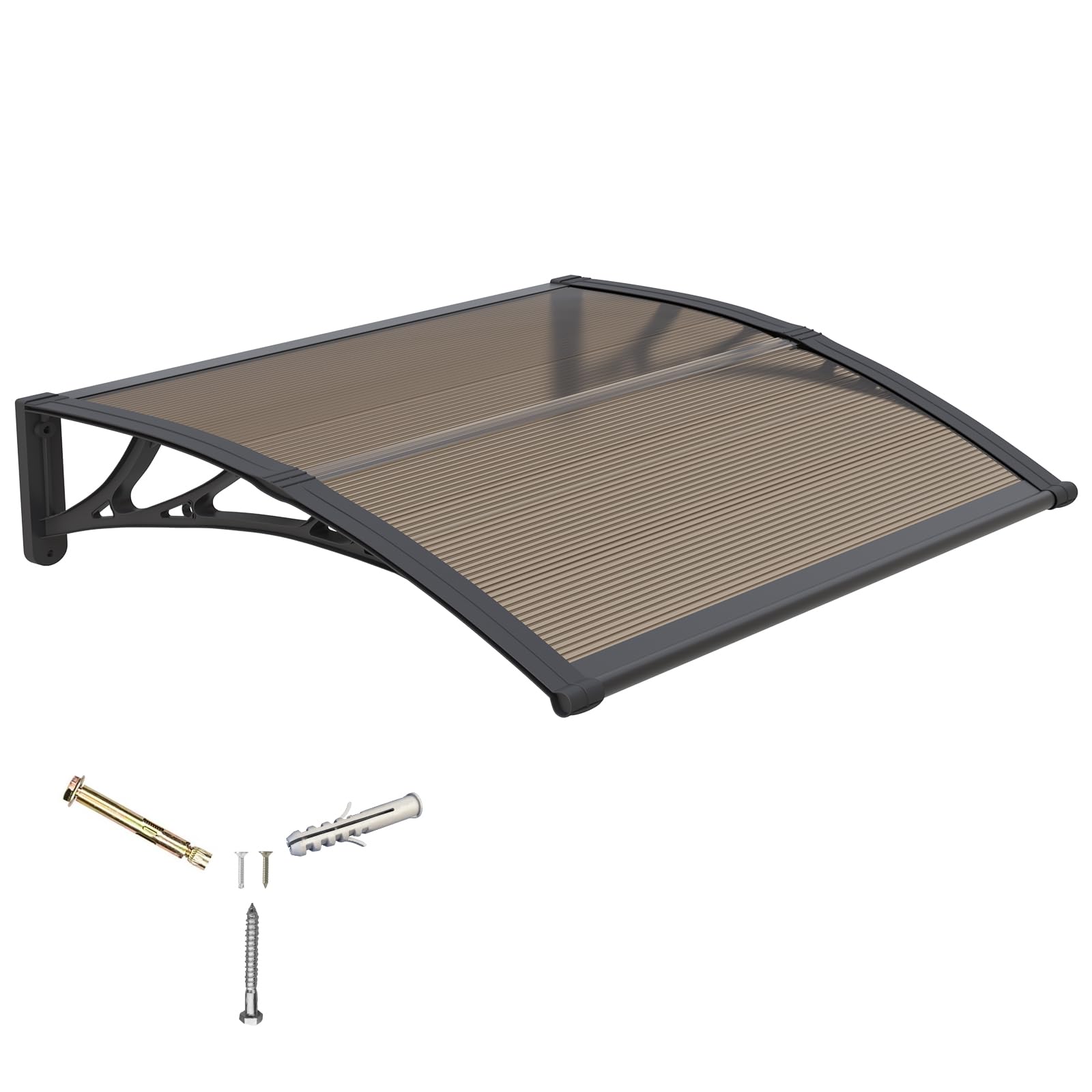
A 32-by-40 canopy for tight entryways where a wider panel would crowd the wall.
Small doors need small awnings, and this one is sized for exactly that. At 32 by 40 inches it is the most compact canopy in this guide, built of high-impact polycarbonate with sturdy ABS brackets (a tough, hard plastic) and aluminum alloy bars. The draw is the tighter footprint — on a narrow side entry or a window that sits close to a corner, a wide panel looks out of place while this one sits neatly. The upgraded sealing components aim to close the gaps that let water drip through at the joints, and the maker recommends glass glue (not included) at the seams during heavy-storm season.
The panels are transparent and designed to handle extreme temperatures while blocking UV, so you keep natural light without the full glare. Installation suits wood, brick, or concrete walls with the included hardware, and the instructions recommend two people for a clean fit. What owners appreciate is the straightforward result: it goes together, it looks good, and it keeps the rain off the entry. One owner mounted it over a sliding door entryway and reported it stays dry where rain used to land. Another noted it stood up to snow and wind without issue, taking three people to level, hold, and bolt in place.
The honest note: assembly has a learning curve. Owners describe it as a little difficult to put together, though manageable solo if you take your time, and the multi-point sealing means the joints reward careful attention. It is a 4.4-star canopy across 300-plus ratings, and it fits the buyer with a compact doorway who wants shade and rain cover without a canopy that dominates the wall.
What it nails: The compact 32-by-40 footprint fits narrow entries and corner windows where bigger panels look clumsy.
Plan for: Sealing is the maker’s own emphasis — apply glass glue at the seams if you face heavy storms, and allow two people for a level fit.
Right for: A tight back door or window where a small, tidy, light-blocking canopy is the goal.
Wrong for: A wide opening — the compact span will leave the far side exposed.
9. Goplus 48″ x 40″ Window Awning with UPF 50+ and Hollow Sheet

A long-projection budget canopy that reaches out 48 inches to catch the rain.
This is the budget pick, and it makes its case on reach. The projection distance here is 48 inches — double the 24-inch projection of the KIZYRQ up top. That means it throws shade and rain cover much further out from the wall, useful on a door where the rain falls straight down the face and splashes the step. It measures 48 inches deep by 40 inches wide by 11 inches high and weighs just 6.5 pounds. Construction is a translucent PC sheet — polycarbonate — on a high-strength ABS bracket with reinforced aluminum bars, rated to hold 44 lbs.
The weather numbers are respectable for the tier: waterproof, UPF 50+ (blocks 98% of UV rays), and wind resistant at grade 4, with a double-layered panel and anti-UV coating to resist fading outdoors. The curved design is meant to stop rainwater pooling, and the smooth surface is designed to keep drips out. It fits cement, wood, and brick walls with the included expansion bolts and clear instructions, so a beginner can manage it.
Weigh the assembly honestly, because it is the one recurring note. Fitting the thin clear sheets into the slots and brackets is tedious for one person and wants patience — and, ideally, a second set of hands. The 4.2-star rating across 200-plus ratings reflects a canopy that most owners find light, easy to install, and steady in brisk winds, with the assembly fiddliness being the honest trade for the budget-friendly price. If you want a long projection without spending much, this covers more ground per dollar than any short-projection canopy here.
Why it earns the budget crown
- 48-inch projection reaches twice as far out from the wall as the 24-inch KIZYRQ
- 6.5 pounds — easy to lift and position during install
- UPF 50+ and grade 4 wind resistance at an entry-level price
The budget trade-offs
- Threading the thin sheets into the slots is tedious solo
- ABS brackets are workable but less rigid than aluminum arms
Best for: A door that gets drenched by falling rain, where long projection matters and budget is tight.
Look up if: You want a rigid aluminum frame and plan to mount high — this leans on ABS brackets instead.
Understanding the Specs
Projection Distance
Projection is how far the canopy reaches out from the wall — the number that decides how much rain and low sun it blocks. A 24-inch projection shades the door and the step beneath it (the KIZYRQ and GGNEBAI 32×40 sit in this range). A 48-inch projection, like the Goplus, throws cover much further out for a wall that takes falling rain head-on. Pair projection with the door width: a narrow door under a deep projection gets excellent splash control, while a wide slider needs width as much as depth.
Panel Material and Thickness
Polycarbonate is the material to hunt for — a tough transparent plastic that resists impact and does not go brittle like cheaper acrylic. Hollow-sheet panels with ribbed channels run lighter and diffuse glare, while thicker panels carry more load. The VIVOHOME uses 2×5 mm panels across its 78-inch span, and the KIZYRQ rates its panel at 250–300 times the impact resistance of glass. Bracket material tracks right alongside: aluminum arms resist rust, powder-coated steel stays rigid on wide canopies, and ABS plastic is fine on small panels but flexes under a lean.
Load and Wind Ratings
Load tolerance tells you how much weight the canopy takes before it bows. The KIZYRQ is rated up to 220 lbs / 100 kg, the Goplus and Tangkula hold 44 lbs, and the VIVOHOME holds 30 lbs. Snow and wind numbers follow the same logic: the Kozyard rates for up to 20 inches of fresh snow and 60 MPH wind, and the Goplus carries grade 4 wind resistance. Match these numbers to your climate — a heavy-snow region wants a high snow load, and a windy, exposed wall wants rigid brackets over flexible plastic.
Drainage Direction
Where the water goes matters as much as how much you block. A front gutter like the KIZYRQ’s pushes rain sideways instead of letting it sheet down the wall, and the VEVOR goes further with a directional drainage sink that routes water off to one side. Panels without a gutter can pool at the seam, which is why a few owners caulk the joints or add glass glue. Before you drill, decide which way you want the water to run — away from the threshold, not across the walkway you step onto.
FAQ
How much projection does a back door awning need?
Will a polycarbonate awning survive a heavy snow load?
Can I install one of these on a stucco or siding wall?
Do I need one or two people to install an awning?
How do I stop water leaking through the panel joints?
Is a hollow-sheet panel better than a solid one?
Can I connect multiple awnings for wider coverage?
Will an awning block too much light from my back door?
What is the difference between polycarbonate and ABS brackets?
Do these awnings work over a sliding patio door?
How long do these awnings last outdoors?
Final Thoughts: The Verdict
For most back doors, the strongest pick is the KIZYRQ Awning for Door Entrance — a 220 lbs / 100 kg load rating on aluminum alloy brackets, a front gutter that drains sideways, and a 4.6-star record over 100-plus ratings that no other canopy here matches. The crowd cheers it for looking better than the corrugated panels and holding up through real weather. If you have a wide sliding door, the VIVOHOME 38″ x 78″ reaches across the full span with 2×5 mm two-piece panels. And if you want one canopy you can re-aim by season, the metal-bodied Kozyard Adjustable with its four tilt positions stands apart from every fixed-angle pick on this list. Measure your door, check your wall type, and pick the projection that reaches furthest — that is the whole game.
How We Picked
We do not accept paid placement. Every pick is matched to a real buyer and a real use-case; we do not hands-on test units.
Sources & Methodology
Specifications: manufacturer listings and product documentation. Review insights: verified customer reviews, as of September 2026. Pricing: not shown on this page (it changes often); check the current price via the retailer link.
As an Amazon Associate, KitchPrep earns from qualifying purchases. This does not affect which products we feature.
Related Guides
