
Specs are compiled from manufacturer listings and verified buyer reviews and can change over time — please confirm the key details on the product page before buying.
If you are shopping for a gate that guards the bottom of a staircase, the single most useful thing to know up front is this: the gate must be pressure-mounted, never hardware-mounted at the top of the stairs. Every pick below is built to sit at the foot of the stairs, span a doorway or a banister, and open with one hand while you are carrying a toddler. Pick the widest opening you actually have to cross, match the mounting style to your walls, then choose.
I’m Mohammad Maruf — the founder and writer behind KitchPrep. This guide is built by comparing the manufacturers’ published specifications and the patterns across verified customer reviews, so you get each pick’s real strengths and trade-offs instead of marketing spin.
The width you measure at floor level decides almost everything here, which is why every entry below lists its true opening range. Each entry below lists its true opening range, mounting type, and lock design, so you can match a gate to your staircase in one pass.
Our Picks at a Glance
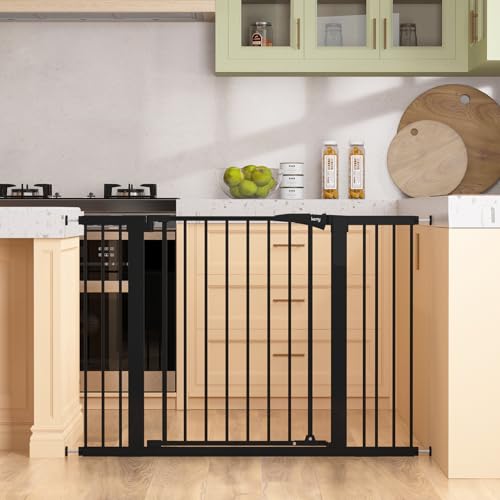

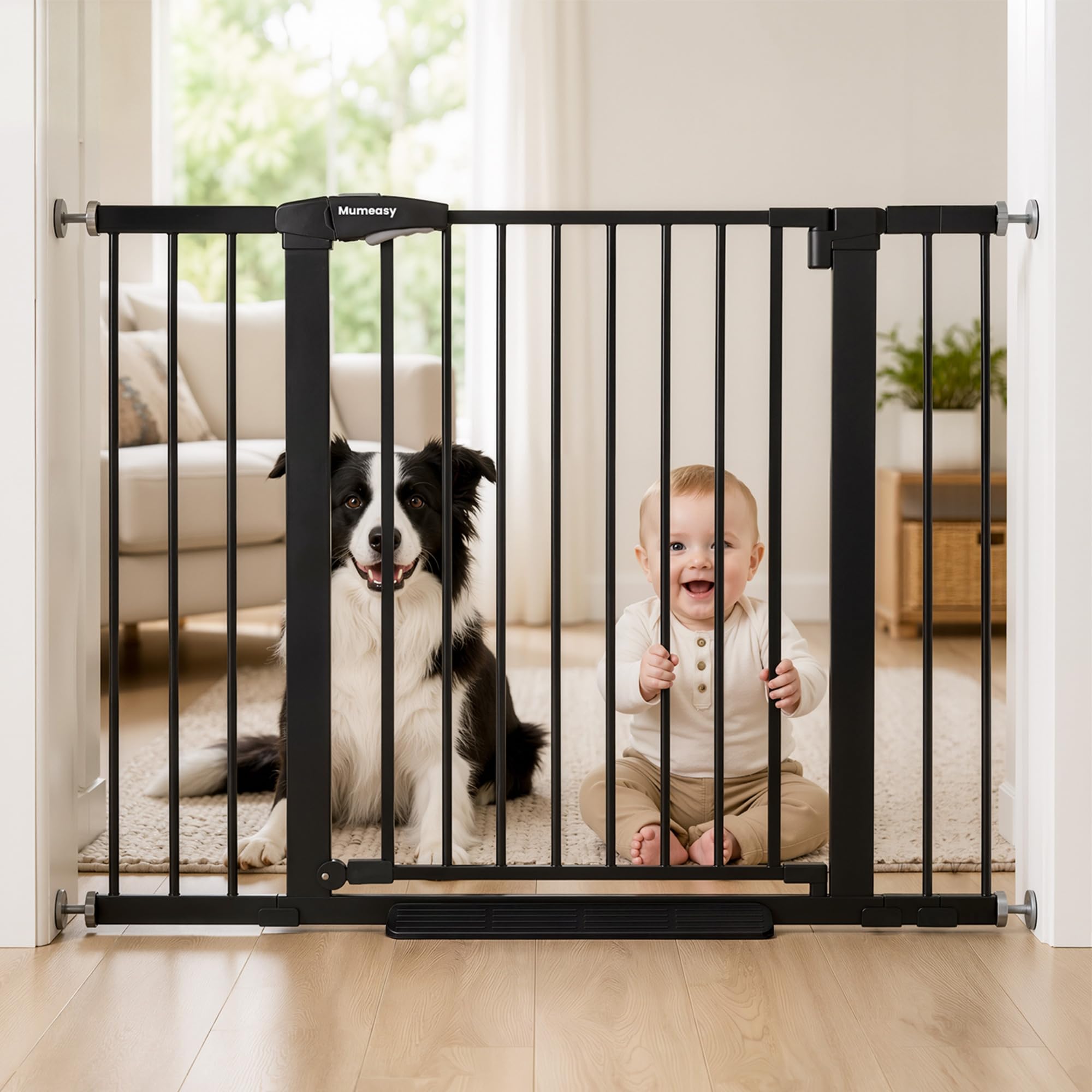
How To Choose The Baby Gate for the Bottom of Stairs
A bottom-of-stairs gate has one job: stop a crawling baby or a determined dog at the foot of the steps without becoming a trip hazard you have to climb over twenty times a day. That means a walk-through door you open with one hand, a lock a toddler cannot flick open, and a mounting method that holds firm against a banister, a wall, or a doorway frame.
Measure the opening, not the wall
Run a tape across the gap at floor level, then again one step up, because stairwells often narrow or widen as they rise. A gate listed as fitting 29.7–46 inches only reaches that range with its extension kits in place — the base gate is only as wide as its smallest figure. Watch for the dead zones some gates publish outright: one popular model here fits 29–32 inches on its own and 35.5–38.5 inches with its six-inch extension, but does not fit 32–35.5 inches at all. A gate that misses your opening by an inch is a gate you cannot use.
Pressure mount or hardware mount
Pressure mounting wedges the gate between two surfaces using adjustable screws and rubber pads, so your walls stay undrilled and you can lift the whole gate out when guests come. Hardware mounting screws the brackets into studs or banister posts for a more rigid hold. Several gates here do both, which is useful: run pressure mounting at a doorway, then add the screws if a big dog leans on the frame.
Height and bar spacing
Thirty inches is the standard height, and it stops a crawler or a small dog without blocking your sightline down the hallway. If you have a climber or a committed jumper, a 36-inch gate changes the math. Bar spacing matters just as much — narrow spacing keeps a tiny puppy or cat from slipping through, while a bottom rail sitting low is the thing people trip on, so look for an anti-stumble pedal or a raised bottom bar.
Auto-close and the lock
Auto-close does the remembering for you: the door swings shut on its own if you release it below a set angle, usually 90 degrees. Push it past that point and it stays open for walkthrough traffic. The lock is the other half — a two-action or double-lock handle needs two motions at once, which is hard for small hands but still opens one-handed once you know the grip.
Quick Comparison
| Model | Best For | Opening Range | Height | Mounting | Amazon |
|---|---|---|---|---|---|
| keny 29.7″-46″ Baby Gate for Stairs★ Best Overall | All-round pick for doorways and stairs | 29.7–46 in | 30 in | Pressure Mount | Amazon |
| InnoTruth 28.9-42.1″ Wide Baby GateTop Performer | Widest walk-through opening on a budget | 28.9–42.1 in | 30 in | Pressure / Hardware | Amazon |
| Mumeasy 29.7-46″ Baby Gate for StairsBuilt Like Steel | Reinforced steel for heavy dogs | 29.7–46 in | 30 in | Pressure / Hardware | Amazon |
| Mumeasy 29.7-51″ Extra Wide Safety Gate | Very wide stair landings and porches | 29.7–51 in | 30 in | Pressure / Hardware | Amazon |
| PLZOIT 29.5-40.5″ Baby Gate for Stairs | Narrow-spaced bars for small pets | 29.5–40.5 in | 30 in | Pressure Mount | Amazon |
| Regalo Safety 29″-38.5″ Easy Step Baby Gate | Tight budgets and simple doorways | 29–38.5 in | 30 in | Pressure Mount | Amazon |
| The Stair Barrier First Fabric Banister Gate | Banister-to-banister gaps with no wall | 36–42 in | 32 in | Strap Mount, No Drill | Amazon |
In‑Depth Reviews
1. keny 29.7″-46″ Baby Gate for Stairs, Auto Close Dog Gates for Doorways
Our pick — over 4.5★ from 750+ verified ratings; the strongest balance of quality and price.
The everyday workhorse for a standard stairwell — wide enough for most landings, steady enough for a jumper.
Most families land here because this gate covers the widths a typical doorway or stair foot actually measures: 29.7 to 46 inches with its extension kits, standing 30 inches tall. That height clears a crawling baby and a small pet without walling off your view of the stairs. It is made of metal rather than plastic or wood, so it holds its shape through daily bumps and rough play instead of flexing or cracking.
The lock is the part you will touch 50 times a day. A double-lock system needs two separate actions, which keeps toddlers from copying what you do, but the whole thing still opens one-handed when you are holding a baby on your hip. Release the door below 90 degrees and the auto-close takes over and shuts it behind you — no more lying awake wondering whether the gate got left swinging. It is pressure mounted, so you adjust the screws until the frame bites into the opening; no drilling, and you can carry it to a different doorway next season.
What wins people over is the build quality, and it shows in the small details — strong hinges, a frame that stays put, and a look that does not scream plastic nursery. One buyer sums up the daily reality: “This blockes off my stairs going to the second floor and my kitchen from my pups, on of which is currently a jumper.” The honest catch is the bottom lock, which takes some getting used to; a handful of owners find it stiff to unlatch at first. Loosen the top tighteners slightly if the handle fights you, and it frees up.
What earns its place
- Fits 29.7–46 inches with extensions, so one gate covers a doorway now and a wider stair foot later
- Metal frame with strong hinges that resists bending from rough play and daily bumps
- Auto-close shuts the door for you when you release it below 90 degrees
- Double-lock handle is awkward for toddlers but still opens one-handed for you
Before you mount it
- The bottom lock is the regular gripe — a few owners need a firmer press to release it
- Pressure mounting needs a solid surface on both sides; it will not bite into a soft wall
Buy it if: you want one gate that fits a normal doorway or stair foot, locks itself, and takes a beating from kids and dogs.
Think twice if: you need a gate wider than 46 inches or a taller frame for a serious climber.
2. InnoTruth 28.9-42.1″ Wide Baby Gate for Stairs & Doorways
A genuinely wide doorway made for carrying a sleeping toddler through without clipping your elbow.
The number that sells this one is the 19-inch walk-through opening — that is 25% wider than an ordinary metal baby gate, and it is the difference between shuffling sideways with a baby carrier and simply walking through. The gate itself stretches from 28.9 to 42.1 inches and stands 30 inches tall, pressure mounted with the option to add hardware if you want more bite. The 2.4-inch wide slots keep the whole frame rigid enough that it will not flex under a leaning dog or a toddler shaking the bars.
Where it quietly beats the wider-looking gates is the spring-loaded latch. Owners of all ages get on with it — the door latches firmly, swings a full 180 degrees, and holds open at 90 degrees when you want hands-free traffic. A senior owner installed hers solo with no fuss and no damage to the doorway, noting “latches easy even with arthritic hands,” which is a real test of any handle. If the latch feels too tight, the fix is in the top tighteners: back them off a quarter turn and the mechanism loosens without losing hold.
The mounting lands in the same camp as the keny gate — pressure four-point fit that pulls out of the opening when company comes. Unlike that mid-range pick, though, the 42.1-inch maximum and its wider door make it the better grab for a busy landing where you cross the threshold constantly. The recurring gripe is stability over time; a handful of owners find the frame creeps loose and needs a re-tighten now and then, which is a quick fix with the tension screws rather than a reason to send it back.
The width story: a 19-inch opening is what you want at a stair foot you cross while holding things, and the 28.9–42.1-inch range swallows most landings with room to spare.
Score keepers: sturdy metal that wipes clean, latches that hold, and a frame strong enough to hold back big dogs without giving.
Reach for this if: your stair opening is a normal-to-wide landing and you want the easiest doorway to walk through on the list.
Look elsewhere if: your gap runs past 42 inches, or you want a gate that never needs a periodic re-tighten.
3. Mumeasy 29.7-46″ Baby Gate for Stairs, Auto Close Dog Gate for Doorways
Forged carbon steel and an anti-trip pedal — this is the gate that shrugs off a dog launching itself at the bars.
If a big dog pounces at the gate the way it pounces at the mailman, the reinforced carbon steel build and 1000N impact resistance are the specs that matter. 1000N is the force the frame absorbs before it deforms, which is what keeps the gate square when a 90-pound dog slams into it. The 30-inch height and 29.7–46-inch width cover a standard stairwell, and a Mom’s Choice Award sits behind the design, with a 3-year warranty backing it up.
The anti-stumble pedal over the bottom rail is the detail you will thank yourself for every single day. It lets wheels and feet roll over the low bar instead of catching on it, which kills the trip hazard that makes rigid gates annoying at high-traffic landings. The double-lock system keeps clever toddlers out while adults open it one-handed, and the door swings both ways with auto-close below 90 degrees. You can pressure mount it tool-free in under ten minutes or screw it in for maximum rigidity — handy if your stair foot is where everyone cuts through.
What people keep coming back to is how strong the frame feels compared to the plastic and light-metal gates they have owned before — it does not budge when shaken. It also covers widths up to 46 inches, the same ceiling as the quieter keny gate. The trade-off to flag is the climb-over risk: a determined dog that can scale a 30-inch gate will still test this one, and the auto-close angle needs patience the first week while you learn where to release the door.
Made for: households with large, enthusiastic dogs and a stair foot where someone is always walking through.
Skip if: you need a taller barrier for an acrobatic climber, or you want a gate that is trivially light to move.
4. Mumeasy 29.7-51″ Extra Wide Baby & Dog Safety Gate for Stairs & Doorways
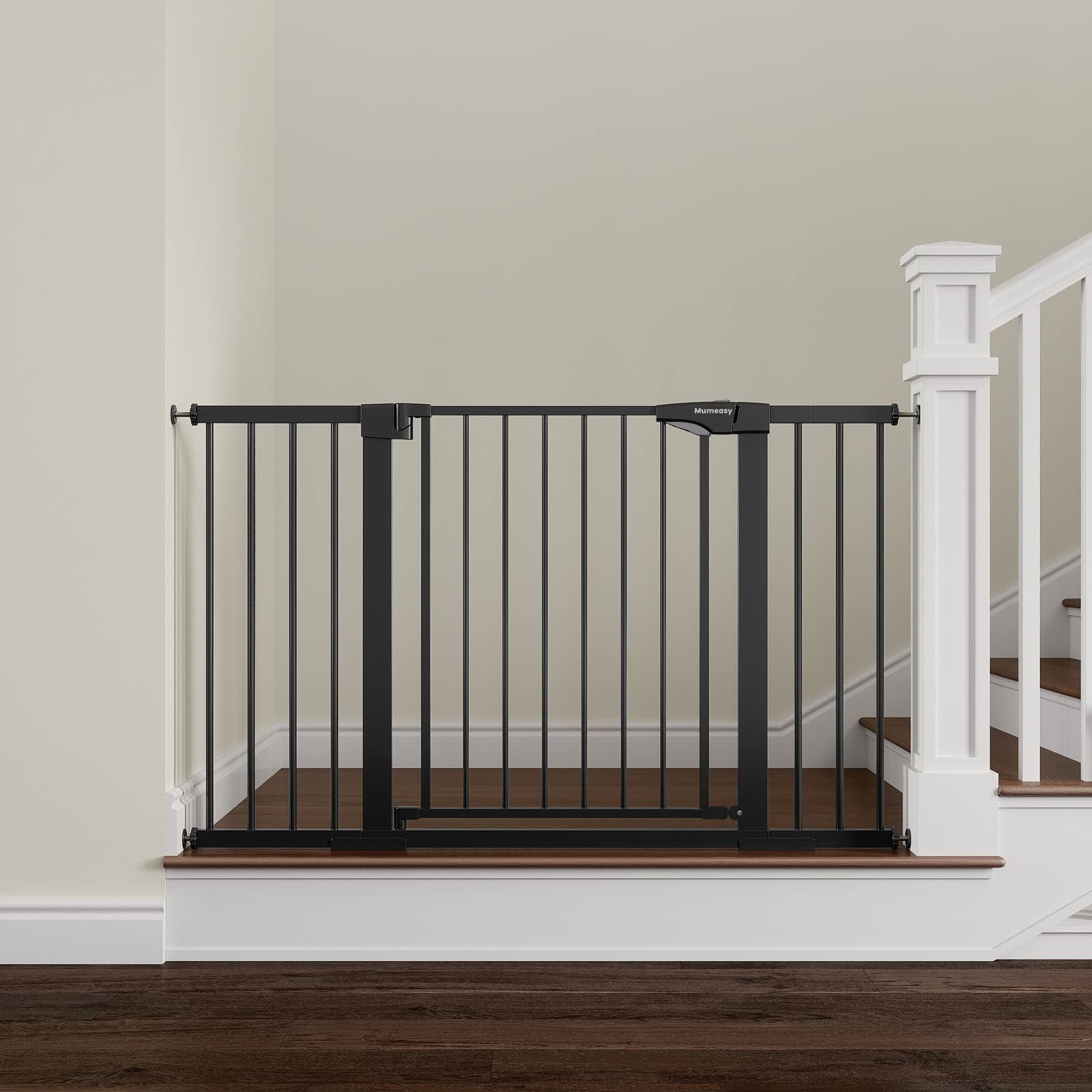
The widest gate on the list — a whole stair landing spans behind a door a grown man walks through smoothly.
Some stair openings are simply enormous — a wide bottom step or a porch landing that no standard gate will span. This one stretches to 51 inches wide at 30 inches tall, with a bar spacing of 2.24 inches that keeps tiny puppies and cats from slipping through. 51 inches of coverage and 2.24-inch bar spacing fit most wide landings, hallways, and doorways without a second gate spliced on.
The walk-through door is 22.84 inches wide, and the spec sheet is blunt about what that means: a 200-pound man can go through easily. So can you, pushing a stroller or carrying a sleeping kid — the door hinge swings both directions and auto-closes behind you, with a two-action handle that kids and dogs struggle to release but you open one-handed. It pressure mounts tool-free and comes with 2.75-inch, 5.5-inch, and 11-inch extension kits, backing up the widths your opening actually needs. A Mom’s Choice Award and 3-year warranty complete the picture.
Owners are clear that this is a well-made gate that goes in without tools and opens and closes nicely, and the fit gets the most discussion once it is up — it goes wide, but the pressure must be just so. The recurring tune is that overtightening the mounts stops the self-close from lining up, and backing off too far lets it slip. Set the tension dial in and the auto-close works perfectly. It is the same breed of trade-off you meet on the keny pick, just at a much wider span.
The width verdict: if standard gates leave you a few inches short, 51 inches of coverage is the quiet fix — no splicing extenders, no gap.
Fit note: you will need to dial in the tension carefully; too tight kills the auto-close, too loose lets the frame slip.
Worth it for: wide landings, oversized doorways, and porches where a normal gate leaves a gap you cannot live with.
Consider the 36-inch model instead if: your gap is smaller but your worry is height, not width.
5. PLZOIT 29.5-40.5″ Baby Gate for Stairs, Walk Thru Auto Close Metal Gate
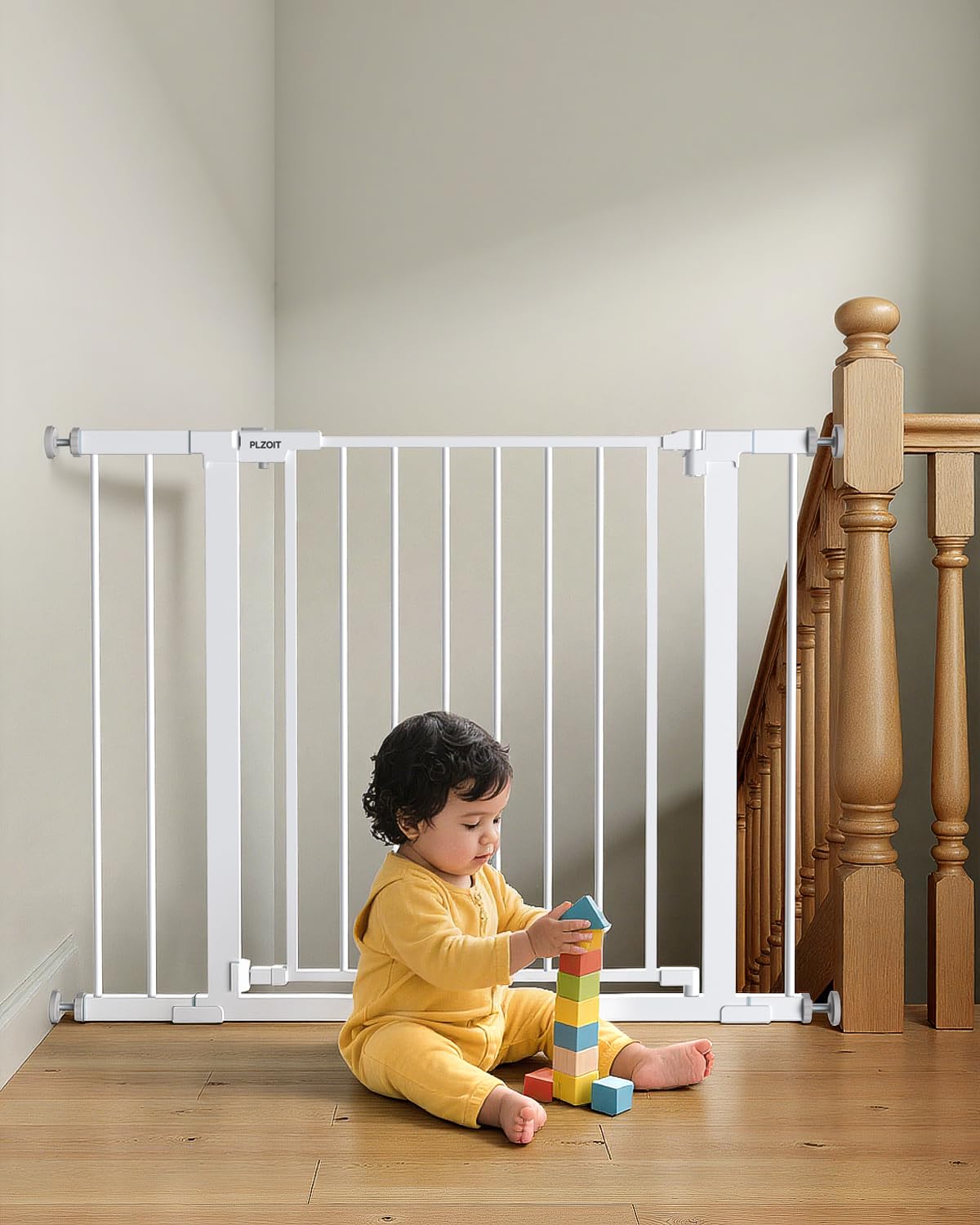
A tight 2.1-inch bar grid that shuts out the smallest pets without a plastic panel in sight.
An all-metal frame is the headline here, and it matters most for dogs that chew. This gate is built to chew-proof, lead-free, and non-toxic, so a bored Labrador cannot work a gap into the bars or mouth its way to the other side. The gate spans 29.5 to 40.5 inches with its 5.5-inch and 2.75-inch extensions, stands 30 inches tall, and the bars sit just 2.1 inches apart — small enough to stop a squirming puppy or a slippy cat without a solid panel to block your view.
The pass-through is a 23.6-inch opening, which is generous for a gate this size, and the door swings a full 180 degrees. Below 90 degrees it auto-closes on its own; push it to 90 and it holds wide open, so you can carry groceries through without propping the gate against your knee. The double lock needs two actions to release, keeping little hands out while it still opens simply for you. It pressure mounts with no tools and no drilling, and it comes back apart just as easily for storage.
Quality leads the way for owners here, and the tight bar spacing is a genuine differentiator against the wider-spaced gates above — it keeps small pets contained where a 2.4-inch or 2.5-inch gap would let them through. One thing to know before you unbox: do not cut the zip ties until you have read the instructions. The latch sits with a visible gap before installation, and that is normal, not a defect — it closes up once the pressure screws bite in.
Pick this if: you have a small pet that squeezes through wider bar gaps, or a dog that chews anything plastic.
Heads-up: the pre-install latch gap looks wrong until you mount it, and the plastic tension screws are slick to turn.
6. Regalo Safety 29″-38.5″ Easy Step Baby Gate, Bottom of Stairs & Doorways
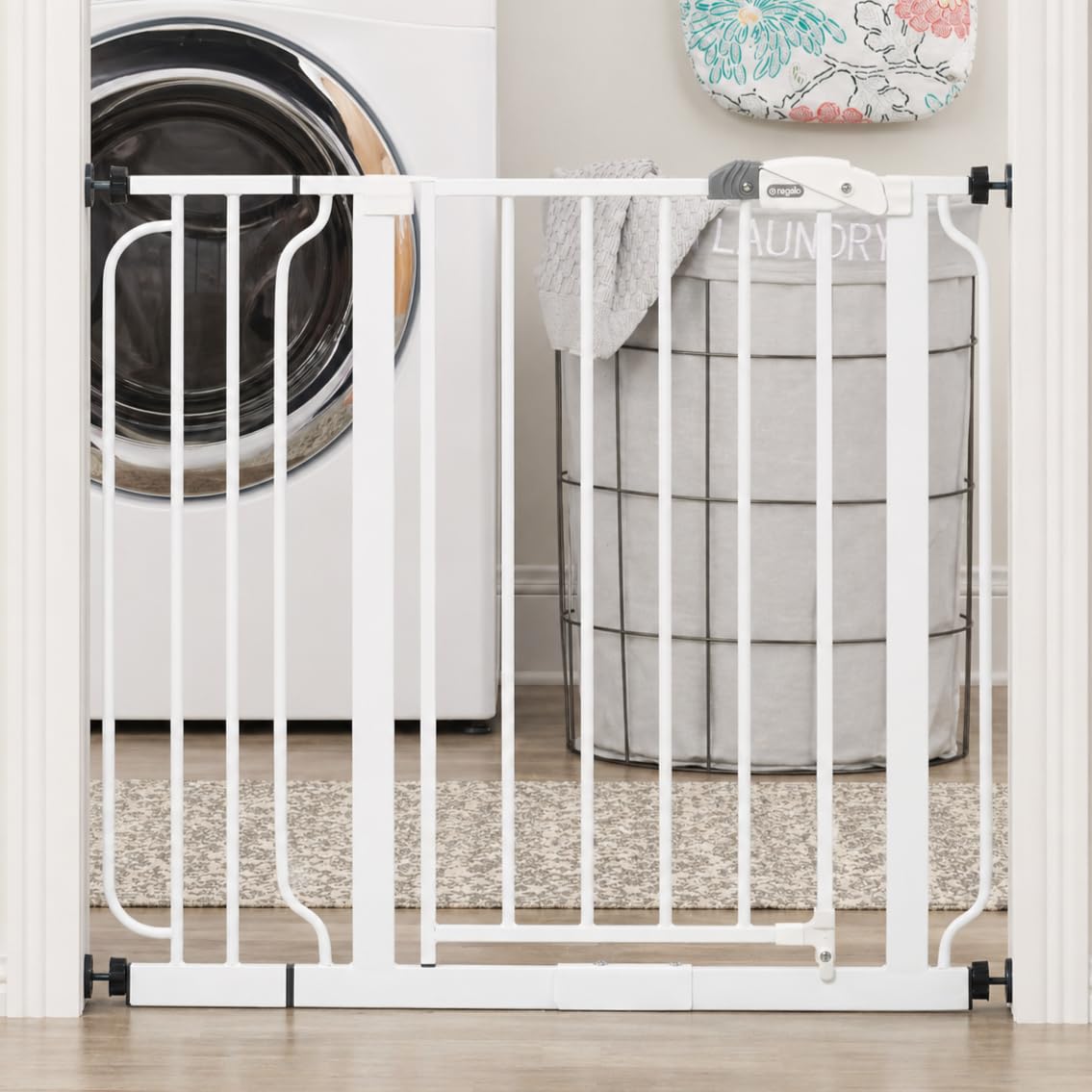
The lightweight weekly-workhorse — an easy metal barrier that proves you do not need to spend big at the bottom of the stairs.
At nine pounds, this is the lightest gate on the list — that is roughly 6.3 pounds lighter than the keny gate, and it is the reason a shaky-handed parent can carry it up and shift it around the house without help. It expands from 29 to 38.5 inches and stands 30 inches tall, which fits a standard stair foot or doorway. Its width range runs slightly narrower than the mid-range picks, and the reason to know that is layout: it fits 29 to 32 inches with no extension and 35.5 to 38.5 inches with the 6-inch piece, but not 32 to 35.5 inches at all. Measure before you buy.
Metal construction keeps it sturdy for the money, and the multi-lock options let you choose the setup that suits your doorway. The gate is certified by the Baby Safety Alliance and designed in the USA, priced as an entry-level option that still does the everyday job. It has one-way opening only — the door will not swing both directions — so think about where your traffic flows before you commit. If a stair foot has people going both ways, that single-direction swing is the thing to weigh against the money you save.
The biggest advantage is the price-to-performance ratio: a proper metal gate at the lowest cost on the list, and it feels sturdy once mounted. The caveats worth knowing are the ones owners flag — the door is narrow and opens only one way, and if you need to carry wide loads through, it is cramped. The bottom bar also sits low enough that you will want to step over it deliberately until it becomes habit.
Right for: tight budgets, cats and small-to-medium pets, and doorways with one-way traffic.
Better to size up if: you have a big jumping dog or a stair foot with people flowing both ways.
7. The Stair Barrier First Fabric Banister to Banister Baby Gate, 36″–42″ Wide x 32″ Tall
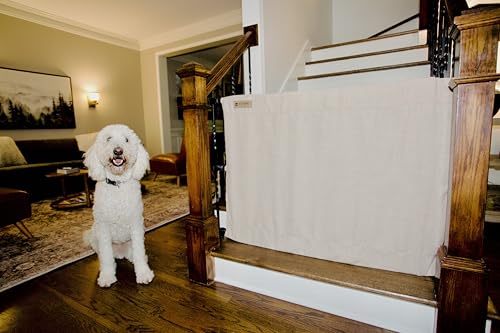
When there is no wall to push against, this fabric panel stretches banister to banister with zero drilling.
Some staircases defeat rigid gates entirely: a wide opening with a banister on one side and a banister on the other, no stud to bite into. This is the gate for that layout. It is a machine-washable fabric barrier, 36 to 42 inches wide and 32 inches tall, that straps from banister to banister with no drilling at all, meeting ASTM Safety Standards and designed in the USA. Reinforced, climb-proof fabric keeps the panel taut so there is nothing to grip and nothing to scale.
Setup is measured in seconds rather than minutes — the straps attach firmly and tightly, and the whole thing rolls neatly to one side when you want the stairway open. That makes it the natural pick for a curved staircase with scrolled handrails or wooden posts, where clips and adjustable straps fit snug against the second step. It also works outdoors, so a porch stair guard is the same product doing a second job. It even ships with a storage bag.
On the honest side, the fabric barrier is not the one for the top of the stairs. A toddler or pet could work underneath it if it cannot be pulled taut enough, so treat it as a bottom-of-stairs and lower-level solution, exactly the job its name advertises. Owners who have lived with it for a while note it does best where the straps run tight and the panel hugs the second step; a slat or two can give out on a heavily used panel, and it takes two hands and a few seconds to open and close.
Where it wins: banister-to-banister and banister-to-wall gaps that rigid metal gates simply cannot bridge without damage or hardware.
Where it is soft: it is a bottom-of-stairs and lower-level answer, not the solution for a full drop guard at the top.
Made for: banister-to-banister staircases, curved rails, porches, and any spot where you refuse to drill into woodwork.
Not for you if: you want a rigid walk-through door that opens one-handed in a fixed frame.
Understanding the Specs
Opening range and the dead zones
Every gate lists a minimum and a maximum width, and the range only reaches its widest point with the extension kits screwed on. Read the small print for gaps the gate cannot cover — the Regalo, for example, fits 29–32 inches on its own and 35.5–38.5 inches with its six-inch extension, with a 32–35.5-inch dead zone in between. A figure in your head like “I need 34 inches” should send you straight to the spec sheet, because a gate that misses by one inch fails at its only job.
Pressure mount versus hardware mount
Pressure mounting presses the gate frame between two surfaces with adjustable screws and rubber pads, which is why it leaves no holes and lifts out when you need the doorway clear. Hardware mounting drills brackets into studs or banister posts for a firmer, more permanent hold. Many gates here support both, so the sensible plan is to pressure mount at the bottom of the stairs and switch to screws only if a big dog keeps leaning on the frame.
The lock and the auto-close angle
A double-lock or two-action handle needs two motions at once to release. That combination is awkward for toddlers to copy but still opens one-handed for you. Auto-close does the remembering: released below 90 degrees, the door swings itself shut, and pushed to a full 90 degrees it holds open for walkthrough traffic. If the latch fights you, back the top tension screws off a quarter turn and it frees up without losing grip.
Height and bar spacing
Thirty inches is the standard height and handles crawlers and small-to-medium pets. Thirty-six inches is the jump for toddlers who climb and dogs that clear a low gate with a hop. Bar spacing decides who stays in: a tighter grid keeps small puppies and cats contained, while a wide bar gap leaves a slot they will squeeze through. Narrower spacing generally means more bars and a slightly heavier gate.
FAQ
Can I use a pressure-mounted gate at the bottom of the stairs?
How do I measure my stair opening before buying a gate?
What extra equipment do I need to mount a gate between two banister posts?
Will a gate with a 2.1-inch bar gap hold a small puppy or cat?
Is a 30-inch gate tall enough for a toddler who climbs?
Does auto-close work if I am carrying a baby in one arm?
Will a metal gate scratch my banister or woodwork?
Can the same gate be used at the bottom of the stairs and on the porch?
What is the difference between a walk-through gate and a fabric gate?
Do I need extensions, and how do I know how many?
Final Thoughts: The Verdict
For most homes looking for the best baby gate for the bottom of stairs, the keny Baby Gate is the one to start with — a metal frame that fits 29.7 to 46 inches, closes itself, and holds firm where a jumper dog or a climbing toddler tests it every day. If your stair foot is a wide landing where you are constantly walking through with full hands, the InnoTruth gate gives you a 19-inch doorway that is 25% wider than an ordinary metal gate. When the risk is height rather than width, the Mumeasy 36-inch gate adds six inches over a standard frame to stop climbers and jumpers.
And if your staircase has bare banister posts with no wall to push against, the Stair Barrier fabric gate solves a problem the rigid gates simply cannot, with no drilling required. Measure your opening at floor level, match the mounting to your stair foot, and the gate you pick will hold for years.
How We Picked
We do not accept paid placement. Every pick is matched to a real buyer and a real use-case; we do not hands-on test units.
Sources & Methodology
Specifications: manufacturer listings and product documentation. Review insights: verified customer reviews, as of September 2026. Pricing: not shown on this page (it changes often); check the current price via the retailer link.
As an Amazon Associate, KitchPrep earns from qualifying purchases. This does not affect which products we feature.
Related Guides
